
📖

Wait! Before You Go…

Try our 100% free Islamic learning resources — no signup needed!

🏠 Home About
🕌 About Us ⚙️ How It Works 👨‍🏫 Meet Our Teachers
🧒 For Kids
Fiqh for Kids Arabic Online for Kids Islamic School for Kids Tajweed Made Easy Quran Memorization Nour El Bayan Noorani Qaida
👨 For Adults
Tajweed for Adults Islamic School for Adults Quran Memorization Arabic Online Online Quran for Adults
🧕 Ladies Section
Online Quran for Ladies Islamic Studies for Sisters Female Quran Teachers
✨ More Programs
Online Islamic School Quran with Tajweed Quranic Arabic Ijaza in Quran Online Quran Classes Qiraat Course Online Hifz Course Quran Memorization Course New Muslim Programs
🎓 Learn Free
🔤 Arabic Alphabet 🎮 Tajweed Game 🕋 Memorize Quran & Tafseer Free 🕌 Islamic Studies Games 📚 Free Resources
📝 Articles 💰 Price 📱 Follow Us
🎁 Free Trial

Category: Tajweed

  • Benefits of Tajweed: 9 Powerful Ways to Improve Quran Recitation

    Benefits of Tajweed: 9 Powerful Ways to Improve Quran Recitation

    Benefits of Tajweed: 9 Powerful Ways to Improve Quran Recitation

    benefits of tajweed for beginners learning quran with tajweed online
    A warm, welcoming photo of an adult learner reading the Qur’an with a teacher on a laptop (online class vibe).
    Jehad Mahmoud Written by | 📅 Published | 🔄 Updated | ⏱️ 12 min read

    If you’ve ever felt nervous reciting the Qur’an out loud, you’re not alone. Many Muslims—especially non-Arabic speakers—worry they’ll “say it wrong,” change a word, or be judged for an accent. That’s exactly where the benefits of Tajweed become a mercy: Tajweed gives you a clear, step-by-step way to recite with correct pronunciation, protect the meaning of Allah’s words, and feel calmer in worship.

    The goal isn’t perfection overnight. Tajweed is simply learning how to give each Arabic letter its right sound (makhraj) and apply a few common rules so your recitation becomes steady and confident. And the beautiful part? Effort counts. The Prophet ﷺ taught that the one who struggles and stumbles while reciting still receives reward for the struggle itself. Once you understand the basics, the benefits of Tajweed show up in your very next recitation—clearer letters, smoother flow, and fewer “guessing” moments.

    In this guide, you’ll learn the 9 benefits of Tajweed (with beginner-friendly examples), what happens if you read the Quran without Tajweed, the 4 core Tajweed rules to start with, and the simplest way to learn Tajweed online without overwhelm. If you’d like gentle feedback from a teacher, start with a free trial lesson and get a clear plan for what to practice next.

    Benefits of Tajweed (Quick Summary for Busy Learners)

    The benefits of Tajweed are simple: it helps you pronounce Arabic letters correctly, protect the meaning of Quranic words, and recite with more beauty and confidence. For beginners, Tajweed reduces the fear of “reading wrong,” creates steady progress, and makes Quran recitation feel calmer and more worship-focused. These benefits of Tajweed are exactly why so many beginners choose a structured plan instead of learning randomly.

    The 9 Benefits of Tajweed

    benefits of tajweed improve quran recitation pronunciation makhraj
    A simple infographic-style image showing 3 outcomes: pronunciation, meaning, confidence.
    • Protects meaning by preventing letter mix-ups that can change words.
    • Improves pronunciation (makhraj) and letter characteristics (ṣifāt).
    • Builds smoother fluency, rhythm, and confidence in joining words.
    • Reduces common mistakes like skipping sounds or over-stretching madd.
    • Increases confidence to recite aloud—in class, with family, or in the masjid.
    • Supports memorization because correct sound patterns “stick” better.
    • Deepens khushu’ (focus in worship) by reducing mental guesswork.
    • Helps you feel more comfortable with salah recitation, especially out loud.
    • Makes learning structured for non-Arabic speakers (clear steps, clear goals).

    Next step: If you want a structured path, explore Quran with Tajweed.

    What Is Tajweed and Why Is It Important?

    Tajweed is the science of reciting the Quran correctly—giving each letter its proper articulation point (makhraj) and characteristics, then applying rules that keep your recitation clear and accurate. It matters because small sound changes can change meanings, and Allah commands measured recitation (tartīl), encouraging careful, respectful tilāwah.

    A beginner-friendly definition

    Think of Tajweed as “how to recite.” It teaches you where sounds come from (throat, tongue, lips) and how long to hold certain vowels. It’s not about showing off or sounding like someone else—it’s about being careful and correct.

    Why Tajweed became a “science”

    As Islam spread beyond Arabia, many new Muslims and non-Arabic speakers needed a reliable method to recite accurately. Scholars organized patterns of pronunciation and common rules into an easy-to-teach system—so the Qur’an could be recited correctly across cultures and accents.

    Helpful foundations: Tajweed Course for Beginners and Tajweed for Adults are popular starting points.

    Preserving Meaning & Avoiding Big Mistakes

    One of the biggest benefits of Tajweed is preserving meaning. If a letter is mispronounced, a Quranic word can change—sometimes completely. Tajweed trains your tongue and ear so you avoid major errors (like swapping letters) and steadily improve smaller rules (like madd or ghunnah) over time.

    Major vs. minor mistakes (without panic)

    • Major mistakes: changes that alter a letter, add/remove a sound, or shift a vowel so the meaning can change. These are the ones beginners should focus on avoiding first.
    • Minor mistakes: issues that don’t typically change meaning but affect the beauty and precision of recitation (like exact lengths of madd). These improve naturally as you practice.

    With Tajweed vs Without Tajweed (Beginner Impact)

    Area With Tajweed (Structured) Without Tajweed (Guessing)
    Accuracy (meaning) Lower risk of changing words; you learn correct letter sounds. Higher risk of mixing similar letters or skipping sounds.
    Confidence You know what to fix and how to practice. Fear of reading aloud stays high.
    Speed of improvement Weekly corrections prevent repeating the same error. Progress feels random; mistakes “fossilize.”
    Salah comfort More peace when reciting in prayer. Persistent worry: “Did I read correctly?”
    Consistency (30 days) Clear routine and measurable goals. On/off practice with no roadmap.

    Want structured correction? Start here: Tajweed for Adults (Online)

    Confidence, Calm, and Consistency

    tajweed for beginners online learn tajweed online confidence in quran recitation
    A screenshot-style image of a friendly online Tajweed class with teacher feedback notes.

    For beginners, the benefits of Tajweed go beyond rules: it lowers anxiety, gives you a clear learning roadmap, and replaces “random guessing” with simple habits. With supportive correction, you stop fearing mistakes and start hearing progress week by week—especially when learning is broken into small, manageable chunks.

    The beginner mindset reset

    • Fear of failure → normal and solvable. Everyone starts messy. Tajweed just makes the “fix” clear.
    • Time stress → solved with micro-practice (5–10 minutes). Short daily sessions beat rare long sessions.
    • Accent shame → replaced with skill-building. Tajweed is a trainable mouth and ear skill.

    Tajweed learning works best when it matches how the brain actually builds a new skill: tiny repetitions, clear feedback, and spaced practice. If you’re a non-Arabic speaker, your tongue and hearing are doing “new-muscle” training—so struggling at first is not a sign you’re bad at Quran, it’s a sign you’re learning.

    What Does Allah Say About Reciting the Quran Properly?

    benefits of tajweed tartil measured recitation quran 73 4
    A tasteful design featuring the Arabic word “ورتل” (tartīl) with an English caption about measured recitation.

    Allah encourages careful, measured recitation. The Quran commands believers to recite in tartīl—a clear, paced style that supports correct pronunciation and reflection. The Quran also highlights following the recitation carefully and reciting over time, which supports learning step by step instead of rushing.

    Key verses that support careful recitation

    • Qur’an 73:4 — a command to recite in a measured way (tartīl).
    • Qur’an 17:106 — the Qur’an was revealed in stages so it can be recited at a deliberate pace.
    • Qur’an 75:16–19 — guidance not to rush, and to follow the recitation as it is taught.

    What Happens If You Read Quran Without Tajweed?

    what happens if you read the quran without tajweed benefits of tajweed
    An image showing a student receiving gentle corrections from a teacher (non-judgmental learning).

    Reading without Tajweed doesn’t automatically mean your recitation is “invalid,” but it can lead to mistakes—especially letter changes that may affect meaning. Many scholars distinguish between basic correct pronunciation (essential) and advanced beautification rules (recommended). The safest path is learning the essentials with a teacher, step by step.

    Do Tajweed mistakes invalidate salah?

    Rulings can vary depending on whether the mistake changes meaning and whether the person is able to correct it. If mistakes are unintentional or due to inability while you’re learning, many scholars emphasize Allah’s mercy—while still encouraging you to learn the essentials.

    The 4 Core Tajweed Rules Beginners Should Learn First

    If you’re new, don’t start with “everything.” The fastest path is mastering 4 core Tajweed areas: (1) correct letter articulation (makhārij), (2) basic letter characteristics (ṣifāt), (3) elongations (madd), and (4) common rule families like Noon Sakinah/Tanween. These cover most beginner errors quickly.

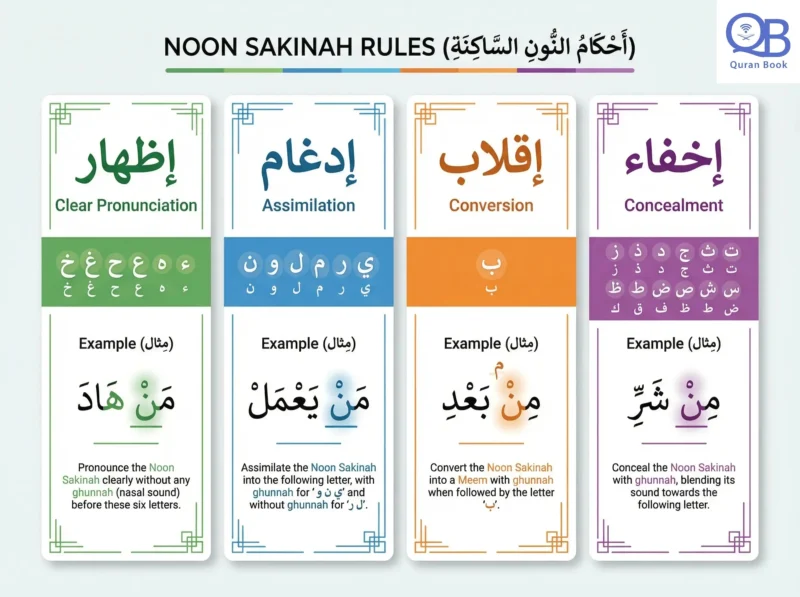
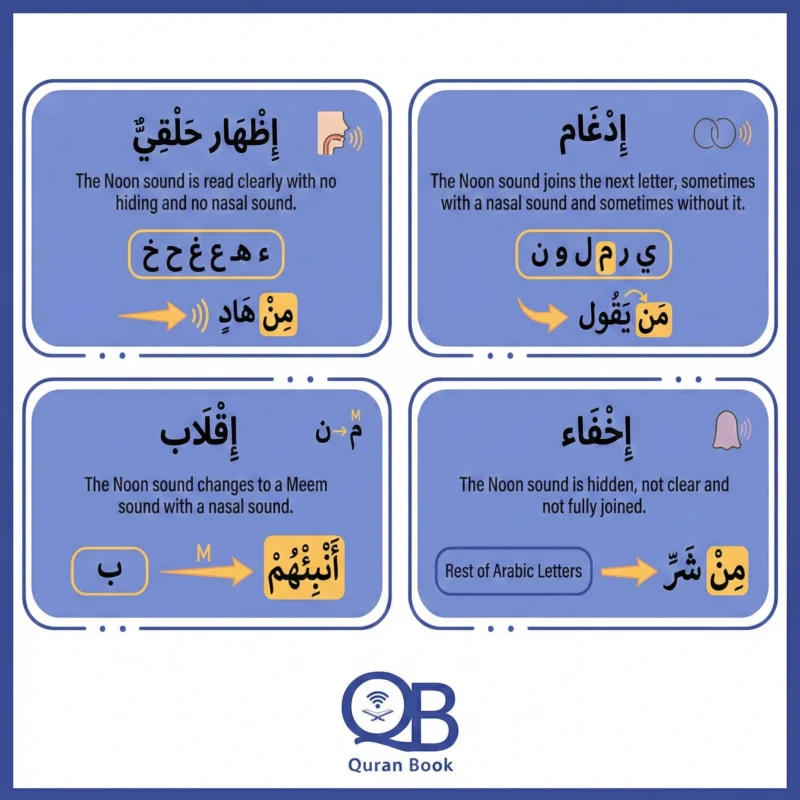
    4 rules of tajweed izhar idgham iqlab ikhfa tajweed for beginners
    A visual cheat sheet showing the four Noon Sakinah/Tanween rules with one example each.

    Noon Sakinah & Tanween Rules (Beginner Cheat Sheet)

    Rule Simple meaning Easy example
    Izhar Clear pronunciation (no merging) مِنْ هَادٍ
    Idgham Merge into the next letter مِنْ رَبِّهِمْ
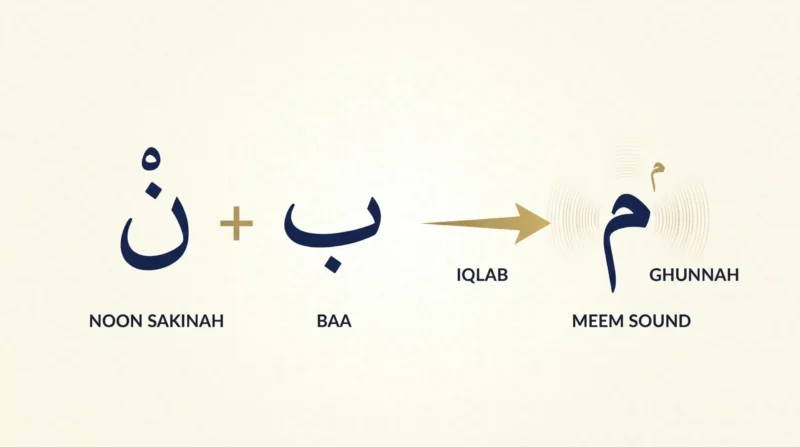
    Iqlab Change to a hidden “m” sound أَنْبِئْهُمْ
    Ikhfa Hide/soften with nasal sound مِنْ شَرِّ

    Mini Tajweed Guide: 7 Heavy Letters, Nun Sakinah & Iqlaab

    7 heavy letters in arabic tajweed benefits of tajweed for beginners
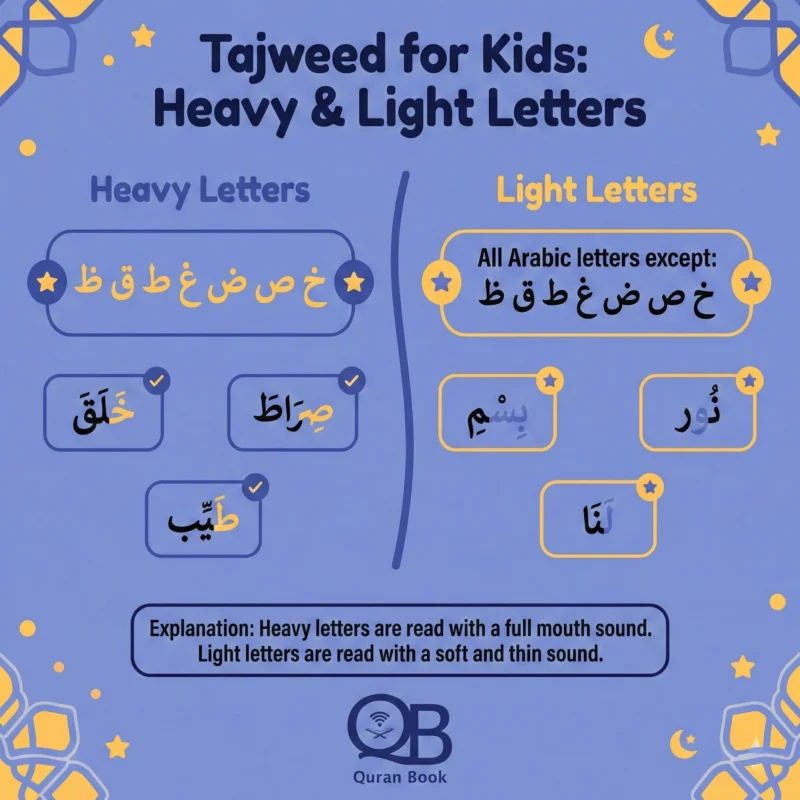
    A neat graphic listing ص خ ظ ق ط غ ض with “heavy letters (isti’lā)” label.

    A practical Tajweed shortcut is learning “high-impact” topics: the 7 heavy letters (letters of isti’lā) that sound fuller, the rules of Nun Sakinah (very common in Quran), and Iqlab (a special transformation rule). These three areas alone noticeably improve a beginner’s sound and clarity.

    The 7 heavy letters in Arabic (isti’lā): خ ص ض غ ط ق ظ

    How to Start Learning Tajweed Online (Without Overwhelm)

    learn tajweed online step by step benefits of tajweed
    A vertical “steps” graphic: foundations → makhraj → rules → feedback → progress.

    To learn Tajweed online, start small: choose a structured beginner path, practice 5–10 minutes daily, and get weekly correction from a teacher. This prevents “fossilizing” mistakes (repeating the same error). A simple routine plus feedback is faster than long, irregular study sessions.

    Step-by-step: a simple Tajweed plan

    1. Start with letters + vowels (a foundations book like Nour El Bayan).
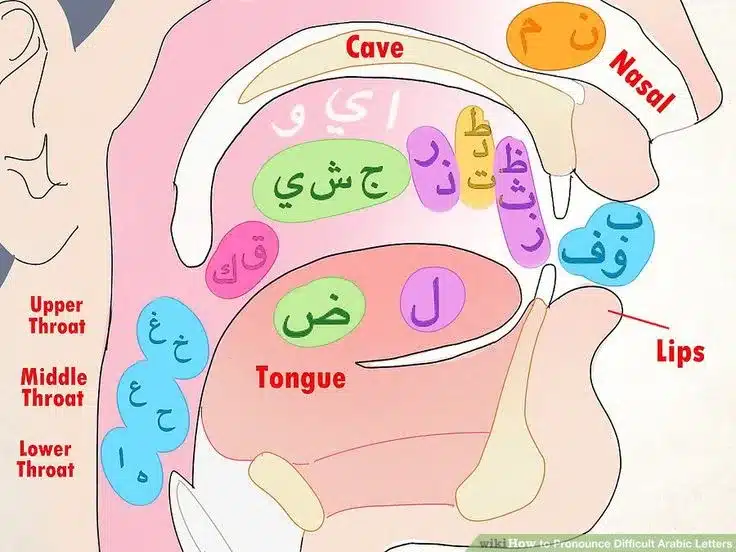
    2. Learn makhraj families (throat, tongue, lips, nasal) instead of random letters.
    3. Add one rule set per week (Noon Sakinah → Madd → Qalqalah).
    4. Record your recitation (30–60 seconds) and review corrections.
    5. Repeat with spaced practice (3–4 days/week) so skills stick.

    How Quran Book Online Teaches Tajweed

    A beginner-friendly Tajweed program works best when it follows a clear sequence: foundations → makhraj → rule families → guided fluency. When lessons are live (video call) and progress is tracked, you always know what to improve next—so you don’t feel lost or overwhelmed.

    A practical teaching method (what to expect)

    • Accuracy first: correct letter sounds and basic joining.
    • Fluency second: smoother rhythm and fewer stops.
    • Beauty third: refinement of madd counts, ghunnah strength, and tone.

    Self-Study vs Teacher: Which Works Faster?

    Self-study helps you understand concepts, but a teacher helps you fix hidden pronunciation errors you may not hear yourself—especially with makhraj and letter qualities. For most beginners, combining free resources (videos) with live correction is the fastest and most confidence-building approach.

    Factor Self-study Teacher / Live class
    Speed of correction Slower: you may not hear your own mistakes. Fast: immediate correction + drills.
    Confidence Can stay shaky without feedback. Grows quickly with gentle correction.
    Accountability Depends on motivation. Built-in schedule + goals.

    Frequently Asked Questions

    What are the benefits of Tajweed?

    The benefits of Tajweed include clearer pronunciation, preserving meaning, smoother recitation, stronger confidence, and deeper worship focus. Tajweed helps non-Arabic speakers avoid common letter mix-ups and develop a consistent method for improvement over time.

    What are the benefits of focusing on Tajweed during recitation?

    Focusing on Tajweed trains your ear and tongue together. You notice mistakes earlier, correct them faster, and build a stable recitation style—especially for makhraj and frequent rules like Noon Sakinah and elongations.

    What is the importance of the science of Tajweed?

    Tajweed organizes pronunciation and rule patterns so learners can recite consistently. It became especially valuable as Islam spread to non-Arab communities, helping protect accurate Quran recitation across languages and accents.

    What does Allah say about Tajweed?

    The word “Tajweed” is a later term, but the principle is directly supported: the Qur’an commands measured recitation (tartīl) and encourages careful, deliberate reading rather than rushing.

    What happens if you read the Quran without Tajweed?

    If you still pronounce letters and vowels correctly, many scholars say your recitation is valid, though less refined. The bigger concern is major mistakes that change meaning. The best approach is learning essentials gradually with feedback.

    What are the 4 rules of Tajweed?

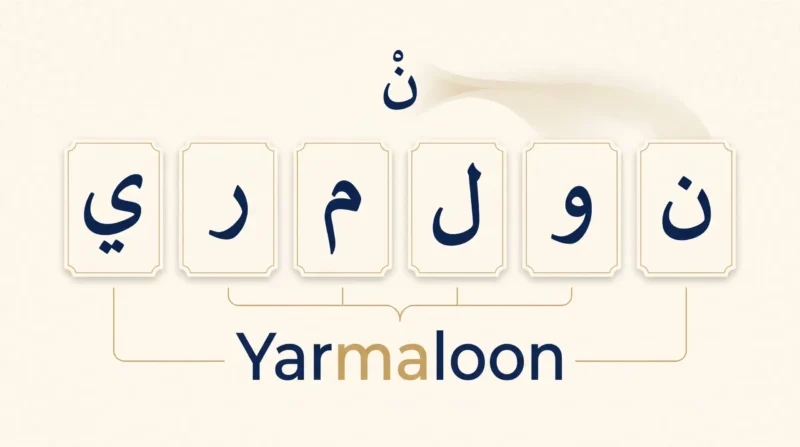
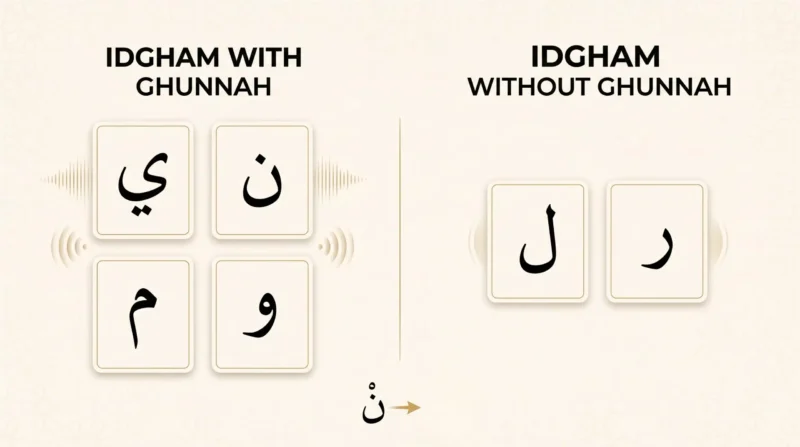
    Often this refers to the four rules of Noon Sakinah & Tanween: Izhar, Idgham, Iqlab, and Ikhfa. These rules appear constantly in Quran recitation and give beginners quick improvement.

    Do Tajweed mistakes invalidate salah?

    Rulings vary based on whether the mistake changes meaning and whether the person can correct it. If mistakes were due to ignorance or inability while learning, scholars often emphasize mercy while encouraging improvement.

    Who codified Tajweed rules?

    Tajweed practice comes from the Prophet ﷺ’s recitation, while later scholars codified the rules to teach learners and preserve accuracy. Well-known names include Abu ‘Amr al-Dani and Ibn al-Jazari.

    What are the 7 heavy letters in Arabic?

    The seven heavy (isti’lā) letters are: ظ ق ط غ ض ص خ. Learning them helps beginners instantly improve “heaviness vs lightness” in pronunciation.

    Is Nun Sakinah related to Tajweed?

    Yes. Nun Sakinah (and Tanween) rules are among the most frequent Tajweed rules in the Quran, and mastering them gives fast improvement in flow and clarity.

    What is Iqlaab in Tajweed?

    Iqlaab is a Noon Sakinah/Tanween rule where the sound shifts in a specific way before the letter ب, with a nasal tone. Beginners learn it as part of the four Noon Sakinah rules because it’s common and easy to spot once taught.

    Ready to Experience the Benefits of Tajweed?

    Start with a free trial lesson and get a clear starting level, a simple learning plan, and supportive correction.

    free trial learn tajweed online benefits of tajweed
    A friendly “Book a Free Trial” banner image with a teacher and student on a video call.
    Book Your Free Trial Now
    • ✅ Live session with a qualified teacher
    • ✅ A simple beginner roadmap
    • ✅ Friendly, confidence-building correction
    • ✅ Clear next steps and practice targets

    Written By

    Jehad Mahmoud — Arabic Language graduate and Hafidha of the Quran, writer on Tajweed and the Quranic sciences

    Hafidha of the Quran · Arabic Language Graduate · Writer on Islamic Sciences

    Jehad Mahmoud is a graduate of the Department of Arabic Language and a hafidha who has memorised the entire Holy Quran. She writes the Islamic content at Quran Book Academy, specialising in Tajweed, the Quranic sciences and the Arabic language that underpins them.

    Having memorised the Quran herself, she writes about recitation from the inside — she knows which letters non-Arabic speakers actually struggle with, and why. Every rule she explains is traced back to the established science of Tajweed, and where the scholars differ, she says so plainly.

    Her articles are educational, not fatwa. For a ruling on a specific personal situation, readers are advised to consult a qualified scholar or mufti.

    Tajweed Makharij Quranic Sciences Hifz Arabic Language Fiqh
  • Common Mistakes in Quran Reading Beginners Must Avoid

    Common Mistakes in Quran Reading Beginners Must Avoid

    7 Common Mistakes in Quran Reading Beginners Must Avoid in 2026

    Jehad Mahmoud - writer at Quran Book Academy
    Written by
    Published: February 3, 2026 · Updated:August 27, 2026 · 12 min read
    Student learning common mistakes in Quran reading with online Tajweed teacher
    Student learning common mistakes in Quran reading with online Tajweed teacher

    Common mistakes in Quran reading include mispronouncing Arabic letters, ignoring Tajweed rules, rushing through verses, and incorrect elongation (Madd). These errors are especially prevalent among non-Arabic speaking beginners and can alter the meaning of sacred verses. Learning proper Tajweed with qualified teachers prevents these mistakes.

    If you’ve ever felt nervous about reciting Quran aloud, worried that you might be making mistakes without knowing it, you’re not alone. Many new Muslims and non-Arabic speakers share this fear—the worry that their pronunciation isn’t quite right, or that they might be changing the meaning of Allah’s words unintentionally.

    The good news? Even the Prophet Muhammad (peace be upon him) encouraged those who struggle, promising them double the reward. Your effort matters, and with the right guidance, perfecting your recitation is absolutely achievable. Understanding the common mistakes in Quran reading is the first step toward beautiful, accurate recitation that honors the sacred text. Consider enrolling in our Quran Reading Course or Tajweed Course for Beginners.

    📜 PROPHETIC GUIDANCE

    “One who recites the Quran beautifully, smoothly, and precisely will be in the company of noble angels. And as for the one who recites with difficulty, stammering or stumbling through its verses, then he will have twice the reward.”

    — Sahih al-Bukhari

    📖 DIVINE COMMAND

    “…and recite the Quran with measured recitation (Tarteel).” — Surah Al-Muzzammil (73:4)

    Table of Contents

    1. Understanding the Two Types of Mistakes (Lahn Jali vs Lahn Khafi)
    2. 7 Common Mistakes in Quran Reading
    3. The Academy Method: How We Fix These Mistakes
    4. How to Correct Common Quran Reading Mistakes
    5. Benefits of Learning Tajweed Correctly
    6. Frequently Asked Questions
    7. Conclusion and Next Steps

    Understanding Lahn Jali and Lahn Khafi: The Two Types of Quran Reading Mistakes

    Infographic explaining Lahn Jali and Lahn Khafi common mistakes in Quran reading
    Infographic explaining Lahn Jali and Lahn Khafi common mistakes in Quran reading

    Quran reading mistakes are categorized into two types: Lahn Jali (major mistakes) that change the meaning of words or add/remove letters, and Lahn Khafi (minor mistakes) that affect the quality of recitation without changing meaning, such as improper elongation or missing ghunnah. Learn more about What is Tajweed?

    Before diving into specific common mistakes in Quran reading, it’s essential to understand how Islamic scholars categorize recitation errors. This classification helps you prioritize which mistakes to address first and understand their significance in preserving the integrity of the Quran.

    What is Lahn Jali (Major Mistakes)?

    Lahn Jali refers to obvious, clear errors that violate fundamental Arabic language rules. These mistakes are considered serious because they can potentially change the meaning of Quranic verses. Even listeners with basic Arabic knowledge can detect these errors.

    Common examples of Lahn Jali include:

    • Pronouncing ط (Ṭa) as ت (Ta) — changing emphatic letters to non-emphatic
    • Saying “الحَمْدَ” instead of “الحَمْدُ” — incorrect vowel marks (harakat)
    • Adding or removing letters from words
    • Confusing similar-looking letters with different sounds

    Ruling: Lahn Jali must be avoided. If committed intentionally, it is considered sinful. For beginners learning Quran with Tajweed online, addressing these major mistakes should be the first priority.

    What is Lahn Khafi (Minor Mistakes)?

    Lahn Khafi refers to subtle errors that only Tajweed specialists can typically detect. These mistakes affect the beauty and quality of recitation but don’t change the fundamental meaning of verses.

    Common examples of Lahn Khafi include:

    • Shortening the types of Madd in Tajweed (elongation rules)
    • Missing Ghunnah Tajweed (nasal sounds)
    • Improper application of Qalqalah letters
    • Not observing proper pauses between verses

    Ruling: Lahn Khafi is considered Makruh (disliked) but not sinful. However, serious students of Quran recitation should strive to correct these errors to achieve beautiful, proper Tajweed.

    Aspect Lahn Jali (Major) Lahn Khafi (Minor)
    Visibility Obvious to all listeners Noticeable only to experts
    Impact Changes meaning of verses Affects quality, not meaning
    Examples Wrong letters, incorrect vowels Short Madd, missing Ghunnah
    Ruling Haram if intentional Makruh (disliked)
    Detection Any Arabic listener Tajweed specialists only

    7 Common Mistakes in Quran Reading Every Beginner Should Know

    7 common mistakes in Quran reading infographic for Tajweed beginners
    7 common mistakes in Quran reading infographic for Tajweed beginners

    Whether you’re learning Quran reading with Tajweed for beginners or you’ve been reciting for years, these seven common mistakes are the ones our certified teachers encounter most frequently. Recognizing them is the first step toward the correct way of reading Quran.

    1

    Mispronouncing Arabic Letters (Makharij al Huruf)

    The Problem: Arabic contains unique sounds that don’t exist in English or many other languages. Non-Arabic speakers often confuse similar-sounding letters, leading to incorrect pronunciation that can change word meanings entirely.

    Commonly confused letter pairs include:

    • ط (Ṭa) vs ت (Ta) — emphatic vs non-emphatic
    • ظ (Ẓa) vs ز (Za) — similar sound, different articulation points
    • ق (Qāf) vs ك (Kāf) — the far back of the tongue, with Qāf articulated farther back than Kāf
    • ض (Ḍad) vs د (Dal) — the unique Arabic letter
    • ح (Ḥā’) vs هـ (Hā’) — middle throat vs deepest part of the throat

    Why It Happens: Non-Arabic speakers lack natural exposure to these distinct sounds during childhood language acquisition. The Makharij al huruf (17 articulation points) require deliberate practice to master.

    ✅ The Solution: Learn the 17 articulation points systematically with a qualified teacher who can provide real-time feedback. Watch our Makharij al Huruf Playlist on YouTube.

    Heavy vs Light Letters: Tafkheem and Tarqeeq

    Tafkheem means producing a fuller, heavier sound when pronouncing a letter, while Tarqeeq means producing a lighter, thinner sound. Keeping these qualities correct helps preserve the intended pronunciation of Quranic Arabic. Making a heavy letter light, or a light letter heavy, can distort correct Quran pronunciation. The seven letters that are consistently heavy are collected in the phrase خُصَّ ضَغْطٍ قِظْ. Other letters can depend on context: Rā’, the Lām in the name of Allah, and Alif may be pronounced with different qualities according to the surrounding context. These contextual rules are best learned separately. For a focused guide, see heavy and light letters.

    Practice: Heavy or Light?

    Test your understanding of heavy and light Arabic letters in this short interactive Tajweed exercise.

    Open the Tajweed game in a new tab

    2

    Ignoring Tajweed Rules

    The Problem: Many beginners read the Quran like regular Arabic text, ignoring the specific rules that govern Quranic recitation. This results in flat, incorrect pronunciation that lacks the beauty and precision Allah commanded.

    Essential Tajweed rules often overlooked:

    ✅ The Solution: Enroll in a structured Tajweed for beginners online course with live correction from certified instructors. Learning each rule systematically with immediate feedback prevents bad habits from forming.

    3

    Incorrect Elongation (Types of Madd in Tajweed)

    The Problem: Madd (elongation) rules specify exactly how long certain vowel sounds should be held. Getting this wrong—either too short or too long—is one of the most common mistakes in Quran reading.

    Key types of Madd to master:

    ✅ The Solution: Practice with a teacher who can count and correct in real-time. Recording your sessions and comparing to expert reciters like Sheikh Husary also helps develop accurate timing.

    4

    Rushing Through Recitation

    The Problem: In an effort to complete more verses or due to nervousness, many reciters read too fast. This leads to skipping sounds, merging words incorrectly, and missing important rules.

    📜 WISDOM FROM THE COMPANIONS

    Ibn Masoud (may God be pleased with him) said to a man who was quick and confused: “Do you recite it as quickly as poetry? If it enters the heart and becomes firmly established there, it will be beneficial.”

    ✅ The Solution: Practice Tarteel (measured recitation) as commanded in Surah Al-Muzzammil. Record yourself and identify rushed sections. Remember: quality of recitation matters more than quantity.

    5

    Improper Stops and Pauses (Waqf)

    The Problem: Stopping in the wrong place or starting from inappropriate points can completely change the meaning of Quranic verses. This is particularly dangerous when the incorrect stop creates a meaning contrary to Islamic belief.

    Common Waqf mistakes:

    • Stopping mid-word when running out of breath
    • Ignoring Waqf symbols in the Mushaf
    • Starting from the middle of a sentence after a pause
    • Not understanding obligatory vs. forbidden stops

    ✅ The Solution: Learn the Waqf symbols used in the Quran and their meanings. Practice with guidance to understand which stops preserve meaning and which ones must be avoided.

    6

    Missing Ghunnah (Nasal Sound)

    The Problem: Ghunnah Tajweed is the nasal sound that should last approximately two counts. Many reciters either skip it entirely or don’t hold it long enough, affecting the beauty and accuracy of recitation.

    When Ghunnah is required:

    • Noon with Shaddah (نّ)
    • Meem with Shaddah (مّ)
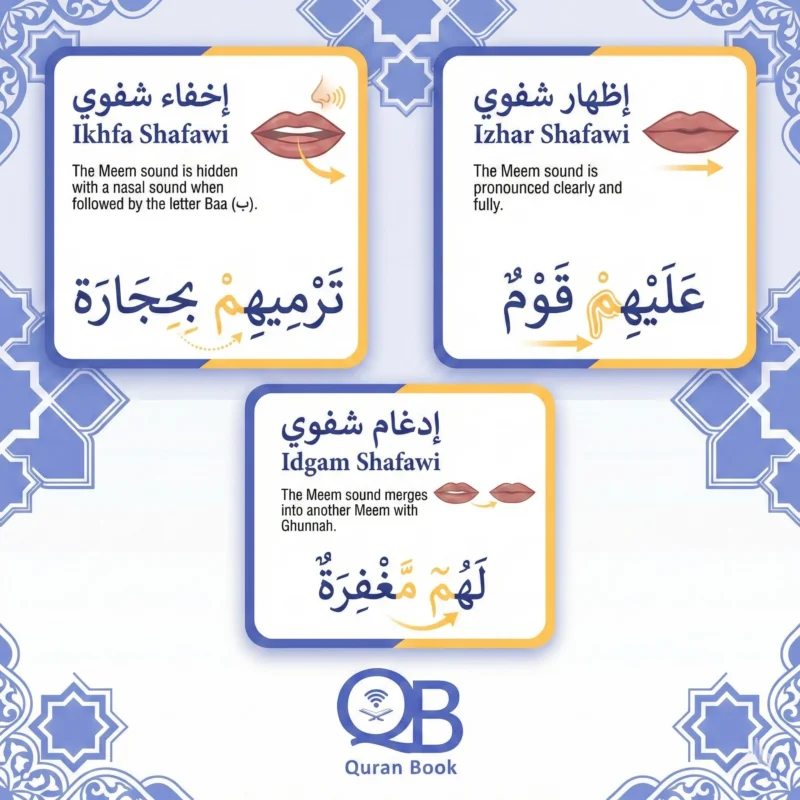
    • During Idgham with Ghunnah
    • When applying Ikhfa rules

    ✅ The Solution: Practice humming exercises to develop the nasal resonance. Listen carefully to expert reciters like Sheikh Husary, known for his clear, slow recitation perfect for beginners learning Tajweed.

    7

    Neglecting Consistent Practice

    The Problem: Perhaps the most damaging mistake isn’t about pronunciation at all—it’s inconsistent practice. Sporadic learning leads to forgotten rules, developing bad habits, and ultimately, loss of motivation.

    Consequences of irregular practice:

    • Rules learned are quickly forgotten
    • Bad pronunciation habits become ingrained
    • Progress plateaus, causing frustration
    • The joy of recitation diminishes

    ✅ The Solution: Establish daily 15–20-minute practice sessions with accountability. Consider our Quran Memorization Course for structured, consistent learning.

    The Quran Book Academy Method: How We Help You Avoid These Mistakes

    Online Quran learning with Tajweed platform showing teacher and student in live session
    Online Quran learning with Tajweed platform showing teacher and student in live session

    At Quran Book Academy, we’ve developed a comprehensive methodology specifically designed for non-Arabic speaking beginners in the USA, Canada, UK, and Australia who want to learn Quran reading with Tajweed. Our approach combines traditional Islamic scholarship with modern educational psychology, breaking down complex Tajweed rules into manageable psychological “chunks” that students can master without feeling overwhelmed.

    Each lesson builds upon the previous one, creating neural pathways that make correct pronunciation automatic over time. We understand that adult learners face unique challenges—busy schedules, fear of making mistakes publicly, and previous unsuccessful attempts at self-study. That’s why our certified teachers, trained in both Tajweed and student psychology, create a supportive environment where mistakes become learning opportunities rather than sources of embarrassment. Learn more about Our Teaching Method.

    💻 Our Technology Stack

    • Live Sessions via Zoom: One-on-one interaction with instant pronunciation feedback
    • Custom LMS Platform: Track your progress through each Tajweed rule
    • Email Progress Reports: Regular updates sent to parents and students
    • Recording Feature: Review your sessions to identify improvement areas
    • Mobile-Friendly Access: Learn from anywhere, anytime on any device

    📚 Our Teaching Methodology

    1. Assessment Phase: Identify current skill level and specific mistakes
    2. Foundation Building: Master Arabic letters and Makharij al huruf first
    3. Rule-by-Rule Progress: One Tajweed rule at a time until complete mastery
    4. Live Practice: Apply rules with teacher supervision
    5. Independent Reading: Build confidence with new passages
    6. Ijazah Preparation: For advanced students seeking certification

    How to Correct Common Quran Reading Mistakes: A Step-by-Step Guide

    Now that you understand the common mistakes in Quran reading, here’s a practical roadmap for how to avoid mistakes when reading Quran and achieve beautiful, accurate recitation:

    1. Get a Qualified Teacher
      Self-study without feedback reinforces errors. A certified teacher catches mistakes you can’t hear yourself making.
    2. Start with Noorani Qaida
      Build strong foundational pronunciation before tackling full verses. This classic method has helped millions learn correctly.
    3. Learn One Rule at a Time
      Don’t overwhelm yourself trying to master everything at once. Master Madd before moving to Ghunnah, for example.
    4. Listen to Expert Reciters
      Sheikh Husary’s slow, clear style is perfect for beginners. His recitations are ideal for learning proper Tajweed.
    5. Record and Review
      Compare your recitation to your teacher’s feedback. Hearing your own mistakes is a powerful learning tool.
    6. Practice Daily
      15-20 minutes consistently beats occasional long sessions. Set a specific time each day for Quran practice.
    7. Join a Supportive Community
      Motivation through accountability helps you stay consistent. Our Telegram community provides daily encouragement.

    5 Life-Changing Benefits of Learning Correct Quran Reading

    Benefits of learning Quran reading with Tajweed for spiritual growth and worship
    Benefits of learning Quran reading with Tajweed for spiritual growth and worship

    Investing time in mastering Tajweed and avoiding common Tajweed mistakes beginners make brings rewards far beyond improved pronunciation. Explore the full Benefits of Tajweed. Here are five transformative benefits:

    1. Deeper Spiritual Connection

    When you recite correctly, you experience deeper khushu (concentration) in Salah. Understanding that you’re pronouncing Allah’s words as they were revealed creates a profound spiritual connection that rushed, incorrect recitation cannot provide.

    2. Double Reward for Effort

    Remember the hadith mentioned earlier—those who struggle with recitation receive double the reward. Your effort, even when difficult, is immensely valuable in Allah’s sight. Learning the correct way of reading Quran honors both the struggle and the achievement.

    3. Preserved Meaning

    Proper Tajweed protects the integrity of Allah’s words. By avoiding mistakes in Quran reading that change meaning, you become a guardian of the Quran’s original message, exactly as it was revealed to Prophet Muhammad (peace be upon him).

    4. Confidence in Worship

    Imagine leading prayers or reciting publicly without anxiety. When you’ve mastered correct pronunciation, you can focus on the meaning and spirituality rather than worrying about making embarrassing mistakes.

    5. Ability to Teach Others

    Once you’ve learned correctly, you can pass this knowledge to your children and community. This fulfills one of the greatest Islamic acts: “The best among you are those who learn the Quran and teach it.” — Sahih al-Bukhari 5027

    Frequently Asked Questions About Common Mistakes in Quran Reading

    Here are answers to the most common questions we receive from students learning how to improve Quran recitation:

    Q1: Is it sinful to make mistakes while reading the Quran? +
    Unintentional mistakes are not sinful, and Allah rewards your effort. The Prophet (PBUH) said those who struggle receive double the reward. However, Muslims are encouraged to learn Tajweed to recite correctly and preserve the original meaning. The key is making sincere effort to improve.
    Q2: Can I learn Quran reading without knowing Arabic? +
    Yes, absolutely. Many non-Arabic speakers successfully learn Quran reading with Tajweed through structured courses. You don’t need to understand Arabic grammar or vocabulary to recite correctly. The key is learning proper pronunciation (Makharij al huruf) and Tajweed rules from qualified teachers.
    Q3: How long does it take to learn correct Quran reading? +
    Most beginners can read basic Arabic letters in 2-3 months with consistent practice. Achieving fluency with Tajweed typically takes 6-12 months. Full mastery is a lifelong journey of continuous improvement. The timeline depends on your starting level, practice consistency, and learning method.
    Q4: What is the difference between Tajweed and Tarteel? +
    Tajweed is the set of rules governing correct pronunciation, including Makharij, Madd, Ghunnah, and other elements. Tarteel is the measured, beautiful application of those rules during recitation—reciting slowly and clearly as commanded in Surah Al-Muzzammil (73:4). Tajweed is the knowledge; Tarteel is the practice.
    Q5: Which apps can help detect Quran recitation mistakes? +
    Apps like Tarteel AI, Quran Majeed, and Muslim Pro offer Tajweed practice features with basic pronunciation feedback. However, these technological tools cannot replace a qualified teacher who provides personalized correction, emotional support, and nuanced feedback. Apps are best used as supplements to formal instruction.
    Q6: How do I know if I’m making Lahn Jali (major) mistakes? +
    Major mistakes typically involve mispronouncing letters in ways that change words, such as saying ك instead of ق. A qualified teacher can quickly identify these during even a brief assessment. If you’re unsure, book a free trial lesson where our certified instructors can evaluate your current level.
    Q7: Can adults learn Quran reading effectively? +
    Yes! Adults often progress faster than children because of their dedication, motivation, and ability to understand rules conceptually. Many of our students at Quran Book Academy are adult converts, busy professionals, and parents who successfully master Quran reading. It’s never too late to begin.
    Q8: What is the correct way of reading Quran for beginners? +
    Beginners should start with the Noorani Qaida to master Arabic letters, learn basic Tajweed rules systematically with a qualified teacher, practice consistently for 15-20 minutes daily, listen to expert reciters like Sheikh Husary, and join a supportive community for accountability. This structured approach ensures lasting success.

    Start Your Journey to Flawless Quran Reading Today

    Start your free trial lesson to learn Quran reading with Tajweed online
    Start your free trial lesson to learn Quran reading with Tajweed online

    Every Muslim deserves to experience the beauty of reciting Allah’s words correctly. The common mistakes in Quran reading we’ve discussed—from mispronunciation to rushing through verses—are all fixable with the right guidance and consistent practice. At Quran Book Academy, our certified teachers have helped thousands of non-Arabic speaking students in the USA, Canada, UK, and Australia transform their recitation from hesitant and error-prone to confident and beautiful.

    Remember, the journey of a thousand miles begins with a single step. Whether you’re a complete beginner worried about Quran pronunciation mistakes for non-Arabs, or an experienced reciter looking to polish your Tajweed, we’re here to guide you every step of the way.

    🌟

    Ready to Fix Your Quran Reading Mistakes?

    Book Your FREE Trial Lesson Today!

    ✅ One-on-one session with a certified Tajweed teacher ✅ Personalized assessment of your current level ✅ Custom learning plan based on your goals ✅ No commitment required
    Start Free Trial →

    Or View All Courses

    Learn More

    Expand your knowledge of Tajweed and Quran reading with these helpful resources:

    Jehad Mahmoud - Hafidha and Arabic Language graduate, writer at Quran Book Academy

    Hafidha of the Quran · Arabic Language Graduate · Writer on Islamic Sciences

    Jehad Mahmoud is a graduate of the Arabic Language department and a Hafidha of the Quran who writes Islamic educational content at Quran Book Academy.

    She specialises in Quranic Arabic, Tajweed, and the Sharia sciences, making correct pronunciation and complex concepts accessible to English-speaking Muslim families.

    Her background in Quranic and Arabic studies supports this practical guide to recognizing and correcting common Quran reading mistakes.

    Her articles are educational, not fatwa. For a ruling on a specific personal situation, readers are advised to consult a qualified scholar or mufti.

    Tajweed Quran Recitation Makharij Quranic Arabic

    References & Internal Links

  • Waqf and Ibtida:Essential Rules for Flawless Quran Recitation

    Waqf and Ibtida:Essential Rules for Flawless Quran Recitation

    Tajweed Guide

    Waqf and Ibtida: A Practical Guide to Quran Stop Signs

    Learn how stopping and starting work in Quranic recitation — so you can improve your stopping and starting and recite more confidently.

    Start your free Quran trial
    Section I

    Introduction: Overcoming the Fear of Stopping

    A student reading the Quran practicing Waqf and Ibtida with a peaceful expression.
    A student reading calmly from the Mushaf while practising where to stop and where to start again.

    Does my breath run out too fast? Did I just negate a blessing?

    If you have ever felt your heart race while reciting a long verse, worrying that stopping to breathe might accidentally distort the meaning of Allah’s words, you are not alone. For many non-Arabic speakers, the rules of Waqf and Ibtida (stopping and starting) can feel like a minefield. The anxiety of turning a compliment into an insult or negating a divine truth simply because you ran out of air is a very real struggle.

    But here is the truth: Waqf and Ibtida are not designed to be a burden. They are the “breathing room” for your soul during recitation. They provide the roadmap that allows you to navigate the Quran’s vast meanings with grace and precision.

    By the end of this guide, you will understand the roadmap of the Quran, allowing you to recite more confidently and without anxiety. We will move past the fear and into a space of connection, ensuring that every pause you take honors the Divine message. Explore our psychology-based methodology that makes learning Tajweed intuitive and stress-free.

    🎧 About the audio in this guide: Every recitation player below plays the complete verse as recorded by Sheikh Mahmoud Khalil Al-Husary, served from the EveryAyah archive. Nothing has been trimmed, edited, or re-cut: each file is the sheikh’s own unaltered reading of that verse, so what you hear is his performance and not an artificial pause created for this article.

    Section II

    What is Waqf and Ibtida in Tajweed?

    Diagram showing difference between Waqf, Ibtida, and Qat in Tajweed stopping rules.
    A simple comparison of Waqf (a pause), Ibtida (starting again) and Qat’ (ending the recitation).

    Waqf and Ibtida refer to the precise rules of stopping and starting in Quranic recitation.

    Waqf (The Stop)

    This is the act of pausing the voice at the end of a word to take a breath, with the specific intention of continuing the recitation. It is not abandoning the reading; it is a strategic pause to refuel.

    Ibtida (The Start)

    This is resuming the recitation from a correct starting point that preserves the linguistic and theological meaning of the verse.

    Qat’ (The Cut)

    Unlike Waqf, this is stopping the recitation completely to move on to another activity, usually done at the end of a passage or surah.

    Understanding the distinction between a temporary breath (Waqf) and a final stop (Qat’) is the first step in mastering the flow of the Quran. If you are new to recitation, our Learn to Read Quran for Beginners course is the perfect starting point, and adults starting from the alphabet can learn Quran reading for adults at a pace that suits them.

    Section III

    Why Meaning Matters: The Psychology of Recitation

    Reciting the Quran is not merely a mechanical exercise of pronouncing letters; it is an act of intellectual and spiritual engagement. The connection between breath and meaning is profound. Reports describing the Prophet’s recitation (ﷺ) indicate a measured style, including reciting the verses of Al-Fatihah distinctly in the report narrated by Umm Salamah.

    ⚠ Worked example — Quran 10:65:

    وَلَا يَحْزُنكَ قَوْلُهُمْ ۘ إِنَّ ٱلْعِزَّةَ لِلَّهِ جَمِيعًا ۚ هُوَ ٱلسَّمِيعُ ٱلْعَلِيمُ

    Stopping at qawluhum (“their words”) separates their speech from Allah’s own statement that all honour belongs to Him. Continuing without that pause may give a listener the impression that the following sentence is still part of what they said. See the verse at Quran 10:65.

    Listen to the complete verse. The Waqf Lazim (م) printed after qawluhum is what keeps their speech separate from the statement that all honour belongs to Allah. وَلَا يَحْزُنكَ قَوْلُهُمْ ۘ إِنَّ ٱلْعِزَّةَ لِلَّهِ جَمِيعًا ۚ هُوَ ٱلسَّمِيعُ ٱلْعَلِيمُ Recitation: Sheikh Mahmoud Khalil Al-Husary — Quran 10:65 (complete verse, unedited).

    Learning these stopping rules is an act of Adab (respect) towards the Divine message. It builds cognitive fluency, allowing you to process the text in meaningful chunks rather than a breathless stream of sound. This is why our methodology focuses on the psychology of the learner—removing the panic of “running out of air” and replacing it with the confidence of knowing exactly where to rest.

    Section IV

    The 4 Main Types of Waqf

    Chart explaining Waqf Idtirari, Waqf Ikhtibari, and Waqf Ikhtiyari in Tajweed.
    A visual overview of the main kinds of stopping a reciter meets: the compelled stop, the testing stop and the voluntary stop.

    As you work through the essential Tajweed rules, you will notice that not all stops are planned. Scholars generally categorise Waqf into four main types to help students handle different scenarios.

    ℹ Why three of these cards have no audio: Waqf Idtirari, Waqf Ikhtibari and Waqf Intizari describe the reason a reciter stops — necessity, teaching, or collecting the readings — not a fixed sign in a particular verse. A normal recitation of a verse cannot demonstrate them, so no recording is attached to those three cards rather than labelling ordinary recitation as something it is not.

    😤 1. Waqf Idtirari (Compelled Stop)

    This occurs when you are forced to stop due to necessity. Perhaps you ran out of breath, sneezed, coughed, or simply forgot the next word.

    Rule: After a compelled stop, restart from the stopped word if beginning there preserves the meaning. Otherwise, return to an earlier suitable point that produces a correct and complete meaning.
    🎓 2. Waqf Ikhtibari (Testing Stop)

    This is a teaching or testing stop. A teacher asks the student to stop at a particular word in order to test how that word is stopped upon according to the Uthmanic script of the Mushaf.

    It covers questions such as connected and separated words, letters that are written but not pronounced or omitted in writing, the different forms of ta, and other features of the Uthmanic script.

    🎯 3. Waqf Ikhtiyari (Voluntary Stop)

    This is the stop the reciter chooses by their own will, rather than being forced or instructed. Its correctness depends on whether the wording and the meaning are complete at that point.

    For that reason, scholars classify voluntary stops into several grades: complete (tamm), sufficient (kaf), good (hasan), and unsuitable (qabih). Choosing to stop somewhere does not by itself make the stop a good one.

    A clear voluntary stop is the end of a verse. In the recording below the sheikh recites one complete verse and comes to rest on its final word, which is the most common voluntary stop a reciter makes.

    Quran 29:57 recited as one complete verse, ending at the end of the verse — a stop that is sound in both wording and meaning. كُلُّ نَفْسٍۢ ذَآئِقَةُ ٱلْمَوْتِ ۖ ثُمَّ إِلَيْنَا تُرْجَعُونَ Recitation: Sheikh Mahmoud Khalil Al-Husary — Quran 29:57 (complete verse, unedited).
    4. Waqf Intizari (Waiting Stop)

    This is used mainly by specialists in the Quranic readings (Qira’at). The reciter stops at a particular place in order to gather the different accepted wordings of that place across the readings or narrations before continuing.

    It is a specialist practice tied to studying the Qira’at, not one of the everyday stopping decisions a beginner needs to make.

    Section V

    Decoding the Stop Signs in the Quran (The “How-To” Guide)

    Visual guide to Quran stop signs: Meem, La, Jeem, Wasil, Waqf, and Mu'anaqah.
    A quick reference to the stopping symbols printed above the text of the Mushaf.

    The Mushaf is filled with small symbols above the text. These are the traffic lights of your recitation. Mastering these stop signs in the Quran is essential for reciting with confidence.

    Here is your essential guide to the Waqf signs meaning:

    Sign Name Meaning Action Worked example
    م Waqf Lazim Strongly indicated stop A strongly indicated stop. Continuing may create ambiguity or suggest an unintended connection in meaning. Quran 10:65
    لا La Waqf No stop Avoid stopping here voluntarily because the meaning remains connected. If you are compelled to stop, resume from a suitable earlier point so that the intended meaning is preserved. Quran 2:159
    ج Waqf Ja’iz Permissible stop Both stopping and continuing are permitted, with no general sign-based preference for either. Quran 51:21
    صلے Al-Wasl Awla Better to continue You are allowed to stop, but continuing is preferred for the flow of meaning. Quran 29:57
    قلے Al-Waqf Awla Better to stop You are allowed to continue, but stopping is preferred to highlight the meaning. Quran 3:163
    ∴ ∴ Mu’anaqah Paired stop Stop at ONE of the two signs, not both. If you stop at the first, do not stop at the second. Quran 2:2

    ℹ About the signs themselves: The stopping symbols are a scholarly editorial convention added to the written Mushaf, based on the judgement of the scholars who devised them. Some placements differ from one printed edition to another. The examples in this article follow the Madinah Mushaf in the narration of Hafs unless stated otherwise — if you read from an Indo-Pak or Turkish printing, you may find a different sign, or no sign, at some of these same places.

    Hear each sign in a real verse

    Each card below pairs one sign with a verse where that sign is printed in the Madinah Mushaf, followed by Sheikh Al-Husary’s recitation of the complete verse.

    م Waqf Lazim — Quran 10:65

    The م is printed after qawluhum (“their words”). Pausing there keeps the disbelievers’ speech separate from Allah’s own declaration that all honour belongs to Him. Reading straight through can leave the impression that the following sentence is still part of what they said.

    Al-Husary recites the complete verse in which the Waqf Lazim (م) is printed after qawluhum, the position that separates their speech from Allah’s statement that all honour belongs to Him. وَلَا يَحْزُنكَ قَوْلُهُمْ ۘ إِنَّ ٱلْعِزَّةَ لِلَّهِ جَمِيعًا ۚ هُوَ ٱلسَّمِيعُ ٱلْعَلِيمُ Recitation: Sheikh Mahmoud Khalil Al-Husary — Quran 10:65 (complete verse, unedited).

    Note: Lazim is a technical recitation term. It does not automatically mean that the reader is sinful for continuing; the concern is preserving the intended meaning. Nor is every place marked Lazim a matter of creed — most simply protect the sentence from being misread.

    لا La Waqf — Quran 2:159

    The لا sits after fi’l-kitab (“in the Scripture”). Everything before it is still an unfinished sentence: “Indeed, those who conceal what We revealed…” has not yet reached its answer, which is “…those are the ones cursed by Allah.” Stopping voluntarily at the sign would leave the sentence hanging without its predicate, so the reading carries on.

    Listen to the complete verse and follow the connected meaning through the لا position — the point where a voluntary stop would cut the sentence off from its answer. إِنَّ ٱلَّذِينَ يَكْتُمُونَ مَآ أَنزَلْنَا مِنَ ٱلْبَيِّنَٰتِ وَٱلْهُدَىٰ مِنۢ بَعْدِ مَا بَيَّنَّٰهُ لِلنَّاسِ فِى ٱلْكِتَٰبِ ۙ أُو۟لَٰٓئِكَ يَلْعَنُهُمُ ٱللَّهُ وَيَلْعَنُهُمُ ٱللَّٰعِنُونَ Recitation: Sheikh Mahmoud Khalil Al-Husary — Quran 2:159 (complete verse, unedited).

    If your breath runs out at such a place, that compelled stop is excused — but when you resume, go back to a suitable earlier point rather than starting from the word that follows the sign.

    ج Waqf Ja’iz — Quran 51:21

    The ج is printed after wa fi anfusikum (“and in yourselves”). Stopping there is sound, because “and in yourselves [are signs]” carries a complete meaning; continuing into afala tubsirun (“then will you not see?”) is equally sound. The sign marks the choice as open, not as a fifty-fifty rule to be measured.

    Al-Husary recites the complete verse. The ج position marks a place where either stopping or continuing is permitted; this single recording presents one permitted way of reading it, and the other remains equally allowed. وَفِىٓ أَنفُسِكُمْ ۚ أَفَلَا تُبْصِرُونَ Recitation: Sheikh Mahmoud Khalil Al-Husary — Quran 51:21 (complete verse, unedited).
    صلے Al-Wasl Awla — Quran 29:57

    The صلے follows dha’iqatu’l-mawt (“shall taste death”). You are permitted to stop there, but the sign tells you that carrying on into “then to Us you will be returned” is the better reading, because the promise of returning to Allah completes the thought that the verse is making.

    Listen to the complete verse. Stopping at this sign is permitted, but continuing is generally preferred according to the صلے. كُلُّ نَفْسٍۢ ذَآئِقَةُ ٱلْمَوْتِ ۖ ثُمَّ إِلَيْنَا تُرْجَعُونَ Recitation: Sheikh Mahmoud Khalil Al-Husary — Quran 29:57 (complete verse, unedited).
    قلے Al-Waqf Awla — Quran 3:163

    The قلے follows ‘inda’llah (“with Allah”). Continuing is allowed, but the sign marks stopping as the better choice: “They are in varying degrees with Allah” is a complete statement, and the next clause, “and Allah is Seeing of what they do,” opens a new one.

    This recording presents the complete verse as one of the permitted ways of reading it, while the قلے printed in this edition indicates that stopping at that position is the preferred choice. هُمْ دَرَجَٰتٌ عِندَ ٱللَّهِ ۗ وَٱللَّهُ بَصِيرٌۢ بِمَا يَعْمَلُونَ Recitation: Sheikh Mahmoud Khalil Al-Husary — Quran 3:163 (complete verse, unedited).
    ∴ ∴ Mu’anaqah — Quran 2:2

    With the paired sign, you choose one of the two positions. Stopping at the first — after la rayba (“no doubt”) — gives “there is no doubt; in it is guidance for the God-fearing.” Stopping at the second — after fih (“in it”) — gives “there is no doubt in it; a guidance for the God-fearing.” Both are correct readings. What you do not do is stop at both.

    One recording, because the file contains one performance of the verse. The two options above are explained in words; neither has been manufactured by editing the recitation. ذَٰلِكَ ٱلْكِتَٰبُ لَا رَيْبَ ۛ فِيهِ ۛ هُدًۭى لِّلْمُتَّقِينَ Recitation: Sheikh Mahmoud Khalil Al-Husary — Quran 2:2 (complete verse, unedited).
    Section VI

    The Academy Method: How We Teach Waqf and Ibtida

    Screen from a Quran Book Academy online Tajweed lesson.
    A view from an online Tajweed lesson at Quran Book Academy.

    At Quran Book Academy, we understand that memorizing rules is different from applying them under pressure. That is why we use a psychology-based approach to teaching, delivered by certified Quran teachers.

    🧠 The Psychology of “Chunking”

    Cognitive overload is the enemy of learning. We break long, complex verses into manageable “chunks” for beginners. Instead of fearing the entire page, you focus on navigating from one stop sign to the next. This builds confidence and rhythm.

    💻 Live lessons and structured follow-up

    We leverage modern technology to ensure you aren’t just guessing:

    Live sessions: Teachers demonstrate breath control in real time, showing you where to breathe and which stopping point to aim for.

    Learning platform: Our custom learning platform helps organize lessons, learning materials, and student follow-up, and your teacher shares written feedback after lessons.

    Section VII

    Quranic Evidence & Hadith

    Calligraphy of Surah Al-Muzzammil verse 4 about measured recitation.
    Calligraphy of the verse of Surah Al-Muzzammil that commands measured recitation.

    Our dedication to Waqf and Ibtida is rooted in the tradition of the Prophet (ﷺ) and the commands of Allah.

    The Quranic Command:

    Allah (SWT) says in Surah Al-Muzzammil:

    أَوْ زِدْ عَلَيْهِ وَرَتِّلِ ٱلْقُرْءَانَ تَرْتِيلًا

    “…or add to it, and recite the Qur’an with measured recitation.”

    — Surah Al-Muzzammil (73:4)
    The verse of tartil itself, recited in full — an unhurried pace, each letter given its due, and a stop at the end of the verse. أَوْ زِدْ عَلَيْهِ وَرَتِّلِ ٱلْقُرْءَانَ تَرْتِيلًا Recitation: Sheikh Mahmoud Khalil Al-Husary — Quran 73:4 (complete verse, unedited).

    Scholars of Quran recitation have connected tartil with clear articulation, measured recitation, and careful attention to suitable stopping points — which is why students are usually taught alongside it how Arabic letters are articulated.

    The Prophetic Method:

    Narrated by Umm Salamah (May Allah be pleased with her):

    “The Prophet (ﷺ) used to recite verse by verse, pausing at the end of each one.”

    Sunan Abi Dawud 4001

    This report illustrates the Prophet’s measured recitation of Al-Fatihah, with its verses recited distinctly. It should not be treated as a complete ruling for every possible stopping point in the Quran.

    Stopping at the end of each verse — Al-Fatihah, verse by verse

    Each player below is a separate file containing one complete verse of Al-Fatihah. Play them in order and you will hear the verses set apart from one another, each one coming to rest on its own final word.

    Verse 1 — the recitation comes to rest on ar-Rahim, the end of the verse. بِسْمِ ٱللَّهِ ٱلرَّحْمَٰنِ ٱلرَّحِيمِ Recitation: Sheikh Mahmoud Khalil Al-Husary — Quran 1:1 (complete verse, unedited).
    Verse 2 — a separate verse, ending on al-‘alamin rather than running into verse 3. ٱلْحَمْدُ لِلَّهِ رَبِّ ٱلْعَٰلَمِينَ Recitation: Sheikh Mahmoud Khalil Al-Husary — Quran 1:2 (complete verse, unedited).
    Verse 3 — two names of Allah standing as a verse of their own. ٱلرَّحْمَٰنِ ٱلرَّحِيمِ Recitation: Sheikh Mahmoud Khalil Al-Husary — Quran 1:3 (complete verse, unedited).
    Verse 4 — ending on ad-din, the fourth verse of the surah. مَٰلِكِ يَوْمِ ٱلدِّينِ Recitation: Sheikh Mahmoud Khalil Al-Husary — Quran 1:4 (complete verse, unedited).

    Correct Ibtida: starting again after a stop

    Once you have stopped at the end of verse 4, the next verse is a sound place to begin again: it opens a complete sentence that does not depend on the words before it. That is what a correct Ibtida looks like — a starting point that carries a whole meaning on its own.

    The recitation begins at Iyyaka na’budu — a self-standing starting point, not a fragment left over from the previous verse. إِيَّاكَ نَعْبُدُ وَإِيَّاكَ نَسْتَعِينُ Recitation: Sheikh Mahmoud Khalil Al-Husary — Quran 1:5 (complete verse, unedited).
    Section VIII

    Common Learner Mistakes to Avoid

    Even advanced students can fall into these traps. Being aware of them is half the battle.

    Restarting from a dependent word

    Beginning with a conjunction is not automatically incorrect. The real concern is starting from a word or phrase whose meaning depends on what came before, or which may suggest an unintended meaning when isolated. Before you resume, ask whether the words you are about to say stand as a complete, correct meaning on their own.

    😰

    The “Breathless” Rush

    This is the most common anxiety-driven error. Students try to finish a long verse in a single breath, which leads to mumbling, loss of Tajweed, and eventual gasping. Remember, the stop signs are there to help you!

    🚦

    Passing over the “Meem” (م) without thought

    Treating a strongly indicated stop (Waqf Lazim) as if it made no difference is a real weakness in recitation. Continuing there may create ambiguity or suggest an unintended connection in meaning, so slow down and take the pause the sign points to.

    How Stopping Can Affect Pronunciation

    Stopping does not only affect meaning; it also changes how the last letter of the word is pronounced. A clear example is the closing word of Quran 112:1:

    قُلْ هُوَ ٱللَّهُ أَحَدٌ

    When you stop on Ahad, the final dal becomes still, and the echoing quality of Qalqalah letters and examples appears on it. Other pronunciation features carry on as normal at the stop too, such as the difference between heavy and light Arabic letters.

    The verse ends on Ahad, so the recitation comes to rest on the dal. Listen for the short echoing release of Qalqalah on that final letter. قُلْ هُوَ ٱللَّهُ أَحَدٌ Recitation: Sheikh Mahmoud Khalil Al-Husary — Quran 112:1 (complete verse, unedited).
    Section IX

    FAQ: Frequently Asked Questions about Tajweed Stops

    The signs are editorial guidance placed in the Mushaf to help the reciter preserve the meaning. The Meem (م) marks a strongly indicated stop: continuing there may create ambiguity or suggest an unintended connection in meaning. At the La (لا) sign, avoid stopping voluntarily because the meaning remains connected; if you are compelled to stop, resume from a suitable earlier point so that the intended meaning is preserved.
    The most common form is that the final short vowel is dropped and the last letter is pronounced with sukun — and you always stop at the end of a word, never in the middle of one. That is not the only form, though. Stopping also has its own rulings for cases such as stopping on ta marbutah, stopping on tanwin al-fath, and the two additional ways of rawm and ishmam. When a long vowel comes before the letter you stop on, the lengthening becomes Madd ‘Arid lis-Sukun; see Madd rules when stopping.
    The same verse of Al-Fatihah, listened to for a different rule: because the recitation stops on the final nun of al-‘alamin, that letter takes sukun and the long vowel before it is stretched as Madd ‘Arid lis-Sukun. ٱلْحَمْدُ لِلَّهِ رَبِّ ٱلْعَٰلَمِينَ Recitation: Sheikh Mahmoud Khalil Al-Husary — Quran 1:2 (complete verse, unedited).
    Do not strain or hold your breath uncomfortably. Recite at a manageable pace and use suitable stopping points — the Waqf Ja’iz (ج) and the other optional stops exist so that you can break a long verse into smaller parts. You do not need to read a whole verse in one go. If you regularly experience unusual breathlessness, seek appropriate medical advice.
    The ‘Jeem’ (ج) stands for Ja’iz, meaning “permissible.” Both stopping and continuing are permitted, with no general sign-based preference for either. A short example is Quran 51:21, where the sign follows wa fi anfusikum.
    The verse that carries the ج sign, recited in full, so you can weigh both permitted choices at that position for yourself. وَفِىٓ أَنفُسِكُمْ ۚ أَفَلَا تُبْصِرُونَ Recitation: Sheikh Mahmoud Khalil Al-Husary — Quran 51:21 (complete verse, unedited).
    Section X

    Quick Waqf and Ibtida Quiz

    Five short questions to check what you took from this guide. Choose an answer and you will see a brief explanation. Nothing is sent anywhere; your answers stay in your browser.

    1. What is Waqf Idtirari?

    2. After a compelled stop, how should you start again?

    3. What does the sign ج tell you?

    4. How do you handle the paired sign (Mu’anaqah)?

    5. Is starting with the conjunction “Wa” always a mistake?

    Section XI

    Conclusion & Call to Action

    A smiling student after an online Quran lesson.
    A student after an online lesson at Quran Book Academy.

    Working on Waqf and Ibtida turns your recitation from a struggle for air into a steady, considered reading. It allows you to connect with the Quran with closer attention to its wording, flow, and intended meaning.

    With practice you can recite more confidently. Do not let the fear of making mistakes hold you back from the beauty of Allah’s words.

    Ready to manage your breath and recite with confidence?

    Join Quran Book Academy today and let our teachers guide you through every pause and start.

    Start your free Quran trial

    Join our Telegram Community for daily Tajweed tips and support.

    Continue Learning Tajweed

    Jehad Mahmoud, Quran educational content writer at Quran Book Academy

    Hafidha of the Quran · Arabic Language Graduate · Islamic Educational Content Writer

    Jehad Mahmoud is a graduate of the Arabic Language department and a Hafidha of the Quran who writes Islamic educational content for Quran Book Academy.

    Her work focuses on presenting Quranic Arabic and Tajweed concepts clearly for English-speaking learners and Muslim families.

    This article is educational and is not a personal fatwa. Readers seeking a ruling for an individual situation should consult a qualified scholar.

    Tajweed Quranic Arabic Waqf and Ibtida Quran Recitation

    References

  • Sifaat Al Huroof: 17 Powerful Letter Qualities Every Beginner Must Learn

    Sifaat Al Huroof: 17 Powerful Letter Qualities Every Beginner Must Learn

    QB
    Quran Book Academy
    Free Trial
    Sifaat Al Huroof – 17 characteristics of letters in tajweed for beginners
    Sifaat Al Huroof — 17 characteristics of letters in Tajweed for beginners

    Sifaat Al Huroof: 17 Powerful Letter Qualities Every Beginner Must Learn in 2026

    If you’ve ever felt frustrated hearing your own Quran recitation and wondering why it doesn’t sound right — even after months of trying — you’re not alone. Most non-Arabic speakers hit this exact wall, and the answer almost always traces back to one overlooked concept: Sifaat Al Huroof (صفات الحروف).

    Sifaat Al Huroof are the unique characteristics or attributes of each Arabic letter that determine how it sounds when pronounced. While Makhraj Al Huroof: Arabic Letter Articulation Points tell you where a letter comes from inside the mouth or throat, Sifaat Al Huroof tell you how that letter should actually sound. Without mastering these qualities, two letters from the same articulation point — like ت (Tā’) and ط (Ṭā’) — would sound identical, and that could change the meaning of Allah’s words entirely.

    “…and recite the Quran with measured recitation.” — Surah Al-Muzzammil 73:4

    By the end of this article, you will understand all 17 Sifaat Al Huroof, organized in a simple, beginner-friendly way with clear examples, a complete reference chart, short Al-Husary audio clips for each quality, and practical tips to transform your recitation from uncertain to confident.

    What Is the Meaning of Sifaat Al Huroof in Tajweed?

    Sifaat Al Huroof literally means “characteristics of the letters.” In Tajweed — the Complete Tajweed Rules Guide — it refers to the 17 inherent qualities that define how each Arabic letter sounds. In this Tajweed counting framework the alphabet is counted as 29 letters, because the Hamzah (ء) is counted as a letter in its own right alongside the Alif (ا). Every figure in this guide — 10 letters of Hams, 19 of Jahr, 22 of Istifal, and so on — is based on that 29-letter count. These attributes are what distinguish letters that share the same Makhraj (articulation point), ensuring every word of the Quran is recited exactly as it was revealed.

    Linguistically, “Sifaat” (صفات) means attributes or qualities, while “Huroof” (حروف) means letters. Scholars of Tajweed, most notably Imam Ibn Al-Jazari, codified 17 essential Sifaat to create a systematic framework that any student — regardless of their native language — can follow to achieve accurate pronunciation.

    Key distinction: Makharij answer the question “where does the sound come from?” while Sifaat answer “how should that sound behave?” A letter’s Makhraj is its birthplace; its Sifaat are its personality.

    “The one who is proficient in the Quran will be with the honorable and obedient scribes (angels)…” — Sahih al-Bukhari 4937

    This hadith encourages Muslims to strive for proficiency in Quran recitation.

    Why Sifaat Al Huroof Matter — The Qul vs. Kul Example

    Sifaat Al Huroof example showing difference between Qul and Kul in learn Quran with tajweed
    Qul (قُل = “Say”) vs. Kul (كُل = “Eat”) — how one Sifah changes meaning entirely

    To truly appreciate why Sifaat Al Huroof are not optional, consider this powerful example. The word قُل (Qul) means “Say” — it is a divine command from Allah to His Messenger ﷺ. The word كُل (Kul) means “Eat.” The only difference between these two words is a single attribute: the heaviness (Isti’la) of the letter Qaaf (ق). If you pronounce Qaaf without raising the back of your tongue — without its proper Sifah — it collapses into Kaaf (ك), and a divine command becomes an everyday word.

    This is why Sifaat Al Huroof are not phonetic decoration. They are guardians of Quranic meaning. Every attribute exists for a reason: to protect the integrity of Allah’s revelation.

    “Indeed, it is We who sent down the Quran and indeed, We will be its guardian.” — Surah Al-Hijr 15:9

    For students who learn Quran with Tajweed, careful pronunciation helps preserve accuracy in their own Quran recitation and in how they pass it on to others.

    The 2 Main Types of Sifaat Al Huroof (With Chart)

    Chart showing the 2 types of Sifaat Al Huroof – characteristics of letters in tajweed with opposites and without opposites
    The 2 categories of Sifaat Al Huroof — with opposites and without opposites

    Sifaat Al Huroof are divided into two main categories. The first category is Sifaat with Opposites (الصفات المتضادة), which consists of 5 pairs totaling 10 attributes. Each pair represents two contrasting qualities — every Arabic letter must carry one quality from each pair. The second category is Sifaat without Opposites (الصفات غير المتضادة), which includes 7 unique attributes that only apply to specific letters. Together, these two categories make up the 17 essential Sifaat that govern Quran tajweed rules.

    A note on Tawassut (التوسط): Tawassut is the intermediate state between Shiddah and Rakhawah, not a separate eighteenth Sifah. It sits inside the Shiddah / Rakhawah pair, so the total remains 17 Sifaat (10 with opposites + 7 without opposites).

    Category Arabic Name Attributes
    Sifaat with Opposites الصفات المتضادة 10 (5 pairs)
    Sifaat without Opposites الصفات غير المتضادة 7 unique
    Tawassut (intermediate state) التوسط Not counted separately — sits within Pair 2
    Total 17 Sifaat

    The 5 Pairs of Sifaat with Opposites — Explained Simply

    The 5 pairs of Sifaat Al Huroof with opposites – hams in tajweed, shiddah tajweed, and 7 heavy letters tajweed explained
    The 5 opposing pairs of Sifaat — the heart of understanding letter characteristics

    This is the heart of understanding Sifaat Al Huroof. Each of the 29 Arabic letters carries one quality from each of these five pairs, giving every letter a unique “fingerprint” of sound characteristics. Each pair below includes a short Al-Husary clip so you can see it, hear it, then repeat it.

    Tap any ▶ button to hear Al-Husary.

    1 Hams (الهمس) vs. Jahr (الجهر) — Whispering vs. Voiced

    Hams in Tajweed means “whispering”: a flow of breath that continues with the letter because of the weakness of reliance on its articulation point. Hams is an inherent quality of its letters in all states — with a vowel or with sukoon — although the flow of breath is usually easiest for beginners to hear when the letter is sakin. The 10 letters of Hams are collected in the Arabic phrase: فحثه شخص سكت.

    Jahr (voiced) is the opposite: the breath does not flow with the letter, because reliance on the articulation point is strong. The remaining 19 Arabic letters all carry this quality. The sound of a Jahr letter is fuller and more resonant because the breath does not escape.

    Quran Example — Hams

    الْمُسْتَقِيمَ

    Surah Al-Fatihah 1:6 — target letter: سْ

    Listen for: the continuous flow of breath through the سْ.

    Quran Example — Jahr

    وَازْدَادُوا

    Surah Al-Kahf 18:25 — target letter: زْ · plays the full ayah

    Listen for the lack of flowing breath compared with a Hams letter such as س.

    Example: The letter ف in the word فَصْلٌ demonstrates Hams beautifully — the breathy quality is clearest when the Faa carries a sukoon, but it belongs to the letter in every state.

    2 Shiddah (الشدة) vs. Rakhawah (الرخاوة) — with Tawassut (التوسط) in Between

    Shiddah in Tajweed means “strong stoppage.” When a Shiddah letter carries sukoon, the sound completely stops at its Makhraj — no sound flows through. The 8 letters of Shiddah are remembered through: أجد قط بكت.

    Rakhawah (softness) is the opposite: the sound flows continuously and smoothly. The remaining 16 letters — everything that is neither Shiddah nor Tawassut — carry this quality.

    Tawassut is the intermediate state between Shiddah and Rakhawah, not an extra Sifah: the sound is neither fully stopped nor fully flowing. The 5 letters of Tawassut are: لن عمر. Because it belongs inside this pair, the overall count of Sifaat stays at 17.

    Quran Example — Shiddah

    أَكْبَرُ

    Surah At-Tawbah 9:72 — target letter: كْ · plays the full ayah

    Listen for the complete stopping of the sound at the Makhraj of كْ.

    Quran Example — Tawassut

    قُلْ هُوَ

    Surah Al-Ikhlas 112:1 — target letter: لْ

    Listen for a sound that is neither completely stopped nor freely flowing.

    Quran Example — Rakhawah

    الْمُسْتَقِيمَ

    Surah Al-Fatihah 1:6 — target letter: سْ (same clip as the Hams example above)

    Listen for the continuation of the sound through سْ.

    Example: The letter ك in أَكْبَر demonstrates Shiddah clearly — the sound firmly stops at the back of the tongue before releasing into the next letter.

    3 Isti’la (الاستعلاء) vs. Istifal (الاستفال) — Elevation vs. Lowering

    Isti’la (elevation) is the quality of heaviness. When pronouncing an Isti’la letter, the back of the tongue rises toward the roof of the mouth, producing a thick, heavy sound. The 7 heavy letters in Tajweed are: خص ضغط قظ (خ، ص، ض، غ، ط، ق، ظ). These are the letters that require Tafkheem (heaviness) at all times.

    Istifal (lowering) is the opposite — the tongue stays low and relaxed, producing the light letters in Tajweed. The remaining 22 Arabic letters carry this quality. Mastering this pair is critical because confusing a heavy letter with a light one — or vice versa — is one of the most common recitation errors among beginners.

    Heavy / Elevated — Isti’la

    الصِّرَاطَ

    Al-Fatihah 1:6 — target letter: ص

    Listen to the elevated, emphatic quality of Ṣād.

    Light / Lowered — Istifal

    سِرَاجًا

    An-Naba 78:13 — target letter: س

    Listen to the lighter sound produced with the tongue remaining lower.

    Heavy Letters in Arabic: Tafkheem & Tarqeeq — learn all 7 heavy letters →

    4 Itbaq (الإطباق) vs. Infitah (الانفتاح) — Adhesion vs. Openness

    Itbaq means that the tongue rises and presses against the roof of the mouth, so the sound is enclosed between the tongue and the palate. Only 4 letters carry this powerful quality: ص، ض، ط، ظ. These four letters have the strongest heaviness in the Arabic language because they combine both Isti’la and Itbaq.

    Infitah (openness) means the tongue stays away from the palate, leaving an open gap through which the sound escapes. All remaining 25 letters carry Infitah.

    Quran Example — Itbaq

    الصِّرَاطَ

    Al-Fatihah 1:6 — target letter: ص (same clip as Isti’la)

    Listen for the strong emphatic quality produced by Ṣād, which combines Isti’la and Itbaq.

    Quran Example — Infitah

    سِرَاجًا

    An-Naba 78:13 — target letter: س (same clip as Istifal)

    Listen for the open, unenclosed sound: no part of the tongue is pressed against the palate.

    5 Idhlaq (الإذلاق) vs. Ismat (الإصمات) — a Classification, Not a Sound Effect

    Idhlaq and Ismat are a classification of the letters by their articulation region, not audible effects you listen for the way you listen for Qalqalah or Safeer. Idhlaq relates traditionally to letters articulated with ease from the tip or edge of the tongue or from the lips. The 6 Idhlaq letters are remembered through: فر من لب (ف، ر، م، ن، ل، ب).

    Ismat is simply the counterpart within this same classification: it covers the letters that are not among the Idhlaq group — the remaining 23 letters. It is a category label, not an instruction to push harder or use extra effort when pronouncing the letter.

    Quranic example of an Idhlaq letter

    الرَّحْمَٰنِ

    Al-Fatihah 1:3 — target letter: ر

    Quranic example of an Ismat letter

    قُلْ هُوَ

    Al-Ikhlas 112:1 — target letter: ق

    The 7 Sifaat Without Opposites

    The 7 Sifaat without opposites including letters of qalqalah and tajweed rules for beginners
    The 7 unique Sifaat — special characteristics found only in specific letters

    These seven attributes are unique — they do not have an opposite quality. Only specific letters carry these characteristics, making them special features that require focused attention. Each card includes a short Al-Husary clip so you can hear the quality in a real Quranic word.

    1. Qalqalah (القلقلة)

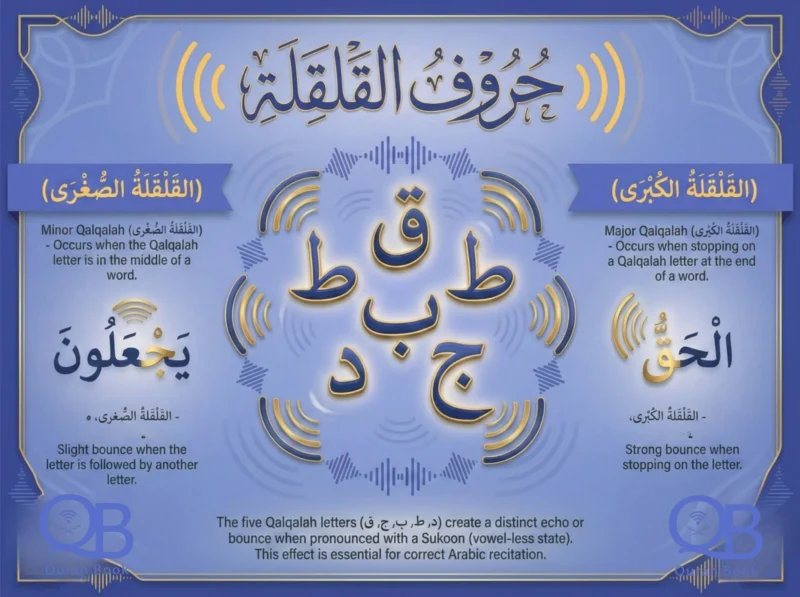
    An echoing, bouncing sound produced when certain letters carry sukoon. The letters of Qalqalah are: ق، ط، ب، ج، د — easily remembered by the phrase قطب جد.

    Three levels: Sughra (small — middle of word), Kubra (big — end of word), Akbar (biggest — end of passage).

    Quran Example — Qalqalah

    لَمْ يَلِدْ

    Al-Ikhlas 112:3 — target letter: دْ

    Listen for the controlled Qalqalah bounce on دْ.

    Want to hear all five Qalqalah letters with more audio examples? Practice all 5 Qalqalah letters with Al-Husary audio

    2. Leen (اللين)

    A soft, gentle sound produced by the letters و and ي when they are preceded by a Fatha and carry a sukoon. The word “Leen” itself means softness, and the sound should glide out smoothly without force.

    Quran Example — Leen (Waw)

    خَوْفٍ

    Quraysh 106:4 — target letter: وْ

    Listen for the soft, effortless glide out of the sakin Waw after a Fatha.

    Quran Example — Leen (Yaa)

    الْبَيْتِ

    Quraysh 106:3 — target letter: يْ

    Listen for the same softness in the sakin Yaa after a Fatha.

    Leen is also important when learning Madd Leen at a stop — Madd Leen with Audio Examples

    3. Inhiraf (الانحراف)

    The leaning or inclination of the sound away from its primary Makhraj toward another point in the mouth. This quality is found in only two letters: ل (Laam) and ر (Raa).

    Quran Example — Inhiraf

    قُلْ هُوَ

    Al-Ikhlas 112:1 — target letter: لْ (same clip as Tawassut)

    Listen for the sound of the Laam running along the side of the tongue rather than stopping dead at one point.

    4. Takreer (التكرير)

    The natural vibration of the tip of the tongue that belongs to the letter ر (Raa). Important caution: Takreer is mentioned as a quality to be aware of, so that it is not overdone. Avoid repeated rolling of the Raa; allow its natural controlled vibration without exaggeration.

    Quran Example — Takreer

    الرَّحْمَٰنِ

    Al-Fatihah 1:3 — target letter: ر (same clip as Idhlaq)

    Listen to the natural controlled quality of Raa without exaggerated rolling.

    5. Tafashshi (التفشي)

    The spreading of air inside the mouth. This quality belongs exclusively to the letter ش (Sheen). When you pronounce Sheen, the air disperses across the oral cavity, creating its distinctive widespread sound.

    Quran Example — Tafashshi

    وَالشَّمْسِ

    Ash-Shams 91:1 — target letter: ش

    Listen for the spreading quality of the sound of Sheen.

    6. Istitalah (الاستطالة)

    The elongation of sound along the edge of the tongue. This unique quality belongs only to the letter ض (Dhad) — the letter so special that Arabic is sometimes called “the language of the Dhad.” The sound stretches from the back molar area to the front of the tongue’s edge.

    Quran Example — Istitalah

    الضَّالِّينَ

    Al-Fatihah 1:7 — target letter: ض

    Listen for the distinctive extension of Dhad along the side of the tongue.

    7. Safeer (الصفير)

    A sharp whistling sound produced by three letters: ص، ز، س. The term Safeer literally means whistling, and you can hear a subtle, high-pitched hiss when these letters are pronounced correctly.

    Quran Example — Safeer

    النَّاسِ

    An-Nas 114:1 — target letter: س

    Listen for the clear whistling quality of Sīn.

    Sifaat Al Huroof Complete Reference Chart

    The chart lists all 17 Sifaat: rows 1–10 are the 5 pairs with opposites, rows 11–17 are the 7 without opposites. Tawassut appears as a shaded note row because it is the intermediate state inside Pair 2, not an eighteenth Sifah. All letter counts follow the 29-letter Tajweed count described above.

    # Sifah (Arabic) Sifah (English) Type Letters
    1 الهمس (Hams) Whispering / flowing breath With Opposite فحثه شخص سكت (10)
    2 الجهر (Jahr) Voiced With Opposite Remaining 19 letters
    3 الشدة (Shiddah) Strong Stop With Opposite أجد قط بكت (8)
    4 الرخاوة (Rakhawah) Softness / Flow With Opposite Remaining 16 letters (neither Shiddah nor Tawassut)
    التوسط (Tawassut) Intermediate state between Shiddah and Rakhawah — not counted as a separate Sifah Inside Pair 2 لن عمر (5)
    5 الاستعلاء (Isti’la) Elevation / Heavy With Opposite خص ضغط قظ (7)
    6 الاستفال (Istifal) Lowering / Light With Opposite Remaining 22 letters
    7 الإطباق (Itbaq) Adhesion With Opposite ص ض ط ظ (4)
    8 الانفتاح (Infitah) Openness With Opposite Remaining 25 letters
    9 الإذلاق (Idhlaq) Letters of the tip/edge of the tongue and the lips With Opposite فر من لب (6)
    10 الإصمات (Ismat) The counterpart group: all letters outside the Idhlaq set With Opposite Remaining 23 letters
    11 القلقلة (Qalqalah) Echoing Bounce Without Opposite ق ط ب ج د
    12 اللين (Leen) Softness Without Opposite و ، ي (sakin, with Fatha before)
    13 الانحراف (Inhiraf) Inclination Without Opposite ل ، ر
    14 التكرير (Takreer) Vibration (to be controlled, not exaggerated) Without Opposite ر
    15 التفشي (Tafashshi) Spreading Without Opposite ش
    16 الاستطالة (Istitalah) Elongation Without Opposite ض
    17 الصفير (Safeer) Whistling Without Opposite ص ، ز ، س

    Tip: Save or bookmark this chart — it’s your go-to reference as you learn Quran reading with Tajweed for beginners.

    How Quran Book Academy Teaches Sifaat Al Huroof — The Academy Method

    Learn Quran with tajweed – Quran Book Academy live Zoom session teaching Sifaat Al Huroof
    Quran Book Academy — personalized live Tajweed instruction via Zoom

    At Quran Book Academy, we understand that memorizing 17 technical attributes can feel overwhelming — especially for beginners. That’s why we developed The Academy Method, a teaching approach rooted in learning psychology and personalized instruction.

    Chunking Technique

    Instead of bombarding students with all 17 Sifaat at once, we break them into small, digestible “chunks.” Students learn 2–3 Sifaat per session, practice them in real Quranic verses, and only move forward once mastery is confirmed. This approach aligns with cognitive load theory, which shows that working memory handles small groups of information far more effectively than large ones.

    Live Zoom Sessions

    Every student practices pronunciation in real time with one of our Certified Quran and Tajweed Teachers via Zoom. You receive instant corrections that a pre-recorded course or a YouTube video cannot provide. When your instructor hears you soften a Qaaf or miss a Qalqalah, they catch it on the spot.

    Custom LMS Tracking

    Our custom Learning Management System tracks each student’s progress lesson by lesson. Parents and students receive regular progress reports after every milestone, so you always know exactly where you stand and what to focus on next.

    Nour El Bayan Foundation

    For absolute beginners who are still building Arabic letter recognition, we start with our Nour El Bayan Course before advancing to Sifaat. This ensures a rock-solid foundation that makes learning the characteristics of letters in Tajweed significantly easier.

    Practice Community

    Students can join our Telegram channel to practice Quran reading with Tajweed alongside peers, share tips, and stay motivated throughout their journey.

    Common Mistakes Beginners Make with Sifaat Al Huroof

    Even dedicated students fall into predictable traps when learning Sifaat Al Huroof. Here are the most frequent mistakes — and how to avoid them.

    Pronouncing ق (Qaaf) like ك (Kaaf)

    This happens when a student fails to raise the back of the tongue, missing the heaviness (Isti’la) of Qaaf. The result is that divine commands lose their weight and meaning.

    Adding Qalqalah to non-Qalqalah letters

    Only the five letters قطب جد carry the echoing bounce. Applying Qalqalah to other letters with sukoon is a common overcorrection that distorts the recitation.

    Over-rolling the ر (Raa)

    Takreer is a natural quality of Raa, but it is meant to be controlled — not exaggerated. Avoid repeated rolling of the Raa; allow its natural controlled vibration without exaggeration. A teacher’s ear is the safest way to judge how much is too much.

    Making ض sound like د

    The letter Dhad has a unique elongation (Istitalah) that no other Arabic letter possesses. Without it, Dhad collapses into Daal, and the “language of the Dhad” loses its most distinctive sound.

    Ignoring Hams

    Hams belongs to letters such as ف، س، ت in every state, and the flowing breath must not be blocked. It is easiest to hear when the letter carries a sukoon — but trapping the breath at any point turns a Hams letter into a Jahr letter, changing its fundamental quality.

    Pro Tip: At Quran Book Academy, our instructors catch these errors in real time during live Zoom sessions — personalized feedback can help students identify pronunciation mistakes that are difficult to notice when studying alone.

    Quick Sifaat Al Huroof Quiz

    Seven short questions for beginners, all answered inside this article. Think about your answer first, then open the box to check it.

    1. Which letters have Hams?
    The 10 letters collected in the phrase فحثه شخص سكت. Hams belongs to these letters in all states; the flowing breath is simply easiest to hear when the letter is sakin.
    2. Which Sifah belongs to ق ط ب ج د?
    Qalqalah (القلقلة) — the echoing bounce heard when one of these five letters carries a sukoon. They are remembered by the phrase قطب جد.
    3. What is the difference between Shiddah and Rakhawah?
    With Shiddah the sound stops completely at the Makhraj (8 letters: أجد قط بكت). With Rakhawah the sound flows on continuously (16 letters). Between them is Tawassut (لن عمر), the intermediate state — not a separate Sifah, which is why the total stays at 17.
    4. Which letter has Tafashshi?
    ش (Sheen) — the air spreads inside the mouth as the letter is pronounced.
    5. Which letter has Istitalah?
    ض (Dhad) — the sound extends along the edge of the tongue, which is why Arabic is called “the language of the Dhad.”
    6. What should a student avoid when pronouncing Raa?
    Repeated rolling. Takreer is a natural quality of the Raa that should be allowed its controlled vibration without exaggeration — the point of naming it is to stop students from overdoing it.
    7. What is the difference between Makharij and Sifaat?
    Makharij tell you where a letter’s sound is articulated; Sifaat tell you how that sound should behave. Two letters can share a Makhraj and still be distinguished entirely by their Sifaat.

    Frequently Asked Questions About Sifaat Al Huroof

    Q1: What is the meaning of Sifaat Al Huroof?
    Sifaat Al Huroof means “characteristics of the letters.” In Tajweed, it refers to the 17 qualities that define how each Arabic letter sounds, distinguishing letters that share the same articulation point.
    Q2: What are the two types of Sifaat?
    The two types are Sifaat with Opposites (5 pairs producing 10 attributes) and Sifaat without Opposites (7 unique attributes), totaling 17 essential characteristics. Tawassut is the intermediate state inside the Shiddah / Rakhawah pair, so it does not add an eighteenth Sifah.
    Q3: What are the 7 heavy letters in Arabic?
    The 7 heavy letters (letters of Isti’la) are: خ، ص، ض، غ، ط، ق، ظ — remembered by the Arabic mnemonic phrase خص ضغط قظ. See Heavy Letters in Arabic for the full treatment.
    Q4: What is Qalqalah in Tajweed?
    Qalqalah is an echoing or bouncing sound produced when the letters ق، ط، ب، ج، د carry a sukoon. It has three levels of intensity depending on the letter’s position in the word. You can hear each one on Qalqalah Letters with Al-Husary Audio.
    Q5: Is Qaaf (ق) a heavy letter?
    Yes, Qaaf is one of the 7 heavy letters (Isti’la letters). It must be pronounced with the back of the tongue raised to produce its full, heavy sound.
    Q6: What is the difference between Sifaat and Makharij?
    Makhraj Al Huroof: Arabic Letter Articulation Points tells you where a letter’s sound originates, while Sifaat Al Huroof tells you how that sound should be produced (its characteristics and qualities).
    Q7: What does Hams mean in Tajweed?
    Hams means “whispering”: the flow of breath that accompanies 10 specific letters (فحثه شخص سكت). It is an inherent quality of those letters in all states, although the flow of breath is usually easiest for beginners to hear when the letter is sakin.
    Q8: What is Shaddah in Tajweed?
    Shaddah (ّ) is a diacritical mark indicating a doubled or stressed letter. While not a Sifah itself, it intensifies the characteristics of the letter it appears on, requiring extra emphasis at the Makhraj.
    Q9: What are the 5 Sifat pairs in Tajweed?
    The 5 opposing pairs are: (1) Hams vs. Jahr, (2) Shiddah vs. Rakhawah, (3) Isti’la vs. Istifal, (4) Itbaq vs. Infitah, and (5) Idhlaq vs. Ismat.
    Q10: Why does this guide count 29 Arabic letters?
    In this Tajweed counting framework the Hamzah (ء) is counted as a letter in its own right alongside the Alif (ا), giving 29 letters. Every count in this article — Hams 10 / Jahr 19, Isti’la 7 / Istifal 22, Itbaq 4 / Infitah 25, Idhlaq 6 / Ismat 23 — follows that framework.

    Start Perfecting Your Sifaat Al Huroof Today — Free Trial Lesson

    Start your free trial lesson to learn Quran with tajweed and master Sifaat Al Huroof at Quran Book Academy
    Start your journey to master Sifaat Al Huroof with Quran Book Academy

    You’ve learned what Sifaat Al Huroof are — now it’s time to hear them, practice them, and master them with expert guidance.

    At Quran Book Academy, we don’t just teach theory. Our certified Tajweed instructors work with you one-on-one via live Zoom sessions, correcting your pronunciation in real time and guiding you through every Sifah with patience and encouragement. Our custom LMS tracks your journey, and you’ll receive regular progress reports so you always know exactly where you stand.

    Whether you’re a complete beginner starting with Nour El Bayan or an intermediate student refining your Tajweed, we have a path designed for you.

    “And We have certainly made the Quran easy for remembrance, so is there any who will remember?” — Surah Al-Qamar 54:17

    About the Author

    Jehad Mahmoud - writer at Quran Book Academy

    Hafidha of the Quran · Arabic Language Graduate · Writer on Islamic Sciences

    Jehad Mahmoud is a graduate of the Arabic Language department and a Hafidha of the Quran who writes Islamic educational content at Quran Book Academy. She specialises in Quranic Arabic, Tajweed and the Sharia sciences, helping English-speaking Muslim families understand correct Quran pronunciation and foundational Islamic knowledge.

    Tajweed Sifaat Al Huroof Quran Recitation Arabic Pronunciation

    References & Resources

    Scholarly Sources

    The Holy Quran — Surah Al-Fatihah 1:3, 1:6, 1:7; Surah Al-Ikhlas 112:1, 112:3; Surah Quraysh 106:3–4; Surah Ash-Shams 91:1; Surah An-Nas 114:1; Surah An-Naba 78:13; Surah Al-Kahf 18:25; Surah At-Tawbah 9:72; Surah Al-Muzzammil 73:4; Surah Al-Hijr 15:9; Surah Al-Qamar 54:17
    Sahih al-Bukhari, Hadith 4937
    Imam Ibn Al-Jazari — Al-Muqaddimah Al-Jazariyyah (foundational Tajweed text)
    Sulayman Al-Jamzuri — Tuhfat Al-Atfal
    Muhammad Makki Nasr — Nihayat Al-Qawl Al-Mufid fi ‘Ilm Al-Tajweed
    Abd Al-Fattah Al-Marsafi — Hidayat Al-Qari ila Tajweed Kalam Al-Bari

    Where each point is grounded:
    • The 29-letter count used in this Tajweed framework (Hamzah counted separately from Alif) — Al-Muqaddimah Al-Jazariyyah; Nihayat Al-Qawl Al-Mufid.
    • Hams / Jahr as inherent qualities of their letters, and the mnemonics فحثه شخص سكتAl-Muqaddimah Al-Jazariyyah; Hidayat Al-Qari.
    • Shiddah, Rakhawah and Tawassut as the intermediate state within one pair (أجد قط بكت / لن عمر) — Al-Muqaddimah Al-Jazariyyah; Nihayat Al-Qawl Al-Mufid.
    • Isti’la / Istifal and the seven letters خص ضغط قظAl-Muqaddimah Al-Jazariyyah; Hidayat Al-Qari.
    • Itbaq / Infitah and the four Itbaq letters ص ض ط ظAl-Muqaddimah Al-Jazariyyah.
    • Idhlaq / Ismat as an articulation-based classification (فر من لب) rather than an audible effect — Nihayat Al-Qawl Al-Mufid; Hidayat Al-Qari.
    • Takreer as a quality to be controlled rather than exaggerated — Al-Muqaddimah Al-Jazariyyah; Hidayat Al-Qari.
    • Qalqalah and its levels — Tuhfat Al-Atfal; Nihayat Al-Qawl Al-Mufid.
    • The Makhraj / Sifah distinction — Al-Muqaddimah Al-Jazariyyah; Hidayat Al-Qari.

    Recitation Audio

    All audio examples in this article are streamed from EveryAyah.com — the recitation of Shaykh Mahmoud Khalil Al-Husary (Hafs ‘an ‘Asim), Husary_128kbps with Husary_64kbps as the automatic fallback. Each button loads one ayah file on demand; nothing is preloaded. To shorten any clip to just the target word, add data-start and data-end (in seconds) to that button.

    © 2026 Quran Book Academy. All rights reserved.