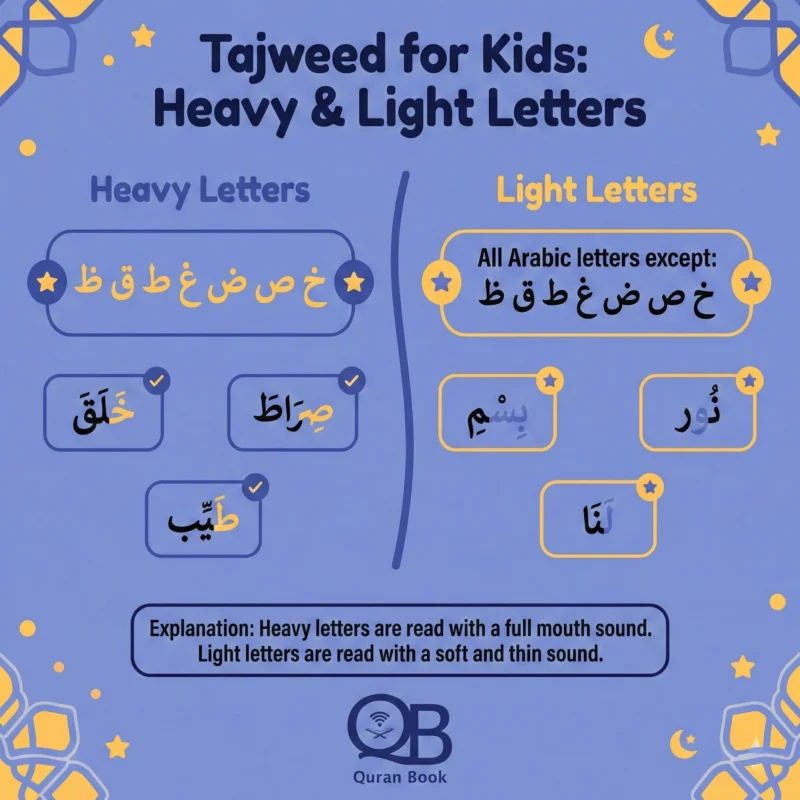
Heavy letters in Arabic — called Tafkheem — are seven letters pronounced with the back of the tongue raised toward the roof of the mouth, giving them a full, thick sound. All remaining letters are light (Tarqeeq). Three letters — Alif, Ra, and the Lam in Allah — switch between heavy and light depending on the vowels around them.
Hear it first: صِرَاط has a heavy ṣād, سِرَاج has a light sīn. Same vowels, same rhythm — one tongue position apart, and two completely different words.
What Do Tafkheem and Tarqeeq Mean?
Tafkheem (تفخيم) means “to make heavy” or “to thicken”. Tarqeeq (ترقيق) is its opposite: “to make thin”. The two words describe what happens to the sound of a letter, not to the letter itself — the same shape on the page can be recited either way, which is why this rule sits under sifat al-huroof, the characteristics of the letters.
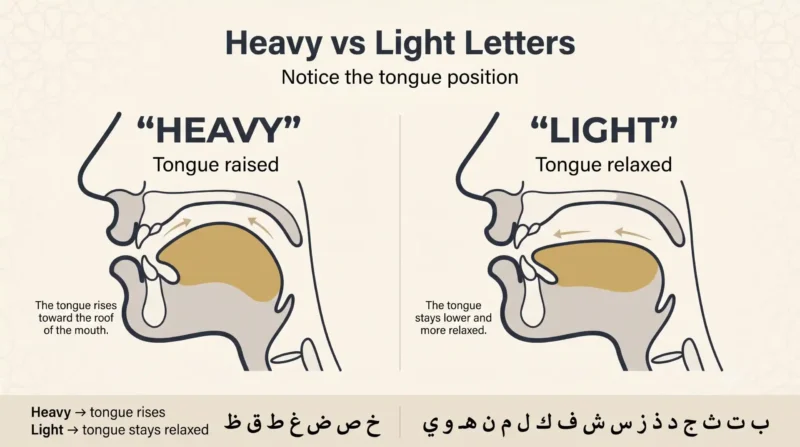
Physically the difference is one movement. For a heavy letter the back of the tongue rises toward the soft palate and the sound fills the mouth; scholars call this isti’la (استعلاء), elevation. For a light letter the tongue stays low and flat — istifal (استفال) — and the sound stays thin and forward.
This is where students often confuse Tafkheem with the Makhraj of Arabic letters. The makhraj is where the sound is produced; Tafkheem is how the tongue is shaped while it is produced. One makhraj can carry two very different sounds depending on that shaping — which is exactly what happens with Ra, and it is why a reader can be hitting the right articulation point and still sound wrong.
💡 The shortcut: Tafkheem is not about volume. Reciting louder does not make a letter heavy, and reciting quietly does not make it light. It is tongue height, nothing else.
The 7 Heavy Letters in Arabic (Huroof al-Isti’la)
There are exactly seven letters of elevation, and every one of them is heavy in every position, without exception. Learn these seven and you have learned the entire heavy list — nothing is added to it later.
خ ص ض ط ظ غ ق
khā · ṣād · ḍād · ṭā · ẓā · ghayn · qāf
The classical memory phrase
Teachers have used the same mnemonic for centuries: خُصَّ ضَغْطٍ قِظْ — Khuṣṣa Ḍaghṭin Qiẓ. It is a deliberately artificial phrase whose only job is to hold the seven letters in order, first letter of each syllable. Say it ten times and you will not lose the list again.
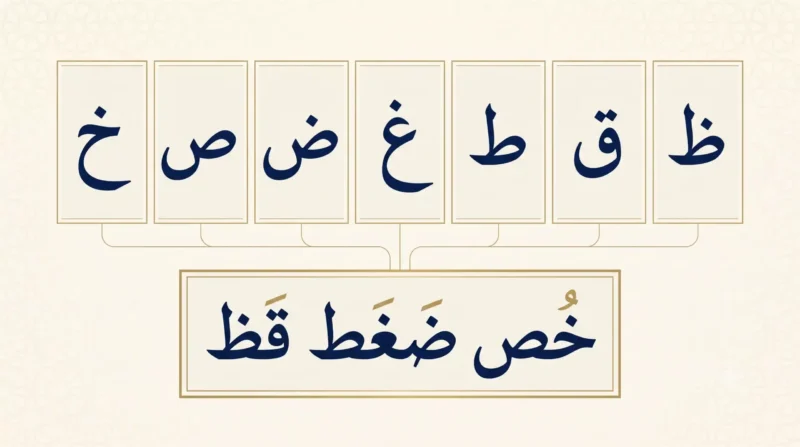
One note on ṭā, ḍād, ṣād and ẓā: these four are also huroof al-itbaq, the letters of adhesion, where the tongue presses flat against the palate as well as rising. They are the heaviest of the seven, and if your ear can only tell one group apart at first, start with these.
Light Letters in Arabic (Huroof al-Istifal)
Here is the part that makes this rule far easier than students expect: there is no list of light letters to memorise. Every Arabic letter that is not one of the seven heavy letters is light. That is twenty-one letters, plus the three conditional ones covered below, and none of them need to be learned individually.
So the entire task is negative: know the seven, and treat everything else as thin by default. Tarqeeq is the resting state of the Arabic alphabet, and Tafkheem is the exception.
The most common error non-Arab readers make
Three light letters get thickened almost universally by English speakers: ء (hamzah), ح (ḥā) and ع (‘ayn). Because they are produced deep in the throat, learners assume “deep” must mean “heavy” and push the tongue up with them.
It does not. Depth of makhraj and heaviness are unrelated. al-Ḥamd, ‘alayhim and a’ūdhu are all recited with a flat tongue and a thin sound, however far back the constriction sits.
The 5 Levels of Tafkheem
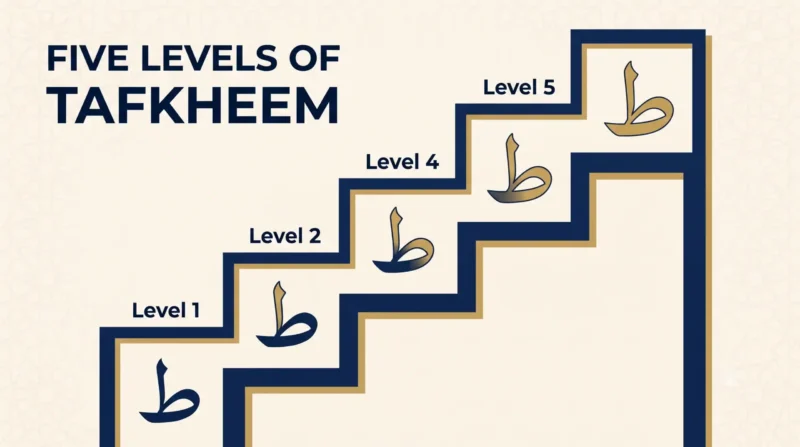
Heaviness is not a switch, it is a dial. A heavy letter is always heavy, but how heavy depends on the vowel it carries and on what follows it. Scholars of Tajweed set out five levels, from strongest to weakest, and this is the layer that separates a reader who knows the rule from a reader who sounds correct.
Levels one to four all use the same letter, ṭā, so the taper is audible rather than theoretical. Play them in order: aṭ-ṭāriq is round and full, ṭaghā a shade lighter, ṭumisat narrower again, baṭsha narrower still. Level five drops to ghayn under a kasrah — ghislīn — still unmistakably heavy, but the sound has thinned and moved forward. None of them is wrong; they are the same characteristic at different points on the dial.
The Three Conditional Letters
Three letters sit outside both lists. They are not permanently heavy and not permanently light — they take one or the other from their surroundings. Understanding heavy and light letters in Arabic properly means understanding these three, because almost every recitation error a beginner makes lives here.
The Ra rule (ر)
Ra is the letter that decides whether a reader sounds trained. It has a full ruling of its own, and the core of it fits on one screen.
Ra is HEAVY when…
- it carries a fatḥah — رَبّ
- it carries a ḍammah — رُزِقَ
- it is silent after a fatḥah — الْأَرْض
- it is silent after a ḍammah — كُرْسِيُّه
Ra is LIGHT when…
- it carries a kasrah — رِزْق
- it is silent after a kasrah — فِرْعَوْن
- it is silent after a yā sākinah — خَيْر
Read the two columns together and the pattern is a single question: is there a kasrah in the picture? If yes, the Ra goes light. If not, it goes heavy. Everything else is detail.
The exceptions worth knowing
A silent Ra after a temporary kasrah stays heavy
The kasrah has to belong to the word. In ارْجِعُوا the kasrah on the connecting hamzah is incidental, so the Ra is heavy.
A silent Ra after a kasrah followed by a heavy letter stays heavy
In قِرْطَاس and مِرْصَاد the ṭā and ṣād pull the Ra up with them. If that heavy letter carries a kasrah itself, as in فِرْقٍ, both readings are transmitted.
Stopping changes the ruling
When you pause on a word, the final vowel drops and the Ra takes its ruling from what precedes it. الْقَدْر stays heavy at a stop; الْفَجْر likewise — but قَدِير goes light, because the long ī before it is a kasrah stretched out.
The Lam in “Allah” (ﷲ)
The Lam is a light letter everywhere in the language except in the name Allah, where it follows the vowel immediately before it.
Heavy — after fatḥah or ḍammah
قَالَ ٱللَّه · هُوَ ٱللَّه
Light — after kasrah
بِسْمِ ٱللَّه · لِلَّه
This is one of the most audible mistakes in the whole of Tajweed, because the phrase bismillāh is recited more often than any other. The kasrah on the mīm makes the Lam thin — thickening it there is immediately noticeable to a trained ear.
The Alif (ا)
The alif has no ruling of its own at all. It is a mirror: it takes the weight of whatever letter comes before it. In قَالَ the alif follows a heavy qāf, so it is heavy; in مَالِك it follows a light mīm, so it is light.
Because of this, the alif is where over-thickening spreads. A reader who gives the heavy letter more weight than it needs drags the alif with it, and the whole syllable turns muddy. Watch the alif and you will usually catch the fault one letter earlier. Linguists describe the same seven sounds as pharyngealised consonants — a useful second lens, because it explains why the heaviness colours the vowels on either side of the letter and not just the letter itself.
Test Yourself: Heavy or Light?
You’ve read the rules — now see if your ear agrees. We’ll show you a word from the Quran, you decide whether the highlighted letter is heavy or light. Ten questions, instant feedback, no sign-up.
Question 1 of 10
Play: The Heavy Letters Gym
The quiz checks whether you know the rule. This one checks whether you can apply it at speed — which is a different skill, and the one that actually shows up in recitation. Play it directly below, or open it in a new tab if you prefer a full screen.
It works well for children too — the seven letters stop being a list to recite and become something they can recognise by sound, which is exactly the transfer you want before formal Tajweed lessons begin.
Tafkheem and Tarqeeq Examples from the Quran
Rules settle once you meet them in the text you actually recite. Each line below highlights the target letter — blue for heavy, gold for light — with the recitation of Sheikh Al-Husary beside it.
Notice how often a heavy and a light letter sit side by side. That is the real training: not producing each sound in isolation, but switching between them cleanly at speed. If you’d like to drill this alongside the other rules, our free Arabic letter games cover the same ground for children and adults.
Common Mistakes to Avoid
1. Thickening a Ra that carries a kasrah
The single most frequent error, and the easiest to fix. Rizq, Fir’awn, ghayri — all thin. If you learned Ra as a “heavy letter” you will need to unlearn that; it is conditional, not heavy by nature.
2. Carrying heaviness onto the following alif
The alif mirrors the letter before it, so a light letter must be followed by a light alif. In mālik and kāna the alif should stay thin; letting it thicken is a habit picked up from imitating heavy words.
3. Over-thickening until the makhraj distorts
Pushing a heavy letter past its level distorts the vowel around it — a ḍammah starts to sound like a fatḥah, and the word changes shape. Heaviness is a raised tongue, not a forced one.
4. Thickening the Lam in bismillāh
Recited more often than any other phrase, and mispronounced constantly. The kasrah on the mīm makes that Lam light.
Frequently Asked Questions
Where This Fits in Tajweed
Tafkheem and Tarqeeq is one characteristic among many in sifat al-huroof, and it sits inside the wider system of Tajweed rules. Seven letters, five levels, three conditionals — that is the whole of it, and most students hold it within a fortnight.
What takes longer is the ear. Reading the Ra rule takes ten minutes; hearing your own Ra correctly takes a teacher. If you want that feedback, our Tajweed courses are built around exactly this kind of correction, or you can simply book a free trial lesson and recite a page.
May Allah make the Quran the spring of your heart, and may He accept it from you. 🤲
Learn More
Tafkheem and Tarqeeq is one rule in a bigger system. Here’s what to study next:
Hafidha of the Quran · Arabic Language Graduate · Writer on Islamic Sciences
Jehad Mahmoud is a graduate of the Arabic Language department and a Hafidha of the Quran who writes the Islamic educational content at Quran Book Academy.
She writes with a focus specialising in fiqh, the fiqh of women and the sharia sciences, making complex rulings accessible to English-speaking Muslim families.
Her articles are educational, not fatwa. For a ruling on a specific personal situation, readers are advised to consult a qualified scholar or mufti.
References & Sources
2. Emphatic consonants — pharyngealisation in Arabic phonetics
3. Quran.com — Quranic text and verse references used throughout
4. EveryAyah.com — recitation of Sheikh Mahmoud Khalil Al-Husary
© 2026 Quran Book Academy. All rights reserved.
Book Your Free Trial · Empowering Muslims Worldwide to Connect with the Quran