Makhraj: The 5 Articulation Points of Arabic Letters Explained
Discover exactly where every Quranic letter comes from — and why it matters

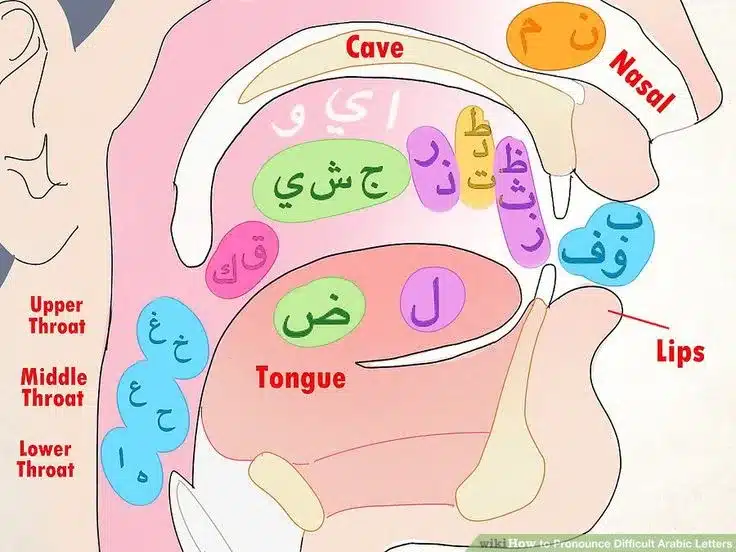
Makhraj (plural: Makharij) is the exact point or area in the mouth, throat, lips, or nasal cavity where an Arabic letter’s sound is produced. Each of the 29 Arabic letters has a defined articulation, though several letters share the same Makhraj and are told apart by their characteristics (Sifaat). In the widely taught classification adopted by Ibn al-Jazari, these 17 precise exit points are grouped into 5 main zones. Getting this right is what separates a letter that sounds correct from one that quietly changes the meaning of the ayah.
What Is Makhraj in Arabic?
In Arabic, makhraj (مخرج) literally means “exit” or “place of coming out.” In Tajweed, it refers to the articulation point or area in the vocal tract — the oral cavity (Al-Jawf), throat, tongue, lips, or nasal passage — from which a letter’s sound physically originates.
Without correct articulation there, a letter loses its identity and can be mistaken for a completely different one.
It helps to keep the singular and plural straight: Makhraj is one articulation point (the exit point of the letter ق, for example), while Makharij is the plural — the full system used across the Arabic alphabet.
Both words come from the same root, and you’ll see them used almost interchangeably in Tajweed books, though you’ll also see the complete science referred to by its formal Arabic name, “Makharij al-Huruf” (مخارج الحروف).
This is one of the two pillars of Tajweed, alongside Sifat al-Huruf (the characteristics of each letter, such as heaviness or softness). Together they answer two different questions: this pillar answers where a letter comes from, and Sifat answers how it sounds once it gets there. That second pillar is also what tells apart letters that share one exit point, like ص، س، and ز.
Our guide to Tajweed Rules covers the second half of that picture in more depth.
The 5 Main Makharij (Articulation Points)

Classical scholars of Tajweed, following Ibn al-Jazari, identified 17 detailed articulation points and organized them under 5 broader regions of the mouth and throat. Other classical classifications counted 16 (Sibawayh) or 14 (Al-Farra’), but the 17-Makhraj system is the one taught in almost every modern Tajweed curriculum. Every Arabic letter belongs to one of these five zones, which makes the system much easier to memorize than it first looks.
| Zone (Arabic) | English name | What it covers | Approx. letters |
|---|---|---|---|
| الجوف | Al-Jawf (Oral Cavity) | The open space of the mouth and throat | 3 (long vowels) |
| الحلق | Al-Halq (Throat) | 3 points across the throat | 6 |
| اللسان | Al-Lisan (Tongue) | 10 points — the largest zone | 18 |
| الشفتان | Ash-Shafatan (Two Lips) | 2 points | 4 |
| الخيشوم | Al-Khayshum (Nasal Cavity) | 1 point — for Ghunnah only | — |
Adding the counts above gives 31, not 29. That is because Alif, Waw, and Ya appear twice: as Madd letters from Al-Jawf, and again as ordinary consonants from the tongue or the lips. Counted once each, the total returns to 29.
Notice that the tongue (Al-Lisan) alone accounts for more articulation points than any other zone — which is exactly why most beginner pronunciation mistakes, including the ones affecting ص, ض, ط, and ظ, trace back to tongue placement rather than the throat.
Al-Jawf (The Oral Cavity)
Al-Jawf is unique among the five Makharij: it isn’t a fixed contact point at all, but the open, empty space running from the throat through the mouth. Classical scholars describe it as an estimated (muqaddar) Makhraj rather than a precisely bounded one. It is the articulation source of the three long vowel letters — Alif Madd (ا) preceded by a Fatha, Waw Sakinah (وْ) preceded by a Damma, and Ya Sakinah (يْ) preceded by a Kasra.
The Sukoon and the matching vowel before it are both conditions. A Waw carrying a Fatha, for example, is not a Madd letter at all — it is an ordinary consonant articulated from the lips.
Because no part of the tongue, lips, or throat touches anything to produce these sounds, Al-Jawf is sometimes called the “no-contact” zone. Its letters are held rather than shaped against a surface, and their length follows whichever Madd rule applies — the natural two counts by default, or longer when a cause such as a Hamzah or a Sukoon follows.
Al-Halq (The Throat)
Al-Halq is the zone behind most searches for throat letters in Arabic, and it divides into three distinct points, moving from deepest to nearest:
- Aqsa al-Halq (deepest throat): ء (Hamzah) and هـ
- Wasat al-Halq (middle throat): ع (Ain) and ح
- Adna al-Halq (nearest throat, closest to the mouth): غ (Ghain) and خ (Kha)
These six throat letters are exactly the trigger letters for the Izhar rule in Noon Sakinah and Tanween, which is one of many places where mastering these points directly unlocks the Tajweed rules built on top of them.
A common beginner error is collapsing ح and هـ into the same sound, or ع into a plain glottal stop — both are Makhraj mistakes, not Tajweed rule mistakes, and they need to be fixed at the articulation-point level first.
Al-Lisan (The Tongue)
Al-Lisan is by far the largest articulation zone, covering ten separate points and around eighteen letters — everything from the back of the tongue against the soft palate (ق, ك) to the tip of the tongue against the front teeth (ث, ذ, ظ). Because so many letters are packed into a small physical space, this is where non-Arabic speakers spend most of their correction time.
A good example is Saad Makhraj: the letter ص (Saad) is produced from the tip of the tongue near the edge of the lower front teeth, with air forced through a narrow channel to create its distinctive whistling, heavy sound.
This is the exact same exit point as س (Seen) and ز (Zay) — the difference isn’t location but Sifat (characteristics): ص carries Itbaq and Isti’la, which make it heavy, while س stays light.
Five of the seven heavy letters (ص، ض، ط، ق، ظ) are articulated here in Al-Lisan; only خ and غ come from the throat. That concentration is why so much beginner correction work happens on the tongue, and why our full Tajweed Rules guide pairs naturally with this article.
Ash-Shafatan (The Two Lips)
Ash-Shafatan covers four letters produced using the lips: ف (Fa), from the inner lower lip touching the tips of the upper front teeth; and ب، م، و (Ba, Meem, and non-Madd Waw), produced by bringing the two lips together or close together. The Waw counted here is the consonant Waw — the one carrying a vowel, as in وَعَدَ. Madd Waw, which is Sakinah after a Damma, comes from Al-Jawf instead.
Meem and Ba can feel almost identical to a beginner, but Meem allows air through the nose (it’s a nasal letter) while Ba is a sharp, fully-closed-lip release — a small difference in articulation with a real difference in sound.
Al-Khayshum (The Nasal Cavity)
Al-Khayshum is the odd one out: it isn’t the fixed point of a specific letter, but of a sound — Ghunnah, the nasal resonance you hear in rules like Idgham with Ghunnah, Ikhfa, and Iqlab. Whenever a Noon or Meem carries a nasal hum, that hum is coming from Al-Khayshum, not from the mouth. Beginners who “flatten” their Ghunnah are usually closing off the nasal passage instead of letting the sound resonate there naturally.
Watch: Our Makharij Video Lessons
Articulation is a sound before it is a description. A diagram can show you where the tongue sits, but hearing a letter produced correctly — and seeing the mouth produce it — is what makes the difference between recognising a Makhraj and actually reproducing it.
The playlist below walks through the articulation points letter by letter, from our own teachers at Quran Book Academy. Work through one zone at a time and repeat after each letter out loud before moving on.
Makharij al-Huruf — Full Playlist
Free on YouTubeTip: pause after each letter and repeat it three times before moving to the next one.
Open the Playlist on YouTubeNew lessons are added regularly — subscribe to the channel to get them as they go live.
Try It Yourself: Interactive Makharij Practice
Watching and reading only get you halfway — the rest comes from active practice. Below is a live preview of one of our interactive Tajweed games, used inside the Quran Book Academy student portal to train letter recognition and correct pronunciation habits in a fun, low-pressure format.
This particular game focuses on the 7 heavy letters, several of which share an articulation zone with letters students most often confuse (like ص and س from Al-Lisan above).
Heavy Letters Gym
Student Portal PreviewTip: the game works on both desktop and mobile — try it right here before scrolling on.
Open FullscreenThis is one small sample from a much larger library of free Arabic letter games our enrolled students use alongside live correction from a teacher — because a game can help you recognize a letter, but only a trained ear can confirm you’re actually getting it right.
Why Makharij Matters in Tajweed
Getting the Makhraj of Arabic letters right isn’t a stylistic preference — Arabic is a language where near-identical sounds can carry completely different meanings. Two words that differ by a single articulation point, like a letter produced from the tongue instead of the throat, can end up meaning entirely different things.
Because the Quran is being recited, not just read, precision at this level is treated as the first and most foundational layer of Tajweed, before any of the Noon Sakinah, Madd, or Qalqalah rules are even introduced.
This is also why Makhraj is taught before the named Tajweed rules in almost every traditional curriculum: a student who merges ح and هـ, or ت and ط, will keep misapplying every rule built on top of those letters until the underlying articulation point is corrected.
Fixing the foundation first saves months of re-learning later.
How to Practice Makharij at Home
You don’t need to memorize all 17 articulation points in one sitting. Start with one zone per week — throat letters first, since there are only six — and use a mirror to check tongue and lip position while you repeat each letter slowly. The video playlist above is organised the same way, so you can follow it zone by zone.
Pair every letter with a short Quranic word that contains it, and listen to a trusted reciter before attempting it yourself; our Ayat al-Kursi memorization tool is a good place to hear phrase-by-phrase audio while you follow along.
Record yourself reciting the same short passage for 60 seconds, then compare it to the reciter’s version. Most self-study plateaus happen because a mistake becomes a habit before anyone catches it.
This is exactly what a live teacher in our Tajweed courses is there to catch early, session by session.
Makhraj FAQ
What is Makhraj?
It is the precise point or area in the mouth, throat, lips, or nasal cavity from which an Arabic letter’s sound originates. Getting it right is essential in Tajweed because it affects how clearly — and correctly — a letter is pronounced.
What is Makharij in the Quran?
This is the plural form, referring to the complete set of articulation points used across all Arabic letters when reciting the Quran. In the widely taught classification, these 17 specific points are grouped into 5 main zones.
What is Makharij in Tajweed?
This is the foundational rule that ensures every letter is pronounced from its correct location, preventing one letter from being mistaken for another during recitation.
What does Makharij mean?
The term literally means “exit points” or “points of articulation” in Arabic, referring to where sound physically originates when a letter is spoken.
How many Makharij are there?
In the classification adopted by Ibn al-Jazari and taught most widely today, there are 17 articulation points, grouped into 5 main zones: the oral cavity (Al-Jawf), the throat (Al-Halq), the tongue (Al-Lisan), the two lips (Ash-Shafatan), and the nasal cavity (Al-Khayshum). Other classical scholars counted 16 or 14.
What is the Makhraj of Saad?
The letter Saad (ص) is articulated from the tip of the tongue against the edge of the lower front teeth, with air forced through a narrow channel to produce its distinctive whistling sound. Seen (س) and Zay (ز) share this same exit point — Saad is distinguished by its heaviness (Itbaq and Isti’la), not by its location.
Why does Makhraj matter in Quran recitation?
Pronouncing a letter from the wrong point can change the meaning of a word entirely, since Arabic letters that sound similar often carry very different meanings.
Can I learn Makharij without a teacher?
Video lessons, audio guides, and interactive charts help build initial awareness, but a live teacher is essential for correcting subtle articulation mistakes that are difficult to hear on your own.
Book Your Free Trial Lesson
Charts, videos, and games can show you where a letter should come from — a live teacher is what confirms you’re actually getting there. We’ll assess your articulation points, build a simple correction plan, and start improving your recitation from day one.
Start Your Free Trial LessonYou can also reach us on WhatsApp or join our free Maqra on Telegram.
Written By
Jehad Mahmoud
Hafidha of the Quran · Arabic Language Graduate · Writer on Islamic Sciences
Jehad Mahmoud is a graduate of the Department of Arabic Language and a hafidha who has memorised the entire Holy Quran. She writes the Islamic content at Quran Book Academy, specialising in Tajweed, the Quranic sciences and the Arabic language that underpins them.
Having memorised the Quran herself, she writes about Makharij and articulation from the inside — she knows exactly which letters non-Arabic speakers confuse, and why. Every point she explains is traced back to the established science of Tajweed, and where scholars differ on the finer points, she says so plainly.
Her articles are educational, not fatwa. For a ruling on a specific personal situation, readers are advised to consult a qualified scholar or mufti.
References & Resources
- Altalmas et al., “Lips Tracking Identification of a Correct Quranic Letters Pronunciation for Tajweed Teaching and Learning,” IIUM Engineering Journal
- Encyclopedia of Arabic Language and Linguistics — Brill
- Tajweed Rules — Quran Book Academy
- Makharij al-Huruf video playlist — Quran Book Online on YouTube
- Quran Book Online YouTube — free Tajweed lessons
- About the author — Jehad Mahmoud