Dammah in Arabic: A Little Curl on Top, a Short “u”
Hear it on every letter, round the “o” into a clean “u”, and read your first words.
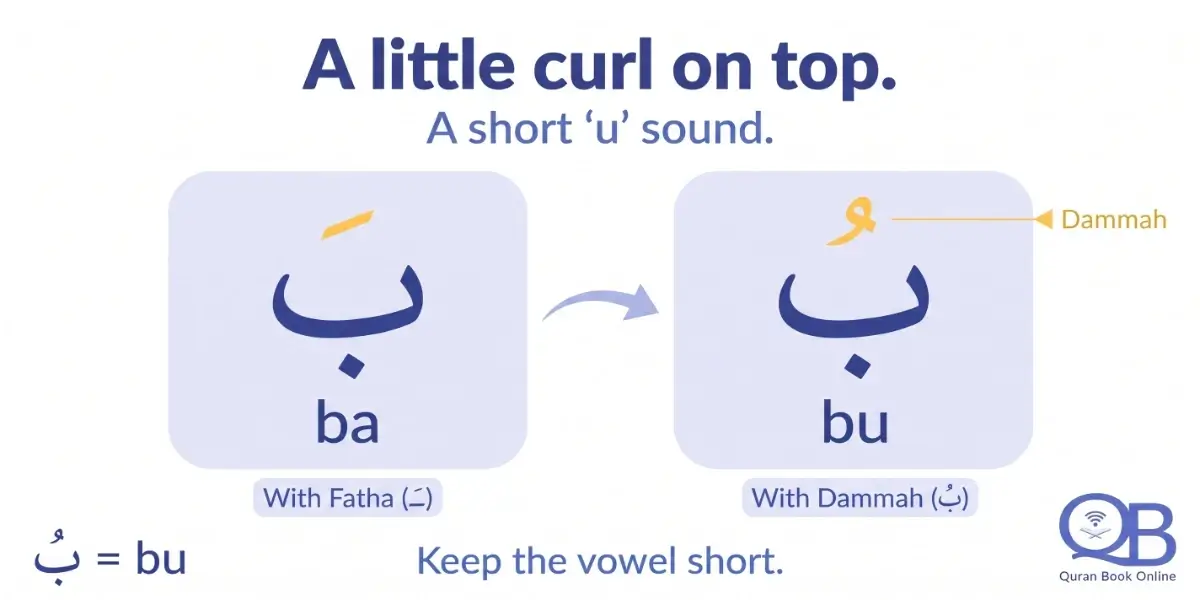
You’ve met fatha and kasra. The last short vowel sits on top, just like fatha — but it’s a little curl, not a dash. That’s the dammah. And it says “bu”, not “bo”.
بَبُ
ba → bu · tap both and listen
It is the third and last of the Arabic harakat, the short vowels you learn after fatha and kasra. In this dammah lesson you’ll hear it on all 28 letters, learn the one mistake to avoid, read your first words with all three short vowels, and play.
What Is Dammah in Arabic?
Dammah (ـُ) is a small curl written above a letter. It looks like a tiny wāw (و), but it isn’t the letter wāw — it’s a vowel mark. The letter gives the consonant; the mark adds a short “u” after it.
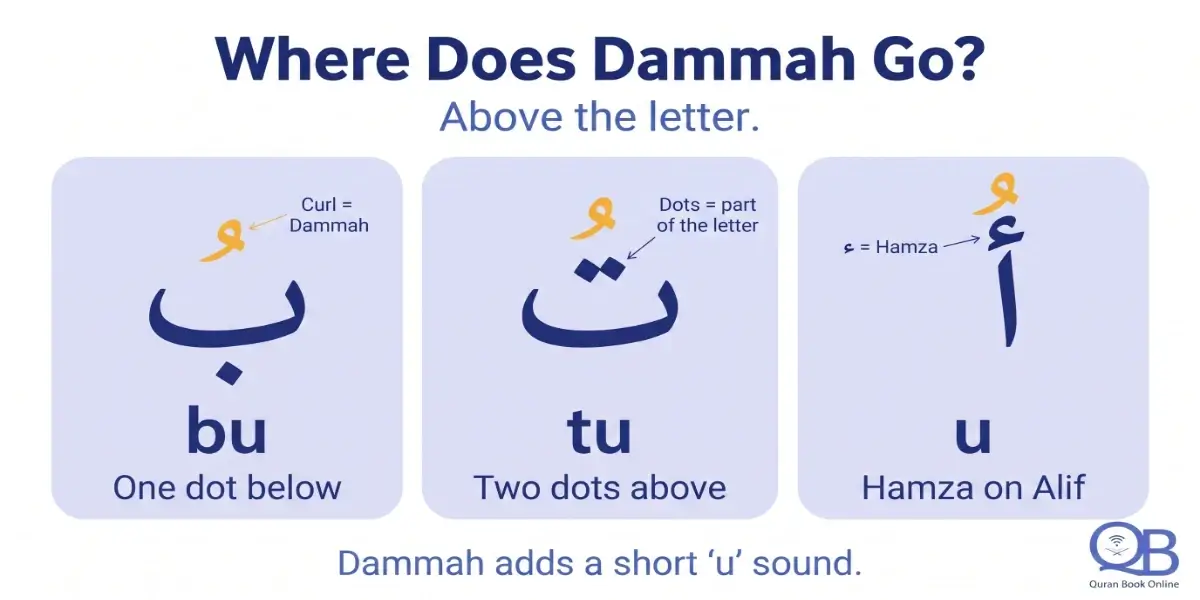
If the letter has dots on top, it goes above the dots: نُ · ثُ · قُ. At the start of a word, it sits above a hamza on an alif: أُ (ʾu).
You may also see it written damma or ḍamma. The name ضَمَّة comes from ضَمَّ (ḍamma), “to join” or “to bring together” — your lips come together into a small circle as you say it.
One thing it isn’t: two dammahs (ـٌ) are a different mark, covered in Tanween in Arabic.
What Does the Dammah Sound Like?
The dammah sound is a short “u”, like the u in “put” — not the u in “cup”. Round your lips, then say the letter with that quick “u”. Tap each syllable and listen:
The “o” trap
- Not “o”. Round your lips into a small circle and push them slightly forward. “bo” (as in “boat”) is wrong; “bu” is right.
- Not “oo” (“boo”). It lasts one beat. Hold it longer and you get a different sound — one of the Arabic long vowels.
If it sounds like “bo”, your lips are too open. Round them and say “bu”.
A quick check: say “bu” in front of a mirror. Your lips should make a small, tight circle, like blowing out a candle — not the wide, open shape of “o”.
Dammah on Heavy Letters and ر
The heavy letters — خ ص ض ط ظ غ ق — keep their deep, full start with dammah, and the vowel sounds fuller. This is where “o” sneaks in most. It must still be a rounded short “u”: صُ is ṣu, not “ṣo”.
And ر with dammah is always heavy in Hafs: رُ (ru) sounds fuller than the light رِ (ri) from the kasra lesson — but it’s still “ru”, not “ro”. Hear both pairs:
Light vs heavy start
Light رِ vs heavy رُ
For the full picture, see heavy letters in Arabic.
Arabic Alphabet With Dammah: All 28 Letters
Here are the Arabic letters with dammah: all 28, one short “u” each. Read down the chart, then tap any syllable to check your sound.
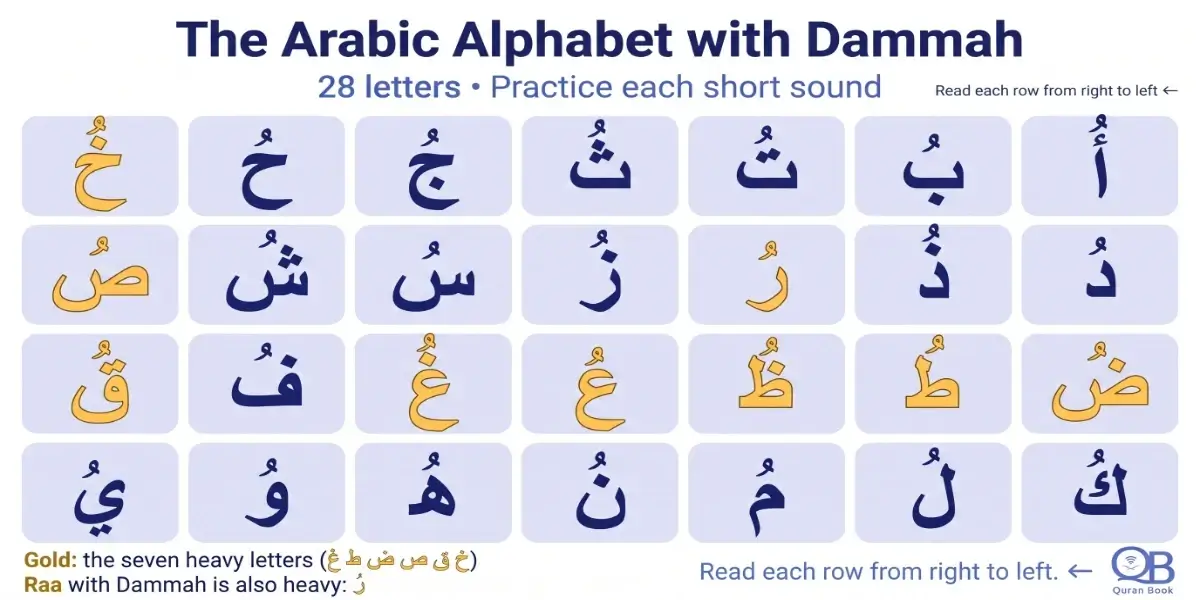
Reading Arabic Letters With Dammah
Read each line out loud first. Then use the activity below to check yourself.
- Level 1 — one syllable: بُ · سُ · لُ · نُ
- Level 2 — two syllables: بُ تُ · مُ نُ · سُ لُ · دُ كُ
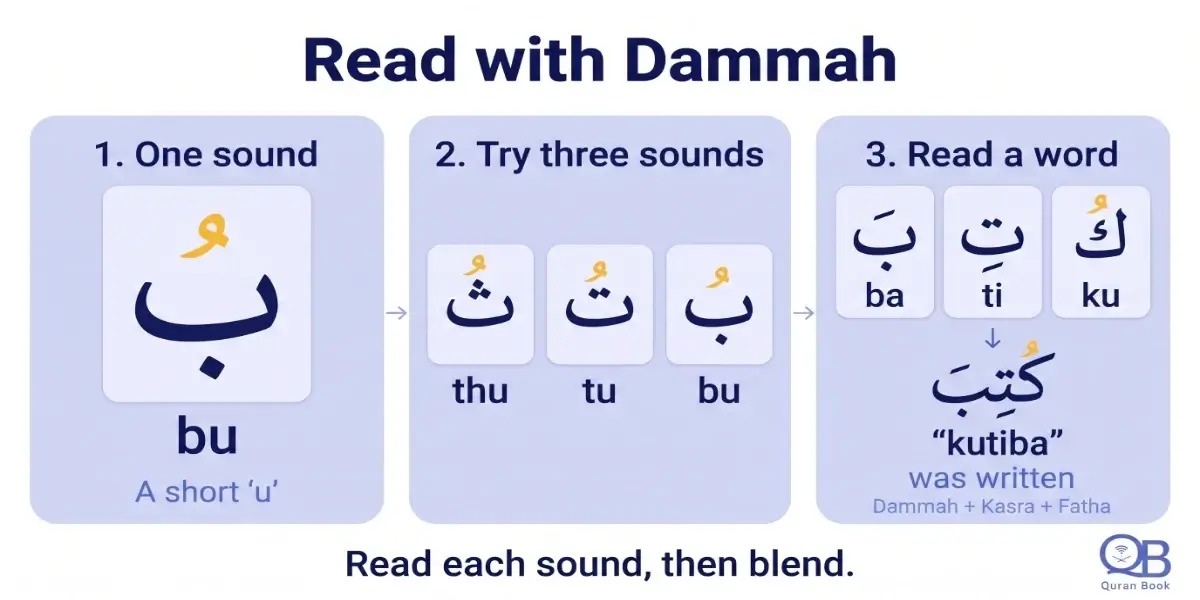
- Level 3 — real words. Now that you know all three short vowels, you can read three-letter words that use them all. Every word has the same beat — dammah, kasra, fatha: fu-ti-ḥa.
فُ | تِ | حَفُتِحَ
fu-ti-ḥa → futiḥa · “was opened”
All six words in the activity mean “was …” — the “u” on the first letter does that. You may recognise some roots from the fatha and kasra lessons.
Inside words, the letters join. If a joined shape looks new, see Arabic letters beginning, middle & end.
Dammah vs Fatha and Kasra
Fatha
above · dash
Kasra
below · dash
Dammah
above · curl
Same letter, three marks, three sounds. Tap each one: the letter ب stays the same, and only the vowel changes.
Fatha and dammah both sit on top — the shape tells them apart: a dash says “a”, a curl says “u”.
See all three side by side in Arabic harakat.
Hear Dammah in the Quran
Now listen for it in real recitation. Read the ayah, play it, and find the words in the “Look for” line.
Look and listen
إِذَا زُلۡزِلَتِ ٱلۡأَرۡضُ زِلۡزَالَهَا
idhā zulzilati l-arḍu zilzālahā
“When the earth is shaken ˹in˺ its ultimate quaking,” — Az-Zalzalah 99:1
Recited by Mahmoud Khalil Al-Husary (murattal), riwayah Hafs ʿan ʿĀṣim. Audio: EveryAyah.
Look for: زُلۡزِلَتِ (zulzilati) — the curl on ز: zu · ٱلۡأَرۡضُ (al-arḍu) — the curl on the heavy ض: fuller, still ḍu, not ḍo.
إِنَّ شَانِئَكَ هُوَ ٱلۡأَبۡتَرُ
inna shāniʾaka huwa l-abtar
“Only the one who hates you is truly cut off ˹from any goodness˺.” — Al-Kawthar 108:3
Look for: هُوَ (huwa) — the curl on ه: hu.
All three words sit in the middle of their ayah. At the end of an ayah the reciter stops, so the last vowel isn’t heard: 108:3 ends in ٱلۡأَبۡتَرُ — written with a dammah, but you won’t hear it.
Hearing a clean “u” in Al-Husary’s recitation is easy. Making yours match — round, short, never “o” — is what a teacher listens for.
Book Your Free Trial LessonAdults can start with our classes to learn Quran reading for adults.
Dammah Game for Kids
Ready to test your ears? In this dammah game for kids, you hear a word and pick it from three. It works just as well for adults. Keep the sound on, and say each word aloud before you tap.
Dammah for Kids: Easy Activities at Home
For parents: dammah for kids works best in short, playful bursts. A few ideas that work well:
- Say “curl on top, lips go round” and make a small round mouth, like a tiny kiss.
- Bring your fingertips together as you say it — the name means “bring together”.
- Clap once per sound so the “u” stays short.
- Read one row of the chart a day, in big print.
- Play “Find every dammah” together and let your child hunt for the curls on top.
- Praise a round “u”, and stop while it’s still fun.
Try it with your child
Read these aloud together, then tap to check.
Want a teacher to guide your child? See our classes in Quran reading for beginners.
Free Dammah Worksheets for Kids (PDF)
Prefer paper? Print these for practice away from the screen. Both are free, direct downloads — no email needed.
Arabic Alphabet With Dammah Chart
All 28 letters on one page, heavy letters and ر in gold. Print it for the fridge or a study wall.
Download the chart (PDF)Dammah Worksheets for Kids
Circle, match and read — 4 pages of practice, plus an answer key. One page a day is plenty.
Download the worksheets (PDF)Common Dammah Mistakes Beginners Make
Mistake: “bo” — the lips are too open, so the “u” drifts to “o”.
Fix: Round the lips for a short “u”: bu.
Mistake: “boo” — stretching it.
Fix: One beat — clap once as you say it. The long one is a different sound.
Mistake: Reading the curl on top as fatha’s dash (both sit above).
Fix: Look at the shape, not just the place: dash = “a”, curl = “u”.
Mistake: “ṣo” or “ro” on heavy letters and ر.
Fix: Keep it heavy, keep it “u”: ṣu, ru.
Mistake: Reading two dammahs (ـٌ) as one.
Fix: That’s tanween — a different mark.
What to Learn After Dammah
Take it one step at a time: a few minutes of reading every day builds the habit faster than one long session a week.
Learn more
- Why some letters sound fuller: heavy letters in Arabic
- Want a free guided start? learn Arabic reading free
Dammah FAQ
What is dammah in Arabic?
Dammah (ضَمَّة) is a small curl, shaped like a tiny wāw (و), written above an Arabic letter. It is a vowel mark, not a letter: it tells you to add a short “u” sound after the letter, so ب (b) with dammah, بُ, is read “bu”. You may also see it spelled damma or ḍamma.
What sound does dammah make?
Dammah makes a short “u” sound, like the u in “put”, with your lips rounded: بُ (bu), تُ (tu), مُ (mu). It should never sound like “o” (bo), and it should not be stretched into “oo” (boo).
Where is dammah placed on an Arabic letter?
Always above the letter. If the letter has dots on top, like ن or ث, the dammah goes above the dots. At the start of a word, the dammah sits above a hamza on an alif: أُ (ʾu).
Is dammah a short vowel?
Yes. Dammah is one of the three Arabic short vowels, together with fatha and kasra. It lasts one beat. When a dammah is followed by a wāw (و) that has no vowel of its own, the sound is held for two beats and becomes a long vowel.
More on this: Arabic long vowels.
Does dammah sound different on heavy letters?
Heavy letters such as ص, ط and ق make the dammah sound fuller and deeper, but it is still a rounded short “u”, never “o”. The letter ر is heavy with dammah too, so رُ sounds fuller than رِ.
How do you read Arabic letters with dammah?
Say the letter’s sound, then a short “u”: ب + dammah = bu, س + dammah = su. Once you know fatha and kasra too, you can read words like فُتِحَ (futiḥa, “was opened”) one syllable at a time: fu-ti-ḥa.
How can kids practise dammah?
Make a small round mouth for dammah and clap once so it stays short, read one short row of letters a day in big print, and play a dammah game together. Short daily practice works better than one long session.
What does the word “dammah” mean?
Dammah comes from the Arabic verb ضَمَّ (ḍamma), “to join” or “to bring together”. The name describes the lips: they come together into a small circle when you say it.
You can now read every letter with all three short vowels
Next comes sukoon — and a teacher can make sure your “u” stays round and never slips into “o”.
Book Your Free Trial LessonArabic Language Graduate · Hafidha of the Quran · Writer on Arabic Reading
Jehad Mahmoud is a graduate of the Arabic Language department and a Hafidha of the Quran who writes the Arabic and Quran-reading guides at Quran Book Academy.
She writes for English-speaking learners and parents starting from zero: the letters by sound, the vowel marks, and the step-by-step order that leads to reading the Quran directly from the Mushaf.
Her Arabic Language studies and her memorisation of the Quran are the foundation of this reading series.
These guides teach the reading system step by step. Pronunciation is a skill of the ear and the mouth, so it is best checked by a qualified teacher who can hear you read.
References
- Quran 99:1 (Az-Zalzalah) — quran.com/99/1
- Quran 108:3 (Al-Kawthar) — quran.com/108/3
- Recitation: Mahmoud Khalil Al-Husary (murattal), via EveryAyah. The letter and word clips on this page are recorded by Quran Book Academy.
- Translations: The Clear Quran, Dr. Mustafa Khattab, via quran.com
- Britannica, “Arabic alphabet”