Alif Madd: Same ‘a’, Two Beats
Hear the difference between ba and baa, find the small alif in the Mushaf, and read your first words.
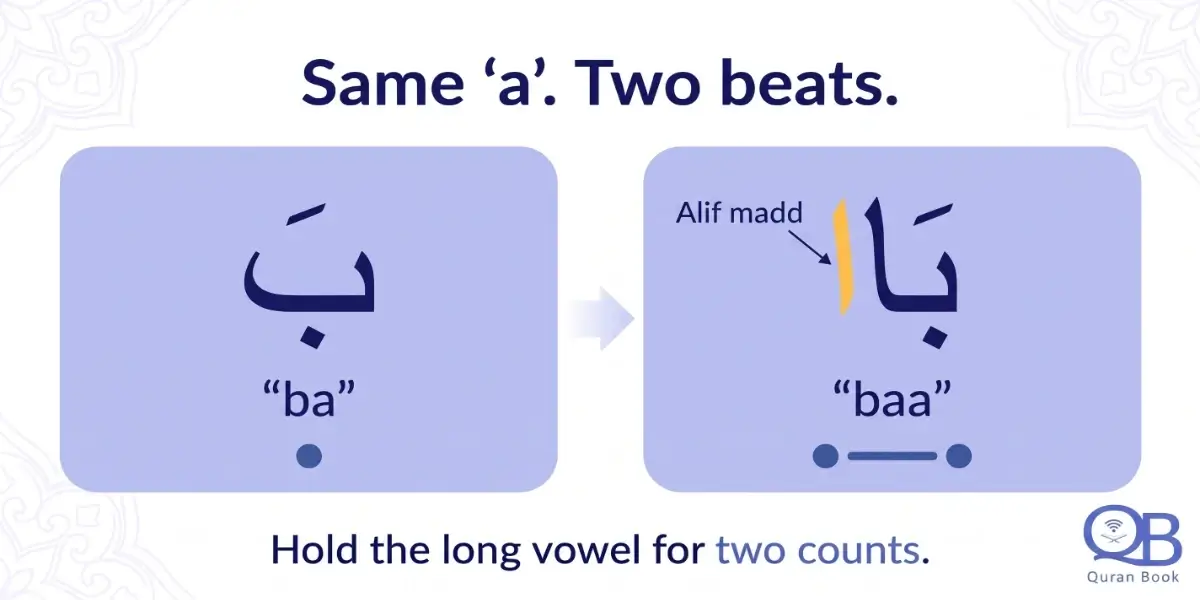
بَ بَا
ba → baa
You know بَ (ba). Put an alif after it, بَا, and hold the same “a” for two beats: “baa”. That’s alif madd. Tap ▶ above to hear both.
Alif madd opens the Arabic long vowels, and it simply stretches the fatha you already know. In this lesson you’ll learn alif madd on all 28 letters, the three mistakes to avoid, the small alif you’ll see in the Quran, and your first words. Then you’ll play a game. Every step comes with sound, so you can hear it before you say it.
What Is Alif Madd?
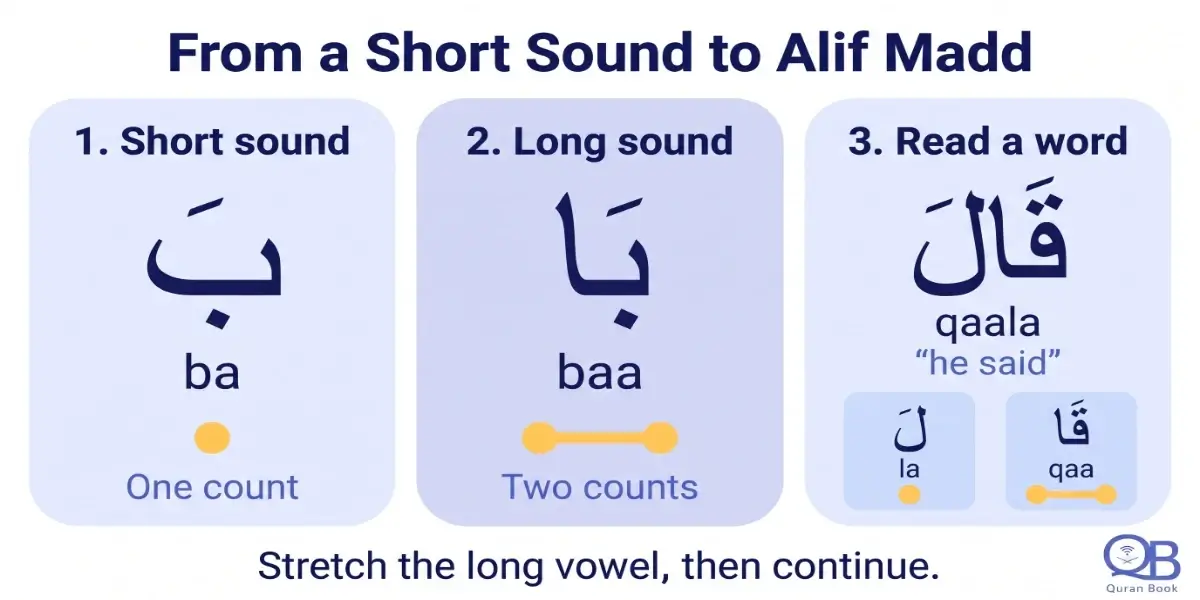
Alif madd is an alif (ا) with no vowel of its own, coming after a letter with fatha:
بَ + ا = بَا
The fatha stays on the letter before. The alif just stretches it.
People often say “alif with fatha”. The idea is close, but the fatha sits on the letter before the alif, never on the alif itself.
An alif at the very start of a word is never alif madd. That’s a hamza: أَ (ʾa), one beat.
Alif madd is the first of three long vowels. See all three in Arabic long vowels.
Alif Madd Pronunciation: Same “a”, Two Beats
Listen to each pair: short first, then long. Same letter, same “a”: only the length changes.
ba → baa
ma → maa
na → naa
Hold it, don’t change it
- Hold it. Two beats, about the time of two short vowels. Clap twice as you say it.
- Don’t change it. Keep the same open “a”: not “ay”, not a flat “æ”.
- Don’t break it. No catch between “ba” and “a”. The alif has no sound of its own.
Same “a”. Just longer.
In the Quran, some alifs are held longer when a madda sign (ـٓ) is written over them. That comes later, with the tajweed rules.
Light and Heavy Alif Madd
The alif follows the letter before it. After light letters it stays light: سَا (sā). After the heavy letters خ ص ض ط ظ غ ق, and after رَ, it is deep and full: صَا (ṣā). Either way, it’s still “aa”, never “o”. Listen to each pair: light first, then heavy.
light → heavy
light → heavy
Want to know why these letters sound fuller? Read about the heavy letters in Arabic.
The Small Alif in the Mushaf
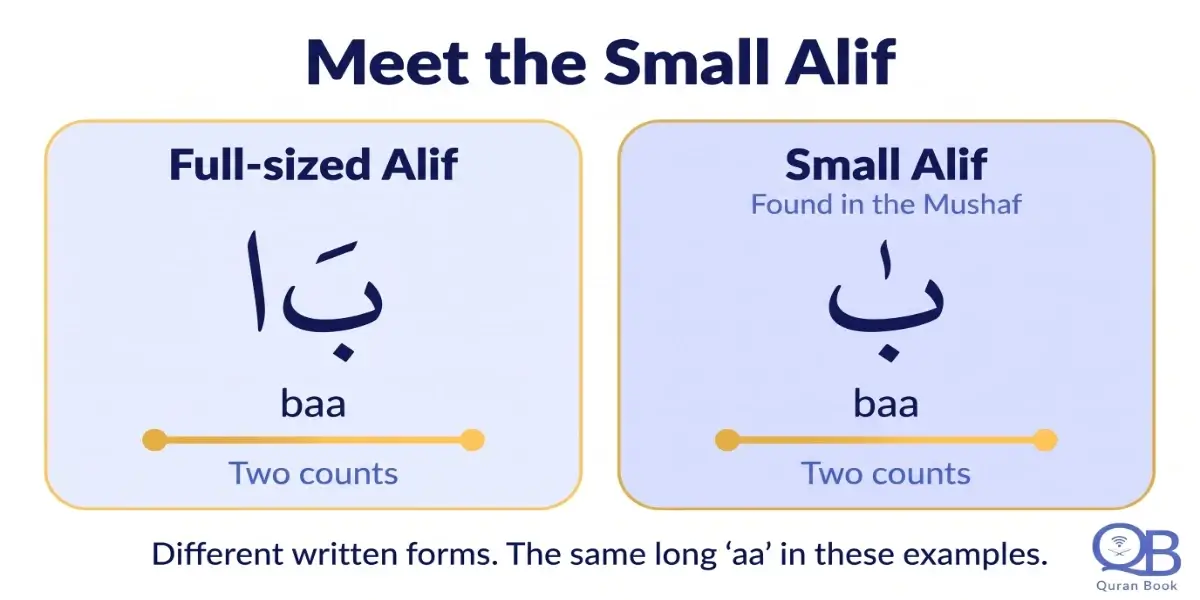
In the Madani Mushaf (the Uthmani script you see on quran.com), many alif madds are written as a small alif above the letter: ـٰ. Read it exactly the same, for two beats: مَٰلِكِ (māliki). It’s small, so it’s easy to miss.
You’ll also meet آ: a hamza and an alif madd written together, read ʾā (row 1 in the chart). And ى with a small alif (ىٰ, as in عَلَىٰ “on”) is read “aa” too.
Arabic Letters With Alif Madd: All 28 Letters
Here it is on every letter of the alphabet. Tap a syllable and listen for the same two beats every time. Gold marks the heavy letters, where the “aa” sounds deeper.
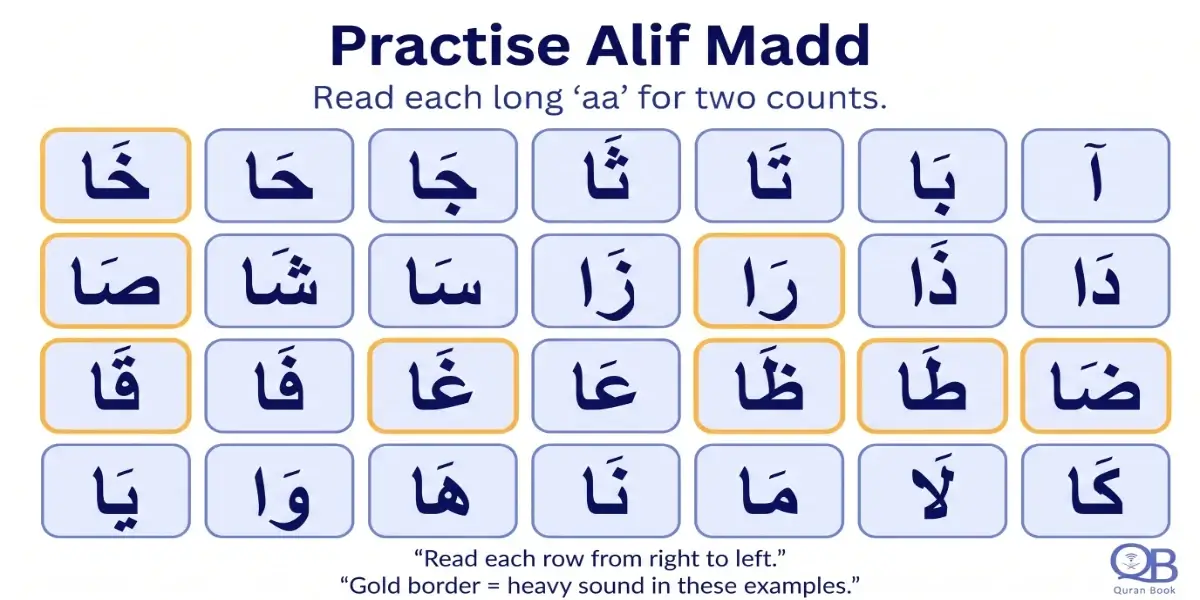
- Row 1: آ is a hamza and an alif madd written as one shape.
- Row 23: لَا is lām and alif joined. See Arabic letters beginning, middle & end.
Alif Madd Examples: Read It, Then Check
Read each level out loud first, then check yourself below. These alif madd examples use only what you know: fatha, alif and the letters.
- Level 1: one syllable. بَا · تَا · مَا · نَا
- Level 2: short, then long. بَ بَا · مَ مَا · سَ سَا · لَ لَا
- Level 3: six words. Each starts with a long syllable, then a short one: two beats, then one. نَا | مَ becomes نَامَ (nā-ma, “he slept”). See the split first, then read the joined word.
Go slowly. Clap twice on the long syllable and once on the short one: nā (clap, clap), ma (clap).
Alif Madd in the Quran
Now hear it in real recitation. Look at the word, then tap ▶ and listen for two clean beats. Both ayat also show the small alif, so look closely.
Look and listen
وَقَالَ ٱلْإِنسَـٰنُ مَا لَهَا
Az-Zalzalah 99:3
wa-qāla l-insānu mā lahā
“and humanity cries, ‘What is wrong with it?’—”
Look for: وَقَالَ (wa-qāla): a full alif after the heavy ق, deep and two beats. And ٱلْإِنسَـٰنُ (al-insānu): the small alif over س, sā, two beats.
Recited by Sheikh Mahmoud Khalil Al-Husary (murattal), riwayah Hafs ʿan ʿĀṣim. Audio: EveryAyah.com.
مَـٰلِكِ يَوْمِ ٱلدِّينِ
Al-Fātiḥah 1:4
māliki yawmi d-dīn
“Master of the Day of Judgment.”
Look for: مَـٰلِكِ (māliki): the small alif over م, mā, two beats.
Every word to look for sits in the middle of its ayah. At the end of an ayah the reciter stops, and the last sound changes.
Hearing two clean beats in Al-Husary’s recitation is easy. Holding every alif exactly that long, every time, is what a teacher listens for.
Book Your Free Trial LessonLearning as an adult? See how we teach you to learn Quran reading for adults.
Alif Madd Interactive Game
Can you hear one beat or two? Train your ear first, then stretch some balloons for fun.
More practice: the balloon stretch game
Tap a letter to stretch it to the alif, and build all 28 long syllables.
Alif Madd Examples for Kids
For parents: keep practice short and playful.
- Clap once for بَ and twice for بَا.
- Slide a finger along the alif while you hold the sound, like stretching a balloon.
- Read one row of the chart a day, in big print.
- Play “Short or long?” together and let your child shout “short!” or “long!”.
- Praise a steady two-beat “aa”, and stop while it’s still fun.
If your child uses the Noorani Qaida, this is the same alif madd lesson.
Try it with your child
Read these aloud together, then tap to check.
Want a teacher to guide your child? See our classes in Quran reading for beginners.
Free Alif Madd Worksheet PDF
Prefer paper? Print these two free printables. No sign-up: tap and save. Put the chart on the wall, and use the worksheet for a few calm minutes at a time.
Arabic Alphabet With Alif Madd Chart
All 28 letters with alif madd on one page.
Download the chart (PDF)Alif Madd Worksheet for Kids
Circle, clap and read: 4 pages of alif madd practice, plus an answer key.
Download the worksheet (PDF)Common Alif Madd Mistakes Beginners Make
These slips are easy for English speakers to make, because English changes a vowel when it makes it long (cat → cake). Check yourself:
Not holding it: بَا read “ba”.
Fix: two beats, “baa”.
Changing the sound: “bay” or a flat “bæ”.
Fix: the same open “a”, just longer.
Breaking it: “ba-a” with a catch.
Fix: one smooth stretch. The alif has no sound of its own.
Holding it for ages.
Fix: two beats. Longer holds come with a madda sign ـٓ, later.
Missing the small alif ـٰ in the Mushaf.
Fix: it’s alif madd too: مَٰلِكِ = māliki.
What to Learn After Alif Madd
Take your time with this lesson. When you can hold every syllable in the chart for two clean beats, you’re ready for the next lesson.
- Next lesson: waw madd, dammah + و, a long “uu”.
- Then: yaa madd, kasra + ي, a long “ii”.
- The big picture: see the full path to how to read Arabic.
Learn more
- Why some letters sound fuller: heavy letters in Arabic
- Want a free guided start? Learn Arabic reading free
Alif Madd FAQ
What is alif madd?
Alif madd is the letter alif (ا) coming after a letter with fatha. The alif has no vowel of its own: it stretches the fatha into a long “aa” held for two beats. So بَ (ba) becomes بَا (baa).
How do you pronounce alif madd?
Say the letter with its fatha and hold the “a” for two beats, with no break: بَا = baa, مَا = maa. Keep the same open “a”, don’t turn it into “ay”, and don’t add a catch in the middle.
How long is alif madd?
Two beats, about the time of two short vowels. In the Quran some alifs are held longer when a madda sign (ـٓ) is written over them; that is a tajweed rule you learn later.
What are some alif madd examples?
Syllables like بَا (baa), مَا (maa) and نَا (naa), and words like قَالَ (qāla, “he said”), نَامَ (nāma, “he slept”) and صَامَ (ṣāma, “he fasted”).
Does alif madd sound different after heavy letters?
Yes. The alif follows the letter before it. After heavy letters like ق, ص and خ, and after رَ, the long “aa” is deep and full: قَا, صَا. After light letters it stays light: بَا, سَا.
What is the small alif above letters in the Quran?
It is a small “dagger” alif (ـٰ) that the Mushaf writes above a letter instead of a full alif. Read it exactly like alif madd, for two beats: مَٰلِكِ is read māliki.
What is the difference between alif madd and آ?
آ is a hamza and an alif madd written together as one shape. Read it as a short catch in the throat followed by a long “aa”: ʾā.
How can kids practise alif madd?
Clap twice for a long “aa” and once for a short “a”, slide a finger along the alif while holding the sound, read one short row a day in big print, and play a short-or-long listening game together.
You can now hold alif madd on every letter
Two more long vowels to go. A teacher can make sure every one is the right length from your very first lesson. Until then, come back to the chart to warm up.
Book Your Free Trial LessonArabic Language Graduate · Hafidha of the Quran · Writer on Arabic Reading
Jehad Mahmoud is a graduate of the Arabic Language department and a Hafidha of the Quran who writes the Arabic and Quran-reading guides at Quran Book Academy.
She writes for English-speaking learners and parents starting from zero: the letters by sound, the vowel marks, and the step-by-step order that leads to reading the Quran directly from the Mushaf.
Her Arabic Language studies and her memorisation of the Quran are the foundation of this reading series.
These guides teach the reading system step by step. Pronunciation is a skill of the ear and the mouth, so it is best checked by a qualified teacher who can hear you read.
References
- Quran 99:3 (Az-Zalzalah), Uthmani text: quran.com/99/3
- Quran 1:4 (Al-Fātiḥah), Uthmani text: quran.com/1/4
- Recitation: Sheikh Mahmoud Khalil Al-Husary (murattal, Hafs ʿan ʿĀṣim), audio from EveryAyah.com
- Translations: The Clear Quran, Dr. Mustafa Khattab, via quran.com
- Encyclopaedia Britannica, “Arabic alphabet”
- Syllable and word recordings: Quran Book Academy