Adult Arabic course · One-to-one online lessons
Learn Arabic Skills for Adult Beginners
Learn Arabic skills for adult life, one step at a time. Our Arabic for adults online lessons help you read and write Arabic script, use everyday Arabic in simple conversations, and build vocabulary that supports your study of the Quran — with explanations in English and feedback from your teacher.
- Live one-to-one lessons
- Explanations in English
- Flexible scheduling
- Free trial lesson
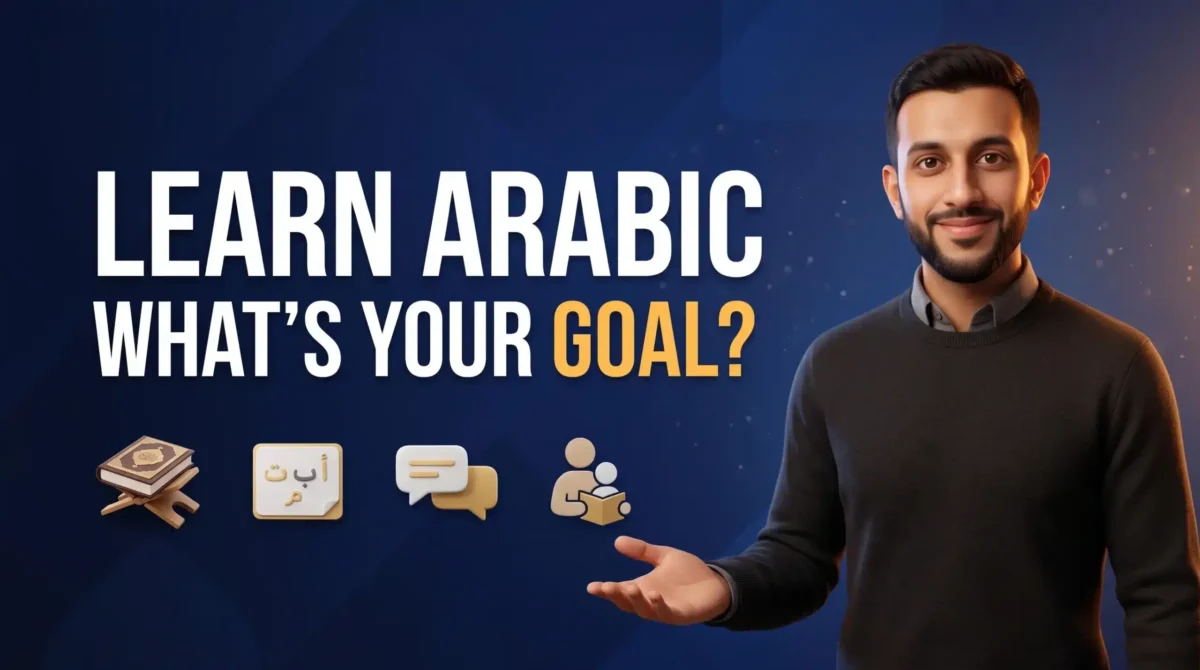
The video opens in a player on this page. Prefer a direct link? Open the video file.
What Do You Want to Learn Arabic For?
Most adults start with one main reason, and many have more than one. These are goals within the same one-to-one course, not separate packages. Tell your teacher which matters most to you, and lessons are planned around it.
Read & Write Arabic
Move from recognising letters to reading words and sentences, and writing them yourself.
- Read words with vowel marks, then short sentences
- Read a du’a card, a book cover or a simple sign
- Write your name and spell everyday words
Use Arabic in Everyday Conversations
Practise the language you would actually use, starting with short, useful exchanges.
- Greet people and introduce yourself
- Talk about family, work, food and your day
- Ask and answer simple questions in role-plays
Build Your Understanding of Quranic Arabic
If you were looking for a Quranic Arabic course, this goal lets Quran-related vocabulary and sentence patterns take a central place in your lessons.
- Recognise frequent words such as رَبّ, رَحْمَة and كِتَاب
- Notice word roots and repeated patterns
- Follow the structure of short phrases you already recite

Language study helps you recognise words and follow how sentences are built. It supports your understanding, but it does not replace tafsir or qualified scholarship, and it does not by itself qualify anyone to interpret the Quran.
Is This Course Right for You?
Adult learners arrive with very different starting points. Here is how one-to-one lessons respond to some common situations.
- You’re starting from the alphabet. Letters are introduced in small groups by sound and shape, and linked to real words straight away, so you begin reading short words early instead of memorising a chart.
- You recognise letters but struggle to read words. Lessons focus on vowel marks and how letters join, with reading aloud syllable by syllable while your teacher corrects you in the moment.
- You know some vocabulary but can’t form sentences. You practise a few sentence patterns at a time — “this is…”, “I have…”, “I want…” — and use them in guided speaking until they feel natural.
- You read Quranic Arabic without understanding familiar words. Your teacher helps you spot frequently repeated words and roots in passages you already know, and you build a personal word list from them.
- You need guided practice around work and family. Lesson times are arranged with you, and practice between lessons is short and specific rather than long homework.
See Learning in Action
These five short animations each introduce one Arabic letter. They were originally made for younger learners, so the style is playful, but they are a quick, clear way to revise a letter’s sound and shape as an adult beginner. They are not recordings of adult lessons.
Swipe or use the arrows. Each video loads only when you press play.


More short videos are on the Quran Book Online YouTube channel.
Learn Arabic Skills for Adult Beginners: What You’ll Cover
Lessons cover the Arabic language for beginners in manageable pieces. How much time you spend on each area depends on your goals and starting point — this describes the ground covered, not a fixed curriculum or schedule.
Letters, sounds & connected forms
Arabic is written from right to left, and most letters join to their neighbours, changing shape as they do. A few letters, such as ا, د, ر and و, never join to the letter after them. You’ll also practise sounds English doesn’t have, such as ع and ح.
Reading words & short sentences
Using vowel marks such as fatḥa, kasra, ḍamma, sukūn and shadda to read words accurately, then moving on to short sentences read aloud.
Writing & spelling
Copying and then writing words yourself, including common points of confusion such as ة and ه at the end of a word.
Listening & everyday vocabulary
Understanding useful words and phrases by ear — greetings, numbers, family, food, time and work.
Speaking & simple daily conversations
Short, practical exchanges and role-plays, with your teacher guiding pronunciation and helping you say more each time.
Basic sentence structure & grammar
Sentences such as هَذِهِ سَيَّارَةٌ (This is a car), masculine and feminine words, pronouns and common verbs — introduced when you need them, with explanations in English.
Quran-related vocabulary
If understanding the Quran is one of your goals, lessons can include frequent Quranic words, roots and patterns chosen to suit your level.
Arabic language lessons and Tajweed are different subjects. This course develops listening, reading, writing and speaking. Tajweed is the specialist study of the rules for reciting the Quran correctly, such as where each letter is pronounced and how long sounds are held. If recitation is your main goal, see our Tajweed course for adults.
Try Arabic: Listen, Read, Write & Speak
These four short activities use the same three beginner words, so you meet each word by listening, reading, writing and speaking. There is no timer, and you can try as many times as you like.
- سَيَّارَة car
- كُرَة ball
- تُفَّاحَة apple
Please note: these are sample practice activities, not a placement assessment or a certificate. Your answers are not saved or sent anywhere. When no teacher recording is available, audio is generated by your device’s Arabic voice, and the activity labels it as device-generated.
Listen & Choose
Play the Arabic word, then choose the picture that matches it. You can replay the word as often as you like.
This activity needs JavaScript enabled in your browser.
Read & Match
Read the Arabic sentence, then choose the picture it describes. Audio help is available if you want it.
This activity needs JavaScript enabled in your browser.
Complete & Write
First fill in a missing letter, then type a whole word. Use the on-screen Arabic letter buttons or an Arabic keyboard, then press Check. This is supported spelling practice, not a handwriting assessment — copying the words on paper is good practice too.
This activity needs JavaScript enabled in your browser.
Look & Say
Look at the picture, listen to the model sentence, then say it aloud. Recording yourself is optional: the recording stays in this browser tab, is never uploaded, and is deleted when you leave the page or start again. There is no automatic pronunciation scoring.
This activity needs JavaScript enabled in your browser.
Your practice summary
- Listen & Choose 0 of 3
- Read & Match 0 of 3
- Complete & Write 0 of 3
- Look & Say 0 of 3
You’ve completed the sample practice.
These were sample activities only — they don’t measure your level and don’t lead to a certificate. A teacher can talk through your goals and starting point with you in a free trial.
Book Your Free TrialReady to Practise With a Teacher?
Activities like these are a starting point. In one-to-one lessons, a teacher listens to you, corrects you as you go and adjusts the next step. A free trial is a chance to discuss your goals and see how lessons work.
Book Your Free TrialHow Your Adult Arabic Lessons Work
Every lesson is live and one-to-one, so it follows your pace. The exact mix changes from lesson to lesson, but a typical lesson has a shape like this:
- A brief reviewA quick check of what you covered last time, so new material builds on something solid.
- One small new language pointA new letter group, a sentence pattern or a set of useful words — kept small enough to use straight away.
- Guided practiceListening, reading, writing or conversation practice with the new point, chosen to match your goals.
- Teacher feedbackCorrections and explanations in English while you practise, so mistakes are fixed before they become habits.
- Manageable practice between lessonsA short task to keep the material fresh until your next lesson.
What this means for you
Explanations you can follow
Grammar and new ideas are explained in English, so you always know why something works the way it does.
Lessons shaped by your goals
Reading, conversation and Quran-related vocabulary are weighted according to what you want from Arabic.
Times that fit your week
Lesson times are arranged with you, which helps if you balance work and family. Female teachers are available if you prefer.
Practice and progress in one place
Between lessons, your practice tasks are set through our online learning platform, and your teacher keeps track of your progress so each lesson can build on the last.

You can read more about how we approach teaching, or see how classes work from booking to your first lesson.
Your Learning Path & Between-Lesson Practice
This is an illustrative path, not a fixed programme or timetable. Your starting point, how often you have lessons and how much you practise all affect how quickly you move through it.
- Establish foundationsLetters, sounds, vowel marks and reading your first words.
- Use words and short sentencesReading, writing and saying short sentences with familiar vocabulary.
- Develop reading and everyday communicationReading more smoothly and holding simple conversations on familiar topics.
- Continue towards your own goalsMore conversation, wider reading or Quran-related vocabulary — depending on what you want from Arabic.
Example: a 15-minute practice routine
Short, regular practice is easier to keep up than occasional long sessions. Here is one optional way to use 15 minutes on a day without a lesson. Example only
| Activity | Time |
|---|---|
| Review the words or letters from your last lesson | 5 min |
| Read your lesson text or sentences aloud | 5 min |
| Listen to a short recording and repeat, or write a few words | 5 min |
| Total | 15 min |
This is a suggestion, not a requirement or a promise of results. Your teacher can suggest practice that suits your schedule.
Frequently Asked Questions
Yes. Many adults start from the alphabet. Your first lessons focus on letters, sounds and vowel marks, and you begin reading simple words early on.
There is no age limit for starting. Adults often bring clear goals and good study habits, which help. Progress varies from person to person, and regular practice usually matters more than age. Our article Is Arabic hard to learn? looks at common challenges.
Yes. Everyday conversation is one of the course’s three learning goals, alongside reading and writing and Quran-related Arabic. Arabic has a standard written form and many spoken dialects, so if you want Arabic for a particular purpose — for example, talking with relatives from a specific country — mention it in your free trial and ask what fits your goal.
Yes. Many adults want to learn Arabic for Quran study, and lessons can centre on frequent Quranic vocabulary, roots and sentence patterns. Understanding grows gradually. Language study helps you recognise words and structures, but it does not replace tafsir or qualified scholarship.
Arabic language learning is about meaning and use: reading, writing, listening and speaking. Tajweed is the set of rules for reciting the Quran correctly, such as where letters are pronounced and how long sounds are held. They complement each other but are taught separately — see our Tajweed course for adults or Quran reading for beginners.
Lesson times are arranged with you, and practice between lessons is kept short. If your schedule changes, talk to the academy about adjusting your lesson times.
There is no fixed timeline. It depends on your starting point, how often you have lessons, how much you practise and what you want to achieve. Your teacher can review your progress with you as you go.
You meet a teacher online, talk about your goals and any Arabic you already know, and get a feel for how a one-to-one lesson works. It’s also a good time to ask questions about scheduling. You can book through our free trial page.
No. They are sample practice activities that give you a taste of listening, reading, writing and speaking. They don’t measure your level, save your answers or lead to a certificate.
Start Your Adult Arabic Lessons
Whether you want to read and write Arabic, hold simple conversations or understand more of the Quran’s vocabulary, a free trial is an easy way to meet a teacher and see whether one-to-one lessons suit you.
Book Your Free TrialHave a question first? Message us on WhatsApp.