
Is Arabic hard to learn? Honestly, yes — Arabic sits in the U.S. Foreign Service Institute’s hardest category for English speakers, with roughly 2,200 class hours needed to reach professional fluency. That number is real. It’s also, for most people asking this question, the wrong number.
If your goal is fluent conversation in Modern Standard Arabic, is Arabic a hard language to learn? Absolutely — plan for years, not months. But if your goal is reading the Quran, you’re solving a much smaller problem. Quranic Arabic is fully vocalized, draws on a limited set of repeating root words, and most beginners read their very first word within a single sitting.
⚡ This article won’t sugarcoat the hard parts. It will also show you, in about ninety seconds, that you can already do more than you think.
So, Is Arabic a Hard Language to Learn? The Short Answer
The short answer is yes — but the number everyone quotes measures something most readers of this page aren’t actually trying to do.
The U.S. Foreign Service Institute places Arabic in its hardest classification for native English speakers, on the same tier as Mandarin and Japanese, and estimates around 2,200 class hours to reach full professional working proficiency — reading newspapers, negotiating contracts, following breaking news in real time. That’s a diplomat’s goal, spoken natively by hundreds of millions of people worldwide, and it’s genuinely difficult.
But “learning Arabic” isn’t one skill. It’s at least three, and they don’t take anywhere near the same amount of time:
Reading the script
Recognizing the 28 letters and sounding out vocalized text. Days to weeks.
Reciting the Quran with correct Tajweed
Pronouncing every letter and rule correctly. Roughly a year or two with a teacher.
Speaking fluent conversational Arabic
Building vocabulary, grammar, and real-time listening. Years.
Here’s the part almost nobody tells you: the script — the part that looks most intimidating on the page, all those unfamiliar curves and dots — is actually the easiest of the three. It’s a fixed, learnable alphabet with genuinely consistent phonetic rules, and most learners are sounding out real words within their first week.
This article isn’t going to pretend Arabic is easy. Some parts of it are genuinely hard, and we’ll walk through those honestly next. But “hard” and “impossible to start today” are two very different things — and by the end of this page, you’ll have proven that to yourself.
4 Things That Are Genuinely Hard About Arabic (No Sugarcoating)
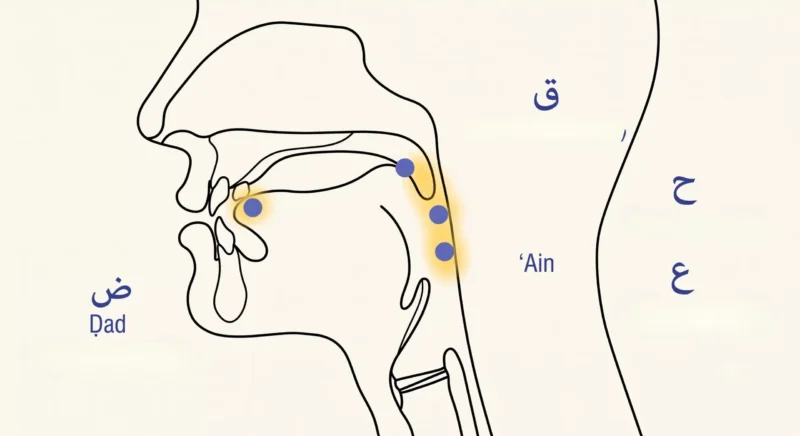
The sounds English doesn’t have
Arabic has a handful of sounds — ع (ayn), ح (haa), ق (qaf), ض (daad) — that simply don’t exist in English. They’re produced deep in the mouth and throat, and adult mouths that have never made these sounds find them physically awkward at first. This isn’t a sign you’re bad at languages. It’s a muscle you haven’t built yet, and like any muscle, it responds to repetition — and, critically, to a teacher who can hear the difference between “close” and “correct” and tell you which one you just made.
The root system takes a mental shift
Most Arabic words are built from a three-letter root that carries a core meaning, reshaped by patterns and added letters into dozens of related words. The first time you meet this system, it feels backwards — English doesn’t work this way, and your brain has to build a new filing cabinet for how vocabulary is organized. Give it a few weeks, though, and the same system that felt confusing becomes a shortcut: learn one root, and you can often guess the meaning of several words you’ve never seen before.
Vowels aren’t always written
Standard Arabic text — newspapers, novels, street signs — is usually printed without the short vowel marks (harakat) that tell you exactly how to pronounce a word. Skilled readers infer them from context. For a beginner, that’s a genuine obstacle. Here’s the exception that matters most for this article: the Quran is printed fully vocalized, every harakah in place. You’re learning to read the one version of Arabic text that doesn’t ask you to guess.
There’s no shortcut, and anyone selling one is lying
⚠️ No app, method, or “21-day fluency” course changes the amount of exposure your brain needs to internalize a new sound system and a new script. What actually moves the needle is unglamorous: short, consistent daily practice, corrected early by someone who can hear your mistakes. Consistency beats intensity — thirty focused minutes a day will take you further than one three-hour weekend cram session, because these sounds and letters need to become automatic, not just familiar.
5 Reasons Arabic Is Easier Than You’ve Been Told
None of that is the whole story. Arabic also has real, structural advantages that rarely make it into “hardest languages” listicles — and several of them work specifically in your favor if your goal is reading the Quran.
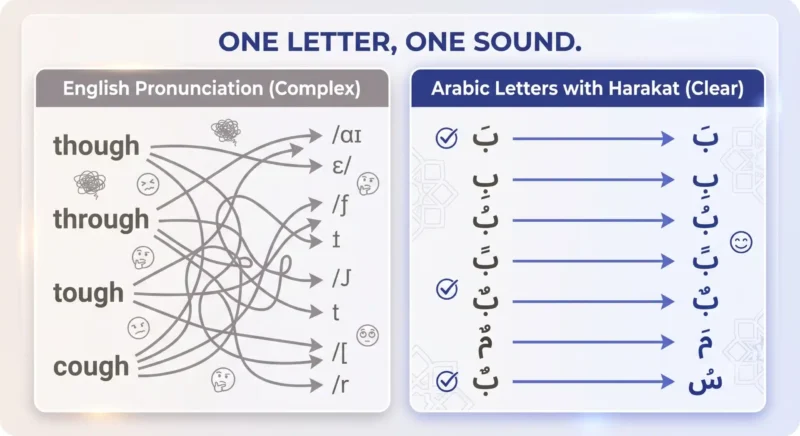
1. Only 28 letters, and they’re phonetically consistent.
Once you learn a letter’s sound, that letter makes that sound every time. There’s no equivalent of English’s “read” (present tense) versus “read” (past tense) — same spelling, different sound, no warning.
2. No silent letters, no spelling chaos.
English asks you to memorize why “through,” “though,” and “tough” don’t rhyme. Arabic doesn’t have that problem. If you can sound out the letters, you can pronounce the word — every time.
3. No verb “to be” in the present tense.
“The book is beautiful” is simply “the book beautiful” (الكتاب جميل) in Arabic. One less grammatical layer to manage while you’re still finding your footing.
4. Quranic vocabulary repeats.
This is the one that matters most for you specifically. The Quran draws heavily on a limited set of repeating roots, and by some counts Arabic’s root-and-pattern system — around 500 of its most frequent words account for over 80% of the entire text, roughly 63,000 of its 77,000 words. Our Quranic Arabic classes are built entirely around learning those roots first, so vocabulary starts compounding instead of piling up one flashcard at a time.
5. You already have your “why.”
Most language learners study without a clear personal reason, and that’s exactly what makes most people quit. You’re not learning Arabic to pass a class or impress anyone at a dinner party — you’re learning it to understand words you already say five times a day. That motivation is worth more than any app or method.
How Long Does It Take to Learn Arabic? A Realistic Timeline
It depends entirely on which of the three goals from earlier you’re chasing — and how consistently you show up. Here’s a realistic breakdown, based on roughly 30 minutes of focused daily practice:
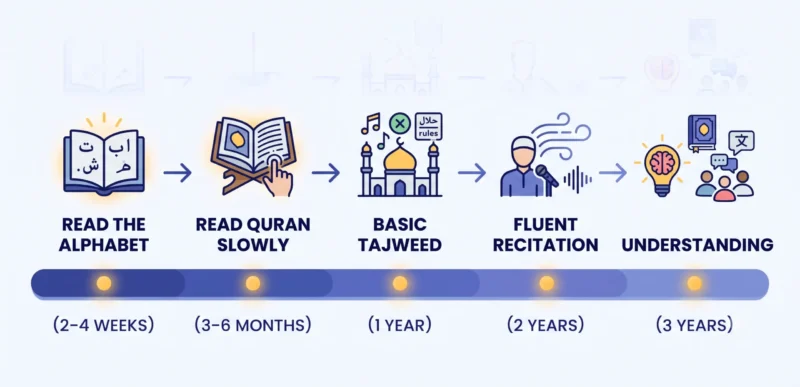
Why such wide ranges? Three factors do almost all of the work: daily consistency (thirty minutes every day beats three hours once a week, every time), regular feedback from a teacher who can correct pronunciation you can’t hear in your own voice, and how much passive exposure to Arabic you already have from salah, family, or community.
⚠️ One honest caveat, since this page promised no sugarcoating: the learners who plateau and quietly give up are almost always the ones who skipped the teacher stage — they taught themselves the alphabet from an app, hit the wall where self-correction stops working (usually around the throat letters or Tajweed rules), and stalled without realizing why. A teacher isn’t a luxury add-on to self-study. It’s the difference between three months and three years stuck at the same level.
Read Your First Arabic Word Right Now — Free Interactive Game
Everything above is theory. This next part takes ninety seconds and settles the question for good: below is the same harakat game our students use in their first lesson. Play one round and you’ll read a real Arabic word — no account, no download, no payment.
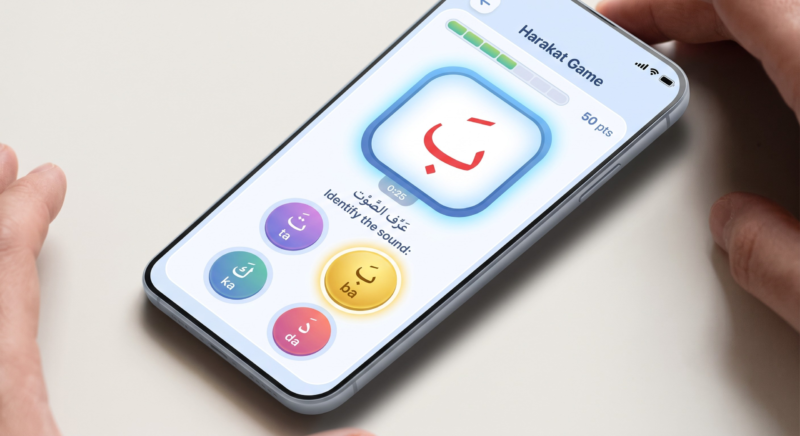
Works on phone, tablet, and desktop. Your progress saves automatically. · Open it in a new tab
If you managed that, you’ve just done the thing most people are afraid of. The full library of free interactive Arabic games — Arabic letters, harakat, and every Tajweed rule — is right here, with real recitation audio from Sheikh Mahmoud Khalil Al-Husary and progress that saves automatically.
The Best Way to Learn Arabic (What Actually Works)
Put the four hard truths and the five genuine advantages together, and a clear method falls out. Here’s what actually separates students who keep going from students who quietly stop.
Start with the script, not vocabulary
Most self-taught beginners open a vocabulary app on day one and start memorizing words — then wonder why nothing sticks. It’s backwards. Learn the alphabet and the harakat system first, fully, before you try to memorize a single word. Our Noorani Qaida course follows exactly this order for a reason — once reading is automatic, every word you learn afterward reinforces the system instead of fighting it.
Get feedback on your pronunciation from day one
This is the single biggest gap between people who succeed and people who quit. You cannot hear your own ع or ح clearly enough to self-correct — your ear hasn’t been trained on the distinction yet, and neither has any app’s speech recognition, not reliably. This is exactly where apps fail and a live teacher wins: someone listening in real time, telling you “closer” or “that’s it” until your mouth learns the difference. It’s the core of every Arabic language course we run.
Short daily sessions beat weekend marathons
This is spaced repetition in plain terms: your brain consolidates new sounds and letters during the gaps between practice sessions, not during the session itself. Fifteen focused minutes today, tomorrow, and the day after will outperform a two-hour session once a week, because you’re giving your brain more chances to lock in what it just learned.
Make the early wins visible
Motivation runs out fast when progress feels invisible. Track what’s actually been mastered — which letters, which harakat, which Tajweed rules — so small wins stay visible instead of disappearing into “I’ve been studying for a while, I guess.” It’s why our students’ parents get a clear report showing precisely which rules their child has mastered — progress you can see, not just a vague sense that lessons are happening.
Is It Difficult to Learn Arabic as an Adult?

The honest answer is: less difficult than you’re afraid it is, and for a reason that has nothing to do with grammar.
Adults generally pick up grammatical structure and pattern recognition faster than children do — decades of pattern-matching experience that a seven-year-old simply doesn’t have yet. Children only reliably outperform adults in one area: accent. And if your goal is reading the Quran accurately, accent takes a back seat to correct pronunciation of the letters and rules — something adults learn perfectly well with the right teacher.
The real obstacle almost never shows up on a syllabus. It’s psychological: the fear of mispronouncing ع in front of another adult, of sounding foolish reciting something you feel you should already know. That fear is completely normal, and it’s also the single biggest reason capable adults quit before they’ve really started.
This is why how you’re taught matters as much as what you’re taught. Our teachers are trained to build a student’s confidence before they correct anything — and sisters who’d prefer a female Arabic teacher have that option throughout the academy. You don’t have to take our word for it, either: a free trial lesson lets you feel the difference for yourself, with zero pressure to continue if it isn’t the right fit.
Your Next Step
Here’s the honest answer to the question you came here with: yes, Arabic is hard — and no, that doesn’t mean it’s not for you. The part everyone fears most, the script, is the easiest part and takes days, not years. The part that takes real time — fluent, confident recitation, and eventually an Ijazah if that’s the road you want — happens the same way anything worth doing happens: in small, consistent steps, with someone experienced correcting you along the way.
From here, you’ve got two honest paths, and neither one is wrong. Keep playing with the free games and come back when you’re ready. Or book a free trial lesson and find out, in twenty-five minutes, what a teacher who’s done this a thousand times can already see in you.
Frequently Asked Questions
Hafidha of the Quran · Arabic Language Graduate · Writer on Islamic Sciences
Jehad Mahmoud is a graduate of the Arabic Language department and a Hafidha of the Quran who writes the Islamic educational content at Quran Book Academy.
She focuses on making the Arabic language and Quranic recitation approachable for complete beginners, drawing on her own experience teaching non-native speakers to read the Quran with confidence.
References & Sources
1. U.S. Department of State — Foreign Service Institute, Foreign Language Training — state.gov
2. The Cambridge Handbook of Arabic Linguistics — Arabic Morphology — cambridge.org
3. Ethnologue — Arabic (macrolanguage) — ethnologue.com
© 2026 Quran Book Academy. All rights reserved.
Book Your Free Trial · Empowering Muslims Worldwide to Connect with the Quran