
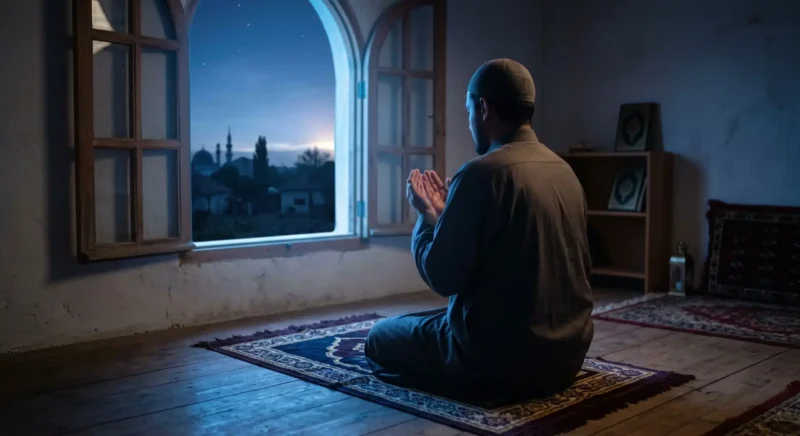

Istikhara Dua in English: The Complete 7-Step Guide (No Dream Needed)
Arabic · Transliteration · English · Step-by-step method
The Istikhara dua is the supplication the Prophet Muhammad ﷺ taught for the moment you are standing in front of a decision and cannot tell which way is better.
If you are facing a difficult choice right now — a marriage proposal, a job, a move, a course of study — this is the prayer taught for exactly that moment.
You do not need to be a scholar, and you do not need perfect Arabic.
You also do not need to see a dream. To pray Istikhara you need two rak’ahs and the istikhara dua below.
The Istikhara Dua — Arabic, Transliteration & English
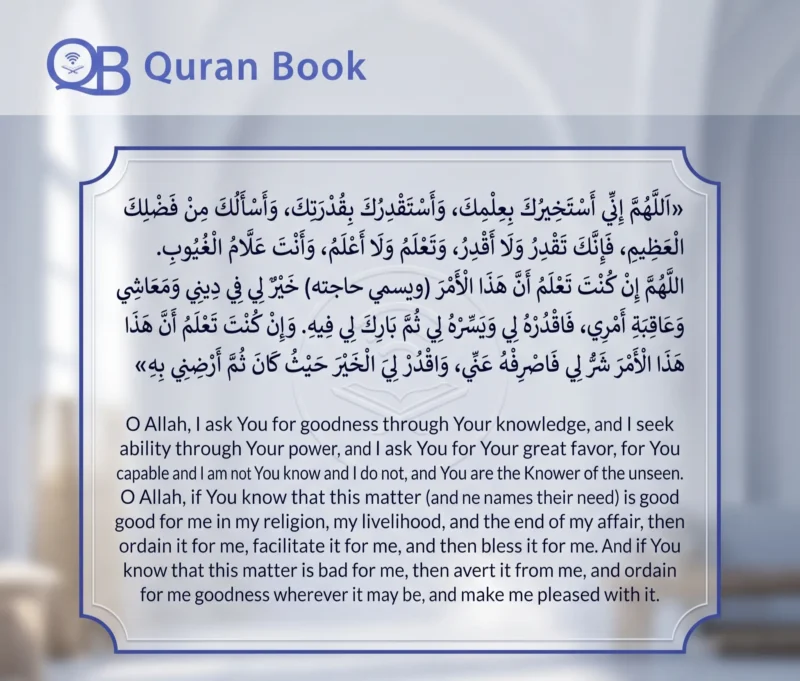
اللَّهُمَّ إِنِّي أَسْتَخِيرُكَ بِعِلْمِكَ، وَأَسْتَقْدِرُكَ بِقُدْرَتِكَ، وَأَسْأَلُكَ مِنْ فَضْلِكَ الْعَظِيمِ
فَإِنَّكَ تَقْدِرُ وَلَا أَقْدِرُ، وَتَعْلَمُ وَلَا أَعْلَمُ، وَأَنْتَ عَلَّامُ الْغُيُوبِ
اللَّهُمَّ إِنْ كُنْتَ تَعْلَمُ أَنَّ هَذَا الْأَمْرَ خَيْرٌ لِي فِي دِينِي وَمَعَاشِي وَعَاقِبَةِ أَمْرِي، فَاقْدُرْهُ لِي وَيَسِّرْهُ لِي ثُمَّ بَارِكْ لِي فِيهِ
وَإِنْ كُنْتَ تَعْلَمُ أَنَّ هَذَا الْأَمْرَ شَرٌّ لِي فِي دِينِي وَمَعَاشِي وَعَاقِبَةِ أَمْرِي، فَاصْرِفْهُ عَنِّي وَاصْرِفْنِي عَنْهُ، وَاقْدُرْ لِيَ الْخَيْرَ حَيْثُ كَانَ ثُمَّ أَرْضِنِي بِهِ
Allahumma inni astakhiruka bi-‘ilmika, wa astaqdiruka bi-qudratika, wa as’aluka min fadlika-l-‘azim.
Fa-innaka taqdiru wa la aqdir, wa ta’lamu wa la a’lam, wa anta ‘allamu-l-ghuyub.
Allahumma in kunta ta’lamu anna hadha-l-amra khayrun li fi dini wa ma’ashi wa ‘aqibati amri — faqdurhu li wa yassirhu li thumma barik li fih.
Wa in kunta ta’lamu anna hadha-l-amra sharrun li fi dini wa ma’ashi wa ‘aqibati amri — fasrifhu ‘anni wasrifni ‘anhu, waqdur liya-l-khayra haythu kan thumma ardini bih.
O Allah, I seek Your guidance through Your knowledge, and I seek strength through Your power, and I ask You from Your immense bounty.
For You are able and I am not, You know and I do not, and You are the Knower of all that is hidden.
O Allah, if You know that this matter is good for me in my religion, my livelihood and the outcome of my affairs — then decree it for me, make it easy for me, and bless me in it.
And if You know that this matter is harmful for me — then turn it away from me and turn me away from it, and decree for me what is good wherever it may be, then make me content with it.
Narrated by Jabir ibn Abdullah (RA) — Sahih al-Bukhari 1166
💡 When you reach hadha-l-amr (“this matter”), that is where you mention your actual decision — by name, aloud or in your heart.
On This Page
What Is Salatul Istikhara? A Prayer for Decisions
Salatul Istikhara is two voluntary rak’ahs followed by a specific supplication, in which you ask Allah to choose for you the better of two options. Linguistically, istikhara means to seek what is good.
It is not a mysterious ritual. It has no secret conditions, and it requires no special place or hour.
It is an ordinary voluntary prayer with an extraordinary purpose — handing a decision you cannot see the end of to the One who can.
The istikhara dua comes to us through Jabir ibn Abdullah (RA). He reported that the Prophet ﷺ used to teach the Companions Istikhara for all their affairs, in the same way he taught them a surah of the Quran.
That comparison is worth pausing on. It tells you how central this prayer was meant to be in an ordinary Muslim life — not reserved for once-in-a-decade crises.
You will see the name written in several ways online: istikhara, istikhaarah, salatul istikhara, salat al-istikhara. These are all transliterations of the same Arabic word, and they refer to exactly the same prayer and the same istikhara dua.
When Should You Pray Istikhara?
Pray Istikhara for any permissible decision where you are genuinely undecided — marriage, work, housing, travel, study. It is not prayed over something forbidden, and not over an obligation you already know you must fulfil.
- Any permissible choice: accepting a proposal, changing jobs, buying a home, emigrating, choosing a degree.
- Not for the forbidden: there is nothing to seek guidance about in something already ruled out.
- Not for the obligatory: you do not pray Istikhara about whether to pray Fajr.
- Any time except the disliked times for voluntary prayer; the last third of the night is excellent, but it is not a condition.
And there is no minimum size for a decision. If something small is genuinely weighing on you, it is worth two rak’ahs.
Nothing you bring to Allah is too trivial to bring, and no choice is too ordinary for the istikhara dua.
How to Pray Istikhara: Step by Step
Make wudu, intend Istikhara, pray two voluntary rak’ahs with al-Fatihah and a short surah in each, give salam, raise your hands, recite the Istikhara dua, and name your decision at “hadha-l-amr.”
- 1 Make wudu. Perform ablution as you would for any prayer.
- 2 Make the intention. Intend in your heart two voluntary rak’ahs for Istikhara. Nothing needs to be said aloud.
- 3 Pray two rak’ahs. Recite Surah al-Fatihah followed by any short surah you know in each rak’ah.
- 4 Give the salam. Complete the prayer as normal before beginning the supplication.
- 5 Raise your hands and praise Allah. Begin with praise of Allah and salutations upon the Prophet ﷺ.
- 6 Recite the Istikhara dua. Read it from a page or your phone if you have not memorised it — that is completely acceptable.
- 7 Name your decision at “hadha-l-amr.” This is the phrase meaning “this matter” — say your actual choice there, in Arabic or your own language, aloud or silently.
Step 7 is where most people get confused. The istikhara dua contains a deliberate blank space, and your decision goes in it.
“This matter” is not a vague reference to life in general — it is this proposal, this job offer, this city. Naming it plainly is what ties the dua for istikhara to the choice in front of you.
What Happens After Istikhara? (The Truth About Dreams)
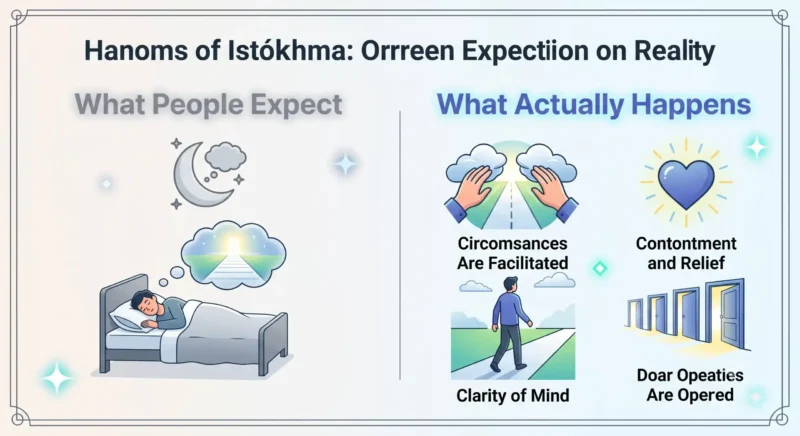
The hadith that teaches Istikhara does not mention dreams at all. The answer usually comes through circumstances — a path becoming easier or harder, doors opening or closing, and the heart gradually settling toward one option.
Many people wait for a dream after praying Istikhara, and feel the prayer “did not work” when no dream comes.
This expectation is understandable, and it comes from a sincere place. But it is not part of the narration — not in the wording of the istikhara dua reported by Jabir ibn Abdullah (RA), and not in any authentic version of it.
What the istikhara dua actually asks for is written into its own words: decree it for me, make it easy for me, and bless me in it. That is the answer, and it arrives as facilitation.
The paperwork goes through smoothly, or it stalls. The person becomes more available, or quietly disappears. An obstacle you dreaded turns out to be nothing, or something small becomes strangely immovable.
Over days, one option simply starts to feel lighter than the other.
The istikhara dua is also not a replacement for research and consultation. It sits alongside them.
You still ask people who know, still check the facts, still think it through. Then you ask Allah to steer the outcome of all that effort toward what is good for you.
And if you feel nothing at all? That is not a failure, and it is not silence. It simply means the next step is yours.
Weigh what you know, choose the option that seems soundest, and move forward trusting that Allah has already been asked to turn you away from harm.
Feeling uncertain and choosing anyway is not a lack of faith — it is what tawakkul looks like in practice.
🌙 If you did see a dream: it is a personal experience, and it may be a comfort. But it is not religious evidence, and a decision should not rest on it alone.
Memorize the Istikhara Dua Line by Line (Free Interactive Tool)
The istikhara dua is longer than most, which is exactly why memorising it in one block rarely works.
Split into six short phrases, each repeated until it is comfortable, it becomes very manageable.
And once the dua for istikhara is in your memory, it stays with you for the rest of your life — available at any hour, without a screen.
Phrase-by-Phrase Player
Six chunks · two speeds (learning & natural) · recited by our Al-Azhar certified teachers · your progress is saved automatically.
<!– PLACEHOLDER: أداة الحفظ التفاعلية –>
Most people will open this page on a phone in the middle of a hard week. That is fine — start there. And when you are done here, you can learn Dua Qunoot with the same tool.
Getting the Pronunciation Right
The istikhara dua is dense with the letters English speakers find hardest.
Astakhiruka has the خ. Bi-qudratika and taqdiru have the ق, which is not the English “k”. Al-ghuyub has the غ.
And ‘ilmika, ‘aqibati and ‘anhu all open with the ع — a sound with no English equivalent at all. Getting these right is not perfectionism; several of them change meaning when swapped.
You can memorise the istikhara dua entirely on your own — genuinely, you can.
What you cannot do alone is correct your pronunciation, because you do not hear your own mistakes. Your ear normalises whatever your mouth produces. That is the one part of this that needs another person.
If you want to understand why these letters behave the way they do, start with the Tajweed rules behind these letters. You can also try a free interactive Tajweed lesson right now, with no sign-up.
A teacher can hear what you can’t
Read the dua once to a certified teacher and find out in thirty seconds which letters need work.
Book a free trial lesson with a certified teacherCommon Mistakes and Misconceptions
Waiting for a dream as the answer
The most widespread misunderstanding, and the reason many people feel their istikhara dua went unanswered. The answer comes through ease and circumstance.
Believing it must be prayed seven times
No fixed number is prescribed in the authentic sunnah. Repeat the dua for istikhara as long as you remain genuinely uncertain — seven is a cultural habit, not a condition.
Refusing to decide until a “sign” appears
Nothing forbids you from acting after Istikhara. Delaying indefinitely while waiting for certainty is often the more harmful choice.
Using Istikhara instead of consultation
Istishara (seeking advice) and Istikhara belong together. Ask knowledgeable people, gather the facts, then pray.
Praying Istikhara over something forbidden
The istikhara dua is for choosing between permissible options. Where the ruling is already clear, there is nothing left to seek.
Asking someone else to pray it on your behalf
This is a common practice and it comes from good intentions — but the prayer is meant to be yours, because the decision is yours. Others can make dua for you; the Istikhara itself, pray it yourself.
Frequently Asked Questions About Istikhara Dua
Looking for more? Here are more essential daily duas with audio.
When the Decision Is Made, Keep Turning to Him
The istikhara dua does not end when you say ameen.
Once the choice is made, the same trust that made you pray is what carries you through what follows — including the parts that turn out harder than you hoped.
You asked Allah to choose. Part of accepting that is not re-opening the case every time the road gets rocky.
And the more of these words you carry in your memory, the less you are searching for them at the moment you need them most.
Our video series and mobile app are built for exactly that — short, repeatable, and made for people learning outside an Arabic-speaking home.
Take it further
The same phrase-by-phrase method that works for a single dua is what carries people through entire surahs.
→ Memorize the Quran using the same methodMay Allah choose for you what is best, make it easy for you, and make you content with it. 🤲
Hafidha of the Quran · Arabic Language Graduate · Writer on Islamic Sciences
Jehad Mahmoud is a graduate of the Arabic Language department and a Hafidha of the Quran who writes the Islamic educational content at Quran Book Academy.
She writes with a focus specialising in fiqh, the fiqh of women and the sharia sciences, making complex rulings accessible to English-speaking Muslim families.
Her articles are educational, not fatwa. For a ruling on a specific personal situation, readers are advised to consult a qualified scholar or mufti.
References & Sources
1. Sahih al-Bukhari — the hadith of Istikhara, narrated by Jabir ibn Abdullah (RA)
2. Sunan Abu Dawud, Sunan al-Tirmidhi, Sunan al-Nasa’i — parallel narrations of the same hadith
3. Surah al-Fatihah (1:1-7) — Quran.com