📖

Wait! Before You Go…

Try our 100% free Islamic learning resources — no signup needed!

🏠 Home About
🕌 About Us ⚙️ How It Works 👨‍🏫 Meet Our Teachers
🧒 For Kids
Fiqh for Kids Arabic Online for Kids Islamic School for Kids Tajweed Made Easy Quran Memorization Nour El Bayan Noorani Qaida
👨 For Adults
Tajweed for Adults Islamic School for Adults Quran Memorization Arabic Online Online Quran for Adults
🧕 Ladies Section
Online Quran for Ladies Islamic Studies for Sisters Female Quran Teachers
✨ More Programs
Online Islamic School Quran with Tajweed Quranic Arabic Ijaza in Quran Online Quran Classes Qiraat Course Online Hifz Course Quran Memorization Course New Muslim Programs
🎓 Learn Free
🔤 Arabic Alphabet 🎮 Tajweed Game 🕋 Memorize Quran & Tafseer Free 🕌 Islamic Studies Games 📚 Free Resources
📝 Articles 💰 Price 📱 Follow Us
🎁 Free Trial

Category: Duaa

  • Inshallah Meaning: What It Really Means & How to Use It

    Inshallah Meaning: What It Really Means & How to Use It

    Quran Book Academy
    Start Free Trial
    Jehad Mahmoud - writer at Quran Book Academy
    Written by
    Published: August 9, 2026 · Updated: August 9, 2026 · 11 min read

    Inshallah Meaning: What It Really Means & How to Use It

    The full meaning, the correct pronunciation, every spelling variant, and how to reply when someone says it to you.

    The inshallah meaning in English is “if Allah wills” or “God willing.” Muslims say inshallah whenever they speak about something in the future — a plan, a promise, a hope — because the outcome of anything ahead of us rests with Allah, not with our intentions alone.

    إِنْ شَاءَ ٱللَّٰهُ

    Transliteration: In shā’ Allāh

    Meaning: “If Allah wills” · “God willing”

    Below you will find the word broken down piece by piece, real sentences you can copy, the Quranic verse behind the phrase, an audio breakdown of the pronunciation, and the clean difference between inshallah and mashallah.

    What Does “Inshallah” Actually Mean?

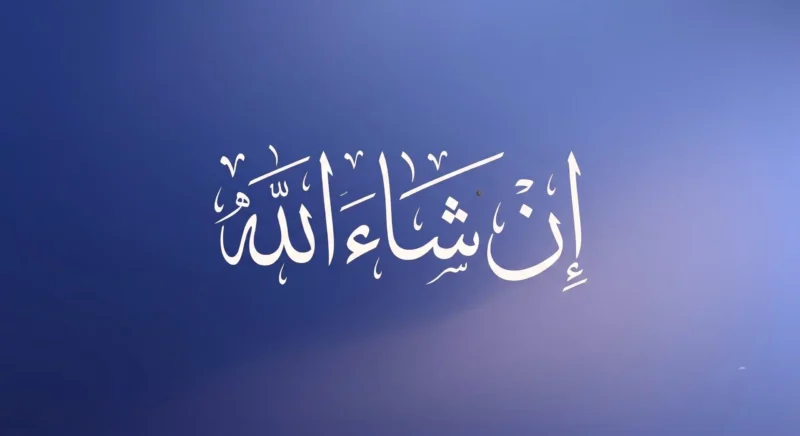
    Inshallah written in Arabic calligraphy meaning if Allah wills
    Inshallah written in Arabic calligraphy — “if Allah wills”

    Inshallah is not one word. It is three Arabic words spoken quickly enough that they blur into one, which is exactly why the spelling causes so much confusion in English.

    Arabic Transliteration What it means
    إِنْ in if
    شَاءَ shā’a He wills / He has willed
    ٱللَّٰه Allāh God

    Put together, in shā’ Allāh reads literally as “if Allah has willed it.” English speakers usually render it as “God willing,” which is close, though the Arabic is doing something slightly stronger: it places the whole outcome inside Allah’s decree rather than inside the speaker’s confidence.

    One thing worth knowing early: the phrase belongs to the Arabic language broadly, not only to formal religious speech. You will hear it in a Cairo taxi, in a Jordanian office, on the phone between friends in Detroit. It has travelled into Urdu, Turkish, Malay, Bosnian and Swahili almost unchanged. If you are just beginning with Arabic vocabulary, our Arabic Language Course starts with exactly these building blocks.

    How Muslims Use Inshallah in Everyday Speech
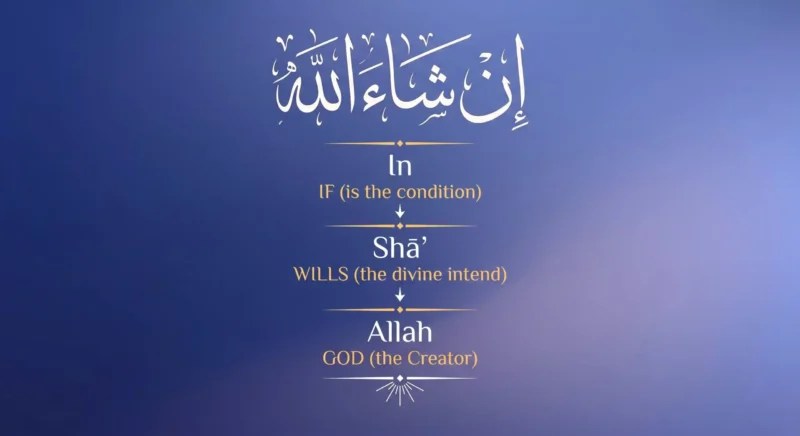
    Breakdown of the word inshallah into in shaa Allah
    The word broken into its three parts: in · shā’a · Allāh

    The rule in practice is simple: if the sentence points forward in time, inshallah belongs at the end of it. Arriving somewhere tomorrow, sitting an exam next month, getting married next year, recovering from an illness — all of it is future, and all of it is decreed by Allah rather than guaranteed by the speaker.

    Here is inshallah used in a sentence, the way you would actually hear it:

    Inshallah in a sentence

    “I’ll see you tomorrow, inshallah.”

    Inshallah I’ll pass my exam.”

    “We’re planning to visit next year, inshallah.”

    Inshallah khair — may it turn out good.”

    Notice the emotional register. Inshallah is not resignation and it is not fatalism — the speaker in every one of those sentences fully intends to show up, sit the exam, book the flight. What the phrase adds is humility on top of intention: I am planning, and Allah is deciding.

    Inshallah Habibi and Other Common Pairings

    “Inshallah habibi” pairs the phrase with habibi (حبيبي), which means “my dear” or “my beloved” and is used freely between friends, family and even shopkeepers across the Arab world. The pairing is conversational warmth, not a fixed religious formula — it softens a promise the way “sure thing, my friend” would in English. You will hear inshallah ya rab (“if Allah wills, O Lord”) in the same spirit when the speaker really wants something to happen.

    Why Do Muslims Say Inshallah? The Quranic Origin

    Muslims say inshallah because the Quran instructs it directly. The command appears in Surah Al-Kahf (18:23–24), where believers are told not to say of anything “I will do that tomorrow” without adding “if Allah wills.”

    وَلَا تَقُولَنَّ لِشَاْىْءٍ إِنِّى فَاعِلٌ ذَٰلِكَ غَدًا ۝ إِلَّآ أَن يَشَآءَ ٱللَّهُ

    “And never say of anything, ‘I will surely do that tomorrow,’ except [when adding], ‘If Allah wills.’” — Surah Al-Kahf 18:23–24

    The context behind these two verses is what gives them their weight. The classical accounts of the sabab al-nuzul (the occasion of revelation) describe the Quraysh putting a set of test questions to the Prophet ﷺ. He replied that he would answer them the following day, without saying inshallah — and revelation then reportedly paused for a period before these ayat came down. The length of that pause is reported differently across the sources, commonly cited as around fifteen days, so it is best treated as a reported detail rather than a settled figure.

    The theological point sits in a single line: humans plan, Allah decrees. Saying inshallah is a spoken acknowledgement that no future tense in any language actually belongs to us. That is why the full inshallah meaning is closer to an act of worship than to a figure of speech — and why our students meet it in their very first weeks of Islamic studies.

    How Do You Respond to Inshallah?

    The most common response to inshallah is “Ameen,” particularly when what was said carries a hope or a dua inside it. But there is no obligatory reply here — this is custom and courtesy, not ruling. Four responses cover almost every situation:

    Ameen آمين

    The default reply when the statement is a hope. “Inshallah you’ll get the job.” — “Ameen.”

    Inshallah, back

    Simply repeating the word is a full answer. It signals mutual acknowledgement — both of you are leaving the outcome where it belongs.

    Inshallah khair إن شاء الله خير

    Used when the news is uncertain or slightly worrying. Explained in full below.

    “Thank you” — and nothing more

    In casual English conversation a plain thank you is completely fine. No one is keeping score.

    What Does “Inshallah Khair” Mean?

    Inshallah khair (إن شاء الله خير) means “if Allah wills, it will be good.” Khair is goodness, and the phrase is reached for at exactly the moment when nobody knows how something will land — a medical test, a court date, a strange phone call at midnight, a relative who has gone quiet. It works both as a reply and as a standalone sentence, and it carries an unmistakable note of comfort: whatever comes, we are asking Allah for the good in it. To go further into the duas that surround moments like these, see our guide to the essential duas every Muslim should know.

    Hear It Said Correctly — Inshallah Pronunciation

    Reading a transliteration only gets you halfway. The player below is real recitation, not a computer voice: it is the voice of Sheikh Mahmoud Khalil Al-Husary, taken from Surah Al-Kahf 18:69, where the phrase in shā’a Allāh appears in the Quran itself. Tap any word to hear that word on its own, or tap the gold card to hear the three words joined at recitation speed.

    🔊 Word by word — Sheikh Al-Husary

    Tap a card to hear it. Slow mode plays the same recitation at half speed — your choice is remembered on this device.

    Recitation: Sheikh Mahmoud Khalil Al-Husary (Murattal, Hafs ‘an ‘Asim) — Surah Al-Kahf 18:69, the words إِن شَاءَ ٱللَّهُ as they occur in the verse.

    Two mistakes account for nearly every mispronunciation by English speakers:

    • Dropping the glottal stop in شَاءَ. That hamza at the end is a real consonant — a clean catch in the throat, the same sound in the middle of the English “uh-oh.” Without it the word slides into “sha-Allah” and loses its shape.
    • Flattening the long ā in shā’a into a short vowel. It is held for roughly twice the length of a short fatha, and Arabic treats vowel length as meaning-bearing, not decorative.

    Both of these are exactly what Tajweed training fixes, because both are about articulation points rather than memorisation. A single session with one of our Al-Azhar certified teachers will usually correct a hamza habit that has been in place for years.

    Inshallah, InshAllah, In Sha Allah — Which Spelling Is Correct?
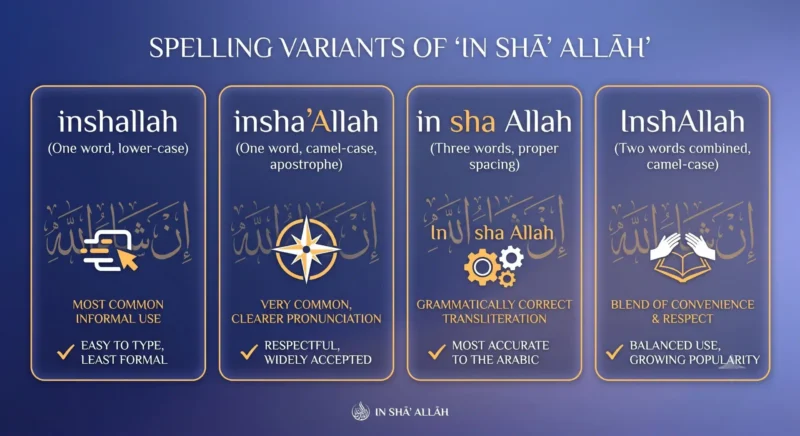
    Common spelling variants of inshallah in English
    Common English spellings of the same Arabic phrase

    All of them are correct. Arabic script has no single standardised English transliteration, so every version below points at the same three words — إن شاء الله — and none of them is “wrong.” What varies is only how visibly the three-word structure survives the crossing into English.

    Spelling How close to the Arabic Where you see it
    InshallahLoosest — reads as one wordMost common in English writing and dictionaries
    In sha AllahClosest — keeps all three words apartIslamic publishers and careful academic writing
    Insha’AllahClose — the apostrophe marks the hamzaVery common online and in messaging
    InshAllah / InshaallahMid — capital A hints at the word breakSocial media, WhatsApp, email sign-offs
    Inshalah / In shallahLoose — a dropped letter, same phraseCasual typing and autocorrect

    One footnote for completeness: you will occasionally see the word typed with spaces between every letter on social media. That is a styling habit for emphasis, nothing more, and it carries no separate meaning. If you want to write it in Arabic script rather than transliterate it at all, the phrase is إن شاء الله — and learning to read that script fluently is a shorter journey than most adults expect.

    Inshallah vs Mashallah — When to Use Each
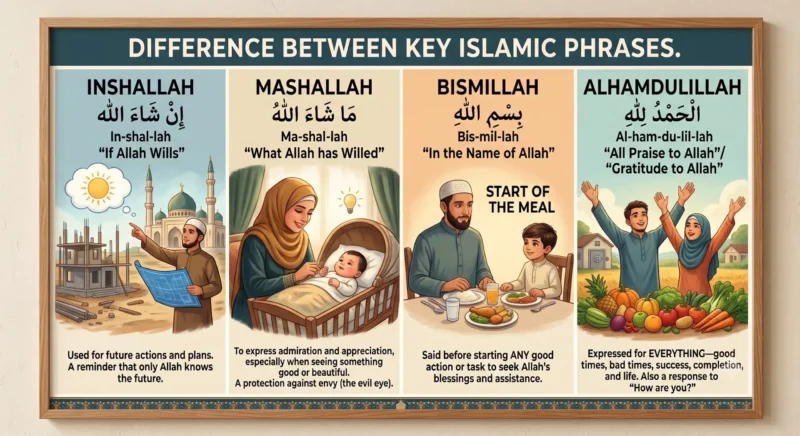
    Difference between Inshallah, Mashallah, Bismillah and Alhamdulillah
    Inshallah, Mashallah, Bismillah and Alhamdulillah — four phrases, four moments

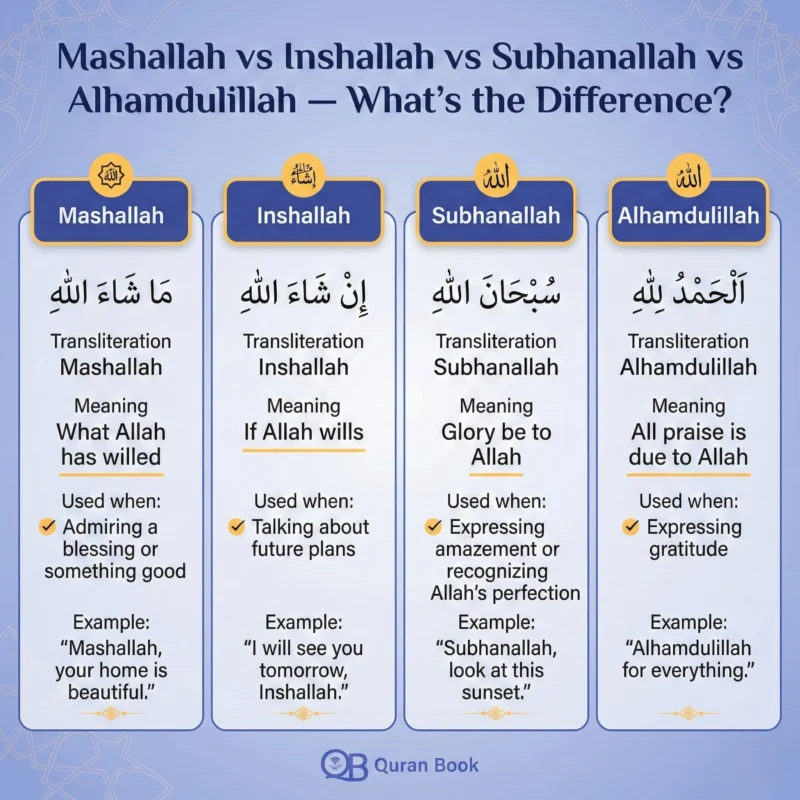
    The distinction is about time, and once you have it you will never mix them up again. Inshallah points at the future: something that has not happened yet. Mashallah points at the present or the past: something already in front of you that you are admiring. One is said before, the other is said after.

    Phrase Arabic Meaning When you say it
    Inshallahإن شاء اللهIf Allah willsTalking about the future
    Mashallahما شاء اللهWhat Allah has willedAdmiring something you see
    Bismillahبسم اللهIn the name of AllahStarting an action
    Alhamdulillahالحمد للهAll praise is for AllahGratitude, after good news

    A worked example makes it concrete. Your friend shows you the keys to a car she has just bought: that is mashallah, because the blessing already exists. She then says she is driving to Manchester on Saturday: that is inshallah, because Saturday has not arrived. When she turns the key and pulls away, she says bismillah, because she is beginning something. And when she arrives safely, alhamdulillah.

    A fifth phrase often joins this group: subhanallah, “glory be to Allah,” used for amazement at something beyond ordinary explanation. Together these five carry a remarkable amount of a Muslim’s daily speech — which is why they are worth learning as a set rather than one at a time.

    The Honest Part — When Inshallah Is Misused

    There is a joke that every Muslim family knows. A child asks if they can go to the amusement park; the parent says inshallah; the child’s face falls, because inshallah in that tone means no. It is funny because it is real. Across a lot of communities, the phrase has quietly picked up a second job as a polite refusal — a way to avoid saying no, avoid committing to a date, avoid an awkward conversation.

    It is worth sitting with why that sits badly. The phrase exists to place an outcome in Allah’s hands, not to remove it from the speaker’s. Someone who says inshallah while privately intending to do nothing has not deferred to Allah’s decree; they have borrowed the language of tawakkul to cover a decision they have already made. The Quranic instruction in Surah Al-Kahf attaches inshallah to a real intention — “I will do that tomorrow” — not as a substitute for one.

    None of that makes the habit a sin, and nobody needs a lecture about it. It is simply worth noticing, because a phrase that means “Allah willing” loses something when it starts to mean “stop asking me.”

    Can non-Muslims say inshallah? Yes. It is used across Arabic-speaking cultures by people of many faiths — Arab Christians have said it for centuries — and it is welcomed when it is said with respect. What people object to is the phrase used mockingly, as shorthand for “that will never happen.” The word itself is open to anyone.

    Used properly, inshallah is one of the most quietly grounding phrases in the Arabic language. It attaches every plan you make to the only will that finally determines whether it happens — and it does that in three syllables, several times a day, without ceremony.

    Want to Learn Phrases Like This in Arabic?

    Every phrase on this page is in the interactive Arabic phrase library inside our free games portal — you can practise common Islamic phrases inside our free games with audio, no account needed. When you are ready to go further than vocabulary, our teachers take students from the Arabic alphabet all the way to a full Ijazah program.

    Book a free trial lesson with an Al-Azhar certified teacher — one-to-one, on Zoom, no commitment.

    Claim your free trial lesson →

    Frequently Asked Questions About Inshallah

    Q. What does inshallah mean in English?

    Inshallah is an Arabic phrase meaning “if Allah wills” or “God willing.” Muslims say it when talking about future plans or hopes, as a reminder that only Allah controls what actually happens.

    Q. How do you spell inshallah correctly?

    There is no single official English spelling, since the phrase is transliterated from Arabic script. Common versions include inshallah, insha’Allah, in sha Allah and InshAllah — all refer to the exact same phrase and all are acceptable.

    Q. What’s the difference between inshallah and mashallah?

    Inshallah looks forward: “if Allah wills,” said about things that have not happened yet. Mashallah looks at what already exists: “what Allah has willed,” said when admiring something good you have just seen or heard.

    Q. Why do Muslims say inshallah?

    The Quran instructs believers in Surah Al-Kahf (18:23–24) not to say they will do something in the future without adding “if Allah wills.” Saying inshallah reflects humility — you plan, but the outcome rests with Allah.

    Q. How do you respond when someone says inshallah?

    The most common reply is “Ameen,” especially if what was said is a hope or a dua. You can also simply say “inshallah” back, or “inshallah khair.” There is no required response — it varies by culture and context.

    Q. Can non-Muslims say inshallah?

    Yes. Inshallah is used widely across Arabic-speaking cultures by people of many faiths, not just Muslims. Non-Muslims can use it respectfully in conversation without it being seen as inappropriate.

    Q. Is inshallah the same as “hopefully”?

    Not exactly. “Hopefully” expresses a personal wish, while inshallah carries a specific meaning — that the outcome ultimately depends on Allah’s will, not on effort or optimism alone.

    Start Your Free Quran Lesson at Quran Book Academy

    You now know the full inshallah meaning, how to pronounce it, and how to reply to it. The next step is reading these words where they were revealed — in the Quran itself.

    A free trial lesson with an Al-Azhar certified teacher is available for every new student — one-to-one on Zoom, scheduled around your week, whether you are in the USA, UK, Canada or Australia.

    Book Your FREE Trial Lesson Now

    Learn More — Related Islamic Phrases

    Now that the inshallah meaning is settled, these companion guides complete the set of phrases you will hear every single day:

    Jehad Mahmoud - Hafidha and Arabic Language graduate, writer at Quran Book Academy

    Hafidha of the Quran · Arabic Language Graduate · Writer on Islamic Sciences

    Jehad Mahmoud is a graduate of the Arabic Language department and a Hafidha of the Quran who writes the Islamic educational content at Quran Book Academy.

    She specialises in fiqh, the fiqh of women, and the sharia sciences, making complex rulings and Arabic vocabulary accessible to English-speaking Muslim families.

    Her articles are educational, not fatwa. For a ruling on a specific personal situation, readers are advised to consult a qualified scholar or mufti.
    Islamic Phrases Adhkar Arabic Language Fiqh

    References & Sources

    © 2026 Quran Book Academy. All rights reserved.

    Understanding the inshallah meaning is one small step in a much longer journey with the Quran.

  • Subhanallah Meaning: When & How to Say It

    Subhanallah Meaning: When & How to Say It

    Quran Book Academy
    Start Free Trial
    Jehad Mahmoud - writer at Quran Book Academy
    Written by
    Published: August 9, 2026 · Updated: August 23, 2026 · 11 min read

    Subhanallah Meaning: When & How to Say It

    The full translation, the Arabic spelling, the complete dhikr with its hadith, and an audio player so you can hear every syllable correctly.

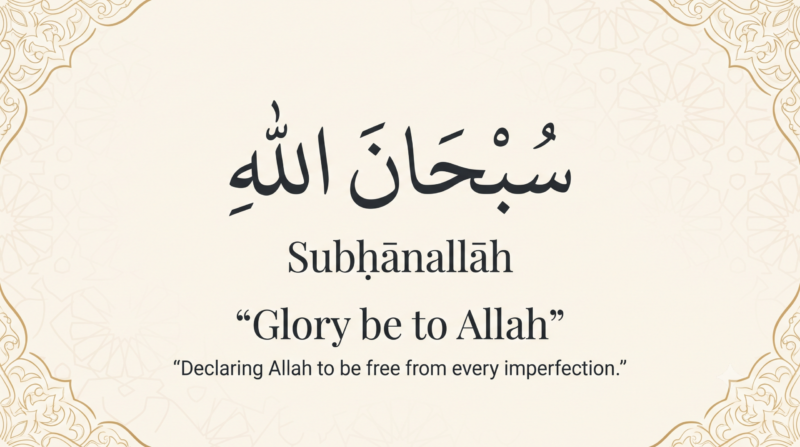
    The subhanallah meaning in English is “Glory be to Allah” — more fully, “Allah is free from every imperfection.” Muslims say it in moments of awe, in prayer, and as dhikr after every salah, declaring that Allah is far above any flaw, partner or resemblance to His creation.

    سُبْحَانَ ٱللَّٰهِ

    Transliteration: SubhānAllāh

    Meaning: “Glory be to Allah” · “Allah is free from all imperfection”

    Below: the word taken apart root by root, the two pronunciation mistakes English speakers make, an audio player for all three forms of the dhikr, the hadith behind saying it a hundred times a day, and the clean difference between SubhanAllah and Subhanahu wa Ta’ala.

    What Does Subhanallah Mean?

    Subhanallah meaning in Arabic and English with transliteration
    Subhanallah in Arabic, with transliteration and English meaning

    The phrase is two words: سُبْحَانَ (subhāna) followed by ٱللَّٰه (Allāh). The first comes from the Arabic root س-ب-ح, whose base sense is to swim, to glide, to move far away from something. Carried into theology, that distance becomes the whole point: the speaker is declaring Allah utterly removed from any defect the mind might attach to Him.

    Scholars call this concept tanzīh — negating from Allah every deficiency, every need, every partner, and every resemblance to created things. So the definition of subhanallah is not simply “praise.” It is a denial before it is an affirmation: Allah is not weak, not tired, not divided, not comparable, not in need of anything. The nearest translation of subhanallah in one breath is “Glory be to Allah,” but the fuller sense is “Allah is far above every imperfection.”

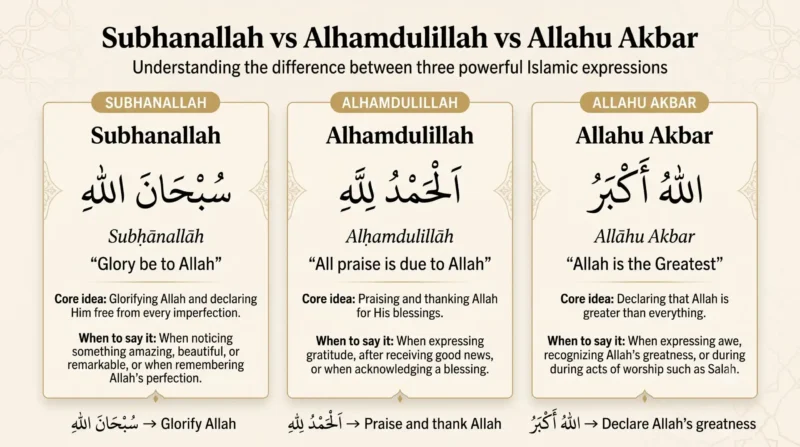
    That is exactly why Muslims carry three separate phrases rather than one. Tasbih (SubhanAllah) removes flaws. Hamd (Alhamdulillah) affirms perfections and gives thanks for them. Takbir (Allahu Akbar) declares that whatever greatness you can imagine, Allah is greater still. Together they form a complete statement about Allah — negation, affirmation, and magnitude — which is why they appear side by side in the dhikr after every prayer.

    Subhanallah in Arabic — Writing & Pronunciation

    Subhanallah in Arabic broken down by root letters and meaning
    The root س-ب-ح and how سُبْحَانَ is built from it

    Written with full harakat, subhanallah in Arabic is سُبْحَانَ ٱللَّٰهِ. Letter by letter, it maps onto English like this:

    Arabic Sound Notes for English speakers
    سُ su Light “s” as in sun — never heavy or hollow
    بْ b Sukoon — closed, no vowel after it
    حَا ḥā Deep throat “ḥ”, articulated from mid-throat; the alif that follows it is a mad ṭabī’ī, held two counts
    نَ na Short, then straight into the name of Allah
    ٱللَّٰهِ Allāh(i) Heavy lām here (tafkhīm) , the letter before Allah (the نَ in سُبْحَانَ) carries a fatha, and any fatha or damma before the Lafẓ al-Jalālah triggers tafkhīm. (Light lām only happens after a kasra, like بِسْمِ اللَّهِ.)

    Two mistakes cover almost every mispronunciation:

    • Turning ح into an English “h.” The English h is a soft puff from the mouth. ح is articulated from the middle of the throat with a distinct friction. Swap it for the English sound and the word drifts towards a different Arabic letter entirely.
    • Making the س heavy. Some learners darken the s until it edges towards ص. In this word the س stays thin and bright all the way through, with the tongue tip low against the front teeth.

    On spelling: SubhanAllah, Subhan Allah, Subhaan Allah and Subhanallah are all the same phrase. Arabic has no single official English transliteration, so none of these is wrong — they only differ in how much of the vowel length they try to show. If the letters themselves are new to you, this is precisely where our students start: children learn to pronounce Arabic letters correctly from the very first lesson.

    Listen & Repeat — Interactive Pronunciation Tool

    Transliteration only takes you halfway. Tap any track below to hear it, tap again to repeat, and switch on slow mode if the throat letter is going past you. Your slow-mode choice is remembered on this device.

    🔊 Three tracks — tap to play

    Tap a track to hear it. Tap again to repeat as many times as you need.

    Both of the mistakes above are articulation habits, not memory problems — which means they are fixed by a teacher’s ear, not by more repetition. A single session with one of our Al-Azhar certified teachers usually corrects a ح that has been wrong for years.

    When Do Muslims Say Subhanallah?

    There is no fixed list of permitted moments — tasbih is open speech, said whenever the heart reaches for it. In practice, five situations account for most of it:

    Witnessing something astonishing in creation

    A newborn’s hand, a thunderstorm over the sea, the sheer scale of a mountain range. The awe belongs to the Creator, so the tongue turns to Him rather than to the thing itself.

    Hearing something unworthy said about Allah

    Here SubhanAllah works as a correction — a spoken refusal of the claim. The Quran itself uses the word this way when it answers those who attribute a son or a partner to Allah.

    In rukū’ of every prayer

    سُبْحَانَ رَبِّيَ الْعَظِيمSubhāna Rabbiyal-‘Adhīm, “Glory to my Lord, the Most Great,” said while bowing, typically three times.

    In the tasbih after every salah — 33 times

    SubhanAllah 33, Alhamdulillah 33, Allahu Akbar 33, then completing the hundred with the declaration of tawhid.

    In general dhikr through the day

    Walking, waiting, driving, unable to sleep. This is the form of worship with no prerequisites at all — no wudu, no direction, no fixed time.

    Abu Hurayrah (may Allah be pleased with him) reported that the Prophet ﷺ taught that whoever glorifies Allah thirty-three times, praises Him thirty-three times and magnifies Him thirty-three times after every prayer, then completes the hundred with the declaration that there is no god but Allah alone, will have his sins forgiven even if they were like the foam of the sea.

    Sahih Muslim 597 (sunnah.com)

    Notice how little the phrase asks of you. It fits in the gap between a red light and a green one. That accessibility is the design: an act of worship deliberately built so that no one has an excuse to be without it.

    Subhanallahi wa Bihamdihi — The Complete Dhikr

    SubhanAllahi wa bihamdihi meaning in Arabic English and transliteration
    SubhanAllahi wa bihamdihi — Arabic, transliteration and meaning

    سُبْحَانَ ٱللَّٰهِ وَبِحَمْدِهِ

    Transliteration: SubhānAllāhi wa bihamdih

    Meaning: “Glory be to Allah, and praise is His”

    The subhanallahi wa bihamdihi meaning joins the two halves described earlier into a single sentence: Allah is free of every defect (tasbih), and every praise belongs to Him (hamd). Abu Hurayrah reported that the Prophet ﷺ said whoever says it a hundred times in a day will have his sins erased even if they were as much as the foam of the sea — Sahih al-Bukhari 6405.

    سُبْحَانَ ٱللَّٰهِ وَبِحَمْدِهِ، سُبْحَانَ ٱللَّٰهِ ٱلْعَظِيمِ

    Transliteration: SubhānAllāhi wa bihamdih, SubhānAllāhil-‘Adhīm

    Meaning: “Glory be to Allah and praise is His; glory be to Allah, the Most Great”

    This longer form — subhanallahi wa bihamdihi subhanallahil azeem — is the one described in Sahih al-Bukhari 6406 as two expressions light on the tongue, heavy on the scale, and beloved to the Most Merciful. The contrast is the whole lesson: almost no effort in this life, considerable weight in the next.

    A practical note on the hundred. Most people who manage it do not sit down to count; they split it — thirty-three after Fajr, a stretch on the commute, the rest before sleep. And on pronunciation, the ending of bihamdih is commonly written both as bihamdihi and bihamdih; both reflect the same word, the difference being whether the final short vowel is voiced or stopped at the end of the phrase.

    Subhanallah vs Subhanahu wa Ta’ala (SWT) — Not the Same Thing

    These two get confused constantly, and the difference is simple once you see it. SubhanAllah is something a person says — a complete sentence, spoken aloud, in awe or in dhikr. Subhanahu wa Ta’ala is an honorific that attaches to the name of Allah when writing or speaking about Him. The subhana wa ta’ala meaning is “Glorified and Exalted is He,” and it never stands alone as a sentence — it always follows a mention of Allah.

    SubhanAllah Subhanahu wa Ta’ala
    Arabicسبحان اللهسبحانه وتعالى
    Who says itThe speaker, about AllahThe writer or speaker, after naming Allah
    FunctionDhikr — a full statement of praiseHonorific — a mark of reverence
    Typical useSpoken far more than writtenWritten far more than spoken
    AbbreviationNone — always written in fullSWT, as in “Allah (SWT)”
    AlternativeSubhanAllahi wa bihamdihiعز وجل — ‘Azza wa Jall, “Mighty and Majestic”

    A third thing sits nearby and is worth naming so it stops causing confusion: tasbih. That word refers to the act of saying SubhanAllah, and also to the counted set of thirty-three after prayer, and in everyday speech to the beads used to keep the count. So “do your tasbih” means “say your post-prayer dhikr” — not a fourth phrase you have yet to learn.

    Subhanallah, Alhamdulillah, Allahu Akbar — What’s the Difference?

    Difference between Subhanallah, Alhamdulillah and Allahu Akbar
    Three phrases, three different jobs
    Subhanallah Alhamdulillah Allahu Akbar
    سبحان الله الحمد لله الله أكبر
    “Glory be to Allah” “All praise is for Allah” “Allah is greater”
    Denies every imperfection Affirms perfection and gratitude Declares nothing outranks Him
    Said in awe, wonder, or correction Said in thanks, after good news, after eating Said opening prayer, and when facing something huge

    A quick test that works nearly every time: if you are amazed, say SubhanAllah; if you are grateful, say Alhamdulillah; if you are overwhelmed by size or power, say Allahu Akbar. And two neighbours complete the daily set — MashAllah for admiring a blessing someone already has, and Bismillah meaning “in the name of Allah,” said at the start of any action.

    Teaching Subhanallah to Children

    Children learn this phrase fastest when it is attached to something they can see. The simplest game: on a walk, each person points at one thing Allah made — a beetle, a cloud shaped like a whale, the moon in daylight — and everyone says SubhanAllah together. Within a week most children start doing it unprompted, which is exactly the habit you are after.

    For the post-prayer count, give them a physical tasbih with beads rather than fingers. Young children lose count in the thirties and get frustrated; beads remove the arithmetic entirely. If 33-33-34 still feels like too much, start with three of each and build up over a month. Nothing is lost by going slowly.

    One more thing that helps: explain the meaning in child-sized language — “Allah is perfect, and nothing bad or broken belongs to Him.” Our Islamic studies for kids classes build the daily adhkar in this way, one phrase at a time, with a teacher who keeps it light.

    Frequently Asked Questions About Subhanallah

    Q. What does Subhanallah mean in English?

    Subhanallah means “Glory be to Allah.” More fully, it declares that Allah is free from every imperfection, partner or resemblance to His creation. Muslims say it in moments of awe, in prayer, and as part of daily dhikr.

    Q. When should you say Subhanallah?

    Say it when you witness something awe-inspiring in creation, when you hear something unworthy said about Allah, while bowing in prayer, in the tasbih after every salah, and at any point in the day as general dhikr. There is no restriction on time or place.

    Q. How many times should you say Subhanallah after prayer?

    Thirty-three times, followed by Alhamdulillah thirty-three times and Allahu Akbar thirty-three times, completing the hundred with the declaration of tawhid. This pattern is reported in Sahih Muslim 597 among the adhkar said after each obligatory prayer.

    Q. What is the difference between Subhanallah and Alhamdulillah?

    Subhanallah removes imperfection from Allah — it is a denial of any flaw. Alhamdulillah affirms His perfection and thanks Him for it. In practice, Subhanallah is said in wonder, Alhamdulillah in gratitude.

    Q. What does SubhanAllahi wa bihamdihi mean?

    It means “Glory be to Allah, and praise is His” — combining tasbih and hamd in one phrase. Sahih al-Bukhari 6405 reports that whoever says it a hundred times a day will have his sins erased even if they were like the foam of the sea.

    Q. Is Subhanallah mentioned in the Quran?

    Yes. The word appears throughout the Quran in various forms — for example Surah Al-Isra opens with “Subhāna alladhī asrā” (17:1), and the same surah states that everything in the heavens and earth glorifies Allah (17:44). The angels also use it in Surah Al-Baqarah 2:32.

    Q. Can non-Muslims say Subhanallah?

    Yes. Nothing prevents a non-Muslim from saying it, and it is heard across Arabic-speaking cultures from people of different faiths. As with any expression of reverence, what matters is that it is said respectfully rather than mockingly.

    Q. What is the difference between Subhanallah and Subhanahu wa Ta’ala?

    Subhanallah is a complete phrase a person says: “Glory be to Allah.” Subhanahu wa Ta’ala (“Glorified and Exalted is He”) is an honorific placed after the name of Allah when writing or speaking about Him, usually abbreviated as SWT.

    Say It the Way It Was Taught

    Reading a transliteration will never fix a throat letter. The ح in Subhanallah, the length of the alif, the heavy lām — these are corrected by a teacher listening to you and telling you where your tongue is sitting.

    Book a free trial lesson with an Al-Azhar certified teacher — one-to-one on Zoom, for you or your children, wherever you are in the USA, UK, Canada or Australia.

    Book Your FREE Trial Lesson Now

    Learn More — Related Islamic Phrases

    Now that the subhanallah meaning is settled, these companion guides complete the set of phrases you will hear every single day:

    Jehad Mahmoud - Hafidha and Arabic Language graduate, writer at Quran Book Academy

    Hafidha of the Quran · Arabic Language Graduate · Writer on Islamic Sciences

    Jehad Mahmoud is a graduate of the Arabic Language department and a Hafidha of the Quran who writes the Islamic educational content at Quran Book Academy.

    She specialises in Quranic Arabic, tajweed and the sharia sciences, making correct pronunciation and complex rulings accessible to English-speaking Muslim families.

    Her articles are educational, not fatwa. For a ruling on a specific personal situation, readers are advised to consult a qualified scholar or mufti.
    Islamic Phrases Adhkar Tasbih Arabic Language

    References & Sources

    © 2026 Quran Book Academy. All rights reserved.

    Learning the subhanallah meaning is one small step in a much longer journey with the Quran.

  • Bismillah Meaning: Full Phrase, Arabic & When to Say It

    Bismillah Meaning: Full Phrase, Arabic & When to Say It

    Quran Book Academy
    Start Free Trial
    Jehad Mahmoud - writer at Quran Book Academy
    Written by
    Published: August 9, 2026 · Updated: August 9, 2026 · 12 min read

    Bismillah Meaning: Full Phrase, Arabic & When to Say It

    The complete Basmala, every English spelling explained, and a phrase-by-phrase audio player recited by Sheikh Mahmoud Khalil Al-Husary.

    The bismillah meaning in English is “in the name of Allah.” It is the short form of the full phrase, the Basmala, which Muslims say before eating, before Wudu, before travelling, and at the opening of almost every surah of the Quran.

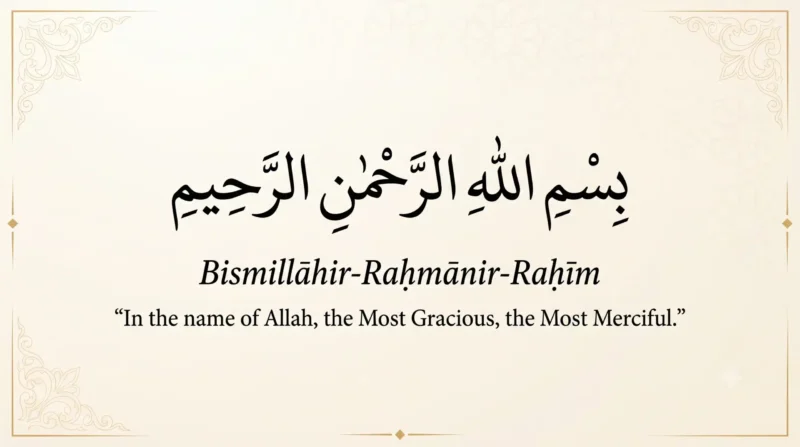
    بِسْمِ ٱللَّٰهِ ٱلرَّحْمَٰنِ ٱلرَّحِيمِ

    Transliteration: Bismillahir Rahmanir Raheem

    Translation: “In the name of Allah, the Most Gracious, the Most Merciful”

    Below: the word split letter by letter, the real difference between Ar-Rahman and Ar-Raheem, every English spelling you have seen online mapped against the Arabic, an audio player you can repeat after, and the moments in a Muslim’s day when the phrase belongs.

    What Does Bismillah Mean?

    Bismillah meaning in Arabic with English translation and transliteration
    The Basmala in Arabic with its English translation and transliteration

    Like most Arabic expressions that reach English as a single block of letters, Bismillah is not one word. It is a preposition, a noun and the divine name fused together in speech:

    Arabic Transliteration What it means
    بِ bi in / with / by means of
    ٱسْم ism name
    ٱللَّٰه Allāh God — the proper name, not a title

    Put together, the bismillah definition is simply “in the name of Allah.” Said on its own, that is the short form. Extend it and you have the full Basmala — Bismillahir Rahmanir Raheem — with two of Allah’s names attached: Ar-Rahman and Ar-Raheem.

    The hidden verb

    Arabic grammarians point out that the phrase is grammatically incomplete on its own — there is an implied verb sitting in front of it. The sense is “in the name of Allah I begin,” and classical commentators note that the unspoken verb takes its shape from whatever you are about to do: I eat, I read, I travel. That is the whole reason Bismillah is said before an action and never after it.

    So when someone asks what is bismillah in English, the honest answer is that it is a declaration of intent as much as a translation. You are not describing Allah; you are attaching the next few minutes of your life to His name. If you are starting from the Arabic alphabet, our Quran reading course for beginners teaches this phrase in the very first lesson, because every recitation begins with it.

    Ar-Rahman and Ar-Raheem — Two Different Mercies

    Difference between Ar-Rahman and Ar-Raheem in Bismillah
    Ar-Rahman and Ar-Raheem — one root, two distinct meanings

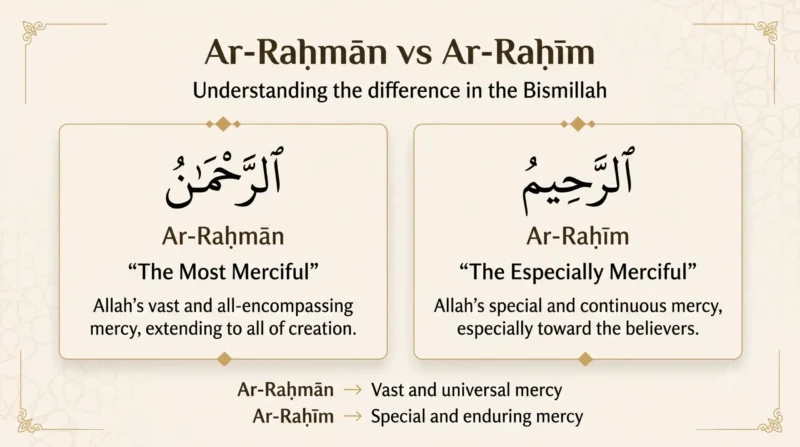
    English translations often render both names as “the Merciful,” which leaves readers assuming the phrase repeats itself for rhythm. It does not. Both names grow from the same three-letter root ر-ح-م (r-ḥ-m), the root that also gives Arabic the word for a mother’s womb — but they sit on different grammatical patterns, and in Arabic the pattern carries meaning.

    Ar-Rahman ٱلرَّحْمَٰن

    The pattern fa’lān in Arabic signals intensity and fullness — a quality overflowing at this very moment. Ar-Rahman is mercy so vast that it reaches every creature without exception: the believer and the disbeliever, the animal, the newborn, the person who has never once thanked Him for it. It is a name the Quran treats as belonging to Allah alone.

    Ar-Raheem ٱلرَّحِيم

    The pattern fa’īl signals a settled, permanent, continuing attribute. Ar-Raheem is mercy that keeps arriving — specific, sustained, and described in the Quran as directed particularly toward the believers, in this life and the next.

    Held side by side, the two names say something a single word cannot: the mercy that gave you this morning is the same mercy that will not let go of you. That is why the Basmala opens the Quran rather than a name of power or majesty — and why a serious student of Tajweed rules learns to give ٱلرَّحْمَٰن and ٱلرَّحِيم their full length rather than clipping them into one breath.

    Bismillah in Arabic — Writing & Correct Transliteration

    What Bismillah means broken down word by word in Arabic
    Bismillah written out word by word with full harakat

    Written fully vocalised, the phrase is:

    بِسْمِ ٱللَّٰهِ ٱلرَّحْمَٰنِ ٱلرَّحِيمِ

    Now the part that sends people to Google. Arabic has no single official transliteration into the Latin alphabet, so the same three-and-a-bit words appear in English in a dozen shapes. Every spelling in the table below refers to the identical Arabic phrase. None of them is wrong; they differ only in how much of the Arabic sound they preserve.

    Spelling How close to the Arabic Where you see it
    Bismillahir Rahmanir RaheemClosest to how it is actually recited — the joining is written inMost Quran study material and English translations
    Bismillah ar-Rahman ar-RaheemClosest to the written Arabic — each word kept separateAcademic writing and careful Islamic publishing
    Bismillah hir Rahman nir RahimSame as the first, split differently — the “hir” and “nir” are joining sounds, not wordsSouth Asian Islamic books and websites
    BismillahirrahmanirrahimAccurate to the sound, hardest to read — no spaces at allTurkish and Malay usage, and filenames
    Bismilah / BismilllahSimple misspellings — a dropped or doubled letterCasual typing and autocorrect

    Two Tajweed Points Worth Knowing

    • The alif in ٱللَّٰه and in ٱلرَّحْمَٰن carries a small ṣād-shaped mark (ٱ) — a hamzat wasl. It is pronounced only when you begin speech there, and its glottal-stop sound drops when the word is joined to what came before it, so there is no pause between “Bismillahi” and “Allahi.” Separately, the lām of “al” in ٱلرَّحْمَٰن and ٱلرَّحِيمِ is itself silent, because rā’ (ر) is a “sun letter” (ḥarf shamsī). The lām fully assimilates into the rā’, shown in the script by the shadda (ٱلرَّحْمَٰنِ), which is exactly why the transliteration reads Bismillahir Rahman and not Bismillahi al-Rahman.
    • The madd in ٱلرَّحِيمِ. The yā’ after the kasra is a natural prolongation (madd tabī’ī) held for two counts. Shortening it is the single most common error English speakers make, and it changes the shape of the word.The same rule applies to the small vertical alif (ٰ) over the mīm in ٱلرَّحْمَٰنِ — it is also a madd tabī’ī held for two counts, and it is just as easy to clip by accident since it isn’t written as a full alif.

    Neither point is memorisation work — both are articulation habits, which is why they correct fastest with a teacher listening in real time rather than from a book.

    Listen & Repeat — Bismillah Pronunciation Tool

    The recitation below is Sheikh Mahmoud Khalil Al-Husary, whose measured pace makes him the standard choice for learners. Tap any card to hear that part on its own. Turn on Loop to hear it repeatedly, Slow to stretch the vowels out, and My turn to leave a silent gap after each segment so you can repeat it back before the next play.

    🔊 Phrase-by-phrase player

    Tap a card to hear it. Your settings and progress are remembered on this device.

    0 of 4 segments practised

    Audio courtesy of EveryAyah.com (Surah Al-Fatiha 1:1, Husary murattal). If the joining between words is still going past you after a few listens, that is normal — it is the exact thing a teacher fixes in one session, and you can try that free with an free trial lesson.

    When Do Muslims Say Bismillah?

    The general principle is that Bismillah belongs at the start of anything worth doing. Beyond that general habit, a number of specific moments are established in the Sunnah:

    Before eating and drinking

    The Prophet ﷺ instructed a young boy at the table to mention the name of Allah, eat with his right hand, and eat from what was nearest to him — Sahih al-Bukhari 5376, Sahih Muslim 2022.

    Before Wudu

    A report in Sunan Abi Dawud 101 states that there is no Wudu for one who does not mention the name of Allah over it. Hadith scholars discuss the chain of this report, and the jurists differ accordingly on whether saying it is obligatory or strongly recommended — but no school disputes that it should be said.

    On entering the home

    In Sahih Muslim 2018, the Prophet ﷺ described that when a person mentions Allah’s name on entering his house and on his food, the shaytan finds neither lodging for the night nor a meal.

    Before travel

    When slaughtering — the one obligatory case

    Here the phrase is not a courtesy. The Quran states plainly not to eat of that over which the name of Allah has not been mentioned — Surah Al-An’am 6:121. This is why halal slaughter requires it.

    Before reciting the Quran — after the Isti’adhah

    The order matters. Surah An-Nahl 16:98 instructs the reciter to seek refuge in Allah first — A’udhu billahi min ash-shaytan ir-rajeem — and the Basmala follows it.

    At the start of any task

    Leaving the house, sitting an exam, opening a laptop, beginning a difficult conversation. A frequently quoted report about every important matter being “cut off” if not begun with Bismillah is graded weak by a number of hadith specialists, so it is better to rest this habit on the broad practice of the Sunnah rather than on that specific wording.

    The one exception people ask about: Surah At-Tawbah is the only surah of the Quran that does not open with the Basmala. Nothing was removed — the Companions who compiled the mushaf did not place it there, and the classical explanations for that range from the surah’s opening theme of disavowal to an early question about whether At-Tawbah and Al-Anfal were counted as one surah. When beginning recitation from the start of At-Tawbah, reciters say the Isti’adhah without the Basmala after it.

    Bismillah and the Quran — Is It a Verse?

    The Basmala appears 114 times in the Quran. It opens 113 of the 114 surahs — all except At-Tawbah — and it occurs once more inside the body of a surah, in the letter of Sulayman (peace be upon him) to the Queen of Sheba at Surah An-Naml 27:30. That occurrence is agreed by all to be an ayah of the Quran in its own right.

    Whether the Basmala at the head of each surah is itself a counted verse of that surah is a long-recognised difference of opinion between the schools, and it is one of those questions where every position has serious evidence behind it. In the Shafi’i school it is counted as the first ayah of Al-Fatiha and recited aloud in the audible prayers. In the Hanafi school it is treated as a verse revealed for separating the surahs rather than as part of each one, and it is recited quietly. The Maliki position generally omits it at the start of Al-Fatiha in obligatory prayer. Recitation practice in the different qira’at reflects the same range.

    None of this is a dispute about the words themselves, and none of the schools questions that the Basmala is revealed speech. It is a question of verse-numbering and prayer practice, and a Muslim following any of the four schools is on solid ground. If you want to know what applies in your own prayer, follow the school your local mosque teaches, or ask a qualified scholar rather than settling it from an article.

    Bismillah vs Inshallah vs Mashallah vs Alhamdulillah

    When to say Bismillah, Inshallah, Mashallah and Alhamdulillah
    Four phrases, four different moments in the day

    These four are the phrases you will hear most in any Muslim household, and they are almost never interchangeable. The cleanest way to keep them apart is by where in the action each one sits.

    Phrase Arabic Meaning When you say it
    Bismillahبسم اللهIn the name of AllahAt the moment you begin something
    Inshallahإن شاء اللهIf Allah willsSpeaking about the future
    Mashallahما شاء اللهWhat Allah has willedAdmiring something already there
    Alhamdulillahالحمد للهAll praise is for AllahAfterwards, in gratitude

    One meal walks you through all four. You sit down and say bismillah as you reach for the food. Your host mentions she is cooking again next Friday — inshAllah. Her son brings the tray in without spilling a drop — MashAllah. And when the plates are empty, alhamdulillah. A fifth phrase, subhanallah meaning “glory be to Allah,” joins the set for moments of genuine amazement.

    Teaching Children to Say Bismillah

    Bismillah is usually the first phrase a Muslim child learns to use on purpose, and it sticks best when it is taught as a rule about beginnings rather than as a rule about food: we say bismillah before we start anything. Before the seatbelt clicks. Before the pencil case opens. Before the swing goes.

    The mealtime routine does most of the work on its own. Hands washed, everyone seated, nobody eats until the youngest has said it — and children who are given that small job say it enthusiastically for years. Pair it with alhamdulillah at the end and the meal quietly becomes a complete lesson.

    If they forget mid-meal

    بِسْمِ ٱللَّٰهِ أَوَّلَهُ وَآخِرَهُ

    Bismillahi awwalahu wa akhirahu — “In the name of Allah, at its beginning and its end.” Reported in Sunan Abi Dawud 3767. Teaching a child this one line removes the anxiety of having got it wrong, which matters more than it sounds.

    Our Islamic studies for kids classes build these daily phrases into the first term through games and repetition, with teachers who are used to teaching children born and raised in English-speaking countries.

    Frequently Asked Questions About Bismillah

    Q. What does Bismillah mean in English?

    Bismillah means “in the name of Allah.” It combines bi (“in”), ism (“name”) and Allah. Muslims say it before beginning an action, with an implied verb behind it: “in the name of Allah I begin.” The full form adds two of Allah’s names — the Most Gracious, the Most Merciful.

    Q. What is the difference between Bismillah and Bismillahir Rahmanir Raheem?

    Bismillah is the short form, “in the name of Allah.” Bismillahir Rahmanir Raheem is the complete phrase, known as the Basmala, and adds “the Most Gracious, the Most Merciful.” The short form is used for everyday actions such as eating; the full form opens the surahs of the Quran.

    Q. What is the difference between Ar-Rahman and Ar-Raheem?

    Both come from the root r-ḥ-m, but they are not synonyms. Ar-Rahman describes mercy that is vast and universal, reaching all of creation. Ar-Raheem describes mercy that is continuous and specific, described in the Quran as directed particularly toward the believers. Translating both as “the Merciful” loses that distinction.

    Q. When should you say Bismillah?

    Before any action worth beginning: eating and drinking, Wudu, entering the home, travelling, sleeping, and reciting the Quran after the Isti’adhah. When slaughtering an animal it is required rather than recommended. The general rule is that it is said at the start of an action, never after it.

    Q. Is Bismillah a verse of the Quran?

    It appears 114 times, opening 113 surahs, and it is agreed by all to be an independent verse within Surah An-Naml (27:30). Whether it is counted as a verse of each surah it opens is a recognised difference between the schools of fiqh, affecting verse numbering and whether it is recited aloud in prayer.

    Q. Why does Surah At-Tawbah not begin with Bismillah?

    At-Tawbah is the only surah without the Basmala at its head. The Companions who compiled the mushaf did not write it there. Classical explanations connect this to the surah’s opening theme of disavowal, and to an early question over whether At-Tawbah and Al-Anfal were treated as a single surah. Nothing was removed from the text.

    Q. Can non-Muslims say Bismillah?

    Yes. The phrase is part of everyday Arabic speech and is used respectfully by people of different faiths across the Arab world. There is nothing preventing a non-Muslim from saying it sincerely or reading it aloud while studying. What is unwelcome is using it mockingly, which is true of any sacred phrase.

    Q. What should you say if you forget Bismillah before eating?

    Say “Bismillahi awwalahu wa akhirahu” — “in the name of Allah, at its beginning and its end” — as soon as you remember, even mid-meal. This is reported in Sunan Abi Dawud 3767. There is no need to stop eating or start the meal again.

    Learn to Recite It the Way It Was Revealed

    You now know the full bismillah meaning, the two mercies inside it, and every spelling you are likely to meet. The step that changes everything is hearing your own recitation corrected out loud.

    A free trial lesson with an Al-Azhar certified teacher is available to every new student — one-to-one on Zoom, scheduled around your week, whether you are in the USA, UK, Canada or Australia.

    Book Your FREE Trial Lesson Now

    Learn More — Related Islamic Phrases

    Bismillah is the phrase for beginnings. These three complete the set you will hear every single day:

    Jehad Mahmoud - Hafidha and Arabic Language graduate, writer at Quran Book Academy

    Hafidha of the Quran · Arabic Language Graduate · Writer on Islamic Sciences

    Jehad Mahmoud is a graduate of the Arabic Language department and a Hafidha of the Quran who writes the Islamic educational content at Quran Book Academy.

    She specialises in fiqh, the fiqh of women, and the sharia sciences, making complex rulings and Quranic vocabulary accessible to English-speaking Muslim families.

    Her articles are educational, not fatwa. For a ruling on a specific personal situation, readers are advised to consult a qualified scholar or mufti.
    Quranic Sciences Tajweed Islamic Phrases Fiqh

    References & Sources

    © 2026 Quran Book Academy. All rights reserved.

    Knowing the bismillah meaning is the first step — reciting it correctly is the next one.

  • Dua Qunoot: Arabic, Transliteration, English Meaning and How to Recite It in Witr

    Dua Qunoot: Arabic, Transliteration, English Meaning and How to Recite It in Witr

    Dua & Worship

    Dua Qunoot: Arabic, Transliteration, English Meaning and How to Recite It in Witr

    The words first — then how to memorise them, line by line

    Jehad Mahmoud Written by | 📅 Published | 🔄 Updated | ⏱️ 9 min read

    Dua Qunoot is the supplication recited while standing in the final rak’ah of the Witr prayer, asking Allah for guidance, wellbeing, protection and blessing. Here are the full words in Arabic, in transliteration, and in English.

    Dua Qunoot recited with hands raised during Witr prayer at night
    Dua Qunoot is recited standing, in the last rak’ah of Witr, after Isha and before Fajr.
    Arabic

    اللَّهُمَّ اهْدِنِي فِيمَنْ هَدَيْتَ، وَعَافِنِي فِيمَنْ عَافَيْتَ، وَتَوَلَّنِي فِيمَنْ تَوَلَّيْتَ، وَبَارِكْ لِي فِيمَا أَعْطَيْتَ، وَقِنِي شَرَّ مَا قَضَيْتَ، إِنَّكَ تَقْضِي وَلَا يُقْضَى عَلَيْكَ، وَإِنَّهُ لَا يَذِلُّ مَنْ وَالَيْتَ، وَلَا يَعِزُّ مَنْ عَادَيْتَ، تَبَارَكْتَ رَبَّنَا وَتَعَالَيْتَ.

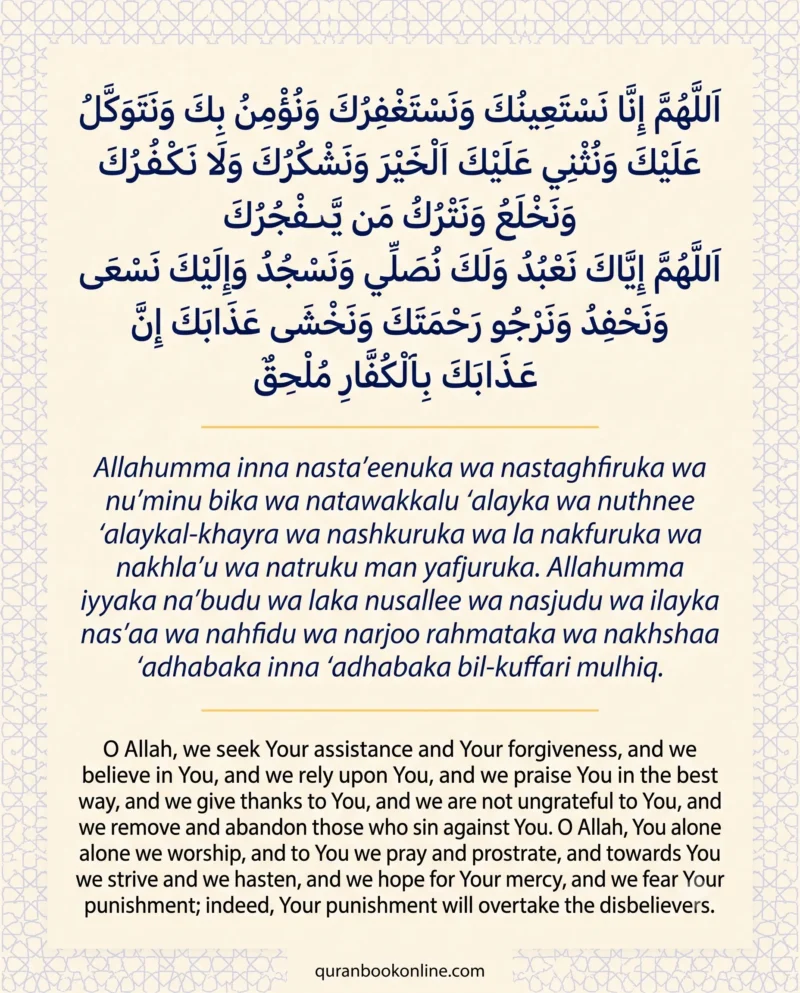
    Transliteration Allahumma-hdinee feeman hadayt, wa ‘aafinee feeman ‘aafayt, wa tawallanee feeman tawallayt, wa baarik lee feema a’tayt, wa qinee sharra ma qadayt, innaka taqdee wa laa yuqdaa ‘alayk, wa innahu laa yadhillu man waalayt, wa laa ya’izzu man ‘aadayt, tabaarakta Rabbanaa wa ta’aalayt.
    English meaning “O Allah, guide me among those You have guided, grant me wellbeing among those You have granted wellbeing, take me into Your care among those You have taken into Your care, bless me in what You have given me, and protect me from the evil of what You have decreed. For You decree, and none decrees over You. The one You support is never disgraced, and the one You oppose is never honoured. Blessed are You, our Lord, and Exalted.”

    Narrated from al-Hasan ibn Ali, who was taught it by the Prophet ﷺ — Sunan Abi Dawud 1425

    Dua Qunoot in Arabic with English transliteration and translation card
    Save this card or share it — the full Dua Qunoot in Arabic, transliteration and English.

    What Is Dua Qunoot? A Simple Definition

    Linguistically, qunoot carries the sense of devout obedience, standing before Allah, and humility — which is exactly the posture in which it is recited.

    Dua Qunoot is a supplication, not a fixed Quranic verse. That single fact explains something many learners find confusing: you can search a Quran recitation archive for it and find nothing, because it is not part of any surah. It is a dua the Prophet ﷺ taught, recited in the standing position of the prayer.

    It also travels under several spellings. Dua qunoot, dua e qunoot, qunoot duas, duas for qunoot and kunuth dua all point to the same supplication — the different forms come from transliterating the Arabic word قنوت into English, Urdu, Malayalam and Tamil.

    One more expectation to set before you memorise anything: the wording varies slightly between narrations and between schools of thought. You may hear an imam add a phrase you did not learn, or omit one you did. That is normal, it is documented, and it does not mean either of you is reciting it wrongly.

    When Is Dua Qunoot Recited? The Three Contexts

    Dua Qunoot appears in three different situations, and almost every disagreement you will read about online is really a disagreement about which of the three someone is talking about. Find the one that applies to you tonight, and the rest becomes much simpler.

    1. Qunoot in Witr Prayer (The Most Common)

    This is the context most readers arrive here for. Dua Qunoot is recited in the final rak’ah of Witr, the odd-numbered prayer that closes the night. All four schools recognise qunoot in Witr; they differ over its timing within the rak’ah and over the season in which it is recited.

    The Hanafi school recites it every night, before bowing (ruku’). The Shafi’i and Hanbali schools most commonly recite it in the second half of Ramadan, after rising from ruku’. The Prophet ﷺ encouraged making Witr the last prayer of the night (Sahih al-Bukhari 998).

    2. Qunoot in Fajr Prayer

    In the Shafi’i school, qunoot is recited daily in the second rak’ah of Fajr, after rising from ruku’, as an established sunnah of that prayer.

    The Hanafi and Hanbali schools do not treat qunoot in Fajr as a regular practice, reserving it instead for times of calamity. Both positions rest on evidence and on centuries of qualified scholarship — this is a genuine difference of interpretation, not a case of one group being careless with the sunnah.

    3. Qunoot an-Nazilah (In Times of Calamity)

    Qunoot an-Nazilah is recited when a hardship strikes the Muslim community — war, oppression, drought, famine or disease. Unlike the other two contexts, it may be recited in any of the five obligatory prayers, and it is broadly agreed upon across the schools.

    The wording here is not fixed either: the imam supplicates for the specific situation the community is facing, often after the standard opening lines of Dua Qunoot.

    How to Pray Witr Prayer with Dua Qunoot: Step by Step

    Witr is prayed after Isha and remains valid until Fajr enters, and it is best offered in the last third of the night if you can wake for it. It is prayed in an odd number of rak’ahs — most commonly one or three. Both methods below are practised, and neither is a lesser version of the other.

    1

    Make your intention

    Intend in your heart to pray Witr. The intention is not spoken aloud.

    2

    Choose one rak’ah or three

    For a single rak’ah, pray it on its own. For three, pray two rak’ahs and complete them, then stand for a final single rak’ah — or pray all three joined, following the practice of your school.

    3

    Recite al-Fatihah and a short surah

    In the final rak’ah, recite Surah al-Fatihah followed by a short surah, as you would in any prayer.

    4

    Recite Dua Qunoot while standing

    Recite the dua before bowing if you follow the Hanafi school, or after rising from ruku’ if you follow the Shafi’i or Hanbali school. Follow the practice of your own school or your local imam.

    5

    Complete the prayer

    Finish the rak’ah with ruku’ and the two prostrations, sit for the tashahhud, and end with the tasleem.

    Keep the dua unhurried. Witr is the last thing you say to Allah before you sleep, and rushing through it to get to the tasleem defeats the point of standing there at all.

    Memorise Dua Qunoot Line by Line (Free Interactive Tool)

    The fastest way to memorise Dua Qunoot is not to read it forty times from top to bottom. It is to take one short phrase, repeat it until it is effortless, then add the next one. Small wins and spaced repetition beat re-reading the whole dua — which is why most people who “read it every night for a month” still cannot recite it without looking.

    Use the trainer below. Hide the text once a line feels familiar, mark it as memorised, and move on. Your progress is saved in this browser, so you can close the page tonight and pick up where you stopped tomorrow.

    Each line is recorded by our own Al-Azhar certified teachers at two speeds — a slow teaching pace so you can hear every letter, and normal prayer pace so you know how it should sound when you stand up to pray.

    0 / 9 lines memorised
    LINE 1

    اللَّهُمَّ اهْدِنِي فِيمَنْ هَدَيْتَ

    Allahumma-hdinee feeman hadayt

    O Allah, guide me among those You have guided

    LINE 2

    وَعَافِنِي فِيمَنْ عَافَيْتَ

    wa ‘aafinee feeman ‘aafayt

    grant me wellbeing among those You have granted wellbeing

    LINE 3

    وَتَوَلَّنِي فِيمَنْ تَوَلَّيْتَ

    wa tawallanee feeman tawallayt

    take me into Your care among those You have taken into Your care

    LINE 4

    وَبَارِكْ لِي فِيمَا أَعْطَيْتَ

    wa baarik lee feema a’tayt

    and bless me in what You have given me

    LINE 5

    وَقِنِي شَرَّ مَا قَضَيْتَ

    wa qinee sharra ma qadayt

    and protect me from the evil of what You have decreed

    LINE 6

    إِنَّكَ تَقْضِي وَلَا يُقْضَى عَلَيْكَ

    innaka taqdee wa laa yuqdaa ‘alayk

    for You decree, and none decrees over You

    LINE 7

    وَإِنَّهُ لَا يَذِلُّ مَنْ وَالَيْتَ

    wa innahu laa yadhillu man waalayt

    the one You support is never disgraced

    LINE 8

    وَلَا يَعِزُّ مَنْ عَادَيْتَ

    wa laa ya’izzu man ‘aadayt

    and the one You oppose is never honoured

    LINE 9

    تَبَارَكْتَ رَبَّنَا وَتَعَالَيْتَ

    tabaarakta Rabbanaa wa ta’aalayt

    Blessed are You, our Lord, and Exalted

    Getting the Pronunciation Right

    There are four sounds in this dua that English speakers almost always miss, and they are not the ones you would expect. The ع in ‘aafinee and ‘aadayt comes from deep in the throat, not from the vowel at the front of the mouth. The ح in hadayt is a breathy throat sound, not the English “h”. The ق in qadayt and taqdee comes from the very back of the tongue, not from the “k” position. And the ض in qadayt has no English equivalent at all.

    Then there is the ت / ط pair. In tawallanee the ت is light; in a’tayt the ط is heavy and full-mouthed. Swapping them changes the word, and it is the single most common slip in this dua. These sounds are governed by the Tajweed rules that govern these letters — the articulation points and the heavy-versus-light distinction.

    Here is the honest part. You can memorise this dua alone, from this page, tonight. What you cannot do alone is correct your own pronunciation, because you cannot hear your own error — your ear has already accepted the sound your mouth is making. If you want to feel a rule rather than read about it, try a free interactive Tajweed lesson and hear the difference for yourself.

    Al-Azhar certified teacher correcting Quran pronunciation in a live online lesson during a dua qunoot lesson
    A teacher can hear what you can’t — one lesson is usually enough to catch the letters you’re missing.

    A teacher can hear what you can’t. You can book a free trial lesson with a certified teacher — male and female teachers available.

    How the Four Madhhabs Approach Dua Qunoot

    If you have ever prayed behind two different imams and noticed the qunoot happening at two different moments, this table explains why. The differences are about timing, frequency and ruling — not about the legitimacy of the dua itself.

    SchoolQunoot in WitrPosition in the rak’ahQunoot in FajrRuling
    HanafiEvery night, all yearBefore ruku’Only in calamityWajib (necessary)
    Shafi’iSecond half of RamadanAfter ruku’Daily sunnahRecommended sunnah
    MalikiNot customaryBefore ruku’Recommended in Fajr
    HanbaliEvery nightAfter ruku’Only in calamityRecommended sunnah

    All four positions come from qualified scholarship working with the same body of authentic narrations, and each has been practised by upright Muslims for over a thousand years. Follow the practice of your own school, or simply follow your local imam — that is what the overwhelming majority of Muslims throughout history have done.

    If you are new to Islam and have no madhhab, you are not doing anything wrong by praying the way your local mosque prays. You do not need to choose a school before you are allowed to raise your hands and ask Allah for guidance.

    Common Mistakes When Reciting Dua Qunoot

    None of these will invalidate your prayer. They are simply the four habits that keep people stuck at the same level for years.

    • Rushing the words without knowing what they mean. You are asking to be guided, protected and blessed. Reciting nine lines of Arabic you cannot translate turns a conversation into a formality — read the English once a week and the dua changes.
    • Treating a slightly different wording as an error. Narrations vary. If the imam adds a phrase, follow him; it is not a correction of you.
    • Assuming Witr is invalid without qunoot. In the majority view it is not. If you forget it, your Witr stands.
    • Learning from unvocalised Arabic text. Without the harakat you will guess the vowels, and a wrong vowel learned tonight takes months to unlearn. Use a vocalised text or a recording.

    Frequently Asked Questions About Dua Qunoot

    What is Dua Qunoot in English?

    Dua Qunoot in English means: “O Allah, guide me among those You have guided, grant me wellbeing among those You have granted wellbeing, take me into Your care among those You have taken into Your care, and bless me in what You have given me.” It is a supplication of humility and reliance, asking Allah for guidance, protection and blessing. The word qunoot itself carries the meaning of devout obedience and standing before Allah.

    Is dua e qunoot the same as kunuth dua?

    Yes — dua e qunoot, kunuth dua, qunoot dua and duas for qunoot all refer to the same supplication recited while standing in prayer. The different spellings come from transliterating the Arabic word قنوت across Urdu, Malayalam, Tamil and English-speaking communities. There is no difference in the dua itself.

    How do you pray Witr prayer?

    Witr prayer is prayed after Isha and before Fajr, in an odd number of rak’ahs — most commonly one or three. In the three-rak’ah method you pray two rak’ahs, then a final single rak’ah in which Dua Qunoot is recited while standing. The Prophet ﷺ encouraged making Witr the final prayer of the night (Sahih al-Bukhari 998).

    When exactly is Dua Qunoot recited in Witr prayer?

    Dua Qunoot is recited in the final rak’ah of Witr prayer, while standing after reciting Surah al-Fatihah and a short surah. The Hanafi school recites it before bowing (ruku’), while the Shafi’i and Hanbali schools commonly recite it after rising from ruku’. Both positions are supported by scholarly evidence, and a Muslim should follow the practice of their own school or local imam.

    Is Dua Qunoot obligatory in Witr?

    Dua Qunoot is not obligatory in the majority view — a Witr prayer without it remains valid. The Hanafi school considers it wajib (necessary) in Witr, while the Shafi’i, Maliki and Hanbali schools generally treat it as a recommended sunnah. If you forget it, your prayer is not invalidated.

    Can I recite Dua Qunoot in English if I can’t read Arabic yet?

    Inside the prayer, the dua should be recited in Arabic, as this is the language of the ritual prayer. If you are still learning, use a transliteration to recite the Arabic sounds while reading the English translation separately to understand the meaning. Many learners begin with the first two lines and add one line each week until the full dua is memorised.

    Are there different versions of Dua Qunoot?

    Yes, there are two widely recited versions. The first — “Allahumma ihdini feeman hadayt” — is narrated from al-Hasan ibn Ali, who was taught it by the Prophet ﷺ (Sunan Abi Dawud 1425). The second — “Allahumma inna nasta’eenuka” — is widely recited in the Hanafi tradition and reported from the practice of the Companions. Both are accepted, and communities differ in which they use.

    Should I raise my hands during Dua Qunoot?

    Scholars differ on raising the hands during Dua Qunoot. Many Hanafi and Hanbali scholars hold that the hands are raised as in supplication, while a number of Maliki scholars hold that they are not raised, and the Shafi’i school permits it. This is a recognised difference among qualified scholars, and following your own school or local imam is entirely correct.

    Looking for the rest of your evening routine? We have more essential daily duas with audio.

    Keep Going: From One Dua to the Whole Quran

    If you worked through the trainer above, you did something specific: you took an Arabic text you could not recite, broke it into nine pieces, and closed the gap one piece at a time. That is not a trick for duas. It is exactly how a surah is memorised, and exactly how a juz is memorised — the pieces just keep coming.

    The method you just used works at any scale.

    Memorise the Quran using the same method

    If your children are learning alongside you, our free animated Islamic video series covers the same material in a form they will actually sit through, and the Quran Book app keeps the lessons in your pocket for the nights you are travelling.

    May Allah make you among those He has guided, and bless you in what He has given you.

    Book Your Free Trial Lesson

    Memorising the words is the part you can do alone. Getting the letters right is the part you can’t. We’ll listen to your recitation, tell you honestly where you are, and give you a simple plan from there.

    Start Your Free Trial Lesson →

    You can also reach us on WhatsApp or join our free Maqra on Telegram.

    Written By

    Jehad Mahmoud — Hafidha and Arabic Language graduate, writer on fiqh and worship at Quran Book Academy

    Hafidha of the Quran · Arabic Language Graduate · Writer on Islamic Sciences

    Jehad Mahmoud is a graduate of the Department of Arabic Language and a hafidha who has memorised the entire Holy Quran. She writes the Islamic content at Quran Book Academy, specialising in fiqh, the fiqh of worship and the Arabic that underpins it.

    On questions where the four schools differ — as they do throughout this article — she presents each position with the evidence it rests on rather than presenting one school’s practice as the only correct one.

    Her articles are educational, not fatwa. For a ruling on a specific personal situation, readers are advised to consult a qualified scholar or mufti.
    Fiqh of Worship Salah Duas Tajweed Hifz Arabic Language
  • Istikhara Dua in English: The Complete 7-Step Guide (No Dream Needed)

    Istikhara Dua in English: The Complete 7-Step Guide (No Dream Needed)

    Istikhara Dua in English: The Complete 7-Step Guide (No Dream Needed)
    Jehad Mahmoud - writer at Quran Book Academy
    Written by
    Published: 7 August 2026· Updated: 25 August 2026 · 10 min read
    Dua & Prayer Guide

    Istikhara Dua in English: The Complete 7-Step Guide (No Dream Needed)

    Arabic · Transliteration · English · Step-by-step method

    Praying Salatul Istikhara and reciting the istikhara dua before dawn
    Praying Salatul Istikhara before dawn — two voluntary rak’ahs followed by the istikhara dua.

    The Istikhara dua is the supplication the Prophet Muhammad ﷺ taught for the moment you are standing in front of a decision and cannot tell which way is better.

    If you are facing a difficult choice right now — a marriage proposal, a job, a move, a course of study — this is the prayer taught for exactly that moment.

    You do not need to be a scholar, and you do not need perfect Arabic.

    You also do not need to see a dream. To pray Istikhara you need two rak’ahs and the istikhara dua below.

    The Istikhara Dua — Arabic, Transliteration & English

    اللَّهُمَّ إِنِّي أَسْتَخِيرُكَ بِعِلْمِكَ، وَأَسْتَقْدِرُكَ بِقُدْرَتِكَ، وَأَسْأَلُكَ مِنْ فَضْلِكَ الْعَظِيمِ

    فَإِنَّكَ تَقْدِرُ وَلَا أَقْدِرُ، وَتَعْلَمُ وَلَا أَعْلَمُ، وَأَنْتَ عَلَّامُ الْغُيُوبِ

    اللَّهُمَّ إِنْ كُنْتَ تَعْلَمُ أَنَّ هَذَا الْأَمْرَ خَيْرٌ لِي فِي دِينِي وَمَعَاشِي وَعَاقِبَةِ أَمْرِي، فَاقْدُرْهُ لِي وَيَسِّرْهُ لِي ثُمَّ بَارِكْ لِي فِيهِ

    وَإِنْ كُنْتَ تَعْلَمُ أَنَّ هَذَا الْأَمْرَ شَرٌّ لِي فِي دِينِي وَمَعَاشِي وَعَاقِبَةِ أَمْرِي، فَاصْرِفْهُ عَنِّي وَاصْرِفْنِي عَنْهُ، وَاقْدُرْ لِيَ الْخَيْرَ حَيْثُ كَانَ ثُمَّ أَرْضِنِي بِهِ

    Allahumma inni astakhiruka bi-‘ilmika, wa astaqdiruka bi-qudratika, wa as’aluka min fadlika-l-‘azim.

    Fa-innaka taqdiru wa la aqdir, wa ta’lamu wa la a’lam, wa anta ‘allamu-l-ghuyub.

    Allahumma in kunta ta’lamu anna hadha-l-amra khayrun li fi dini wa ma’ashi wa ‘aqibati amri — faqdurhu li wa yassirhu li thumma barik li fih.

    Wa in kunta ta’lamu anna hadha-l-amra sharrun li fi dini wa ma’ashi wa ‘aqibati amri — fasrifhu ‘anni wasrifni ‘anhu, waqdur liya-l-khayra haythu kan thumma ardini bih.

    O Allah, I seek Your guidance through Your knowledge, and I seek strength through Your power, and I ask You from Your immense bounty.

    For You are able and I am not, You know and I do not, and You are the Knower of all that is hidden.

    O Allah, if You know that this matter is good for me in my religion, my livelihood and the outcome of my affairs — then decree it for me, make it easy for me, and bless me in it.

    And if You know that this matter is harmful for me — then turn it away from me and turn me away from it, and decree for me what is good wherever it may be, then make me content with it.

    Narrated by Jabir ibn Abdullah (RA) — Sahih al-Bukhari 1166

    💡 When you reach hadha-l-amr (“this matter”), that is where you mention your actual decision — by name, aloud or in your heart.

    What Is Salatul Istikhara? A Prayer for Decisions

    Salatul Istikhara is two voluntary rak’ahs followed by a specific supplication, in which you ask Allah to choose for you the better of two options. Linguistically, istikhara means to seek what is good.

    It is not a mysterious ritual. It has no secret conditions, and it requires no special place or hour.

    It is an ordinary voluntary prayer with an extraordinary purpose — handing a decision you cannot see the end of to the One who can.

    The istikhara dua comes to us through Jabir ibn Abdullah (RA). He reported that the Prophet ﷺ used to teach the Companions Istikhara for all their affairs, in the same way he taught them a surah of the Quran.

    That comparison is worth pausing on. It tells you how central this prayer was meant to be in an ordinary Muslim life — not reserved for once-in-a-decade crises.

    You will see the name written in several ways online: istikhara, istikhaarah, salatul istikhara, salat al-istikhara. These are all transliterations of the same Arabic word, and they refer to exactly the same prayer and the same istikhara dua.

    When Should You Pray Istikhara?

    Pray Istikhara for any permissible decision where you are genuinely undecided — marriage, work, housing, travel, study. It is not prayed over something forbidden, and not over an obligation you already know you must fulfil.

    • Any permissible choice: accepting a proposal, changing jobs, buying a home, emigrating, choosing a degree.
    • Not for the forbidden: there is nothing to seek guidance about in something already ruled out.
    • Not for the obligatory: you do not pray Istikhara about whether to pray Fajr.
    • Any time except the disliked times for voluntary prayer; the last third of the night is excellent, but it is not a condition.

    And there is no minimum size for a decision. If something small is genuinely weighing on you, it is worth two rak’ahs.

    Nothing you bring to Allah is too trivial to bring, and no choice is too ordinary for the istikhara dua.

    How to Pray Istikhara: Step by Step

    Make wudu, intend Istikhara, pray two voluntary rak’ahs with al-Fatihah and a short surah in each, give salam, raise your hands, recite the Istikhara dua, and name your decision at “hadha-l-amr.”

    1. 1 Make wudu. Perform ablution as you would for any prayer.
    2. 2 Make the intention. Intend in your heart two voluntary rak’ahs for Istikhara. Nothing needs to be said aloud.
    3. 3 Pray two rak’ahs. Recite Surah al-Fatihah followed by any short surah you know in each rak’ah.
    4. 4 Give the salam. Complete the prayer as normal before beginning the supplication.
    5. 5 Raise your hands and praise Allah. Begin with praise of Allah and salutations upon the Prophet ﷺ.
    6. 6 Recite the Istikhara dua. Read it from a page or your phone if you have not memorised it — that is completely acceptable.
    7. 7 Name your decision at “hadha-l-amr.” This is the phrase meaning “this matter” — say your actual choice there, in Arabic or your own language, aloud or silently.

    Step 7 is where most people get confused. The istikhara dua contains a deliberate blank space, and your decision goes in it.

    “This matter” is not a vague reference to life in general — it is this proposal, this job offer, this city. Naming it plainly is what ties the dua for istikhara to the choice in front of you.

    Istikhara dua card in Arabic with English transliteration and translation
    The istikhara dua card — Arabic with transliteration and English translation. Save it or share it.

    What Happens After Istikhara? (The Truth About Dreams)

    What happens after praying Istikhara — clarity and ease, not dreams
    The answer to the istikhara dua comes through ease and circumstance, not through a dream.

    The hadith that teaches Istikhara does not mention dreams at all. The answer usually comes through circumstances — a path becoming easier or harder, doors opening or closing, and the heart gradually settling toward one option.

    Many people wait for a dream after praying Istikhara, and feel the prayer “did not work” when no dream comes.

    This expectation is understandable, and it comes from a sincere place. But it is not part of the narration — not in the wording of the istikhara dua reported by Jabir ibn Abdullah (RA), and not in any authentic version of it.

    What the istikhara dua actually asks for is written into its own words: decree it for me, make it easy for me, and bless me in it. That is the answer, and it arrives as facilitation.

    The paperwork goes through smoothly, or it stalls. The person becomes more available, or quietly disappears. An obstacle you dreaded turns out to be nothing, or something small becomes strangely immovable.

    Over days, one option simply starts to feel lighter than the other.

    The istikhara dua is also not a replacement for research and consultation. It sits alongside them.

    You still ask people who know, still check the facts, still think it through. Then you ask Allah to steer the outcome of all that effort toward what is good for you.

    And if you feel nothing at all? That is not a failure, and it is not silence. It simply means the next step is yours.

    Weigh what you know, choose the option that seems soundest, and move forward trusting that Allah has already been asked to turn you away from harm.

    Feeling uncertain and choosing anyway is not a lack of faith — it is what tawakkul looks like in practice.

    🌙 If you did see a dream: it is a personal experience, and it may be a comfort. But it is not religious evidence, and a decision should not rest on it alone.

    Memorize the Istikhara Dua Line by Line (Free Interactive Tool)

    The istikhara dua is longer than most, which is exactly why memorising it in one block rarely works.

    Split into six short phrases, each repeated until it is comfortable, it becomes very manageable.

    And once the dua for istikhara is in your memory, it stays with you for the rest of your life — available at any hour, without a screen.

    Phrase-by-Phrase Player

    Six chunks · two speeds (learning & natural) · recited by our Al-Azhar certified teachers · your progress is saved automatically.

    <!– PLACEHOLDER: أداة الحفظ التفاعلية –>

    Most people will open this page on a phone in the middle of a hard week. That is fine — start there. And when you are done here, you can learn Dua Qunoot with the same tool.

    Getting the Pronunciation Right

    The istikhara dua is dense with the letters English speakers find hardest.

    Astakhiruka has the خ. Bi-qudratika and taqdiru have the ق, which is not the English “k”. Al-ghuyub has the غ.

    And ‘ilmika, ‘aqibati and ‘anhu all open with the ع — a sound with no English equivalent at all. Getting these right is not perfectionism; several of them change meaning when swapped.

    You can memorise the istikhara dua entirely on your own — genuinely, you can.

    What you cannot do alone is correct your pronunciation, because you do not hear your own mistakes. Your ear normalises whatever your mouth produces. That is the one part of this that needs another person.

    If you want to understand why these letters behave the way they do, start with the Tajweed rules behind these letters. You can also try a free interactive Tajweed lesson right now, with no sign-up.

    A teacher can hear what you can’t

    Read the dua once to a certified teacher and find out in thirty seconds which letters need work.

    Book a free trial lesson with a certified teacher

    Common Mistakes and Misconceptions

    Waiting for a dream as the answer

    The most widespread misunderstanding, and the reason many people feel their istikhara dua went unanswered. The answer comes through ease and circumstance.

    Believing it must be prayed seven times

    No fixed number is prescribed in the authentic sunnah. Repeat the dua for istikhara as long as you remain genuinely uncertain — seven is a cultural habit, not a condition.

    Refusing to decide until a “sign” appears

    Nothing forbids you from acting after Istikhara. Delaying indefinitely while waiting for certainty is often the more harmful choice.

    Using Istikhara instead of consultation

    Istishara (seeking advice) and Istikhara belong together. Ask knowledgeable people, gather the facts, then pray.

    Praying Istikhara over something forbidden

    The istikhara dua is for choosing between permissible options. Where the ruling is already clear, there is nothing left to seek.

    Asking someone else to pray it on your behalf

    This is a common practice and it comes from good intentions — but the prayer is meant to be yours, because the decision is yours. Others can make dua for you; the Istikhara itself, pray it yourself.

    Frequently Asked Questions About Istikhara Dua

    Q1. What is the Istikhara dua in English?

    The Istikhara dua asks Allah to choose what is best when you face a decision.

    Its core meaning is: “O Allah, I seek Your guidance through Your knowledge, and I seek strength through Your power, and I ask You from Your great bounty — for You are able and I am not, You know and I do not, and You are the Knower of all that is hidden.”

    The supplication then asks that if the matter is good for you, it be made easy and blessed, and if it is harmful, that it be turned away from you.

    Q2. How do I pray Salatul Istikhara step by step?
    Pray two voluntary rak’ahs, reciting Surah al-Fatihah and a short surah in each. After giving salam, raise your hands and recite the Istikhara dua. When you reach the phrase “hadhal amr” (this matter), mention your specific decision — either aloud or in your heart — so the supplication is tied to the choice you are actually facing.
    Q3. How many times can I pray Istikhara?
    There is no fixed number of times prescribed in the authentic sunnah. You may repeat Istikhara as often as you remain uncertain, and many scholars encourage repeating it until clarity or ease appears. The commonly repeated idea that it must be prayed exactly seven times is a cultural practice, not a requirement from the hadith.
    Q4. Do I need to see a dream after praying Istikhara?

    No. The hadith that teaches Istikhara contains no mention of dreams at all.

    The answer typically comes through circumstances — a path becoming easier or harder, doors opening or closing, or a gradual settling of the heart toward one option.

    If someone does see a dream, it is a personal experience and not religious evidence to base a decision on by itself.

    Q5. Can I pray Istikhara after an obligatory prayer instead of praying two separate rak’ahs?
    The sunnah as narrated is to pray two voluntary rak’ahs specifically for Istikhara, then recite the dua. Some scholars permit reciting the dua after any voluntary prayer, such as the sunnah rak’ahs following an obligatory prayer, since the intention can be combined. If you are able to pray two dedicated rak’ahs, that follows the narration most closely.
    Q6. Can a woman pray Istikhara during her period?
    A woman who is menstruating does not pray the two rak’ahs, since prayer is not performed during this time. She may still recite the Istikhara supplication on its own as a dua, and scholars widely permit this because dua is not restricted by ritual purity. She can also pray the full Istikhara once her period has ended.
    Q7. How do I pray Istikhara for marriage?

    Istikhara for marriage follows exactly the same method as any other decision — two rak’ahs followed by the dua, naming the specific proposal or person at “hadhal amr.”

    It is meant to work alongside practical steps, not replace them. Continue asking about the person’s character, consulting family, and seeking honest advice.

    The prayer asks Allah to make the right path easy and to turn you away from what would harm you.

    Q8. What if I don’t feel anything after praying Istikhara?

    Feeling nothing clear is normal and does not mean the prayer was unanswered. Istikhara is not a request for a sign, but a request that Allah choose and facilitate what is best.

    Weigh your options, consult people you trust, make the decision that seems soundest, and proceed with confidence — the ease or difficulty that follows is itself part of the answer.

    Looking for more? Here are more essential daily duas with audio.

    When the Decision Is Made, Keep Turning to Him

    The istikhara dua does not end when you say ameen.

    Once the choice is made, the same trust that made you pray is what carries you through what follows — including the parts that turn out harder than you hoped.

    You asked Allah to choose. Part of accepting that is not re-opening the case every time the road gets rocky.

    And the more of these words you carry in your memory, the less you are searching for them at the moment you need them most.

    Our video series and mobile app are built for exactly that — short, repeatable, and made for people learning outside an Arabic-speaking home.

    Take it further

    The same phrase-by-phrase method that works for a single dua is what carries people through entire surahs.

    → Memorize the Quran using the same method

    May Allah choose for you what is best, make it easy for you, and make you content with it. 🤲

    Jehad Mahmoud - Hafidha and Arabic Language graduate, writer at Quran Book Academy

    Hafidha of the Quran · Arabic Language Graduate · Writer on Islamic Sciences

    Jehad Mahmoud is a graduate of the Arabic Language department and a Hafidha of the Quran who writes the Islamic educational content at Quran Book Academy.

    She writes with a focus specialising in fiqh, the fiqh of women and the sharia sciences, making complex rulings accessible to English-speaking Muslim families.

    Her articles are educational, not fatwa. For a ruling on a specific personal situation, readers are advised to consult a qualified scholar or mufti.
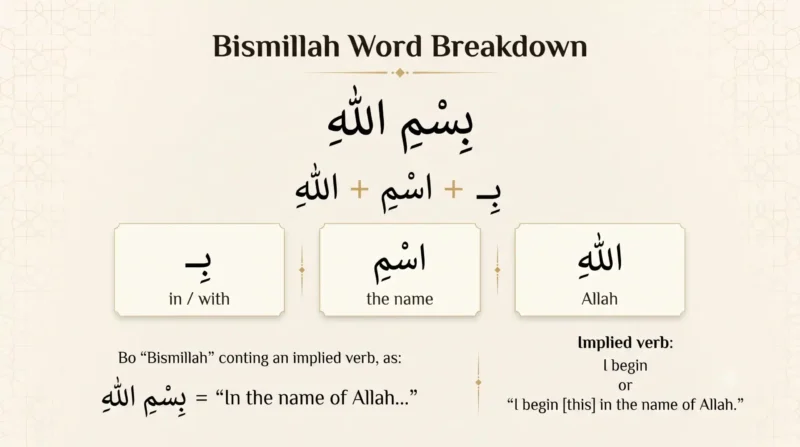
    Fiqh Dua Salah Fiqh of Women

    References & Sources

    1. Sahih al-Bukhari — the hadith of Istikhara, narrated by Jabir ibn Abdullah (RA)

    2. Sunan Abu Dawud, Sunan al-Tirmidhi, Sunan al-Nasa’i — parallel narrations of the same hadith

    3. Surah al-Fatihah (1:1-7) — Quran.com

    External Links

    © 2026 Quran Book Academy. All rights reserved.

    Book Your Free Trial · Empowering Muslims Worldwide to Connect with the Quran

  • Mashallah Meaning: Powerful Ways to Use It Correctly

    Mashallah Meaning: Powerful Ways to Use It Correctly

    Quran Book Academy
    Start Free Trial
    Jehad Mahmoud - writer at Quran Book Academy
    Written by
    Published: February 2, 2026 · Updated: July 23, 2026 · 15 min read

    Mashallah Meaning: 7 Powerful Ways to Use It Correctly

    A complete guide to the meaning, usage, and spiritual depth of one of Islam’s most beautiful expressions.

    Why Understanding Mashallah Meaning Changes How You Practice Islam

    Mashallah meaning — Muslim family expressing gratitude and blessings together
    Mashallah meaning — Muslim family expressing gratitude and blessings together

    Mashallah meaning in English is “God has willed it” or “What Allah has willed.” Muslims commonly say Mashallah when admiring a blessing, to express admiration and gratitude and to acknowledge that the blessing exists by Allah’s will. Understanding its correct usage strengthens your daily Islamic practice and deepens your connection with Allah’s blessings.

    If you have ever felt unsure whether you are saying Mashallah at the right time, or worried about making mistakes with Arabic phrases, you are not alone. Thousands of new Muslims and non-Arabic speakers across the USA, UK, Canada, and Australia share the same concern.

    The fear of mispronunciation, cultural intimidation, and simply not knowing when to use certain expressions can feel overwhelming at first. But the good news is that learning the mashallah meaning is simpler than you think — and this guide will walk you through it step by step.

    Learning Islamic phrases is a journey, not a test. Every Muslim — whether born into the faith or a new revert — started by learning one word at a time.

    The mashallah meaning is deeply rooted in the Quran itself. In Surah Al-Kahf (18:39), Allah recounts the story of two men, where the righteous one advises his companion: “It was better for him to say, when he entered his garden: That which Allah wills (Mashallah)! There is no power but with Allah.”

    This verse reminds us that acknowledging Allah’s will is not just a cultural habit — it is a Quranic instruction and a shield of humility. By the end of this article, you will understand the full mashallah meaning, know exactly when and how to say it, and feel confident using it in your everyday conversations.

    Explore our full range of Islamic Courses for Kids and Adults at Quran Book Academy to deepen your understanding further.

    What Is the Actual Mashallah Meaning in English?

    The actual mashallah meaning is “What Allah has willed” or “God has willed it.” It comes from three Arabic words: “Ma” (what), “Sha” (willed), and “Allah” (God). Muslims say it to acknowledge that all good things come from Allah and to express wonder at His creation.

    This phrase carries a profound spiritual weight. When a Muslim says Mashallah, they are essentially declaring that whatever beauty, success, or goodness they see before them exists solely because Allah willed it. It removes arrogance from the heart and replaces it with gratitude and humility.

    Mashallah in Arabic Script and Transliteration

    Mashallah meaning transliteration guide showing Arabic script and English spellings
    Mashallah meaning transliteration guide showing Arabic script and English spellings

    Here is a quick reference for the correct way to write and spell Mashallah:

    Mashallah in Arabic script, its transliteration, and common English spellings
    Arabic Script Transliteration Common English Spellings
    ما شاء الله Mā shāʾ Allāh MashAllah, Masha’Allah, Ma Sha Allah

    Whether you write it as MashAllah, Masha’Allah, or Ma Sha Allah, the mashallah meaning remains the same. It is an expression of awe and recognition of Allah’s divine will.

    The Quranic Origin of Mashallah

    The mashallah meaning has its strongest roots in Surah Al-Kahf (18:39). The story tells of two men: one who owned a lush, prosperous garden and boasted about his wealth, and another who humbly reminded him that all blessings come from Allah.

    The righteous man told his companion that he should have said “Mashallah, La Quwwata Illa Billah” — meaning “What Allah has willed! There is no power except with Allah.”

    The lesson is timeless. Mashallah is not just a word of praise — it is an expression of humility and gratitude. It reminds us that no matter how impressive something appears, it exists only because Allah decreed it. This Quranic foundation makes the mashallah meaning much deeper than a simple cultural expression. Strengthen your understanding through our Online Quran Classes.

    How to Use Mashallah Correctly — 7 Everyday Situations

    How to use mashallah meaning correctly in 7 everyday Muslim life situations
    How to use mashallah meaning correctly in 7 everyday Muslim life situations

    You use Mashallah correctly by saying it whenever you admire something good — a child’s achievement, someone’s health, a new home, or any blessing. It acknowledges that the blessing exists by Allah’s will. When you admire another person’s blessing, it is also good to pray for blessing by saying “Allahumma barik” (O Allah, bless it).

    Here are the seven most common everyday situations where saying Mashallah is appropriate:

    01

    When you see a beautiful child or baby

    Saying “Mashallah, your baby is so adorable!” is one of the most common uses. Saying “Mashallah” acknowledges that the child’s beauty is by Allah’s will. You may also say “Allahumma barik” to ask Allah to bless the child.

    02

    When someone shares good news

    Whether it is a new job, a graduation, or a marriage announcement, responding with Mashallah shows you recognize Allah’s hand in their blessing.

    03

    When admiring someone’s talent or skill

    Hearing beautiful Quran recitation, tasting someone’s cooking, or watching an athletic achievement — all are perfect moments to say Mashallah, and to add “Allahumma barik” as a supplication for blessing.

    04

    When you see something beautiful in nature

    Sunsets, mountains, blooming gardens, the ocean — Allah’s creation constantly inspires the mashallah meaning in our hearts.

    05

    When someone recovers from illness

    Expressing “Mashallah, you look so much better!” conveys gratitude for Allah’s mercy in restoring their health.

    06

    When visiting someone’s new home or car

    Saying Mashallah when entering someone’s new space is respectful and acknowledges that their blessing is by Allah’s will. Adding “Allahumma barik” is a direct supplication asking Allah to place blessing in it.

    07

    When reflecting on your own blessings

    The mashallah meaning is not only for others. Looking at your own life and whispering Mashallah is a personal act of gratitude that acknowledges Allah’s will behind every blessing.

    The Prophet Muhammad ﷺ confirmed that the evil eye is real: “The evil eye is real…” (Sahih Muslim 2188). However, this hadith does not specifically state that saying “Mashallah” alone prevents it. Muslims commonly use Mashallah to acknowledge Allah’s will, while “Allahumma barik” is a direct supplication asking Allah to bless what is being admired.

    Enroll your children in our Islamic Studies for Kids program and join our Quran Book Academy Telegram Channel for daily practice support.

    How to Reply to Mashallah — The Complete Response Guide

    How to reply to Mashallah meaning — best Islamic responses and phrases guide
    How to reply to Mashallah meaning — best Islamic responses and phrases guide

    There is no single required Islamic response to “Mashallah.” Depending on the context, you may reply politely with “JazakAllahu Khairan” (May Allah reward you), “Barakallahu Feek” (May Allah bless you), or simply “Alhamdulillah” (All praise is due to Allah). Each response shows gratitude and acknowledges the blessing.

    Common and Polite Ways to Respond to Mashallah

    There is no single required Islamic response to “Mashallah.” Depending on the context, you may reply politely with “JazakAllahu khayran,” “BarakAllahu feek,” or “Alhamdulillah.” These are courteous responses, not a prescribed formula for replying to Mashallah.

    Common polite responses when someone says Mashallah, with their Arabic script and meaning
    # Response Arabic Meaning
    1 JazakAllahu Khairan جزاك الله خيرًا May Allah reward you with goodness
    2 Barakallahu Feek بارك الله فيك May Allah bless you
    3 Alhamdulillah الحمد لله All praise is due to Allah

    Related Phrases When Admiring a Blessing

    The Quran mentions the combined expression “Ma sha Allah, la quwwata illa billah” in Surah Al-Kahf 18:39. In its original context, it acknowledges that a blessing exists by Allah’s will and power; it is not prescribed as a required response to someone saying Mashallah.

    “Allahumma barik” (اللهم بارك) means “O Allah, bless it.” It is a direct supplication asking Allah to place blessing in what is being admired, and it is commonly said alongside Mashallah.

    Neither phrase should be presented as a mandatory response to someone saying Mashallah. Learn proper Arabic pronunciation through our Arabic Language Course.

    Mashallah vs Inshallah vs Subhanallah vs Alhamdulillah — What’s the Difference?

    Mashallah meaning vs Inshallah vs Subhanallah vs Alhamdulillah — differences explained
    Mashallah meaning vs Inshallah vs Subhanallah vs Alhamdulillah — differences explained

    Mashallah means “God has willed it” and is used for admiration. Inshallah means “If God wills” for future events. Subhanallah means “Glory be to God” for amazement. Alhamdulillah means “Praise be to God” for gratitude.

    Each phrase has a distinct purpose in a Muslim’s vocabulary. Many people confuse these expressions, so here is a clear comparison:

    Comparison of Mashallah, Inshallah, Subhanallah, Alhamdulillah and TabarakAllah — meaning and when to use each
    Phrase Arabic Meaning When to Use
    Mashallahما شاء اللهWhat Allah has willedAdmiring something present
    Inshallahإن شاء اللهIf Allah willsSpeaking about the future
    Subhanallahسبحان اللهGlory be to AllahAmazement or glorification
    Alhamdulillahالحمد للهPraise be to AllahExpressing gratitude
    TabarakAllahتبارك اللهBlessed is AllahDeep admiration and glorification

    Understanding the mashallah meaning alongside these related phrases helps you speak with greater clarity and spiritual precision. For a deeper look at each one, see our dedicated guides to the Inshallah meaning and the Subhanallah meaning.

    What Is Mashallah TabarakAllah Meaning?

    The combined phrase “Mashallah TabarakAllah” translates to “What Allah has willed; Blessed is Allah.” Muslims use this expression when they witness something truly remarkable.

    It adds a layer of glorification on top of the admiration that Mashallah alone carries. In Arab culture, saying Mashallah TabarakAllah is common when seeing something exceptionally beautiful — such as a newborn, a stunning Quran recitation, or a life-changing accomplishment.

    The mashallah meaning becomes even more powerful when paired with TabarakAllah.

    Can I Say Subhanallah and Alhamdulillah Together?

    Yes. Both SubhanAllah and Alhamdulillah are established forms of dhikr (remembrance of Allah) and may be said together.

    A specific authentic dhikr mentioned in Sahih al-Bukhari is: “Two words which are light on the tongue, heavy on the Scale, and beloved to the Most Merciful: SubhanAllahi wa bihamdihi, SubhanAllahil-Azeem” (Sahih al-Bukhari 6406). The reward mentioned in this hadith relates to that specific wording rather than to pairing the separate words “SubhanAllah” and “Alhamdulillah.”

    How Quran Book Academy Teaches Islamic Phrases the Right Way

    At Quran Book Academy, learning Islamic phrases like Mashallah, Inshallah, and Alhamdulillah does not feel overwhelming — it feels like a natural part of your spiritual growth. The teaching methodology is built on the principle of manageable psychological “chunks,” a proven educational technique where complex knowledge is broken into small, digestible lessons.

    Whether you are an adult learner juggling work and family, or a parent enrolling your child in Islamic Courses for Kids, every lesson is designed to remove the fear of failure and replace it with steady progress.

    Live sessions are conducted via Zoom with certified teachers, and every student’s journey is tracked through a custom LMS (Learning Management System) which sends detailed progress reports to parents and adult learners.

    Free downloadable resources are also available, including a Reward Chart for Salah, a Salah Lesson Plan for Kids, and a Prayer Chart for Kids in Islam — tools that make daily practice fun and structured. This is not just an online course — it is a complete Islamic learning ecosystem designed around how the brain actually learns.

    Explore our Online Quran Classes for Adults and join the Quran Book Academy YouTube Channel and Telegram Channel for ongoing support.

    What We Offer — Islamic Courses for Kids and Adults

    Islamic courses for kids and adults — learn mashallah meaning, Quran, Tajweed, and Arabic
    Islamic courses for kids and adults — learn mashallah meaning, Quran, Tajweed, and Arabic

    Quran Book Academy offers a comprehensive range of courses designed for every level of learner. Available programs include Quran Reading with Tajweed, Quran Memorization (Hifz), Islamic Studies, Arabic Language, and Noorani Qaida for absolute beginners.

    Free resources such as the Reward Chart for Salah, Salah Lesson Plan for Kids, and Prayer Chart for Kids in Islam are included to support students between sessions.

    Our Tech Stack — How We Deliver World-Class Learning

    The Academy uses Zoom for live one-on-one and group sessions. A custom LMS tracks progress, attendance, and milestones automatically.

    Gmail reports are sent to parents weekly, and a dedicated Telegram Channel supports students in practicing Quran reading with Tajweed between sessions. This technology-powered approach ensures that learning the mashallah meaning — and the full Islamic curriculum — happens in a structured and supportive environment.

    Frequently Asked Questions About Mashallah Meaning

    Q. What is the actual meaning of Mashallah?

    Mashallah literally means “What Allah has willed.” It is used by Muslims to express admiration and gratitude while acknowledging that all good things come from Allah alone.

    Muslims commonly say it when admiring a blessing, to acknowledge that the blessing exists by Allah’s will. It should not be presented as a guaranteed formula against the evil eye. When admiring another person’s blessing, it is also good to pray for blessing by saying “Allahumma barik.”

    Q. How to use Mashallah correctly?

    Say Mashallah when you admire something — a person’s beauty, a child’s achievement, someone’s health, or any blessing. It shows you recognize Allah’s will behind all good things.

    Always say it sincerely from the heart, and remember that the mashallah meaning is rooted in humility, not flattery.

    Q. How to reply to Mashallah?

    There is no single required Islamic response to “Mashallah.” Depending on the context, you may reply politely with “JazakAllahu khayran” (May Allah reward you), “BarakAllahu feek” (May Allah bless you), or “Alhamdulillah” (All praise to Allah).

    These are courteous responses, not a prescribed formula. The expression “Ma sha Allah, la quwwata illa billah” appears in Surah Al-Kahf 18:39 in the context of acknowledging that a blessing exists by Allah’s will and power — it is not prescribed as a required reply.

    Q. What can I say instead of Masha Allah?

    You can say “TabarakAllah” (Blessed is Allah), “Allahumma Barik” (O Allah, bless it), or “SubhanAllah” (Glory to Allah). Each carries a similar spirit of acknowledging Allah’s blessings.

    However, the mashallah meaning remains the most specific expression for admiration.

    Q. What does “اللهم بارك” (Allahumma Barik) mean?

    Allahumma Barik means “O Allah, bless it.” It is often said alongside or instead of Mashallah to ask Allah to place blessings upon what is being admired.

    It functions as a dua (supplication) — a direct request that Allah place blessing in what is admired — while Mashallah acknowledges Allah’s will.

    Q. What is TabarakAllah?

    TabarakAllah means “Blessed is Allah” or “May Allah bless.” It is used to glorify Allah when you witness something beautiful or impressive.

    It is often paired with Mashallah as “Mashallah TabarakAllah,” combining admiration with glorification.

    Q. What is Hamdullah?

    Hamdullah is a casual shortening of Alhamdulillah, meaning “Praise be to Allah.” Both are used to express gratitude, especially after receiving good news, finishing a meal, or recovering from illness.

    Understanding the mashallah meaning alongside Hamdullah completes your essential Islamic vocabulary.

    Q. Is it Alhamdulillah or Hamdullah?

    Both are correct. “Alhamdulillah” (الحمد لله) is the full, formal Arabic phrase. “Hamdullah” is its shortened, colloquial version.

    In formal settings like prayer or Quran recitation, always use the full form Alhamdulillah.

    Q. Can I say Subhanallah and Alhamdulillah together?

    Yes. Both SubhanAllah and Alhamdulillah are established forms of dhikr (remembrance of Allah) and may be said together.

    A specific authentic dhikr mentioned in Sahih al-Bukhari is: “SubhanAllahi wa bihamdihi, SubhanAllahil-Azeem” — words the Prophet Muhammad ﷺ described as light on the tongue, heavy on the Scale, and beloved to the Most Merciful (Sahih al-Bukhari 6406).

    Start Your Free Quran Lesson at Quran Book Academy Today

    Start your free Quran lesson today — learn mashallah meaning and more at Quran Book Academy
    Start your free Quran lesson today — learn mashallah meaning and more at Quran Book Academy

    Now that you understand the beautiful mashallah meaning and how to use it in your daily life, imagine what a full Islamic education could do for you or your child.

    At Quran Book Academy, a FREE trial lesson is offered with a certified teacher — no commitment, no pressure. Whether you are in the USA, UK, Canada, or Australia, Zoom-based live classes fit your schedule.

    Plus, download the free Reward Chart for Salah and Prayer Chart for Kids in Islam when you sign up. Do not let another day pass without growing closer to the Quran. The mashallah meaning is just the beginning of your journey.

    Book Your FREE Trial Lesson Now

    Learn More — Related Islamic Phrases

    Now that the mashallah meaning is clear, continue building your Islamic vocabulary with these companion guides:

    Jehad Mahmoud - Hafidha and Arabic Language graduate, writer at Quran Book Academy

    Hafidha of the Quran · Arabic Language Graduate · Writer on Islamic Sciences

    Jehad Mahmoud is a graduate of the Arabic Language department and a Hafidha of the Quran who writes the Islamic educational content at Quran Book Academy.

    She specialises in fiqh, the fiqh of women, and the sharia sciences, making complex rulings accessible to English-speaking Muslim families.

    Her articles are educational, not fatwa. For a ruling on a specific personal situation, readers are advised to consult a qualified scholar or mufti.

    Islamic Phrases Adhkar Arabic Language Fiqh

    References & Sources

    © 2026 Quran Book Academy. All rights reserved.

    Understanding the mashallah meaning is just the beginning of your Islamic learning journey.