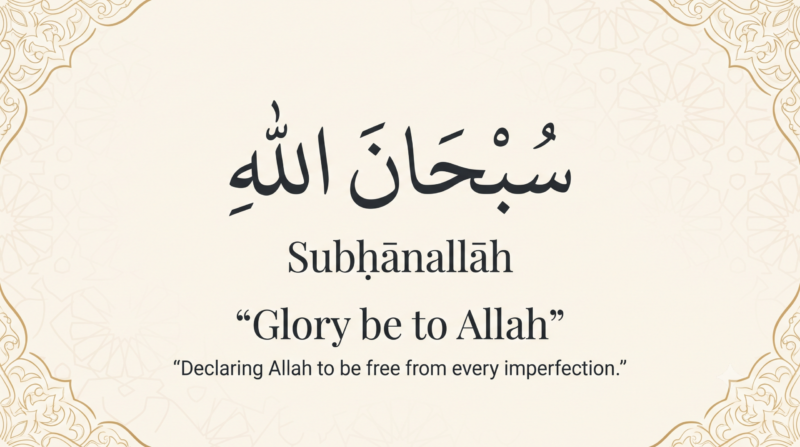
The subhanallah meaning in English is “Glory be to Allah” — more fully, “Allah is free from every imperfection.” Muslims say it in moments of awe, in prayer, and as dhikr after the obligatory prayers, declaring that Allah is far above any flaw, partner or resemblance to His creation.
سُبْحَانَ ٱللَّٰهِ
Transliteration: SubḥānAllāh
Meaning: “Glory be to Allah” · “Allah is free from all imperfection”
Below: the word taken apart root by root, the three pronunciation mistakes English speakers make, an audio player for all three forms of the dhikr, the hadith behind saying it a hundred times a day, the phrase that completes the hundred after prayer, and the clean difference between SubhanAllah and Subhanahu wa Ta’ala.
📖 In This Article
What Does Subhanallah Mean?
The phrase is two words: سُبْحَانَ (subḥāna) followed by ٱللَّٰه (Allāh). The first comes from the Arabic root س-ب-ح. Classical lexicographers give its base sense as swift movement — passing quickly through water or air — and derive the theological meaning from the idea of distance: al-Rāghib al-Iṣfahānī defines tasbīḥ as declaring Allah remote from every deficiency, and Ibn Fāris records the same link in Maqāyīs al-Lugha. The speaker is declaring Allah utterly removed from any defect the mind might attach to Him.
Scholars call this concept tanzīh — declaring Allah free of every deficiency, every need, every partner, and every resemblance to created things. So the definition of subhanallah is not simply “praise.” It is a declaration before it is an affirmation: Allah is not weak, not tired, not divided, not comparable, not in need of anything. The nearest translation of subhanallah in one breath is “Glory be to Allah,” but the fuller sense is “Allah is far above every imperfection.”
Muslims carry three short phrases of dhikr, and they complement one another in meaning. Tasbih (SubhanAllah) declares Allah completely free from every imperfection. Hamd (Alhamdulillah) praises Allah for His perfect attributes and His blessings, and can also express gratitude for His favours. Takbir (Allahu Akbar) declares Allah’s supreme greatness. These three phrases are also authentically recited together as dhikr after the obligatory prayers.
Subhanallah in Arabic — Writing & Pronunciation
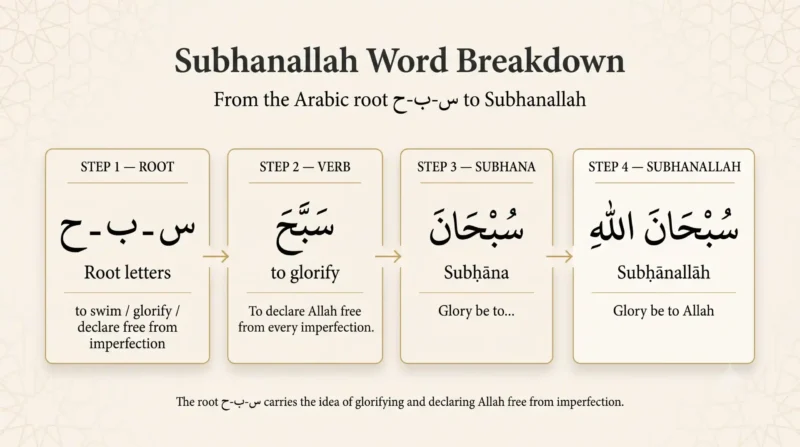
Written with full harakat, subhanallah in Arabic is سُبْحَانَ ٱللَّٰهِ. Letter by letter, it maps onto English like this:
Three mistakes cover almost every mispronunciation:
- Turning ح into an English “h.” Arabic ح is produced from the middle of the throat and must remain distinct from ه. The English h is much closer to Arabic ه than to ح, so using an ordinary English h sound can change the Arabic letter you are producing.
- Making the س heavy. Some learners darken the s until it edges towards ص. In this word the س stays thin and bright all the way through, with the tongue tip low against the lower front teeth.
- Pausing between the two words. The alif of ٱللَّٰه is a hamzat waṣl, so it is dropped whenever the phrase is joined. Say Subḥāna-llāh in one breath — not “Subḥāna … Allāh” with a stop and a fresh glottal start in the middle.
On spelling: SubhanAllah, Subhan Allah, Subhaan Allah and Subhanallah are all the same phrase. Arabic has no single official English transliteration, so none of these is wrong — they only differ in how much of the vowel length they try to show. In this article the academic form SubḥānAllāh is used wherever precision matters, with ḥ marking the Arabic ح so it is never confused with English h. You will also see both SubḥānAllāh and SubḥānAllāhi: the final kasra is voiced when the phrase continues and dropped when you stop. If the letters themselves are new to you, this is precisely where our students start: children learn to pronounce Arabic letters correctly from the very first lesson.
Listen & Repeat — Interactive Pronunciation Tool
Transliteration only takes you halfway. Every track below is a recording of a qualified reciter — no synthetic voices are used anywhere on this page, because a human recording is far more reliable for teaching a precise makhraj and the tafkhīm of the heavy lām. Tap any track to hear it, tap again to repeat, and switch on slow mode if the throat letter is going past you. Your slow-mode choice is remembered on this device.
🔊 Three tracks — tap to play
Tap a track to hear it. Tap again to repeat as many times as you need.
All three mistakes above are articulation habits, not memory problems — which means they are fixed by a teacher’s ear, not by more repetition. A single session with one of our Al-Azhar certified teachers usually corrects a ح that has been wrong for years.
When Do Muslims Say Subhanallah?
There is no fixed list of permitted moments — tasbih is open speech, said whenever the heart reaches for it. In practice, five situations account for most of it:
Witnessing something astonishing in creation
A newborn’s hand, a thunderstorm over the sea, the sheer scale of a mountain range. The awe belongs to the Creator, so the tongue turns to Him rather than to the thing itself.
Hearing something unworthy said about Allah
Here SubhanAllah works as a correction — a spoken refusal of the claim. The Quran uses the exact phrase this way when it answers those who attribute a son or a partner to Allah: سُبْحَانَ ٱللَّٰهِ عَمَّا يَصِفُونَ — “Glory be to Allah above what they ascribe to Him” (Al-Mu’minun 23:91, and again at As-Saffat 37:159).
In rukū’ of every prayer
سُبْحَانَ رَبِّيَ ٱلْعَظِيمِ — Subḥāna Rabbiyal-ʿAẓīm, “Glory to my Lord, the Most Great,” said while bowing, typically three times.
In the tasbih after each obligatory prayer — 33 times
SubhanAllah 33, Alhamdulillah 33, Allahu Akbar 33, then completing the hundred with the declaration of tawhid given below. A second authentic narration gives the takbir as 34 instead, with no closing phrase — both patterns are established, and either one may be used.
In general dhikr through the day
Walking, waiting, driving, unable to sleep. This is the form of worship with the fewest prerequisites of all — no wudu, no direction, no fixed time.
Abu Hurayrah (may Allah be pleased with him) reported that the Prophet ﷺ taught that whoever glorifies Allah thirty-three times, praises Him thirty-three times and magnifies Him thirty-three times after prayer, then completes the hundred with the declaration that there is no god but Allah alone, will have his sins forgiven even if they were like the foam of the sea.
The Phrase That Completes the Hundred
33 + 33 + 33 comes to ninety-nine. The hundredth is a single sentence of tawhid, and it is the part most beginners are never actually taught:
لَا إِلَٰهَ إِلَّا ٱللَّٰهُ وَحْدَهُ لَا شَرِيكَ لَهُ، لَهُ ٱلْمُلْكُ وَلَهُ ٱلْحَمْدُ وَهُوَ عَلَىٰ كُلِّ شَيْءٍ قَدِيرٌ
Transliteration: Lā ilāha illa-llāhu waḥdahu lā sharīka lah, lahul-mulku wa lahul-ḥamd, wa huwa ʿalā kulli shay’in qadīr
Meaning: “There is no god but Allah alone, He has no partner. His is the dominion and His is the praise, and He has power over all things.”
On the 33 versus 34 question: both come from authentic narrations. Sahih Muslim 597 gives 33 / 33 / 33 closed by the sentence above. Sahih Muslim 596, narrated by Ka’b ibn ‘Ujrah, gives 33 / 33 / 34 and states the wording plainly as دُبُرَ كُلِّ صَلَاةٍ مَكْتُوبَةٍ — after every prescribed prayer. That second narration is also why this formula is described here as belonging to the five obligatory prayers rather than to every voluntary prayer as well.
Notice how little the phrase asks of you. It fits in the gap between a red light and a green one. That simplicity makes it an easy form of dhikr to carry throughout the day.
Subhanallahi wa Bihamdihi — The Complete Dhikr
سُبْحَانَ ٱللَّٰهِ وَبِحَمْدِهِ
Transliteration: SubḥānAllāhi wa biḥamdihi
Meaning: “Glory be to Allah, and praise be to Him”
The subhanallahi wa bihamdihi meaning joins the two halves described earlier into a single sentence: Allah is free of every defect (tasbih), and praise belongs to Him (hamd). Abu Hurayrah reported that the Prophet ﷺ said whoever says it a hundred times in a day will have his sins erased even if they were as much as the foam of the sea — Sahih al-Bukhari 6405.
سُبْحَانَ ٱللَّٰهِ وَبِحَمْدِهِ، سُبْحَانَ ٱللَّٰهِ ٱلْعَظِيمِ
Transliteration: SubḥānAllāhi wa biḥamdihi, SubḥānAllāhil-ʿAẓīm
Meaning: “Glory be to Allah and praise be to Him; glory be to Allah, the Most Great”
This longer form — subhanallahi wa bihamdihi subhanallahil azeem — is the one described in Sahih al-Bukhari 6406 as two expressions light on the tongue, heavy on the scale, and beloved to the Most Merciful. Ibn Hajar notes in Fath al-Bari that this is the closing hadith of Sahih al-Bukhari, and that its point is the contrast itself: almost no effort in this life, considerable weight in the next.
A practical note on the hundred. Most people who manage it do not sit down to count; they split it — thirty-three after Fajr, a stretch on the commute, the rest before sleep. And on pronunciation, the ending of biḥamdihi is commonly written both as bihamdihi and bihamdih; both reflect the same word, the difference being whether the final short vowel is voiced or stopped at the end of the phrase.
Subhanallah vs Subhanahu wa Ta’ala (SWT) — Not the Same Thing
These two get confused constantly, and the difference is simple once you see it. SubhanAllah is something a person says — a complete sentence, spoken aloud, in awe or in dhikr. Subhanahu wa Ta’ala is an honorific that attaches to the name of Allah when writing or speaking about Him. The subhana wa ta’ala meaning is “Glorified and Exalted is He,” and it never stands alone as a sentence — it always follows a mention of Allah.
A third thing sits nearby and is worth naming so it stops causing confusion: tasbih. That word refers to the act of saying SubhanAllah, and also to the counted set of thirty-three after prayer, and in everyday speech to the beads used to keep the count. So “do your tasbih” means “say your post-prayer dhikr” — not a fourth phrase you have yet to learn.
Subhanallah, Alhamdulillah, Allahu Akbar — What’s the Difference?
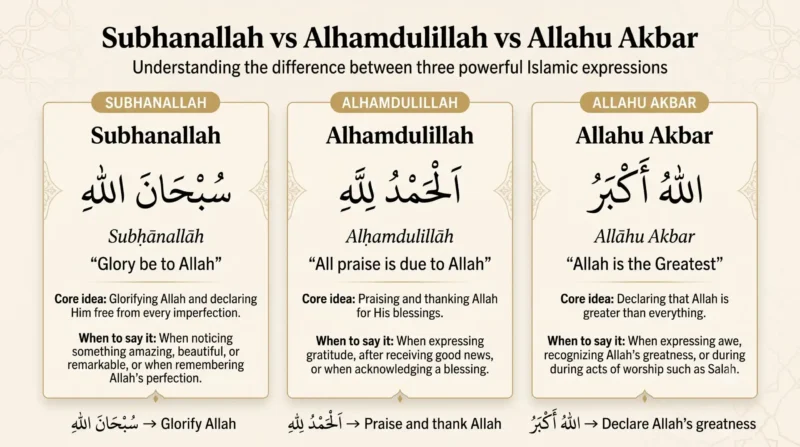
A quick test that works nearly every time: if you are amazed, say SubhanAllah; if you are grateful, say Alhamdulillah; if you are overwhelmed by size or power, say Allahu Akbar. And two neighbours complete the daily set — MashAllah for admiring a blessing someone already has, and Bismillah meaning “in the name of Allah,” said at the start of any action.
Teaching Subhanallah to Children
Children learn this phrase fastest when it is attached to something they can see. The simplest game: on a walk, each person points at one thing Allah made — a beetle, a cloud shaped like a whale, the moon in daylight — and everyone says SubhanAllah together. Within a week most children start doing it unprompted, which is exactly the habit you are after.
For the post-prayer count, give them a physical tasbih with beads rather than fingers. Young children lose count in the thirties and get frustrated; beads remove the arithmetic entirely. Either established pattern works — 33 / 33 / 33 closed with the tawhid sentence, or 33 / 33 / 34 — so pick one and keep it the same so the child is not relearning the count each week. If the full set still feels like too much, start with three of each and build up over a month. Nothing is lost by going slowly.
One more thing that helps: explain the meaning in child-sized language — “Allah is perfect, and nothing bad or broken belongs to Him.” Our Islamic studies for kids classes build the daily adhkar in this way, one phrase at a time, with a teacher who keeps it light.
Frequently Asked Questions About Subhanallah
Q. What does Subhanallah mean in English?
Subhanallah means “Glory be to Allah.” More fully, it declares that Allah is free from every imperfection, partner or resemblance to His creation. Muslims say it in moments of awe, in prayer, and as part of daily dhikr.
Q. When should you say Subhanallah?
Say it when you witness something awe-inspiring in creation, when you hear something unworthy said about Allah, while bowing in prayer, in the tasbih after each obligatory prayer, and at any point in the day as general dhikr. No wudu, fixed direction or set time is required.
Q. How many times should you say Subhanallah after prayer?
Thirty-three times, followed by Alhamdulillah thirty-three times and Allahu Akbar thirty-three times, then completing the hundred with Lā ilāha illa-llāhu waḥdahu lā sharīka lah, lahul-mulku wa lahul-ḥamd, wa huwa ʿalā kulli shay’in qadīr. This pattern is reported in Sahih Muslim 597. A second authentic narration, Sahih Muslim 596, gives the takbir as thirty-four with no closing phrase, and states explicitly that it is said after each prescribed (obligatory) prayer. Both patterns are established.
Q. What is the difference between Subhanallah and Alhamdulillah?
Subhanallah declares Allah free from every imperfection. Alhamdulillah praises Him for His perfect attributes and His blessings, and can also express gratitude for His favours. In practice, Subhanallah is said in wonder, Alhamdulillah in gratitude.
Q. What does SubhanAllahi wa bihamdihi mean?
It means “Glory be to Allah, and praise be to Him” — combining tasbih and hamd in one phrase. Sahih al-Bukhari 6405 reports that whoever says it a hundred times a day will have his sins erased even if they were like the foam of the sea.
Q. Is Subhanallah mentioned in the Quran?
Yes — the exact phrase سُبْحَانَ ٱللَّٰهِ appears in several verses, including Yusuf 12:108 (“Glory be to Allah, and I am not one of the polytheists”), Al-Mu’minun 23:91 and As-Saffat 37:159 (“Glory be to Allah above what they ascribe to Him”), and An-Naml 27:8 (“Glory be to Allah, the Lord of all worlds”). Related forms of tasbih appear far more widely still — Al-Isra opens with “Subḥāna alladhī asrā” (17:1), the same surah states that everything in the heavens and earth glorifies Allah (17:44), and the angels say “Subḥānaka” in Al-Baqarah 2:32.
Q. Can non-Muslims say Subhanallah?
It is commonly heard across Arabic-speaking cultures from people of different faiths, and Muslims generally take no issue with it when it is said respectfully rather than mockingly. Since it is a statement about Allah, the question of how it is used is one of intention and respect; anyone wanting a formal ruling for their own situation should ask a qualified scholar.
Q. What is the difference between Subhanallah and Subhanahu wa Ta’ala?
Subhanallah is a complete phrase a person says: “Glory be to Allah.” Subhanahu wa Ta’ala (“Glorified and Exalted is He”) is an honorific placed after the name of Allah when writing or speaking about Him, usually abbreviated as SWT.
Say It the Way It Was Taught
Reading a transliteration will never fix a throat letter. The ح in Subhanallah, the length of the alif, the heavy lām — these are corrected by a teacher listening to you and telling you where your tongue is sitting.
Book a free trial lesson with an Al-Azhar certified teacher — one-to-one on Zoom, for you or your children, wherever you are in the USA, UK, Canada or Australia.
Book Your FREE Trial Lesson NowLearn More — Related Islamic Phrases
Now that the subhanallah meaning is settled, these companion guides complete the set of phrases you will hear every single day:
Hafidha of the Quran · Arabic Language Graduate · Writer on Islamic Sciences
Jehad Mahmoud is a graduate of the Arabic Language department and a Hafidha of the Quran who writes the Islamic educational content at Quran Book Academy.
She specialises in Quranic Arabic, tajweed and the sharia sciences, making correct pronunciation and complex rulings accessible to English-speaking Muslim families.
Her articles are educational, not fatwa. For a ruling on a specific personal situation, readers are advised to consult a qualified scholar or mufti.