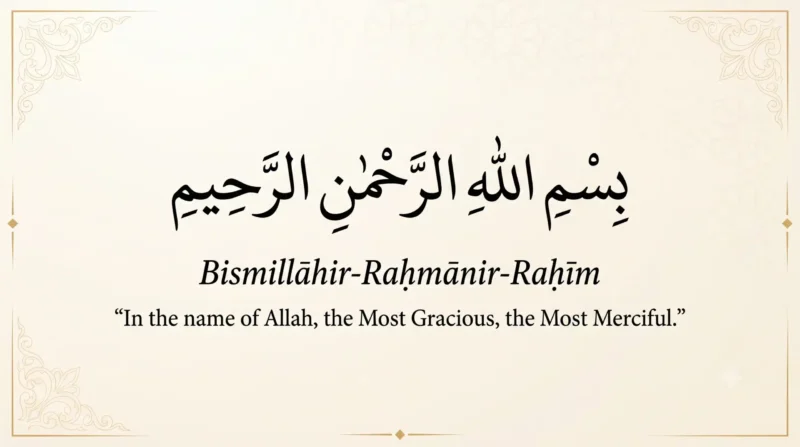
The bismillah meaning in English is “in the name of Allah.” It is the short form of the full phrase, the Basmala, which Muslims say before eating, before Wudu, before travelling, and at the opening of almost every surah of the Quran.
بِسْمِ ٱللَّٰهِ ٱلرَّحْمَٰنِ ٱلرَّحِيمِ
Transliteration: Bismillahir Rahmanir Raheem
Translation: “In the name of Allah, the Most Gracious, the Most Merciful”
Below: the word split letter by letter, the real difference between Ar-Rahman and Ar-Raheem, every English spelling you have seen online mapped against the Arabic, an audio player you can repeat after, and the moments in a Muslim’s day when the phrase belongs.
📖 In This Article
What Does Bismillah Mean?
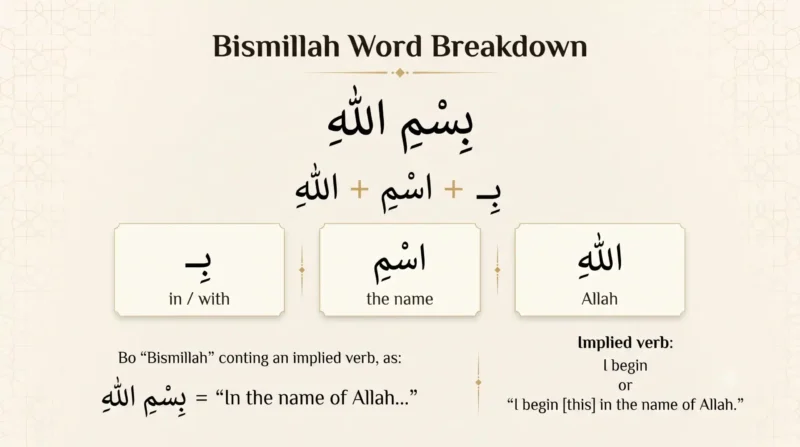
Like most Arabic expressions that reach English as a single block of letters, Bismillah is not one word. It is a preposition, a noun and the divine name fused together in speech:
Put together, the bismillah definition is simply “in the name of Allah.” Said on its own, that is the short form. Extend it and you have the full Basmala — Bismillahir Rahmanir Raheem — with two of Allah’s names attached: Ar-Rahman and Ar-Raheem.
The hidden verb
Arabic grammarians point out that the phrase is grammatically incomplete on its own — it attaches to an unspoken verb, which the classical commentators estimate as coming after it: “in the name of Allah I begin.” The Name is placed first, and the unspoken verb takes its shape from whatever you are about to do: I eat, I read, I travel. That is why Bismillah normally belongs at the beginning of an action. In certain established cases — eating is the clearest — if it was forgotten at the start, it is said as soon as it is remembered.
So when someone asks what is bismillah in English, the honest answer is that it is a declaration of intent as much as a translation. You are not describing Allah; you are attaching the next few minutes of your life to His name. If you are starting from the Arabic alphabet, our Quran reading course for beginners teaches this phrase in the very first lesson, because the Basmala stands at the head of nearly every surah and is one of the first phrases a new Quran reader meets.
Ar-Rahman and Ar-Raheem — Two Different Mercies
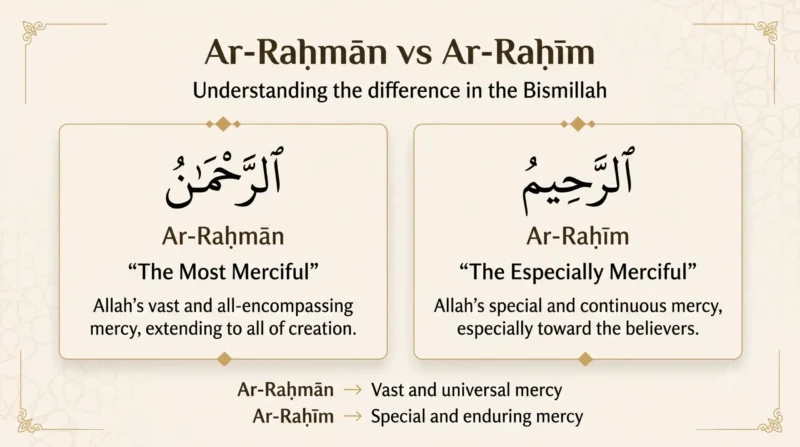
English translations often render both names as “the Merciful,” which leaves readers assuming the phrase repeats itself for rhythm. It does not. Both names grow from the same three-letter root ر-ح-م (r-ḥ-m), the root that also gives Arabic the word for a mother’s womb — but they sit on different grammatical patterns, and in Arabic the pattern carries meaning.
Ar-Rahman ٱلرَّحْمَٰن
The pattern fa’lān in Arabic signals intensity and fullness — a quality overflowing at this very moment. Ar-Rahman is mercy so vast that it reaches every creature without exception: the believer and the disbeliever, the animal, the newborn, the person who has never once thanked Him for it. It is a name the Quran treats as belonging to Allah alone.
Ar-Raheem ٱلرَّحِيم
The pattern fa’īl signals a settled, permanent, continuing attribute. Ar-Raheem is mercy that keeps arriving — specific, sustained, and described in the Quran as directed particularly toward the believers, in this life and the next.
Held side by side, the two Names put Allah’s mercy in front of the reader before anything else: the mercy that gave you this morning is the same mercy that will not let go of you. Their place at the opening of the Quran is part of why a student of Tajweed rules learns to give the madd in ٱلرَّحْمَٰن and ٱلرَّحِيم its correct length — two counts when joining to what follows, and 2, 4 or 6 counts when stopping on either word — rather than treating breath or speed as the rule.
Bismillah in Arabic — Writing & Correct Transliteration
Written fully vocalised, the phrase is:
بِسْمِ ٱللَّٰهِ ٱلرَّحْمَٰنِ ٱلرَّحِيمِ
Now the part that sends people to Google. Arabic has no single official transliteration into the Latin alphabet, so the same three-and-a-bit words appear in English in a dozen shapes. Every spelling in the table below refers to the identical Arabic phrase. The first four are different transliteration conventions, and none of them is wrong — they differ only in how much of the Arabic sound they preserve. The last row is not a convention at all; those are simply misspellings.
Three Tajweed Points Worth Knowing
- The hamzat wasl in ٱللَّٰه and ٱلرَّحْمَٰن. The alif carries a small ṣād-shaped mark (ٱ). It is pronounced only when you begin speech on that word, and it drops when the word is joined to what came before it. That is why بِسْمِ ٱللَّٰهِ is read Bismillahi in one connected movement rather than Bismi-Allahi with a separate glottal stop in the middle.
- The silent lām in ٱلرَّحْمَٰن and ٱلرَّحِيم. The lām of “al” is not pronounced, because rā’ (ر) is a “sun letter” (ḥarf shamsī). The lām fully assimilates into the rā’, shown in the script by the shadda (ٱلرَّحْمَٰنِ), which is exactly why the transliteration reads Bismillahir Rahman and not Bismillahi al-Rahman.
- The madd in ٱلرَّحْمَٰن and ٱلرَّحِيم. The yā’ after the kasra in ٱلرَّحِيم, and the small vertical alif (ٰ) over the mīm in ٱلرَّحْمَٰن, are both natural prolongations (madd tabī’ī), held for two counts when you continue on to the next word. If you stop on either word, the madd becomes madd ‘āriḍ li-s-sukūn and may be held for 2, 4 or 6 counts. Clipping it short is the single most common error English speakers make, and the vertical alif is the easiest of all to miss because it isn’t written as a full alif.
None of the three is memorisation work — they are articulation habits, which is why they correct fastest with a teacher listening in real time rather than from a book.
Listen & Repeat — Bismillah Pronunciation Tool
The recitation below is Sheikh Mahmoud Khalil Al-Husary, whose measured pace makes him the standard choice for learners. Tap any card to hear that part on its own. Turn on Loop to hear it repeatedly, Slow to stretch the vowels out, and My turn to leave a silent gap after each segment so you can repeat it back before the next play.
🔊 Phrase-by-phrase player
Tap a card to hear it. Your settings and progress are remembered on this device.
0 of 4 segments practised
Audio courtesy of EveryAyah.com (the Basmala as recited before Surah Al-Fatiha, numbered 1:1 in the standard mushaf — Husary murattal). If the joining between words is still going past you after a few listens, that is normal — it is the exact thing a teacher fixes in one session, and you can try that free with an free trial lesson.
When Do Muslims Say Bismillah?
The general principle is that Bismillah belongs at the start of anything worth doing. Beyond that general habit, a number of specific moments are established in the Sunnah:
Before eating and drinking
The Prophet ﷺ instructed a young boy at the table to mention the name of Allah, eat with his right hand, and eat from what was nearest to him — Sahih al-Bukhari 5376, Sahih Muslim 2022.
Before Wudu
A report in Sunan Abi Dawud 101 states that there is no Wudu for one who does not mention the name of Allah over it. Hadith scholars discuss the chain of this report, and the jurists differ accordingly on whether saying it is obligatory or strongly recommended — but no school disputes that it should be said.
On entering the home
In Sahih Muslim 2018, the Prophet ﷺ described that when a person mentions Allah’s name on entering his house and on his food, the shaytan finds neither lodging for the night nor a meal.
When mounting for travel
‘Ali (may Allah be pleased with him) said Bismillah as he put his foot in the stirrup, and praised Allah once he had settled on the animal’s back — Jami’ at-Tirmidhi 3446. The longer travelling supplication that follows, recorded in Sahih Muslim 1342, opens with takbir — “Allahu Akbar” said three times — and then the Quranic praise of the One who subjected this transport to us.
When slaughtering — a case of particular weight
Here the phrase is not a courtesy. The Quran states plainly not to eat of that over which the name of Allah has not been mentioned — Surah Al-An’am 6:121. Scholars therefore give the Tasmiyah at slaughter special importance, although the schools of Islamic law differ over whether it is an absolute condition for the meat to be lawful, and over the ruling when it is left out through forgetfulness.
Before beginning a surah — after the Isti’adhah
The order matters. Surah An-Nahl 16:98 instructs the reciter to seek refuge in Allah first — A’udhu billahi min ash-shaytan ir-rajeem — and when you begin from the start of a surah, the Basmala follows it, except at the start of At-Tawbah. If you begin from the middle of a surah, the scholars of recitation allow you to begin either with the Basmala or without it.
At the start of any task
Leaving the house, sitting an exam, opening a laptop, beginning a difficult conversation. A frequently quoted report about every important matter being “cut off” if not begun with Bismillah is graded weak by a number of hadith specialists, so it is better to rest this habit on the broad practice of the Sunnah rather than on that specific wording.
The one exception people ask about: Surah At-Tawbah is the only surah of the Quran that does not open with the Basmala. Nothing was removed — the Companions who compiled the mushaf did not place it there, and the classical explanations for that range from the surah’s opening theme of disavowal to an early question about whether At-Tawbah and Al-Anfal were counted as one surah. When beginning recitation from the start of At-Tawbah, reciters say the Isti’adhah without the Basmala after it.
Bismillah and the Quran — Is It a Verse?
The Basmala appears 114 times in the Quran. It opens 113 of the 114 surahs — all except At-Tawbah — and it occurs once more inside the body of a surah, in the letter of Sulayman (peace be upon him) to the Queen of Sheba at Surah An-Naml 27:30. All scholars agree that this occurrence is Quranic; there it forms part of verse 30 rather than a separate ayah of its own.
Whether the Basmala at the head of each surah is itself a counted verse of that surah is a long-recognised difference of opinion between the schools, and it is one of those questions where every position has serious evidence behind it. In the Shafi’i school it is counted as the first ayah of Al-Fatiha and recited aloud in the audible prayers. In the Hanafi school it is treated as a verse revealed for separating the surahs rather than as part of each one, and it is recited quietly. The Maliki position generally omits it at the start of Al-Fatiha in obligatory prayer. Recitation practice in the different qira’at reflects the same range.
None of this is a dispute about the words themselves. The disagreement is over the status of the Basmala at the openings of the surahs — whether it is part of the surah, an independent revealed verse placed there to separate one surah from the next, or not counted as part of the surah text at all — and verse-numbering and prayer practice follow from that. A Muslim following any of the four schools is on solid ground. If you want to know what applies in your own prayer, follow the school your local mosque teaches, or ask a qualified scholar rather than settling it from an article.
Bismillah vs Inshallah vs Mashallah vs Alhamdulillah
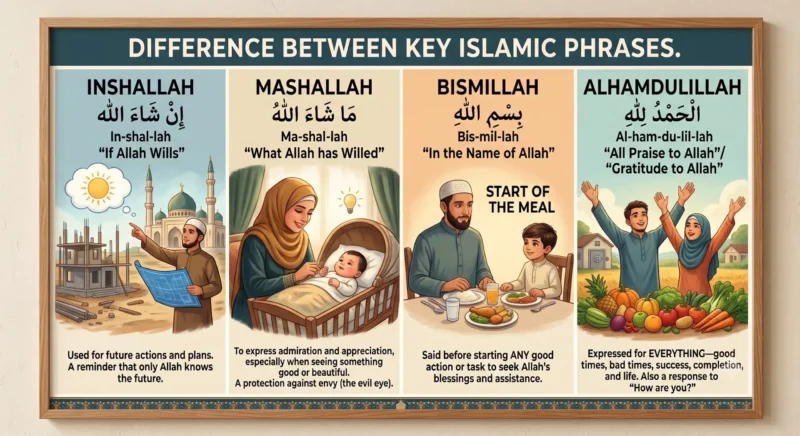
These four are the phrases you will hear most in any Muslim household, and they are almost never interchangeable. The cleanest way to keep them apart is by where in the action each one sits.
One meal walks you through all four. You sit down and say bismillah as you reach for the food. Your host mentions she is cooking again next Friday — inshAllah. Her son brings the tray in without spilling a drop — MashAllah. And when the plates are empty, alhamdulillah. A fifth phrase, subhanallah meaning “glory be to Allah,” joins the set for moments of genuine amazement.
Teaching Children to Say Bismillah
Bismillah is usually the first phrase a Muslim child learns to use on purpose, and it sticks best when it is taught as a rule about beginnings rather than as a rule about food: we say bismillah before we start anything. Before the seatbelt clicks. Before the pencil case opens. Before the swing goes.
The mealtime routine does most of the work on its own. Hands washed, everyone seated, nobody eats until the youngest has said it — and children who are given that small job say it enthusiastically for years. Pair it with alhamdulillah at the end and the meal quietly becomes a complete lesson.
If they forget mid-meal
بِسْمِ ٱللَّٰهِ أَوَّلَهُ وَآخِرَهُ
Bismillahi awwalahu wa akhirahu — “In the name of Allah, at its beginning and its end.” Reported in Sunan Abi Dawud 3767. Teaching a child this one line removes the anxiety of having got it wrong, which matters more than it sounds.
Our Islamic studies for kids classes build these daily phrases into the first term through games and repetition, with teachers who are used to teaching children born and raised in English-speaking countries.
Frequently Asked Questions About Bismillah
Q. What does Bismillah mean in English?
Bismillah means “in the name of Allah.” It combines bi (“in”), ism (“name”) and Allah. Muslims say it before beginning an action, with an implied verb behind it: “in the name of Allah I begin.” The full form adds two of Allah’s names — the Most Gracious, the Most Merciful.
Q. What is the difference between Bismillah and Bismillahir Rahmanir Raheem?
Bismillah is the short form, “in the name of Allah.” Bismillahir Rahmanir Raheem is the complete phrase, known as the Basmala, and adds “the Most Gracious, the Most Merciful.” The short form is used for everyday actions such as eating; the full form opens the surahs of the Quran.
Q. What is the difference between Ar-Rahman and Ar-Raheem?
Both come from the root r-ḥ-m, but they are not synonyms. Ar-Rahman describes mercy that is vast and universal, reaching all of creation. Ar-Raheem describes mercy that is continuous and specific, described in the Quran as directed particularly toward the believers. Translating both as “the Merciful” loses that distinction.
Q. When should you say Bismillah?
Before any action worth beginning: eating and drinking, Wudu, entering the home, mounting for travel, and beginning a surah after the Isti’adhah. At slaughter it carries particular weight, although the schools differ over the detail of the ruling. The general rule is that it is said at the start of an action — and if you forget at the start of a meal, you say it as soon as you remember.
Q. Is Bismillah a verse of the Quran?
It appears 114 times, opening 113 surahs, and all scholars agree that the Basmala inside Surah An-Naml (27:30) is Quranic — there it forms part of verse 30 rather than a verse of its own. At the openings of the surahs the schools differ over whether it is part of the surah, an independent verse revealed to separate the surahs, or not counted as part of the surah text, and verse numbering and reciting it aloud in prayer follow from that.
Q. Why does Surah At-Tawbah not begin with Bismillah?
At-Tawbah is the only surah without the Basmala at its head. The Companions who compiled the mushaf did not write it there. Classical explanations connect this to the surah’s opening theme of disavowal, and to an early question over whether At-Tawbah and Al-Anfal were treated as a single surah. Nothing was removed from the text.
Q. Can non-Muslims say Bismillah?
Yes. The phrase is part of everyday Arabic speech and is used respectfully by people of different faiths across the Arab world. There is nothing preventing a non-Muslim from saying it sincerely or reading it aloud while studying. What is unwelcome is using it mockingly, which is true of any sacred phrase.
Q. What should you say if you forget Bismillah before eating?
Say “Bismillahi awwalahu wa akhirahu” — “in the name of Allah, at its beginning and its end” — as soon as you remember, even mid-meal. This is reported in Sunan Abi Dawud 3767. There is no need to stop eating or start the meal again.
Learn to Recite It the Way It Was Revealed
You now know the full bismillah meaning, the two mercies inside it, and every spelling you are likely to meet. The step that changes everything is hearing your own recitation corrected out loud.
A free trial lesson with an Al-Azhar certified teacher is available to every new student — one-to-one on Zoom, scheduled around your week, whether you are in the USA, UK, Canada or Australia.
Book Your FREE Trial Lesson NowLearn More — Related Islamic Phrases
Bismillah is the phrase for beginnings. These three complete the set you will hear every single day:
Hafidha of the Quran · Arabic Language Graduate · Writer on Islamic Sciences
Jehad Mahmoud is a graduate of the Arabic Language department and a Hafidha of the Quran who writes the Islamic educational content at Quran Book Academy.
She specialises in fiqh, the fiqh of women, and the sharia sciences, making complex rulings and Quranic vocabulary accessible to English-speaking Muslim families.
Her articles are educational, not fatwa. For a ruling on a specific personal situation, readers are advised to consult a qualified scholar or mufti.