What Is Ijazah? The Honest Truth in 5 Real Facts
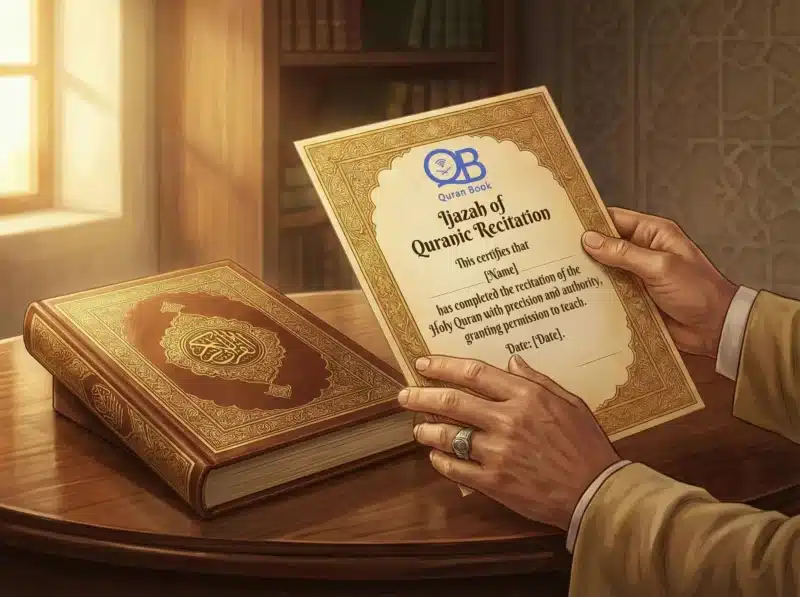
What is Ijazah in Quran? In plain terms, it’s a formal certificate of permission that a qualified teacher grants once a student has recited the Quran, or a defined portion of it, correctly and often from memory. It confirms an unbroken chain of transmission back to the Prophet Muhammad ﷺ, and it authorizes the student to recite — and in many cases to teach — that portion with confidence. Here’s the honest, practical breakdown of what this credential really is — and everything around it.
What Is Ijazah? A Clear Definition
The word Ijazah, sometimes spelled Ijaza or Ejaza, refers to one of the oldest forms of academic credentialing in the world. Long before universities issued diplomas, Islamic scholars issued them: individual, teacher-to-student permissions that certified a specific body of knowledge had genuinely been mastered.
For the Quran specifically, this permission certifies that a student has recited a defined portion — sometimes a chapter, sometimes the entire Quran — directly to a qualified teacher, with correct pronunciation, correct Tajweed, and, depending on the type, complete memorization. The teacher listens, corrects every mistake, and only signs off once the recitation meets the required standard.
Historically, the document itself often opened with a short prayer, introduced the student, recorded the date, and listed the teacher’s own line of teachers reaching back through history. That last part, the chain, is what gives an Ijazah its weight. It isn’t a test score. It’s proof of a real, verified relationship, passed down generation after generation.
That matters more than ever today, when anyone can publish a Quran recitation video online. This kind of certification is one of the few credentials that simply cannot be faked, because its entire value depends on a real, traceable teacher standing behind it.
What Does “Ijazah” Mean in Arabic?
Ijazah (إجازة) comes from the Arabic root ج-و-ز, meaning “to permit,” “to allow,” or “to pass.” You’ll also see it written Ijaza or Ejaza — these are simply different English spellings of the same Arabic word, not different concepts.
In everyday Arabic, the word can describe any kind of permission, license, or even a vacation. In Islamic scholarship, though, it narrows to something specific: certified authorization in a particular field of religious knowledge — Quran recitation, memorization, Hadith, or a specific Qira’ah, or reading, of the Quran.
So when someone asks what “ejaza” means in Arabic in a Quranic context, the honest answer is: permission, earned, and formally granted by someone already qualified to grant it.
Ijazah vs. Sanad — What’s the Difference?
Ijazah and Sanad are two sides of the same coin, and even native Arabic speakers use the words almost interchangeably. Here’s the honest distinction.
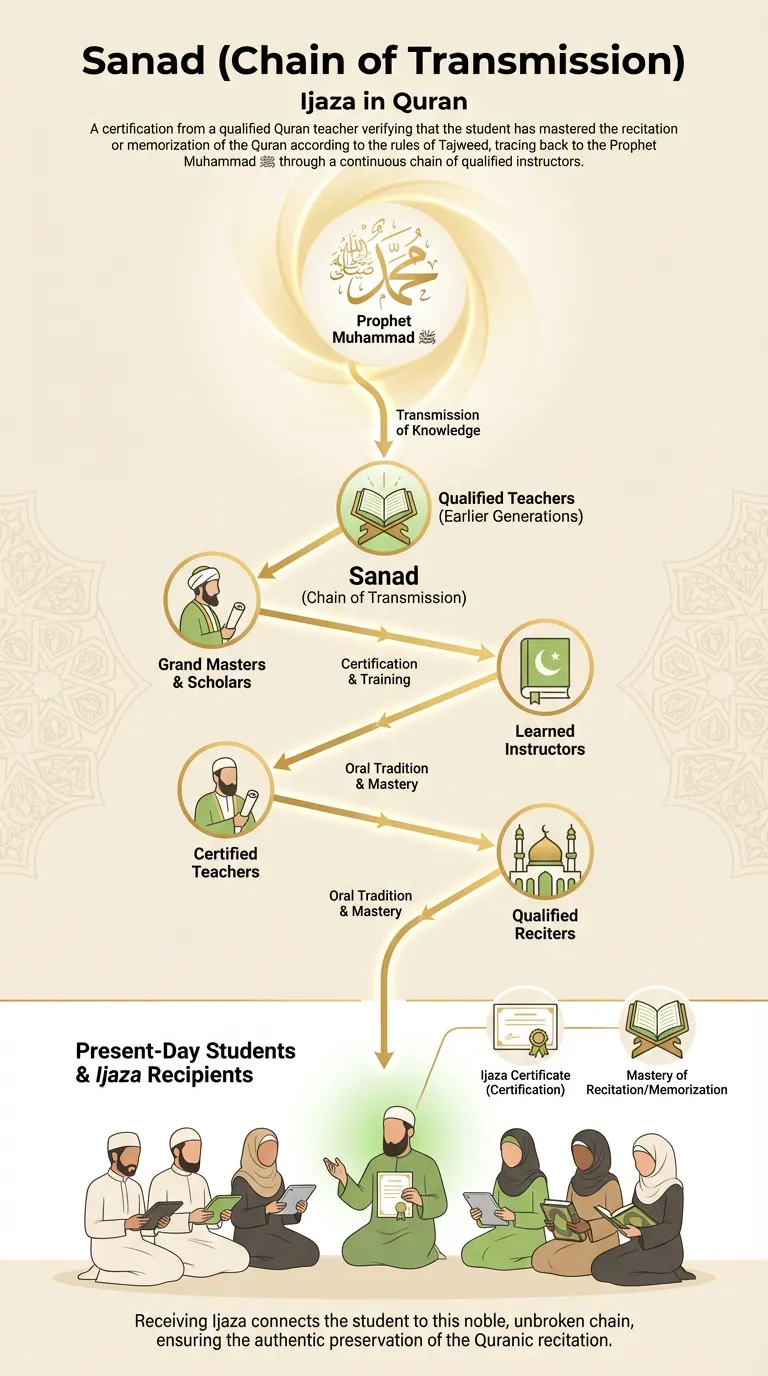
One is the certificate itself — the formal permission a teacher gives a student. The other, Sanad (سند), is the chain of transmission that certificate documents: the unbroken list of teachers connecting that student, name by name, all the way back to the Prophet Muhammad ﷺ.
Think of the Sanad as the family tree, and the certificate as the diploma that places you on it. A genuine Ijazah can’t exist without an accompanying Sanad, because its entire value comes from proving that chain is real and unbroken.
It helps to actually see that chain rather than just read about it. Below is a simplified picture of what an unbroken Sanad looks like — from the Prophet ﷺ, through generations of scholars, to an Al-Azhar certified teacher, to the student sitting in the lesson today.
The Types of Ijazah in Quran
Not every Ijazah certifies the same thing. Three main types exist, each representing a different level of mastery.
Ijazah in Hifz (Memorization)
This version certifies that a student has memorized the entire Quran, all 30 Juz, and can recite it accurately from memory without a Mushaf in front of them. Teachers typically test this by asking the student to continue reciting from random points throughout the Quran, to confirm the memorization is genuinely secure and not simply memorized in sequence.
Ijazah in Tilawah (Recitation)
This one certifies correct application of Tajweed: the rules governing how each letter is pronounced, where the voice should pause, and how sounds are elongated or blended. A student can pursue it on a specific portion of the Quran without necessarily having the whole text memorized, though many students work toward Hifz and Tilawah together.
Ijazah in the Qira’at (Advanced, Multiple Readings)
This is the most advanced type. The Quran was preserved through several authentic, verified ways of being read, known as the Qira’at, with Hafs ‘an ‘Asim being the reading most commonly taught and used worldwide today. This level certifies mastery of one or more of these readings, and it’s typically pursued only after a student has already secured the Tilawah certificate, sometimes years into serious study.
Build Your Foundation First: Practice Izhar
Every one of these paths rests on the same foundation: individual Tajweed rules, mastered one at a time. Izhar, reading Noon Sakinah or Tanween clearly, with no nasal sound, before one of six throat letters, is usually among the first rules a student learns on the road toward Tilawah.
Try it yourself below. This free interactive game lets you listen to real recitation and identify the throat letters that trigger clear pronunciation, the exact kind of ear-training a teacher will expect before ever signing off on an Ijazah.
Game not loading above? Open it in a new tab, or explore our full library of Tajweed rules and games.
How Do You Get an Ijazah in Quran?
Getting one is a process, not a purchase. Here is what it honestly involves, step by step.
First, you need a qualified teacher who already holds their own verified Ijazah and Sanad. Without that, nothing that follows carries any weight.
Second, you recite directly to that teacher, portion by portion, live, historically face-to-face and today just as validly over live video. This is sometimes called talaqqi, learning mouth-to-mouth and ear-to-ear, in real time.
Third, the teacher corrects every mistake as it happens, whether a mispronounced letter, a missed Tajweed rule, or a shaky memorization point. You repeat that portion until it’s correct, then move to the next.
Fourth, once you’ve covered the required scope, whether a single Surah or the entire Quran, and the teacher is fully satisfied, it’s formally granted, usually with a written certificate recording your place in the Sanad.
How long this takes depends entirely on the portion, the student’s pace, and how much time they can commit each week. Some students complete a shorter one in a matter of months; the full Hifz version can reasonably take several years. Be cautious of anyone promising a fixed timeline, since real teachers assess every student individually. Our own Ijaza in Quran course is structured around exactly this process.
Who Can Grant an Ijazah?
Only someone who already holds a verified Ijazah and Sanad of their own can grant one to a student. This single rule is what protects the entire system.
It means an Ijazah’s credibility is inherited, not self-declared. A teacher cannot simply decide they’re qualified to certify students; their authority to do so was itself granted by their own teacher, who received it the same way, in an unbroken line.
This is why the institution behind a teacher’s own certification matters so much. Al-Azhar, one of the oldest and most respected centers of Islamic learning in the world, is widely regarded as one of the strongest sources of a verified chain, which is part of why families specifically look for Al-Azhar certified teachers when choosing who will teach their children.
Do You Need an Ijazah to Teach the Quran?
Not legally, in most countries. There’s no government requirement to hold an Ijazah before teaching Quran recitation. But traditionally, and among serious students and parents, it remains the closest thing to a gold standard.
Scholars themselves aren’t entirely uniform on this point. Some hold that teaching basic reading or early Arabic literacy doesn’t require formal certification, while transmitting Tajweed rules or a specific Qira’ah with authority does. Rather than flatten that into one simple rule, it’s worth knowing that reputable teachers genuinely differ on exactly where the line sits.
What is consistent, though, is why families care. It’s verifiable evidence that a teacher’s own recitation was checked, corrected, and approved by someone else qualified to do so, rather than simply self-taught and self-declared.
Can Women Receive an Ijazah?
Yes. Women have studied, memorized, and been formally certified in the Quran throughout Islamic history, and many hold their own verified Sanad chains today, just as men do.
This matters practically, too. Many families, particularly for daughters, or for adult women who simply prefer it, look specifically for female teachers who hold their own Ijazah. At Quran Book Academy, our certified female teachers hold verified Ijazah and Sanad chains of their own, and are available for sisters and children who prefer a same-gender teacher.
Why This Matters for You or Your Child
If you’re a parent researching this before enrolling your child, here’s the honest, practical takeaway: an Ijazah is the clearest signal of teaching quality that exists in Quran education. Anyone can claim to be an expert online. Very few can show an unbroken, verifiable chain proving it.
You don’t need to aim for one on day one. Most students begin with the basics: Arabic letters, correct pronunciation, foundational Tajweed rules, and an Ijazah becomes a natural milestone years into study with the right teacher, not a starting requirement.
For adult learners, pursuing your own Ijazah is often described as one of the most meaningful achievements in a lifetime of learning the Quran: a permission that, once granted, is genuinely yours to carry forward, including passing it on to your own children one day.
Not sure where you or your child currently stand on this path?
Book Your Free Trial LessonHow Quran Book Academy Can Help You Start This Path
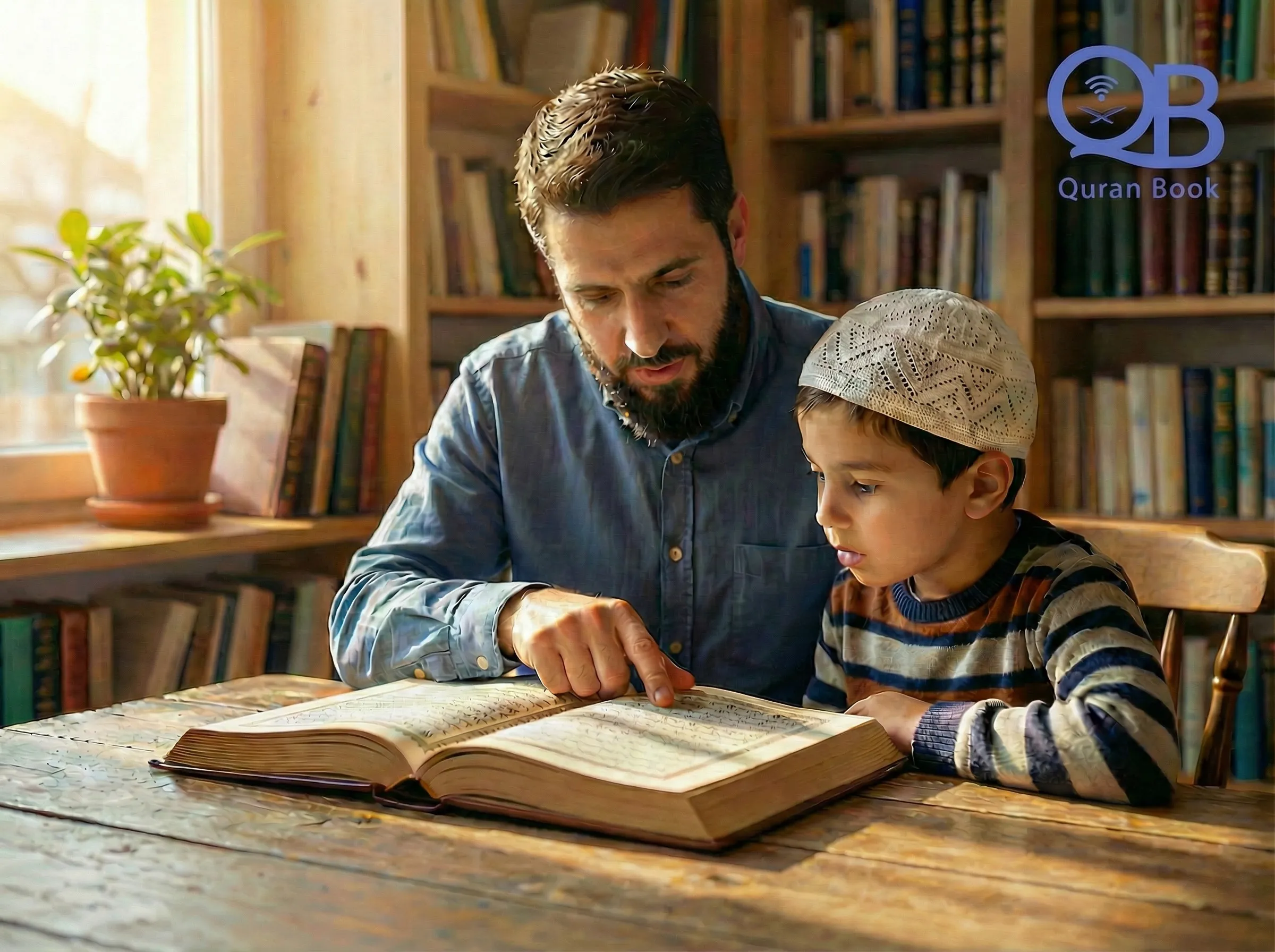
We built Quran Book Academy specifically around the standards this article describes.
Every teacher on our platform holds their own verified Ijazah and Sanad chain — nothing is self-declared. Lessons are 1-on-1 and live over Zoom, not pre-recorded, because an Ijazah can only ever be earned through real, corrected recitation with a real teacher listening. Both male and female certified teachers are available, so families can choose what’s most comfortable for them.
Behind the scenes, our progress reporting portal tracks exactly which Tajweed rules a student has mastered, so both the family and the teacher can see, objectively, how close a student is getting to Ijazah-level accuracy, long before the formal certificate is ever discussed.
If you’re ready to start down this path in a structured way, our Ijaza in Quran program is built exactly for this, and our foundational Tajweed course and Quran memorization program are there for students who want to build up to it first.
Frequently Asked Questions
What is Ijazah in Quran?
This kind of certification in Quran is formal permission granted by a qualified teacher after a student has correctly recited the Quran, or a defined portion, often from memory. It confirms an unbroken chain of transmission back to the Prophet Muhammad ﷺ and authorizes the student to recite, and often teach, that portion.
What does the word Ijazah mean in Arabic?
It comes from an Arabic root meaning “to permit” or “to allow.” In everyday Arabic it can mean any kind of permission or license. In Quranic studies specifically, it refers to certified authorization in recitation, memorization, or a particular Qira’ah of the Quran.
What is the difference between Ijazah and Sanad?
One is the certificate itself. The other, Sanad, is the chain of transmission it documents — the unbroken line of teachers connecting a student back to the Prophet ﷺ. The two are closely linked, which is why teachers often use the words interchangeably.
What are the types of Ijazah in Quran?
The main types are the Hifz certificate, granted after full, accurate memorization of the Quran, and the Tilawah certificate, which certifies correct application of Tajweed. Advanced students can go further and earn one in a specific Qira’ah, or authentic reading, of the Quran.
How do you get an Ijazah in Quran?
You recite the required portion directly to a certified teacher, live, who corrects every mistake in pronunciation, Tajweed, or memorization. This continues, portion by portion, until the teacher is fully satisfied the recitation meets the required standard, at which point it’s formally granted.
Who can grant an Ijazah?
Only a teacher who already holds their own verified credential and Sanad can grant one to a student. This is exactly why the credibility of any such certificate depends entirely on the chain of the teacher issuing it.
Do you need an Ijazah to teach Quran?
There’s no universal legal requirement, and scholars differ on exactly where formal certification becomes necessary. In practice, it remains the most respected traditional qualification, which is why many families specifically look for Al-Azhar certified teachers who hold one.
Can women receive an Ijazah in Quran?
Yes. Women can and do receive this certification in both memorization and recitation, and many hold their own verified Sanad chains. Quran Book Academy’s certified female teachers hold these credentials and are available for sisters and children who prefer a female teacher.
Sources referenced for historical and etymological context: Wikipedia — Ijazah and World History Commons — Ijazahs (Diploma).