📖

Wait! Before You Go…

Try our 100% free Islamic learning resources — no signup needed!

🏠 Home About
🕌 About Us ⚙️ How It Works 👨‍🏫 Meet Our Teachers
🧒 For Kids
Fiqh for Kids Arabic Online for Kids Islamic School for Kids Tajweed Made Easy Quran Memorization Nour El Bayan Noorani Qaida
👨 For Adults
Tajweed for Adults Islamic School for Adults Quran Memorization Arabic Online Online Quran for Adults
🧕 Ladies Section
Online Quran for Ladies Islamic Studies for Sisters Female Quran Teachers
✨ More Programs
Online Islamic School Quran with Tajweed Quranic Arabic Ijaza in Quran Online Quran Classes Qiraat Course Online Hifz Course Quran Memorization Course New Muslim Programs
🎓 Learn Free
🔤 Arabic Alphabet 🎮 Tajweed Game 🕋 Memorize Quran & Tafseer Free 🕌 Islamic Studies Games 📚 Free Resources
📝 Articles 💰 Price 📱 Follow Us
🎁 Free Trial

Category: Tajweed

  • Madd Leen in Tajweed: The Soft Madd, Its Two Letters, and Why It Only Appears When You Stop

    Madd Leen in Tajweed: The Soft Madd, Its Two Letters, and Why It Only Appears When You Stop

    Madd Rules · Madd Leen

    Madd Leen in Tajweed: The Soft Madd, Its Two Letters, and Why Its Lengthening Appears When You Stop

    Quran Book Academy · Quran & Tajweed Library

    Two letters · Three conditions · 2, 4 or 6 counts · Audio by Sheikh Al-Husary · Free quiz & game

    A learner recites أَلَمْ تَرَ كَيْفَ فَعَلَ رَبُّكَ and stretches the yaa of كَيْفَ while continuing into فَعَلَ. That is the mistake. The word contains a letter of leen, but the optional lengthening appears only when the reciter stops on كَيْفْ. Madd Leen is not a property of the word. It is a property of the moment you stop on it. This rule belongs to the Madd rules chapter of Tajweed rules.

    Also written Madd Lin, Madd Layyin or Madd Layn, and sometimes called the soft madd — in Arabic, مد اللين. All one rule.

    The 30-second version: two letters (وْ and يْ) · each preceded by a fathah · one letter after it · and you must be stopping on that word · then hold it 2, 4 or 6 counts, your choice. Keep reading and there is no lengthening at all. Everything on this page follows the riwayah of Hafs ‘an ‘Asim by the way of Ash-Shatibiyyah.

    Madd Leen in Tajweed showing waw and yaa sakinah after a fathah stretched at a stop
    The letters are always there. The madd is only there when you stop.

    What Is Madd Lin in Tajweed?

    Madd Leen (مد اللين) is the soft lengthening of a waw sakinah (وْ) or yaa sakinah (يْ) preceded by a fathah, when you stop on that word. It is held for 2, 4 or 6 counts. While you continue reading there is no lengthening, though the letter of leen is still pronounced softly.

    The name is literal. Leen (لين) means softness and ease. The letter does not stretch the way a madd letter stretches — it glides. The name is describing the sound, not the length.

    What sets this rule apart from most of the madds on the hub is conditional existence. Madd Asli, Madd Badal, Madd Muttasil — all of them exist the moment their letters exist on the page. The lengthening of Madd Leen appears only when the reciter chooses to stop. It is one of the stop-dependent madds, alongside Madd ‘Arid lis-Sukoon, whose extra lengthening also appears at a stop and disappears when you continue. That is the part almost every English lesson leaves out.

    One note on the unit before we go further: a count (harakah) is a relative timing unit based on the reciter’s own natural pace, not a fixed number of seconds. Opening or closing one finger is only a beginner training aid for feeling that pace — which is why two reciters at “four counts” can still sound slightly different and both be correct.

    Madd Leen, Madd Lin or Madd Layyin: are they the same?

    Yes — one rule, four transliterations of the same Arabic term مد اللين: Leen, Lin, Layyin and Layn. Classical books say leen; English courses split between lin and layyin; some translations simply write soft madd.

    So if your teacher says one spelling and your book prints another, nothing has changed underneath. Same letters, same conditions, same counts.

    The Madd Lin Letters: Just Two

    There are two Madd Lin letters: و and ي. That is the entire list. Alif is never a leen letter — and there is a clean reason why, which we come to in a moment.

    Leen letter Must be Preceded by Example Sound
    وْ sakinah — no vowel fathah خَوْف aw — a soft glide, not oo
    يْ sakinah — no vowel fathah بَيْت ay — a soft glide, not ee

    Alif is not included because the letters of leen are specifically a sakin waw or sakin yaa preceded by a fathah. Alif has its own fixed relationship with fathah as a madd letter. The answer to “are there three leen letters?” is no — there are two, and there is no fourth case hiding anywhere.

    Leen letters vs madd letters: the two-step vowel test

    This is the test that ends the confusion, and it runs in two short steps. Step one: the letter must be a sakin waw (وْ) or a sakin yaa (يْ). If it is not one of those two, neither label applies. Step two: look at the vowel on the letter before it. A sakin waw after a dammah, or a sakin yaa after a kasrah, is a madd letter — it stretches. Either a sakin waw or a sakin yaa after a fathah is a leen letter — it softens into a glide. Those are the combinations the two labels cover; any other combination is simply neither, so do not label a letter “leen” just because the vowel before it happens not to match.

    Sakin letter Vowel before it Result Example Listen
    و dammah — the madd pairing madd letter → stretches يَقُوْلُ
    و fathah — the leen pairing leen letter → softens خَوْفٍ
    ي kasrah — the madd pairing madd letter → stretches قِيْلَ
    ي fathah — the leen pairing leen letter → softens الْبَيْتِ

    🔑 The takeaway: once you have confirmed the letter is a sakin waw or a sakin yaa, the vowel before it decides which of the two labels applies — dammah or kasrah for a madd letter, fathah for a leen letter. The same waw sakinah is a madd letter in يَقُولُ and a leen letter in خَوْف. Once you hear that, you never confuse them again. The stretching version belongs to Madd Asli.

    The Madd Lin Rules and Conditions

    Three conditions, and every one of them has to hold at the same time. The Madd Lin Tajweed rule is only in force when all three are true together.

    1 · There is a leen letter

    A و or ي, sakinah, with a fathah on the letter before it.

    خَوْف    يَقُول — dammah before the waw, so that is a madd letter

    2 · The letter after it is the last letter of the word

    Exactly one letter follows the leen letter — no more.

    قُرَيْشٍ    عَلَيْهِمْ — the yaa here is a leen letter, but two letters follow it, so stopping on this word does not produce Madd Leen

    3 · You are stopping on that word

    This is the condition that gets dropped, and dropping it is what makes people recite the rule wrong for years.

    stopping on خَوْفٍ    continuing through خَوْفٍ — the leen letter is simply pronounced softly, with no length at all

    Hear the difference: the same word, stopped and continued

    Teacher recordings made for this lesson. Same word, opposite result — then the same test on كَيْفَ.

    Tap a line to hear it.

    ⚠️ All three must hold together. Drop the third and the lengthening disappears completely. Madd Leen is one of the stop-dependent madds: like Madd ‘Arid lis-Sukoon, its extra lengthening appears when you stop and is not there when you continue. The key difference is the type of letter involved — Madd Leen uses a leen letter, while Madd ‘Arid lis-Sukoon involves a regular madd letter. There is one exceptional case — the letter عَيْن in two surah openings — and it has its own section below.

    How Many Counts Is Madd Lin?

    Madd Lin is 2, 4 or 6 counts, and the reciter chooses. The three lengths have names your teacher will say out loud but you will rarely see printed in English material: qasr (قصر, 2 counts), tawassut (توسط, 4 counts) and tul (طول, 6 counts).

    Rule Counts Fixed or optional?
    Madd Leen 2 · 4 · 6 Optional — choose one, then keep it
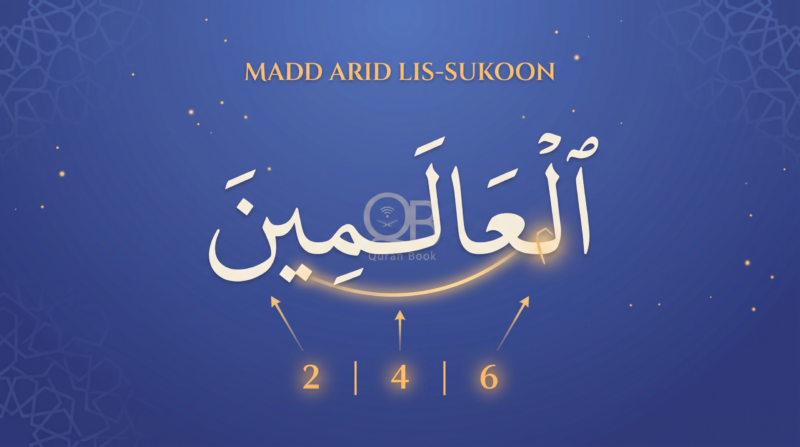
    Madd ‘Arid lis-Sukoon 2 · 4 · 6 Optional — choose one, then keep it
    Madd Asli 2 Fixed

    Three rows on purpose. The full counts table for every madd type lives on the Madd rules hub.

    Hear the three lengths on one word, stopped on خَوْفْ. Each button is its own separate teacher recording.

    خَوْفْ

    2 counts · qasr

    خَوْفْ

    4 counts · tawassut

    خَوْفْ

    6 counts · tul

    Whichever length you choose for Madd Leen, keep it steady rather than switching at random from one stop to the next. Drifting between two counts at one ayah-end and six at the next, with no settled pattern, is one of the most audible marks of an untrained reciter, and it is rarely explained in English material.

    For beginners, matching Madd Leen with Madd ‘Arid lis-Sukoon can be a simple way to practise consistency, and many teachers start beginners that way. It is a training method, not a rule: the two should not be presented as if they must always have exactly the same length. Your teacher will tell you which pattern to follow as your recitation develops.

    Many teachers ask beginners to take two counts everywhere until their stops are stable, and only then move up to four or six. That is good advice: consistency at two is worth far more than an impressive six that wanders.

    How to Pronounce Madd Lin

    The sound is a glide, not a stretch. Feel the difference in your own mouth. In يَقُولُ the mouth locks into one position and stays there for the whole length — nothing moves. In خَوْفٍ the mouth travels from the fathah toward the waw, and then rests. That travel is precisely what the word leen is naming.

    Madd Lin pronunciation: three details that fix it

    No ghunnah, no pitch rise, no wobble. The held part is level and relaxed. If you hear a hum through the nose, that is a different rule leaking in.

    English starting points, not targets. خَوْف sits near the vowel in “how”, and بَيْت near the vowel in “bite”. Use them to find the shape of the mouth, then take the actual sound from the reciter — never from English.

    The six-count trap. At six counts learners re-open the mouth in the middle of the hold and produce aa-oo-f. The glide happens once, at the very start. Everything after it is one steady, unmoving position.

    خَوْفٍ

    Quraysh 106:4 · the glide, then the hold

    نَسْتَعِيْنُ

    Al-Fatihah 1:5 · a pure, level stretch — no travel at all

    Play them back to back. Side by side the difference is obvious; in isolation it is almost inaudible — which is exactly the learner’s problem.

    The same test on الْبَيْت, in the teacher’s voice: stopped, then continued.

    الْبَيْتْ

    Stopped · Madd Leen is lengthened — 2 counts here

    الْبَيْتِ

    Continued · the yaa is still a letter of leen, with no lengthening

    Madd Lin vs Madd Arid Lis-Sukoon

    If you already know both names and still cannot tell them apart, you are in the right place — and the reason is simple. Madd Lin and Madd Arid Lis-Sukoon share almost everything.

    Madd Leen versus Madd Arid Sukoon compared by letter cause and counts
    Same cause, same counts, same choice — one difference.
    Madd Leen Madd ‘Arid lis-Sukoon
    The letter Leen letterوْ or يْ after a fathah Madd letterا, و after dammah, ي after kasrah
    Cause Temporary sukoon from stopping Temporary sukoon from stopping
    Counts 2 · 4 · 6 2 · 4 · 6
    Exists while continuing? No No
    Sound A glide, then a hold A pure, level stretch
    Example at a stop خَوْفٍ · قُرَيْشٍ · الْبَيْتِ نَسْتَعِينُ · الْعَالَمِينَ · تَعْمَلُونَ

    The verdict: they share the same temporary cause and the commonly taught 2, 4 and 6-count options, but they differ in the type of letter being lengthened. Giving both the same length — four counts for your Madd ‘Arid lis-Sukoon and four for your Madd Leen — is a useful beginner drill for building a steady recitation. Treat it as a practice aid rather than a requirement: the two do not have to be identical in length, and choosing differently is not in itself a Tajweed error. Follow the pattern your teacher sets for you.

    Madd Lin Examples in the Quran

    Surah Quraysh is the best training surah in the Quran for this rule. All four of its ayat end with a word containing a leen letter — قُرَيْشٍ, الصَّيْفِ, الْبَيْتِ and خَوْفٍ — and almost every learner already knows it by heart, which makes it the fastest possible proof. Tap any word below to hear it in Sheikh Al-Husary’s voice. Words outlined in gold carry the leen letter.

    Surah Quraysh, word by word

    Every word is a clip from Al-Husary’s recitation of that ayah. Tap a gold word twice — once here, once in your own mushaf.

    Quraysh 106:1  · 

    Quraysh 106:2  · 

    Quraysh 106:3  · 

    Quraysh 106:4  · 

    All four ayat of Surah Quraysh end with a word containing a leen letter: قُرَيْشٍ, الصَّيْفِ, الْبَيْتِ and خَوْفٍ — four leen stops in four ayat.

    More Madd Lin examples with Quran references

    Three more, beyond Surah Quraysh. The last two are the exceptional case, and on this short list they are the only ones that apply whether you stop or not.

    لَا رَيْبَ ۛ

    Al-Baqarah 2:2 · yaa after a fathah · only at the permitted waqf mark · full ayah, continuous recitation

    عسق

    Ash-Shura 42:2 · the عَيْن · Madd Leen Lazim — 4 or 6 counts, 6 the more widely taught

    كهيعص

    Maryam 19:1 · the عَيْن · Madd Leen Lazim — 4 or 6 counts, 6 the more widely taught

    Madd Lin words to practise

    A word bank you can drill away from the mushaf, split by letter.

    Yaa يْ after a fathah

    بَيْت · شَيْء · كَيْف · خَيْر · غَيْب · صَيْف · قُرَيْش · رَيْب · عَيْن · بَيْن

    Waw وْ after a fathah

    خَوْف · يَوْم · قَوْم · لَوْن · نَوْم · مَوْت · صَوْت · طَوْع

    ⚠️ None of these words has madd leen on its own. Each one becomes a madd leen only when you stop on it. Read any of them in the middle of a phrase and there is no lengthening at all — the letters of leen are always there, the madd is not.

    The Exceptional Case: ‘Ayn in Two Surah Openings

    There is one exceptional case where Madd Leen is obligatory rather than optional — and it occurs in the disconnected letters that open two surahs.

    The letter عَيْن, which appears in كهيعص at the opening of Surah Maryam and in عسق in Surah Ash-Shura, is spelled ع – يْ – ن: a leen letter followed by a permanent sukoon, not a temporary one. Because the sukoon does not come from your decision to stop, your decision cannot remove it.

    So the usual 2-4-6 choice does not apply. Two lengths are transmitted in this route — four counts or six, whether you stop or continue — with six commonly presented as the preferred and more widely taught performance. This is the one case where the ordinary Madd Leen choice is not yours to make.

    كهيعص

    Surah Maryam 19:1 · listen for the length on the عَيْن

    عسق

    Surah Ash-Shura 42:2 · the same length, in a shorter opening

    The wider family of permanent-sukoon madds — and the four types it splits into — is covered on Madd Lazim.

    6 Common Madd Leen Mistakes

    1 · Stretching it while continuing

    The single most common error, and the reason most people learn this rule wrong in the first place. خَوْفٍ in the middle of a phrase gets no length whatsoever.

    2 · Calling it a madd because the letter looks like one

    يَقُولُ and خَوْف share a waw sakinah — and nothing else. Run the two-step vowel test instead of trusting the shape.

    3 · Changing the count from stop to stop

    Two counts at one ayah-end and six at the next. Pick one length at the start of the session and hold it.

    4 · Using inconsistent lengths without following a recognised recitation pattern

    Lengths that move around at random, with no settled pattern behind them, are what unsettle a recitation. Madd Leen and Madd ‘Arid lis-Sukoon do not have to be given exactly the same length, so a difference between them is not automatically an error. For beginners, matching the two is a simple way to practise consistency — treat it as a training method and follow the pattern your teacher sets.

    5 · Re-opening the mouth mid-hold

    At four or six counts this produces aa-oo-f instead of one steady glide-and-hold. The glide happens once, at the start.

    6 · Treating عَيْن in the surah openings as optional

    It is the exceptional case, in two surah openings: the ordinary 2-4-6 choice does not apply there. Four counts and six are both transmitted, with six the preferred and more widely taught — stopping or continuing.

    Practise Madd Leen

    Consistency trainer: pick a length and hold it

    Accuracy is not the skill here — evenness is. Choose your length, then recite five stops in a row, pressing and holding the bar for each one. The feedback you get back is simply how much your five holds varied from each other in this drill, not how close they were to a stopwatch and not a judgement on your recitation.

    Hold 0 of 5. Recite a leen stop out loud while you hold.

    A guide, not a ruling: counts are relative to your own pace. What matters is that your five holds match each other. This trainer measures consistency, not the religious validity of your timing. A qualified teacher should assess the actual recitation.

    Leen letter or madd letter?

    Ten words, one highlighted letter in each. The question is what the highlighted letter is — a leen letter or a madd letter — not whether Madd Leen would occur if you stopped on the word. Run the two-step vowel test in your head, then tap. Instant feedback, no sign-up.

    Question 1 of 10 Score: 0

    Look at the vowel before the highlighted letter.

    Play: Madd Leen Star Jar (Free Game)

    Recognition on a page and recognition under time pressure are two different skills. Sort the words into the right jar and watch the stars stack up. It works on phones and tablets, and no account is needed.

    Game not loading? Open it in a new tab · or browse all our free Tajweed games · the full madd counts drill lives on the Madd rules hub.

    Learn More

    Read these four in order and the whole madd chapter falls into place. Madd Asli is the two-count baseline everything else is measured against; Madd Badal is a hamzah before the madd letter and stays at two; Madd Wajib Muttasil is a hamzah after it in the same word and is obligatory at four to five; Madd Silah is the pronoun’s ha’, short at two or long at four to five before a hamzah. Madd Leen sits outside this group because it is stop-dependent — as is Madd ‘Arid lis-Sukoon, which is why the two are grouped together below.

    The other stop-dependent madds, and the hub:

    All of them are taught step by step in our Tajweed for adults and Tajweed for kids classes.

    Madd Leen FAQ

    Q1. What is Madd Leen?
    Madd Leen (مد اللين) is the soft lengthening of a waw sakinah (وْ) or yaa sakinah (يْ) preceded by a fathah, when you stop on that word. It is held for 2, 4 or 6 counts.
    Q2. What are the Madd Leen letters?
    Only two: waw sakinah and yaa sakinah, each preceded by a fathah — as in خَوْف and بَيْت. Alif is never a leen letter, because alif always follows a fathah, which is exactly what makes it a madd letter.
    Q3. How many counts is Madd Leen?
    2, 4 or 6 counts — qasr, tawassut or tul. The reciter chooses one and keeps it steady rather than switching at random from stop to stop. For beginners, matching it with Madd ‘Arid lis-Sukoon can be a simple way to practise that consistency, but the two are not required to have exactly the same length.
    Q4. How do you pronounce Madd Leen?
    As a glide, not a stretch: the mouth moves from the fathah toward the waw or yaa, then holds that position — level and relaxed, with no ghunnah and no change in pitch.
    Q5. What is the difference between Madd Leen and Madd ‘Arid lis-Sukoon?
    The cause is the same and the options are the same — both come from a temporary sukoon caused by stopping, and both are commonly given 2, 4 or 6 counts. The key difference is the type of letter: ‘Arid lengthens a madd letter (ا, و after a dammah, ي after a kasrah), while Leen lengthens a leen letter (و or ي after a fathah). Sharing the same three options does not mean the two must always be given exactly the same length; matching them is a beginner practice method, not a requirement.
    Q6. Is there Madd Leen when I keep reading?
    No. If you do not stop, there is no lengthening at all — the leen letter is simply pronounced softly. This is the most common Madd Leen mistake by a wide margin.
    Q7. Is the waw in خَوْف a madd letter?
    No. It is sakinah, but it is preceded by a fathah rather than a dammah, so it is a leen letter. It is only lengthened if you stop on the word.
    Q8. Where is Madd Leen in Surah Quraysh?
    All four ayat of Surah Quraysh end with a word containing a leen letter: قُرَيْشٍ, الصَّيْفِ, الْبَيْتِ and خَوْفٍ. Stop on any of those four word-endings and you have a Madd Leen — which is why Surah Quraysh is the best surah in the Quran to practise this rule.
    Q9. Why is عَيْن in عسق and كهيعص six counts?
    Because the sukoon after the leen letter there is permanent, not temporary. That makes it Madd Leen Lazim, and the usual 2-4-6 choice does not apply. Two lengths are transmitted in this route — four counts or six, whether you stop or continue — with six commonly presented as the preferred and more widely taught performance. It is one exceptional case, occurring in these two Quranic openings.
    Q10. Are Madd Leen, Madd Lin and Madd Layyin different rules?
    No. They are three English spellings of the same Arabic term, مد اللين. Some books also call it the soft madd. Same letters, same conditions, same counts.

    Fix Your Stops in One Free Lesson

    Madd Leen is not a knowledge problem — it is a stopping problem, and nobody can hear their own stops. Read Surah Quraysh to an Al-Azhar certified teacher and find out in one ayah.

    Book Your Free Trial Lesson

    May Allah beautify your recitation and accept it from you. 🤲

    Jehad Mahmoud - Hafidha and Arabic Language graduate, writer at Quran Book Academy

    Hafidha of the Quran · Arabic Language Graduate · Writer on Islamic Sciences

    Jehad Mahmoud is a graduate of the Arabic Language department and a Hafidha of the Quran who writes the Islamic educational content at Quran Book Academy.

    She writes with a focus on Tajweed, Quranic recitation and the sharia sciences, making technical rules accessible to English-speaking Muslim families.

    Her articles are educational, not fatwa. For a ruling on a specific personal situation, readers are advised to consult a qualified scholar or mufti.

    Tajweed Madd Rules Waqf Quran Recitation

    References & Sources

    1. Al-Azhar Al-Sharif — azhar.eg

    2. Surah Quraysh 106 — Quran.com

    3. Surah Maryam 19 and Surah Ash-Shura 42 — Quran.com

    4. Tuhfat al-Atfal, Sulayman al-Jamzuri — the chapter on madd, in the riwayah of Hafs ‘an ‘Asim by the way of Ash-Shatibiyyah

    5. Recitation — Sheikh Mahmoud Khalil Al-Husary, via EveryAyah.com

    © 2026 Quran Book Academy. All rights reserved.

    Book Your Free Trial · Empowering Muslims Worldwide to Connect with the Quran
  • Madd Silah in Tajweed: The Invisible Madd of the Pronoun Ha’ — Sughra (2) and Kubra (4–5)

    Madd Silah in Tajweed: The Invisible Madd of the Pronoun Ha’ — Sughra (2) and Kubra (4–5)

    Jehad Mahmoud - writer at Quran Book Academy
    Written by
    Published: 26 August 2026 · Updated: 8 September 2026 · 24 min read
    Madd Rules · Madd Silah

    Madd Silah in Tajweed: The Invisible Madd of the Pronoun Ha’ — Sughra (2) and Kubra (4–5)

    One letter you cannot see · Two lengths · One question that decides between them

    Word-by-word audio by Sheikh Mahmoud Khalil Al-Husary · Free quiz and game

    Madd Silah in Tajweed showing the pronoun ha with a small waw held for two counts

    In Madd Silah, the madd letter is not written as a full letter on the baseline; it may be indicated by a small waw or yaa above or below the pronoun ha’.

    A learner recites وَلَمْ يَكُن لَّهُۥ كُفُوًا أَحَدٌ but pronounces the هُ short, without the connecting stretch the rule requires. Nothing appears to signal the mistake because no full alif, waw or yaa is written on the baseline to indicate the stretch. In some Mushaf editions, only a small waw or yaa marks the connection. That is Madd Silah (also spelled Madd Sila) — the lengthening produced when the pronoun ha’ is connected to the following word.

    One letter, two forms, one question. Silah Sughra is 2 counts. Silah Kubra is 4 or 5 counts. The only thing separating them is whether the next word begins with a hamzah. Every count on this page follows the riwayah of Hafs ‘an ‘Asim by the way of Ash-Shatibiyyah. Madd Silah belongs to the wider family of madd rules, which is one chapter of the Tajweed rules.

    What Is Madd Silah in Tajweed?

    Madd Silah (مد الصلة) is the lengthening of the pronoun ha’ (هـ) when it falls between two vowelled letters. The ha’ is stretched with an unwritten waw if it carries a dammah, or an unwritten yaa if it carries a kasrah. It is 2 counts (Sughra) or 4–5 counts (Kubra).

    Silah means connection. The madd exists to connect the pronoun to the word after it, so the ha’ is never left hanging in the middle of a sentence. Once you know that, the name stops being arbitrary: this is the connecting madd, and it exists only while you are joining one word to the next.

    Which ha’ is it? Only the ha’ ad-damir (هاء الضمير), also called ha’ al-kinayah — the ha’ that stands for a third-person singular masculine referent: his, him or it. The ha’ in وَجْه, نَفْقَهُ or ٱللَّهُ is part of the word itself, not a pronoun, and takes no silah. (Watch the letter too: the final letter of فَاكِهَةٌ is a taa marbutah ة, not a ha’ ه — it is not a candidate for silah in the first place.) Run this test before every rule below: is this ha’ ha’ al-kinayah? If not, silah normally does not apply.

    One word breaks the test, and you should learn it now: هَٰذِهِۦ. The ha’ in هَٰذِهِ is not a pronoun — it belongs to the demonstrative itself — yet Hafs treats it like ha’ al-kinayah for silah, and the Madinah mushaf prints the small yaa on it: إِنَّ هَٰذِهِۦ تَذْكِرَةٌ (Al-Muzzammil 73:19). Being treated like a pronoun ha’ does not mean it is always stretched — the joining conditions still decide. In وَهَٰذِهِ ٱلْأَنْهَٰرُ (Az-Zukhruf 43:51) the next letter is the sakin lam of ال, so there is no silah at all.

    One line on the unit of measure: a count (harakah) is the time it takes to open or close one finger at a steady pace. It is relative to your own tempo, not a fixed number of seconds.

    Madd Silah Pronunciation

    After a dammah the ha’ becomes a pure oo: هُhoo. After a kasrah it becomes a pure ee: هِhee. Keep the vowel pure and the length steady: no ghunnah, no break in the middle of the stretch, and the mouth does not move until it is finished. A natural rise or fall in tone is not itself a mistake — distorting the vowel or chopping the madd into pulses is. Hear the word on its own first, then inside the ayah:

    لَّهُۥ كُفُوًا lahoo kufuwan · Al-Ikhlas 112:4 · Sughra, 2 counts

    Transliteration matters more here than on any other madd page: lahu and lahoo are the entire lesson.

    Riwayah note. Every count on this page follows Hafs ‘an ‘Asim by the way of Ash-Shatibiyyah. Madd Silah is one of the rules where the riwayat genuinely differ, and several of the words below are read another way in other narrations. This page does not cover them.

    The Madd Silah Letter You Cannot See

    In Madd Silah, no full madd letter is written on the baseline. Instead, some Mushaf editions mark the connection with a small waw after a dammah or a small yaa after a kasrah. Other editions may leave the ha’ without this additional sign, so the reciter must recognise the rule from ha’ al-kinayah and the surrounding letters.

    The ha’ carriesYou addIt sounds likeMushaf mark
    هُ dammahan unwritten waw وhoosmall waw ـۥ
    هِ kasrahan unwritten yaa يheesmall yaa ـۦ

    Not every mushaf prints that mark. Madinah-script copies show the small waw and small yaa clearly. Some other printings mark them differently or leave the ha’ bare, and the reciter is expected to apply the rule from the grammar alone. That single fact is why the pronoun test below matters more on this page than on any other madd page.

    Three words, three different ha’s. Listen to them back to back and the difference stops being theoretical:

    لَّهُۥ كُفُوًا pronoun ha’ → silah · lahoo
    لَهُ ٱلْعَذَابُ pronoun ha’, but the next letter is sakin → no silah · lahul-‘adhab
    لِعِبَادِهِ ٱلْكُفْرَ same shape, same trap → no silah · li’ibaadihil-kufr

    The Rules and Conditions of Madd Silah

    Five conditions. As a general rule: if all five hold you have a silah, and if one fails you normally do not. Hafs also transmits two special cases that sit outside this framework and are memorised exactly as they were received — you will meet both further down the page.

    1. The ha’ must be ha’ al-kinayah — the pronoun meaning his, him or its.
    بِعَبْدِهِۦ   ❌ وَجْه   ❌ نَفْقَهُ
    Transmitted case: هَٰذِهِ is not a pronoun ha’, but is treated like one for silah when the joining conditions hold.

    2. The letter before it must be vowelled — not sakin.
    إِنَّهُۥ   ❌ مِنْهُ (noon sakinah)   ❌ إِلَيْهِ (yaa sakinah — this is Madd Lin territory, not silah)

    3. The letter after it must be vowelled — not sakin.
    لَّهُۥ كُفُوًا   ❌ لَهُ ٱلْمُلْكُ (the lam of ال is sakin)

    4. The ha’ itself must be vowelled — not sakin.
    يَرَهُۥ   ❌ فَأَلْقِهْ (An-Naml 27:28 — a sakin ha’ in Hafs, so no silah)

    5. You must be continuing, not stopping.
    يَرَهُۥ joined to the next word   ❌ يَرَهْ at a stop

    Madd Silah depends on the ha’ itself and on the letters around it. Conditions 1 and 4 are about the ha’ — its identity and its vowel. Conditions 2, 3 and 5 are about what surrounds it. That second half is why the very same pronoun can take a silah in one ayah and none in another.

    Madd Silah Sughra (The Lesser Connection)

    Silah Sughra is 2 counts, and it applies when the next word begins with any letter other than a hamzah. It is a branch of Madd Asli: the same fixed length, the same absence of a cause, and no choice for the reciter. If you can already hold a natural madd for two counts, you can already read a Silah Sughra — you just have to notice it is there.

    And it is everywhere. Silah Sughra occurs frequently throughout the Quran. It is frequently shortened by learners because the full madd letter is not written on the baseline, and the person clipping it usually has no idea the rule exists. Four examples, word first, then the whole ayah:

    إِنَّهُۥ كَانَ innahoo kaana · An-Nasr 110:3 · next letter ك → 2 counts
    بِعَبْدِهِۦ لَيْلًا bi’abdihee laylan · Al-Isra 17:1 · kasrah → an unwritten yaa
    حَوْلَهُۥ لِنُرِيَهُۥ hawlahoo linuriyahoo · Al-Isra 17:1 · two Sughras in a row
    سَبِيلَهُۥ فِى sabeelahoo fee · Al-Kahf 18:63 · next letter ف → 2 counts

    Madd Silah Kubra (The Greater Connection)

    Silah Kubra is 4 or 5 counts, and it applies when the next word begins with a hamzah qat’ (ء أ إ آ). This one is a Far’i madd — a branched madd with a cause — and it is the exact twin of Madd Jaiz Munfasil: a madd letter at the end of one word meeting a hamzah at the start of the next. The only difference is that here the madd letter is unwritten. The same hamzah, met inside a single word, would give you Madd Wajib Muttasil instead.

    Choose one length and keep it. Whether you read 4 counts or 5, that choice applies to every Munfasil and every Silah Kubra in the same recitation. It is not a word-by-word decision. Sheikh Al-Husary reads 4, which is what you hear in every clip on this page.

    مَالَهُۥٓ أَخْلَدَهُۥ maalahooo akhladah · Al-Humazah 104:3 · next word starts with أ → 4–5 counts
    رَبِّهِۦٓ أَحَدًۢا rabbiheee ahadaa · Al-Kahf 18:110 · kasrah + hamzah → 4–5 counts
    رَبِّهِۦ فَلْيَعْمَلْ rabbihee falya’mal · same ayah, same word, 2 counts — because ف is not a hamzah

    The best teaching pair on the page. Al-Kahf 18:110 contains the word رَبِّهِۦ twice. The first one is 2 counts, the second is 4. The word did not change. The next word did.

    One more trap worth naming: in مَالَهُۥٓ أَخْلَدَهُۥ the first ha’ is a Kubra, and the second sits at the end of the ayah — so if you stop there, it takes no silah at all.

    Madd Silah Kubra vs Sughra

    In isolation the two lengths are almost impossible to judge. Side by side, in the same voice, they are unmistakable. Play them one after the other:

    SUGHRA · 2 COUNTS

    لَّهُۥ كُفُوًا

    KUBRA · 4 COUNTS

    مَالَهُۥٓ أَخْلَدَهُۥ

    Madd Silah Kubra versus Sughra shown as one ha splitting into two count lengths

    One pronoun ha’, two roads — and the next word chooses the road.

    Silah Sughra الصلة الصغرىSilah Kubra الصلة الكبرى
    Next word starts withany letter except a hamzaha hamzah qat’ ء أ إ آ
    Length2 counts4 or 5 counts
    FamilyMadd Asli (natural)Madd Far’i (branched)
    Rulingfixed — no choicepermissible — choose 4 or 5, then stay consistent
    Twin ruleMadd AsliMadd Jaiz Munfasil
    Frequencyvery commonuncommon
    Exampleإِنَّهُۥ كَانَمَالَهُۥٓ أَخْلَدَهُۥ

    Sughra and Kubra are not two rules. They are one rule meeting two different next words — and the ha’ does not change at all. Only what follows it does.

    When There Is No Madd Silah at All

    Learning the rule creates a second problem: the reader starts saying hoo after every ha’ they meet. These five cases are the cure, and they are the ones you will meet first.

    لَهُ ٱلْمُلْكُ وَلَهُ ٱلْحَمْدُ Sukoon after the ha’ · the lam of ال is sakin · At-Taghabun 64:1
    يَرَهُۥ Stopping on the ha’ · at the end of the ayah it is read yarah · Az-Zalzalah 99:7
    فَأَلْقِهْ إِلَيْهِمْ The ha’ itself is sakin · Hafs reads a plain sukoon here · An-Naml 27:28

    Sukoon before the ha’مِنْهُ · عَلَيْهِ · إِلَيْهِ · فِيهِ. A sakin letter cannot be connected across, so there is no silah.

    It is not a pronoun ha’وَجْه · نَفْقَهُ · ٱللَّهُ. (هَٰذِهِ is the transmitted case: not a pronoun, but treated like one for silah when the conditions hold.) In وَجْهَهُۥ the first ha’ is a root letter and the second is the pronoun: only the second one can ever take a silah.

    Stopping removes the connecting sound of the ha’, but this does not automatically create Madd ‘Arid lis-Sukoon; that rule applies only when its own conditions are present.

    The Special Cases in Hafs

    Two special cases in Hafs do not follow the general conditions described above. Their recitation is transmitted through the riwayah rather than derived from the general rule: one takes silah despite a sakin letter before the ha’, while the other takes no silah despite meeting the usual conditions.

    فِيهِۦ مُهَانًا Al-Furqan 25:69 · Silah Sughra, 2 counts — read with silah although the letter before the ha’ is a sakin yaa. The exception is that a silah happens here, not how long it is: م is not a hamzah, so the length is still 2.
    يَرْضَهُ لَكُمْ Az-Zumar 39:7 · read without silah, although every condition is met

    To hear how strange يَرْضَهُ لَكُمْ really is, play the silah that appears at the end of the very same ayah: Same reciter, same ayah, one held and one not.

    Madd Silah Examples in the Quran

    Ten Madd Silah examples from the Quran, ordered by difficulty rather than by page: eight live silahs and two cases where the rule does not apply. The last two rows are deliberate — a table of nothing but valid silahs teaches the eye to stretch every ha’ it meets.

    #WordReferenceTypeCountsListen
    1لَّهُۥ كُفُوًا
    lahoo kufuwan
    Al-Ikhlas 112:4Sughra2
    2إِنَّهُۥ كَانَ
    innahoo kaana
    An-Nasr 110:3Sughra2
    3بِعَبْدِهِۦ لَيْلًا
    bi’abdihee laylan
    Al-Isra 17:1Sughra2
    4حَوْلَهُۥ لِنُرِيَهُۥ
    hawlahoo linuriyahoo
    Al-Isra 17:1Sughra ×22
    5سَبِيلَهُۥ فِى
    sabeelahoo fee
    Al-Kahf 18:63Sughra2
    6مَالَهُۥٓ أَخْلَدَهُۥ
    maalahooo akhladah
    Al-Humazah 104:3Kubra4–5
    7رَبِّهِۦٓ أَحَدًۢا
    rabbiheee ahadaa
    Al-Kahf 18:110Kubra4–5
    8عِندَهُۥٓ إِلَّا بِإِذْنِهِۦ
    ‘indahooo illaa bi idhnih · full ayah
    Al-Baqarah 2:255Kubra4–5
    9لَهُ ٱلْمُلْكُ
    lahul-mulk
    At-Taghabun 64:1No silah — sakin after
    10يَرَهُۥ
    yarah at a stop
    Az-Zalzalah 99:7No silah — stopping

    Madd Silah Examples in Surah Al-Ikhlas and Ayat al-Kursi

    Al-Ikhlas is the cleanest Sughra in the Quran and almost everyone has it memorised. The whole surah contains exactly one Madd Silah, in the final ayah: وَلَمْ يَكُن لَّهُۥ كُفُوًا أَحَدٌ. The هُ is a pronoun, the letter before it is vowelled, the next word starts with ك — so it is two counts, and it is the one most people cut short.

    Ayat al-Kursi is one of the most widely memorised and frequently recited long verses and it carries all three states at once: لَّهُۥ مَا (Sughra), عِندَهُۥٓ إِلَّا and عِلْمِهِۦٓ إِلَّا (Kubra), and كُرْسِيُّهُ ٱلسَّمَٰوَٰتِ (no silah — the next letter is sakin). Tap the colours off and test yourself:

    blue = Sughra · orange = Kubra · grey = no silah

    بِإِذْنِهِۦ is the one that depends on you: continue into يَعْلَمُ and it is a Silah Sughra of 2 counts; stop at the waqf mark and the silah drops.

    5 Common Madd Silah Mistakes

    1. Cutting the ha’ dead. The default error, because nothing on the line asks for a stretch. لَّهُۥ كُفُوًا read as lahu kufuwan instead of lahoo kufuwan.

    2. Stretching every ha’ you see. The over-correction that follows learning the rule: وَجْه · ٱللَّهُ · نَفْقَهُ all get a hoo, although their ha’ is part of the word itself. Identify ha’ al-kinayah first, then apply the silah.

    3. Giving Kubra only 2 counts. Sughra is met first, so every silah gets treated as a Sughra. مَالَهُۥٓ أَخْلَدَهُۥ clipped to two.

    4. Keeping the silah when you stop. yarahoo at the end of the ayah. The connection has nothing left to connect to.

    5. Distorting the stretch. A ghunnah on the hoo, a wobble that breaks it into separate pulses, or a shift in the vowel itself part-way through. Melody is not the problem — changing the sound of the letter or cutting the count short is.

    Practise Madd Silah

    Two drills. The first trains the only decision this page rests on. The second stops you applying the rule where it does not belong.

    Drill 1 — Sughra or Kubra?

    Look at the word after the pronoun. If it starts with a hamzah, you are holding 4 or 5. If not, 2.

    QUESTION 1 / 12 · SCORE 0

    Drill 2 — Is There a Silah at All?

    Six cards. Some are silahs, some fail one of the five conditions. The feedback names the condition that failed.

    CARD 1 / 6 · SCORE 0

    Want the full pronoun-ha’ hunt with decoys? It lives in our free Tajweed games.

    Play: The Madd Silah Circle (Free Game)

    Recognition on a page and recognition under time pressure are two different skills. Spot the pronoun ha’ that takes a connection and let the rest go past. It works on phones and tablets, and no account is needed.

    Game not loading? Open it in a new tab · or browse all our free Tajweed games · the full counts table lives on the madd rules hub.

    Learn More

    Madd Silah only makes sense inside its family. Madd Asli is the baseline your Silah Sughra is measured against — the same two counts under a different name. Madd Badal is the other 2-count madd that looks as if it should be longer, and learners confuse the two constantly. Madd Wajib Muttasil has the same hamzah cause as your Silah Kubra, but inside one word instead of across two; the position of the hamzah is what separates the two rules, not the length — in Hafs by the way of Ash-Shatibiyyah, Muttasil is read 4 or 5 counts as well. The 4–5 you hold on a Kubra comes from the transmitted riwayah and tariq, not from counting words. And Madd Lazim provides the fixed six-count benchmark in this madd family, so it shows you how much freedom Kubra’s 4-or-5 really gives you.

    The rest of the chapter: Tajweed Rules · Rules of Meem Sakinah · Noon Sakin Rules · Qalqalah Letters · Tajweed for Adults · Tajweed for Kids

    Madd Silah FAQ

    What is Madd Silah?

    Madd Silah (مد الصلة) is the lengthening of the pronoun ha’ (هـ) when it sits between two vowelled letters. The ha’ is stretched with an unwritten waw after a dammah or an unwritten yaa after a kasrah — 2 counts for Sughra, 4 or 5 for Kubra.

    Is it spelled Madd Silah or Madd Sila?

    Both refer to the same rule. Silah (صلة) means connection in Arabic, and the final h is only a transliteration choice. You will also see silla and sillah.

    What is the difference between Madd Silah Sughra and Kubra?

    Only the next word. If it begins with a hamzah, the silah is Kubra and held 4 or 5 counts. If it begins with anything else, it is Sughra and held exactly 2.

    How many counts is Madd Silah?

    Sughra is 2 counts and fixed. Kubra is 4 or 5, and whichever length you choose must stay the same across the whole recitation.

    Which ha’ takes Madd Silah?

    Ha’ al-kinayah — the pronoun ha’ (هاء الضمير) standing for a third-person singular masculine referent: his, him or it. The ha’ in وَجْه, نَفْقَهُ or ٱللَّهُ is part of the word itself and takes no silah. The one case to memorise is هَٰذِهِ: not a pronoun ha’, yet treated like one for silah in Hafs — إِنَّ هَٰذِهِۦ تَذْكِرَةٌ takes the silah, while وَهَٰذِهِ ٱلْأَنْهَٰرُ does not, because a sakin follows.

    Why can’t I see the madd letter in the mushaf?

    Because it is not written on the line. Madinah-script copies mark it with a small waw (ـۥ) or a small yaa (ـۦ); some other printings use a different sign for the same job, and others leave it unmarked, so you apply the rule from the surrounding letters.

    Does Madd Silah apply when I stop on the ha’?

    No. The silah connects the pronoun to the next word, so when you stop there is nothing left to connect to and the ha’ is read with a plain sukoon.

    Why is there no silah in مِنْهُ or عَلَيْهِ?

    The letter before the ha’ is sakin in both. Madd Silah requires a vowelled letter on each side of the pronoun ha’.

    What are the special cases of Madd Silah in Hafs?

    Two special cases are highlighted in Hafs. فِيهِۦ مُهَانًا (Al-Furqan 25:69) takes silah although the letter before the ha’ is sakin, while يَرْضَهُ لَكُمْ (Az-Zumar 39:7) takes no silah although the usual conditions are met. Both readings are transmitted through the riwayah rather than derived from the general rule.

    Is Madd Silah Sughra a natural madd?

    Yes. Silah Sughra is a branch of Madd Asli — 2 counts, no cause and no choice of length. Silah Kubra is a Far’i madd, caused by the hamzah after it.

    Hear the Ha’ You Have Been Missing

    Madd Silah is invisible on the page and inaudible to the person reciting — but a teacher hears the missing hoo in the first ayah. One lesson is usually enough to hear it forever.

    Book Your Free Trial Lesson →
    Jehad Mahmoud - writer at Quran Book Academy

    ABOUT THE AUTHOR

    Hafidha of the Quran · Arabic Language Graduate · Writer on Islamic Sciences

    Jehad Mahmoud is a graduate of the Arabic Language department and a Hafidha of the Quran who writes the Islamic educational content at Quran Book Academy.

    She writes with a focus on Tajweed, Quranic recitation and the sharia sciences, making technical rules accessible to English-speaking Muslim families.

    Her articles are educational, not fatwa. For a ruling on a specific personal situation, readers are advised to consult a qualified scholar or mufti.

    Tajweed Madd Quranic Sciences Quran Recitation

    References & Sources

    1. Al-Azhar Al-Sharif — azhar.eg

    2. Sulayman al-Jamzuri, Tuhfat al-Atfal — the chapter on the madd letters and their lengths

    3. Ayat cited in this article — Quran.com (Al-Ikhlas 112:4 · Al-Isra 17:1 · An-Nasr 110:3 · Al-Humazah 104:3 · Al-Baqarah 2:255 · Al-Kahf 18:63 and 18:110 · At-Taghabun 64:1 · Az-Zalzalah 99:7 · Al-Furqan 25:69 · Az-Zumar 39:7 · An-Naml 27:28)

    4. Recitation — Sheikh Mahmoud Khalil Al-Husary (Hafs, murattal), audio via EveryAyah.com, word timings via Quran.com

    © 2026 Quran Book Academy. All rights reserved.

    Book Your Free Trial · Empowering Muslims Worldwide to Connect with the Quran
  • Madd Rules in Tajweed: The 3 Madd Letters, Every Type, and How Long to Hold Each One

    Madd Rules in Tajweed: The 3 Madd Letters, Every Type, and How Long to Hold Each One

    Jehad Mahmoud - writer at Quran Book Academy
    Written by
    Published: 26 August 2026 · Updated: 9 September 2026 · 12 min read
    Tajweed Rules · Letters, Types & Counts

    Madd Rules in Tajweed: The 3 Madd Letters, Every Type, and How Long to Hold Each One

    Quran Book Academy · Quran & Tajweed Library

    Three letters · Two main types · 2, 4–5 and 6 counts · Word-by-word audio by Sheikh Al-Husary · Free ear trainer & game

    Two learners recite قَالَ. One stretches it noticeably longer than the other, and both are certain they are right. Neither of them is arguing about which letters to read — they can both see the alif. They are arguing, without knowing it, about how long to hold it. There are only three Madd letters — alif (ا), waw (و) and yaa (ي) — and no one ever disagrees about those.

    That is the whole difficulty of this chapter. Madd Rules are the part of Tajweed rules where the letters are easy to see and the length is easy to get wrong. The good news is how short the real list is: those three letters, one natural length of two counts, and a small set of reasons that length changes. Learn the reasons and the numbers stop being a memory test.

    Also written Mad; in Arabic المد, plural Mudood (المدود). The letters themselves are called huroof al-madd (حروف المد). Every count on this page follows the riwayah of Hafs ‘an ‘Asim by the way of Ash-Shatibiyyah, and the first stop after this page should be Madd Asli, the natural length everything else is measured against.

    The 30-second version: three letters carry Madd (ا و ي) · the natural length is 2 counts · a hamzah after a Madd letter may raise the length to 4 or 5 · a permanent sukoon or shaddah after it gives 6 · a temporary sukoon created by stopping may give 2, 4 or 6 depending on the Madd type · and when a type allows more than one length, keep the chosen reading face consistent.

    Madd rules in Tajweed showing the three Madd letters alif, waw and yaa with their counts
    Three letters, one natural length, and a short list of reasons that length changes.

    What Is Madd in Tajweed?

    Madd (المد) means lengthening. In Tajweed, Madd is the rule of stretching the sound of a vowel when it carries one of the three Madd letters — alif (ا), waw (و) or yaa (ي). The natural length is two counts, and it increases to four, five or six counts when a hamzah or a sukoon follows.

    The literal meaning of madd is to extend or draw something out. Its opposite in this chapter is qasr (قصر), shortening — and both words appear in the counts table further down, because several types of Madd give you a choice between a longer and a shorter reading. So the Madd Tajweed rules are not really a list of sounds. They are a list of durations, and that is why so many learners who can read Arabic fluently still recite this chapter incorrectly.

    The unit of measurement is the count, called a harakah (حركة) and often translated as a beat. The classical description is simple: one count is the time it takes to open or close one finger at a steady recitation pace. Notice what that definition does not contain — a number of seconds. A count is relative to your own pace. A slow reciter’s two counts last longer in real time than a fast reciter’s two counts, and both are correct. What is not correct is your own two-count changing from one ayah to the next.

    One more thing worth saying early, because it removes a lot of confusion later: Madd in Tajweed is not something you add to a word. The stretching is already built into the letter. A Madd letter is a vowel with nothing to stop it, so the sound simply continues until something ends it. The rules below are all answers to one question — what ends it, and how long does it run before it does?

    📖 Riwayah note: every count on this page follows Hafs ‘an ‘Asim by the way of Ash-Shatibiyyah, the reading printed in the standard Madani mushaf. Other turuq differ — most visibly on Madd Jaiz Munfasil, which some routes of Hafs transmitted through At-Tayyibah read with two counts. If your teacher’s numbers differ from ours on that one type, this is almost always why.

    Madd Letters: The Three Letters of Lengthening

    There are three Madd letters, and that number never changes: alif (ا), waw (و) and yaa (ي). Every single Madd in the Quran, from the shortest to the longest, is built on one of these three. What changes from one type of Madd to another is not the Madd letter itself — it is the cause or condition around it: a hamzah before or after it, a sukoon after it, or a stop that creates a temporary sukoon.

    Madd letter Must be Preceded by Example Sounds like
    ا (alif) always sakinah — it never carries a vowel of its own fathah قَالَ aa
    و (waw) sakinah dammah يَقُولُ oo
    ي (yaa) sakinah kasrah قِيلَ ee

    🔑 The condition is the whole rule: a waw or a yaa is only a Madd letter when it is sakin AND the letter before it carries the matching vowel. The waw in وَلَد is not a Madd letter, because it carries a fathah of its own. The yaa in بَيَان is not a Madd letter either. Miss this one line and you will stretch half the words on the page.

    The three Madd letters in Tajweed with their preceding vowels fathah, dammah and kasrah
    Each Madd letter has one vowel that must come before it — fathah for alif, dammah for waw, kasrah for yaa.

    One word that contains all three: نُوحِيهَا

    You do not need to memorise a list. All three Madd letters appear together, in order, inside a single Quranic word — نُوحِيهَا in Surah Hud. The waw follows a dammah, the yaa follows a kasrah, and the alif follows a fathah. Teach a child this one word and the letters are learned for life. Listen to Sheikh Al-Husary say it on its own:

    نُوحِيهَا

    Hud 11:49 · nooheehaa — “We reveal it” · waw, yaa and alif, one after the other

    Tap any word or row to hear it.

    How many Madd letters are there?

    Three: ا, و and ي. A waw or a yaa only counts as one of the Madd letters in Tajweed when it is sakin and the letter before it carries the matching vowel — a dammah before the waw, a kasrah before the yaa. A Madd alif is always sakinah and always preceded by a fathah, so it can never carry a vowel of its own — but not every written alif is pronounced as a Madd letter. An alif carrying a hamzah (أ إ) is a consonant, and the alif written after the waw of the plural in آمَنُوا is not pronounced at all.

    The layn letters (حروف اللين) — related, but not Madd letters

    There is one near-miss worth naming. A waw or a yaa that is sakinah but preceded by a fathah — as in خَوْف and بَيْت — is called a letter of softness, harf layn, not a letter of lengthening. In normal reading it is not stretched at all. It is only lengthened when you stop on the word it ends, and that stretched version has its own name, Madd Layn, which appears in the counts table below. Most English pages either skip this distinction or teach it as a fourth Madd letter; it is neither.

    Types of Madd in Tajweed

    Before any list, take the map. Every Madd in the Quran is one of two things: Asli — natural, needing no cause — or Far‘i — secondary, caused by an additional factor attached to the Madd letter. That factor is only ever a hamzah (ء) or a sukoon; the hamzah usually comes after the Madd letter, but in Madd Badal it comes before it. Every named type you have ever seen is a branch of one of those two, and once you can place a type on this map you can work out its length without remembering it.

    Types of Madd in Tajweed diagram branching into Madd Asli and Madd Far‘i
    Two trunks, then branches: Madd Asli needs no cause, Madd Far‘i is caused by a hamzah or a sukoon.
    Main type What it is Cause Branches
    Madd Asli (Tabee‘i)
    المد الأصلي
    The natural length: a Madd letter with no additional hamzah- or sukoon-based cause affecting it. None — this is the baseline Madd ‘Iwad · Madd Silah Sughra · Madd Tamkeen (appended to the natural Madd — all two counts)
    Madd Far‘i
    المد الفرعي
    A secondary Madd caused by an additional factor attached to the Madd letter — a hamzah or a sukoon. Its length depends on the specific type; some, such as Madd Badal, stay at two counts. A hamzah (ء) — after the Madd letter, or before it in Madd Badal — or a sukoon after it Because of hamzah: Wajib Muttasil · Jaiz Munfasil · Silah Kubra · Badal (hamzah before the Madd letter — Far‘i by cause, but still 2 counts)
    Because of sukoon: Lazim · ‘Arid lis-Sukoon · Layn

    Read the middle column again, because it is the shortcut. Madd Asli is the default state of a Madd letter: nothing has happened to it, so it runs for two counts and stops. Everything filed under Far‘i is a Madd Asli that met a hamzah or a sukoon. That cause is what decides the length — usually pushing it above two counts, though in Madd Badal the hamzah sits before the Madd letter and the length does not change at all. This is why the causes — hamzah, permanent sukoon, temporary sukoon — matter more than the names.

    How many types of Madd are there?

    There are two main types — Madd Asli and Madd Far‘i — and they branch into around ten commonly taught kinds. If you have searched this question before, you will have seen “2”, “6”, “13” and “15” all given as the answer, which is why the question keeps being asked.

    Here is the honest explanation nobody puts on the page: those numbers are not disagreements about the rules. They are different levels of the same tree. Count the trunks and you get 2. Count the main branches of Far‘i and you get around seven. Keep going and split Madd Lazim into its four classical sub-varieties — kalimi and harfi, each of which can be muthaqqal or mukhaffaf — and the total climbs past 13. Every one of those authors would recite the same ayah with exactly the same length. They are slicing one tree at different heights.

    So the useful question is not how many types exist. It is what is in front of my Madd letter, and how many counts does that mean — which is the table in the next section.

    The four types with their own guides

    Four of the branches are common enough to deserve a full page each. This page is the map; those four are the territory.

    How Many Counts Is Each Madd?

    This is the reference table, and it is deliberately sorted by length rather than by name — because when you are mid-recitation you are not looking up a taxonomy, you are looking up a number. If you have ever searched how many beats is Madd, this is the answer to it — a beat and a count are the same unit. Short answer for the impatient: Madd Asli is 2, Muttasil and Munfasil are 4 or 5, Madd Lazim is always 6, and the temporary ones let you choose.

    Counts Type Trigger Quran example Ruling
    2 Madd Asli (Tabee‘i) Madd letter with no additional hamzah- or sukoon-based cause قَالَ · نُوحِيهَا Fixed
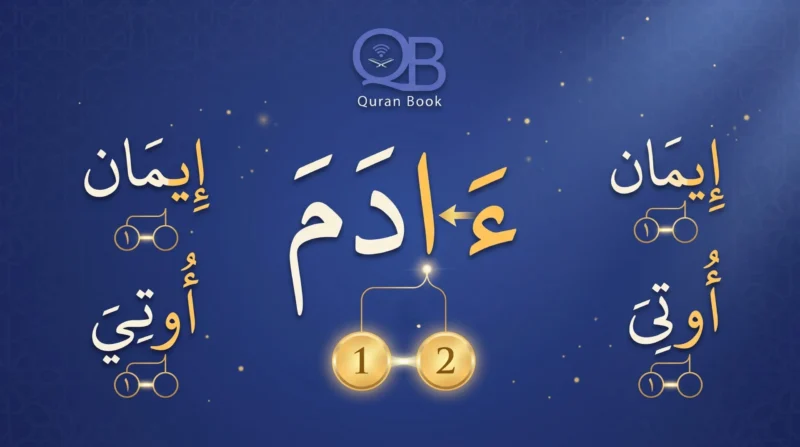
    2 Madd Badal Hamzah before the Madd letter آمَنُوا · إِيمَان Fixed
    2 Madd ‘Iwad Tanween fath when you stop — except on a ta’ marbutah (رَحْمَةً) حَكِيمًا → حَكِيمَا Fixed (at a stop only)
    2 Madd Silah Sughra Ha’ of the pronoun between two vowels إِنَّهُ كَانَ Fixed
    4 or 5 Madd Wajib Muttasil Hamzah after the Madd letter, same word جَاءَ · وَالسَّمَاءِ Obligatory
    4 or 5 Madd Jaiz Munfasil Hamzah after the Madd letter, next word إِنَّا أَعْطَيْنَاكَ Permissible — 2 counts in some paths of At-Tayyibah
    4 or 5 Madd Silah Kubra Ha’ of the pronoun followed by a hamzah مَالَهُ أَخْلَدَهُ Permissible
    2, 4 or 6 Madd ‘Arid lis-Sukoon Temporary sukoon, because you stopped الْعَالَمِينَ (at a stop) Permissible — pick one and stay consistent
    2, 4 or 6 Madd Layn Layn letter + temporary sukoon at a stop خَوْفٍ (at a stop) Permissible
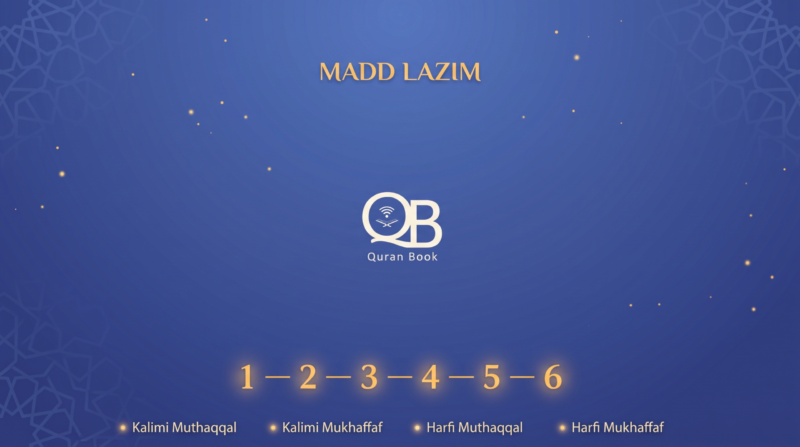
    6 Madd Lazim Permanent sukoon or a shaddah after the Madd letter الضَّالِّينَ · الم Obligatory — no choice

    Scroll the table sideways on a phone. Counts follow Hafs ‘an ‘Asim by the way of Ash-Shatibiyyah.

    ⚖️ The consistency rule: wherever a Madd allows 4 or 5 counts, or 2, 4 or 6, the choice is genuinely yours — but once you have chosen, keep it identical for every occurrence in the same recitation. Four counts on one Munfasil and five on the next, in the same page, is the mistake.

    One extra condition that most pages leave out: in Hafs by Ash-Shatibiyyah, Muttasil and Munfasil are not chosen independently of each other. They are read as a matched pair — four with four, or five with five — and Munfasil must never be held longer than Muttasil. Choosing 5 for Munfasil and 4 for Muttasil is a mixing of turuq, not a free choice.

    Madd counts ladder in Tajweed comparing two, four and six counts
    The 2 / 4 / 6 ladder — the only three lengths you actually need in your ear.

    Hear the ladder: 2, then 4–5, then 6

    Play these three in order, from Sheikh Al-Husary, without reading anything in between. The table becomes obvious the moment you hear the difference instead of picturing it.

    قَالَ

    Al-Baqarah 2:30 · Madd Asli · qaala — no additional cause affects the alif, so it stays at the natural length

    جَاءَ

    An-Nasr 110:1 · Madd Wajib Muttasil · the hamzah sits in the same word, so the alif is held

    الضَّالِّينَ

    Al-Fatihah 1:7 · Madd Lazim · a shaddah follows the alif, so six counts, every time · the yaa at the end is a separate ‘Arid lis-Sukoon at the stop

    Muttasil or Munfasil? Only the space matters

    These two are the pair most often confused, and the test takes half a second: look at where the hamzah is. In جَاءَ the hamzah is inside the same word as the alif — connected, muttasil, and the lengthening is obligatory. In إِنَّا أَعْطَيْنَاكَ the alif ends one word and the hamzah begins the next — separated, munfasil, and the lengthening is permissible. Same three letters, same hamzah, different ruling, entirely because of a space.

    Madd Wajib Muttasil and Madd Jaiz Munfasil compared by where the hamzah falls
    Inside the word: Muttasil, obligatory. Across the gap: Munfasil, permissible.

    🎧 Why your sheikh may differ on Munfasil: by the way of Ash-Shatibiyyah — the path this page follows and the one Sheikh Al-Husary recites in the recordings above — Madd Jaiz Munfasil is four or five counts. In some paths of At-Tayyibah it is read at two counts, the same as a natural Madd. Both are authentic transmissions of Hafs — but they are not interchangeable mid-recitation. Each is a route with its own matched set of lengths, so you follow one route throughout rather than borrowing a length from the other because it is easier on the breath.

    Which Madd Is This? Answer Two Questions

    Ten names is a lot to hold in your head while you are reciting. You do not have to. This tool identifies the main Madd patterns from two questions, and asks them for you. Special cases — Madd Layn, ‘Iwad, Silah and Tamkeen — have their own conditions and are not covered by it. Use it on a word you are stuck on and it will tell you the type, the count and where to read more.

    Step 1 of 2

    Look at your word. Is there a Madd letter in it — an alif, or a sakin waw after a dammah, or a sakin yaa after a kasrah?

    A learning aid, not a ruling. Rare cases — and any word you are unsure of — belong with a teacher.

    Madd Rules in the Quran: Worked Examples

    Madd in Quran recitation is not a rare event — it is on almost every line, which is exactly why an error in it spreads so far. Everything below is Sheikh Mahmoud Khalil Al-Husary, cut word by word: tap a single word and you hear that word alone, at teaching pace. Words carrying a Madd are marked in orange. Use Hide highlights to test yourself, and Slow speed when you are counting.

    Madd in Surah Al-Fatihah, ayah by ayah

    Start here, with the surah you already know by heart. Seven ayat give you the three most frequent Madd patterns and not one new word to learn — which makes Al-Fatihah the fastest tour of this chapter in the Quran. Read the note under each ayah, then tap the words.

    Al-Fatihah 1:1

    Three natural Madds, two counts each: the alif of the lafz al-jalalah in اللَّهِ, the dagger alif in الرَّحْمَٰنِ and the yaa in الرَّحِيمِ. The first two are written without a full alif but are pronounced long. Stopping on the last word turns it into ‘Arid lis-Sukoon.

    Al-Fatihah 1:2

    لِلَّهِ carries a natural two-count Madd on its alif of the lafz al-jalalah. الْعَالَمِينَ then holds two Madds of its own — a natural alif in the middle, and a yaa at the end that becomes Madd ‘Arid lis-Sukoon because you stop on it. Listen to how long Al-Husary holds it.

    Al-Fatihah 1:3

    The same two words as ayah 1, but now the second one is at the end of an ayah — so the natural two counts become 2, 4 or 6, your choice, held consistently.

    Al-Fatihah 1:4

    Watch the middle word. يَوْمِ has a sakin waw after a fathah — a layn letter, not a Madd letter, and not stretched here at all.

    Al-Fatihah 1:5

    The alif in إِيَّاكَ and وَإِيَّاكَ is a natural two-count Madd — the shaddah sits on the yaa before it, so it changes nothing. The yaa in نَسْتَعِينُ becomes Madd ‘Arid lis-Sukoon when you stop at the end of the ayah.

    Al-Fatihah 1:6

    Three natural Madds appear across the ayah. The Madd in اهْدِنَا and الصِّرَاطَ stays at the natural two counts. The final yaa in الْمُسْتَقِيمَ is also Madd Asli while continuing, but when you stop at the end of the ayah it becomes Madd ‘Arid lis-Sukoon and may be held for 2, 4 or 6 counts.

    Al-Fatihah 1:7

    The longest Madd in the surah closes it. In الضَّالِّينَ the alif before the doubled laam is Madd Lazim Kalimi Muthaqqal — six counts, obligatory. Then, because you stop at the end of the surah, the final yaa is a second Madd in the same word: Madd ‘Arid lis-Sukoon, 2, 4 or 6 at your choice. Two Madds, one word. Compare both with وَلَا immediately before, which is only two counts.

    🕌 Three patterns, one surah: Madd Asli (وَلَا), Madd ‘Arid lis-Sukoon at the end of each ayah (الْعَالَمِينَ) and Madd Lazim (الضَّالِّينَ). You recite all three at least seventeen times a day. Madd Badal does not occur anywhere in Al-Fatihah — for that one, see آمَنُوا in the examples below.

    Twelve worked examples, shortest length first

    One clip per row, ordered from the shortest length to the longest. Read the count before you press play, then check whether your ear agrees with the number.

    قَالَ

    Al-Baqarah 2:30 · Madd Asli · 2 counts · “he said”

    نُوحِيهَا

    Hud 11:49 · Madd Asli · 2 counts · all three Madd letters in one word. Its final alif meets the hamzah of إِلَيْكَ, which makes that one a Munfasil.

    آمَنُوا

    Al-Baqarah 2:9 · Madd Badal · 2 counts · hamzah first, Madd letter second

    جَاءَ نَصْرُ اللَّهِ

    An-Nasr 110:1 · Madd Wajib Muttasil · 4–5 counts

    وَالسَّمَاءِ

    Ash-Shams 91:5 · Madd Wajib Muttasil · 4–5 counts · the hamzah closes the same word

    إِنَّا أَعْطَيْنَاكَ

    Al-Kawthar 108:1 · Madd Jaiz Munfasil · 4–5 counts · the alif ends one word, the hamzah begins the next

    يَا أَيُّهَا الَّذِينَ آمَنُوا

    Al-Baqarah 2:104 · two Munfasil positions, then Badal, in one phrase · 4–5, 4–5, then 2يَا أَ and الَّذِينَ آ are both Munfasil, then Badal on آمَنُوا

    وَلَا الضَّالِّينَ

    Al-Fatihah 1:7 · Madd Lazim Kalimi Muthaqqal · 6 counts · a shaddah follows the alif

    الم

    Al-Baqarah 2:1 · Madd Lazim Harfi · 6 counts on the laam and the meem of the huroof muqatta‘ah (الحروف المقطعة)

    آلْآنَ

    Yunus 10:51 · Madd Lazim Kalimi Mukhaffaf · 6 counts · this form occurs only twice in the whole Quran, both in Surah Yunus

    مِنْ خَوْفٍ

    Quraysh 106:4 · Madd Layn, and only when you stop · 2, 4 or 6 counts. Continue past it and there is nothing to stretch.

    رَبِّ الْعَالَمِينَ

    Al-Fatihah 1:2 · Madd ‘Arid lis-Sukoon at the stop · 2, 4 or 6 counts · your choice, then the same choice every time

    Every ayah above can be checked against Quran.com, and the recitation throughout is Sheikh Mahmoud Khalil Al-Husary.

    5 Common Madd Mistakes

    Four of these five are length errors, not reading errors. That is the pattern: learners who make them can read every letter on the page correctly.

    1. Flattening everything to two counts

    By a wide margin the most common error. Every long vowel gets the natural length, so جَاءَ comes out the same size as قَالَ, and الضَّالِّينَ loses two thirds of its length. Play the 2 / 4–5 / 6 ladder above three times a day for a week and the ear fixes itself.

    2. Being inconsistent

    Four counts on one Munfasil and five on the next, in the same page. Both numbers are correct on their own; using both in one sitting is not. Decide before you open the mushaf.

    3. Stretching a waw or yaa that carries a vowel

    وَلَد and بَيَان look like they contain Madd letters and do not. The letter must be sakin, and the vowel before it must match. This is the mistake the letters table above exists to prevent.

    4. Over-holding Madd Lazim past six counts

    Usually done to sound more beautiful. Six is the ruling, not a minimum, and going beyond it changes the recitation rather than adorning it. The same applies to squeezing the ‘Arid at a stop down to nothing because you have run out of breath.

    5. Applying the temporary Madds while continuing

    Madd ‘Arid lis-Sukoon and Madd Layn exist only because you stopped. Read straight through الْعَالَمِينَ into the next ayah and it is an ordinary two-count Madd Asli again. Stretching it anyway is a length that has no cause.

    🎧 On the audio: every clip on this page is a correct recitation by Sheikh Al-Husary. We do not publish recordings of the mistakes above, because an incorrect recitation should never be attached to a reciter’s name — and because hearing an error repeatedly is a good way to learn it.

    Practise the Rules of Madd in Tajweed

    How many counts? A 10-clip ear trainer

    Naming a Madd from the page is one skill; hearing its length is another, and it is the one this chapter is actually about. Play the clip, decide whether Sheikh Al-Husary held it for 2, 4–5 or 6, then check. No account, no sign-up, and your score resets whenever you like.

    Question 1 of 10 Score: 0

    Listen, then choose the length you heard.

    Listen and copy: six ayat, one per length

    Work through the clips in the examples table in this order, repeating each one aloud straight after Sheikh Al-Husary and matching his length rather than his voice: قَالَ (2) → آمَنُوا (2) → إِنَّا أَعْطَيْنَاكَ (4–5) → وَالسَّمَاءِ (4–5) → الم (6) → الضَّالِّينَ (6). Turn on Repeat and Slow speed for the first pass. Five minutes a day for a week does more than reading this page twice.

    Play: The 4 or 6 Counts Basketball Game

    Deciding a length calmly is one thing; deciding it in the half-second you actually get while reciting is another. Shoot each word into the 4-count hoop or the 6-count hoop before the clock runs out. It works on phones and tablets, and no account is needed.

    Game not loading? Open it in a new tab · or browse all our free Tajweed games.

    Learn More

    Start with the four types that have their own guides — each one takes a single row of the counts table and opens it out. The badge on each card is its length, so this row doubles as a revision aid.

    The four types of Madd

    The rest of the Tajweed cluster

    All of them sit inside the wider set of Tajweed rules, and all are taught step by step in our Tajweed for adults and Tajweed for kids classes.

    Madd Rules FAQ

    Q1. What is Madd in Tajweed?
    Madd (المد) means lengthening. It is the Tajweed rule of stretching a vowel sound when it carries one of the three Madd letters — alif (ا), waw (و) or yaa (ي). The natural length is two counts.
    Q2. What are the Madd letters?
    There are three: alif (ا) preceded by a fathah, waw (و) sakinah preceded by a dammah, and yaa (ي) sakinah preceded by a kasrah. All three appear together in the word نُوحِيهَا.
    Q3. How many Madd letters are there?
    Three: ا, و and ي. A waw or yaa only counts as a Madd letter when it is sakin and the letter before it carries the matching vowel.
    Q4. How many types of Madd are there?
    There are two main types — Madd Asli (natural) and Madd Far‘i (secondary) — which branch into around ten commonly taught kinds. Different books quote different totals because they count the sub-varieties differently, not because the rules differ.
    Q5. How many beats is Madd?
    Madd Asli is two counts. Madd Wajib Muttasil and Madd Jaiz Munfasil are four or five. Madd Lazim is always six. Madd ‘Arid lis-Sukoon and Madd Layn may be two, four or six — choose one length and stay consistent.
    Q6. What is the difference between Madd Asli and Madd Far‘i?
    Madd Asli needs no cause: a Madd letter with no additional hamzah- or sukoon-based cause affecting it, held for two counts. Madd Far‘i is caused by a hamzah or a sukoon attached to the Madd letter — the hamzah may follow it (Muttasil, Munfasil) or precede it (Badal), and the sukoon may be permanent (Lazim) or created by stopping (‘Arid, Layn). Most kinds of Far‘i are longer than two counts, but Madd Badal stays at two.
    Q7. What is the difference between Madd Wajib Muttasil and Madd Jaiz Munfasil?
    In Muttasil the hamzah is in the same word as the Madd letter (جَاءَ), so lengthening is obligatory. In Munfasil the hamzah begins the next word (إِنَّا أَعْطَيْنَاكَ), so lengthening is permissible and the reciter may choose the length.
    Q8. What are the Madd rules in the Quran?
    They are the rules that decide how long to hold each Madd letter: two counts by default, four or five when a hamzah follows, and six when a permanent sukoon or shaddah follows. Surah Al-Fatihah alone gives you three of them: Madd Asli, Madd ‘Arid lis-Sukoon and Madd Lazim.
    Q9. Are the layn letters Madd letters?
    No. Waw and yaa sakinah preceded by a fathah (خَوْف, بَيْت) are letters of softness, not lengthening. They are only stretched when you stop on them, which is called Madd Layn.
    Q10. Do the Madd counts change between reciters?
    Some Madd lengths are fixed, while others vary by type and transmission. Madd Lazim is fixed at six counts. In Hafs by Ash-Shatibiyyah, Madd Wajib Muttasil and Madd Jaiz Munfasil are read with four or five counts as a matched reading face. Some paths of At-Tayyibah also transmit two counts for Munfasil. This page follows Hafs ‘an ‘Asim by Ash-Shatibiyyah.

    Get Your Counts Checked in One Free Lesson

    Length is the one thing you cannot self-assess — a 4-count and a 5-count feel identical from the inside. An Al-Azhar certified teacher hears the difference in a single ayah.

    Book Your Free Trial Lesson

    May Allah beautify your recitation and accept it from you. 🤲

    Jehad Mahmoud - Hafidha and Arabic Language graduate, writer at Quran Book Academy

    Hafidha of the Quran · Arabic Language Graduate · Writer on Islamic Sciences

    Jehad Mahmoud is a graduate of the Arabic Language department and a Hafidha of the Quran who writes the Islamic educational content at Quran Book Academy.

    She writes with a focus on Tajweed, Quranic recitation and the sharia sciences, making technical rules accessible to English-speaking Muslim families.

    Her articles are educational, not fatwa. For a ruling on a specific personal situation, readers are advised to consult a qualified scholar or mufti.

    Tajweed Madd Quranic Sciences Arabic Language Quran Recitation

    References & Sources

    1. Al-Azhar Al-Sharif — azhar.eg

    2. The chapter on Madd in the classical primers Tuhfat al-Atfal and Al-Muqaddimah al-Jazariyyah, and the riwayah of Hafs ‘an ‘Asim by the way of Ash-Shatibiyyah.

    3. Surah Al-Fatihah 1 — Quran.com · Surah Al-Kawthar 108 — Quran.com · Surah An-Nasr 110 — Quran.com

    4. Encyclopedia of Arabic Language and Linguistics — Brill Reference Works

    5. Recitation — Sheikh Mahmoud Khalil Al-Husary (Hafs, murattal), audio via EveryAyah.com; word-level timings via the Quran.com audio segment data.

    © 2026 Quran Book Academy. All rights reserved.

    Book Your Free Trial · Empowering Muslims Worldwide to Connect with the Quran
  • Ghunnah in Tajweed: The Nasal Sound of Noon and Meem, and Exactly When You Hold It

    Ghunnah in Tajweed: The Nasal Sound of Noon and Meem, and Exactly When You Hold It

    Jehad Mahmoud - writer at Quran Book Academy
    Written by
    Published: 21/8/2026 · Updated: 22/8/2026 · 11 min read
    Tajweed Rules · The Sound of Noon & Meem

    Ghunnah in Tajweed: The Nasal Sound of Noon and Meem, and Exactly When You Hold It

    Quran Book Academy · Quran & Tajweed Library

    Two letters · Five rulings that hold it · Five levels · Word-by-word audio by Sheikh Al-Husary · Free quiz & game

    Before you read a single line about it, test yourself. Pinch your nostrils shut and say إِنَّ. If the sound chokes off, you are making Ghunnah. If it carries on unchanged, you are making a throat hum that only resembles it — and most learners fail this test the first time, after years of reciting.

    That is what makes this rule different. Ghunnah (الغنة) is not a rule you apply to Noon and Meem — it is a sound that already lives inside them. Both letters carry it at all times, and the whole Noon and Meem chapter of Tajweed rules is simply a set of instructions about how much of it to let out. In its complete form it is held for two counts.

    Also written Ghunna or ghunnah tajweed; in Arabic الغنة, in English usually translated as nasalisation or simply nasal sound. All counts on this page follow the riwayah of Hafs ‘an ‘Asim by the way of Ash-Shatibiyyah.

    The 30-second version: two letters carry it (ن and م) · it leaves through the nasal passage, not the throat · five rulings hold it for two counts — shaddah, Idgham bi-Ghunnah, Idgham Shafawi (Meem into Meem), Ikhfa, Ikhfa Shafawi and Iqlab · in Izhar and on vowelled letters it is present but never held · and in Idgham bila Ghunnah (before ل and ر) it is dropped altogether.

    Ghunnah in Tajweed showing the nasal sound of Noon and Meem held for two counts
    Ghunnah is a quality of Noon and Meem — the rules only decide how long you hold it.

    What Is Ghunnah in Tajweed?

    Ghunnah (الغنة) is a nasal sound that comes out of the nasal passage (khayshoom) and is a permanent quality of the two letters Noon (ن) and Meem (م). The classical definition adds the detail that decides everything else: the tongue has no part in it. It is present in both letters at all times, and is held for two full counts when either letter carries a shaddah, or is merged with Ghunnah, hidden, or converted.

    One word in that definition changes everything: permanent. In Arabic it is called a sifah lazimah (صفة لازمة) — an inseparable attribute. You could not remove the Ghunnah from a Noon or a Meem if you tried; take it away and the letter stops being that letter. Which means the Tajweed rules never add Ghunnah to anything. Ikhfa does not create it, Idgham does not create it, Iqlab does not create it. They only tell you how much of it to release and how long to hold it. Once that clicks, the entire Noon and Meem chapter reorganises itself in your head: one sound, a small set of settings.

    Its source is the khayshoom (الخيشوم) — the nasal cavity. In Tajweed the Ghunnah is attributed to the khayshoom rather than to any point of articulation in the mouth or the throat, and that single fact is why the pinch test works: block the exit and the sound has nowhere to go.

    Ghunnah meaning: literal and technical

    The literal Ghunnah meaning in Arabic is a soft, resonant sound made through the nose — the classical books compare it to the sound a deer makes when calling her young. The technical meaning is the definition boxed above: the nasal quality carried by Noon and Meem, held for two counts in specific positions. Two senses, one idea, and the second is just the first with a stopwatch attached.

    📖 Riwayah note: every count on this page follows Hafs ‘an ‘Asim by the way of Ash-Shatibiyyah, the reading printed in the standard Madani mushaf.

    The Ghunnah Letters

    There are exactly two Ghunnah letters: ن and م. No third letter carries it, in any state, anywhere in the Quran. That is the whole list, and there is nothing to memorise beyond it.

    Letter Carries Ghunnah Held when Example
    نAlwaysIt carries a shaddah, or is hidden (Ikhfa), merged with Ghunnah, or converted (Iqlab)إِنَّ · مِن قَبْلُ
    مAlwaysIt carries a shaddah, or is hidden into a ب, or merges into another مثُمَّ · تَرْمِيهِم بِحِجَارَةٍ

    Now the correction that almost no English page makes. Tanween is not a third Ghunnah letter. Tanween is a Noon Sakinah in sound — the mushaf writes it as a doubled vowel, but in connected recitation your mouth produces an unwritten Noon Sakinah. That is the entire reason خَيْرًا يَرَهُ behaves exactly like مَن يَقُولُ. Learners who treat tanween as a separate topic end up memorising the same four rules twice.

    🧠 Memory hook: every held Ghunnah in the Quran is a Noon or a Meem wearing a different hat. Find the hat — shaddah, sukoon with a merge, a hidden letter, tanween — and you have found the rule.

    إِنَّ

    Al-Baqarah 2:6 · one word, Al-Husary · this is the reference Ghunnah for the whole page

    How to Pronounce Ghunnah (4 Steps)

    This is the part every other page skips. “Make a nasal sound” describes the output and says nothing about the source, so learners produce a throat hum with a nasal colour and have no reliable way of knowing they are wrong — an incorrect nasal-sounding voice can resemble the correct one closely, especially from inside your own head. Here is the physical method, and then the test.

    1. Use the mouth position required by the rule

    The Ghunnah itself resonates through the nasal passage, and the tongue plays no part in the sound — but the mouth position is not the same in every rule. With a clear or mushaddad Noon, the tongue uses the normal Noon articulation. With Meem, the lips provide its normal articulation. In Ikhfa Haqiqi, however, do not make the full Noon contact — the tongue prepares toward the following letter while the Ghunnah continues through the nose. In Idgham, the articulation follows the letter into which the Noon is merged.

    2. Let the sound out through the nose

    Not a hum “with a nasal feel” — the air genuinely leaves through your nostrils. Put a fingertip lightly on the side of your nose and you should feel it vibrate.

    3. Hold it level for two counts

    Keep the Ghunnah steady and natural for the required duration, with no rise or fall in pitch. The Ghunnah sound in Tajweed is resonance, not volume — it should never be louder than the letters around it.

    4. Run the pinch test

    Block your nostrils in the middle of the sound. A correct Ghunnah chokes off immediately and audibly, because you have just closed its only exit. If nothing changes, the sound is coming from your throat — go back to step 2.

    How to pronounce Ghunnah with a cross section of the mouth and nasal passage
    The mouth is closed, the khayshoom is open — that is the whole mechanism.

    Listen to it at full speed, then slowed down. Tap the Slow speed button in the walkthrough below and replay this clip to hear the two counts stretch out.

    إِنَّ الَّذِينَ

    Al-Baqarah 2:6 · inna-lladhīna · “Indeed, those who…” · the held Noon is the first word

    How Many Counts Is Ghunnah?

    A 2 count Ghunnahharakatayn — in its complete form. That is the same unit used for madd: roughly the time it takes to fold one finger at a steady pace, or to say “one-two” at recitation speed. It is a relative measure, not a stopwatch reading, so a slow recitation has a longer Ghunnah than a fast one. What must stay constant is the ratio: whatever your two counts sound like, they should sound the same on every held Ghunnah in the same recitation. The same clock governs the Madd rules, which is why training one improves the other.

    But “Ghunnah is 2 counts” is only part of the picture, and the missing part is where accuracy lives:

    Situation Ghunnah length
    Noon or Meem with a shaddah (نّ / مّ)2 counts — full, strongest
    Idgham bi-Ghunnah (ي ن م و), Ikhfa, Ikhfa Shafawi, Iqlab2 counts
    Noon or Meem sakinah in Izhar (Halqi or Shafawi)Inherent only — do not hold
    Noon or Meem with a vowel (نَ / مِ)Inherent only — do not hold
    Idgham bila Ghunnah — Noon Sakinah or tanween before ل or رNothing at all — the Ghunnah is dropped, not shortened

    That last row is the one most learners never meet. In مِن رَّبِّهِمْ and مِن لَّدُنْهُ the Noon does not merely lose its length — it hands over completely to the ر or the ل and the nasal sound disappears. Compare that with مَن يَقُولُ, where the Noon also disappears but the Ghunnah carries the join for two counts. Same word shape, opposite treatment.

    Holding a Ghunnah where the rule does not ask for one is as much an error as dropping one where it does.

    Over-nasalising every Noon and Meem in the ayah is the beginner signature, and almost no page warns about it. Hear the difference for yourself — the two clips below are the same reciter in the same session.

    إِنَّ

    Al-Baqarah 2:6 · Noon with shaddah · 2 counts

    لَكُمْ دِينُكُمْ

    Al-Kafirun 109:6 · Meem Sakinah before د (Izhar Shafawi) · nothing held

    Ghunnah held for two counts compared with an unheld Noon and Meem
    Two counts when the rule asks for it — and not a beat when it does not.

    Ghunnah Rules: When Is It Held for Two Counts?

    These are the Ghunnah rules in Tajweed, grouped by where you actually meet the sound on the page. They fall into the four places a Ghunnah can turn up in the mushaf — a doubled letter, a Noon Sakinah or tanween, a Meem Sakinah, or a vowelled Noon or Meem — and the map below shows which of them you hold. The six headings that follow walk the same ground from the learner’s side, so a Noon Mushaddadah appears under “with shaddah” and again under “with Noon”: one event, two angles.

    Held for two counts: shaddah · Idgham bi-Ghunnah · Idgham Shafawi (Meem into Meem) · Ikhfa and Ikhfa Shafawi · Iqlab.
    Not held: Izhar Halqi and Izhar Shafawi, and any vowelled Noon or Meem.
    Dropped entirely: Idgham bila Ghunnah, before ل and ر.

    Each clip below is a single word or phrase in Sheikh Al-Husary’s voice.

    1 · Ghunnah with Shaddah

    The strongest and simplest case. Any نّ or مّ takes a full two-count Ghunnah — no conditions, no exceptions, anywhere it appears, in the middle of a word or at the start of one. ✅ إِنَّ · ثُمَّ · جَنَّاتٍ · مُحَمَّدٌ. Master this case first: it is the only one you can identify without knowing any other rule.

    إِنَّا

    Al-Kawthar 108:1 · Noon Mushaddadah

    2 · Ghunnah with Noon

    Noon carries the nasal quality in every state it can be in — vowelled, silent, doubled — but it is only lengthened in the rulings listed above. The held form you hear most often is Noon Mushaddadah, as in آمَنَّا, where the tongue stays pressed to the gum ridge while the sound runs out through the nose.

    آمَنَّا

    Al-Baqarah 2:8 · Noon Mushaddadah · āmannā

    3 · Ghunnah with Meem

    Same story at the lips. Meem Mushaddadah (ثُمَّ · عَمَّ) is held for two counts, and so is the merging of a silent Meem into a following Meem — Idgham Mutamathilain, as in قُلُوبِهِم مَّرَضٌ. In both, the lips close once and the sound leaves through the nose.

    قُلُوبِهِم مَّرَضٌ

    Al-Baqarah 2:10 · Idgham Mutamathilain · one closure, two counts · see the Rules of Meem Sakinah

    4 · Ghunnah with Noon Sakinah

    A Noon Sakinah meets the next letter, and that letter decides what happens to the Ghunnah. It is held in Ikhfa (أَندَادًا), held in Idgham bi-Ghunnah (مَن يَقُولُ), held in Iqlab (لَيُنبَذَنَّ), not held in Izhar Halqi (أَنْعَمْتَ), and dropped altogether in Idgham bila Ghunnah (مِن رَّبِّهِمْ). Which letters trigger which rule is a separate lesson: the Noon Sakin rules page carries you across.

    أَندَادًا

    Al-Baqarah 2:22 · Ikhfa · the tongue never touches, and the Ghunnah carries the join

    5 · Ghunnah with Meem Sakinah

    The Meem half of the same idea. Ikhfa Shafawi (Meem Sakinah before ب) and Idgham Shafawi (Meem into Meem) both hold the Ghunnah for two counts; Izhar Shafawi — every other letter — does not. On how the lips behave during Ikhfa Shafawi the scholars differ: most describe the lips meeting without pressure, others describe a slight gap. Both groups agree on the ruling and on the two counts, so learn the ruling first and take the lip detail from your own teacher. Full treatment on the Rules of Meem Sakinah.

    تَرْمِيهِم بِحِجَارَةٍ

    Al-Fil 105:4 · Ikhfa Shafawi · the Meem is concealed before Baa while the Ghunnah is held for two counts

    6 · Ghunnah with Tanween

    Tanween behaves exactly like a Noon Sakinah, because in pronunciation it is one. So it is shown clearly with no held Ghunnah when the next letter is a throat letter (عَلِيمًا حَكِيمًا — Izhar before ح), it is hidden with a held Ghunnah in Ikhfa, it merges with a held Ghunnah before ي ن م و (هُدًى مِّن), it converts with a held Ghunnah in Iqlab (سَمِيعٌ بَصِيرٌ), and it loses the Ghunnah completely before ل and ر (غَفُورٌ رَّحِيمٌ). Nothing extra to learn — the details live on the Noon Sakin rules page.

    هُدًى مِّن

    Al-Baqarah 2:5 · tanween merging into م · Idgham bi-Ghunnah, 2 counts

    Ghunnah Map: When Is It Held?

    Every place a Noon or a Meem can appear, and what you do with the nasal sound there.

    A · Noon or Meem with Shaddah نّ / مّ

    • Anywhere in the Quran2 counts

    B · Noon Sakinah & Tanween

    • Izhar HalqiDo not hold
    • Ikhfa Haqiqi2 counts
    • Idgham with Ghunnah ي ن م و2 counts
    • Iqlab2 counts
    • Idgham without Ghunnah ل / رNo Ghunnah

    C · Meem Sakinah مْ

    • Ikhfa Shafawi (before ب)2 counts
    • Idgham Shafawi (Meem into Meem)2 counts
    • Izhar ShafawiDo not hold

    D · Vowelled Noon or Meem نَ نِ نُ / مَ مِ مُ

    • Every vowelled Noon and MeemInherent only

    Read it this way: “2 counts” means you hold the nasal sound. “Do not hold” means the Ghunnah is still there as the letter’s own quality but is never lengthened. “No Ghunnah” happens in one place only — Idgham bila Ghunnah before ل and ر, where the Noon merges away and the nasal sound goes with it.

    The Levels of Ghunnah (Marātib al-Ghunnah)

    Here is the piece that the “Ghunnah is 2 counts” summary hides. Ghunnah in Quran recitation has degreesmarātib al-ghunnah (مراتب الغنة). They are commonly classified into five levels, from a full held sound down to a trace you never lengthen; some Tajweed works group the same degrees into three or four instead, and some order the middle two differently. The levels rank completeness and strength, not length — every level that is held is held for the same two counts. The Ghunnah inside an Ikhfa does not carry the same weight as the Ghunnah of نَّ, and even a plain vowelled Noon still has some of it in there.

    # Level Where Held?
    1Mushaddad / complete Idghamنّ · مّ · Noon Sakinah or tanween fully merged into ن or م · Meem Sakinah merged into another MeemYes — 2 counts, strongest
    2Incomplete Idgham with GhunnahNoon Sakinah or tanween merging into ي or وYes — 2 counts
    3MukhfaIkhfa · Ikhfa Shafawi · IqlabYes — 2 counts
    4Sakin in IzharNoon Sakinah in Izhar Halqi · Meem Sakinah in Izhar ShafawiNo — inherent only, do not lengthen
    5Vowelled Noon or Meem (mutaharrik)نَ نِ نُ / مَ مِ مُNo — weakest, inherent only

    One thing the ladder does not include: Idgham bila Ghunnah. Before ل and ر the Noon is not weakened to a lower level — it is gone, and the Ghunnah goes with it. That is why it sits outside the five degrees rather than beneath them.

    One honest note, because you will meet the disagreement sooner or later: the books do not all order the middle levels the same way — some place the hidden Ghunnah (Ikhfa) above the merged one, and some do not split complete from incomplete Idgham at all. The practical takeaway is untouched either way. The top three are held for two counts; the bottom two are never lengthened at all. That is the line that matters when you are reciting, and it is worth more to you than any ranking of the middle.

    The Five Levels of Ghunnah

    Strength and completeness, top to bottom — not length.

    Level 1 — Mushaddad / complete IdghamNoon or Meem with shaddah, and any Idgham that merges completely — including a Meem Sakinah into another Meem. 2 counts
    Level 2 — Incomplete Idgham with GhunnahNoon Sakinah or tanween merging into ي or و. 2 counts
    Level 3 — MukhfaIkhfa Haqiqi, Ikhfa Shafawi and Iqlab. 2 counts
    Level 4 — Sakin in IzharNoon Sakinah in Izhar Halqi, Meem Sakinah in Izhar Shafawi. Do not hold
    Level 5 — Vowelled Noon or Meemنَ نِ نُ · مَ مِ مُ — the weakest degree. Do not hold

    All three held levels are the same two counts; the levels rank how complete and strong the Ghunnah is, not how long you hold it. Idgham bila Ghunnah before ل and ر is not on this ladder at all — there the Noon merges without keeping its Ghunnah.

    Ghunnah Examples in the Quran

    Reading about a sound only takes you so far. Everything below is Sheikh Mahmoud Khalil Al-Husary, and it is cut word by word: tap any single word and you hear that word on its own, at teaching pace. Letters marked in orange carry a held Ghunnah; letters marked in blue have the nasal quality but nothing to lengthen.

    Ghunnah examples in Surah An-Nas — the word-by-word map

    Six short ayat you almost certainly know by heart already, and they are dense with Noon Mushaddadah — النَّاسِ alone appears five times. That makes Surah An-Nas the best forty-second Ghunnah drill in the Quran. Tap a word to isolate it, or press Play word by word to walk through the ayah one word at a time.

    An-Nas 114:1

    One held Ghunnah: النَّاسِ — Noon with a shaddah, two counts.

    An-Nas 114:2

    Same word, same two counts. Compare your hold on this one against ayah 1.

    An-Nas 114:3

    Three ayat, three identical holds — consistency is the whole exercise.

    An-Nas 114:4

    Two held Ghunnahs of different kinds: مِن before ش is Ikhfa, الْخَنَّاسِ is a shaddah. Same length, different mouth.

    An-Nas 114:5

    Four words with no held Ghunnah at all, then one that has it. Resist the urge to hum through the rest.

    An-Nas 114:6 · two in one ayah

    Note the first word: مِنَ has a vowelled Noon — the Ghunnah is in there, but you never hold it.

    Ten Ghunnah Tajweed examples across the Quran

    One clip per situation, ordered from the simplest to the hardest to hear. Read the last two rows carefully — one has nothing to hold, and one contains a held Ghunnah and an unheld Noon side by side. Both are there on purpose.

    إِنَّ الَّذِينَ كَفَرُوا

    Al-Baqarah 2:6 · Noon Mushaddadah · the reference length for this page

    عَمَّ يَتَسَاءَلُونَ

    An-Naba 78:1 · Meem Mushaddadah · one word, all lips and nose

    إِنَّا أَعْطَيْنَاكَ الْكَوْثَرَ

    Al-Kawthar 108:1 · Noon Mushaddadah opening a surah you recite often

    مِنَ الْجِنَّةِ وَالنَّاسِ

    An-Nas 114:6 · two held Ghunnahs in one short ayah

    مَن يَقُولُ

    Al-Baqarah 2:8 · Idgham bi-Ghunnah · the Noon disappears, the sound does not

    أَندَادًا

    Al-Baqarah 2:22 · Ikhfa · the Noon loses its contact while the nasal sound keeps running

    لَيُنبَذَنَّ

    Al-Humazah 104:4 · Iqlab, then a Noon Mushaddadah — two held Ghunnahs in one word

    تَرْمِيهِم بِحِجَارَةٍ

    Al-Fil 105:4 · Ikhfa Shafawi · the Meem is concealed before Baa, Ghunnah held for two counts

    خَيْرًا يَرَهُ

    Az-Zalzalah 99:7 · tanween merging into ي · proof that tanween is a Noon in disguise

    لَكُمْ دِينُكُمْ

    Al-Kafirun 109:6 · Izhar Shafawi · no held Ghunnah — the Meem is clear and quick

    بِشَيْءٍ مِّنْ عِلْمِهِ

    Al-Baqarah 2:255 · both in one word. The tanween of بِشَيْءٍ merges into the Meem — held, 2 counts. The Noon Sakinah that follows meets ع — Izhar, nothing held. Judge the letter, not the word.

    🎧 Why the last two rows matter: a page about Ghunnah that only plays Ghunnah teaches your ear to nasalise everything. One clean negative, and one word that holds a Ghunnah and drops one within the same three syllables, do more for your accuracy than three more positives would.

    Tap any word or row to hear it.

    6 Common Ghunnah Mistakes

    1. Making the sound in the throat instead of the nose

    The single biggest error, and the only one that is completely invisible from the inside. The pinch test tells you whether the nasal resonance is there at all; a qualified teacher listening to you is what confirms the sound is right.

    2. Over-nasalising every Noon and Meem

    The “everything hums” habit — vowelled letters included. Ghunnah is present in all of them; it is only held in five rulings.

    3. Inconsistent length

    A long Ghunnah on إِنَّ and a clipped one on ثُمَّ in the same ayah. Wherever it is held, it is the same two counts.

    4. Turning it into a pitch bend

    Sliding the note up or down to sound melodic. Keep the Ghunnah steady, without deliberately changing its pitch; the melody belongs to the recitation, not to this sound.

    5. Holding a Ghunnah in Izhar — or keeping one in Idgham bila Ghunnah

    أَنْعَمْتَ and هُمْ فِيهَا take no hold at all — and before و and ف the Izhar Shafawi needs extra care, since the Meem shares its makhraj with the Waw and sits beside the Faa — and مِن رَّبِّهِمْ takes no Ghunnah whatsoever. Both are the mirror image of dropping one where it belongs, and just as much an error.

    6. Changing the articulation position too early

    Keep the correct articulation posture for the specific rule until the Ghunnah is complete. Do not release a required contact too early — but do not create a closure where the rule does not ask for one either. In Ikhfa Haqiqi, for example, the Noon stays concealed without its normal full tongue contact, and forcing that contact is its own mistake.

    Practise Ghunnah

    The 2-count timer: make the length visible

    Length is the part you cannot judge from the inside — it always feels right. Play إِنَّ once for reference, then press and hold the bar while you recite it yourself, releasing exactly when your nasal hold ends. Green means you landed inside a plausible two-count window for a normal recitation pace.

    إِنَّ

    Hold it for two counts at your own natural recitation pace.

    A guide, not a ruling: the count is relative to your own pace, so a slow tahqiq reading fills more of the bar than a fast one. What matters is that yours is the same every time.

    Hold it or not? A 10-word decision drill

    Ghunnah for beginners comes down to one repeated judgement: does this Noon or Meem get two counts, or not? Play the clip, look at the highlighted letter only, then choose. The feedback names the rule and points you to the page that owns it.

    Question 1 of 10 Score: 0

    Listen, then decide whether the highlighted letter is held.

    Play: Catch the Ghunnah Bee (Free Game)

    Spotting a Ghunnah on a page and spotting one under time pressure are two different skills. Catch only the words that carry a held Ghunnah and let the rest fly past. It works on phones and tablets, and no account is needed.

    Game not loading? Open it in a new tab · or browse all our free Tajweed games.

    Learn More

    Ghunnah is a quality of two letters. Qalqalah and Raa are qualities of others. The Noon and Meem pages are where Ghunnah is actually applied, and Madd is where you reuse the same counting — so read them in that order.

    All of them sit inside the wider set of Tajweed rules, and all are taught step by step in our Tajweed for adults and Tajweed for kids classes.

    Ghunnah FAQ

    Q1. What is Ghunnah?
    Ghunnah (الغنة) is a nasal sound produced from the nasal passage (khayshoom), and the classical books add that the tongue has no part in producing it. It is a permanent quality of the letters Noon (ن) and Meem (م), and is held for two counts when either letter carries a shaddah, or is merged with Ghunnah, hidden, or converted.
    Q2. What are the Ghunnah letters?
    Two: Noon (ن) and Meem (م). Tanween is not a third letter — it is pronounced as a Noon Sakinah, which is why it follows the same rules.
    Q3. How many counts is Ghunnah?
    Two counts (harakatayn) whenever it is held. In Izhar, and on a vowelled Noon or Meem, only the letter’s inherent nasal quality remains and nothing is lengthened. In Idgham bila Ghunnah — before ل and ر — the nasal sound is dropped completely.
    Q4. How do I know if I am pronouncing Ghunnah correctly?
    Pinch your nostrils shut while producing the sound. A correct Ghunnah cuts off immediately, because the air is leaving through the nose. If the sound continues unchanged, you are producing it in the throat or the mouth. The test confirms the resonance is there; only a teacher listening to you can confirm the length and quality.
    Q5. What is the difference between Ghunnah and Ikhfa?
    Ghunnah is the sound; Ikhfa is one of the rules that requires you to hold it. Ikhfa hides the Noon Sakinah into the following letter while the Ghunnah is held for two counts.
    Q6. Does every Noon and Meem have Ghunnah?
    Yes, as an inherent quality — Noon and Meem cannot be pronounced without it. But it is only held for two counts in five rulings: a Noon or Meem carrying a shaddah, Idgham bi-Ghunnah, Idgham Shafawi (a Meem Sakinah merging into another Meem), Ikhfa, Ikhfa Shafawi, and Iqlab. The one exception in the other direction is Idgham bila Ghunnah before ل and ر, where the Noon merges away and the nasal sound is not produced at all.
    Q7. What is Ghunnah with shaddah?
    Any Noon or Meem carrying a shaddah (نّ or مّ) takes a full two-count Ghunnah, with no conditions, anywhere in the Quran — as in إِنَّ and ثُمَّ. This is the strongest level of Ghunnah.
    Q8. Is there Ghunnah in Izhar?
    Not as a held sound. In Izhar the Noon or Meem is pronounced clearly and quickly, with only its natural nasal quality. Holding a Ghunnah in أَنْعَمْتَ or in لَكُمْ دِينُكُمْ is an error.
    Q9. Does tanween have Ghunnah?
    Tanween carries a held Ghunnah when it is subject to Ikhfa, Idgham bi-Ghunnah, or Iqlab. For example, خَيْرًا يَرَهُ is Idgham bi-Ghunnah and سَمِيعٌ بَصِيرٌ is Iqlab. In عَلِيمًا حَكِيمًا the tanween is followed by ح, so the ruling is Izhar and nothing is held. In غَفُورٌ رَّحِيمٌ it is Idgham bila Ghunnah, and the nasal sound is dropped entirely.
    Q10. What is the best surah to practise Ghunnah?
    Surah An-Nas. Its six short ayat contain several instances of Noon Mushaddadah (النَّاسِ, الْخَنَّاسِ, الْجِنَّةِ), so you can drill a consistent two-count hold in under a minute.

    Get Your Ghunnah Checked in One Free Lesson

    Ghunnah is the one sound you cannot correct alone — it sounds right from inside your own head and wrong to everyone else. An Al-Azhar certified teacher hears it in a single ayah.

    Book Your Free Trial Lesson

    May Allah beautify your recitation and accept it from you. 🤲

    Jehad Mahmoud - Hafidha and Arabic Language graduate, writer at Quran Book Academy

    Hafidha of the Quran · Arabic Language Graduate · Writer on Islamic Sciences

    Jehad Mahmoud is a graduate of the Arabic Language department and a Hafidha of the Quran who writes the Islamic educational content at Quran Book Academy.

    She writes with a focus on Tajweed, Quranic recitation and the sharia sciences, making technical rules accessible to English-speaking Muslim families.

    Her articles are educational, not fatwa. For a ruling on a specific personal situation, readers are advised to consult a qualified scholar or mufti.

    Tajweed Ghunnah Noon and Meem Quran Recitation

    References & Sources

    1. Al-Azhar Al-Sharif — azhar.eg

    2. The chapter on Ghunnah in the classical primers Tuhfat al-Atfal and Al-Muqaddimah al-Jazariyyah.

    3. Surah An-Nas 114 — Quran.com · Surah Al-Baqarah 2 — Quran.com

    4. Encyclopedia of Arabic Language and Linguistics — Brill Reference Works

    5. Recitation — Sheikh Mahmoud Khalil Al-Husary (Hafs, murattal), audio via EveryAyah.com; word-level timings via the Quran.com audio segment data.

    © 2026 Quran Book Academy. All rights reserved.

    Book Your Free Trial · Empowering Muslims Worldwide to Connect with the Quran

  • Makhraj: The 5 Articulation Points of Arabic Letters Explained

    Makhraj: The 5 Articulation Points of Arabic Letters Explained

    Tajweed Foundations

    Makhraj: The 5 Articulation Points of Arabic Letters Explained

    Discover exactly where every Quranic letter comes from — and why it matters

    Jehad Mahmoud Written by | 📅 Published | 🔄 Updated | ⏱️ 10 min read
    Makhraj diagram showing 5 articulation points of Arabic letters
    The 5 main Makharij zones — every Arabic letter is produced from one of these locations.

    Makhraj (plural: Makharij) is the exact point in the mouth, throat, lips, or nasal cavity where an Arabic letter’s sound is produced. Every one of the 29 Arabic letters has its own articulation point, and classical Tajweed scholars group these 17 precise exit points into 5 main zones. Getting this right is what separates a letter that sounds correct from one that quietly changes the meaning of the ayah.

    What Is Makhraj in Arabic?

    In Arabic, makhraj (مخرج) literally means “exit” or “place of coming out.” In Tajweed, it refers to the specific spot in the vocal tract — the throat, tongue, lips, or nasal passage — from which a letter’s sound physically originates.

    Without correct articulation there, a letter loses its identity and can be mistaken for a completely different one.

    It helps to keep the singular and plural straight: Makhraj is one articulation point (the exit point of the letter ق, for example), while Makharij is the plural — the full system used across the Arabic alphabet.

    Both words come from the same root, and you’ll see them used almost interchangeably in Tajweed books, though you’ll also see the complete science referred to by its formal Arabic name, “Makharij al-Huruf” (مخارج الحروف).

    This is one of the two pillars of Tajweed, alongside Sifat al-Huruf (the characteristics of each letter, such as heaviness or softness). Together they answer two different questions: this pillar answers where a letter comes from, and Sifat answers how it sounds once it gets there.

    Our guide to Tajweed Rules covers the second half of that picture in more depth.

    The 5 Main Makharij (Articulation Points)

    Makharij al-huruf chart with Arabic letters
    The complete map of Arabic articulation points — 17 in total, grouped under 5 zones.

    Classical scholars of Tajweed, following Ibn al-Jazari, identified 17 detailed articulation points and organized them under 5 broader regions of the mouth and throat. Every single Arabic letter belongs to exactly one of these five zones, which makes the system much easier to memorize than it first looks.

    Zone (Arabic)English nameWhat it coversApprox. letters
    الجوفAl-Jawf (Oral Cavity)The open space of the mouth and throat3 (long vowels)
    الحلقAl-Halq (Throat)3 points across the throat6
    اللسانAl-Lisan (Tongue)10 points — the largest zone18
    الشفتانAsh-Shafatan (Two Lips)2 points4
    الخيشومAl-Khayshum (Nasal Cavity)1 point — for Ghunnah only

    Notice that the tongue (Al-Lisan) alone accounts for more articulation points than any other zone — which is exactly why most beginner pronunciation mistakes, including the ones affecting ص, ض, ط, and ظ, trace back to tongue placement rather than the throat.

    Al-Jawf (The Oral Cavity)

    Al-Jawf is unique among the five Makharij: it isn’t a fixed contact point at all, but the open, empty space running from the throat through the mouth. It is the articulation source of the three long vowel letters — Alif (ا) preceded by a Fatha, Waw (و) preceded by a Damma, and Ya (ي) preceded by a Kasra.

    Because no part of the tongue, lips, or throat touches anything to produce these sounds, Al-Jawf is sometimes called the “no-contact” zone, and its letters are simply held for their natural count rather than shaped against a surface.

    Al-Halq (The Throat)

    Al-Halq — one of the most searched throat letters in Arabic topics for Tajweed students — is divided into three distinct points, moving from deepest to nearest:

    • Aqsa al-Halq (deepest throat): ء (Hamzah) and هـ
    • Wasat al-Halq (middle throat): ع (Ain) and ح
    • Adna al-Halq (nearest throat, closest to the mouth): غ (Ghain) and خ (Kha)

    These six throat letters are exactly the trigger letters for the Izhar rule in Noon Sakinah and Tanween, which is one of many places where mastering these points directly unlocks the Tajweed rules built on top of them.

    A common beginner error is collapsing ح and هـ into the same sound, or ع into a plain glottal stop — both are Makhraj mistakes, not Tajweed rule mistakes, and they need to be fixed at the articulation-point level first.

    Al-Lisan (The Tongue)

    Al-Lisan is by far the largest articulation zone, covering ten separate points and around eighteen letters — everything from the back of the tongue against the soft palate (ق, ك) to the tip of the tongue against the front teeth (ث, ذ, ظ). Because so many letters are packed into a small physical space, this is where non-Arabic speakers spend most of their correction time.

    A good example is Saad Makhraj: the letter ص (Saad) is produced from the tip of the tongue near the edge of the lower front teeth, with air forced through a narrow channel to create its distinctive whistling, heavy sound.

    This is the exact same exit point as س (Seen) and ز (Zay) — the difference isn’t location but Sifat (characteristics): ص carries Itbaq and Isti’la (making it heavy), while س stays light.

    Five of the 7 heavy letters (ص ض ط ق ظ) are articulated here in Al-Lisan ; most beginners struggle with are concentrated, which is why our full Tajweed Rules guide pairs naturally with this article.

    Ash-Shafatan (The Two Lips)

    Ash-Shafatan covers four letters produced using the lips: ف (Fa), from the inner lower lip touching the tips of the upper front teeth; and ب، م، و (Ba, Meem, Waw), produced by bringing the two lips together or close together. Meem and Ba can feel almost identical to a beginner, but Meem allows air through the nose (it’s a nasal letter) while Ba is a sharp, fully-closed-lip release — a small difference in articulation with a real difference in sound.

    Al-Khayshum (The Nasal Cavity)

    Al-Khayshum is the odd one out: it isn’t the fixed point of a specific letter, but of a sound — Ghunnah, the nasal resonance you hear in rules like Idgham with Ghunnah, Ikhfa, and Iqlab. Whenever a Noon or Meem carries a nasal hum, that hum is coming from Al-Khayshum, not from the mouth. Beginners who “flatten” their Ghunnah are usually closing off the nasal passage instead of letting the sound resonate there naturally.

    Try It Yourself: Interactive Makharij Practice

    Reading about articulation points only gets you halfway — the rest comes from active practice. Below is a live preview of one of our interactive Tajweed games, used inside the Quran Book Academy student portal to train letter recognition and correct pronunciation habits in a fun, low-pressure format.

    This particular game focuses on the 7 heavy letters, several of which share an articulation zone with letters students most often confuse (like ص and س from Al-Lisan above).

    Heavy Letters Gym

    Student Portal Preview

    Tip: the game works on both desktop and mobile — try it right here before scrolling on.

    Open Fullscreen →

    This is one small sample from a much larger library of free Arabic letter games our enrolled students use alongside live correction from a teacher — because a game can help you recognize a letter, but only a trained ear can confirm you’re actually getting it right.

    Why Makharij Matters in Tajweed

    Getting the Makhraj of Arabic letters right isn’t a stylistic preference — Arabic is a language where near-identical sounds can carry completely different meanings. Two words that differ by a single articulation point, like a letter produced from the tongue instead of the throat, can end up meaning entirely different things.

    Because the Quran is being recited, not just read, precision at this level is treated as the first and most foundational layer of Tajweed, before any of the Noon Sakinah, Madd, or Qalqalah rules are even introduced.

    This is also why Makhraj is taught before the named Tajweed rules in almost every traditional curriculum: a student who merges ح and هـ, or ت and ط, will keep misapplying every rule built on top of those letters until the underlying articulation point is corrected.

    Fixing the foundation first saves months of re-learning later.

    How to Practice Makharij at Home

    You don’t need to memorize all 17 articulation points in one sitting. Start with one zone per week — throat letters first, since there are only six — and use a mirror to check tongue and lip position while you repeat each letter slowly.

    Pair every letter with a short Quranic word that contains it, and listen to a trusted reciter before attempting it yourself; our Ayat al-Kursi memorization tool is a good place to hear phrase-by-phrase audio while you follow along.

    Record yourself reciting the same short passage for 60 seconds, then compare it to the reciter’s version. Most self-study plateaus happen because a mistake becomes a habit before anyone catches it.

    This is exactly what a live teacher in our Tajweed courses is there to catch early, session by session.

    Makhraj FAQ

    What is Makhraj?

    It is the precise point in the mouth or throat from which an Arabic letter’s sound originates. Getting it right is essential in Tajweed because it affects how clearly — and correctly — a letter is pronounced.

    What is Makharij in the Quran?

    This is the plural form, referring to the complete set of articulation points used across all Arabic letters when reciting the Quran. Scholars group these 17 specific points into 5 main zones.

    What is Makharij in Tajweed?

    This is the foundational rule that ensures every letter is pronounced from its correct location, preventing one letter from being mistaken for another during recitation.

    What does Makharij mean?

    The term literally means “exit points” or “points of articulation” in Arabic, referring to where sound physically originates when a letter is spoken.

    How many Makharij are there?

    Classical scholars group the articulation points into 5 main areas: the oral cavity (Al-Jawf), the throat (Al-Halq), the tongue (Al-Lisan), the two lips (Ash-Shafatan), and the nasal cavity (Al-Khayshum).

    What is the Makhraj of Saad?

    The letter Saad (ص) is articulated from the tip of the tongue against the edge of the upper front teeth, with the tongue pressed to produce its distinctive whistling sound.

    Why does Makhraj matter in Quran recitation?

    Pronouncing a letter from the wrong point can change the meaning of a word entirely, since Arabic letters that sound similar often carry very different meanings.

    Can I learn Makharij without a teacher?

    While self-study resources like audio guides and interactive charts help build initial awareness, a live teacher is essential for correcting subtle articulation mistakes that are difficult to hear on your own.

    Book Your Free Trial Lesson

    Charts and games can show you where a letter should come from — a live teacher is what confirms you’re actually getting there. We’ll assess your articulation points, build a simple correction plan, and start improving your recitation from day one.

    Start Your Free Trial Lesson →

    You can also reach us on WhatsApp” style=”color:#fff;text-decoration:underline;”>WhatsApp or join our free Maqra on Telegram.

    Written By

    Jehad Mahmoud — Arabic Language graduate and Hafidha of the Quran, writer on Makharij and the Quranic sciences

    Hafidha of the Quran · Arabic Language Graduate · Writer on Islamic Sciences

    Jehad Mahmoud is a graduate of the Department of Arabic Language and a hafidha who has memorised the entire Holy Quran. She writes the Islamic content at Quran Book Academy, specialising in Tajweed, the Quranic sciences and the Arabic language that underpins them.

    Having memorised the Quran herself, she writes about Makharij and articulation from the inside — she knows exactly which letters non-Arabic speakers confuse, and why. Every point she explains is traced back to the established science of Tajweed, and where scholars differ on the finer points, she says so plainly.

    Her articles are educational, not fatwa. For a ruling on a specific personal situation, readers are advised to consult a qualified scholar or mufti.

    Makharij Tajweed Articulation Points Quranic Sciences Hifz Arabic Language
  • What Is Ijazah? The Honest Truth in 5 Real Facts

    What Is Ijazah? The Honest Truth in 5 Real Facts

    Quran Book Academy · Certification Guide

    What Is Ijazah? The Honest Truth in 5 Real Facts

    Jehad Mahmoud - writer at Quran Book Academy
    Written by
    Published:13 August 2026· Updated:23 August 2026· 12 min read

    What is Ijazah in Quran? In plain terms, it’s a formal certificate of permission that a qualified teacher grants once a student has recited the Quran, or a defined portion of it, correctly and often from memory. It confirms an unbroken chain of transmission back to the Prophet Muhammad ﷺ, and it authorizes the student to recite — and in many cases to teach — that portion with confidence. Here’s the honest, practical breakdown of what this credential really is — and everything around it.

    What Is Ijazah? A Clear Definition

    The word Ijazah, sometimes spelled Ijaza or Ejaza, refers to one of the oldest forms of academic credentialing in the world. Long before universities issued diplomas, Islamic scholars issued them: individual, teacher-to-student permissions that certified a specific body of knowledge had genuinely been mastered.

    For the Quran specifically, this permission certifies that a student has recited a defined portion — sometimes a chapter, sometimes the entire Quran — directly to a qualified teacher, with correct pronunciation, correct Tajweed, and, depending on the type, complete memorization. The teacher listens, corrects every mistake, and only signs off once the recitation meets the required standard.

    Historically, the document itself often opened with a short prayer, introduced the student, recorded the date, and listed the teacher’s own line of teachers reaching back through history. That last part, the chain, is what gives an Ijazah its weight. It isn’t a test score. It’s proof of a real, verified relationship, passed down generation after generation.

    That matters more than ever today, when anyone can publish a Quran recitation video online. This kind of certification is one of the few credentials that simply cannot be faked, because its entire value depends on a real, traceable teacher standing behind it.

    What Does “Ijazah” Mean in Arabic?

    Ijazah (إجازة) comes from the Arabic root ج-و-ز, meaning “to permit,” “to allow,” or “to pass.” You’ll also see it written Ijaza or Ejaza — these are simply different English spellings of the same Arabic word, not different concepts.

    In everyday Arabic, the word can describe any kind of permission, license, or even a vacation. In Islamic scholarship, though, it narrows to something specific: certified authorization in a particular field of religious knowledge — Quran recitation, memorization, Hadith, or a specific Qira’ah, or reading, of the Quran.

    So when someone asks what “ejaza” means in Arabic in a Quranic context, the honest answer is: permission, earned, and formally granted by someone already qualified to grant it.

    Ijazah vs. Sanad — What’s the Difference?

    Ijazah and Sanad are two sides of the same coin, and even native Arabic speakers use the words almost interchangeably. Here’s the honest distinction.

    One is the certificate itself — the formal permission a teacher gives a student. The other, Sanad (سند), is the chain of transmission that certificate documents: the unbroken list of teachers connecting that student, name by name, all the way back to the Prophet Muhammad ﷺ.

    Think of the Sanad as the family tree, and the certificate as the diploma that places you on it. A genuine Ijazah can’t exist without an accompanying Sanad, because its entire value comes from proving that chain is real and unbroken.

    It helps to actually see that chain rather than just read about it. Below is a simplified picture of what an unbroken Sanad looks like — from the Prophet ﷺ, through generations of scholars, to an Al-Azhar certified teacher, to the student sitting in the lesson today.

    Sanad chain diagram showing Ijazah transmission from the Prophet Muhammad ﷺ through scholars to an Al-Azhar certified teacher and the student
    The Sanad: an unbroken chain of teachers, verified link by link.

    The Types of Ijazah in Quran

    Not every Ijazah certifies the same thing. Three main types exist, each representing a different level of mastery.

    Ijazah in Hifz (Memorization)

    This version certifies that a student has memorized the entire Quran, all 30 Juz, and can recite it accurately from memory without a Mushaf in front of them. Teachers typically test this by asking the student to continue reciting from random points throughout the Quran, to confirm the memorization is genuinely secure and not simply memorized in sequence.

    Ijazah in Tilawah (Recitation)

    This one certifies correct application of Tajweed: the rules governing how each letter is pronounced, where the voice should pause, and how sounds are elongated or blended. A student can pursue it on a specific portion of the Quran without necessarily having the whole text memorized, though many students work toward Hifz and Tilawah together.

    Ijazah in the Qira’at (Advanced, Multiple Readings)

    This is the most advanced type. The Quran was preserved through several authentic, verified ways of being read, known as the Qira’at, with Hafs ‘an ‘Asim being the reading most commonly taught and used worldwide today. This level certifies mastery of one or more of these readings, and it’s typically pursued only after a student has already secured the Tilawah certificate, sometimes years into serious study.

    Build Your Foundation First: Practice Izhar

    Every one of these paths rests on the same foundation: individual Tajweed rules, mastered one at a time. Izhar, reading Noon Sakinah or Tanween clearly, with no nasal sound, before one of six throat letters, is usually among the first rules a student learns on the road toward Tilawah.

    Try it yourself below. This free interactive game lets you listen to real recitation and identify the throat letters that trigger clear pronunciation, the exact kind of ear-training a teacher will expect before ever signing off on an Ijazah.

    Game not loading above? Open it in a new tab, or explore our full library of Tajweed rules and games.

    How Do You Get an Ijazah in Quran?

    Getting one is a process, not a purchase. Here is what it honestly involves, step by step.

    First, you need a qualified teacher who already holds their own verified Ijazah and Sanad. Without that, nothing that follows carries any weight.

    Second, you recite directly to that teacher, portion by portion, live, historically face-to-face and today just as validly over live video. This is sometimes called talaqqi, learning mouth-to-mouth and ear-to-ear, in real time.

    Third, the teacher corrects every mistake as it happens, whether a mispronounced letter, a missed Tajweed rule, or a shaky memorization point. You repeat that portion until it’s correct, then move to the next.

    Fourth, once you’ve covered the required scope, whether a single Surah or the entire Quran, and the teacher is fully satisfied, it’s formally granted, usually with a written certificate recording your place in the Sanad.

    How long this takes depends entirely on the portion, the student’s pace, and how much time they can commit each week. Some students complete a shorter one in a matter of months; the full Hifz version can reasonably take several years. Be cautious of anyone promising a fixed timeline, since real teachers assess every student individually. Our own Ijaza in Quran course is structured around exactly this process.

    Who Can Grant an Ijazah?

    Only someone who already holds a verified Ijazah and Sanad of their own can grant one to a student. This single rule is what protects the entire system.

    It means an Ijazah’s credibility is inherited, not self-declared. A teacher cannot simply decide they’re qualified to certify students; their authority to do so was itself granted by their own teacher, who received it the same way, in an unbroken line.

    This is why the institution behind a teacher’s own certification matters so much. Al-Azhar, one of the oldest and most respected centers of Islamic learning in the world, is widely regarded as one of the strongest sources of a verified chain, which is part of why families specifically look for Al-Azhar certified teachers when choosing who will teach their children.

    Do You Need an Ijazah to Teach the Quran?

    Not legally, in most countries. There’s no government requirement to hold an Ijazah before teaching Quran recitation. But traditionally, and among serious students and parents, it remains the closest thing to a gold standard.

    Scholars themselves aren’t entirely uniform on this point. Some hold that teaching basic reading or early Arabic literacy doesn’t require formal certification, while transmitting Tajweed rules or a specific Qira’ah with authority does. Rather than flatten that into one simple rule, it’s worth knowing that reputable teachers genuinely differ on exactly where the line sits.

    What is consistent, though, is why families care. It’s verifiable evidence that a teacher’s own recitation was checked, corrected, and approved by someone else qualified to do so, rather than simply self-taught and self-declared.

    Can Women Receive an Ijazah?

    Yes. Women have studied, memorized, and been formally certified in the Quran throughout Islamic history, and many hold their own verified Sanad chains today, just as men do.

    This matters practically, too. Many families, particularly for daughters, or for adult women who simply prefer it, look specifically for female teachers who hold their own Ijazah. At Quran Book Academy, our certified female teachers hold verified Ijazah and Sanad chains of their own, and are available for sisters and children who prefer a same-gender teacher.

    Why This Matters for You or Your Child

    If you’re a parent researching this before enrolling your child, here’s the honest, practical takeaway: an Ijazah is the clearest signal of teaching quality that exists in Quran education. Anyone can claim to be an expert online. Very few can show an unbroken, verifiable chain proving it.

    You don’t need to aim for one on day one. Most students begin with the basics: Arabic letters, correct pronunciation, foundational Tajweed rules, and an Ijazah becomes a natural milestone years into study with the right teacher, not a starting requirement.

    For adult learners, pursuing your own Ijazah is often described as one of the most meaningful achievements in a lifetime of learning the Quran: a permission that, once granted, is genuinely yours to carry forward, including passing it on to your own children one day.

    Not sure where you or your child currently stand on this path?

    Book Your Free Trial Lesson

    How Quran Book Academy Can Help You Start This Path

    Teacher and student practicing Tajweed together online toward formal certification

    We built Quran Book Academy specifically around the standards this article describes.

    Every teacher on our platform holds their own verified Ijazah and Sanad chain — nothing is self-declared. Lessons are 1-on-1 and live over Zoom, not pre-recorded, because an Ijazah can only ever be earned through real, corrected recitation with a real teacher listening. Both male and female certified teachers are available, so families can choose what’s most comfortable for them.

    Behind the scenes, our progress reporting portal tracks exactly which Tajweed rules a student has mastered, so both the family and the teacher can see, objectively, how close a student is getting to Ijazah-level accuracy, long before the formal certificate is ever discussed.

    If you’re ready to start down this path in a structured way, our Ijaza in Quran program is built exactly for this, and our foundational Tajweed course and Quran memorization program are there for students who want to build up to it first.

    Frequently Asked Questions

    What is Ijazah in Quran?

    This kind of certification in Quran is formal permission granted by a qualified teacher after a student has correctly recited the Quran, or a defined portion, often from memory. It confirms an unbroken chain of transmission back to the Prophet Muhammad ﷺ and authorizes the student to recite, and often teach, that portion.

    What does the word Ijazah mean in Arabic?

    It comes from an Arabic root meaning “to permit” or “to allow.” In everyday Arabic it can mean any kind of permission or license. In Quranic studies specifically, it refers to certified authorization in recitation, memorization, or a particular Qira’ah of the Quran.

    What is the difference between Ijazah and Sanad?

    One is the certificate itself. The other, Sanad, is the chain of transmission it documents — the unbroken line of teachers connecting a student back to the Prophet ﷺ. The two are closely linked, which is why teachers often use the words interchangeably.

    What are the types of Ijazah in Quran?

    The main types are the Hifz certificate, granted after full, accurate memorization of the Quran, and the Tilawah certificate, which certifies correct application of Tajweed. Advanced students can go further and earn one in a specific Qira’ah, or authentic reading, of the Quran.

    How do you get an Ijazah in Quran?

    You recite the required portion directly to a certified teacher, live, who corrects every mistake in pronunciation, Tajweed, or memorization. This continues, portion by portion, until the teacher is fully satisfied the recitation meets the required standard, at which point it’s formally granted.

    Who can grant an Ijazah?

    Only a teacher who already holds their own verified credential and Sanad can grant one to a student. This is exactly why the credibility of any such certificate depends entirely on the chain of the teacher issuing it.

    Do you need an Ijazah to teach Quran?

    There’s no universal legal requirement, and scholars differ on exactly where formal certification becomes necessary. In practice, it remains the most respected traditional qualification, which is why many families specifically look for Al-Azhar certified teachers who hold one.

    Can women receive an Ijazah in Quran?

    Yes. Women can and do receive this certification in both memorization and recitation, and many hold their own verified Sanad chains. Quran Book Academy’s certified female teachers hold these credentials and are available for sisters and children who prefer a female teacher.

    Jehad Mahmoud - Hafidha and Arabic Language graduate, writer at Quran Book Academy

    Hafidha of the Quran · Arabic Language Graduate · Writer on Islamic Sciences

    Jehad Mahmoud is a graduate of the Arabic Language department and a Hafidha of the Quran who writes the Islamic educational content at Quran Book Academy.

    She writes with a focus specialising in fiqh, the fiqh of women and the sharia sciences, making complex rulings accessible to English-speaking Muslim families.

    She also holds credentials in Tajweed and the Quranic sciences — the expertise behind this guide to Ijazah and Sanad.

    Her articles are educational, not fatwa. For a ruling on a specific personal situation, readers are advised to consult a qualified scholar or mufti.

    Fiqh Purification (Tahara) Wudu Fiqh of Women Tajweed

    Sources referenced for historical and etymological context: Wikipedia — Ijazah and World History Commons — Ijazahs (Diploma).