A learner recites أَلَمْ تَرَ كَيْفَ فَعَلَ رَبُّكَ and stretches the yaa of كَيْفَ while continuing into فَعَلَ. That is the mistake. The word contains a letter of leen, but the optional lengthening appears only when the reciter stops on كَيْفْ. Madd Leen is not a property of the word. It is a property of the moment you stop on it. This rule belongs to the Madd rules chapter of Tajweed rules.
Also written Madd Lin, Madd Layyin or Madd Layn, and sometimes called the soft madd — in Arabic, مد اللين. All one rule.
⚡ The 30-second version: two letters (وْ and يْ) · each preceded by a fathah · one letter after it · and you must be stopping on that word · then hold it 2, 4 or 6 counts, your choice. Keep reading and there is no lengthening at all. Everything on this page follows the riwayah of Hafs ‘an ‘Asim by the way of Ash-Shatibiyyah.
What Is Madd Lin in Tajweed?
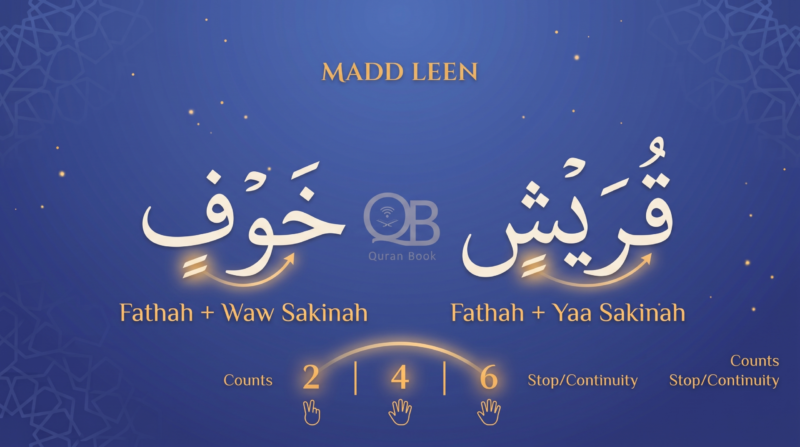
Madd Leen (مد اللين) is the soft lengthening of a waw sakinah (وْ) or yaa sakinah (يْ) preceded by a fathah, when you stop on that word. It is held for 2, 4 or 6 counts. While you continue reading there is no lengthening, though the letter of leen is still pronounced softly.
The name is literal. Leen (لين) means softness and ease. The letter does not stretch the way a madd letter stretches — it glides. The name is describing the sound, not the length.
What sets this rule apart from most of the madds on the hub is conditional existence. Madd Asli, Madd Badal, Madd Muttasil — all of them exist the moment their letters exist on the page. The lengthening of Madd Leen appears only when the reciter chooses to stop. It is one of the stop-dependent madds, alongside Madd ‘Arid lis-Sukoon, whose extra lengthening also appears at a stop and disappears when you continue. That is the part almost every English lesson leaves out.
One note on the unit before we go further: a count (harakah) is a relative timing unit based on the reciter’s own natural pace, not a fixed number of seconds. Opening or closing one finger is only a beginner training aid for feeling that pace — which is why two reciters at “four counts” can still sound slightly different and both be correct.
Madd Leen, Madd Lin or Madd Layyin: are they the same?
Yes — one rule, four transliterations of the same Arabic term مد اللين: Leen, Lin, Layyin and Layn. Classical books say leen; English courses split between lin and layyin; some translations simply write soft madd.
So if your teacher says one spelling and your book prints another, nothing has changed underneath. Same letters, same conditions, same counts.
The Madd Lin Letters: Just Two
There are two Madd Lin letters: و and ي. That is the entire list. Alif is never a leen letter — and there is a clean reason why, which we come to in a moment.
Alif is not included because the letters of leen are specifically a sakin waw or sakin yaa preceded by a fathah. Alif has its own fixed relationship with fathah as a madd letter. The answer to “are there three leen letters?” is no — there are two, and there is no fourth case hiding anywhere.
Leen letters vs madd letters: the two-step vowel test
This is the test that ends the confusion, and it runs in two short steps. Step one: the letter must be a sakin waw (وْ) or a sakin yaa (يْ). If it is not one of those two, neither label applies. Step two: look at the vowel on the letter before it. A sakin waw after a dammah, or a sakin yaa after a kasrah, is a madd letter — it stretches. Either a sakin waw or a sakin yaa after a fathah is a leen letter — it softens into a glide. Those are the combinations the two labels cover; any other combination is simply neither, so do not label a letter “leen” just because the vowel before it happens not to match.
🔑 The takeaway: once you have confirmed the letter is a sakin waw or a sakin yaa, the vowel before it decides which of the two labels applies — dammah or kasrah for a madd letter, fathah for a leen letter. The same waw sakinah is a madd letter in يَقُولُ and a leen letter in خَوْف. Once you hear that, you never confuse them again. The stretching version belongs to Madd Asli.
The Madd Lin Rules and Conditions
Three conditions, and every one of them has to hold at the same time. The Madd Lin Tajweed rule is only in force when all three are true together.
1 · There is a leen letter
A و or ي, sakinah, with a fathah on the letter before it.
✅ خَوْف ❌ يَقُول — dammah before the waw, so that is a madd letter
2 · The letter after it is the last letter of the word
Exactly one letter follows the leen letter — no more.
✅ قُرَيْشٍ ❌ عَلَيْهِمْ — the yaa here is a leen letter, but two letters follow it, so stopping on this word does not produce Madd Leen
3 · You are stopping on that word
This is the condition that gets dropped, and dropping it is what makes people recite the rule wrong for years.
✅ stopping on خَوْفٍ ❌ continuing through خَوْفٍ — the leen letter is simply pronounced softly, with no length at all
Hear the difference: the same word, stopped and continued
Teacher recordings made for this lesson. Same word, opposite result — then the same test on كَيْفَ.
Tap a line to hear it.
⚠️ All three must hold together. Drop the third and the lengthening disappears completely. Madd Leen is one of the stop-dependent madds: like Madd ‘Arid lis-Sukoon, its extra lengthening appears when you stop and is not there when you continue. The key difference is the type of letter involved — Madd Leen uses a leen letter, while Madd ‘Arid lis-Sukoon involves a regular madd letter. There is one exceptional case — the letter عَيْن in two surah openings — and it has its own section below.
How Many Counts Is Madd Lin?
Madd Lin is 2, 4 or 6 counts, and the reciter chooses. The three lengths have names your teacher will say out loud but you will rarely see printed in English material: qasr (قصر, 2 counts), tawassut (توسط, 4 counts) and tul (طول, 6 counts).
Three rows on purpose. The full counts table for every madd type lives on the Madd rules hub.
Hear the three lengths on one word, stopped on خَوْفْ. Each button is its own separate teacher recording.
خَوْفْ
2 counts · qasr
خَوْفْ
4 counts · tawassut
خَوْفْ
6 counts · tul
Whichever length you choose for Madd Leen, keep it steady rather than switching at random from one stop to the next. Drifting between two counts at one ayah-end and six at the next, with no settled pattern, is one of the most audible marks of an untrained reciter, and it is rarely explained in English material.
For beginners, matching Madd Leen with Madd ‘Arid lis-Sukoon can be a simple way to practise consistency, and many teachers start beginners that way. It is a training method, not a rule: the two should not be presented as if they must always have exactly the same length. Your teacher will tell you which pattern to follow as your recitation develops.
Many teachers ask beginners to take two counts everywhere until their stops are stable, and only then move up to four or six. That is good advice: consistency at two is worth far more than an impressive six that wanders.
How to Pronounce Madd Lin
The sound is a glide, not a stretch. Feel the difference in your own mouth. In يَقُولُ the mouth locks into one position and stays there for the whole length — nothing moves. In خَوْفٍ the mouth travels from the fathah toward the waw, and then rests. That travel is precisely what the word leen is naming.
Madd Lin pronunciation: three details that fix it
No ghunnah, no pitch rise, no wobble. The held part is level and relaxed. If you hear a hum through the nose, that is a different rule leaking in.
English starting points, not targets. خَوْف sits near the vowel in “how”, and بَيْت near the vowel in “bite”. Use them to find the shape of the mouth, then take the actual sound from the reciter — never from English.
The six-count trap. At six counts learners re-open the mouth in the middle of the hold and produce aa-oo-f. The glide happens once, at the very start. Everything after it is one steady, unmoving position.
خَوْفٍ
Quraysh 106:4 · the glide, then the hold
نَسْتَعِيْنُ
Al-Fatihah 1:5 · a pure, level stretch — no travel at all
Play them back to back. Side by side the difference is obvious; in isolation it is almost inaudible — which is exactly the learner’s problem.
The same test on الْبَيْت, in the teacher’s voice: stopped, then continued.
الْبَيْتْ
Stopped · Madd Leen is lengthened — 2 counts here
الْبَيْتِ
Continued · the yaa is still a letter of leen, with no lengthening
Madd Lin vs Madd Arid Lis-Sukoon
If you already know both names and still cannot tell them apart, you are in the right place — and the reason is simple. Madd Lin and Madd Arid Lis-Sukoon share almost everything.
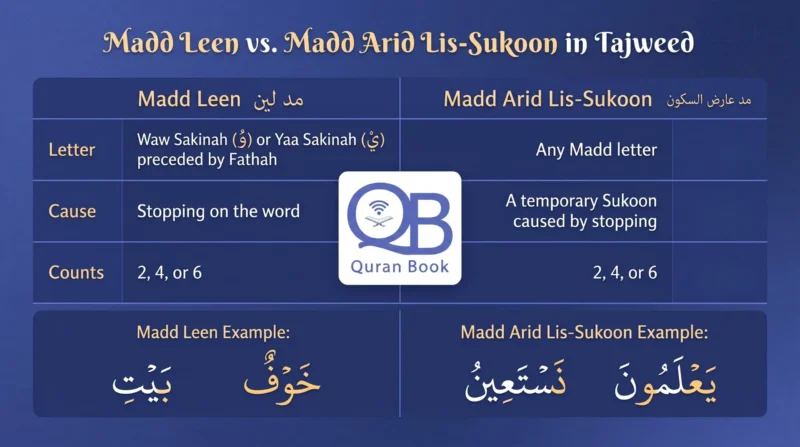
The verdict: they share the same temporary cause and the commonly taught 2, 4 and 6-count options, but they differ in the type of letter being lengthened. Giving both the same length — four counts for your Madd ‘Arid lis-Sukoon and four for your Madd Leen — is a useful beginner drill for building a steady recitation. Treat it as a practice aid rather than a requirement: the two do not have to be identical in length, and choosing differently is not in itself a Tajweed error. Follow the pattern your teacher sets for you.
Madd Lin Examples in the Quran
Surah Quraysh is the best training surah in the Quran for this rule. All four of its ayat end with a word containing a leen letter — قُرَيْشٍ, الصَّيْفِ, الْبَيْتِ and خَوْفٍ — and almost every learner already knows it by heart, which makes it the fastest possible proof. Tap any word below to hear it in Sheikh Al-Husary’s voice. Words outlined in gold carry the leen letter.
Surah Quraysh, word by word
Every word is a clip from Al-Husary’s recitation of that ayah. Tap a gold word twice — once here, once in your own mushaf.
Quraysh 106:1 ·
Quraysh 106:2 ·
Quraysh 106:3 ·
Quraysh 106:4 ·
All four ayat of Surah Quraysh end with a word containing a leen letter: قُرَيْشٍ, الصَّيْفِ, الْبَيْتِ and خَوْفٍ — four leen stops in four ayat.
More Madd Lin examples with Quran references
Three more, beyond Surah Quraysh. The last two are the exceptional case, and on this short list they are the only ones that apply whether you stop or not.
لَا رَيْبَ ۛ
Al-Baqarah 2:2 · yaa after a fathah · only at the permitted waqf mark · full ayah, continuous recitation
عسق
Ash-Shura 42:2 · the عَيْن · Madd Leen Lazim — 4 or 6 counts, 6 the more widely taught
كهيعص
Maryam 19:1 · the عَيْن · Madd Leen Lazim — 4 or 6 counts, 6 the more widely taught
Madd Lin words to practise
A word bank you can drill away from the mushaf, split by letter.
Yaa يْ after a fathah
بَيْت · شَيْء · كَيْف · خَيْر · غَيْب · صَيْف · قُرَيْش · رَيْب · عَيْن · بَيْن
Waw وْ after a fathah
خَوْف · يَوْم · قَوْم · لَوْن · نَوْم · مَوْت · صَوْت · طَوْع
⚠️ None of these words has madd leen on its own. Each one becomes a madd leen only when you stop on it. Read any of them in the middle of a phrase and there is no lengthening at all — the letters of leen are always there, the madd is not.
The Exceptional Case: ‘Ayn in Two Surah Openings
There is one exceptional case where Madd Leen is obligatory rather than optional — and it occurs in the disconnected letters that open two surahs.
The letter عَيْن, which appears in كهيعص at the opening of Surah Maryam and in عسق in Surah Ash-Shura, is spelled ع – يْ – ن: a leen letter followed by a permanent sukoon, not a temporary one. Because the sukoon does not come from your decision to stop, your decision cannot remove it.
So the usual 2-4-6 choice does not apply. Two lengths are transmitted in this route — four counts or six, whether you stop or continue — with six commonly presented as the preferred and more widely taught performance. This is the one case where the ordinary Madd Leen choice is not yours to make.
كهيعص
Surah Maryam 19:1 · listen for the length on the عَيْن
عسق
Surah Ash-Shura 42:2 · the same length, in a shorter opening
The wider family of permanent-sukoon madds — and the four types it splits into — is covered on Madd Lazim.
6 Common Madd Leen Mistakes
1 · Stretching it while continuing
The single most common error, and the reason most people learn this rule wrong in the first place. خَوْفٍ in the middle of a phrase gets no length whatsoever.
2 · Calling it a madd because the letter looks like one
يَقُولُ and خَوْف share a waw sakinah — and nothing else. Run the two-step vowel test instead of trusting the shape.
3 · Changing the count from stop to stop
Two counts at one ayah-end and six at the next. Pick one length at the start of the session and hold it.
4 · Using inconsistent lengths without following a recognised recitation pattern
Lengths that move around at random, with no settled pattern behind them, are what unsettle a recitation. Madd Leen and Madd ‘Arid lis-Sukoon do not have to be given exactly the same length, so a difference between them is not automatically an error. For beginners, matching the two is a simple way to practise consistency — treat it as a training method and follow the pattern your teacher sets.
5 · Re-opening the mouth mid-hold
At four or six counts this produces aa-oo-f instead of one steady glide-and-hold. The glide happens once, at the start.
6 · Treating عَيْن in the surah openings as optional
It is the exceptional case, in two surah openings: the ordinary 2-4-6 choice does not apply there. Four counts and six are both transmitted, with six the preferred and more widely taught — stopping or continuing.
Practise Madd Leen
Consistency trainer: pick a length and hold it
Accuracy is not the skill here — evenness is. Choose your length, then recite five stops in a row, pressing and holding the bar for each one. The feedback you get back is simply how much your five holds varied from each other in this drill, not how close they were to a stopwatch and not a judgement on your recitation.
Hold 0 of 5. Recite a leen stop out loud while you hold.
A guide, not a ruling: counts are relative to your own pace. What matters is that your five holds match each other. This trainer measures consistency, not the religious validity of your timing. A qualified teacher should assess the actual recitation.
Leen letter or madd letter?
Ten words, one highlighted letter in each. The question is what the highlighted letter is — a leen letter or a madd letter — not whether Madd Leen would occur if you stopped on the word. Run the two-step vowel test in your head, then tap. Instant feedback, no sign-up.
Look at the vowel before the highlighted letter.
Play: Madd Leen Star Jar (Free Game)
Recognition on a page and recognition under time pressure are two different skills. Sort the words into the right jar and watch the stars stack up. It works on phones and tablets, and no account is needed.
Game not loading? Open it in a new tab · or browse all our free Tajweed games · the full madd counts drill lives on the Madd rules hub.
Learn More
Read these four in order and the whole madd chapter falls into place. Madd Asli is the two-count baseline everything else is measured against; Madd Badal is a hamzah before the madd letter and stays at two; Madd Wajib Muttasil is a hamzah after it in the same word and is obligatory at four to five; Madd Silah is the pronoun’s ha’, short at two or long at four to five before a hamzah. Madd Leen sits outside this group because it is stop-dependent — as is Madd ‘Arid lis-Sukoon, which is why the two are grouped together below.
The other stop-dependent madds, and the hub:
All of them are taught step by step in our Tajweed for adults and Tajweed for kids classes.
Madd Leen FAQ
May Allah beautify your recitation and accept it from you. 🤲

Hafidha of the Quran · Arabic Language Graduate · Writer on Islamic Sciences
Jehad Mahmoud is a graduate of the Arabic Language department and a Hafidha of the Quran who writes the Islamic educational content at Quran Book Academy.
She writes with a focus on Tajweed, Quranic recitation and the sharia sciences, making technical rules accessible to English-speaking Muslim families.
Her articles are educational, not fatwa. For a ruling on a specific personal situation, readers are advised to consult a qualified scholar or mufti.
References & Sources
1. Al-Azhar Al-Sharif — azhar.eg
2. Surah Quraysh 106 — Quran.com
3. Surah Maryam 19 and Surah Ash-Shura 42 — Quran.com
4. Tuhfat al-Atfal, Sulayman al-Jamzuri — the chapter on madd, in the riwayah of Hafs ‘an ‘Asim by the way of Ash-Shatibiyyah
5. Recitation — Sheikh Mahmoud Khalil Al-Husary, via EveryAyah.com
© 2026 Quran Book Academy. All rights reserved.
Book Your Free Trial · Empowering Muslims Worldwide to Connect with the Quran