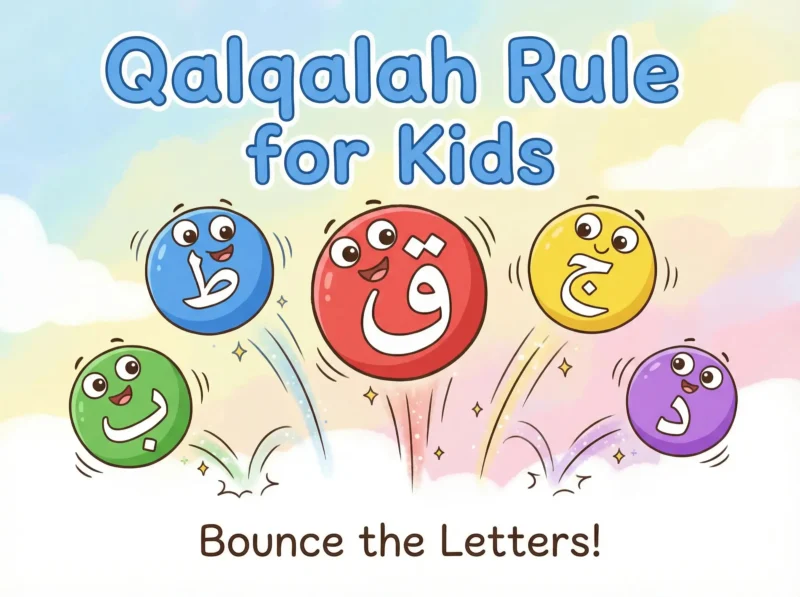
There are five qalqalah letters in Arabic: ق ط ب ج د — Qaf, Ta, Ba, Jeem and Dal — gathered in the mnemonic قطب جد (Qutbu Jad). When one of them carries a sukoon, it is released with a light bounce or echo instead of being pressed flat. That bounce is qalqalah, and this page gives you the letters, the two types, real Quranic examples with the recitation of Sheikh Al-Husary, and a free game to practise spotting them.
⚡ The 30-second version: 5 letters (ق ط ب ج د) · they only bounce when they carry sukoon · light bounce mid-word (Sughra) · stronger bounce at a stop (Kubra) · never add a vowel to the bounce.
What Are the Qalqalah Letters?
The qalqalah letters are ق (Qaf), ط (Ta), ب (Ba), ج (Jeem) and د (Dal). Qalqalah is the slight bounce or echo that these five letters produce when they carry a sukoon, and the five are memorised together through the phrase قطب جد.
The word qalqalah (قلقلة) literally means shaking, disturbance or vibration. In Tajweed it describes a very short, controlled movement of sound that escapes when one of the five letters is released. You will also see the rule written as qalqala, qolqolah or haroof e qalqalah in different transliterations — they all refer to the same rule and the same five letters.
The reason this rule exists is phonetic rather than decorative. These five letters share one key feature: they are all shadidah (plosive) — the airflow is completely blocked at the point of articulation. Without the bounce, the blocked air simply has nowhere to go and the letter gets swallowed — the listener hears a gap instead of a consonant. The qalqalah releases that blockage cleanly, so the letter stays audible.
This is why qalqalah is not optional. A reciter who skips it is not reciting in a plainer style; the letter itself has been dropped from the word. Every recognised chain of recitation applies the rule, which is one of the reasons it is usually among the first three or four rules taught to a beginner alongside the other core Tajweed rules.
The 5 Qalqalah Letters and Their Makhraj
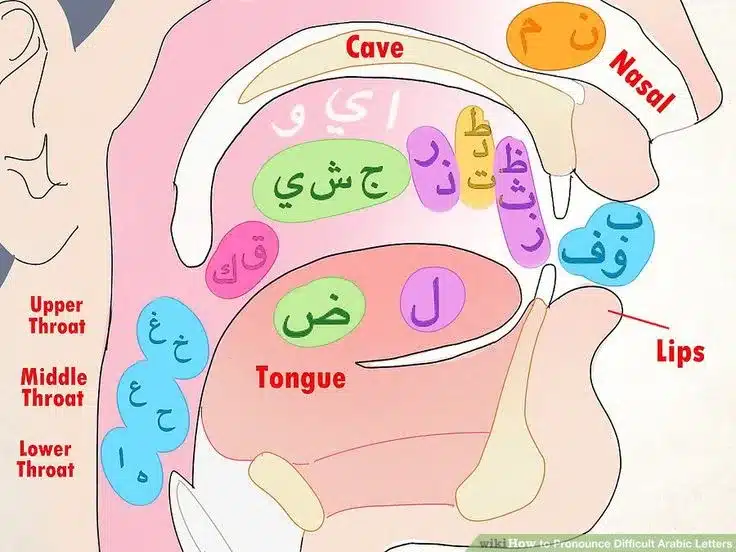
Each of the letters of qalqalah has its own point of articulation (makhraj). Knowing where the letter is formed makes the bounce far easier to produce, because the bounce is simply the release of that exact point:
The mnemonic: قطب جد
Rather than memorising five separate letters, teachers gather them into one short phrase: قطب جد, read as Qutbu Jad. Every letter in that phrase is a qalqalah letter, in order: ق, ط, ب, then ج, د. Learn the phrase and the whole list comes with it — which is why almost every child taught in a traditional halaqah can recite the huruf qalqalah before they can explain the rule.
Some books use the variant qutb jadd or write it as two words. The spelling makes no difference; the five letters are fixed and agreed upon.
How Many Qalqalah Letters Are There?
There are exactly five qalqalah letters in Arabic: ق, ط, ب, ج and د. No recognised school of recitation adds a sixth or removes one of the five.
Learners often expect the list to be longer, and there are two usual reasons. The first is confusion with the heavy letters of tafkheem — ص, ض, ط, ظ, غ, خ, ق. Two letters (ط and ق) belong to both groups, so students who meet tafkheem first assume the rest of that group bounces too. It does not: ص and ض are pronounced heavy, but the air is not released with an echo.
The second reason is that a qalqalah letter with a vowel on it does not bounce, so learners hear ب in bismi and conclude the rule is inconsistent. It is not — the rule only ever activates on sukoon. That single condition is what separates a qalqalah letter from an actual qalqalah occurrence.
How to Pronounce Qalqalah Letters (Step by Step)
The mechanic is the same for all five letters. Only the point of contact changes:
1. Close the makhraj completely
Press the two lips together for ب, the tip of the tongue for د and ط, the middle of the tongue for ج, the back of the tongue for ق. The airflow must stop fully — a partial closure gives you a hiss, not a bounce.
2. Hold for an instant
A sukoon means no vowel follows, so the letter is held rather than moved through. This pause is what builds the small amount of pressure that the bounce releases.
3. Release sharply, not slowly
Open the makhraj in one clean movement. The sound that escapes is the qalqalah: a short echo, closer to a knock than to a syllable.
4. Keep the mouth neutral
Do not shape the lips or tongue towards a vowel while releasing. If your bounce sounds like “qa”, “qi” or “qu”, you have added a vowel that is not in the text — this is the single most common error in the rule.
Listen and Practice: Qalqalah Letters in Action
Reading about qalqalah isn’t the same as hearing it. Below, tap each letter to hear a real Quranic word where that letter carries a sukoon, recited by Sheikh Mahmoud Khalil Al-Husary, so you can hear exactly what the bounce sounds like — then repeat it aloud yourself before moving to the next one.
Tap a letter to hear it.
💡 A test you can do alone: say the word twice — once pressing the letter flat and once with the bounce. If the two versions sound identical, you are not closing the makhraj fully. The difference should be obvious even to someone who does not speak Arabic.
The Two Types of Qalqalah: Sughra vs Kubra
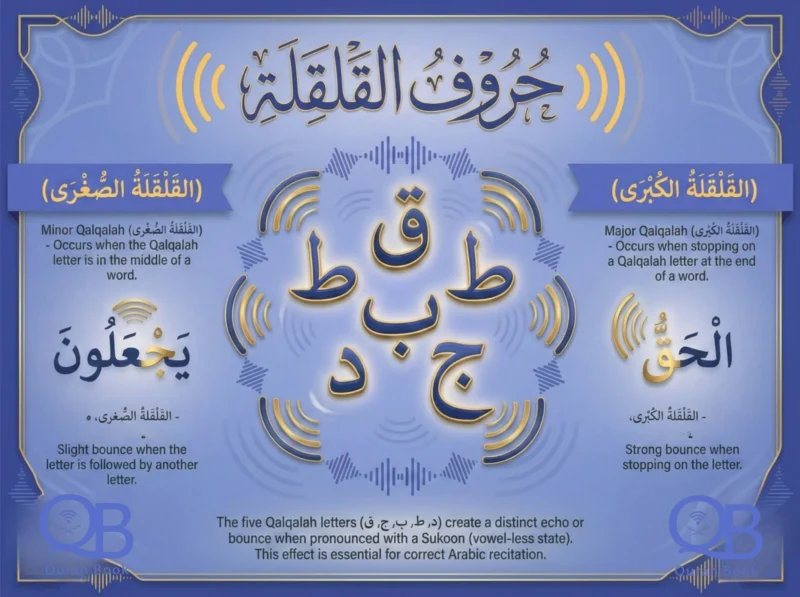
The rules of qalqalah divide it into two levels of strength. The letters are identical in both; what changes is where the sukoon falls, and therefore how much the bounce is emphasised.
Qalqalah Sughra (القلقلة الصغرى) — minor
The letter carries an original sukoon in the middle of a word, and the recitation continues straight past it. The bounce is light and quick, just enough to keep the letter audible.
وَٱلْفَجْرِ · لَمْ يَلِدْ وَلَمْ يُولَدْ
Qalqalah Kubra (القلقلة الكبرى) — major
The letter falls at the end of a word or an ayah and takes a sukoon only because the reciter stops there. Because the voice comes to rest on that letter, the bounce is noticeably stronger and slightly longer. This is what people usually mean by qalqalah akbar in the Quran.
قُلْ هُوَ ٱللَّهُ أَحَدْ · بِرَبِّ ٱلْفَلَقْ
The last row of that table catches a lot of learners. In qul huwa Allāhu aḥad, the د bounces only because you stopped on it. If you join the ayah to the next one, the word is read aḥadun and there is no bounce at all — the sukoon was never there to begin with.
Examples of Qalqalah from the Quran
These five ayat are the ones most often used to teach the rule, because the bounce falls in a place you cannot miss. Press play on each, and follow the highlighted letter as Sheikh Al-Husary recites it.
وَٱلْفَجْرِ
Surah Al-Fajr 89:1 · ج with sukoon · Sughra
لَمْ يَلِدْ وَلَمْ يُولَدْ
Surah Al-Ikhlas 112:3 · د twice · Sughra then Kubra at the stop
قُلْ أَعُوذُ بِرَبِّ ٱلْفَلَقْ
Surah Al-Falaq 113:1 · ق at the stop · Kubra
تَبَّتْ يَدَآ أَبِى لَهَبٍ وَتَبّْ
Surah Al-Masad 111:1 · ب at the stop · Kubra on a doubled letter
إِنَّ ٱلْإِنسَٰنَ لَيَطْغَىٰ
Surah Al-‘Alaq 96:6 · ط with sukoon · Sughra, heavy
Surah Al-Ikhlas, Al-Falaq and An-Nas are worth reciting slowly as a set once you know the rule, because the qalqalah kubra lands on the final letter of several ayat in a row. Children pick the rule up from those three surahs faster than from any explanation.
If you want to hear the same reciter across a longer passage while you practise, the phrase-by-phrase player on our Ayat al-Kursi memorization tool and on the last two ayat of Al-Baqarah uses the same recitation.
Common Mistakes Students Make with Qalqalah
Over-exaggerating the bounce
The most frequent error by far. The bounce becomes a full vowel and aḥad turns into aḥadah. A qalqalah is an echo, not a syllable — if you can write it with a letter, it is too big.
Dropping it at the stop
Learners apply the rule carefully mid-word and then forget it at the end of the ayah, which is exactly where it should be strongest. Qalqalah kubra is the version listeners notice most.
Confusing qalqalah with tafkheem
Heavy letters such as ص, ض and ظ are pronounced with a raised tongue, but they do not bounce. Only ط and ق belong to both groups.
Bouncing a letter that has a vowel
No sukoon, no qalqalah. The ب of bismillāh and the د of al-ḥamdu are read normally — adding an echo there is an invented sound.
Mistaking ذ for د
In bi-idhnih the letter is ذ, not د, so there is no qalqalah in it. This is also why there is no qalqalah anywhere in Ayat al-Kursi, despite what many pages claim.
Practise: Pop the Qalqalah Letters (Free Game)
Recognising the letters in isolation is easy; recognising them inside a running word is the actual skill. Play the game below — pop only the letters of qalqalah as they appear, and try to finish without popping a wrong letter. It works on phones and tablets, and no account is needed.
Game not loading? Open it in a new tab · or browse all our free Tajweed games.
Qalqalah video for kids
A short animated explanation of the rule for younger learners — useful if you are teaching qalqalah to a child at home:
Why Qalqalah Matters in Quran Recitation
Tajweed exists to preserve the Quran as it was recited and taught, sound for sound, through an unbroken chain of transmission. Qalqalah is a small part of that, but it is a part that is heard on almost every page — the five letters are among the most common in the language, and a reciter who ignores the rule alters the shape of hundreds of words.
It is also a rule with a genuine payoff for beginners. Unlike the finer points of madd, qalqalah can be learned in an afternoon and applied immediately, and it makes recitation sound noticeably more correct straight away. That early win is often what carries a student into the rest of the Tajweed rules course.
Common Questions About Qalqalah
Practise Qalqalah with Quran Book Online
You can learn the five letters from this page and drill them in the game above, but qalqalah is a sound, and a sound needs an ear on the other side. A teacher listening to you for ten minutes will tell you immediately whether your bounce is too heavy, too light, or landing on the wrong letter — something no page or app can do for you.
May Allah beautify your recitation and accept it from you. 🤲
Learn More
Continue with these guides from our Quran and Tajweed library
Hafidha of the Quran · Arabic Language Graduate · Writer on Islamic Sciences
Jehad Mahmoud is a graduate of the Arabic Language department and a Hafidha of the Quran who writes the Islamic educational content at Quran Book Academy.
She writes with a focus on Tajweed, Quranic recitation and the sharia sciences, making technical rules accessible to English-speaking Muslim families.
Her articles are educational, not fatwa. For a ruling on a specific personal situation, readers are advised to consult a qualified scholar or mufti.
References & Sources
1. Surah Al-Ikhlas 112 — Quran.com
2. Surah Al-Falaq 113 — Quran.com
3. PLACEHOLDER — Tajweed manual / Islamic studies institution reference for the Sughra vs Kubra distinction
4. PLACEHOLDER — Arabic phonetics source supporting the makhraj descriptions
5. Recitation — Sheikh Mahmoud Khalil Al-Husary, via EveryAyah.com
© 2026 Quran Book Academy. All rights reserved.
Book Your Free Trial · Empowering Muslims Worldwide to Connect with the Quran