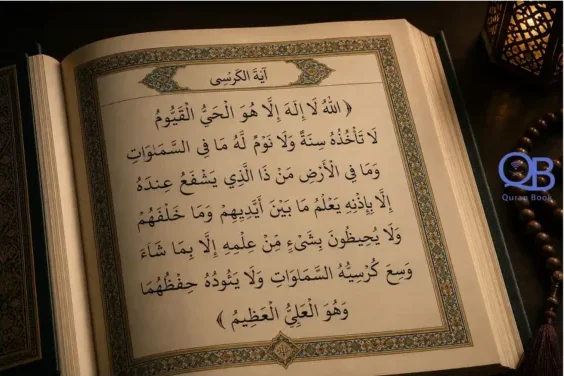
Ayat al-Kursi is verse 255 of Surah Al-Baqarah, and the Prophet ﷺ described it as the greatest verse in the Quran. Below you will find the full Arabic text, a clear transliteration, the English meaning, the recitation of Sheikh Mahmoud Khalil Al-Husary, the Tajweed rules that appear inside the verse, and a free line-by-line tool to help you memorise it.
اللَّهُ لَا إِلَٰهَ إِلَّا هُوَ الْحَيُّ الْقَيُّومُ ۚ لَا تَأْخُذُهُ سِنَةٌ وَلَا نَوْمٌ ۚ لَّهُ مَا فِي السَّمَاوَاتِ وَمَا فِي الْأَرْضِ ۗ مَن ذَا الَّذِي يَشْفَعُ عِندَهُ إِلَّا بِإِذْنِهِ ۚ يَعْلَمُ مَا بَيْنَ أَيْدِيهِمْ وَمَا خَلْفَهُمْ ۖ وَلَا يُحِيطُونَ بِشَيْءٍ مِّنْ عِلْمِهِ إِلَّا بِمَا شَاءَ ۚ وَسِعَ كُرْسِيُّهُ السَّمَاوَاتِ وَالْأَرْضَ ۖ وَلَا يَئُودُهُ حِفْظُهُمَا ۚ وَهُوَ الْعَلِيُّ الْعَظِيمُ
Surah Al-Baqarah 2:255
Allāhu lā ilāha illā huw, al-Ḥayyu al-Qayyūm. Lā ta’khudhuhū sinatun wa lā nawm. Lahū mā fis-samāwāti wa mā fil-arḍ. Man dhal-ladhī yashfa’u ‘indahū illā bi-idhnih. Ya’lamu mā bayna aydīhim wa mā khalfahum, wa lā yuḥīṭūna bi-shay’in min ‘ilmihī illā bimā shā’. Wasi’a kursiyyuhus-samāwāti wal-arḍ, wa lā ya’ūduhū ḥifẓuhumā, wa huwal-‘Aliyyul-‘Aẓīm.
Allah — there is no god but Him, the Ever-Living, the Sustainer of all existence. Neither drowsiness nor sleep overtakes Him. To Him belongs whatever is in the heavens and whatever is on the earth. Who is there that can intercede with Him except by His permission? He knows what lies before them and what lies behind them, and they encompass nothing of His knowledge except what He wills. His Kursi extends over the heavens and the earth, and their preservation does not tire Him. And He is the Most High, the Most Great.
Translation of the meaning, rendered for clarity. To compare with a published translation, see Quran.com 2:255.
🎧 Listen: Sheikh Mahmoud Khalil Al-Husary
What Is Ayat al-Kursi?
Ayat al-Kursi is verse 255 of Surah Al-Baqarah, the second chapter of the Quran (2:255). It takes its name from the word kursi, which appears within it, and the Prophet ﷺ described it as the greatest verse in the Quran.
The verse sits roughly in the middle of Surah Al-Baqarah, the longest chapter of the Quran, rather than at its end. It is a single verse of around fifty words, which makes it longer than most short surahs but still short enough for a beginner or a child to memorise in under a week.
The name comes from the phrase wasi’a kursiyyuhu as-samāwāti wal-arḍ — “His Kursi extends over the heavens and the earth.” Because kursi is usually rendered as throne or footstool in English, the verse is also widely known as the Throne Verse.
You will see the name written in several different ways in English: Ayat al-Kursi, Ayatul Kursi, Aayat al-Kursi, Ayat ul Kursi, or simply the Throne Verse. These are all transliterations of the same Arabic name for the same verse — there is no difference in meaning between them.
Quick answers
- Which verse is it? Verse 255 — the 255th ayah of Surah Al-Baqarah.
- Which surah? Surah Al-Baqarah, chapter 2 of the Quran.
- Is it in the Quran? Yes. It is a verse of the Quran, not a supplication or a narration.
- How long is it? Around fifty words — one long verse, recited in about one minute.
Ayat al-Kursi in English: Full Translation
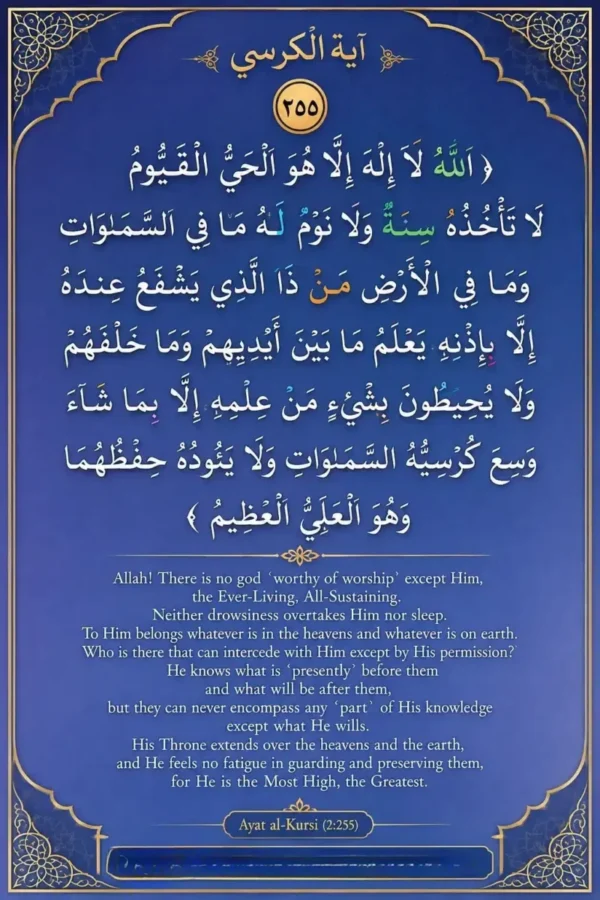
No English rendering can carry everything the Arabic carries, which is why translators describe their work as a translation of the meaning rather than a translation of the Quran itself. The rendering below follows the wording of the verse closely, sentence by sentence.
Allah — there is no god but Him, the Ever-Living, the Sustainer of all existence. Neither drowsiness nor sleep overtakes Him. To Him belongs whatever is in the heavens and whatever is on the earth. Who is there that can intercede with Him except by His permission? He knows what lies before them and what lies behind them, and they encompass nothing of His knowledge except what He wills. His Kursi extends over the heavens and the earth, and their preservation does not tire Him. And He is the Most High, the Most Great. — Surah Al-Baqarah 2:255, translation of the meaning
Word-by-word meaning
Working through the verse word by word is the fastest way to move from reciting sounds to understanding what you are saying:
Ayat al-Kursi Transliteration (How to Pronounce It)
The transliteration below is broken at the natural pausing points of the verse. Press the play button beside any line to hear that part in the recitation of Sheikh Al-Husary, then repeat it aloud before moving on.
💡 Worth knowing: transliteration is a temporary bridge, not a replacement for the Arabic. Letters such as ع, ح, ق and ط have no English equivalent, so any Latin spelling of them is an approximation. Use the transliteration to get started, and use the audio to correct it.
The Meaning of Ayat al-Kursi
Ayat al-Kursi is unusual among the long verses of the Quran: from beginning to end it speaks only about Allah. It contains no command, no prohibition and no legal ruling. It is a pure statement about who Allah is — His oneness, His life, His ownership, His knowledge and His power — and that is a large part of why it holds the standing it does.
اللَّهُ لَا إِلَٰهَ إِلَّا هُوَ
The verse opens with pure tawhid: worship belongs to Allah alone, and nothing else has any share in it. Everything that follows is an explanation of why that is so.
الْحَيُّ الْقَيُّومُ
Two names that scholars have long treated as the axis of the verse. Al-Ḥayy is the One whose life is perfect and never ends. Al-Qayyūm is the One who stands in need of nothing and by whom everything else is maintained.
لَا تَأْخُذُهُ سِنَةٌ وَلَا نَوْمٌ
Every deficiency is ruled out, and in ascending order: not even a moment of drowsiness, let alone sleep. Nothing in creation is ever unattended.
لَّهُ مَا فِي السَّمَاوَاتِ وَمَا فِي الْأَرْضِ
Absolute ownership. Not partial, not shared, not delegated — whatever exists in the heavens and the earth belongs to Him.
مَن ذَا الَّذِي يَشْفَعُ عِندَهُ إِلَّا بِإِذْنِهِ
A question that expects no answer. Intercession exists, but only with His permission — which closes the door on the idea that anyone can be approached as a route to Allah independently of Him.
يَعْلَمُ مَا بَيْنَ أَيْدِيهِمْ وَمَا خَلْفَهُمْ
His knowledge covers what is ahead of creation and what is behind it — the future and the past, the seen and the hidden.
وَلَا يُحِيطُونَ بِشَيْءٍ مِّنْ عِلْمِهِ إِلَّا بِمَا شَاءَ
Creation knows only what it has been given to know. Whatever anyone understands of revelation, of the world, or of themselves is something Allah chose to disclose.
وَسِعَ كُرْسِيُّهُ السَّمَاوَاتِ وَالْأَرْضَ
The image that gives the verse its name. The heavens and the earth, vast as they are, are encompassed by the Kursi — and the Kursi itself is part of creation.
وَلَا يَئُودُهُ حِفْظُهُمَا وَهُوَ الْعَلِيُّ الْعَظِيمُ
Holding all of that in existence costs Him nothing. The verse then closes on two names — the Most High and the Most Great — returning the reader to where it began.
Read as a whole, the verse moves outward in stages: from Allah alone, to His perfect life, to His ownership of everything, to His knowledge of everything, to the vastness of His dominion — and then back to Him. That structure is worth noticing while you memorise it, because it makes the order of the phrases much easier to hold.
Why Ayat al-Kursi Is Considered the Greatest Verse
The standing of Ayat al-Kursi rests on a small number of authentic narrations, not on the long lists of guaranteed outcomes that circulate online. Those established reports are set out below, followed by an equally important note on what is not established.
The greatest verse in the Quran
The Prophet ﷺ asked the companion Ubayy ibn Ka’b which verse of the Book of Allah he considered the greatest. Ubayy answered with Ayat al-Kursi, and the Prophet ﷺ affirmed his answer. This is reported in Sahih Muslim.
Protection through the night
Sahih al-Bukhari records the well-known account of Abu Hurairah and the thief who came to the charity of Ramadan. In that narration the Prophet ﷺ confirmed what the thief had told Abu Hurairah: whoever recites Ayat al-Kursi when going to bed will have a protector from Allah with him, and no devil will come near him until morning.
After the obligatory prayers
It is reported in Sunan an-Nasa’i that whoever recites Ayat al-Kursi after every obligatory prayer, nothing stands between him and entering Paradise except death. Scholars have differed over the grading of this narration, so it is presented here as a report rather than as a settled ruling.
What Ayat al-Kursi Is Not
A great deal of what is written about Ayat al-Kursi online has no authentic basis. You will find claims that reciting it a fixed number of times produces a specific result, that it guarantees wealth, that it removes illness or magic within a set period, or that it protects a person from harm unconditionally.
None of that is established. Attaching specific counts to specific outcomes, in particular, is an addition to the religion rather than a part of it, and it changes an act of worship into a formula.
The established virtues are the ones listed above. Ayat al-Kursi is recited because it is the word of Allah and because the Prophet ﷺ taught it — not as a technique for obtaining results.
When to Recite Ayat al-Kursi
For families, the bedtime recitation is usually where it starts. Many parents read Ayat al-Kursi aloud with their children as part of the routine before sleep, and after a few weeks the child is repeating it from memory without ever having sat down to “study” it. Along with Surah Al-Fatihah, it is often the first passage children hold.
There is no requirement of wudu or facing the qiblah to recite it, although being in a state of purity is better. It can be recited quietly, aloud, from a Mushaf or from memory.
Tajweed Rules Inside Ayat al-Kursi
Most pages that publish this verse stop at the translation. Because Ayat al-Kursi is recited more often than almost any other passage, it is worth knowing exactly which Tajweed rules occur in it and where. Use the key below, then read the coloured text.
اللَّهُ لَا إِلَٰهَ إِلَّا هُوَ الْحَيُّ الْقَيُّومُ ۚ لَا تَأْخُذُهُ سِنَةٌ وَلَا نَوْمٌ ۚ لَّهُ مَا فِي السَّمَاوَاتِ وَمَا فِي الْأَرْضِ ۗ مَن ذَا الَّذِي يَشْفَعُ عِندَهُ إِلَّا بِإِذْنِهِ ۚ يَعْلَمُ مَا بَيْنَ أَيْدِيهِمْ وَمَا خَلْفَهُمْ ۖ وَلَا يُحِيطُونَ بِشَيْءٍ مِّنْ عِلْمِهِ إِلَّا بِمَا شَاءَ ۚ وَسِعَ كُرْسِيُّهُ السَّمَاوَاتِ وَالْأَرْضَ ۖ وَلَا يَئُودُهُ حِفْظُهُمَا ۚ وَهُوَ الْعَلِيُّ الْعَظِيمُ
Madd Munfasil — لَا إِلَٰهَ
The long ā at the end of lā is followed by a hamzah at the start of the next word, so the vowel is stretched beyond its normal length. This is the single most commonly rushed point in the whole verse.
Madd Muttasil — شَاءَ
Here the long vowel and the hamzah sit inside the same word, which makes the elongation obligatory and longer still.
Ikhfa — مَن ذَا · عِندَهُ
A silent nūn followed by dhāl in the first case and dāl in the second. The nūn is neither pronounced clearly nor merged: it is hidden, with a nasal sound held for about two counts.
Madd Asli — يُحِيطُونَ
The madd in yuḥīṭūna is two vowel counts, so the ṭā is extended for two counts because of the wāw carrying a ḍammah before it. Many readers shorten it to a single count — take care with this one, barak Allahu feek.
Idgham — سِنَةٌ وَلَا · بِشَيْءٍ مِّنْ · نَوْمٌ لَّهُ
Tanwīn followed by wāw and by mīm merges with a nasal sound; tanwīn followed by lām merges without one. Notice the shaddah printed on the following letter in the Mushaf — that mark is the instruction.
Ghunnah — مِّنْ in بِشَيْءٍ مِّنْ
The doubled mīm produced by the merger is held on the nose for two counts. If you want to drill this sound on its own, try our free interactive Ghunnah lesson.
Heavy Rā — الْأَرْضِ · كُرْسِيُّهُ
A silent rā preceded by a fatḥah or a ḍammah is pronounced heavy, with the back of the tongue raised. English speakers tend to flatten it into an English “r”, which changes the sound noticeably.
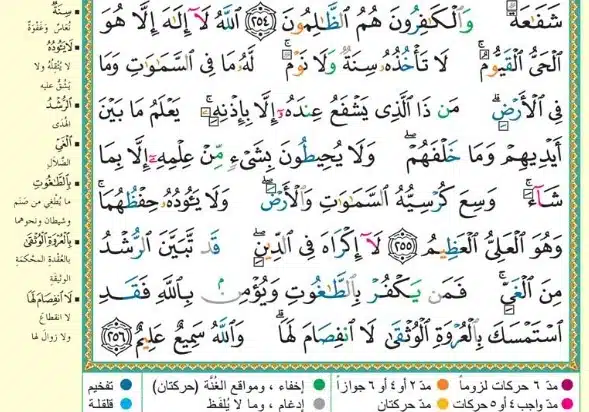
💡 A point most pages get wrong: there is no Qalqalah in Ayat al-Kursi. The Qalqalah letters are ق ط ب ج د, and each of them must carry a sukūn for the rule to apply — which does not happen anywhere in this verse. The dhāl in bi-idhnih is often mistaken for a dāl, but it is a different letter.
Memorise Ayat al-Kursi Line by Line (Free Tool)
Tap any line to hear it recited by Sheikh Al-Husary. Repeat it aloud until it settles, then move to the next. Use the fade control to hide the text gradually as you gain confidence — your progress is saved on this device.
0 of 8 lines practised
Most learners hold the whole verse within five to seven days at one line per day, with a full read-through of the earlier lines each time. Children often take a little longer but retain it far better, because they usually learn it by hearing it repeated rather than by reading.
When you are ready to go further, our free Quran memorisation app uses the same method across longer passages, with the same reciter throughout.
Getting the Recitation Right
Ayat al-Kursi contains a handful of points that are mispronounced very consistently. The elongation in lā ilāha illā huw is usually cut short. The madd asli in yuḥīṭūna is often shortened to a single count. The heavy rā in al-arḍ and kursiyyuh is usually flattened into an English “r”. None of these are difficult once someone points them out — but they are almost impossible to notice on your own.
That is the real limit of any page like this one. You can learn the text from a screen, you can learn the rules from a screen, but you cannot hear yourself from a screen. A teacher listening to you for ten minutes will catch things you would otherwise repeat for years.
Common Questions About Ayat al-Kursi
From One Verse to the Whole Quran
If you have worked through this page and can now recite Ayat al-Kursi from memory, you are holding the verse the Prophet ﷺ called the greatest in the Book of Allah. That is not a small thing to have done in a week.
The natural next step is the last two verses of the same surah, which are recited at night for the same reason and are just as approachable.
Ready to keep going?
The method you just used — short phrases, one reciter, daily repetition — is the same one our students follow through the whole Quran.
Memorize the Quran using the same methodMay Allah make the Quran the spring of your heart, and may He accept it from you. 🤲
Learn More
Continue with these guides from our Quran and Tajweed library
Hafidha of the Quran · Arabic Language Graduate · Writer on Islamic Sciences
Jehad Mahmoud is a graduate of the Arabic Language department and a Hafidha of the Quran who writes the Islamic educational content at Quran Book Academy.
She writes with a focus specialising in fiqh, the fiqh of women and the sharia sciences, making complex rulings accessible to English-speaking Muslim families.
Her articles are educational, not fatwa. For a ruling on a specific personal situation, readers are advised to consult a qualified scholar or mufti.
References & Sources
1. Surah Al-Baqarah 2:255 — Quran.com
2. Sahih Muslim — the narration of Ubayy ibn Ka’b on the greatest verse in the Quran
3. Sahih al-Bukhari — the narration of Abu Hurairah on reciting Ayat al-Kursi before sleep
4. Sunan an-Nasa’i — reciting Ayat al-Kursi after the obligatory prayers (grading differed over)
5. Recitation — Sheikh Mahmoud Khalil Al-Husary, via EveryAyah.com
External Links
© 2026 Quran Book Academy. All rights reserved.
Book Your Free Trial · Empowering Muslims Worldwide to Connect with the Quran