

📖

Wait! Before You Go…

Try our 100% free Islamic learning resources — no signup needed!

🏠 Home About
🕌 About Us ⚙️ How It Works 👨‍🏫 Meet Our Teachers
🧒 For Kids
Fiqh for Kids Arabic Online for Kids Islamic School for Kids Tajweed Made Easy Quran Memorization Nour El Bayan Noorani Qaida
👨 For Adults
Tajweed for Adults Islamic School for Adults Quran Memorization Arabic Online Online Quran for Adults
🧕 Ladies Section
Online Quran for Ladies Islamic Studies for Sisters Female Quran Teachers
✨ More Programs
Online Islamic School Quran with Tajweed Quranic Arabic Ijaza in Quran Online Quran Classes Qiraat Course Online Hifz Course Quran Memorization Course New Muslim Programs
🎓 Learn Free
🔤 Arabic Alphabet 🎮 Tajweed Game 🕋 Memorize Quran & Tafseer Free 🕌 Islamic Studies Games 📚 Free Resources
📝 Articles 💰 Price 📱 Follow Us
🎁 Free Trial

Category: Quran

  • 7 Powerful Benefits of Learning Quran with Tajweed in 2026

    7 Powerful Benefits of Learning Quran with Tajweed in 2026

    7 Powerful Benefits of Learning Quran with Tajweed in 2026 | Quran Book Academy
    Quran Book Academy • quranbookonline.com

    7 Powerful Benefits of Learning Quran with Tajweed in 2026

    Your Complete Guide to Beautiful, Confident Quran Recitation

    Start Your Free Trial
    Muslim woman learning Quran with Tajweed at home using an online class
    A focused Muslim woman wearing a hijab reads the Quran on her tablet during a live online Tajweed lesson, symbolizing accessible Quran education for non-Arabic speakers.

    Introduction — You’re Not Behind, You’re Beginning

    If you want to learn Quran with Tajweed, you are taking one of the most rewarding steps in your spiritual journey. Millions of non-Arabic speaking Muslims around the world share the same desire—to recite Allah’s words with correct pronunciation and deep understanding. Yet many feel overwhelmed, too old to start, or unsure where to begin. The truth is: you are not behind, and you are not alone.

    Life is busy. Between work, parenting, and daily responsibilities, finding time to study Quran recitation can feel impossible. But here is the beautiful reality: the Prophet (ﷺ) reminded us that “The one who recites the Quran and struggles with it will have a double reward.” (Sahih al-Bukhari 4937). Your effort, no matter how small, carries immense spiritual weight.

    Allah Himself reassures us in the Quran: “And We have certainly made the Quran easy for remembrance.” (Surah Al-Qamar 54:17). This verse is a divine promise that the Quran is accessible to everyone who approaches it with sincerity. Whether you are a complete beginner or someone returning after years away, this guide will show you the powerful benefits of learning Quran with Tajweed and exactly how to get started from home.

    What Is Tajweed? A Simple Explanation for Beginners

    Tajweed is the science of reciting the Quran correctly. Linguistically, the Arabic word “Tajweed” means beautification or improvement. Technically, it refers to the precise set of rules that govern how every letter of the Quran should be pronounced—from its correct articulation point (makhraj) with its proper characteristics (sifaat). When you learn Quran with Tajweed, you ensure that each word carries its intended meaning exactly as it was revealed to the Prophet Muhammad (ﷺ).

    Think of Tajweed as the grammar of Quran recitation. Just as English grammar protects the meaning of a sentence, Tajweed protects the meaning of Allah’s words. A small change in pronunciation can completely alter the meaning of a verse. The majority of Islamic scholars consider learning basic Tajweed rules an individual obligation (fard ‘ayn) for every Muslim, based on the Quranic verse: “…and recite the Quran with measured recitation.” (Surah Al-Muzzammil 73:4).

    Tajweed rules showing Arabic letter articulation points for learning Quran with Tajweed
    An educational diagram illustrating the articulation points (makharij) of Arabic letters, helping beginners understand Tajweed rules for correct Quran pronunciation.

    7 Powerful Benefits of Learning Quran with Tajweed

    Here are the seven most impactful benefits you will experience when you learn Quran with Tajweed online or with a qualified teacher: improved pronunciation accuracy, greater spiritual rewards, unshakeable confidence in Salah, a deeper connection with Allah, protection of the Quran’s meaning, enhanced cognitive function, and membership in a global community of learners.

    1. Recite the Quran the Way It Was Revealed

    The most fundamental benefit of learning Quran with Tajweed is that it allows you to recite the Quran in the exact manner it was revealed to the Prophet Muhammad (ﷺ) through Angel Jibreel. Tajweed preserves the original sound, rhythm, and phonetic precision of the divine revelation. Without proper Tajweed, even a single articulation error can change one word into another entirely.

    For example, the difference between the Arabic words “qalb” (heart) and “kalb” (dog) lies in just one articulation point. When a reciter masters these distinctions through Tajweed study, they build a deeply personal identity as a faithful carrier of the Quran’s original message. This is not merely an academic exercise—scholars across centuries have emphasized that Tajweed is the guardian of the Quran’s linguistic integrity.

    From a psychological perspective, mastering correct pronunciation builds a student’s self-concept as a competent Quran reader, which in turn motivates continued learning and deeper engagement with the text. Each correctly articulated letter becomes a building block of confidence, transforming the student from a hesitant beginner into a purposeful reciter who carries the words of Allah with dignity and precision.

    2. Earn Greater Spiritual Rewards

    The Prophet (ﷺ) said: “The best among you are those who learn the Quran and teach it.” (Sahih al-Bukhari 5027). When you learn Quran with Tajweed, you are not only improving your recitation—you are striving toward a rank of excellence in the eyes of Allah.

    Every letter recited with proper Tajweed carries a reward (hasanah), and the Prophet (ﷺ) confirmed that each hasanah is multiplied tenfold. Imagine the accumulated blessings from reciting just one page of the Quran with beautiful, accurate Tajweed every single day.

    3. Build Unshakeable Confidence in Salah

    For many Muslims, prayer is a source of anxiety rather than peace—not because they lack devotion, but because they are unsure whether they are pronouncing the verses correctly. When you learn Quran with Tajweed online, you systematically eliminate that uncertainty.

    Students who master Tajweed rules report feeling a profound shift in their prayer experience: they stop second-guessing every syllable and start truly connecting with the meaning of what they recite. This transforms Salah from a source of stress into a sanctuary of tranquility.

    4. Strengthen Your Connection with Allah (سبحانه وتعالى)

    Tajweed is not just about technical accuracy—it is about contemplation (tadabbur). When you pronounce each word correctly and understand the rules behind the elongation and pauses, you begin to feel the emotional weight of the verses. Online Tajweed classes help students slow down, listen to the rhythm of the Quran, and develop a personal, heartfelt relationship with Allah’s message. This deeper connection is one of the most life-changing benefits students describe.

    5. Protect the Meaning of the Quran

    Tajweed prevents lahn (errors) that can unintentionally distort the meaning of Allah’s words. There are two types of lahn: major errors (lahn jaliyy) that change the meaning entirely, and minor errors (lahn khafiyy) that affect the beauty of recitation without altering meaning. Learning Tajweed online equips you to avoid both types, ensuring that when you recite the Quran—whether in prayer or study—you are faithfully conveying the exact message Allah intended.

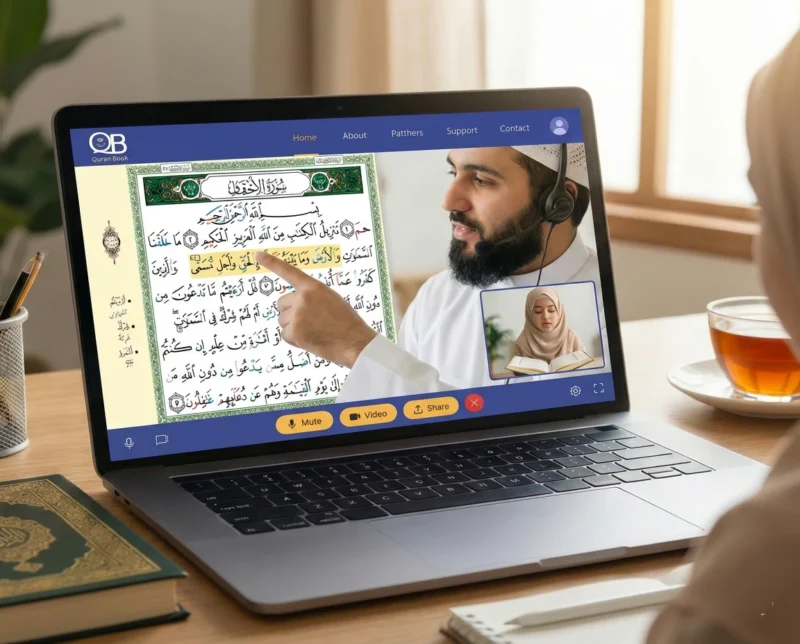
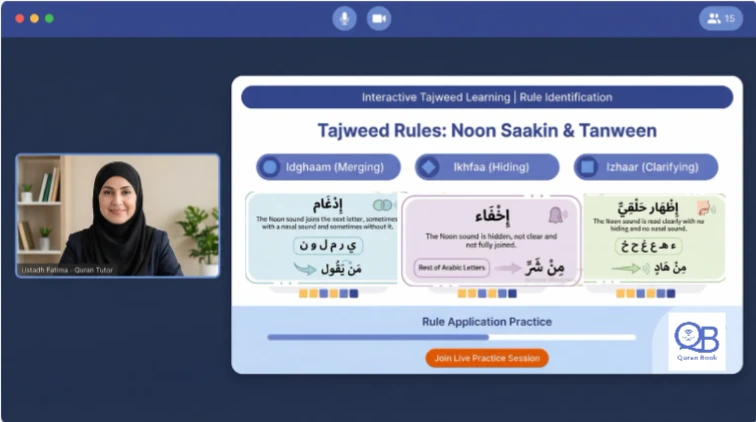
    Students in an online Tajweed class learning Quran with Tajweed via Zoom
    A live Zoom session where a certified teacher corrects a student’s Tajweed pronunciation in real time, representing the interactive learning experience at Quran Book Academy.

    6. Improve Cognitive Function and Mental Wellness

    The benefits of learning Quran with Tajweed extend beyond spirituality into neuroscience. Studying Tajweed engages multiple cognitive systems simultaneously: phonetic processing, auditory discrimination, working memory, and motor coordination of the mouth and tongue. Research has shown that regular Quran recitation activates brain regions associated with calmness and emotional regulation. For adults, this makes Tajweed study a powerful form of cognitive exercise that can sharpen focus, reduce stress, and promote overall mental wellness.

    7. Join a Global Community of Learners

    When you learn Quran with Tajweed online, you join a worldwide community of Muslims who share the same goal. Platforms like Quran Book Academy connect students from the USA, Canada, UK, and Australia with certified teachers and fellow learners. The Academy’s Telegram channel offers daily Tajweed practice, peer support, and encouragement—making the journey less lonely and far more sustainable. Community accountability is one of the strongest predictors of long-term learning success.

    The 4 Core Principles of Tajweed Every Student Must Know

    The four core principles of Tajweed are: (1) Makharij al-Huruf (articulation points), (2) Sifaat al-Huruf (letter characteristics), (3) rules of Noon Sakinah and Tanween, and (4) rules of Madd (elongation). Mastering these four areas provides the complete foundation for beautiful Quran recitation.

    Infographic showing the 4 core principles of Tajweed for learning Quran with Tajweed
    A clean, educational infographic illustrating the four pillars of Tajweed: Makharij al-Huruf, Sifaat al-Huruf, Noon Sakinah & Tanween rules, and Madd rules.
    1

    Makharij al-Huruf

    Every Arabic letter originates from a specific point in the mouth, throat, or nasal passage. Knowing the exact makhraj of each letter is the first step toward accurate Tajweed. For instance, the letter “Ain” comes from the middle of the throat, while “Ba” comes from both lips. Quran Book Academy’s YouTube channel features detailed Makhraj Huruf video lessons that demonstrate each articulation point visually.

    2

    Sifaat al-Huruf

    Each letter carries specific qualities that distinguish it from others. These include heaviness (tafkheem), lightness (tarqeeq), softness (hams), and strength (jahr). Understanding sifaat ensures that letters are not just pronounced from the right place but also carry the right sonic character.

    3

    Noon Sakinah & Tanween

    When the letter Noon carries a sukoon or when Tanween appears, four specific rules apply: Ikhfa (concealment), Idgham (merging), Iqlab (conversion), and Izhar (clear pronunciation). These rules dictate how the Noon sound interacts with the letter that follows it, and they are among the most frequently applied Tajweed rules in daily recitation.

    4

    Rules of Madd (Elongation)

    Madd rules determine when and how to stretch vowel sounds for 2, 4, or 6 counts. There are several types of Madd, including Madd Tabee’ee (natural elongation), Madd Muttasil (connected), and Madd Munfasil (separated). Proper elongation adds beauty and rhythm to recitation and is essential for anyone who wants to learn Quran with Tajweed correctly.

    How to Learn Quran with Tajweed at Home (Step-by-Step)

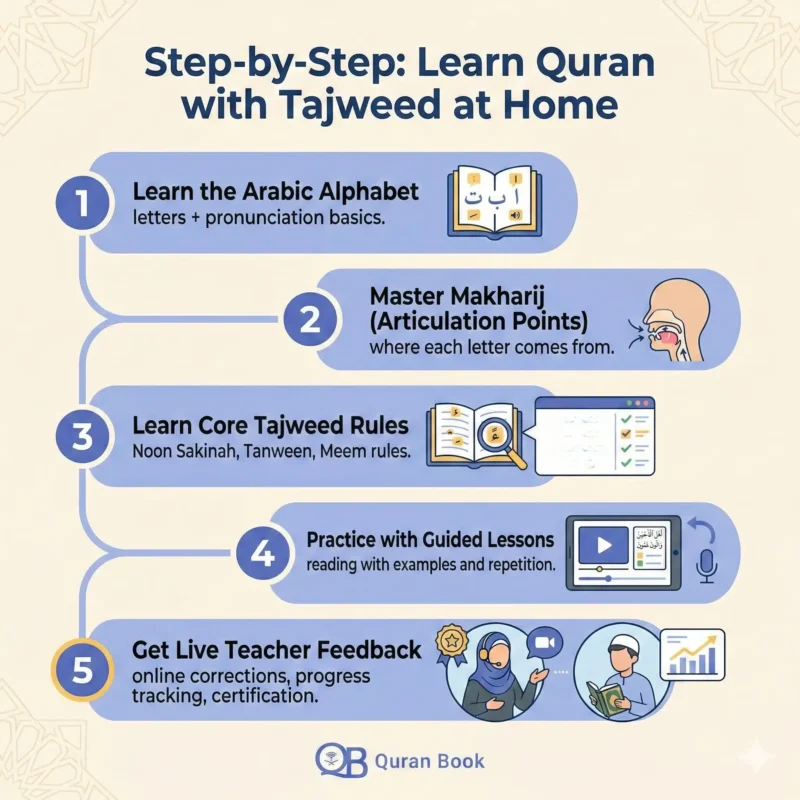
    You can learn Quran with Tajweed at home by following these five proven steps: (1) learn the Arabic alphabet and sounds, (2) master the articulation points, (3) study basic Tajweed rules, (4) apply rules through daily Quran reading, and (5) get feedback from a certified teacher.

    Step-by-step guide to learn Quran with Tajweed at home online
    A visually appealing step-by-step graphic showing the five stages of learning Tajweed from home, from learning the Arabic alphabet to receiving live teacher feedback.
    1

    Learn the Arabic Alphabet and Sounds

    Begin with a foundational course such as Nour El Bayan, which teaches Arabic letter recognition and proper pronunciation from scratch. Quran Book Academy offers a complete Nour El Bayan course on YouTube and through live sessions, designed specifically for non-Arabic speaking beginners.

    2

    Master the Makharij (Articulation Points)

    Practice each letter’s exit point with guidance from a qualified teacher. Live Zoom sessions allow your instructor to see and hear your pronunciation in real time and provide immediate corrections that self-study alone cannot offer.

    3

    Study Basic Tajweed Rules

    Start with the most commonly applied rules: Noon Sakinah, Tanween, and Madd. A good approach is to learn one rule per week, practicing it in context with short Quranic passages. This “cognitive chunking” method prevents overwhelm and builds lasting mastery.

    4

    Apply Rules by Reading Quran Daily

    Dedicate 10–15 minutes each day to reciting a short surah while consciously applying the Tajweed rules you have learned. Consistency matters more than duration. Track your progress through a structured learning management system like the one offered by Quran Book Academy.

    5

    Get Feedback from a Certified Teacher

    Self-study has its limits. A certified Quran teacher catches pronunciation mistakes that your own ear cannot detect. Booking a free trial with Quran Book Academy connects you with experienced instructors who specialize in teaching Tajweed to non-Arabic speakers in the USA, Canada, UK, and Australia.

    The Academy Method — How Quran Book Academy Teaches Tajweed

    Quran Book Academy has developed a distinctive teaching methodology rooted in educational psychology and modern technology. Here is what sets the Academy apart for students who want to learn Quran with Tajweed online.

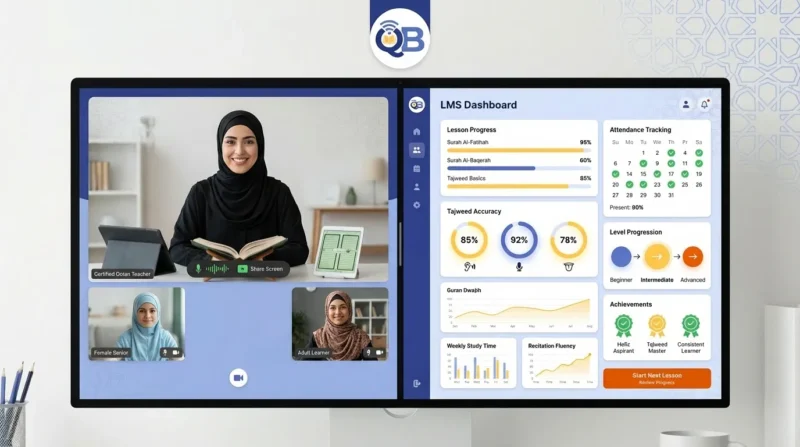
    Quran Book Academy online Tajweed classes LMS dashboard for learning Quran with Tajweed
    A mockup of Quran Book Academy’s Learning Management System dashboard showing lesson progress, Tajweed rule completion, and upcoming Zoom session schedules.

    Psychological Chunking

    Complex Tajweed rules are broken into small, manageable lessons that build on each other—a technique known as cognitive chunking. This approach, grounded in educational psychology research, reduces overwhelm and accelerates skill acquisition. Lessons are designed with spaced repetition, immediate feedback, and incremental difficulty to maximize retention.

    Live Zoom Sessions

    Every student receives real-time correction and personalized feedback via live Zoom. Sessions are available in one-on-one or small group formats with flexible scheduling to accommodate students across time zones in the USA, Canada, UK, and Australia. Each teacher is certified in Quran recitation and trained to work with non-Arabic speakers.

    Custom LMS & Progress Reports

    Students and parents receive regular progress reports tracking lesson completion, Tajweed rule mastery, and areas for improvement. The Academy’s custom Learning Management System logs every session and skill milestone, providing a transparent view of your learning journey.

    Courses We Offer

    Quran Book Academy offers a comprehensive suite of courses: Quran Reading & Tajweed Course, Quran Memorization (Hifz) Course, Nour El Bayan Course, and Islamic Studies. Each course is structured for online delivery with live teacher interaction and LMS tracking.

    What Happens to Your Brain When You Listen to the Quran?

    Listening to the Quran activates brain regions associated with calmness, emotional regulation, and deep memory processing. Neuroscience research has shown that rhythmic, melodic recitation—the kind that Tajweed enables—stimulates the parasympathetic nervous system, reducing cortisol (the stress hormone) and promoting a state of tranquility.

    Studies conducted on Quran listeners have documented measurable decreases in anxiety levels and improvements in emotional well-being. This aligns with the Quranic verse: “Verily, in the remembrance of Allah do hearts find rest.” (Surah Ar-Ra’d 13:28).

    When you learn Quran with Tajweed, you are not only fulfilling a spiritual obligation—you are investing in your mental health. The precise rhythm and pronunciation that Tajweed teaches enhances the naturally calming effect of Quran recitation, making every listening session a form of therapeutic meditation.

    Tajweed vs. No Tajweed — A Side-by-Side Comparison

    The following table highlights the practical differences between reciting the Quran with and without Tajweed. This comparison illustrates why so many Muslims choose to learn Quran with Tajweed online.

    Aspect With Tajweed ✓ Without Tajweed ✗
    Pronunciation Accuracy Correct makhraj for each letter Frequent mispronunciation risk
    Meaning Preservation Original meaning protected Potential meaning distortion
    Spiritual Reward Higher reward (reciting as revealed) Reward present but diminished
    Confidence in Salah High — no second-guessing Low — constant uncertainty
    Listening Experience Beautiful, melodic recitation Choppy, inconsistent flow
    Learning Speed (long-term) Faster with strong foundation Slower due to bad habits
    Community Recognition Respected reciter (Qari/Qari’ah) Casual reader

    FAQ — Your Top Questions About Learning Quran with Tajweed

    Q Why is learning Quran with Tajweed important?
    Learning Quran with Tajweed is important because it ensures correct pronunciation, preserves the intended meaning of Allah’s words, and fulfills the obligation of reciting the Quran as it was revealed. The majority of scholars agree that basic Tajweed is fard ‘ayn (individually obligatory) for every Muslim. Without Tajweed, a reciter risks making errors that could unintentionally distort the Quran’s message.
    Q How can a non-Arabic speaker learn Quran with Tajweed?
    Non-Arabic speakers can learn Quran with Tajweed by starting with foundational courses like Nour El Bayan to master Arabic letter sounds, then progressing to structured Tajweed rules with a qualified teacher. Online platforms such as Quran Book Academy offer live Zoom classes specifically designed for non-Arabic speakers in the USA, Canada, UK, and Australia.
    Q What are the 4 principles of Tajweed?
    The four core principles of Tajweed are: Makharij al-Huruf (articulation points where each letter originates), Sifaat al-Huruf (the unique characteristics of each letter), rules of Noon Sakinah and Tanween (how the Noon sound interacts with following letters), and rules of Madd (when and how to elongate vowel sounds).
    Q Can I learn Quran with Tajweed at home?
    Yes, you can absolutely learn Quran with Tajweed at home. With live online classes via Zoom, certified teachers can provide real-time correction and personalized feedback from anywhere in the world. Quran Book Academy offers one-on-one sessions with flexible scheduling and progress tracking through a custom Learning Management System.
    Q What happens to your brain when you listen to the Quran?
    Research suggests that listening to Quran recitation activates brain regions associated with calmness and emotional regulation, potentially reducing stress, anxiety, and cortisol levels. Tajweed-based recitation enhances this effect through its rhythmic, melodic structure, making it both a spiritual and therapeutic experience.
    Q How does the Quran influence daily life?
    The Quran provides comprehensive guidance on ethics, relationships, gratitude, patience, and purpose. Learning to read it properly with Tajweed deepens your understanding of its teachings, which naturally translates into more mindful daily habits, stronger family bonds, and a more consistent spiritual routine.
    Q Is Tajweed mandatory (fard) when reading Quran?
    The majority of scholars hold that learning basic Tajweed is an individual obligation (fard ‘ayn). Imam Ibn Al-Jazari, one of the greatest scholars of Quran recitation, stated: “Applying Tajweed is an absolute necessity; whoever does not apply Tajweed to the Quran is a sinner.” This underscores the scholarly consensus on the importance of Tajweed in Quran recitation.

    Start Your Free Tajweed Lesson Today

    Your journey to beautiful, confident Quran recitation starts with a single lesson. Whether you are a complete beginner who has never read Arabic or an intermediate reader looking to perfect your Tajweed, Quran Book Academy is here to walk with you every step of the way.

    Here is what you get when you sign up for a free trial lesson: a live one-on-one Zoom session with a certified Quran teacher, a personalized assessment of your current recitation level, a customized learning plan based on your goals, and access to our Learning Management System for progress tracking.

    Start your free trial to learn Quran with Tajweed online at Quran Book Academy
    A warm, inviting banner showing a student and teacher in a Zoom session — begin your Tajweed journey with Quran Book Academy.
    ➤ Book Your Free Trial Lesson Now ➤

    Join Our Telegram Community for Daily Tajweed Practice

    References

    [1] Sahih al-Bukhari 4937 — Hadith on double reward for struggling reciters. sunnah.com/bukhari/4937

    [2] Sahih al-Bukhari 5027 — “The best among you are those who learn the Quran and teach it.” sunnah.com/bukhari/5027

    [3] Surah Al-Qamar 54:17 — “And We have certainly made the Quran easy for remembrance.” quran.com/54/17

    [4] Surah Al-Muzzammil 73:4 — “…and recite the Quran with measured recitation.” quran.com/73/4

    [5] Surah Ar-Ra’d 13:28 — “Verily, in the remembrance of Allah do hearts find rest.” quran.com/13/28

    [6] Makhraj Huruf Video Lessons — YouTube Playlist. YouTube Playlist

    [7] Nour El Bayan Course — YouTube Playlist. YouTube Playlist

    [8] Quran Book Academy Telegram Practice Channel. t.me/maqraquranbookonline

    © 2026 Quran Book Academy — quranbookonline.com

    Empowering Muslims worldwide to recite the Quran with beauty, confidence, and Tajweed.

  • The benefits of learning Quran online go far beyond convenience. For busy Muslim families

    The benefits of learning Quran online go far beyond convenience. For busy Muslim families

    7 Powerful Benefits of Learning Quran Online in 2026 | Quran Book Academy
    Benefits of learning Quran online – Muslim family studying Quran together on laptop at home
    Benefits of learning Quran online – Muslim family studying Quran together on laptop at home

    7 Powerful Benefits of Learning Quran Online in 2026

    By Quran Book Academy  ·  2026  ·  15 min read

    Introduction

    The benefits of learning Quran online go far beyond convenience. For busy Muslim families across the USA, UK, Canada, and Australia, online Quran classes eliminate the two biggest barriers to consistent Quran study: time and access to qualified teachers. Whether you are an adult beginner or a parent seeking Tajweed instruction for your child, digital learning makes the Quran accessible from the comfort of your home.

    You may worry that you are too old to start, that your pronunciation will never be correct, or that you simply cannot fit classes into your packed schedule. These are the exact challenges our students at Quran Book Academy overcame – and this article will show you how online Quran learning makes it possible, one manageable step at a time. By the end, you will understand why thousands of Muslims worldwide are choosing to learn Quran with Tajweed online and how you can begin your own journey today.

    1. Learn From Certified Tajweed Teachers Anywhere in the World

    Learn Quran with Tajweed online – certified Egyptian teacher conducting a live Tajweed lesson via Zoom
    Learn Quran with Tajweed online – certified Egyptian teacher conducting a live Tajweed lesson via Zoom

    One of the most important benefits of learning Quran online is direct access to certified, Arabic-speaking Tajweed teachers. Students no longer need to rely solely on local options that may be limited in quality or availability. Online Tajweed classes connect learners with qualified Egyptian and Arab instructors who specialize in Quranic phonetics (Makharij al-Huruf) and the precise rules of recitation. This means that whether you live in a small town in the USA or a suburb in Australia, you receive the same world-class instruction as someone studying in Cairo.

    Why a Native Arabic Teacher Matters for Tajweed

    Tajweed is the science of reciting the Quran with correct pronunciation, and mastering it requires learning the exact articulation points (Makhraj al-Huruf) for each Arabic letter. A native Arabic speaker naturally produces these sounds and can detect even subtle errors in a student’s recitation. Incorrect pronunciation can change the meaning of Quranic words entirely, which is why learning from a certified teacher is essential for anyone who wants to learn Quran with Tajweed properly.

    At Quran Book Academy, every instructor undergoes rigorous qualification screening. Our teachers hold recognized Ijazah certifications in Quran recitation and have years of experience teaching non-Arabic speaking students. This combination of academic credentials and practical teaching experience is what sets Quran Tajweed online classes apart from informal learning methods.

    The best among you are those who learn the Quran and teach it.

    Sahih al-Bukhari, Hadith 5027
    Practice your Tajweed with our community on Telegram

    2. Flexible Scheduling That Fits Your Real Life

    Online Quran classes for adults offer the flexibility that traditional madrasas simply cannot match. Students in the USA, Canada, UK, and Australia can schedule live, one-on-one sessions at times that work around their jobs, school, and family obligations. This is one of the most practical benefits of learning Quran online – removing the rigid time constraints that prevent many Muslims from beginning or continuing their Quran education.

    Best Online Quran Classes for Adults & Working Professionals

    Quran Book Academy provides 24/7 scheduling availability across multiple time zones, ensuring that every student finds a slot that genuinely fits their life. All sessions are live, one-on-one interactions via Zoom – not pre-recorded videos – so students receive personalized attention and real-time feedback. For busy parents and professionals, the academy also offers generous rescheduling flexibility, because life is unpredictable.

    You do not need hours every day. Even 30 minutes, three times a week, can lead to remarkable progress when guided by an expert teacher. The key is consistency, and the flexibility of adult Quran classes online makes that consistency achievable for the first time for many learners.

    3. A Safe, Comfortable Learning Environment (Especially for Women & Children)

    Online Quran classes for ladies – Muslim woman learning Quran online with a female teacher from home
    Online Quran classes for ladies – Muslim woman learning Quran online with a female teacher from home

    For Muslim women and children, learning Quran online provides a secure, private environment that traditional settings may not always guarantee. Female students can learn from dedicated online female Quran teachers without leaving the comfort and safety of their homes. Parents can monitor their children’s progress in real-time. This safety and privacy dimension is one of the most valued benefits of online Quran learning for families.

    Online Quran Classes for Ladies with Female Teachers

    Quran Book Academy understands the importance of providing online Quran classes for ladies with the option of female instructors. Sisters who prefer learning from a woman can choose from our roster of certified female Tajweed teachers. Camera-optional settings ensure maximum comfort and modesty, and the privacy of home-based learning means students can study in an environment where they feel completely at ease.

    Benefits of Online Quran Learning for Kids

    Children thrive when learning is interactive, engaging, and safe. The best online Quran classes for kids use age-appropriate lesson structures that keep young learners excited about their Quran journey. Parents can sit in on Zoom sessions to observe their child’s progress, and gamified progress tracking through the custom LMS gives kids a sense of accomplishment after every lesson.

    “And We have certainly made the Quran easy for remembrance, so is there any who will remember?”

    Quran 54:17

    4. The Academy Method: How We Teach Quran Reading with Tajweed

    Best online Quran classes for kids – child engaged in an interactive online Quran lesson
    Best online Quran classes for kids – child engaged in an interactive online Quran lesson

    Quran Book Academy uses a structured, psychologically-informed teaching methodology called “The Academy Method,” designed specifically for non-Arabic speaking beginners who want to learn Quran reading with Tajweed for beginners. This method is the cornerstone of everything we do, and it is one of the reasons our students consistently achieve their goals.

    The Academy Method Explained

    The Academy Method is built on the Nour El Bayan foundation – a proven pedagogical framework that breaks Arabic letters and sounds into manageable psychological “chunks,” so students never feel overwhelmed. The learning journey follows a progressive Tajweed integration path: students first master basic letter recognition and pronunciation (Makhraj al-Huruf), then advance to connecting letters into words, and finally progress to applying Tajweed rules in actual Quran recitation. Every lesson is designed around the psychological principle of “small wins” – each session ends with a measurable achievement that builds confidence and momentum. This approach directly addresses the fear of failure that prevents many adults from starting their Quran education. Unlike pre-recorded videos that offer no interaction, our live one-on-one Zoom sessions allow instant correction and personalized pacing. When a teacher hears a mispronunciation, they correct it immediately, creating a feedback loop that accelerates learning. This is what makes online Quran learning with Tajweed at Quran Book Academy fundamentally different from self-study or group classes. The method transforms apprehension into enthusiasm, and hesitation into consistent progress.

    Nour El Bayan: The Foundation Course

    Nour El Bayan is the ideal starting point for absolute beginners – those with zero Arabic knowledge who dream of reading the Quran. This foundation course bridges the gap between not knowing a single Arabic letter and being able to read the Quran fluently. The program is available as a structured course through Quran Book Academy’s Nour El Bayan Course and is also supported by introductory content on the academy’s YouTube channel, giving prospective students a taste of the methodology before they enroll.

    For anyone searching for Tajweed for beginners online, the Nour El Bayan pathway combined with The Academy Method provides the most comprehensive and supportive learning experience available.

    “Verily the one who recites the Quran beautifully, smoothly, and precisely, will be in the company of the noble and obedient angels.”

    Sahih al-Bukhari, Hadith 4937

    5. Spiritual Rewards and Islamic Motivation for Learning Quran

    Reward for learning Quran – open Quran with prayer beads and soft light representing spiritual rewards
    Reward for learning Quran – open Quran with prayer beads and soft light representing spiritual rewards

    The spiritual reward for learning the Quran is immense. Every letter recited carries a reward (hasanah) multiplied tenfold, and both the learner and the teacher earn ongoing blessings. This is one of the most profound benefits of learning Quran online – the ability to pursue these divine rewards consistently, from anywhere in the world, without barriers.

    What Is the Reward of Learning and Teaching the Quran?

    The Prophet Muhammad (PBUH) taught us that whoever recites a single letter from the Book of Allah receives a good deed, and that good deed is multiplied ten times. Imagine the rewards accumulated from an entire Surah, an entire Juz, or a complete recitation of the Quran. The reward for teaching the Quran is equally magnificent – it is considered Sadaqah Jariyah, a continuous charity whose reward persists even after death.

    The status of the Hafiz (one who memorizes the entire Quran) and their family on the Day of Judgment is described in numerous ahadith as one of great honor. This spiritual motivation serves as one of the strongest intrinsic drivers of student persistence. When the journey feels challenging, remembering the eternal rewards of Quran education provides the motivation to continue. Explore our Hifz program to start your memorization journey.

    “Whoever recites a letter from the Book of Allah, he will be credited with a good deed, and a good deed gets a ten-fold reward.”

    Jami at-Tirmidhi, Hadith 2910

    “Read! And your Lord is the Most Generous.”

    Quran 96:3

    6. Affordable & Accessible: Best Online Quran Classes in the USA, UK & Beyond

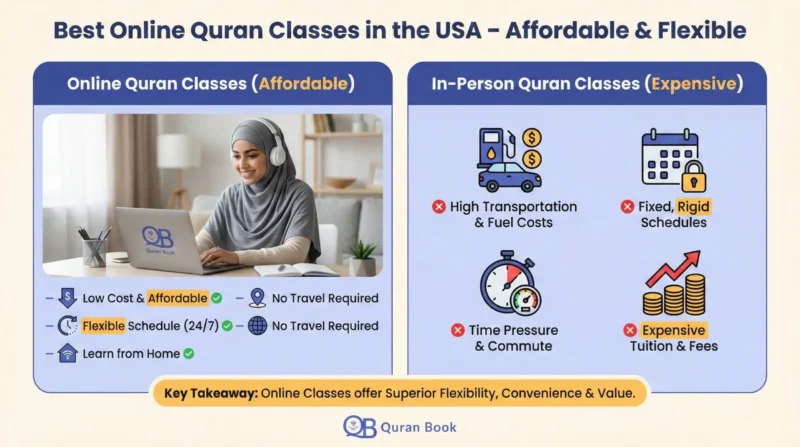
    Best online Quran classes USA – affordable online Quran learning comparison with pricing icons
    Best online Quran classes USA – affordable online Quran learning comparison with pricing icons

    Learning Quran online is significantly more affordable than traditional in-person tutoring. The best online Quran classes in the USA, UK, Canada, and Australia eliminate commuting costs, save valuable time, and offer flexible pricing plans that fit different budgets. Many platforms, including Quran Book Academy, offer free trial lessons so students can experience the quality before committing – making Quran online classes free of risk to begin.

    Cost Comparison: Online vs. In-Person Quran Classes

    Feature Online Classes (Quran Book Academy) In-Person / Masjid Classes
    Teacher Qualification Certified Egyptian Tajweed Teachers Varies by location
    Schedule Flexibility 24/7, any time zone Fixed times only
    Average Cost Affordable monthly plans Higher per-session rates
    Commute None – learn from home Required (time + cost)
    Free Trial Yes (Quran Book Academy) Rarely offered
    Progress Tracking LMS + Automated Gmail Reports Usually none

    Start with a free trial lesson to experience the difference yourself. There is absolutely zero risk – and the potential reward is a lifelong connection with the Quran.

    7. Technology-Powered Progress: Zoom, LMS & Gmail Reports

    Online Quran classes – technology-powered learning with Zoom, LMS dashboard, and progress reports
    Online Quran classes – technology-powered learning with Zoom, LMS dashboard, and progress reports

    Quran Book Academy uses a modern technology stack to ensure every student makes measurable, trackable progress. Our platform combines Zoom for live interactive sessions, a custom Learning Management System (LMS) for tracking milestones, and automated Gmail reports to keep students and parents informed. This technology-driven approach is a key part of what makes online Quran learning so effective in 2026.

    Our Tech Stack

    Zoom

    HD video and crystal-clear audio for live one-on-one and group sessions, with screen sharing for Mushaf display. Students interact face-to-face with their teacher, creating the same personal connection as in-person learning.

    Custom LMS

    Tracks lesson completion, Tajweed milestones, Hifz progress, and attendance in real-time. Students and parents can view their learning journey at a glance and celebrate progress.

    Gmail Reports

    Automated weekly and monthly progress reports are sent directly to students and parents, ensuring transparency and accountability. You always know exactly where you stand in your Quran learning journey.

    Visible progress tracking is not just a convenience – psychological research shows it significantly increases student motivation and reduces dropout rates. When you can see how far you have come, the next step feels achievable. Learn more about how it works at Quran Book Academy.

    FAQ – Your Questions About Learning Quran Online Answered

    What are the benefits of learning the Quran online? +

    The benefits of learning Quran online include access to certified Tajweed teachers worldwide, flexible scheduling for all time zones, affordable pricing with free trial lessons, a safe and private learning environment for women and children, technology-powered progress tracking through LMS and reports, and the immense spiritual rewards of consistent Quran study. Quran Book Academy offers all these benefits with a free trial lesson to get started.

    Is it possible to learn the Quran online? +

    Yes, it is absolutely possible to learn the Quran online. With platforms like Quran Book Academy, students learn through live Zoom sessions with certified Tajweed teachers, using structured curricula like Nour El Bayan and progressive Tajweed courses designed specifically for non-Arabic speakers. Thousands of students across the USA, UK, Canada, and Australia are successfully learning Quran online every day.

    What is the reward for teaching the Quran? +

    The Prophet Muhammad (PBUH) said: “The best among you are those who learn the Quran and teach it” (Sahih al-Bukhari 5027). Teaching the Quran is considered Sadaqah Jariyah – a continuous charity whose reward persists even after death. Both the teacher and the student are blessed in this noble pursuit.

    Can I complete Hifz in 6 months? +

    Completing Hifz (full Quran memorization) in 6 months is possible but extremely intensive, requiring approximately 1.5 pages of memorization daily with consistent revision. Most students benefit from a longer, more sustainable timeline of 1–3 years with regular review cycles. Quran Book Academy’s Hifz program provides personalized pacing to match each student’s capacity and schedule.

    What do you call a person who memorized the Quran? +

    A male who has memorized the entire Quran is called a “Hafiz” (plural: Huffaz). A female who has memorized the Quran is called a “Hafiza.” This title carries great honor and respect in Islam, and the Hafiz holds a special status on the Day of Judgment.

    What are common mistakes in Quran recitation? +

    Common recitation mistakes include incorrect Makhraj (articulation points), ignoring essential Tajweed rules like Ghunnah and Idgham, rushing through verses without proper pauses, and confusing similar-sounding Arabic letters. A qualified Tajweed teacher can identify and correct these errors in real-time during live online sessions.

    Can listening to Quran help with sleep? +

    Many Muslims report that listening to Quran recitation promotes tranquility and better sleep. The Quran itself states: “Verily, in the remembrance of Allah do hearts find rest” (Quran 13:28). While Quran recitation is not a substitute for medical advice, it can be a beneficial and soothing part of a calming bedtime routine.

    Why is Quran education important? +

    Quran education is the foundation of Islamic knowledge. It develops a deep spiritual connection with Allah, teaches timeless moral principles, improves Arabic literacy, and fulfills a fundamental religious duty. Online Quran education makes these benefits accessible to Muslims everywhere, regardless of geographic location or schedule constraints.

    Online Quran learning free trial – start your Quran journey today with Quran Book Academy
    Start your Quran journey today with Quran Book Academy

    Start Your Quran Journey Today with a Free Trial Lesson

    You have read about the benefits of learning Quran online. Now it is time to experience them firsthand. Whether you are an adult taking your first step toward reading the Quran, a parent enrolling your child in a safe and engaging program, or a sister looking for a certified female teacher – Quran Book Academy is ready to guide you.

    Our certified teachers, proven Academy Method, and flexible scheduling make it easy to start. And our free trial lesson means there is absolutely zero risk. Join thousands of students across the USA, Canada, UK, and Australia who have transformed their Quran journey with us.

    References

    Internal Links

    1. About Quran Book Academy
    2. Quran Reading and Tajweed Course
    3. Schedule / Booking Page
    4. Quran for Kids Course / Nour El Bayan Course
    5. Female Teachers Page
    6. Hifz Course / Blog
    7. Pricing Page
    8. How It Works Page
    9. All Courses Page

    External Links & Hadith/Quran Sources

    1. Sahih al-Bukhari, Hadith 5027 – sunnah.com
    2. Sahih al-Bukhari, Hadith 4937 – sunnah.com
    3. Jami at-Tirmidhi, Hadith 2910 – sunnah.com
    4. Quran 54:17 – quran.com
    5. Quran 96:3 – quran.com
    6. Quran 13:28 – quran.com
    7. Telegram Channel – Tajweed Practice
    8. YouTube: Makhraj al-Huruf Video
    9. YouTube: Nour El Bayan Intro

  • Benefits of Learning Arabic for Quran That Will Transform Your Recitation

    Benefits of Learning Arabic for Quran That Will Transform Your Recitation

    7 Powerful Benefits of Learning Arabic for Quran | Quran Book Academy
    Comprehensive Guide 2026

    7 Powerful Benefits of Learning Arabic for Quran That Will Transform Your Recitation

    Published by Quran Book Academy · Expert Islamic Education Since 2018

    Start Your Free Trial Lesson
    Student experiencing the benefits of learning Arabic for Quran at Quran Book Academy
    A Muslim student experiencing the spiritual and educational journey of learning Quranic Arabic

    Why Every Muslim Should Discover the Benefits of Learning Arabic for Quran

    The benefits of learning Arabic for Quran go far beyond simply reading words on a page. When you learn Arabic for Quran, you unlock a direct, unfiltered connection with Allah’s words—hearing His guidance exactly as it was revealed. For non-Arabic speakers, this journey may feel overwhelming at first, but it is one of the most rewarding steps a Muslim can take in their spiritual life.

    You may be thinking: “I’m too old to start,” or “Arabic looks impossible.” These feelings are completely natural, and you are not alone. At Quran Book Academy, we have guided thousands of students—from complete beginners to confident reciters—using a step-by-step method built on educational psychology and Islamic pedagogy. Whether you are a busy professional in the USA, a parent in Canada, or a student in the UK, our approach meets you exactly where you are.

    In this comprehensive guide, we will explore the life-changing benefits of learning Arabic for Quran, explain why the Quran was revealed in Arabic, share a proven method for learning Quranic Arabic, and show you how to get started today—completely free.

    Why Is the Quran in Arabic? Understanding Allah’s Choice

    Open Quran book in Arabic showing why learning Arabic for Quran preserves divine meaning
    An open Quran displaying Arabic calligraphy — the linguistic miracle of the divine revelation

    The Quran was revealed in Arabic because Allah chose it as the most eloquent and precise language to convey His message. Surah Yusuf (12:2) states: “Indeed, We have sent it down as an Arabic Quran so that you might understand.” Arabic’s unique grammar preserves layers of meaning that no translation can fully capture, making the importance of Arabic language for understanding Islam undeniable.

    This concept is known as the linguistic miracle, or I’jaz, of the Quran. The Arabic language possesses a richness in its morphology, syntax, and rhetorical devices that makes it uniquely suited for divine revelation. Surah Az-Zumar (39:28) emphasizes: “An Arabic Quran, without any crookedness,” highlighting that the language itself was chosen to preserve the purity and precision of the message.

    Surah Fussilat (41:3) further reinforces this: “A Book whose verses have been detailed, an Arabic Quran for a people who know.” Scholars throughout Islamic history have echoed this understanding. Umar ibn al-Khattab (RA) famously said: “Learn Arabic, for it is part of your religion.” This is why the Quran is in Arabic—the language is inseparable from the message itself.

    When you understand this, the benefits of learning Arabic for Quran become even clearer: you are not merely learning a language—you are accessing the very vessel Allah chose to deliver His guidance to humanity.

    7 Benefits of Learning Arabic for Quran Every Muslim Needs to Know

    Now let us explore the seven most transformative benefits of learning Arabic for Quran that can reshape your relationship with Allah’s Book.

    1

    Understand the Quran Directly Without Translation

    Learning Arabic for Quran allows you to understand Allah’s words in their original form, bypassing the limitations of translation. You experience the full depth of meaning, context, and emotion that translators simply cannot replicate. Surah Ibrahim (14:4) reminds us: “We have not sent a messenger except in the language of his people.” When you learn Arabic, you become part of that direct conversation.

    Translations, while valuable, are inherently limited. A single Arabic word in the Quran can carry multiple layers of meaning—historical, grammatical, and spiritual—that a translator must reduce to one English equivalent. By learning Quranic Arabic grammar, you access all those layers yourself.

    2

    Perfect Your Tajweed and Quran Recitation

    When you learn Arabic for Quran, you naturally improve your Tajweed—the correct pronunciation and articulation of every letter. Understanding makhraj huruf (articulation points) becomes intuitive rather than mechanical, leading to beautiful and accurate recitation.

    The Prophet (PBUH) said: “The one who is proficient in the Quran will be with the noble and obedient angels.” (Sahih al-Bukhari 4937). Mastering Tajweed rules through Arabic knowledge transforms your recitation from hesitant reading into a flowing, melodious experience that honors the divine text.

    3

    Deepen Your Salah and Spiritual Connection

    Deepening Salah connection through learning Arabic for Quran and understanding prayer
    Deep spiritual connection through understanding Quranic Arabic during daily Salah

    Knowing Arabic transforms your daily prayers from routine repetition into a heartfelt conversation with Allah. You understand every word of Al-Fatiha, every supplication, and every verse recited in Salah. This is one of the most personally impactful benefits of learning Arabic for Quran—your five daily prayers become moments of genuine connection and reflection, not just physical motions.

    Imagine standing in prayer and truly comprehending the words “Ihdina as-sirat al-mustaqeem”—feeling the weight of asking Allah for guidance on the straight path. This level of spiritual engagement is only possible when you understand the Arabic language for Islam at its core.

    4

    Access Classical Islamic Scholarship

    Arabic opens the door to Tafsir (Quran commentary), Hadith collections, and centuries of Islamic scholarship in their original language. Works by scholars like Ibn Kathir, Al-Qurtubi, and An-Nawawi were written in Arabic, and their insights carry nuances that are inevitably lost in translation. The benefits of Arabic language extend far beyond the Quran itself—they grant you access to the entire Islamic intellectual tradition.

    5

    Boost Cognitive Skills and Memory

    Research in educational psychology shows that learning a new language, especially one with a different script like Arabic, strengthens neural pathways associated with memory, attention, and problem-solving. Studies have found that bilingual individuals demonstrate significant improvement in executive function tasks compared to monolinguals.

    For Muslims learning Arabic for Quran, this cognitive benefit is compounded by the memorization (Hifz) tradition. Regularly memorizing Quran verses builds long-term memory capacity and mental discipline. The structured repetition used in Quranic memorization mirrors evidence-based spaced repetition techniques used in modern education.

    At Quran Book Academy, our teaching methodology leverages these psychological principles by breaking Arabic learning into manageable “chunks”—small, achievable lessons that build confidence and reduce overwhelm. This approach aligns with the Chunking Theory in cognitive psychology and makes even the Arabic alphabet for beginners feel approachable and achievable.

    6

    Protect Yourself from Misinterpretation

    Reading the Quran in Arabic ensures you receive the message as Allah intended. Translations vary significantly depending on the translator’s perspective, linguistic choices, and cultural background. By learning Arabic, you gain the ability to verify meanings independently, cross-reference with Tafsir, and protect yourself from misunderstandings that can arise from relying solely on translated texts.

    This is a crucial yet often overlooked benefit of learning Arabic for Quran. In a world where misinformation about Islam is widespread, having direct access to the source material empowers you to engage with your faith on your own terms.

    7

    Earn Greater Rewards (Ajr) with Every Letter

    Earning spiritual rewards by learning Arabic for Quran and reciting with Tajweed
    Light emanating from the Quran — symbolizing multiplied spiritual rewards through Arabic recitation

    The Prophet (PBUH) said: “Whoever reads a letter from the Book of Allah will receive a hasanah (good deed), and the hasanah is multiplied by ten.” (Jami’ at-Tirmidhi 2910). Learning Arabic for Quran amplifies this reward by enabling you to recite Quran with Tajweed, understanding, and reflection.

    Every moment spent learning Arabic is an investment in both your worldly education and your eternal rewards. The more fluently you read, the more letters you recite, and the greater your accumulation of hasanat. This spiritual incentive makes learning Arabic one of the highest-return activities a Muslim can pursue.

    How to Learn Arabic for Quran Step-by-Step (The Academy Method)

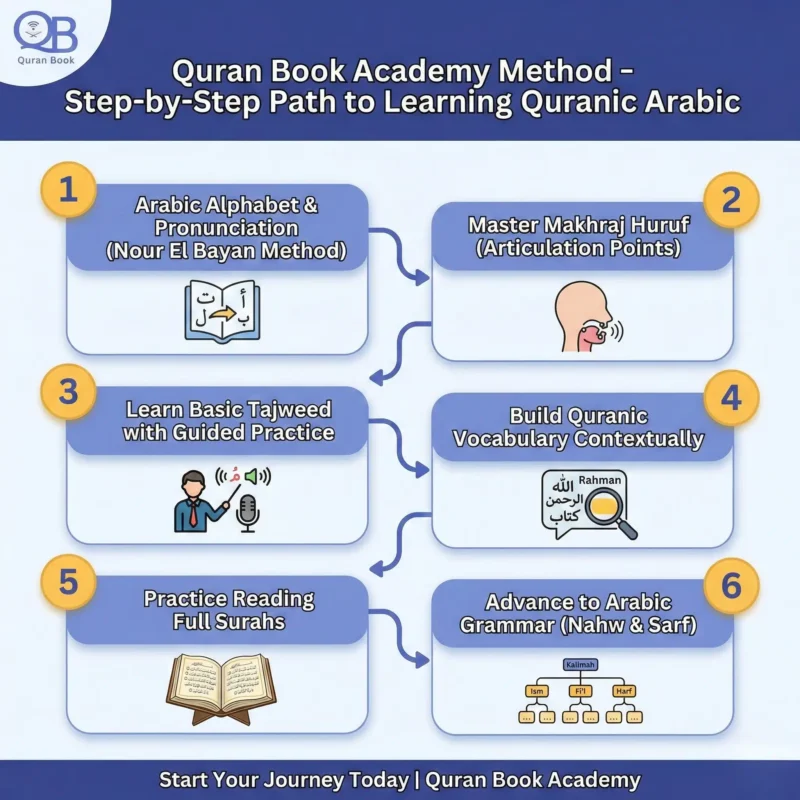
    How to learn Arabic for Quran step-by-step using the Academy Method at Quran Book Academy
    The six steps of the Academy Method for learning Quranic Arabic

    If you are wondering how to learn Arabic for Quran, Quran Book Academy has developed a proven, step-by-step method that has helped thousands of students achieve Quran reading fluency. Here is the Academy Method:

    1

    Start with the Arabic alphabet and pronunciation using the Nour El Bayan method—a renowned pedagogical approach that introduces letters systematically.

    2

    Master makhraj huruf (articulation points) for each letter, ensuring correct sound production from the very beginning.

    3

    Learn basic Tajweed rules through guided practice with a certified teacher who provides real-time feedback.

    4

    Build Quranic vocabulary through contextual learning—understanding words as they appear in the Quran, not in isolation.

    5

    Practice reading full Surahs with a certified instructor to develop fluency and confidence.

    6

    Advance to Arabic grammar (Nahw & Sarf) for deeper understanding of sentence structure and word derivation.

    This structured progression—from reading to Tajweed to grammar to understanding—ensures that every student builds a solid foundation. The Nour El Bayan method is available on the Quran Book Academy YouTube channel, and makhraj huruf video lessons are also accessible for self-study.

    Best Way to Learn Arabic for Quran Online with Live Teachers

    Learn Arabic for Quran online with live teachers at Quran Book Academy via Zoom
    Live online Quran class with real-time interaction and Tajweed correction via Zoom

    The best online Quranic Arabic course combines the convenience of remote learning with the effectiveness of live, interactive instruction. At Quran Book Academy, we believe that the best way to learn Quranic Arabic is through real-time sessions with certified teachers who can correct your pronunciation, answer your questions, and adapt to your pace.

    Our technology stack is designed to support your learning journey at every step. We use Zoom for live one-on-one and group sessions with screen sharing for real-time correction. Our custom Learning Management System (LMS) tracks student progress, lesson completion, quiz scores, and Tajweed milestones. Weekly Gmail progress reports are sent to students and parents with actionable feedback. And our Telegram channel serves as a community practice group for Quran reading with Tajweed corrections.

    When you learn Arabic for Quran online with Quran Book Academy, you get the structure of a traditional Islamic classroom combined with the flexibility and accessibility of modern technology. Classes are available for students in the USA, Canada, UK, and Australia, with flexible scheduling to accommodate different time zones.

    Reading Quran in Arabic vs. Translation: A Clear Comparison

    To fully appreciate the benefits of learning Arabic for Quran, it helps to see a direct comparison between reading in Arabic and relying on translation alone.

    Aspect Arabic (Original) Translation Only
    Meaning Depth Full semantic layers and nuance Approximation; translator-dependent
    Tajweed Natural pronunciation and rhythm Not applicable
    Spiritual Reward Reward for every Arabic letter Reward for effort, less for recitation
    Salah Understanding Full comprehension in prayer Requires separate memorization
    Scholarly Access Direct access to Tafsir & Hadith Limited to translated works
    Emotional Impact Original rhetorical power (I’jaz) Diluted emotional resonance
    Misinterpretation Minimal with proper knowledge Higher due to translator choices

    As the table above illustrates, while translations serve as a helpful starting point, they cannot replace the depth, beauty, and spiritual reward of engaging with the Quran in its original Arabic. This is precisely why the benefits of learning Arabic for Quran are so transformative.

    How to Overcome the Fear of Learning Arabic for Quran

    Overcoming the fear of learning Arabic for Quran with supportive teaching methods
    From fear and hesitation to confidence — a student’s journey through structured Arabic learning

    To overcome the fear of learning Arabic for Quran, start with small, achievable goals—like learning five new letters per week. Choose a structured course with a supportive teacher, use the Nour El Bayan method for gradual progression, and remember that every effort you make is rewarded by Allah.

    Many students hesitate because they feel they are too old, too busy, or simply not talented enough to learn a new language. These feelings are natural, but they are not facts. The truth is that Arabic can be learned at any age, and the Quran itself was meant to be understood by all people—not just scholars.

    The Prophet (PBUH) encouraged this journey: “The best of you are those who learn the Quran and teach it.” (Sahih al-Bukhari 5027). Notice that he did not say “the youngest of you” or “the most talented of you.” The best are simply those who begin.

    At Quran Book Academy, we use the “chunking” approach—breaking how to read Quran in Arabic correctly into small, manageable pieces that reduce overwhelm and build confidence step by step. Our student success stories prove that anyone, regardless of age or background, can achieve fluency with the right support.

    Frequently Asked Questions About Learning Arabic for Quran

    Q: Does learning Arabic help with the Quran?
    Yes, learning Arabic is one of the most effective ways to deepen your understanding of the Quran. It allows you to access the original meaning, improve Tajweed, and build a stronger spiritual connection during Salah and personal study. The benefits of learning Arabic for Quran are both spiritual and intellectual.
    Q: Should I learn Arabic to understand the Quran?
    While translations provide a starting point, learning Arabic for Quran gives you a direct understanding of Allah’s words. Even basic Arabic knowledge can dramatically improve your comprehension and recitation quality. Quran Book Academy offers a structured Quran Reading Course for beginners.
    Q: Is it better to read the Quran in Arabic?
    Yes. Reading the Quran in Arabic preserves the original meaning, rhythm, and linguistic miracle (I’jaz) that translations cannot fully convey. The Prophet (PBUH) recited in Arabic, and the reward for reading each Arabic letter is multiplied. (Jami’ at-Tirmidhi 2910).
    Q: What does Allah say about learning Arabic?
    While there is no direct Quranic verse commanding Muslims to learn Arabic, Allah revealed the Quran in Arabic (Surah Yusuf 12:2) and scholars like Umar ibn al-Khattab encouraged Arabic learning as part of the faith. Understanding Arabic enables you to fulfill the command to reflect on the Quran (Surah Muhammad 47:24).
    Q: What are the advantages of learning Arabic?
    The advantages include understanding the Quran directly, perfecting Tajweed, deepening prayer, accessing Islamic scholarship, boosting cognitive abilities, protecting against misinterpretation, and earning greater spiritual rewards. See our full 7 benefits section above for a detailed breakdown.
    Q: How long does it take to learn Arabic for Quran?
    With consistent practice of three to four sessions per week, most beginners can read Arabic fluently within three to six months using the Nour El Bayan method. Understanding Quranic Arabic at a deeper grammatical level may take one to two years depending on your goals. Quran Book Academy offers a Free Trial Lesson to help you get started.
    Q: What is the best way to learn Quranic Arabic?
    The best way is through structured, live classes with a certified teacher. At Quran Book Academy, we combine the Nour El Bayan method, Tajweed instruction, and Quranic vocabulary in manageable lessons via Zoom. Our custom LMS tracks your progress and ensures accountability throughout your learning journey.

    Start Your Free Trial Lesson at Quran Book Academy

    Start your free trial lesson to experience benefits of learning Arabic for Quran at Quran Book Academy
    Book your free trial — experience the Quran Book Academy method firsthand

    You have now seen the incredible benefits of learning Arabic for Quran—from understanding Allah’s words directly to earning greater rewards with every letter. The question is not whether you should start; it is how soon.

    Free Trial Lesson – No commitment, no pressure

    Certified Teachers – Native Arabic-speaking instructors with Ijazah

    Flexible Scheduling – USA, Canada, UK, Australia

    Proven Results – Thousands of students, from beginners to confident reciters

    ➡ Book Your Free Trial Lesson Now

    “The best of you are those who learn the Quran and teach it.” (Sahih al-Bukhari 5027). Your journey starts with a single step. Let us walk it with you.

    References

    Quranic Verses

    1. 1. Surah Yusuf 12:2 — Revelation of the Quran in Arabic
    2. 2. Surah Az-Zumar 39:28 — Purity of the Arabic Quran
    3. 3. Surah Fussilat 41:3 — Detailed Book in Arabic
    4. 4. Surah Ibrahim 14:4 — Messengers in the language of their people
    5. 5. Surah Muhammad 47:24 — Reflecting upon the Quran

    Hadith Collections

    1. 6. Sahih al-Bukhari 4937 — Proficiency in Quran recitation
    2. 7. Sahih al-Bukhari 5027 — The best are those who learn and teach the Quran
    3. 8. Jami’ at-Tirmidhi 2910 — Reward for every letter of Quran

    Academy Resources

    1. 9. YouTube: Makhraj al-Huruf Video Lessons
    2. 10. YouTube: Nour El Bayan Course Playlist
    3. 11. Telegram: Tajweed Practice Community
  • Mosquito in the Quran: 5 Powerful Lessons from Surah Al-Baqarah

    Mosquito in the Quran: 5 Powerful Lessons from Surah Al-Baqarah

    Mosquito in the Quran: 5 Powerful Lessons from Surah Al-Baqarah
    Quran Book Academy
    Free Trial

    Mosquito in the Quran: 5 Powerful Lessons from Surah Al-Baqarah

    Exploring Divine Wisdom in the Smallest of Creations | Islamic Studies

    Mosquito in the Quran verse from Surah Al-Baqarah with Arabic calligraphy
    Surah Al-Baqarah 2:26 – The Mosquito Verse in elegant Islamic calligraphy design

    Have you ever wondered why Allah mentions something as small as a mosquito in the Quran? Many Muslims struggle to connect with deeper Quranic wisdom, feeling overwhelmed by complex interpretations. Yet, the mosquito in the Quran offers profound lessons that transform how we approach faith, humility, and divine wisdom. In Surah Al-Baqarah 2:26, Allah uses this tiny creature to teach believers five powerful truths that apply to our modern lives. Whether you’re seeking Islamic lessons for your children or yearning to deepen your Quran understanding, this verse holds practical wisdom for everyone.

    The Mosquito in the Quran: What Does Surah Al-Baqarah Say?

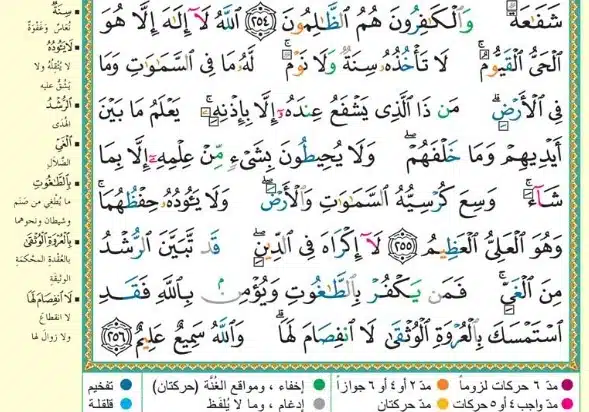
    The mosquito mentioned in Quran appears in Surah Al-Baqarah, verse 26. Allah states:

    Indeed, Allah is not ashamed to present an example—that of a mosquito or what is smaller than it. And those who have believed know that it is the truth from their Lord. But as for those who disbelieve, they say, ‘What did Allah intend by this as an example?’ He misleads many thereby and guides many thereby. And He misleads not except the deviantly disobedient.

    This Quran verse about mosquito was revealed during the Madinah period when critics mocked the Quran’s use of simple examples. Some doubted why Allah would mention insignificant creatures like spiders, flies, bees, or mosquitoes in divine revelation. The verse directly addresses this skepticism, affirming that divine wisdom transcends human judgment of what seems “too small” for Allah’s attention.

    📜 Why Was This Verse Revealed?

    According to Ibn Kathir’s renowned Tafsir, this verse responded to disbelievers who questioned the Quran’s legitimacy based on its use of everyday examples. They wondered how a divine book could reference common insects. Allah’s response is profound: truth doesn’t require grand symbols to validate itself.

    The Quran mentions various creatures—spiders, flies, bees, and the mosquito in the Quran—to demonstrate that every creation, regardless of size, contains divine wisdom. This Islamic perspective on mosquitoes extends beyond literal biology into spiritual understanding and humility before Allah’s infinite knowledge.

    5 Profound Lessons from the Mosquito Verse

    1 Nothing Is Too Small for Allah’s Attention

    The mosquito in the Quran reminds us that Allah’s care extends to every detail of our lives. When you make dua for something that seems insignificant—a child’s worry, a small financial need, a minor health concern—remember this verse. If Allah doesn’t consider a mosquito beneath His mention in the eternal Quran, He certainly doesn’t dismiss your smallest prayers.

    💡 Practical Takeaway:

    Start acknowledging “small” blessings in your daily gratitude practice. The functioning of your eyes, the air you breathe, the safety of your home—these seemingly minor gifts reflect Allah’s detailed care.

    2 Wisdom Recognizes Truth in All Forms

    Ibn Abbas, the Prophet Muhammad’s ﷺ cousin, explained this verse beautifully: believers recognize truth whether presented through grand miracles or simple examples. The Surah Baqarah mosquito verse divides humanity into two categories—those whose hearts are open to wisdom regardless of the vessel, and those who reject truth based on superficial judgments.

    A hadith in Sahih Muslim reinforces this: “The believer’s affair is amazing; all of his matters are good for him.” Whether Allah teaches through a mosquito or a mountain, the lesson remains profound for those with humble hearts.

    3 Scientific Miracles Confirm Quranic Truth

    The phrase “or what is smaller than it” in the mosquito mentioned in Quran astounded modern scientists. Written 1,400 years ago, this statement anticipated microscopic organisms invisible to the naked eye—bacteria, viruses, atoms, and subatomic particles.

    Quranic Statement Scientific Discovery Size Comparison
    “What is smaller than a mosquito” Microscopic organisms Bacteria: 1000x smaller
    Divine knowledge in 7th century Microscope invented 1590 CE Viruses: 10,000x smaller
    No human technology available Electron microscope 1931 Atoms: millions of times smaller

    This Islamic perspective on mosquitoes extends beyond the visible world into realms only recently confirmed by science.

    4 Allah’s Examples Are Universal

    The accessibility of the mosquito example demonstrates divine mercy. Allah didn’t choose obscure creatures known only to scholars. He selected a mosquito—something encountered by every human across cultures, climates, and centuries. You don’t need advanced Arabic knowledge to grasp the mosquito in the Quran lesson. A child can understand that small things matter to Allah, while adults appreciate deeper layers of humility and wisdom.

    5 Humility Opens Hearts, Pride Closes Them

    Here lies the deepest lesson of the Quran verse about mosquito: your response to simple truths reveals your spiritual condition. When disbelievers heard about the mosquito example, they scoffed. Believers, however, thought, “If Allah teaches through a mosquito, every detail of creation contains guidance.”

    The Prophet Muhammad ﷺ warned in Sahih Muslim: “No one who has even an atom’s weight of pride in his heart will enter Paradise.”

    The Surah Baqarah mosquito verse teaches us that pride manifests in rejecting simple beginnings, while humility embraces gradual growth.

    Common Questions About Mosquitoes in Islam

    Is Killing a Mosquito Haram in Islam?

    No, killing a mosquito is not haram in Islam. The Prophet Muhammad ﷺ permitted eliminating harmful creatures that pose threats to human health. Islamic scholars from Sahih Bukhari apply this principle to disease-carrying insects while emphasizing balance—eliminate threats when necessary but avoid unnecessary harm.

    Does Killing a Mosquito Break Wudu?

    No, killing a mosquito does not break wudu. Islamic scholars have consensus that wudu is only invalidated by specific actions like urination, defecation, passing gas, or deep sleep. Your ablution remains valid for prayer after swatting a mosquito.

    Are Mosquitoes Mentioned Elsewhere in the Quran?

    The mosquito mentioned in Quran appears only in Surah Al-Baqarah 2:26. However, other creatures feature throughout with spiritual lessons:

    Creature Surah Reference Lesson Taught
    🐝 Bee Surah An-Nahl (16:68-69) Divine inspiration, productivity
    🕷️ Spider Surah Al-Ankabut (29:41) False security, weak reliance
    🪰 Fly Surah Al-Hajj (22:73) Human powerlessness
    🐜 Ant Surah An-Naml (27:18) Community, communication

    Conclusion

    The mosquito in the Quran is far more than a passing reference—it’s a profound teaching tool that challenges our pride, confirms scientific truths, and demonstrates Allah’s care for every detail of creation. Through Surah Al-Baqarah 2:26, we learn that divine wisdom comes in all sizes, and humble hearts recognize truth regardless of its vessel.

    Start Your Free Trial in Islamic Course

    References & Links

    Source Description Link/Reference
    Quran (Surah Al-Baqarah 2:26) Primary verse about mosquito Quran.com
    Tafsir Ibn Kathir Classical Quranic interpretation IslamicStudies.info
    Sahih Muslim Hadith about pride Sunnah.com
    Sahih Bukhari Hadith about harmful animals Sunnah.com
    Surah An-Nahl (16:68-69) Bee verse reference Quran.com
    Surah Al-Ankabut (29:41) Spider verse reference Quran.com
    Surah Al-Hajj (22:73) Fly verse reference Quran.com
    Surah An-Naml (27:18) Ant verse reference Quran.com

    © 2026 Islamic Wisdom. All rights reserved.

    Spreading the light of Quranic wisdom to hearts around the world

  • Best Quran Memorization Techniques That Actually Work

    Best Quran Memorization Techniques That Actually Work

    7 Best Quran Memorization Techniques That Actually Work in 2026

    7 Best Quran Memorization Techniques
    That Actually Work in 2026

    A Complete Beginner’s Guide to Hifz for Non-Arabic Speakers

    Published by Quran Book Academy  ·  Updated February 2026  ·  18 min read

    Best Quran memorization techniques – a Muslim student memorizing the Quran with a Mushaf open
    A serene, well-lit image of a student sitting with an open Quran (Mushaf), highlighting the spiritual journey of Hifz

    Introduction: Your Quran Memorization Journey Starts Here

    If you have ever opened the Mushaf, tried to memorize an ayah, and felt like your brain just would not hold it…you are not alone. Millions of non-Arabic speaking Muslims around the world share the same struggle. The good news? Memorizing the Quran is a learnable skill, not a talent reserved for a chosen few. With the right best Quran memorization techniques, anyone can begin and sustain their Hifz journey—regardless of age, language background, or schedule.

    The Prophet Muhammad (ﷺ) received the Quran gradually over 23 years—a divine methodology of incremental learning. This teaches us that memorization is not about rushing; it is about consistency and the right approach. Allah Himself reassures us in the Quran:

    “And We have certainly made the Quran easy for remembrance, so is there any who will remember?”

    Surah Al-Qamar (54:17)

    In this comprehensive guide, we will walk you through the 7 best Quran memorization techniques that actually work for beginners and non-Arabic speakers. Each method is backed by Islamic tradition, cognitive science, or both—and every single one is actionable from day one. Whether you are looking for tips to memorize Quran or searching for structured hifz classes for beginners, this article will give you everything you need to start today.

    Why Is Quran Memorization Hard for Non-Arabic Speakers?

    Quran memorization presents unique challenges for non-Arabic speakers. Understanding these obstacles is the first step toward overcoming them. The primary difficulty lies in the language barrier itself—unfamiliar Arabic phonetics, a completely different script, and sounds that do not exist in English or other Western languages make the initial learning curve steep.

    Beyond the language challenge, most beginners attempt memorization without a structured methodology. They try random approaches—listening to a reciter here, reading a page there—without any system to build upon. This lack of structure leads to inconsistency and frustration. Add to that the psychological overwhelm of facing 6,236 ayahs across 604 pages, and it becomes clear why so many aspiring Huffaz give up before they truly begin.

    The absence of accountability and tracking makes self-study particularly difficult. Without a teacher or a structured hifz program to hold you accountable, it is easy to skip days, forget review sessions, and gradually lose what you have already memorized. That is exactly why having proven, structured best Quran memorization techniques is essential for anyone serious about completing their Hifz.

    7 Best Quran Memorization Techniques for Beginners

    This is the heart of the article. Each of the following techniques has been used successfully by thousands of students worldwide. Choose the method that fits your learning style, or combine multiple approaches for maximum retention. These are the tips to memorize Quran that scholars, teachers, and cognitive scientists agree on.

    1

    The 3×3 Repetition Method

    Best Quran memorization techniques – the 3x3 repetition method for Hifz
    An infographic showing a Quran page divided into 3 sections with the 3x read, 3x recite cycle

    The 3×3 Repetition Method is one of the most popular and beginner-friendly best Quran memorization techniques used in Hifz circles worldwide. It works by dividing each page of the Quran into three equal sections. You read the first section three times while looking at the Mushaf, then attempt to recite it three times from memory. Once the first section is solid, you move to the second and third sections using the same approach, then connect all three sections together.

    Best For: Visual learners & beginners

    “The one who recites the Quran and learns it by heart will be with the noble righteous scribes.”

    Sahih al-Bukhari 4937
    2

    The 3-10 Hifz Technique

    Tips on memorizing the Quran – the 3-10 Hifz technique explained step by step
    A numbered visual guide showing the 3-10 cycle: 3 ayahs, 10 repetitions each, then combined recitation

    The 3-10 Hifz Technique is an excellent method for memorizing the Quran efficiently, especially for surahs with longer ayahs. Here is how it works: memorize three ayahs at a time. Repeat each individual ayah ten times, then recite all three ayahs together ten times. Once you can recite the set of three flawlessly, move to the next set and repeat the process. At the end of your session, connect all the sets together.

    Best For: Auditory learners & longer surahs

    Pro Tip: Pair this technique with a qualified teacher on Zoom for real-time Tajweed correction. This is exactly how Quran Book Academy structures its live Hifz sessions in its hifz program, ensuring every student receives personalized guidance.

    3

    The 6446 Structured Method

    How to memorize the holy Quran easily – the 6446 structured spaced repetition method
    A calendar/cycle diagram showing the 6-4-4-6 daily structure with color-coded sections for new memorization and review

    The 6446 Structured Method is a powerful approach for intermediate students who already have a foundation in memorization. It follows a daily cycle: memorize 6 new ayahs in the morning, review 4 ayahs from yesterday, review 4 ayahs from last week, and review 6 ayahs from the previous month. This layered system builds long-term retention through spaced repetition.

    The science behind this technique mirrors what cognitive psychologists call “spaced repetition”—a learning strategy proven to boost long-term memory retention by over 200% compared to massed practice. By cycling through new and old material at calculated intervals, your brain strengthens neural pathways for each ayah, making recall faster and more reliable over time. This is one of the most effective tips to memorize Quran for serious students.

    Best For: Intermediate students with several Juz memorized
    4

    The 5-Repeat Listening Method

    Best Quran memorization techniques – the 5-repeat listening method for auditory learners
    A person wearing headphones with a Quran nearby, representing the listening-reciting-reading cycle

    The 5-Repeat Listening Method is ideal for auditory learners and those who have limited Arabic reading fluency. The process is straightforward: listen to a Qari recite the ayah five times, then repeat it aloud five times yourself without looking at the Mushaf, and finally read it five times from the Mushaf to reinforce visual memory. This triple-layered approach—listening, speaking, and reading—engages multiple learning channels simultaneously.

    Best For: Auditory learners, commuters & beginners

    If your reading fluency is not yet strong, we highly recommend starting with a Quran Reading and Tajweed course before jumping into full memorization. Building phonetic familiarity first makes these best Quran memorization techniques dramatically more effective.

    5

    The Chunking Method (Psychological Approach)

    Hifz program – the chunking method for Quran memorization using cognitive psychology
    A mind-map illustration showing Quranic themes branching into smaller chunks for meaning-based memorization

    The Chunking Method takes a cognitive science approach to Quran memorization. Instead of breaking pages into arbitrary ayah segments, you divide them into meaning-based “chunks.” First, you understand the theme and Tafsir (interpretation) of each chunk, then you memorize it. The brain retains meaningful groups of information far better than random sequences, making this one of the most intellectually satisfying techniques available.

    The educational psychology behind chunking traces back to George Miller’s “Magic Number 7” theory, which found that working memory processes information in groups of five to nine items. By organizing Quranic ayahs into thematic clusters, you reduce cognitive load and allow your brain to form stronger associations. Quran Book Academy applies this principle by training students to read with Tajweed first—building phonetic familiarity through the Nour El Bayan course—before introducing memorization. This phased approach reduces cognitive overload and makes memorization up to three times faster. We call this “The Academy Method,” and it is the foundation of our hifz classes for beginners.

    Best For: Analytical minds & non-Arabic speakers
    6

    Writing & Visual Mapping

    The Writing and Visual Mapping technique engages your motor memory through the physical act of writing. Write each ayah by hand three to five times, then create a visual mind map connecting ayahs by theme, surah, or narrative flow. The combination of handwriting and spatial visualization creates multiple memory anchors that reinforce retention from different cognitive angles.

    This technique also doubles as a beautiful act of worship—many scholars throughout Islamic history were known for copying the Quran by hand as a form of devotion and memorization combined. It remains one of the most time-tested tips on memorizing the Quran.

    Best For: Kinesthetic learners & writing-oriented students
    7

    The Recitation Partner (Mushafahah) Method

    Best Quran memorization techniques – the Mushafahah recitation partner method via Zoom
    A split-screen Zoom session showing a student reciting to a teacher — the modern Mushafahah tradition

    The Mushafahah Method is the gold standard of Quran memorization and the closest to the Sunnah of the Prophet (ﷺ). It involves reciting to a partner or teacher face-to-face (or via Zoom). The teacher listens carefully, corrects any Tajweed errors, and confirms the accuracy of your memorization. This real-time feedback loop is irreplaceable—no app or recording can substitute for a qualified human ear.

    Jibreel (‘alayhi al-salam) used to review the entire Quran with the Prophet (ﷺ) every Ramadan.

    Sahih al-Bukhari 4998
    Best For: Everyone — universally recommended

    Quran Book Academy’s hifz program is built around the Mushafahah method, with live 1-on-1 Zoom sessions led by certified Huffaz teachers. If you are serious about learning how to memorize the holy Quran easily, having a teacher guide you through this method is the single most impactful step you can take.

    How to Memorize 2 Pages of the Quran in 1 Hour

    How to memorize the holy Quran easily – memorize 2 pages in 1 hour step by step
    A timeline infographic showing the 5-step, 60-minute memorization process with time allocations

    Many students wonder if it is truly possible to memorize two full pages of the Quran in just one hour. The answer is yes—with the right approach. Here is a step-by-step process that combines several of the best Quran memorization techniques into a focused one-hour session:

    1

    Read the full 2 pages aloud with proper Tajweed (5 minutes). This gives your brain a complete overview of the material.

    2

    Divide the 2 pages into 4 half-page sections. Each section becomes a manageable unit.

    3

    Apply the 3×3 method to each section. Spend approximately 10 minutes per section (40 minutes total).

    4

    Connect all 4 sections by reciting the full 2 pages from memory (10 minutes).

    5

    Review by reciting to a teacher, study partner, or recording yourself for self-assessment (5 minutes).

    This process works best after you have built foundational reading fluency. If you find yourself stumbling over pronunciation, consider enrolling in a Quran Reading and Tajweed course first to build the skills that make memorization effortless.

    Comparison Table: Which Hifz Technique Is Best for You?

    Use this quick-reference table to find the best Quran memorization techniques that match your learning style, available time, and experience level.

    Technique Best For Difficulty Time/Day Teacher? Key Benefit
    3×3 Repetition Visual learners Easy 30–45 min Optional Simple, structured approach
    3-10 Hifz Auditory learners Easy 30 min Recommended Strong ayah-level retention
    6446 Structured Intermediate Medium 45–60 min Optional Built-in spaced repetition
    5-Repeat Listening Auditory / Beginners Easy 20–30 min Optional Multi-sensory engagement
    Chunking (Psych.) Analytical minds Medium 30–45 min Recommended Deep meaning-based retention
    Writing & Mapping Kinesthetic learners Easy 30–40 min No Motor memory activation
    Mushafahah Everyone Varies 20–30 min Required Real-time teacher correction

    The Academy Method: How Quran Book Academy Teaches Hifz

    Hifz program – Quran Book Academy's unique teaching method for Quran memorization
    A professional image showing a Zoom lesson in progress at Quran Book Academy — the modern, tech-enabled approach to Hifz

    At Quran Book Academy, we do not start with memorization. We start with reading fluency. Our approach is grounded in a simple principle: students who can read Arabic fluently and with correct Tajweed memorize three times faster than those who jump straight into Hifz without foundational skills. This is The Academy Method, and it is what sets our hifz program apart from any other online Quran school.

    Students first master Tajweed rules and Makhraj (articulation points) through our structured Nour El Bayan course. This builds the phonetic foundation that eliminates the biggest bottleneck in memorization—struggling with pronunciation. Once students graduate from this phase, they enter our Hifz program with confidence and fluency.

    Our live sessions combine the Chunking Method with Mushafahah recitation on Zoom. Each session is structured into manageable 15–20 minute blocks, ensuring focused, high-quality memorization without burnout. Our certified teachers provide real-time feedback, and our custom Learning Management System (LMS) tracks every student’s progress page-by-page, surah-by-surah. Weekly progress reports are sent directly to students (and parents, for children) via email.

    Whether you are searching for hifz classes for beginners or an advanced review program, the Academy Method provides a complete, end-to-end system built on the best Quran memorization techniques available today.

    Hadith & Rewards: Why Memorize the Quran?

    Beyond technique and methodology, the motivation to memorize the Quran comes from the immense spiritual rewards promised to those who undertake this journey. Let these reminders fuel your determination:

    Reward for the Hafiz

    “It will be said to the companion of the Quran: ‘Read, ascend, and recite as you used to recite in the world, for your rank will be at the last verse you recite.’”

    Sunan Abu Dawud 1464

    Reward for Parents

    “Whoever reads the Quran, learns it, and acts according to it, on the Day of Judgment his parents will be crowned with a crown of light whose radiance is like that of the sun.”

    — Musnad Ahmad (graded Hasan)

    Quranic Promise

    “Rather, it [the Quran] is distinct verses [preserved] within the breasts of those who have been given knowledge.”

    Surah Al-Ankabut (29:49)

    Every letter you recite counts. Every ayah you memorize elevates you. The journey of Hifz is not a sprint—it is a lifelong act of worship. Whether you memorize one ayah a day or one page, every effort is seen and rewarded by Allah. These tips to memorize Quran are not just academic strategies; they are pathways to eternal reward.

    Frequently Asked Questions (FAQ)

    What is the most effective way to memorize the Quran? +

    The most effective method combines structured repetition (like the 3×3 or 3-10 technique) with a qualified teacher for Mushafahah. Quran Book Academy uses this exact approach in our hifz program, combining cognitive science-backed techniques with live teacher guidance for maximum retention.

    How long does it take to become a Hafiz? +

    With consistent daily practice of one to two hours, most students complete full Hifz in two to four years. Intensive programs requiring three to four hours per day can achieve it in one to two years. The timeline depends on your reading fluency, consistency, and the quality of your review habits.

    Can I complete Hifz in 6 months? +

    It is extremely challenging but possible for dedicated students who already have strong Arabic reading fluency and can commit four to six hours daily. For most beginners, one to three years is a realistic and sustainable goal that ensures long-term retention.

    What is a person who memorized the Quran called? +

    A person who has memorized the entire Quran is called a Hafiz (male) or Hafiza (female). The plural is Huffaz. Achieving this status is one of the highest honors in Islam.

    What is the reward for parents of a Hafiz? +

    According to a Hadith narrated in Musnad Ahmad, the parents of a Hafiz will be crowned with a crown of light on the Day of Judgment, whose radiance is brighter than the sun. This reward extends to parents who support and encourage their children in Quran memorization.

    How can I memorize 2 pages of the Quran in 1 hour? +

    Divide the two pages into four half-page sections. Apply the 3×3 repetition method to each section, spending approximately ten minutes each. Then recite all sections together and use the remaining time to review. See our detailed step-by-step guide above.

    What is the best Hifz method for non-Arabic speakers? +

    Start with a Tajweed and reading fluency course (like Nour El Bayan) to build phonetic familiarity, then use the Chunking plus Mushafahah method with a teacher. This is the approach Quran Book Academy recommends and uses in our hifz classes for beginners.

    Start Your Quran Memorization Journey Today

    You have learned the techniques. Now let our certified teachers guide you step by step. Book your FREE trial Hifz lesson with Quran Book Academy today.

    ✓ Live 1-on-1 Zoom sessions with certified Huffaz teachers ✓ Personalized Hifz plan based on your schedule and level ✓ Weekly progress reports delivered to your email ✓ Access to our custom LMS for tracking every page and surah

    Whether you are starting from zero or looking to accelerate your existing memorization, our hifz program has a path for you. Apply the best Quran memorization techniques under expert guidance and join thousands of students worldwide who are transforming their relationship with the Quran.

    Book Your Free Trial Now

    References

    All internal and external links referenced throughout this article: