
Sifaat Al Huroof: 17 Powerful Letter Qualities Every Beginner Must Learn in 2026
If you’ve ever felt frustrated hearing your own Quran recitation and wondering why it doesn’t sound right — even after months of trying — you’re not alone. Most non-Arabic speakers hit this exact wall, and the answer almost always traces back to one overlooked concept: Sifaat Al Huroof (صفات الحروف).
Sifaat Al Huroof are the unique characteristics or attributes of each Arabic letter that determine how it sounds when pronounced. While Makhraj Al Huroof: Arabic Letter Articulation Points tell you where a letter comes from inside the mouth or throat, Sifaat Al Huroof tell you how that letter should actually sound. Without mastering these qualities, two letters from the same articulation point — like ت (Tā’) and ط (Ṭā’) — would sound identical, and that could change the meaning of Allah’s words entirely.
“…and recite the Quran with measured recitation.” — Surah Al-Muzzammil 73:4
By the end of this article, you will understand all 17 Sifaat Al Huroof, organized in a simple, beginner-friendly way with clear examples, a complete reference chart, short Al-Husary audio clips for each quality, and practical tips to transform your recitation from uncertain to confident.
What Is the Meaning of Sifaat Al Huroof in Tajweed?
Sifaat Al Huroof literally means “characteristics of the letters.” In Tajweed — the Complete Tajweed Rules Guide — it refers to the 17 inherent qualities that define how each Arabic letter sounds. In this Tajweed counting framework the alphabet is counted as 29 letters, because the Hamzah (ء) is counted as a letter in its own right alongside the Alif (ا). Every figure in this guide — 10 letters of Hams, 19 of Jahr, 22 of Istifal, and so on — is based on that 29-letter count. These attributes are what distinguish letters that share the same Makhraj (articulation point), ensuring every word of the Quran is recited exactly as it was revealed.
Linguistically, “Sifaat” (صفات) means attributes or qualities, while “Huroof” (حروف) means letters. Scholars of Tajweed, most notably Imam Ibn Al-Jazari, codified 17 essential Sifaat to create a systematic framework that any student — regardless of their native language — can follow to achieve accurate pronunciation.
Key distinction: Makharij answer the question “where does the sound come from?” while Sifaat answer “how should that sound behave?” A letter’s Makhraj is its birthplace; its Sifaat are its personality.
“The one who is proficient in the Quran will be with the honorable and obedient scribes (angels)…” — Sahih al-Bukhari 4937
This hadith encourages Muslims to strive for proficiency in Quran recitation.
Why Sifaat Al Huroof Matter — The Qul vs. Kul Example
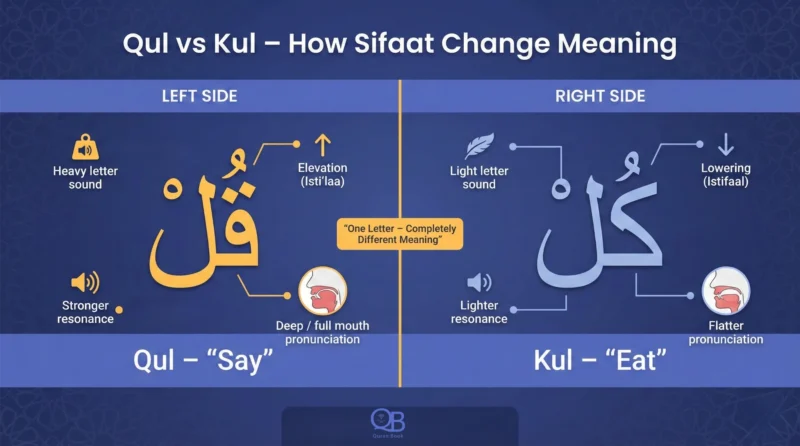
To truly appreciate why Sifaat Al Huroof are not optional, consider this powerful example. The word قُل (Qul) means “Say” — it is a divine command from Allah to His Messenger ﷺ. The word كُل (Kul) means “Eat.” The only difference between these two words is a single attribute: the heaviness (Isti’la) of the letter Qaaf (ق). If you pronounce Qaaf without raising the back of your tongue — without its proper Sifah — it collapses into Kaaf (ك), and a divine command becomes an everyday word.
This is why Sifaat Al Huroof are not phonetic decoration. They are guardians of Quranic meaning. Every attribute exists for a reason: to protect the integrity of Allah’s revelation.
“Indeed, it is We who sent down the Quran and indeed, We will be its guardian.” — Surah Al-Hijr 15:9
For students who learn Quran with Tajweed, careful pronunciation helps preserve accuracy in their own Quran recitation and in how they pass it on to others.
The 2 Main Types of Sifaat Al Huroof (With Chart)
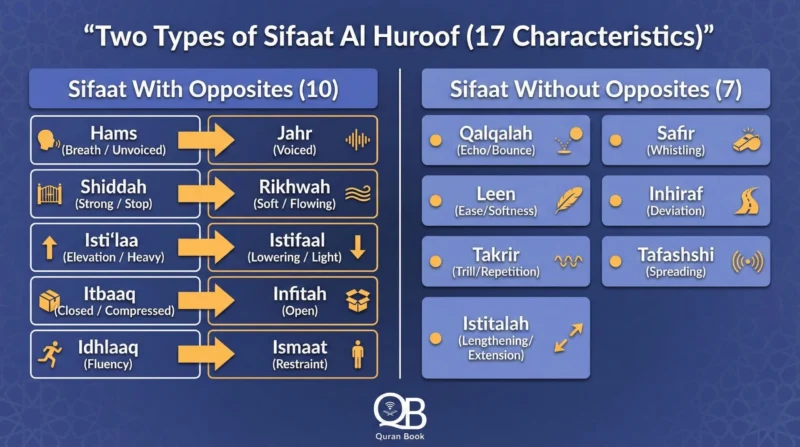
Sifaat Al Huroof are divided into two main categories. The first category is Sifaat with Opposites (الصفات المتضادة), which consists of 5 pairs totaling 10 attributes. Each pair represents two contrasting qualities — every Arabic letter must carry one quality from each pair. The second category is Sifaat without Opposites (الصفات غير المتضادة), which includes 7 unique attributes that only apply to specific letters. Together, these two categories make up the 17 essential Sifaat that govern Quran tajweed rules.
A note on Tawassut (التوسط): Tawassut is the intermediate state between Shiddah and Rakhawah, not a separate eighteenth Sifah. It sits inside the Shiddah / Rakhawah pair, so the total remains 17 Sifaat (10 with opposites + 7 without opposites).
The 5 Pairs of Sifaat with Opposites — Explained Simply
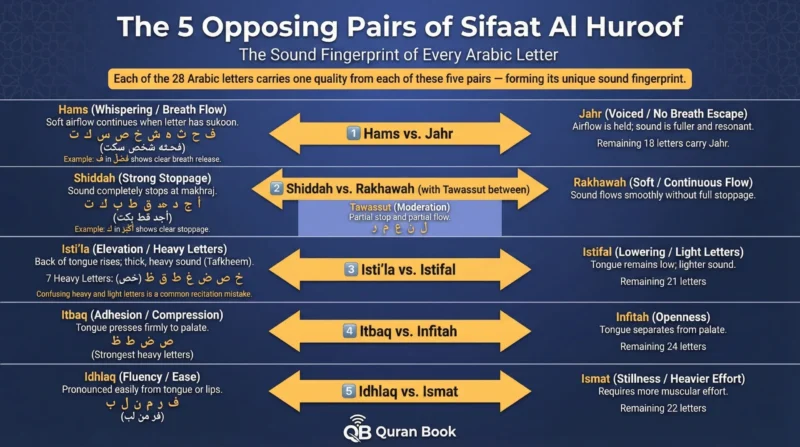
This is the heart of understanding Sifaat Al Huroof. Each of the 29 Arabic letters carries one quality from each of these five pairs, giving every letter a unique “fingerprint” of sound characteristics. Each pair below includes a short Al-Husary clip so you can see it, hear it, then repeat it.
1 Hams (الهمس) vs. Jahr (الجهر) — Whispering vs. Voiced
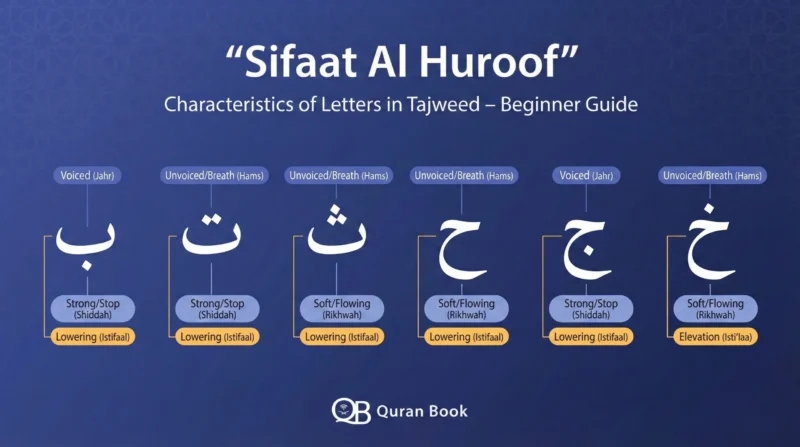
Hams in Tajweed means “whispering”: a flow of breath that continues with the letter because of the weakness of reliance on its articulation point. Hams is an inherent quality of its letters in all states — with a vowel or with sukoon — although the flow of breath is usually easiest for beginners to hear when the letter is sakin. The 10 letters of Hams are collected in the Arabic phrase: فحثه شخص سكت.
Jahr (voiced) is the opposite: the breath does not flow with the letter, because reliance on the articulation point is strong. The remaining 19 Arabic letters all carry this quality. The sound of a Jahr letter is fuller and more resonant because the breath does not escape.
الْمُسْتَقِيمَ
Surah Al-Fatihah 1:6 — target letter: سْ
Listen for: the continuous flow of breath through the سْ.
وَازْدَادُوا
Surah Al-Kahf 18:25 — target letter: زْ · plays the full ayah
Listen for the lack of flowing breath compared with a Hams letter such as س.
Example: The letter ف in the word فَصْلٌ demonstrates Hams beautifully — the breathy quality is clearest when the Faa carries a sukoon, but it belongs to the letter in every state.
2 Shiddah (الشدة) vs. Rakhawah (الرخاوة) — with Tawassut (التوسط) in Between
Shiddah in Tajweed means “strong stoppage.” When a Shiddah letter carries sukoon, the sound completely stops at its Makhraj — no sound flows through. The 8 letters of Shiddah are remembered through: أجد قط بكت.
Rakhawah (softness) is the opposite: the sound flows continuously and smoothly. The remaining 16 letters — everything that is neither Shiddah nor Tawassut — carry this quality.
Tawassut is the intermediate state between Shiddah and Rakhawah, not an extra Sifah: the sound is neither fully stopped nor fully flowing. The 5 letters of Tawassut are: لن عمر. Because it belongs inside this pair, the overall count of Sifaat stays at 17.
أَكْبَرُ
Surah At-Tawbah 9:72 — target letter: كْ · plays the full ayah
Listen for the complete stopping of the sound at the Makhraj of كْ.
قُلْ هُوَ
Surah Al-Ikhlas 112:1 — target letter: لْ
Listen for a sound that is neither completely stopped nor freely flowing.
الْمُسْتَقِيمَ
Surah Al-Fatihah 1:6 — target letter: سْ (same clip as the Hams example above)
Listen for the continuation of the sound through سْ.
Example: The letter ك in أَكْبَر demonstrates Shiddah clearly — the sound firmly stops at the back of the tongue before releasing into the next letter.
3 Isti’la (الاستعلاء) vs. Istifal (الاستفال) — Elevation vs. Lowering
Isti’la (elevation) is the quality of heaviness. When pronouncing an Isti’la letter, the back of the tongue rises toward the roof of the mouth, producing a thick, heavy sound. The 7 heavy letters in Tajweed are: خص ضغط قظ (خ، ص، ض، غ، ط، ق، ظ). These are the letters that require Tafkheem (heaviness) at all times.
Istifal (lowering) is the opposite — the tongue stays low and relaxed, producing the light letters in Tajweed. The remaining 22 Arabic letters carry this quality. Mastering this pair is critical because confusing a heavy letter with a light one — or vice versa — is one of the most common recitation errors among beginners.
الصِّرَاطَ
Al-Fatihah 1:6 — target letter: ص
Listen to the elevated, emphatic quality of Ṣād.
سِرَاجًا
An-Naba 78:13 — target letter: س
Listen to the lighter sound produced with the tongue remaining lower.
Heavy Letters in Arabic: Tafkheem & Tarqeeq — learn all 7 heavy letters →
4 Itbaq (الإطباق) vs. Infitah (الانفتاح) — Adhesion vs. Openness
Itbaq means that the tongue rises and presses against the roof of the mouth, so the sound is enclosed between the tongue and the palate. Only 4 letters carry this powerful quality: ص، ض، ط، ظ. These four letters have the strongest heaviness in the Arabic language because they combine both Isti’la and Itbaq.
Infitah (openness) means the tongue stays away from the palate, leaving an open gap through which the sound escapes. All remaining 25 letters carry Infitah.
الصِّرَاطَ
Al-Fatihah 1:6 — target letter: ص (same clip as Isti’la)
Listen for the strong emphatic quality produced by Ṣād, which combines Isti’la and Itbaq.
سِرَاجًا
An-Naba 78:13 — target letter: س (same clip as Istifal)
Listen for the open, unenclosed sound: no part of the tongue is pressed against the palate.
5 Idhlaq (الإذلاق) vs. Ismat (الإصمات) — a Classification, Not a Sound Effect
Idhlaq and Ismat are a classification of the letters by their articulation region, not audible effects you listen for the way you listen for Qalqalah or Safeer. Idhlaq relates traditionally to letters articulated with ease from the tip or edge of the tongue or from the lips. The 6 Idhlaq letters are remembered through: فر من لب (ف، ر، م، ن، ل، ب).
Ismat is simply the counterpart within this same classification: it covers the letters that are not among the Idhlaq group — the remaining 23 letters. It is a category label, not an instruction to push harder or use extra effort when pronouncing the letter.
الرَّحْمَٰنِ
Al-Fatihah 1:3 — target letter: ر
قُلْ هُوَ
Al-Ikhlas 112:1 — target letter: ق
The 7 Sifaat Without Opposites
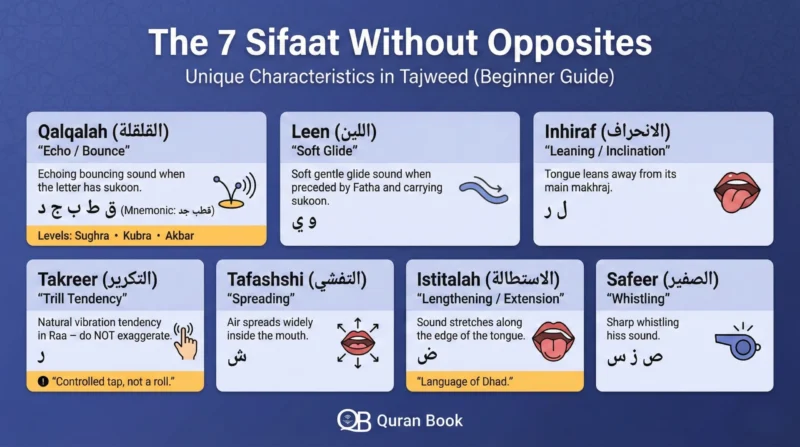
These seven attributes are unique — they do not have an opposite quality. Only specific letters carry these characteristics, making them special features that require focused attention. Each card includes a short Al-Husary clip so you can hear the quality in a real Quranic word.
1. Qalqalah (القلقلة)
An echoing, bouncing sound produced when certain letters carry sukoon. The letters of Qalqalah are: ق، ط، ب، ج، د — easily remembered by the phrase قطب جد.
Three levels: Sughra (small — middle of word), Kubra (big — end of word), Akbar (biggest — end of passage).
لَمْ يَلِدْ
Al-Ikhlas 112:3 — target letter: دْ
Listen for the controlled Qalqalah bounce on دْ.
Want to hear all five Qalqalah letters with more audio examples? Practice all 5 Qalqalah letters with Al-Husary audio
2. Leen (اللين)
A soft, gentle sound produced by the letters و and ي when they are preceded by a Fatha and carry a sukoon. The word “Leen” itself means softness, and the sound should glide out smoothly without force.
خَوْفٍ
Quraysh 106:4 — target letter: وْ
Listen for the soft, effortless glide out of the sakin Waw after a Fatha.
الْبَيْتِ
Quraysh 106:3 — target letter: يْ
Listen for the same softness in the sakin Yaa after a Fatha.
Leen is also important when learning Madd Leen at a stop — Madd Leen with Audio Examples
3. Inhiraf (الانحراف)
The leaning or inclination of the sound away from its primary Makhraj toward another point in the mouth. This quality is found in only two letters: ل (Laam) and ر (Raa).
قُلْ هُوَ
Al-Ikhlas 112:1 — target letter: لْ (same clip as Tawassut)
Listen for the sound of the Laam running along the side of the tongue rather than stopping dead at one point.
4. Takreer (التكرير)
The natural vibration of the tip of the tongue that belongs to the letter ر (Raa). Important caution: Takreer is mentioned as a quality to be aware of, so that it is not overdone. Avoid repeated rolling of the Raa; allow its natural controlled vibration without exaggeration.
الرَّحْمَٰنِ
Al-Fatihah 1:3 — target letter: ر (same clip as Idhlaq)
Listen to the natural controlled quality of Raa without exaggerated rolling.
5. Tafashshi (التفشي)
The spreading of air inside the mouth. This quality belongs exclusively to the letter ش (Sheen). When you pronounce Sheen, the air disperses across the oral cavity, creating its distinctive widespread sound.
وَالشَّمْسِ
Ash-Shams 91:1 — target letter: ش
Listen for the spreading quality of the sound of Sheen.
6. Istitalah (الاستطالة)
The elongation of sound along the edge of the tongue. This unique quality belongs only to the letter ض (Dhad) — the letter so special that Arabic is sometimes called “the language of the Dhad.” The sound stretches from the back molar area to the front of the tongue’s edge.
الضَّالِّينَ
Al-Fatihah 1:7 — target letter: ض
Listen for the distinctive extension of Dhad along the side of the tongue.
7. Safeer (الصفير)
A sharp whistling sound produced by three letters: ص، ز، س. The term Safeer literally means whistling, and you can hear a subtle, high-pitched hiss when these letters are pronounced correctly.
النَّاسِ
An-Nas 114:1 — target letter: س
Listen for the clear whistling quality of Sīn.
Sifaat Al Huroof Complete Reference Chart
The chart lists all 17 Sifaat: rows 1–10 are the 5 pairs with opposites, rows 11–17 are the 7 without opposites. Tawassut appears as a shaded note row because it is the intermediate state inside Pair 2, not an eighteenth Sifah. All letter counts follow the 29-letter Tajweed count described above.
| # | Sifah (Arabic) | Sifah (English) | Type | Letters |
|---|---|---|---|---|
| 1 | الهمس (Hams) | Whispering / flowing breath | With Opposite | فحثه شخص سكت (10) |
| 2 | الجهر (Jahr) | Voiced | With Opposite | Remaining 19 letters |
| 3 | الشدة (Shiddah) | Strong Stop | With Opposite | أجد قط بكت (8) |
| 4 | الرخاوة (Rakhawah) | Softness / Flow | With Opposite | Remaining 16 letters (neither Shiddah nor Tawassut) |
| — | التوسط (Tawassut) | Intermediate state between Shiddah and Rakhawah — not counted as a separate Sifah | Inside Pair 2 | لن عمر (5) |
| 5 | الاستعلاء (Isti’la) | Elevation / Heavy | With Opposite | خص ضغط قظ (7) |
| 6 | الاستفال (Istifal) | Lowering / Light | With Opposite | Remaining 22 letters |
| 7 | الإطباق (Itbaq) | Adhesion | With Opposite | ص ض ط ظ (4) |
| 8 | الانفتاح (Infitah) | Openness | With Opposite | Remaining 25 letters |
| 9 | الإذلاق (Idhlaq) | Letters of the tip/edge of the tongue and the lips | With Opposite | فر من لب (6) |
| 10 | الإصمات (Ismat) | The counterpart group: all letters outside the Idhlaq set | With Opposite | Remaining 23 letters |
| 11 | القلقلة (Qalqalah) | Echoing Bounce | Without Opposite | ق ط ب ج د |
| 12 | اللين (Leen) | Softness | Without Opposite | و ، ي (sakin, with Fatha before) |
| 13 | الانحراف (Inhiraf) | Inclination | Without Opposite | ل ، ر |
| 14 | التكرير (Takreer) | Vibration (to be controlled, not exaggerated) | Without Opposite | ر |
| 15 | التفشي (Tafashshi) | Spreading | Without Opposite | ش |
| 16 | الاستطالة (Istitalah) | Elongation | Without Opposite | ض |
| 17 | الصفير (Safeer) | Whistling | Without Opposite | ص ، ز ، س |
Tip: Save or bookmark this chart — it’s your go-to reference as you learn Quran reading with Tajweed for beginners.
How Quran Book Academy Teaches Sifaat Al Huroof — The Academy Method
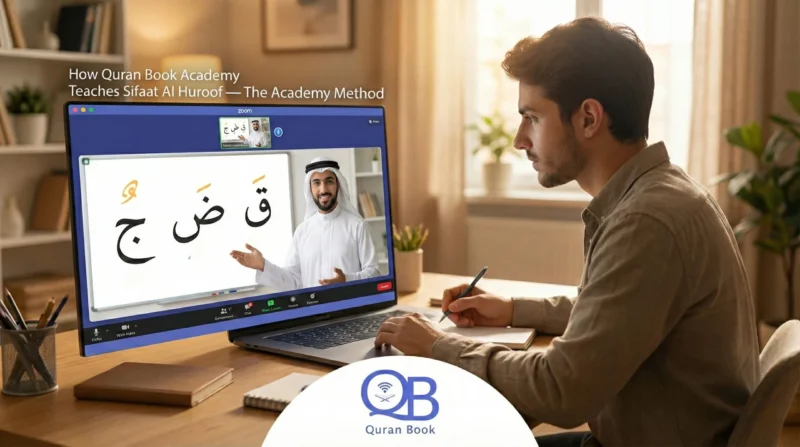
At Quran Book Academy, we understand that memorizing 17 technical attributes can feel overwhelming — especially for beginners. That’s why we developed The Academy Method, a teaching approach rooted in learning psychology and personalized instruction.
Chunking Technique
Instead of bombarding students with all 17 Sifaat at once, we break them into small, digestible “chunks.” Students learn 2–3 Sifaat per session, practice them in real Quranic verses, and only move forward once mastery is confirmed. This approach aligns with cognitive load theory, which shows that working memory handles small groups of information far more effectively than large ones.
Live Zoom Sessions
Every student practices pronunciation in real time with one of our Certified Quran and Tajweed Teachers via Zoom. You receive instant corrections that a pre-recorded course or a YouTube video cannot provide. When your instructor hears you soften a Qaaf or miss a Qalqalah, they catch it on the spot.
Custom LMS Tracking
Our custom Learning Management System tracks each student’s progress lesson by lesson. Parents and students receive regular progress reports after every milestone, so you always know exactly where you stand and what to focus on next.
Nour El Bayan Foundation
For absolute beginners who are still building Arabic letter recognition, we start with our Nour El Bayan Course before advancing to Sifaat. This ensures a rock-solid foundation that makes learning the characteristics of letters in Tajweed significantly easier.
Practice Community
Students can join our Telegram channel to practice Quran reading with Tajweed alongside peers, share tips, and stay motivated throughout their journey.
Common Mistakes Beginners Make with Sifaat Al Huroof
Even dedicated students fall into predictable traps when learning Sifaat Al Huroof. Here are the most frequent mistakes — and how to avoid them.
Pronouncing ق (Qaaf) like ك (Kaaf)
This happens when a student fails to raise the back of the tongue, missing the heaviness (Isti’la) of Qaaf. The result is that divine commands lose their weight and meaning.
Adding Qalqalah to non-Qalqalah letters
Only the five letters قطب جد carry the echoing bounce. Applying Qalqalah to other letters with sukoon is a common overcorrection that distorts the recitation.
Over-rolling the ر (Raa)
Takreer is a natural quality of Raa, but it is meant to be controlled — not exaggerated. Avoid repeated rolling of the Raa; allow its natural controlled vibration without exaggeration. A teacher’s ear is the safest way to judge how much is too much.
Making ض sound like د
The letter Dhad has a unique elongation (Istitalah) that no other Arabic letter possesses. Without it, Dhad collapses into Daal, and the “language of the Dhad” loses its most distinctive sound.
Ignoring Hams
Hams belongs to letters such as ف، س، ت in every state, and the flowing breath must not be blocked. It is easiest to hear when the letter carries a sukoon — but trapping the breath at any point turns a Hams letter into a Jahr letter, changing its fundamental quality.
Pro Tip: At Quran Book Academy, our instructors catch these errors in real time during live Zoom sessions — personalized feedback can help students identify pronunciation mistakes that are difficult to notice when studying alone.
Quick Sifaat Al Huroof Quiz
Seven short questions for beginners, all answered inside this article. Think about your answer first, then open the box to check it.
1. Which letters have Hams?
2. Which Sifah belongs to ق ط ب ج د?
3. What is the difference between Shiddah and Rakhawah?
4. Which letter has Tafashshi?
5. Which letter has Istitalah?
6. What should a student avoid when pronouncing Raa?
7. What is the difference between Makharij and Sifaat?
Frequently Asked Questions About Sifaat Al Huroof
Q1: What is the meaning of Sifaat Al Huroof?
Q2: What are the two types of Sifaat?
Q3: What are the 7 heavy letters in Arabic?
Q4: What is Qalqalah in Tajweed?
Q5: Is Qaaf (ق) a heavy letter?
Q6: What is the difference between Sifaat and Makharij?
Q7: What does Hams mean in Tajweed?
Q8: What is Shaddah in Tajweed?
Q9: What are the 5 Sifat pairs in Tajweed?
Q10: Why does this guide count 29 Arabic letters?
Start Perfecting Your Sifaat Al Huroof Today — Free Trial Lesson

You’ve learned what Sifaat Al Huroof are — now it’s time to hear them, practice them, and master them with expert guidance.
At Quran Book Academy, we don’t just teach theory. Our certified Tajweed instructors work with you one-on-one via live Zoom sessions, correcting your pronunciation in real time and guiding you through every Sifah with patience and encouragement. Our custom LMS tracks your journey, and you’ll receive regular progress reports so you always know exactly where you stand.
Whether you’re a complete beginner starting with Nour El Bayan or an intermediate student refining your Tajweed, we have a path designed for you.
“And We have certainly made the Quran easy for remembrance, so is there any who will remember?” — Surah Al-Qamar 54:17
About the Author
Jehad Mahmoud
Hafidha of the Quran · Arabic Language Graduate · Writer on Islamic Sciences
Jehad Mahmoud is a graduate of the Arabic Language department and a Hafidha of the Quran who writes Islamic educational content at Quran Book Academy. She specialises in Quranic Arabic, Tajweed and the Sharia sciences, helping English-speaking Muslim families understand correct Quran pronunciation and foundational Islamic knowledge.
References & Resources
Scholarly Sources
The Holy Quran — Surah Al-Fatihah 1:3, 1:6, 1:7; Surah Al-Ikhlas 112:1, 112:3; Surah Quraysh 106:3–4; Surah Ash-Shams 91:1; Surah An-Nas 114:1; Surah An-Naba 78:13; Surah Al-Kahf 18:25; Surah At-Tawbah 9:72; Surah Al-Muzzammil 73:4; Surah Al-Hijr 15:9; Surah Al-Qamar 54:17
Sahih al-Bukhari, Hadith 4937
Imam Ibn Al-Jazari — Al-Muqaddimah Al-Jazariyyah (foundational Tajweed text)
Sulayman Al-Jamzuri — Tuhfat Al-Atfal
Muhammad Makki Nasr — Nihayat Al-Qawl Al-Mufid fi ‘Ilm Al-Tajweed
Abd Al-Fattah Al-Marsafi — Hidayat Al-Qari ila Tajweed Kalam Al-Bari
Where each point is grounded:
• The 29-letter count used in this Tajweed framework (Hamzah counted separately from Alif) — Al-Muqaddimah Al-Jazariyyah; Nihayat Al-Qawl Al-Mufid.
• Hams / Jahr as inherent qualities of their letters, and the mnemonics فحثه شخص سكت — Al-Muqaddimah Al-Jazariyyah; Hidayat Al-Qari.
• Shiddah, Rakhawah and Tawassut as the intermediate state within one pair (أجد قط بكت / لن عمر) — Al-Muqaddimah Al-Jazariyyah; Nihayat Al-Qawl Al-Mufid.
• Isti’la / Istifal and the seven letters خص ضغط قظ — Al-Muqaddimah Al-Jazariyyah; Hidayat Al-Qari.
• Itbaq / Infitah and the four Itbaq letters ص ض ط ظ — Al-Muqaddimah Al-Jazariyyah.
• Idhlaq / Ismat as an articulation-based classification (فر من لب) rather than an audible effect — Nihayat Al-Qawl Al-Mufid; Hidayat Al-Qari.
• Takreer as a quality to be controlled rather than exaggerated — Al-Muqaddimah Al-Jazariyyah; Hidayat Al-Qari.
• Qalqalah and its levels — Tuhfat Al-Atfal; Nihayat Al-Qawl Al-Mufid.
• The Makhraj / Sifah distinction — Al-Muqaddimah Al-Jazariyyah; Hidayat Al-Qari.
Recitation Audio
All audio examples in this article are streamed from EveryAyah.com — the recitation of Shaykh Mahmoud Khalil Al-Husary (Hafs ‘an ‘Asim), Husary_128kbps with Husary_64kbps as the automatic fallback. Each button loads one ayah file on demand; nothing is preloaded. To shorten any clip to just the target word, add data-start and data-end (in seconds) to that button.
Internal — Course Pages
Quran Reading and Tajweed Course
Nour El Bayan Course
All Courses
Quran Recitation Course
Certified Quran and Tajweed Teachers
Free Trial Lesson
Internal — Related Guides
Makhraj Al Huroof: Arabic Letter Articulation Points
Complete Tajweed Rules Guide
Heavy Letters in Arabic: Tafkheem & Tarqeeq
Qalqalah Letters with Al-Husary Audio
Madd Leen with Audio Examples
Community & Media (not scholarly sources)
Quran Book Academy YouTube Channel
Telegram Channel for Tajweed Practice
Quran Book Academy Learning Management System
© 2026 Quran Book Academy. All rights reserved.
Leave a Reply