

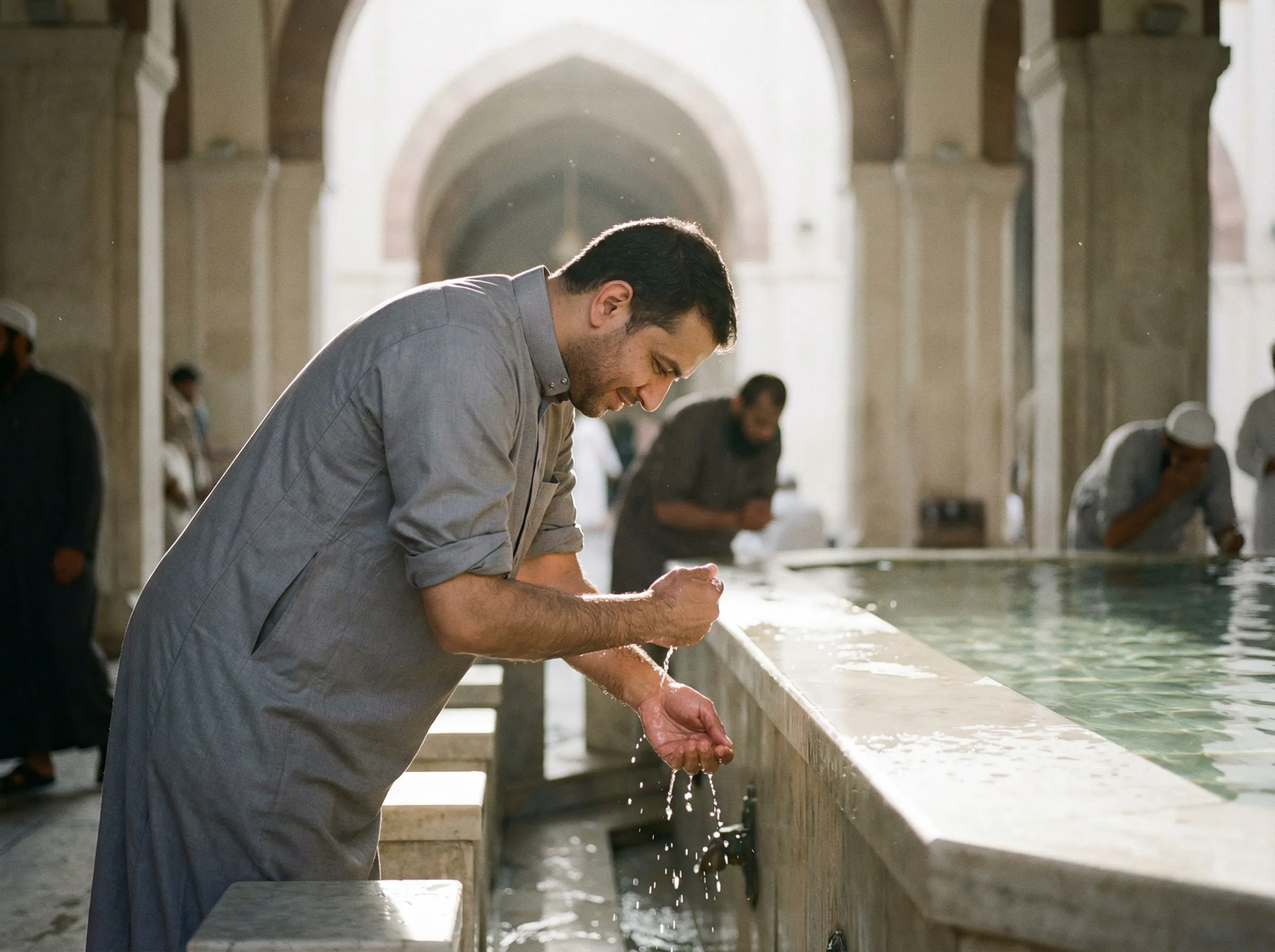
If you have ever stood up for prayer and suddenly wondered, “Wait, did something just break my wudu?” — you are not alone. This question haunts millions of Muslims worldwide, from new converts taking their first steps in Islam to lifelong believers seeking clarity on specific situations.
Understanding what breaks wudu is not merely an academic exercise—it is fundamental to the validity of your salah (prayer). The anxiety of uncertainty can rob you of the peace and tranquility that prayer is meant to bring. Many Muslims feel embarrassed to ask these questions, fearing judgment or appearing ignorant. But seeking knowledge is one of the most beloved acts in Islam.
This comprehensive guide will give you clear, scholarly-backed answers so you can pray with confidence. We will explore every aspect of what invalidates your wudu, examine the differences between Islamic schools of thought (madhabs), address special cases for women and men, and provide practical solutions for common challenges.
Quranic Foundation“O you who believe! When you rise up for prayer, wash your faces and your hands up to the elbows, and wipe your heads and your feet to the ankles…”
— Surah Al-Ma’idah 5:6
What Does “Breaking Wudu” Mean in Islam?

In Islamic jurisprudence, scholars distinguish between two levels of ritual impurity. Minor ritual impurity (al-hadath al-asghar) is what wudu normally removes, and it is caused by matters such as passing gas or using the toilet. Major ritual impurity (al-hadath al-akbar) requires ghusl (a full ritual bath); it includes janabah (the state following sexual discharge or intercourse) and also applies to menstruation and postnatal bleeding once the bleeding has ended. Janabah is therefore one cause of major impurity, not a name for all of them. When we discuss what breaks wudu, we are specifically addressing the causes of minor impurity.
Wudu is not merely physical cleanliness—it is a spiritual gateway to prayer. The Prophet Muhammad ﷺ emphasized its importance when he said: “Allah does not accept the prayer of any one of you if he breaks his wudu until he performs wudu again.” (Sahih al-Bukhari 6954)
Understanding what breaks your wudu allows you to maintain a state of purity and present yourself before Allah with confidence and reverence. For a complete guide on how to perform wudu correctly, see our article on How to Perform Wudu Step by Step.
Main Wudu Nullifiers and Disputed Cases
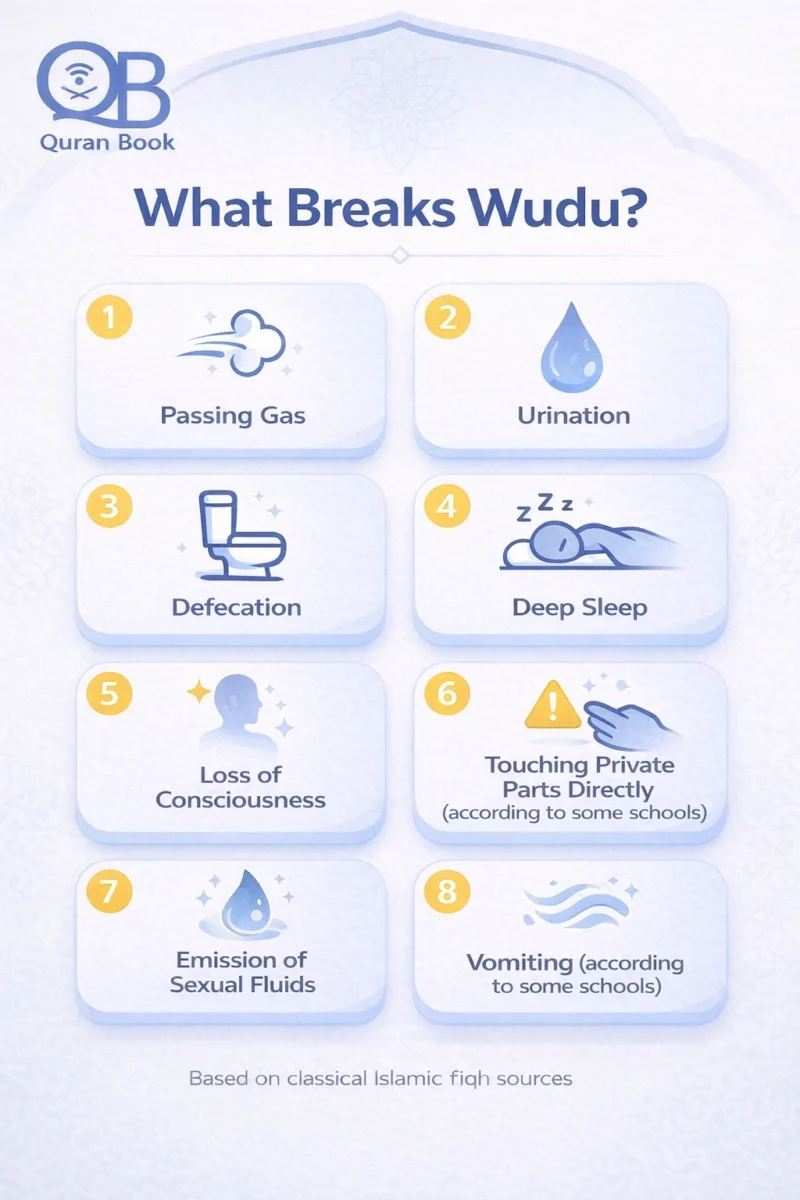
The items below are grouped for clarity. The first group is broadly agreed upon across the four Sunni madhabs. The second group is genuinely disputed, and each school has its own reasoning and conditions, so the correct approach is to follow a recognised school of fiqh rather than to look for a single universal answer.
1 Passing Gas (Flatulence)
Passing gas is perhaps the most commonly asked-about wudu invalidator. The Prophet ﷺ clearly stated: “Allah does not accept the prayer of anyone who has released gas until he makes wudu.” (Sahih al-Bukhari)
Important: Only the actual release of gas breaks wudu, not merely the feeling or sensation of needing to pass gas. If you are uncertain whether you actually released gas, your wudu remains valid. The principle in Islamic jurisprudence is that certainty is not removed by doubt.
2 Urination
Any discharge from the urinary tract invalidates wudu. This includes urine itself as well as any other liquid that exits through this passage. This is unanimously agreed upon by all Islamic schools of thought.
3 Defecation
Any discharge from the bowels invalidates wudu. This is also unanimously agreed upon. After using the restroom, Muslims should clean themselves properly (istinja) before making a fresh wudu.
4 Deep Sleep (Lying Down)
This addresses the common question: what type of sleep breaks wudu? Heavy sleep where one loses complete awareness of their surroundings breaks wudu. The reasoning is that during deep sleep, one may unknowingly pass gas without realizing it.
5 Loss of Consciousness
Fainting, general anesthesia, or any form of intoxication that causes loss of consciousness invalidates wudu. The principle is the same as deep sleep—when the mind loses control over the body, one cannot be certain of maintaining purity.
6 Touching Private Parts Directly (Disputed)
The First View: Wudu is invalidated by touching the penis directly, without any barrier, in all cases. This is the view of the majority of scholars from the Maliki, Shafi’i, and Hanbali schools.
The Second View: Touching the penis directly does not invalidate wudu at all. This is the position of the Hanafi school.
The Third View: Differentiates between touching with desire and without desire. If touched with desire, wudu is invalidated.
The Fourth View: Performing wudu after touching is recommended, not mandatory.
With a barrier (clothing, etc.): Wudu is not broken in any madhab. Because the ruling on direct contact differs among the madhabs, readers should follow a recognized school of fiqh or ask a qualified scholar about their specific situation.
7 Emission of Mathi/Wadi/Mani
Understanding these terms is important. Mathi (pre-seminal fluid) and wadi (a thick white discharge) break wudu and require only wudu to purify. However, mani (seminal fluid with climax) requires ghusl (full bath).
8 Vomiting (Disputed)
The Hanafi school holds that a mouthful of vomit breaks wudu, while the Shafi’i, Maliki, and Hanbali schools maintain that vomiting does not invalidate wudu. Follow the guidance of your chosen madhab on this matter.
What Breaks Wudu for Women vs. Men

Understanding what breaks wudu for a woman requires acknowledging the biological differences that Islam addresses with wisdom and sensitivity. While the core nullifiers apply equally to both genders, women experience specific conditions that affect their ritual purity. It is important not to confuse the two levels: an ordinary nullifier such as passing gas is resolved by simply repeating wudu, whereas menstruation and postnatal bleeding are not situations that repeating wudu resolves. During the valid period of that bleeding a woman does not pray, and once it ends she performs ghusl before returning to prayer. For more detailed guidance, see our Ghusl Guide for Women.
*Note: The ruling on what breaks wudu between husband and wife varies by madhab—see the madhab comparison section below. Menstruation and postnatal bleeding are listed here for completeness, but they belong to major ritual impurity rather than to the ordinary wudu nullifiers.
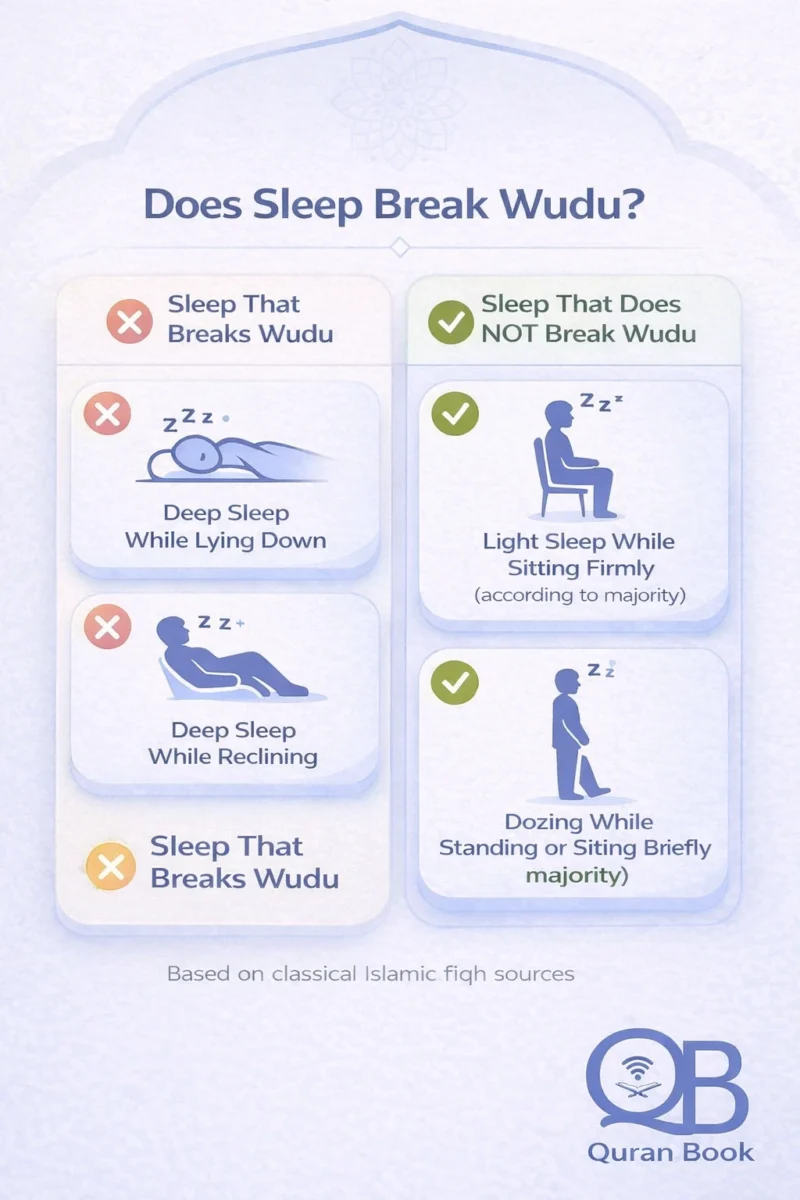
Does Sleep Break Wudu? Types of Sleep Explained
The question “what sleep breaks wudu” is among the most frequently asked questions regarding ritual purity. The hadith provides guidance: “The eyes are the string that ties the purse; when the eyes sleep, the string is loosened.” (Ahmad, Abu Dawud)
❌ Types That BREAK Wudu
- Lying down and sleeping deeply
- Reclining with full relaxation
- Sleep during sujood (prostration) — Disputed among scholars
✓ Types That Do NOT Break Wudu
- Light dozing while sitting upright
- Nodding off briefly while praying (if sitting firmly)
What Breaks Wudu According to Different Madhabs
Understanding what breaks wudu Hanafi versus Shafi’i or Maliki rulings helps Muslims navigate their specific circumstances according to their chosen school of thought. For detailed fiqh rulings, you can also consult IslamQA.info.
*Hanafi details: Bleeding breaks wudu only if the blood flows beyond the wound site; vomiting breaks wudu only if it fills the mouth.
†The Hanbali discussion of bleeding involves further detail regarding the type and quantity of what exits the body, so it should not be reduced to a simple yes or no. Consult reliable Hanbali sources or a qualified scholar.
‡Shafi’i details: the relied-upon position concerns direct skin-to-skin contact with a marriageable member of the opposite sex. Contact with a mahram, or with hair, nails or teeth, or contact through a barrier such as clothing, is excluded.
These are simplified educational summaries of positions that each school states with its own conditions. For a personal case, consult a qualified scholar.
Common Misconceptions About What Breaks Wudu
Things That Do NOT Break Wudu
Sins but do not affect ritual purity
A major sin but does not break wudu
Touching a dog does not itself invalidate wudu. Any required cleaning depends on whether saliva, moisture, or another impurity made contact, as well as the applicable madhab ruling.
According to 3 of 4 madhabs
Eating in itself does not invalidate wudu
A sin, not a hadath
Does not affect wudu in any way
Different from passing gas
The Hanbali school holds that eating camel meat invalidates wudu; the other three Sunni schools generally do not consider it a nullifier. This is a difference of opinion, not a misconception.
What to Do If Your Wudu Keeps Breaking
Many Muslims struggle with the question: what to do if your wudu keeps breaking? This can be due to a persistent condition that a person cannot control. Islam provides merciful accommodations for such situations, and the schools of fiqh set out their own conditions for when those accommodations apply.
Practical Tips for Those with Chronic Conditions
- Learn the concept of “ma’dhur” (excused person) — In the Hanafi formulation, this qualification is not established merely because a condition is frequent. The condition must continue throughout one complete prayer time without a sufficient interval in which the person could perform a minimal valid wudu and a quick obligatory prayer
- Understand how the excused person’s wudu works — Once a person qualifies as ma’dhur under the Hanafi rules, they perform wudu after the prayer time begins. That wudu generally remains valid for that prayer time despite the continuing excuse, unless another independent nullifier occurs
- Remember that the details differ among the madhabs — The conditions above describe the Hanafi formulation. The other schools discuss the excused person with their own conditions, so ask a qualified scholar which rules apply to your circumstances
- Do not let waswasa (whispers of doubt) overwhelm you — Certainty is not removed by doubt. For more guidance, see our article on Dealing with Waswasa in Prayer
- Use protective garments if needed — Practical accommodations are permissible
The Academy Method — Learning Wudu & Prayer Correctly

At Quran Book Academy, we understand that learning the intricacies of wudu and prayer can feel overwhelming, especially for new Muslims or those who did not grow up with formal Islamic education. That is why we developed “The Academy Method” — our structured teaching approach, which presents fiqh (jurisprudence) as a step-by-step learning method built on recognized fiqh discussions.
Our certified instructors break down topics like “what breaks wudu” into small, memorable segments. Instead of presenting a list of 15 rules to memorize, we teach students to understand the underlying principles—anything that exits from the private parts, loss of consciousness, direct contact with private parts—so they can apply this knowledge with certainty.
This is not just about memorizing rules; it is about building the spiritual confidence to stand before Allah in prayer, knowing your wudu is valid. Students in the USA, Canada, UK, and Australia study wudu, prayer, and Quran recitation with us through The Academy Method.
Technology Stack for Modern Learning
Interactive, face-to-face learning with qualified instructors
Regular learning updates and progress feedback for students and families.
Connect with us on Telegram or YouTube for free resources and updates.
Frequently Asked Questions About What Breaks Wudu
Quick Quiz: What Breaks Wudu?
Five short questions based on what this article explains. Choose an answer to see a brief explanation. The quiz asks only about points that the article states clearly, and where a matter is disputed the correct answer is simply that it is disputed.
Conclusion — Pray With Confidence
Understanding what breaks wudu is essential for every Muslim who wishes to perform valid prayer. The knowledge we have explored in this guide—from the nullifiers that are broadly agreed upon, to the cases genuinely disputed between the madhabs, to the special considerations for women and the practical accommodations for chronic conditions—empowers you to approach your salah with certainty rather than doubt.
Remember that seeking knowledge is itself an act of worship. The Prophet ﷺ taught us that Allah makes the path to Paradise easy for those who seek knowledge. By taking the time to learn these rulings, you are investing in the quality of your relationship with Allah. For a complete guide on prayer, see our article on How to Pray Salah for Beginners.
“Allah intends for you ease and does not intend for you hardship.”
— Surah Al-Baqarah 2:185
Start Your Free Trial Lesson Today
Ready to learn Islamic essentials with confidence? Study wudu, prayer, and Quran recitation with Quran Book Academy through The Academy Method, our structured teaching approach.
Start My Free TrialNo commitment required — just a genuine desire to grow closer to Allah through knowledge.
📖 Learn More
How to Perform Wudu Step by Step
Complete guide to performing ablution correctly
🌸Ghusl Guide for Women
Comprehensive guide to ritual bathing for sisters
🧘Dealing with Waswasa in Prayer
Overcome doubts and whispers during worship
🕌How to Pray Salah for Beginners
Learn the fundamentals of Islamic prayer
Hafidha of the Quran · Arabic Language Graduate · Writer at Quran Book Academy
Jehad Mahmoud is a Hafidha of the Quran and a graduate of the Arabic Language department who writes accessible Islamic educational content for Quran Book Academy.
She writes for English-speaking Muslim families, presenting the discussions of the recognized schools of fiqh in plain language.
Her articles are educational, not fatwa. For a ruling on a specific personal situation, readers are advised to consult a qualified scholar or mufti.
📚 References & External Links
- IslamQA.info — Detailed fiqh rulings
- Sunnah.com — Hadith verification
- Quran Book Academy Telegram Channel
- Quran Book Academy YouTube Channel
Leave a Reply