Waqf and Ibtida: A Practical Guide to Quran Stop Signs
Learn how stopping and starting work in Quranic recitation — so you can improve your stopping and starting and recite more confidently.
Start your free Quran trial
Introduction: Overcoming the Fear of Stopping

Does my breath run out too fast? Did I just negate a blessing?
If you have ever felt your heart race while reciting a long verse, worrying that stopping to breathe might accidentally distort the meaning of Allah’s words, you are not alone. For many non-Arabic speakers, the rules of Waqf and Ibtida (stopping and starting) can feel like a minefield. The anxiety of turning a compliment into an insult or negating a divine truth simply because you ran out of air is a very real struggle.
But here is the truth: Waqf and Ibtida are not designed to be a burden. They are the “breathing room” for your soul during recitation. They provide the roadmap that allows you to navigate the Quran’s vast meanings with grace and precision.
By the end of this guide, you will understand the roadmap of the Quran, allowing you to recite more confidently and without anxiety. We will move past the fear and into a space of connection, ensuring that every pause you take honors the Divine message. Explore our psychology-based methodology that makes learning Tajweed intuitive and stress-free.
🎧 About the audio in this guide: Every recitation player below plays the complete verse as recorded by Sheikh Mahmoud Khalil Al-Husary, served from the EveryAyah archive. Nothing has been trimmed, edited, or re-cut: each file is the sheikh’s own unaltered reading of that verse, so what you hear is his performance and not an artificial pause created for this article.
What is Waqf and Ibtida in Tajweed?
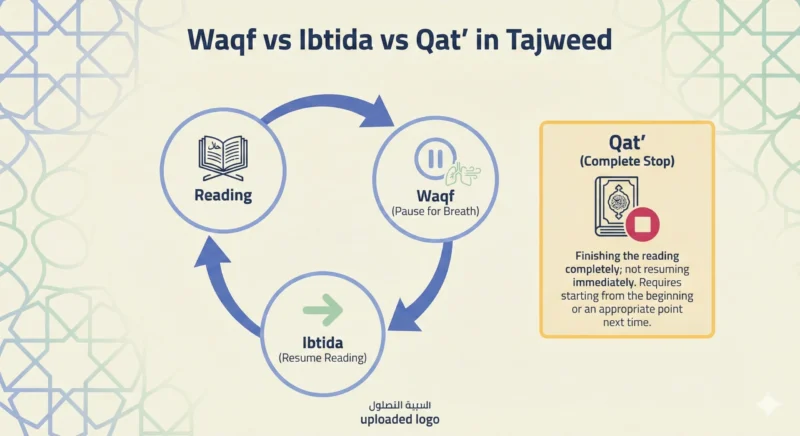
Waqf and Ibtida refer to the precise rules of stopping and starting in Quranic recitation.
This is the act of pausing the voice at the end of a word to take a breath, with the specific intention of continuing the recitation. It is not abandoning the reading; it is a strategic pause to refuel.
This is resuming the recitation from a correct starting point that preserves the linguistic and theological meaning of the verse.
Unlike Waqf, this is stopping the recitation completely to move on to another activity, usually done at the end of a passage or surah.
Understanding the distinction between a temporary breath (Waqf) and a final stop (Qat’) is the first step in mastering the flow of the Quran. If you are new to recitation, our Learn to Read Quran for Beginners course is the perfect starting point, and adults starting from the alphabet can learn Quran reading for adults at a pace that suits them.
Why Meaning Matters: The Psychology of Recitation
Reciting the Quran is not merely a mechanical exercise of pronouncing letters; it is an act of intellectual and spiritual engagement. The connection between breath and meaning is profound. Reports describing the Prophet’s recitation (ﷺ) indicate a measured style, including reciting the verses of Al-Fatihah distinctly in the report narrated by Umm Salamah.
⚠ Worked example — Quran 10:65:
وَلَا يَحْزُنكَ قَوْلُهُمْ ۘ إِنَّ ٱلْعِزَّةَ لِلَّهِ جَمِيعًا ۚ هُوَ ٱلسَّمِيعُ ٱلْعَلِيمُ
Stopping at qawluhum (“their words”) separates their speech from Allah’s own statement that all honour belongs to Him. Continuing without that pause may give a listener the impression that the following sentence is still part of what they said. See the verse at Quran 10:65.
Learning these stopping rules is an act of Adab (respect) towards the Divine message. It builds cognitive fluency, allowing you to process the text in meaningful chunks rather than a breathless stream of sound. This is why our methodology focuses on the psychology of the learner—removing the panic of “running out of air” and replacing it with the confidence of knowing exactly where to rest.
The 4 Main Types of Waqf
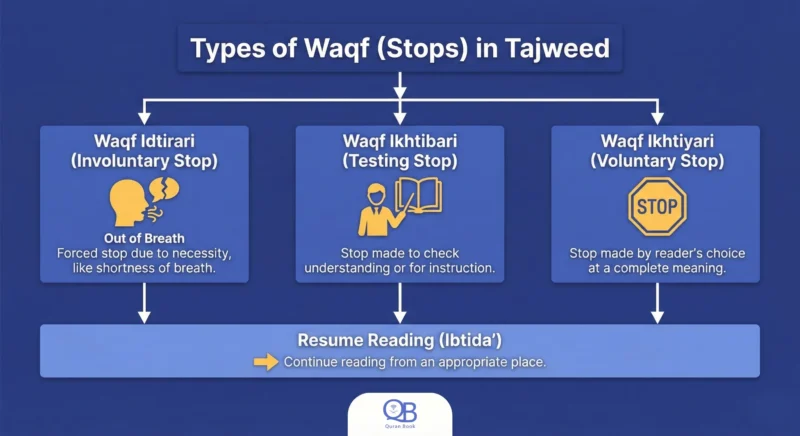
As you work through the essential Tajweed rules, you will notice that not all stops are planned. Scholars generally categorise Waqf into four main types to help students handle different scenarios.
ℹ Why three of these cards have no audio: Waqf Idtirari, Waqf Ikhtibari and Waqf Intizari describe the reason a reciter stops — necessity, teaching, or collecting the readings — not a fixed sign in a particular verse. A normal recitation of a verse cannot demonstrate them, so no recording is attached to those three cards rather than labelling ordinary recitation as something it is not.
This occurs when you are forced to stop due to necessity. Perhaps you ran out of breath, sneezed, coughed, or simply forgot the next word.
This is a teaching or testing stop. A teacher asks the student to stop at a particular word in order to test how that word is stopped upon according to the Uthmanic script of the Mushaf.
It covers questions such as connected and separated words, letters that are written but not pronounced or omitted in writing, the different forms of ta, and other features of the Uthmanic script.
This is the stop the reciter chooses by their own will, rather than being forced or instructed. Its correctness depends on whether the wording and the meaning are complete at that point.
For that reason, scholars classify voluntary stops into several grades: complete (tamm), sufficient (kaf), good (hasan), and unsuitable (qabih). Choosing to stop somewhere does not by itself make the stop a good one.
A clear voluntary stop is the end of a verse. In the recording below the sheikh recites one complete verse and comes to rest on its final word, which is the most common voluntary stop a reciter makes.
This is used mainly by specialists in the Quranic readings (Qira’at). The reciter stops at a particular place in order to gather the different accepted wordings of that place across the readings or narrations before continuing.
It is a specialist practice tied to studying the Qira’at, not one of the everyday stopping decisions a beginner needs to make.
Decoding the Stop Signs in the Quran (The “How-To” Guide)
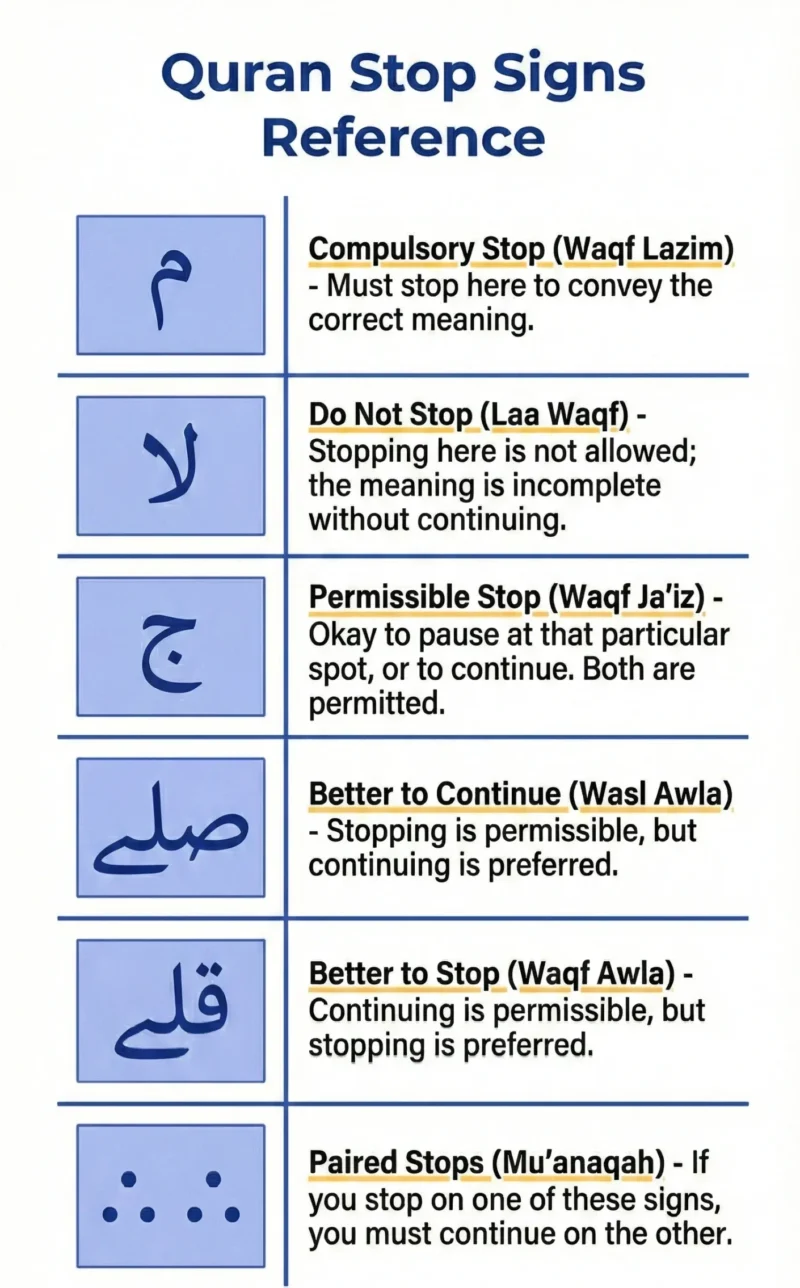
The Mushaf is filled with small symbols above the text. These are the traffic lights of your recitation. Mastering these stop signs in the Quran is essential for reciting with confidence.
Here is your essential guide to the Waqf signs meaning:
| Sign | Name | Meaning | Action | Worked example |
|---|---|---|---|---|
| م | Waqf Lazim | Strongly indicated stop | A strongly indicated stop. Continuing may create ambiguity or suggest an unintended connection in meaning. | Quran 10:65 |
| لا | La Waqf | No stop | Avoid stopping here voluntarily because the meaning remains connected. If you are compelled to stop, resume from a suitable earlier point so that the intended meaning is preserved. | Quran 2:159 |
| ج | Waqf Ja’iz | Permissible stop | Both stopping and continuing are permitted, with no general sign-based preference for either. | Quran 51:21 |
| صلے | Al-Wasl Awla | Better to continue | You are allowed to stop, but continuing is preferred for the flow of meaning. | Quran 29:57 |
| قلے | Al-Waqf Awla | Better to stop | You are allowed to continue, but stopping is preferred to highlight the meaning. | Quran 3:163 |
| ∴ ∴ | Mu’anaqah | Paired stop | Stop at ONE of the two signs, not both. If you stop at the first, do not stop at the second. | Quran 2:2 |
ℹ About the signs themselves: The stopping symbols are a scholarly editorial convention added to the written Mushaf, based on the judgement of the scholars who devised them. Some placements differ from one printed edition to another. The examples in this article follow the Madinah Mushaf in the narration of Hafs unless stated otherwise — if you read from an Indo-Pak or Turkish printing, you may find a different sign, or no sign, at some of these same places.
Hear each sign in a real verse
Each card below pairs one sign with a verse where that sign is printed in the Madinah Mushaf, followed by Sheikh Al-Husary’s recitation of the complete verse.
The م is printed after qawluhum (“their words”). Pausing there keeps the disbelievers’ speech separate from Allah’s own declaration that all honour belongs to Him. Reading straight through can leave the impression that the following sentence is still part of what they said.
Note: Lazim is a technical recitation term. It does not automatically mean that the reader is sinful for continuing; the concern is preserving the intended meaning. Nor is every place marked Lazim a matter of creed — most simply protect the sentence from being misread.
The لا sits after fi’l-kitab (“in the Scripture”). Everything before it is still an unfinished sentence: “Indeed, those who conceal what We revealed…” has not yet reached its answer, which is “…those are the ones cursed by Allah.” Stopping voluntarily at the sign would leave the sentence hanging without its predicate, so the reading carries on.
If your breath runs out at such a place, that compelled stop is excused — but when you resume, go back to a suitable earlier point rather than starting from the word that follows the sign.
The ج is printed after wa fi anfusikum (“and in yourselves”). Stopping there is sound, because “and in yourselves [are signs]” carries a complete meaning; continuing into afala tubsirun (“then will you not see?”) is equally sound. The sign marks the choice as open, not as a fifty-fifty rule to be measured.
The صلے follows dha’iqatu’l-mawt (“shall taste death”). You are permitted to stop there, but the sign tells you that carrying on into “then to Us you will be returned” is the better reading, because the promise of returning to Allah completes the thought that the verse is making.
The قلے follows ‘inda’llah (“with Allah”). Continuing is allowed, but the sign marks stopping as the better choice: “They are in varying degrees with Allah” is a complete statement, and the next clause, “and Allah is Seeing of what they do,” opens a new one.
With the paired sign, you choose one of the two positions. Stopping at the first — after la rayba (“no doubt”) — gives “there is no doubt; in it is guidance for the God-fearing.” Stopping at the second — after fih (“in it”) — gives “there is no doubt in it; a guidance for the God-fearing.” Both are correct readings. What you do not do is stop at both.
The Academy Method: How We Teach Waqf and Ibtida

At Quran Book Academy, we understand that memorizing rules is different from applying them under pressure. That is why we use a psychology-based approach to teaching, delivered by certified Quran teachers.
Cognitive overload is the enemy of learning. We break long, complex verses into manageable “chunks” for beginners. Instead of fearing the entire page, you focus on navigating from one stop sign to the next. This builds confidence and rhythm.
We leverage modern technology to ensure you aren’t just guessing:
Live sessions: Teachers demonstrate breath control in real time, showing you where to breathe and which stopping point to aim for.
Learning platform: Our custom learning platform helps organize lessons, learning materials, and student follow-up, and your teacher shares written feedback after lessons.
Quranic Evidence & Hadith

Our dedication to Waqf and Ibtida is rooted in the tradition of the Prophet (ﷺ) and the commands of Allah.
The Quranic Command:
Allah (SWT) says in Surah Al-Muzzammil:
أَوْ زِدْ عَلَيْهِ وَرَتِّلِ ٱلْقُرْءَانَ تَرْتِيلًا
“…or add to it, and recite the Qur’an with measured recitation.”
— Surah Al-Muzzammil (73:4)
Scholars of Quran recitation have connected tartil with clear articulation, measured recitation, and careful attention to suitable stopping points — which is why students are usually taught alongside it how Arabic letters are articulated.
The Prophetic Method:
Narrated by Umm Salamah (May Allah be pleased with her):
“The Prophet (ﷺ) used to recite verse by verse, pausing at the end of each one.”
— Sunan Abi Dawud 4001
This report illustrates the Prophet’s measured recitation of Al-Fatihah, with its verses recited distinctly. It should not be treated as a complete ruling for every possible stopping point in the Quran.
Stopping at the end of each verse — Al-Fatihah, verse by verse
Each player below is a separate file containing one complete verse of Al-Fatihah. Play them in order and you will hear the verses set apart from one another, each one coming to rest on its own final word.
Correct Ibtida: starting again after a stop
Once you have stopped at the end of verse 4, the next verse is a sound place to begin again: it opens a complete sentence that does not depend on the words before it. That is what a correct Ibtida looks like — a starting point that carries a whole meaning on its own.
Common Learner Mistakes to Avoid
Even advanced students can fall into these traps. Being aware of them is half the battle.
Restarting from a dependent word
Beginning with a conjunction is not automatically incorrect. The real concern is starting from a word or phrase whose meaning depends on what came before, or which may suggest an unintended meaning when isolated. Before you resume, ask whether the words you are about to say stand as a complete, correct meaning on their own.
The “Breathless” Rush
This is the most common anxiety-driven error. Students try to finish a long verse in a single breath, which leads to mumbling, loss of Tajweed, and eventual gasping. Remember, the stop signs are there to help you!
Passing over the “Meem” (م) without thought
Treating a strongly indicated stop (Waqf Lazim) as if it made no difference is a real weakness in recitation. Continuing there may create ambiguity or suggest an unintended connection in meaning, so slow down and take the pause the sign points to.
How Stopping Can Affect Pronunciation
Stopping does not only affect meaning; it also changes how the last letter of the word is pronounced. A clear example is the closing word of Quran 112:1:
قُلْ هُوَ ٱللَّهُ أَحَدٌ
When you stop on Ahad, the final dal becomes still, and the echoing quality of Qalqalah letters and examples appears on it. Other pronunciation features carry on as normal at the stop too, such as the difference between heavy and light Arabic letters.
FAQ: Frequently Asked Questions about Tajweed Stops
Quick Waqf and Ibtida Quiz
Five short questions to check what you took from this guide. Choose an answer and you will see a brief explanation. Nothing is sent anywhere; your answers stay in your browser.
Conclusion & Call to Action

Working on Waqf and Ibtida turns your recitation from a struggle for air into a steady, considered reading. It allows you to connect with the Quran with closer attention to its wording, flow, and intended meaning.
With practice you can recite more confidently. Do not let the fear of making mistakes hold you back from the beauty of Allah’s words.
Ready to manage your breath and recite with confidence?
Join Quran Book Academy today and let our teachers guide you through every pause and start.
Start your free Quran trialJoin our Telegram Community for daily Tajweed tips and support.
Continue Learning Tajweed
Hafidha of the Quran · Arabic Language Graduate · Islamic Educational Content Writer
Jehad Mahmoud is a graduate of the Arabic Language department and a Hafidha of the Quran who writes Islamic educational content for Quran Book Academy.
Her work focuses on presenting Quranic Arabic and Tajweed concepts clearly for English-speaking learners and Muslim families.
This article is educational and is not a personal fatwa. Readers seeking a ruling for an individual situation should consult a qualified scholar.
References
- Recitation audioSheikh Mahmoud Khalil Al-Husary — EveryAyah archive (128 kbps)
- Quran 1:1–1:5quran.com/1
- Quran 2:2quran.com/2/2
- Quran 2:159quran.com/2/159
- Quran 3:163quran.com/3/163
- Quran 10:65quran.com/10/65
- Quran 29:57quran.com/29/57
- Quran 51:21quran.com/51/21
- Quran 73:4quran.com/73/4
- Quran 112:1quran.com/112/1
- Sunan Abi Dawud 4001sunnah.com/abudawud:4001
- Egyptian Ministry of AwqafWaqf and Ibtida (Arabic)
- IslamwebExplanation of Quran stopping signs (Arabic)
- IslamwebExplanation of stopping signs and adherence to them (Arabic)
Leave a Reply