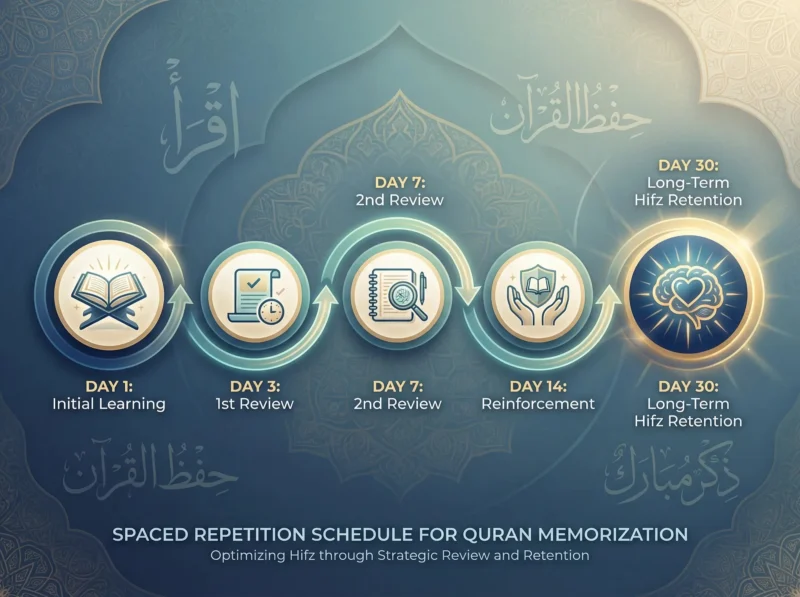


Introduction: Your Quran Memorization Journey Starts Here
If you have ever opened the Mushaf, tried to memorize an ayah, and felt like your brain just would not hold it…you are not alone. Many non-Arabic speaking Muslims around the world share the same struggle. The good news? Memorizing the Quran is a learnable skill, not a talent reserved for a chosen few. With clear Quran memorization techniques and consistent review, anyone can begin and sustain their Hifz journey—regardless of age, language background, or schedule.
The Quran was revealed gradually over approximately 23 years. While this was not a prescribed Hifz technique, it can serve as a helpful reminder that meaningful learning does not need to be rushed. Allah reassures us in the Quran:
“And We have certainly made the Quran easy for remembrance, so is there any who will remember?”
— Surah Al-Qamar (54:17)
In this guide, we walk you through seven Hifz methods that work well for beginners and non-Arabic speakers. Each one is drawn from long-standing Quran memorization practice, from established learning research, or from both—and every single one is actionable from day one. Whether you are looking for practical tips on how to memorize Quran or searching for structured hifz classes for beginners, this article will give you everything you need to start today. You can also apply each method immediately using our free Quran memorization tool.
Why Is Quran Memorization Hard for Non-Arabic Speakers?
Quran memorization presents unique challenges for non-Arabic speakers. Understanding these obstacles is the first step toward overcoming them. The primary difficulty lies in the language barrier itself—unfamiliar Arabic phonetics, a completely different script, and sounds that do not exist in English or other Western languages make the initial learning curve steep.
Beyond the language challenge, most beginners attempt memorization without a structured methodology. They try random approaches—listening to a reciter here, reading a page there—without any system to build upon. This lack of structure leads to inconsistency and frustration. Add to that the psychological overwhelm of facing 6,236 ayahs across 604 pages, and it becomes clear why so many aspiring Huffaz give up before they truly begin.
The absence of accountability and tracking makes self-study particularly difficult. Without a teacher or a structured hifz program to hold you accountable, it is easy to skip days, forget review sessions, and gradually lose what you have already memorized. That is exactly why a clear, repeatable Hifz method matters for anyone serious about completing their memorization.
7 Best Quran Memorization Techniques for Beginners
This is the heart of the article. Choose the method that fits your circumstances, or combine several approaches. These practical routines combine repetition, active recall and regular review—principles commonly used in Quran memorization and supported by established learning research. The exact numbers in each routine are starting points, not fixed rules: adjust them to your level and to the length of the ayahs you are working on.
The 3×3 Repetition Routine
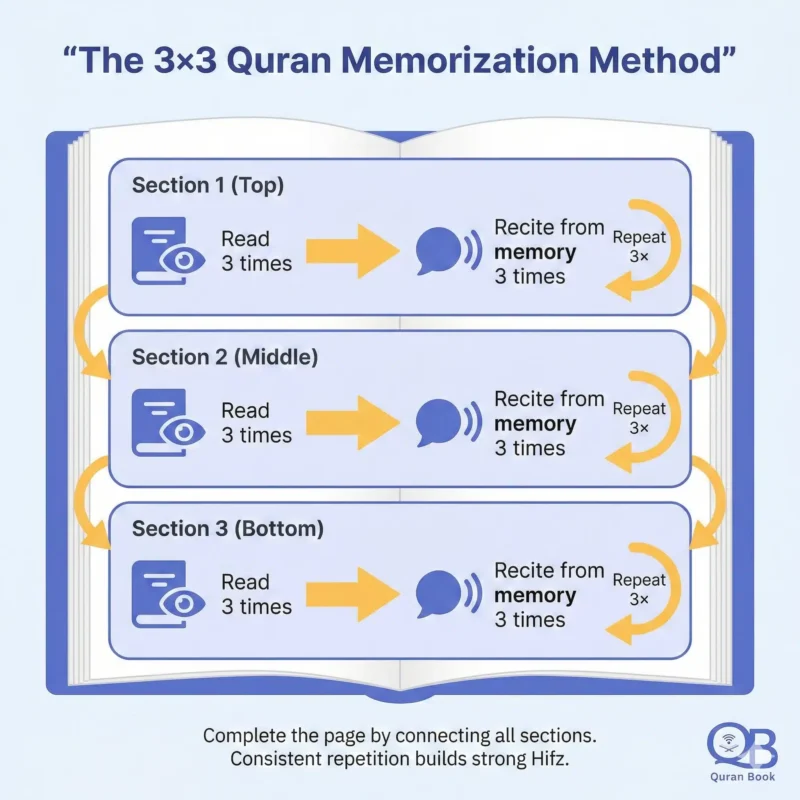
The 3×3 repetition routine is one of the most popular and beginner-friendly Hifz methods used in memorization circles. It works by dividing each page of the Quran into three sections. You read the first section three times while looking at the Mushaf, then attempt to recite it three times from memory. Once the first section is solid, you move to the second and third sections using the same approach, then connect all three sections together.
The value of this routine is not in the number three itself, but in the pattern behind it: read with the eyes, then recall without looking. Retrieval practice—trying to recall material rather than only re-reading it—is one of the better-supported study strategies in learning research, so feel free to raise or lower the repetitions until the recall step feels demanding but achievable.
“The one who recites the Quran and learns it by heart will be with the noble righteous scribes.”
— Sahih al-Bukhari 4937
The 3-10 Hifz Routine
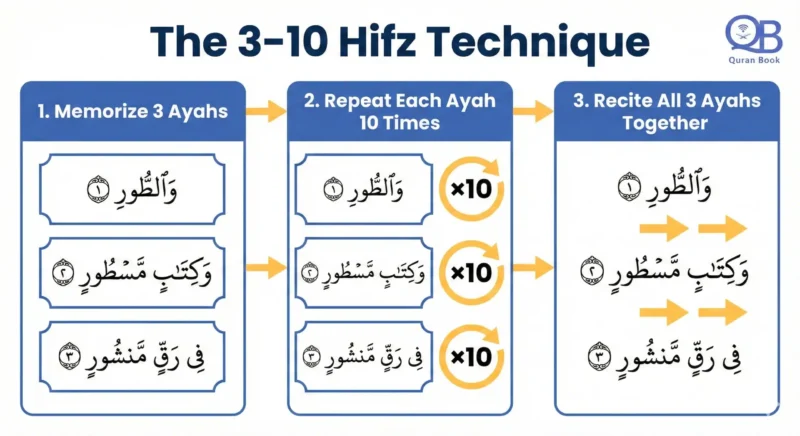
The 3-10 routine is a practical option for memorizing the Quran, especially for surahs with longer ayahs. Here is how it works: take three ayahs at a time. Repeat each individual ayah ten times, then recite all three ayahs together ten times. Once you can recite the set of three accurately, move to the next set and repeat the process. At the end of your session, connect all the sets together.
Three and ten are not magic numbers, and no study establishes them as the ideal count. Treat them as a convenient rhythm: enough repetition to stabilise a short passage, followed by a joining step that stops the ayahs from living in isolation from each other.
Pro Tip: Pair this routine with a qualified teacher on Zoom for real-time Tajweed correction. This is exactly how Quran Book Academy structures its live Hifz sessions in its hifz program, so every student receives personalized guidance.
A 6-4-4-6 Structured Review Schedule
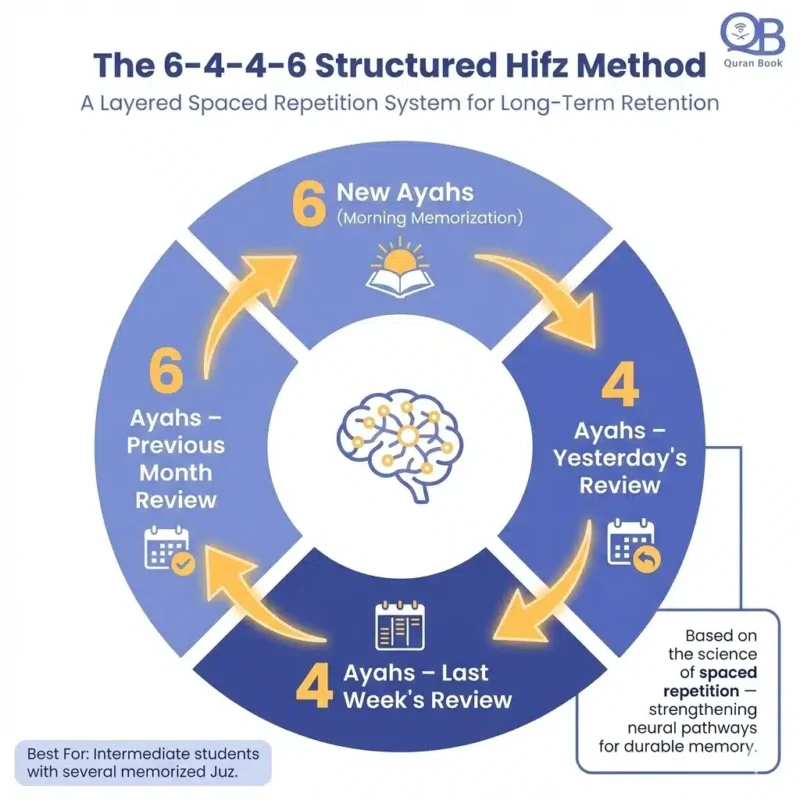
This is one possible structured review schedule rather than a standardised or universally agreed method—the label “6446” is used with different meanings in different places, so treat the numbers below simply as a template. It follows a daily cycle: memorize 6 new ayahs in the morning, review 4 ayahs from yesterday, review 4 ayahs from an earlier review period such as last week, and review 6 ayahs from a longer-term review set such as the previous month.
What makes the schedule useful is the layering, not the specific counts: new material meets old material on a repeating cycle instead of being memorized once and abandoned. Spaced practice—spreading study of the same material across separate sessions—can support stronger long-term retention than massed practice, which is why almost every durable Hifz plan builds in old-material review alongside new memorization.
Adjust the four numbers to your own level and to the length of the ayahs. A student working through Juz ‘Amma and a student working through Surah Al-Baqarah will not carry the same daily load, and a schedule you can keep every day beats an ambitious one you abandon in a week.
The 5-Repeat Listening Method
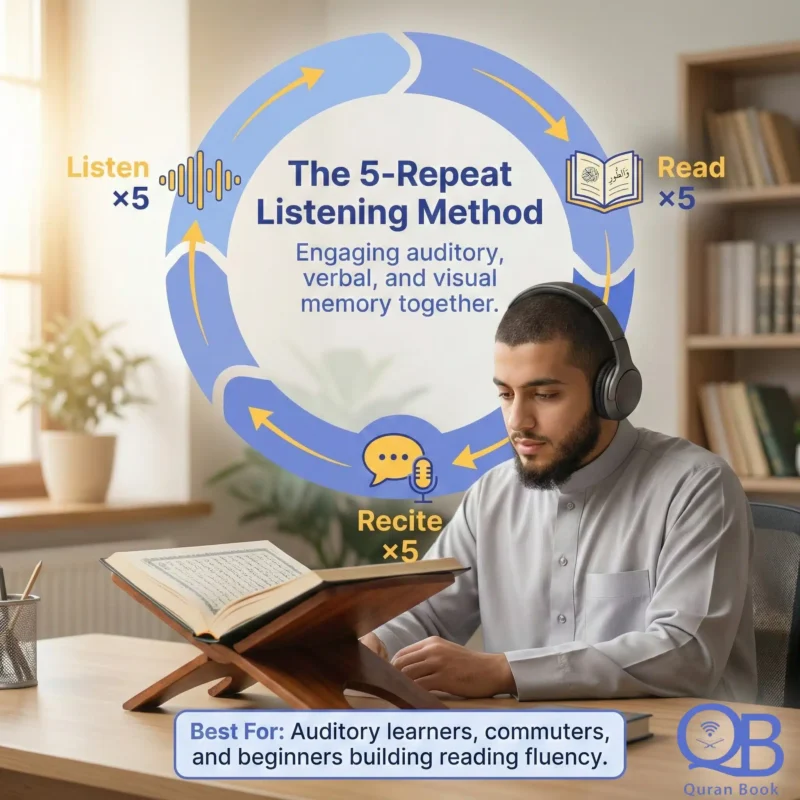
The 5-Repeat Listening Method suits students who have limited Arabic reading fluency, or who simply retain more when they hear a passage before reading it. The process is straightforward: listen to a Qari recite the ayah five times, then repeat it aloud five times yourself without looking at the Mushaf, and finally read it five times from the Mushaf to reinforce visual memory. This triple-layered approach—listening, speaking, and reading—engages several channels at once.
You can run this method directly in our free Quran memorization tool: choose the ayahs you are working on, play the recitation of Sheikh Mahmoud Khalil Al-Husary, and repeat the passage as many times as you need before switching to recall from memory.
If your reading fluency is not yet strong, we recommend starting with a Quran Reading and Tajweed course before jumping into full memorization. Building reading fluency and accurate pronunciation can make the memorization process more efficient by reducing pronunciation-related difficulty.
The Chunking Method (Meaning-Based Grouping)
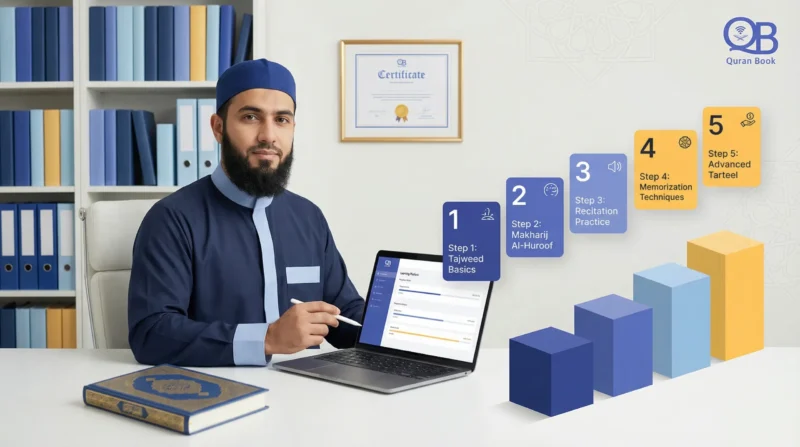
Instead of breaking pages into arbitrary segments, the chunking method divides them into meaning-based units. First you understand the theme and the Tafsir of each chunk, then you memorize it.
Chunking is a well-established memory strategy in which larger amounts of information are organised into smaller meaningful units. In Quran memorization, grouping connected ayahs by meaning or topic may help some learners form stronger associations and follow the flow of the passage. Reading the Tafsir of a passage before memorizing it is the simplest way to apply this—and the free memorization tool makes the Tafsir available beside the ayahs you are studying.
Quran Book Academy applies this principle by training students to read with Tajweed first—building phonetic familiarity through the Nour El Bayan course—before introducing memorization. This phased approach reduces the difficulty of decoding the text while trying to memorize it. We call it “The Academy Method,” and it is the foundation of our hifz classes for beginners.
Writing & Visual Mapping
The Writing and Visual Mapping technique uses the physical act of writing as an extra review step. Write each ayah by hand three to five times, then create a simple visual map connecting ayahs by theme, surah, or narrative flow. Writing forces you to reproduce the text rather than recognise it, which makes it a form of recall practice as much as a copying exercise.
This technique also carries its own dignity in the Islamic tradition—copying the Quran by hand has long been a devotional practice as well as a study one. It remains one of the most time-tested tips on memorizing the Quran.
The Recitation Partner (Mushafahah) Method
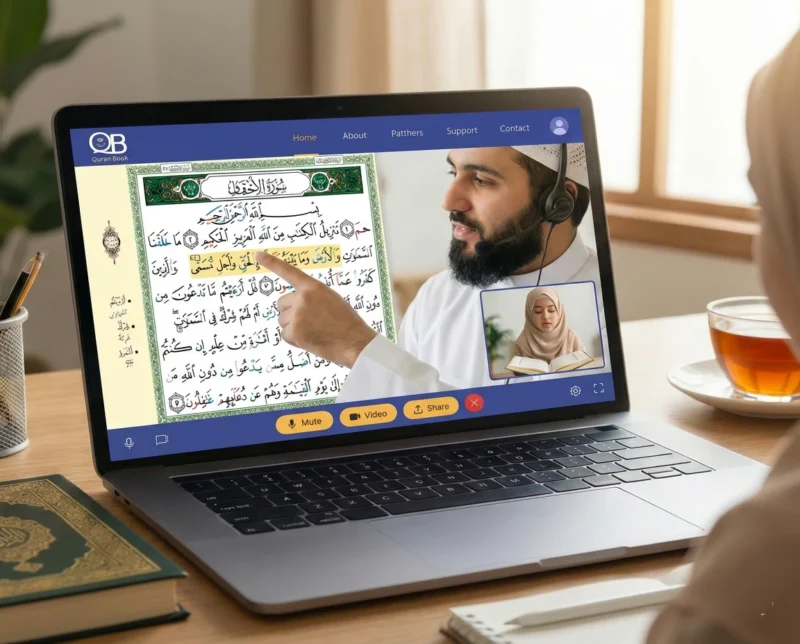
Mushafahah means reciting to a partner or teacher face-to-face (or today, via Zoom). The teacher listens carefully, corrects any Tajweed errors, and confirms the accuracy of your memorization. Reciting to a qualified teacher reflects the long-standing Quranic tradition of oral transmission and gives the learner immediate feedback on pronunciation, Tajweed and memorization accuracy—feedback that a recording or an app cannot fully replace.
Jibreel (‘alayhi al-salam) used to review the Quran with the Prophet (ﷺ) every Ramadan.
— Sahih al-Bukhari 4998
Quran Book Academy’s hifz program is built around the Mushafahah method, with live 1-on-1 Zoom sessions led by certified Quran teachers. If you want to learn how to memorize the Quran accurately, regular recitation to a teacher is the single most valuable habit you can build.
How to Memorize 2 Pages of the Quran in 1 Hour
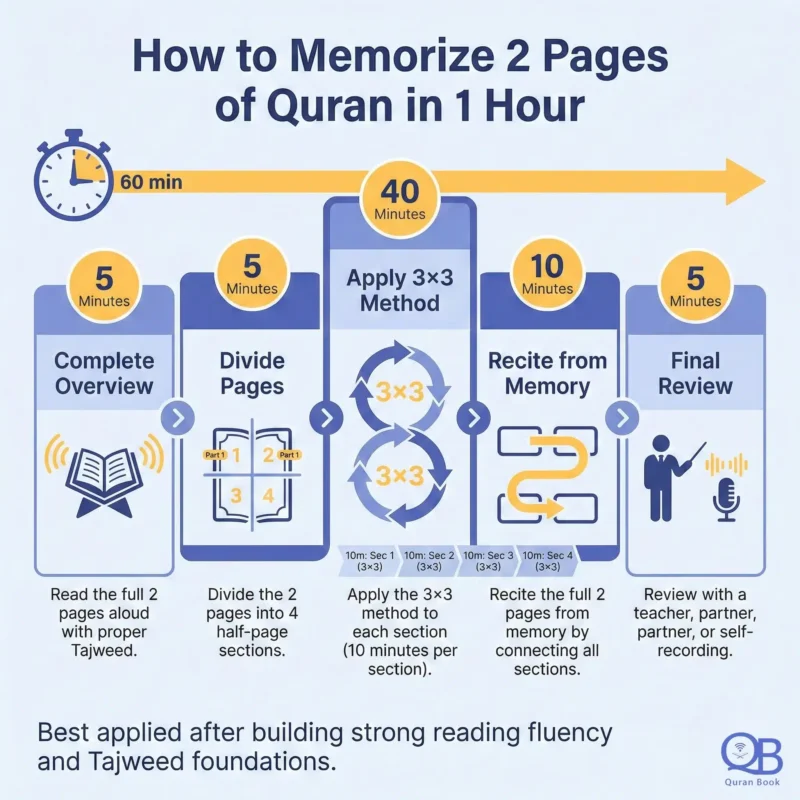
Some experienced learners with strong Arabic reading fluency may be able to memorize two pages in an hour, but memorization speed varies greatly. Beginners should prioritize accurate recitation, strong recall and consistent review rather than chasing a fixed page target.
With that in mind, here is an example 60-minute intensive routine that combines several of the methods above. Treat it as a template for a focused session, not as a promised result:
Read the full 2 pages aloud with proper Tajweed (5 minutes). This gives your brain a complete overview of the material.
Divide the 2 pages into 4 half-page sections. Each section becomes a manageable unit.
Apply the 3×3 routine to each section. Spend approximately 10 minutes per section (40 minutes total).
Connect all 4 sections by reciting the full 2 pages from memory (10 minutes).
Review by reciting to a teacher, study partner, or recording yourself for self-assessment (5 minutes).
A session like this works best once you have built foundational reading fluency. If you find yourself stumbling over pronunciation, consider a Quran Reading and Tajweed course first, and shorten the target to half a page or one page until recall becomes reliable.
Comparison Table: Which Hifz Technique Is Best for You?
Use this quick-reference table to find the Quran memorization methods that match your circumstances, available time, and experience level.
| Technique | Useful For | Difficulty | Time/Day | Teacher? | Key Benefit |
|---|---|---|---|---|---|
| 3×3 Repetition | Students who benefit from seeing the page structure repeatedly | Easy | 30–45 min | Optional | Simple, structured approach |
| 3-10 Hifz | Students who prefer listening-based practice | Easy | 30 min | Recommended | Strong ayah-level retention |
| 6-4-4-6 Review Schedule | Intermediate students with several Juz memorized | Medium | 45–60 min | Optional | Built-in spaced review |
| 5-Repeat Listening | Students who prefer listening-based practice & beginners | Easy | 20–30 min | Optional | Combines listening, speaking and reading |
| Chunking | Students who like to understand meaning first | Medium | 30–45 min | Recommended | Meaning-based retention |
| Writing & Mapping | Students who find handwriting helpful for review | Easy | 30–40 min | No | Written recall practice |
| Mushafahah | Every level | Varies | 20–30 min | Required | Real-time teacher correction |
Practice Quran Memorization for Free
Put the techniques above into practice with our free Quran memorization tool. Choose the verses you are working on, listen to the recitation of Sheikh Mahmoud Khalil Al-Husary, repeat the ayahs during your Hifz session, and read the available Tafsir to better understand the passage you are memorizing.
If the embedded tool does not load on your device, open the free Quran memorization tool here .
A good way to use it: play the ayah, repeat after the recitation until the pronunciation feels natural, then pause the audio and try to recite from memory. Read the Tafsir before you begin so the passage carries meaning rather than sound alone, and come back to the same ayahs the next day for review.
The Academy Method: How Quran Book Academy Teaches Hifz
At Quran Book Academy, we do not start with memorization. We start with reading fluency. Building reading fluency and accurate pronunciation can make the memorization process more efficient by reducing pronunciation-related difficulty, so students spend their Hifz sessions memorizing rather than decoding. This is The Academy Method, and it shapes our hifz program from the first lesson.
Students first work through Tajweed rules and Makhraj (articulation points) in our structured Nour El Bayan course. This builds the phonetic foundation that removes the biggest bottleneck in memorization—struggling with pronunciation. Once students complete this phase, they enter the Hifz program with confidence and fluency.
Our live sessions combine meaning-based chunking with Mushafahah recitation on Zoom. Each session is structured into manageable 15–20 minute blocks, keeping the work focused without burnout. Our certified Quran teachers provide real-time feedback, and our Learning Management System (LMS) tracks each student’s progress page-by-page, surah-by-surah. Weekly progress reports are sent to students—and to parents, for children—by email.
Whether you are searching for hifz classes for beginners or an advanced review program, the Academy Method provides a complete, end-to-end system built around the Hifz methods described in this guide.
Hadith & Rewards: Why Memorize the Quran?
Beyond technique and methodology, the motivation to memorize the Quran comes from the virtue described in the texts themselves. Let these reminders fuel your determination:
Reward for the Companion of the Quran
“It will be said to the companion of the Quran: ‘Read, ascend, and recite as you used to recite in the world, for your rank will be at the last verse you recite.’”
— Sunan Abu Dawud 1464A Reported Virtue for Parents
“Whoever reads the Quran, learns it and acts upon it, his parents will be crowned on the Day of Resurrection with a crown of light whose radiance is like the light of the sun…”
— Reported by al-Hakim; al-Albani graded it Hasan li-ghayrihi in Sahih al-Targhib wa al-Tarhib.This report has come through more than one chain of narration, and some scholars of Hadith strengthened it by the sum of its routes rather than by any single chain. It is not among the reports agreed upon as authentic, and its wording concerns the person who reads the Quran, learns it and acts upon it.
Quranic Promise
“Rather, it [the Quran] is distinct verses [preserved] within the breasts of those who have been given knowledge.”
— Surah Al-Ankabut (29:49)The Quran and authentic Sunnah contain numerous texts describing the virtue of reciting, learning, preserving and living by the Quran. The journey of Hifz is not a sprint—it is a long act of worship, and whether you memorize one ayah a day or one page, the effort itself is what you are asked to bring.
Frequently Asked Questions (FAQ)
Start Your Quran Memorization Journey Today
You have learned the techniques. Now let a qualified teacher guide you step by step. Book your FREE trial Hifz lesson with Quran Book Academy today.
Apply these Quran memorization techniques with structured teacher guidance and a personalized Hifz plan through our hifz program—and practise between lessons with the free memorization tool.
Book Your Free Trial NowHafidha of the Quran · Arabic Language Graduate · Writer on Islamic Sciences
Jehad Mahmoud is a graduate of the Arabic Language department and a Hafidha of the Quran who writes Islamic educational content at Quran Book Academy.
She specialises in Quranic Arabic, Tajweed and Islamic sciences, helping English-speaking Muslim families understand Quran recitation, memorization and pronunciation in a clear and practical way.
Her background in Quran memorization, Tajweed and Arabic informs the educational guidance presented in this Hifz guide.
Her articles are educational, not fatwa. For a ruling on a specific personal situation, readers are advised to consult a qualified scholar or mufti.
References
Sources referenced in this article, grouped by type.
Quranic References
Hadith References
The report on the crown of light for parents: narrated by al-Hakim and others; graded Hasan li-ghayrihi by al-Albani in Sahih al-Targhib wa al-Tarhib.
Learning & Memory Research
Cepeda, N. J., Pashler, H., Vul, E., Wixted, J. T., & Rohrer, D. (2006). Distributed practice in verbal recall tasks: A review and quantitative synthesis. Psychological Bulletin, 132(3), 354–380. — PubMed (spaced practice)
Roediger, H. L., & Karpicke, J. D. (2006). Test-enhanced learning: Taking memory tests improves long-term retention. Psychological Science, 17(3), 249–255. — PubMed (retrieval practice)
Dunlosky, J., Rawson, K. A., Marsh, E. J., Nathan, M. J., & Willingham, D. T. (2013). Improving students’ learning with effective learning techniques. Psychological Science in the Public Interest, 14(1), 4–58. — SAGE Journals
Miller, G. A. (1956). The magical number seven, plus or minus two. Psychological Review, 63(2), 81–97. — Classics in the History of Psychology (chunking)
Pashler, H., McDaniel, M., Rohrer, D., & Bjork, R. (2008). Learning styles: Concepts and evidence. Psychological Science in the Public Interest, 9(3), 105–119. — SAGE Journals (why this guide describes preferences, not fixed learner types)
Quran Book Academy Resources
Learn Quran & Islamic Studies online with certified teachers. Flexible schedules, dedicated programs for kids, adults & sisters — from anywhere in the world.
Our Programs
Contact Us
- 📧
- 📞Phone +20 106 049 0579
- 💬WhatsApp Chat with us on WhatsApp
© 2026 Quran Book Online. All rights reserved.