
Dua Qunoot: Arabic, Transliteration, English Meaning and How to Recite It in Witr
The words first — then how to memorise them, line by line
Dua Qunoot is the supplication recited while standing in the final rak’ah of the Witr prayer, asking Allah for guidance, wellbeing, protection and blessing. Here are the full words in Arabic, in transliteration, and in English.

اللَّهُمَّ اهْدِنِي فِيمَنْ هَدَيْتَ، وَعَافِنِي فِيمَنْ عَافَيْتَ، وَتَوَلَّنِي فِيمَنْ تَوَلَّيْتَ، وَبَارِكْ لِي فِيمَا أَعْطَيْتَ، وَقِنِي شَرَّ مَا قَضَيْتَ، إِنَّكَ تَقْضِي وَلَا يُقْضَى عَلَيْكَ، وَإِنَّهُ لَا يَذِلُّ مَنْ وَالَيْتَ، وَلَا يَعِزُّ مَنْ عَادَيْتَ، تَبَارَكْتَ رَبَّنَا وَتَعَالَيْتَ.
Narrated from al-Hasan ibn Ali, who was taught it by the Prophet ﷺ — Sunan Abi Dawud 1425
What Is Dua Qunoot? A Simple Definition
Linguistically, qunoot carries the sense of devout obedience, standing before Allah, and humility — which is exactly the posture in which it is recited.
Dua Qunoot is a supplication, not a fixed Quranic verse. That single fact explains something many learners find confusing: you can search a Quran recitation archive for it and find nothing, because it is not part of any surah. It is a dua the Prophet ﷺ taught, recited in the standing position of the prayer.
It also travels under several spellings. Dua qunoot, dua e qunoot, qunoot duas, duas for qunoot and kunuth dua all point to the same supplication — the different forms come from transliterating the Arabic word قنوت into English, Urdu, Malayalam and Tamil.
One more expectation to set before you memorise anything: the wording varies slightly between narrations and between schools of thought. You may hear an imam add a phrase you did not learn, or omit one you did. That is normal, it is documented, and it does not mean either of you is reciting it wrongly.
When Is Dua Qunoot Recited? The Three Contexts
Dua Qunoot appears in three different situations, and almost every disagreement you will read about online is really a disagreement about which of the three someone is talking about. Find the one that applies to you tonight, and the rest becomes much simpler.
1. Qunoot in Witr Prayer (The Most Common)
This is the context most readers arrive here for. Dua Qunoot is recited in the final rak’ah of Witr, the odd-numbered prayer that closes the night. All four schools recognise qunoot in Witr; they differ over its timing within the rak’ah and over the season in which it is recited.
The Hanafi school recites it every night, before bowing (ruku’). The Shafi’i and Hanbali schools most commonly recite it in the second half of Ramadan, after rising from ruku’. The Prophet ﷺ encouraged making Witr the last prayer of the night (Sahih al-Bukhari 998).
2. Qunoot in Fajr Prayer
In the Shafi’i school, qunoot is recited daily in the second rak’ah of Fajr, after rising from ruku’, as an established sunnah of that prayer.
The Hanafi and Hanbali schools do not treat qunoot in Fajr as a regular practice, reserving it instead for times of calamity. Both positions rest on evidence and on centuries of qualified scholarship — this is a genuine difference of interpretation, not a case of one group being careless with the sunnah.
3. Qunoot an-Nazilah (In Times of Calamity)
Qunoot an-Nazilah is recited when a hardship strikes the Muslim community — war, oppression, drought, famine or disease. Unlike the other two contexts, it may be recited in any of the five obligatory prayers, and it is broadly agreed upon across the schools.
The wording here is not fixed either: the imam supplicates for the specific situation the community is facing, often after the standard opening lines of Dua Qunoot.
How to Pray Witr Prayer with Dua Qunoot: Step by Step
Witr is prayed after Isha and remains valid until Fajr enters, and it is best offered in the last third of the night if you can wake for it. It is prayed in an odd number of rak’ahs — most commonly one or three. Both methods below are practised, and neither is a lesser version of the other.
Make your intention
Intend in your heart to pray Witr. The intention is not spoken aloud.
Choose one rak’ah or three
For a single rak’ah, pray it on its own. For three, pray two rak’ahs and complete them, then stand for a final single rak’ah — or pray all three joined, following the practice of your school.
Recite al-Fatihah and a short surah
In the final rak’ah, recite Surah al-Fatihah followed by a short surah, as you would in any prayer.
Recite Dua Qunoot while standing
Recite the dua before bowing if you follow the Hanafi school, or after rising from ruku’ if you follow the Shafi’i or Hanbali school. Follow the practice of your own school or your local imam.
Complete the prayer
Finish the rak’ah with ruku’ and the two prostrations, sit for the tashahhud, and end with the tasleem.
Keep the dua unhurried. Witr is the last thing you say to Allah before you sleep, and rushing through it to get to the tasleem defeats the point of standing there at all.
Memorise Dua Qunoot Line by Line (Free Interactive Tool)
The fastest way to memorise Dua Qunoot is not to read it forty times from top to bottom. It is to take one short phrase, repeat it until it is effortless, then add the next one. Small wins and spaced repetition beat re-reading the whole dua — which is why most people who “read it every night for a month” still cannot recite it without looking.
Use the trainer below. Hide the text once a line feels familiar, mark it as memorised, and move on. Your progress is saved in this browser, so you can close the page tonight and pick up where you stopped tomorrow.
Each line is recorded by our own Al-Azhar certified teachers at two speeds — a slow teaching pace so you can hear every letter, and normal prayer pace so you know how it should sound when you stand up to pray.
اللَّهُمَّ اهْدِنِي فِيمَنْ هَدَيْتَ
Allahumma-hdinee feeman hadayt
O Allah, guide me among those You have guided
وَعَافِنِي فِيمَنْ عَافَيْتَ
wa ‘aafinee feeman ‘aafayt
grant me wellbeing among those You have granted wellbeing
وَتَوَلَّنِي فِيمَنْ تَوَلَّيْتَ
wa tawallanee feeman tawallayt
take me into Your care among those You have taken into Your care
وَبَارِكْ لِي فِيمَا أَعْطَيْتَ
wa baarik lee feema a’tayt
and bless me in what You have given me
وَقِنِي شَرَّ مَا قَضَيْتَ
wa qinee sharra ma qadayt
and protect me from the evil of what You have decreed
إِنَّكَ تَقْضِي وَلَا يُقْضَى عَلَيْكَ
innaka taqdee wa laa yuqdaa ‘alayk
for You decree, and none decrees over You
وَإِنَّهُ لَا يَذِلُّ مَنْ وَالَيْتَ
wa innahu laa yadhillu man waalayt
the one You support is never disgraced
وَلَا يَعِزُّ مَنْ عَادَيْتَ
wa laa ya’izzu man ‘aadayt
and the one You oppose is never honoured
تَبَارَكْتَ رَبَّنَا وَتَعَالَيْتَ
tabaarakta Rabbanaa wa ta’aalayt
Blessed are You, our Lord, and Exalted
Getting the Pronunciation Right
There are four sounds in this dua that English speakers almost always miss, and they are not the ones you would expect. The ع in ‘aafinee and ‘aadayt comes from deep in the throat, not from the vowel at the front of the mouth. The ح in hadayt is a breathy throat sound, not the English “h”. The ق in qadayt and taqdee comes from the very back of the tongue, not from the “k” position. And the ض in qadayt has no English equivalent at all.
Then there is the ت / ط pair. In tawallanee the ت is light; in a’tayt the ط is heavy and full-mouthed. Swapping them changes the word, and it is the single most common slip in this dua. These sounds are governed by the Tajweed rules that govern these letters — the articulation points and the heavy-versus-light distinction.
Here is the honest part. You can memorise this dua alone, from this page, tonight. What you cannot do alone is correct your own pronunciation, because you cannot hear your own error — your ear has already accepted the sound your mouth is making. If you want to feel a rule rather than read about it, try a free interactive Tajweed lesson and hear the difference for yourself.

A teacher can hear what you can’t. You can book a free trial lesson with a certified teacher — male and female teachers available.
How the Four Madhhabs Approach Dua Qunoot
If you have ever prayed behind two different imams and noticed the qunoot happening at two different moments, this table explains why. The differences are about timing, frequency and ruling — not about the legitimacy of the dua itself.
| School | Qunoot in Witr | Position in the rak’ah | Qunoot in Fajr | Ruling |
|---|---|---|---|---|
| Hanafi | Every night, all year | Before ruku’ | Only in calamity | Wajib (necessary) |
| Shafi’i | Second half of Ramadan | After ruku’ | Daily sunnah | Recommended sunnah |
| Maliki | Not customary | — | Before ruku’ | Recommended in Fajr |
| Hanbali | Every night | After ruku’ | Only in calamity | Recommended sunnah |
All four positions come from qualified scholarship working with the same body of authentic narrations, and each has been practised by upright Muslims for over a thousand years. Follow the practice of your own school, or simply follow your local imam — that is what the overwhelming majority of Muslims throughout history have done.
If you are new to Islam and have no madhhab, you are not doing anything wrong by praying the way your local mosque prays. You do not need to choose a school before you are allowed to raise your hands and ask Allah for guidance.
Common Mistakes When Reciting Dua Qunoot
None of these will invalidate your prayer. They are simply the four habits that keep people stuck at the same level for years.
- Rushing the words without knowing what they mean. You are asking to be guided, protected and blessed. Reciting nine lines of Arabic you cannot translate turns a conversation into a formality — read the English once a week and the dua changes.
- Treating a slightly different wording as an error. Narrations vary. If the imam adds a phrase, follow him; it is not a correction of you.
- Assuming Witr is invalid without qunoot. In the majority view it is not. If you forget it, your Witr stands.
- Learning from unvocalised Arabic text. Without the harakat you will guess the vowels, and a wrong vowel learned tonight takes months to unlearn. Use a vocalised text or a recording.
Frequently Asked Questions About Dua Qunoot
What is Dua Qunoot in English?
Dua Qunoot in English means: “O Allah, guide me among those You have guided, grant me wellbeing among those You have granted wellbeing, take me into Your care among those You have taken into Your care, and bless me in what You have given me.” It is a supplication of humility and reliance, asking Allah for guidance, protection and blessing. The word qunoot itself carries the meaning of devout obedience and standing before Allah.
Is dua e qunoot the same as kunuth dua?
Yes — dua e qunoot, kunuth dua, qunoot dua and duas for qunoot all refer to the same supplication recited while standing in prayer. The different spellings come from transliterating the Arabic word قنوت across Urdu, Malayalam, Tamil and English-speaking communities. There is no difference in the dua itself.
How do you pray Witr prayer?
Witr prayer is prayed after Isha and before Fajr, in an odd number of rak’ahs — most commonly one or three. In the three-rak’ah method you pray two rak’ahs, then a final single rak’ah in which Dua Qunoot is recited while standing. The Prophet ﷺ encouraged making Witr the final prayer of the night (Sahih al-Bukhari 998).
When exactly is Dua Qunoot recited in Witr prayer?
Dua Qunoot is recited in the final rak’ah of Witr prayer, while standing after reciting Surah al-Fatihah and a short surah. The Hanafi school recites it before bowing (ruku’), while the Shafi’i and Hanbali schools commonly recite it after rising from ruku’. Both positions are supported by scholarly evidence, and a Muslim should follow the practice of their own school or local imam.
Is Dua Qunoot obligatory in Witr?
Dua Qunoot is not obligatory in the majority view — a Witr prayer without it remains valid. The Hanafi school considers it wajib (necessary) in Witr, while the Shafi’i, Maliki and Hanbali schools generally treat it as a recommended sunnah. If you forget it, your prayer is not invalidated.
Can I recite Dua Qunoot in English if I can’t read Arabic yet?
Inside the prayer, the dua should be recited in Arabic, as this is the language of the ritual prayer. If you are still learning, use a transliteration to recite the Arabic sounds while reading the English translation separately to understand the meaning. Many learners begin with the first two lines and add one line each week until the full dua is memorised.
Are there different versions of Dua Qunoot?
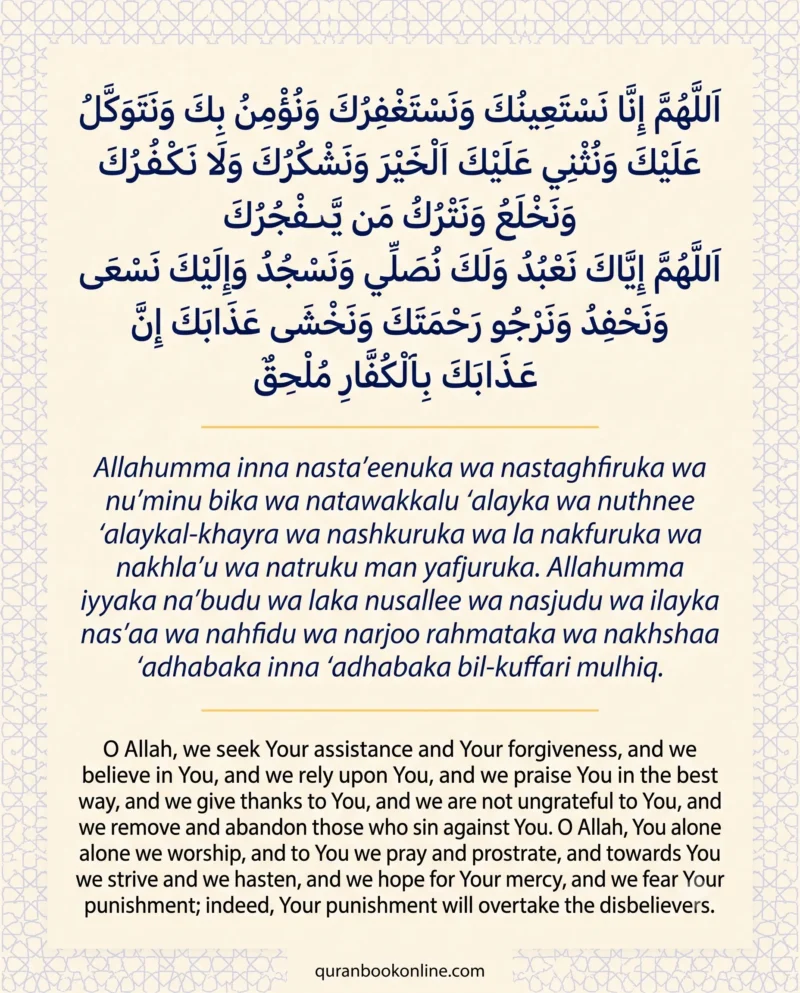
Yes, there are two widely recited versions. The first — “Allahumma ihdini feeman hadayt” — is narrated from al-Hasan ibn Ali, who was taught it by the Prophet ﷺ (Sunan Abi Dawud 1425). The second — “Allahumma inna nasta’eenuka” — is widely recited in the Hanafi tradition and reported from the practice of the Companions. Both are accepted, and communities differ in which they use.
Should I raise my hands during Dua Qunoot?
Scholars differ on raising the hands during Dua Qunoot. Many Hanafi and Hanbali scholars hold that the hands are raised as in supplication, while a number of Maliki scholars hold that they are not raised, and the Shafi’i school permits it. This is a recognised difference among qualified scholars, and following your own school or local imam is entirely correct.
Looking for the rest of your evening routine? We have more essential daily duas with audio.
Keep Going: From One Dua to the Whole Quran
If you worked through the trainer above, you did something specific: you took an Arabic text you could not recite, broke it into nine pieces, and closed the gap one piece at a time. That is not a trick for duas. It is exactly how a surah is memorised, and exactly how a juz is memorised — the pieces just keep coming.
The method you just used works at any scale.
Memorise the Quran using the same methodIf your children are learning alongside you, our free animated Islamic video series covers the same material in a form they will actually sit through, and the Quran Book app keeps the lessons in your pocket for the nights you are travelling.
May Allah make you among those He has guided, and bless you in what He has given you.
Book Your Free Trial Lesson
Memorising the words is the part you can do alone. Getting the letters right is the part you can’t. We’ll listen to your recitation, tell you honestly where you are, and give you a simple plan from there.
Start Your Free Trial Lesson →You can also reach us on WhatsApp or join our free Maqra on Telegram.
Written By

Jehad Mahmoud
Hafidha of the Quran · Arabic Language Graduate · Writer on Islamic Sciences
Jehad Mahmoud is a graduate of the Department of Arabic Language and a hafidha who has memorised the entire Holy Quran. She writes the Islamic content at Quran Book Academy, specialising in fiqh, the fiqh of worship and the Arabic that underpins it.
On questions where the four schools differ — as they do throughout this article — she presents each position with the evidence it rests on rather than presenting one school’s practice as the only correct one.
Her articles are educational, not fatwa. For a ruling on a specific personal situation, readers are advised to consult a qualified scholar or mufti.