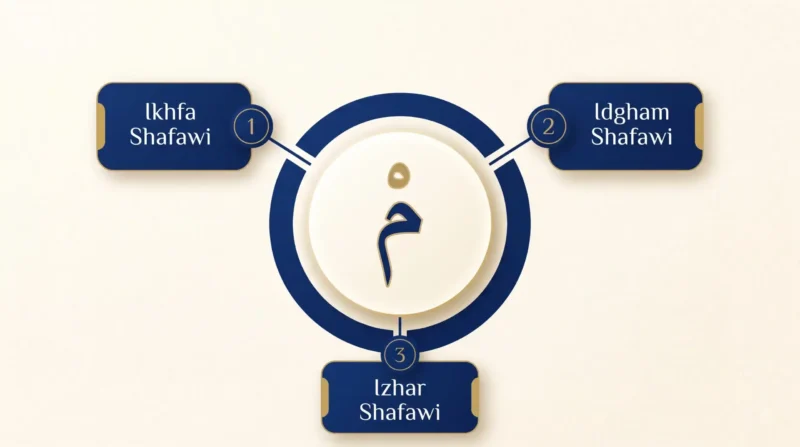
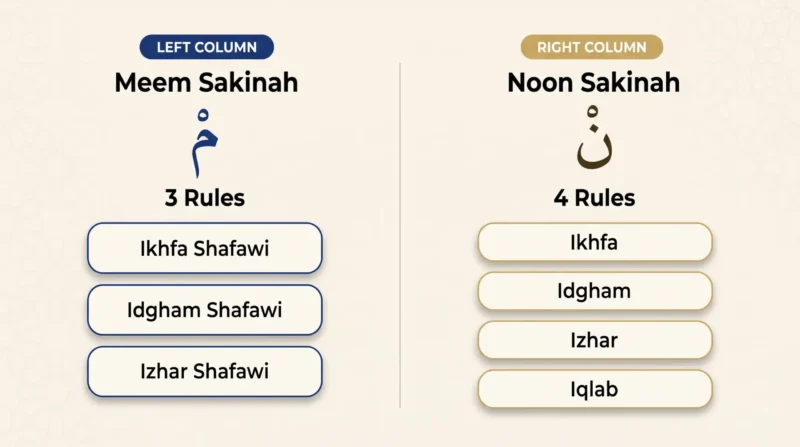
The rules of Meem Sakinah are three: Ikhfa Shafawi, Idgham Shafawi and Izhar Shafawi. Which one you apply depends entirely on the single letter that comes after the silent meem (مْ). This is the easiest chapter in Tajweed rules — and it is worth saying so plainly, because most learners arrive here bracing for another list of twenty-eight letters to memorise.
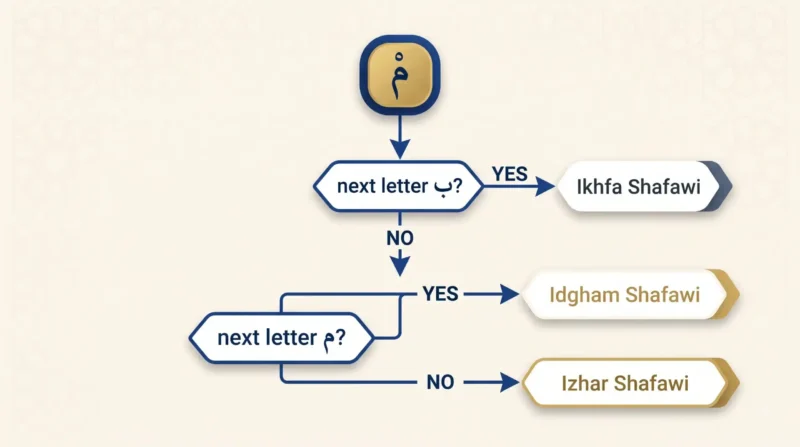
Noon Sakinah has four rules and letter groups to sort. Meem Sakinah has three rules, and two of them are triggered by one letter each: ب and م. Everything else falls to the third rule by default. If you can answer one question — is the next letter ب or م? — you know which rule applies. The rest is practising the sound until it is steady.
⚡ The 30-second version: مْ before ب → Ikhfa Shafawi, 2-count ghunnah · مْ before م → Idgham Shafawi, 2-count ghunnah · مْ before any of the other 26 letters → Izhar Shafawi, a clear meem with no prolonged ghunnah. All three are called Shafawi because the meem is made with the two lips.
What Is Meem Sakinah?
Meem Sakinah (ميم ساكنة) is the letter meem (م) carrying a sukoon — a meem with no vowel on it, like the مْ in هُمْ or أَلَمْ. In Tajweed it has three rules, and which one applies depends entirely on the letter that comes immediately after it.
That is the whole Meem Sakinah meaning in one line. Sakinah comes from sukoon (سكون), stillness — a letter with no vowel. In print, this is shown by the sukoon mark above the letter, though its shape varies between mushafs. A meem that is still is a Meem Sakinah, whether or not the sign is printed: many mushafs, including the widely used Madani mushaf, leave the meem bare before ب and م to signal concealment or merging. A missing sign in that position does not mean the meem has a vowel. You will also see it written Meem Sakin, Mim Sakin or Meem Saakinah in English; all four spellings describe the same مْ, and the Meem Sakin rules are the same rules.
Where you will find it
A Meem Sakinah sits in one of two places, and the rules work identically in both:
At the end of a word
لَكُمْ · عَلَيْهِمْ · أَنتُمْ
In the middle of a word
الْحَمْدُ · يَمْشُونَ · أَمْوَال
Meem Sakinah is not the same as a meem with shaddah
This is one of the most common beginner confusions. A meem written with a shaddah as part of the word itself — as in أُمَّة or ثُمَّ — is a Meem Mushaddadah, not a Meem Sakinah. A shaddah means the letter is doubled, and a doubled meem is always read with a two-count ghunnah, whatever letter comes after it.
There is one overlap to understand. In Idgham Shafawi, a meem sakinah merges into the meem that follows it, and the result is pronounced as a doubled meem — which is why the mushaf usually prints a shaddah on the second meem, as in لَهُم مَّا. So when you see a meem with a shaddah, check what stands before it: a silent meem at the end of the previous word means Idgham Shafawi; a shaddah that belongs to the word itself is Meem Mushaddadah.
Meem Sakinah Pronunciation and Makhraj
The meem is articulated by bringing the two lips together — ash-shafatayn (الشفتان) — while its ghunnah resonates through the nasal passage. That single fact explains the naming of the entire chapter. Shafawi (شفوي) means “of the lips”, from shafah (شفة). All three rules of Meem Sakinah carry the label because all three concern a letter made at the lips. You can place it against the other articulation points in our guide to the Makhraj of Arabic letters.
Once the makhraj is settled, the next letter decides what happens to the meem: it is concealed before ب, merged before م, and pronounced clearly before every other letter. Each outcome also needs the right ghunnah. Ikhfa and Idgham both hold a two-count ghunnah, so length alone does not tell them apart — what differs is how the meem meets the next letter. In Izhar, the meem is pronounced clearly without a prolonged ghunnah.
What “no ghunnah” means in Izhar Shafawi
In Izhar Shafawi, pronounce the meem clearly without prolonging its ghunnah. The meem retains its natural nasal quality, but it is not held for the two-count ghunnah taught for Ikhfa or Idgham.[1]
🎧 Listen-and-repeat drill
Play clip 1 below, أَلَمْ تَرَ, and notice how the meem is closed and released straight into ت — heard clearly, not held. Then play clip 2, تَرْمِيهِم بِحِجَارَةٍ, and clip 3, وَلَكُم مَّا, where the ghunnah is sustained for two counts. Repeat each phrase after the reciter three times, using the Repeat button if it helps. If you can, record yourself and compare — and ask a teacher to check what you cannot yet hear.
Hear the three rules back to back
Three short clips in the recitation of Shaykh Mahmoud Khalil Al-Husary (Hafs ‘an ‘Asim), each only a few seconds long so you can focus on the meem. Play them in order: a clear meem, a concealed meem with a two-count ghunnah before ب, and a merged meem held with a two-count ghunnah before م. The contrast becomes easier to hear with each pass.
Tap a clip to hear it.
The 3 Meem Sakinah Rules With Examples
Here is the entire chapter in one table. Everything below it is detail; if you only read one thing on this page, read this.
1. Ikhfa Shafawi (مْ before ب)
Ikhfa (إخفاء) means hiding; shafawi means of the lips. Put together: the meem is hidden at the lips. It is neither pronounced fully clearly nor merged away — it sits in the middle, which is exactly why it takes practice.
To produce it, conceal the meem with a two-count ghunnah before ب. Teachers differ in how they describe and transmit the lip position in Ikhfa Shafawi. Some teach a slight gap; others teach gentle lip contact with reduced pressure. Learn the precise movement through direct instruction from a qualified Quran teacher, while maintaining the two-count ghunnah before ب.[2]
This lesson illustrates the slight-gap approach: the lips come very close without pressing, the ghunnah is held for two counts, and the lips then close onto the ب. Whichever method your teacher transmits, the error to avoid is the same — pronouncing a full, crisp meem with firm lip pressure and no held ghunnah. That is a clear meem, which belongs to Izhar, not a concealed one.
تَرْمِيهِم بِحِجَارَةٍ
Al-Fil 105:4 · tarmeehim bi-hijarah — “pelting them with stones”
أَلَمْ يَعْلَم بِأَنَّ اللَّهَ يَرَىٰ
Al-‘Alaq 96:14 · alam yaʿlam bi-anna… — “does he not know that Allah sees?”
وَهُم بِالْآخِرَةِ هُمْ يُوقِنُونَ
Luqman 31:4 · wa hum bil-aakhirati hum yooqinoon — “and of the Hereafter they are certain”
An honest note on the difference
Scholars and teachers have described the lips in Ikhfa Shafawi in more than one way. Some teach that the lips meet lightly, with the concealment carried by the ghunnah and the reduced pressure; others teach a slight gap. Both descriptions have been taught and passed on, and the discussion has not settled into a consensus for either. Some scholars accept either, according to what the reciter received from his teachers.[2][3] Audio alone cannot show you where a reciter’s lips are, so this is learned face to face: if your teacher transmits light contact, follow your teacher.
2. Idgham Shafawi (مْ before م)
Idgham (إدغام) means merging. A silent meem meets another meem, and the two become one. Because the two letters are identical, the classical books give this rule a second, more precise name: Idgham Mutamathilayn Sagheer (إدغام متماثلين صغير) — the small merging of two identical letters. “Small” because the first letter is silent and the second carries a vowel.
How to read Idgham Mim Sakin words
1. Do not pronounce the first meem separately
It has no independent sound of its own. Reading it as its own letter is the error that produces two meems where there should be one.
2. Close the lips once, on the second meem
Press them together slightly firmer than usual, exactly as though the second meem carried a shaddah — because in effect it does.
3. Hold the ghunnah for two counts, then release
The nasal sound runs while the lips stay shut. Only after two counts do you open into the vowel that follows.
❌ Wrong: لَهُمْ · مَا — two separate meems with a bump between them.
✅ Right: لَهُم مَّا — one meem, lips shut, held two counts.
وَلَكُم مَّا كَسَبْتُمْ
Al-Baqarah 2:141 · wa lakum maa kasabtum — “and for you is what you earned”
وَمَا بِكُم مِّن نِّعْمَةٍ
An-Nahl 16:53 · wa maa bikum min niʿmah — “whatever blessing you have”
لَهُم مَّغْفِرَةٌ وَأَجْرٌ عَظِيمٌ
Al-Ma’idah 5:9 · lahum maghfiratun wa ajrun ʿaẓeem — “for them is forgiveness and a great reward”
A clue printed in your mushaf. In the Madani mushaf the first meem is printed without a sukoon mark, and the second meem carries a shaddah — showing that the two are pronounced as one doubled meem. If you see a bare meem followed immediately by a meem with a shaddah, you are looking at Idgham Shafawi. It is the fastest visual giveaway in the whole chapter.
3. Izhar Shafawi (مْ before the other 26 letters)
This is the default, and it comes with the best news on the page: there is no list to memorise. Take the twenty-eight letters of the alphabet, remove ب and م; whatever is left triggers it. Izhar Shafawi has the largest set of trigger letters: the remaining 26 letters.
How to read it: close the lips on the meem and pronounce it clearly — without prolonging its ghunnah, without lengthening and without a pause — then release straight into the next letter. The meem keeps its natural nasal quality; it is simply not held for the two counts of Ikhfa or Idgham.[1]
The two letters to watch: و and ف
Both are made at or very near the lips — the waw with the lips rounded, the fa with the lower lip against the upper teeth. Because the meem has only just left the lips, it is easy to let it blur into them or slip into a concealed, held ghunnah. Tuhfat al-Atfal specifically warns against hiding the meem before و and ف,[4] so give these two extra care with clear pronunciation.
عَلَيْهِمْ وَلَا الضَّالِّينَ
Al-Fatihah 1:7 · meem before و — extra care
هُمْ فِيهَا خَالِدُونَ
Al-Baqarah 2:39 · meem before ف — extra care
أَلَمْ تَرَ كَيْفَ
Al-Fil 105:1 · meem before ت
الْحَمْدُ لِلَّهِ
Al-Fatihah 1:2 · meem before د, inside one word
Meem Sakinah Examples in the Quran
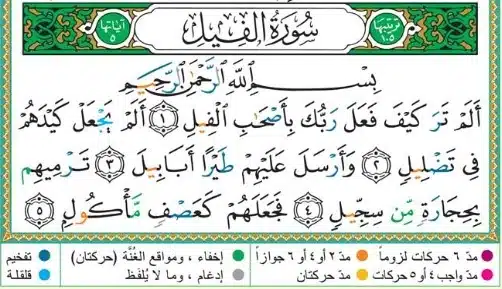
The best way to meet the Meem Sakinah rules in the Quran is not a list of scattered verses — it is a few short ayat that contain all three. Selected ayat from Surah Al-Fil and Surah Quraysh, two short surahs many learners already know, do exactly that between them. Work through the five selected ayat below to practise all three rules of Meem Sakinah.
Worked passage: Al-Fil 105:1–4 & Quraysh 106:4
أَلَمْ تَرَ كَيْفَ
105:1 · after مْ: ت · Izhar Shafawi
أَلَمْ يَجْعَلْ كَيْدَهُمْ فِي تَضْلِيلٍ
105:2 · after مْ: ي, then ف · Izhar Shafawi ×2
عَلَيْهِمْ طَيْرًا
105:3 · after مْ: ط · Izhar Shafawi
تَرْمِيهِم بِحِجَارَةٍ
105:4 · after مْ: ب · Ikhfa Shafawi
أَطْعَمَهُم مِّن جُوعٍ وَآمَنَهُم مِّنْ خَوْفٍ
106:4 · after مْ: م, twice · Idgham Shafawi ×2
The highlighted meems in Al-Fil 105:1–4 give you four examples of Izhar Shafawi and one of Ikhfa Shafawi; Quraysh 106:4 gives you two Idgham Shafawi in a row. That is all three rules in five short ayat. These rows show selected phrases and highlighted examples — they are not the full text of either surah or a complete list of every Meem Sakinah in them.
More Meem Sakinah Quran examples
الْحَمْدُ لِلَّهِ
1:2 · د · Izhar Shafawi, inside one word
عَلَيْهِمْ وَلَا الضَّالِّينَ
1:7 · و · Izhar Shafawi — extra care
لَمْ يَلِدْ وَلَمْ يُولَدْ
112:3 · ي twice · Izhar Shafawi
لَكُمْ دِينُكُمْ وَلِيَ دِينِ
109:6 · د · Izhar Shafawi
هُمْ فِيهَا خَالِدُونَ
2:39 · ف · Izhar Shafawi — extra care
أَلَمْ يَعْلَم بِأَنَّ اللَّهَ يَرَىٰ
96:14 · ب · Ikhfa Shafawi
وَهُم بِالْآخِرَةِ هُمْ يُوقِنُونَ
31:4 · ب · Ikhfa Shafawi
وَلَكُم مَّا كَسَبْتُمْ
2:141 · م · Idgham Shafawi
لَهُم مَّغْفِرَةٌ وَأَجْرٌ عَظِيمٌ
5:9 · م · Idgham Shafawi
وَمَا بِكُم مِّن نِّعْمَةٍ
16:53 · م · Idgham Shafawi
How to Recognize Meem Sakinah in the Quran (3 Steps)
1. Find the meem with no vowel
Look for a meem carrying the sukoon mark (مْ), or a meem printed bare before ب or م, as many mushafs show it. A meem with a shaddah that belongs to the word itself, as in أُمَّة, is Meem Mushaddadah — a separate rule. A shaddah on a meem that follows a silent meem is Idgham Shafawi.
2. Look at the very next letter
Even if it is the first letter of the next word. When you read on without stopping, word boundaries do not matter here; only adjacency does.
When the meem is at the end of a word, apply the rule based on the following letter when continuing into the next word. If you stop on the word, do not apply a cross-word merging or concealment across the pause.
3. Apply the two-question test
Is it ب? → Ikhfa Shafawi. Is it م? → Idgham Shafawi. Neither? → Izhar Shafawi.
There is no third question. That settles which rule applies — and it is why Meem Sakin rules are often among the first things a Tajweed teacher gives a beginner who needs an early win. Producing the ghunnah and the meem accurately is the part that takes practice.
Try it: which letter comes after the مْ?
Tap any letter of the alphabet and the widget gives you the rule, the ghunnah and an example.
Pick a letter above to see the rule.
Meem Sakinah vs Noon Sakinah: What’s the Difference?
These two chapters are taught side by side, and mixing them up is the fastest way to make an easy rule feel hard. They share the idea of a silent letter changing behaviour according to what follows it, but the number of rules, the trigger letters and the articulation point all differ.
The tanween row is the one to internalise. Tanween is phonetically a silent noon, so it belongs entirely to the noon chapter — a word ending in ـٌ or ـً never triggers anything on this page. ➜ Noon Sakin Rules
5 Common Meem Sakinah Mistakes
1. Reading a clear meem before ب
Pressing the lips firmly and releasing a crisp meem with no held ghunnah turns the concealment into a clear meem — Izhar instead of Ikhfa. Whether your teacher transmits a slight gap or gentle contact with reduced pressure, keep the pressure light and hold the ghunnah for two counts before ب.
2. Pronouncing two separate meems in Idgham
Reading لَهُمْ مَا instead of لَهُم مَّا. There is one meem, closed once and held — not two with a bump between them.
3. Holding the ghunnah in Izhar Shafawi
Especially before و and ف, where the lips are already busy. The meem keeps its natural nasal quality, but in Izhar Shafawi it is not prolonged into a two-count ghunnah or concealed. The listen-and-repeat drill above helps you hear the difference.
4. Treating a Meem Mushaddadah as Meem Sakinah
Words like أُمَّة and ثُمَّ have their own compulsory two-count ghunnah and are not governed by the letter that follows them. The exception to watch for is a shaddah on a meem that follows a silent meem — that is Idgham Shafawi.
5. An inconsistent ghunnah length
One count in this ayah, four in the next. The two-count ghunnah should be the same length every time. Recording yourself helps, and a teacher’s feedback can reveal inconsistencies you may miss.
Practise the Rules of Meem Sakinah
Two ways to drill this, both free and both usable on a phone. Start with the quiz — you get a short Al-Husary clip with every question, so you are training your ear and your eye at the same time.
Which rule is it? — 9 questions
Choose the rule that applies to the highlighted meem.
Naming the rule is the first step. Producing the ghunnah and the meem accurately is judged by ear, and a teacher’s feedback can catch what you might miss.
Book a free trial lessonPlay: Catch the Meem Sakinah (free game)
Recognition under time pressure is a different skill from recognition on a page. Catch the letters that follow the silent meem and see how long you last. Works on phones and tablets, no account needed.
Game not loading? Open it in a new tab · or browse all our free Tajweed games.
📚 Continue Learning
Each of the three rules has a full guide of its own, with more examples, more audio and the finer points this overview leaves out:
All of these sit inside the wider set of Tajweed rules, and are taught step by step in our Tajweed for adults and Tajweed for kids courses.
Rules of Meem Sakinah FAQ
May Allah beautify your recitation and accept it from you. 🤲
Hafidha of the Quran · Arabic Language Graduate · Writer on Islamic Sciences
Jehad Mahmoud is a graduate of the Arabic Language department and a Hafidha of the Quran who writes the Islamic educational content at Quran Book Academy.
She writes with a focus on Tajweed, Quranic recitation and the sharia sciences, making technical rules accessible to English-speaking Muslim families.
Her articles are educational, not fatwa. For a ruling on a specific personal situation, readers are advised to consult a qualified scholar or mufti.
References and Further Reading
-
Egyptian Ministry of Awqaf — الغنة، أحكامها، وأقوال العلماء في ذلك (in Arabic).
Discusses ghunnah, its outlet in the nasal passage, and how its natural basis remains in noon and meem even when they are pronounced clearly. Cited here for the explanation of ghunnah in Izhar Shafawi. -
Islamweb, Fatwa No. 192131 (in Arabic).
Includes a discussion of the differing descriptions of lip position in Ikhfa Shafawi and Iqlab, noting that some scholars accept either according to what the reciter received from his teachers. -
Islamweb, Fatwa No. 52856 — الأدلة على ترك فرجة في النطق بالإقلاب والإخفاء الشفوي (in Arabic).
A discussion compiling views and quotations about lip position in Iqlab and Ikhfa Shafawi, presenting both closure and a slight gap without establishing a consensus for either. -
Sulayman al-Jamzuri, Tuhfat al-Atfal, verses 18–23 (Arabic text, Alukah).
These verses present the three rules of Meem Sakinah — Ikhfa before ب, Idgham before م, Izhar before the remaining letters — and the caution against concealing the meem before و and ف. -
Quran text and references — Quran.com: Surah Al-Fil (105) · Surah Quraysh (106).
Other examples on this page: 1:2 · 1:7 · 2:39 · 2:141 · 5:9 · 16:53 · 31:4 · 96:14 · 109:6 · 112:3. These links support the Quranic text and verse references. -
Recitation — Shaykh Mahmoud Khalil Al-Husary (Hafs ‘an ‘Asim), from the Al-Husary recordings on EveryAyah.
Short phrase clips are played from the full-ayah recordings using start and end times. This is the recording source for the audio on this page; the textual Tajweed references are listed above.
© 2026 Quran Book Academy. All rights reserved.
Book Your Free Trial · Empowering Muslims Worldwide to Connect with the Quran