
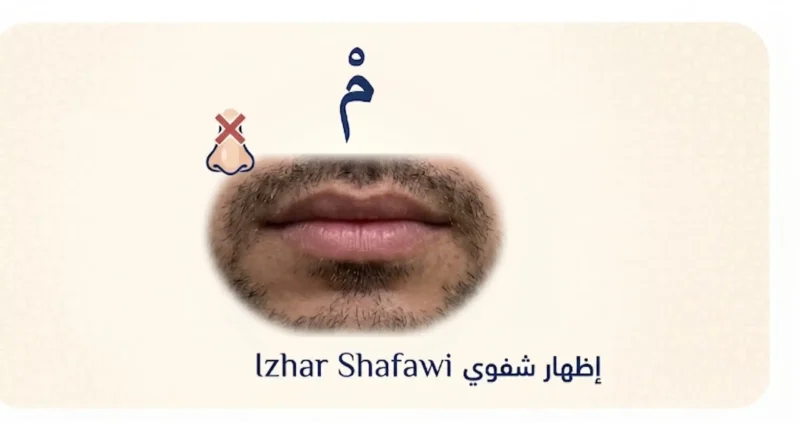
Izhar Shafawi means reading a silent Meem (مْ) clearly, with the lips closed gently and no added or prolonged hum in the nose, when the next letter is any of 26 letters — that is, every Arabic letter except ب and م. It is the first and easiest of the three rules of Meem Sakinah, and it is the default: if the letter after the Meem is not ب and not م, you are already doing it.
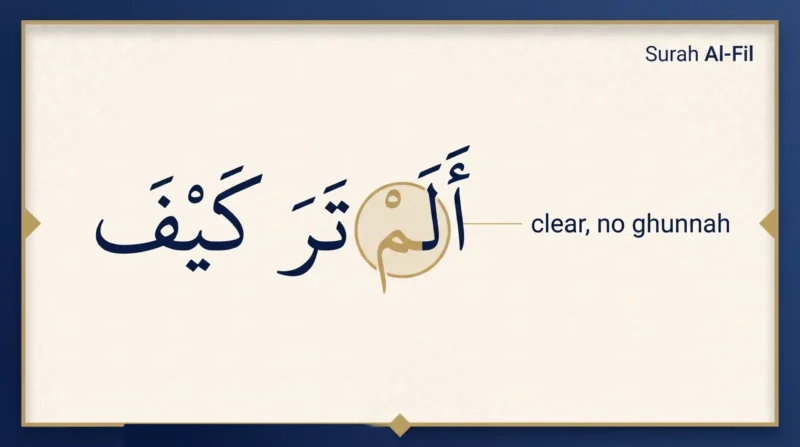
Here is the problem that brings most learners to this page. You close your lips on the Meem of أَلَمْ تَرَ, hold them a fraction too long, and a stretched hum escapes through the nose. What comes out sounds like أَلَمّ تَرَ — a doubled Meem that is not in the text. The rule itself takes thirty seconds to learn. Hearing your own extra hum is the part that takes practice, and this page is built around that.
⚡ The 30-second version: silent Meem مْ + any of 26 letters · lips close, then release cleanly · no added or prolonged ghunnah, no extra lengthening · the only two exceptions are ب (Ikhfa Shafawi) and م (Idgham Shafawi) · be extra careful before و and ف.
What Does Izhar Shafawi Mean?
Izhar Shafawi (إظهار شفوي) means “clear pronunciation from the lips”. It is the rule of Meem Sakinah (مْ) when it is followed by any letter except م and ب. The Meem is pronounced clearly, with the lips closed gently, and without adding or prolonging a ghunnah on it.
The name is two words, and each one tells you something useful.
إظهار
Izhar — to make clear, to reveal. The letter is left plainly audible instead of being hidden or merged.
شفوي
Shafawi — labial, “of the lips”, from shafah (شفة). The Meem is made by the two lips (الشفتان), which is its makhraj.
Put together: a Meem made at the lips and left completely clear. You will also see it written Izhar Shafawee, Ith-har Shafawi or Idhhar Shafawi in English books — all the same rule, spelled from the same Arabic word إظهار شفوي.
This matters because Meem Sakinah has a partner chapter. The parallel rules for the silent Noon are covered in our guide to the Noon Sakin rules, and both chapters sit inside the wider set of Tajweed rules. Izhar Shafawi is simple in this sense: you do not add hiding, merging or extra lengthening to the Meem — you let it come out as it is.
Izhar Shafawi Letters: All 26
You do not need to memorise 26 separate letters. Just remember the two exceptions: ب and م. Take the 28 letters of the Arabic alphabet, remove those two, and everything left over — 26 letters — is Izhar Shafawi.
Tap any letter to see which rule it triggers after مْ
Green = Izhar Shafawi (26 letters). Red = an exception.
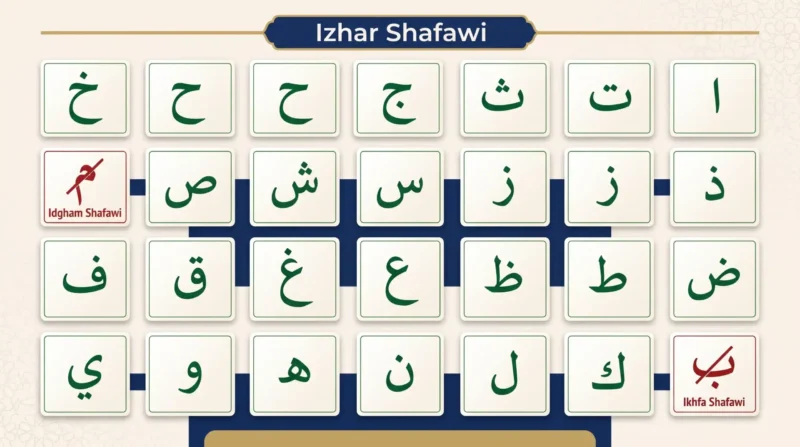
The two exceptions
مْ + ب → Ikhfa Shafawi — the lips are not fully closed and a two-count ghunnah is held.
مْ + م → Idgham Shafawi — the two Meems merge into one, again with a two-count ghunnah.
The two letters that need extra care: و and ف
All twenty-six letters follow the same rule — but two of them are much easier to get wrong, and almost no English page says so. Classical Tajweed texts specifically warn against hiding the Meem before و and ف. Some teachers refer to this extra care with the term Izhar Shafawi Aqwa; it is not a separate fourth rule you need to memorise, only a reminder that the Meem here must stay clearly audible.
The reason is anatomical. و is made at the two lips — the same makhraj as the Meem — and ف is made right beside them, at the inside of the lower lip against the upper front teeth. When two sounds sit at or beside the same place of articulation, the mouth wants to blend them, and the Meem can slide into the letter after it with a hum that should not be there.
عَلَيْهِمْ وَلَا الضَّالِّينَ
ʿalayhim wa-lā ḍ-ḍāllīn — “…nor of those who are astray.” · Al-Fatihah 1:7 · مْ + و
هُمْ فِيهَا خَالِدُونَ
hum fīhā khālidūn — “they will abide in it forever.” · Al-Baqarah 2:39 · مْ + ف
The instruction is mechanical: close the lips → release them → then start the و or ف. Three separate movements, in that order. If you start shaping the next letter while the lips are still shut, the extra hum has already happened.
The Izhar Shafawi Rule in Meem Sakinah
One sentence: when a Meem Sakinah is followed by any letter other than ب or م, read the Meem clearly and move on. The rule itself is simple, and it works the same way inside a single word and across a word boundary, in every surah. The only thing that needs extra attention is و and ف, so that the Meem is not accidentally hidden.
Beginners often miss the trigger rather than the rule. A Meem Sakinah is a Meem with no vowel, commonly written with a sukoon (مْ). The everyday plural endings are full of them — هُمْ, لَكُمْ, عَلَيْهِمْ, أَنْتُمْ — and so are mid-word forms like الْحَمْدُ and يَمْشُونَ. Every one of those is a decision point.
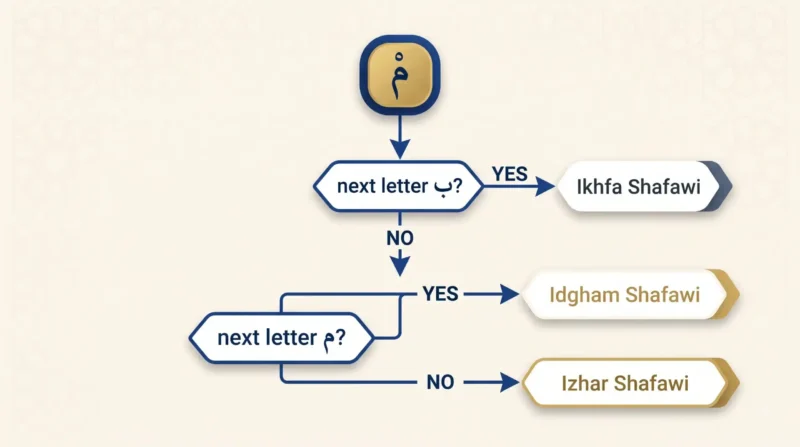
Those three rules are the entire chapter of Meem Sakinah. Nothing else is hiding in it. Read them together in the parent guide to the rules of Meem Sakinah, and you have closed one of the shortest and most useful chapters in Tajweed.
How to Pronounce Izhar Shafawi (4 Steps)
Four movements. The second one is where the mistake lives.
1. Close your lips fully but lightly
The two lips meet on the مْ with no pressure and no push of air behind them. Full contact, soft contact.
2. Do not stretch the sound in the nose
The Meem is a nasal letter by nature, but here you do not hold or prolong that nasal sound. This is the step that decides whether you are reading Izhar Shafawi or quietly turning it into Idgham.
3. Release cleanly into the next letter
Open the lips and go straight to the following letter. No pause, no breath, and no small vowel slipped in after the Meem.
4. Do not lengthen
A Meem Sakinah with Izhar takes zero extra counts. If you can hold it while counting, you are holding it too long.
👃 The nose-pinch awareness exercise
Pinch your nose lightly with two fingers and recite أَلَمْ تَرَ out loud. Then try تَرْمِيهِم بِحِجَارَةٍ, which is Ikhfa Shafawi and does carry a held ghunnah. Comparing the two helps you notice when you are stretching a nasal sound on the Meem.
Treat this as a way of building awareness, not as a pass-or-fail test. Closing the nose changes how your own voice feels to you, so it should never replace listening to a qualified reciter or being corrected by a teacher.
Listen & Copy: record yourself
Listen to Sheikh Al-Husary, record the same phrase in your own voice, then play the two back to back. Most learners hear their own stretched ghunnah the first time they do this. Nothing is uploaded and nothing is stored — the recording stays in your browser and disappears when you close the page.
Press ▶ to hear a phrase.
Izhar Shafawi Examples from the Quran
Ten short Izhar Shafawi Quran examples, covering mid-word and end-of-word Meems and both of the difficult letters. The Meem Sakinah is marked in blue and the letter after it in orange. Every clip is a short excerpt in the recitation of Sheikh Mahmoud Khalil Al-Husary.
Surah Al-Ikhlas is the best place to start drilling. It is four short ayat you already know by heart, it contains two instances of this rule in a single line, and you can recite it slowly enough to catch your own hum before the next word arrives.
Izhar Shafawi vs Ikhfa Shafawi vs Idgham Shafawi
Do not try to remember three rules. Remember two letters and a default. Look at the letter that comes straight after the مْ: is it ب? Then Ikhfa Shafawi. Is it م? Then Idgham Shafawi. Anything else, all 26 of them, is Izhar Shafawi. That single question answers every Meem Sakinah in the Quran.
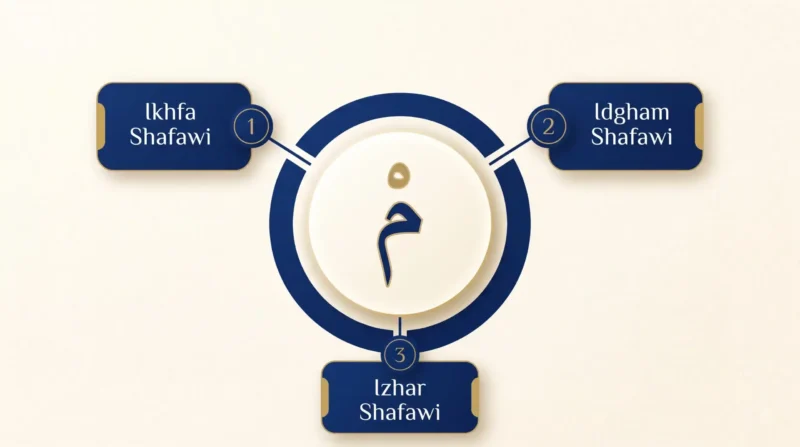
Read the two exceptions in full: Ikhfa Shafawi covers the Meem before ب, and Idgham Shafawi covers the Meem before another Meem. The parallel chapter for the silent Noon is the Noon Sakin rules — same logic, four rules instead of three.
4 Common Izhar Shafawi Mistakes
1. Stretching the hum — turning Izhar into Idgham
The number one error worldwide, and it happens most before و and ف. The reader who does it usually cannot hear it, which is exactly why the awareness exercise above is worth ten minutes of reading.
2. Lengthening the Meem as if it had a shaddah
Holding the lips shut for an extra beat produces أَلَمّ تَرَ instead of أَلَمْ تَرَ — a doubled letter that changes the word.
3. Inserting a small vowel after the Meem
Non-native speakers often slip a tiny “u” in to bridge two consonants, reading لَهُمُ where the text says لَهُمْ. A silent letter must stay silent.
4. Pressing the lips too hard
The over-correction of mistake one. Too much pressure builds air behind the lips and releases it as a small pop. Full contact, light contact — those are different things.
Practise Izhar Shafawi: Spot the Rule
A 12-question quiz covering all three Meem Sakinah rules — Izhar, Ikhfa and Idgham Shafawi — so you have to decide, not guess. Twelve real Quranic phrases, one at a time: look at the letter after the highlighted Meem and tap the rule. Instant feedback with the reason, and audio on the ones recited by Sheikh Al-Husary. No sign-up.
Look at the letter right after the highlighted Meem.
Play: Eagle of Izhar Shafawi (Free Game)
Recognising a rule with time to think is one skill. Recognising it in half a second is another. Fly the eagle, catch only the letters that trigger Izhar Shafawi, and avoid ب and م. It works on phones and tablets, and no account is needed.
Game not loading? Open it in a new tab · or browse all our free Tajweed games.
📚 Continue Learning
Izhar Shafawi is one third of the Meem Sakinah chapter. Here is what to study next:
All of them sit inside the wider set of Tajweed rules, and are taught step by step in our courses for adults and kids.
Izhar Shafawi FAQ
May Allah beautify your recitation and accept it from you. 🤲
Hafidha of the Quran · Arabic Language Graduate · Writer on Islamic Sciences
Jehad Mahmoud is a graduate of the Arabic Language department and a Hafidha of the Quran who writes the Islamic educational content at Quran Book Academy.
She writes with a focus on Tajweed, Quranic recitation and the sharia sciences, making technical rules accessible to English-speaking Muslim families.
Her articles are educational, not fatwa. For a ruling on a specific personal situation, readers are advised to consult a qualified scholar or mufti.
References & Sources
The descriptions of the makhraj of the Meem, the three rules of Meem Sakinah, and the caution against hiding the Meem before و and ف follow standard classical Tajweed descriptions of the rules of Meem Sakinah.
1. Al-Azhar Al-Sharif — azhar.eg
2. Encyclopedia of Arabic Language and Linguistics — Brill Reference Works
3. Surah Al-Fatihah 1 — Quran.com
4. Surah Al-Fil 105 — Quran.com
5. Recitation — Sheikh Mahmoud Khalil Al-Husary (Hafs ʿan ʿAsim, murattal), via EveryAyah.com and Quran.com word-by-word audio
© 2026 Quran Book Academy. All rights reserved.
Book Your Free Trial · Empowering Muslims Worldwide to Connect with the Quran