Most learners read أَطْعَمَهُم مِّن جُوعٍ as hum-min — two separate meems, a small stumble that nobody corrects. It should be one meem carrying a shaddah, held with a gentle hum. That single fix is the whole of Idgham Shafawi, and it has exactly one trigger letter: م. It is the shortest rule in Tajweed, and one of the three rules of Meem Sakinah.
Also written Idgham Shafawee, Idghaam Shafawi, Idgham Mim Sakin or Idgham Meem Sakinah — in Arabic, إدغام شفوي.
⚡ The 30-second version: one trigger letter (م) · a meem sakinah meets another meem · the two merge into a single meem with a shaddah · that merged meem is held with a ghunnah of two counts · then released. You can learn the theory in sixty seconds; the rest of this page is about making your mouth do it.
What Is Idgham Shafawi?
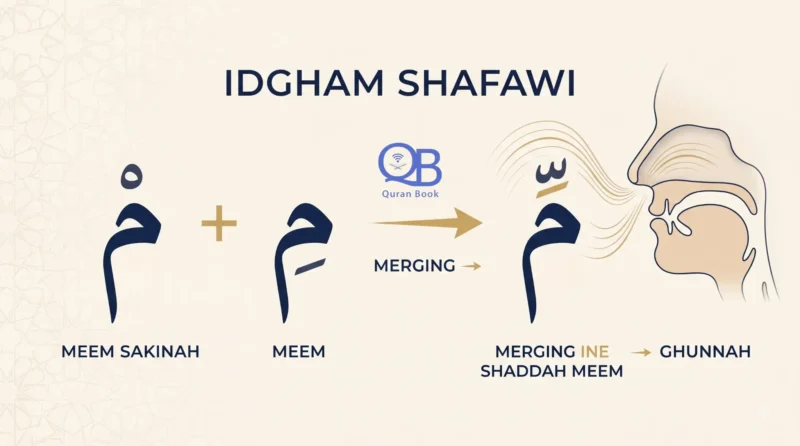
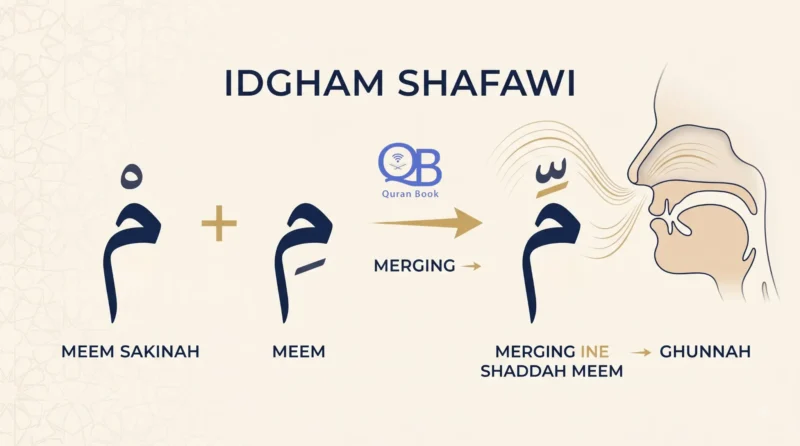
Idgham Shafawi (إدغام شفوي) is the Tajweed rule that applies when a meem sakinah (مْ) is followed by another meem (م). The two meems merge into a single meem carrying a shaddah, which is pronounced with a ghunnah held for two counts. It is the only Meem Sakinah rule where two identical letters meet.
The name breaks into two halves, and both are literal. Idgham (إدغام) means merging or inserting one thing into another. Shafawi (شفوي) means “of the lips”, from shafah (شفة) — because the meem is produced by closing the two lips together, the shafatayn. So the name tells you the action and the place: a merging that happens at the lips.
Notice what that means for your mouth. Two meems in a row are not two events. What you produce is one meem, doubled by the shaddah, with the nasal sound running through it — not a meem finished and a meem begun.
The rule in one line
Meem sakinah + meem = one meem with a shaddah, held with a ghunnah of two counts. If you remember nothing else from this page, remember that sentence. Everything below is either a way of hearing it or a way of practising it.
Idgham Shafawi Letters: Just One
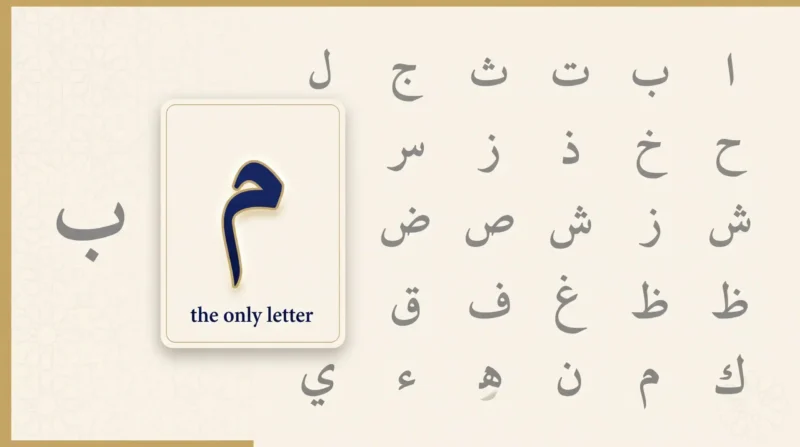
There is one Idgham Shafawi letter: م. That is the entire list. If a meem sakinah is followed by another meem, this rule applies — every time, in every position, with no exceptions and nothing to memorise.
What is worth memorising is how that one letter sits against the other two rules of the chapter:
How to spot it in the mushaf
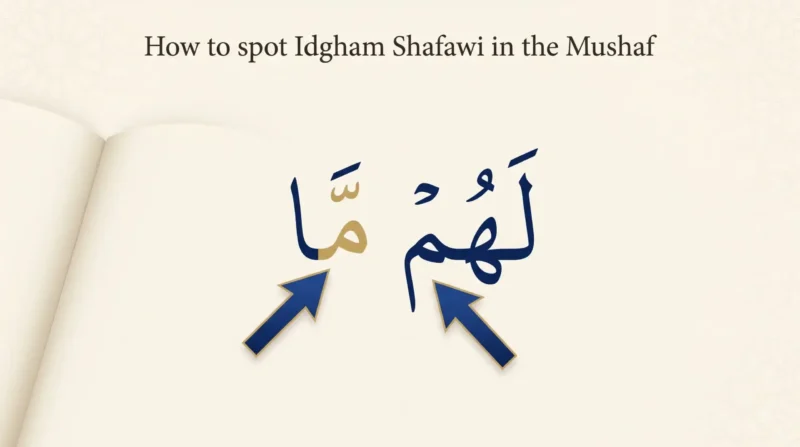
Here is the detail almost no page mentions, and it turns the rule into something you see rather than something you work out. In the Madani script the first meem is written bare — no sukoon sign on it — and the second meem carries a shaddah:
لَهُم مَّا
The shaddah on the second meem is your signal. That is the mark that tells you a merging has taken place, and it is the one to train your eye on. The bare first meem is a supporting clue rather than the rule itself — printings differ, and some editions mark the merged letter in their own way, so read the shaddah first and let the rest confirm it.
⚠️ Not Idgham Shafawi: a doubled meem inside a single word, such as أُمَّة or مُحَمَّد. There is no meem sakinah meeting a second meem there; the shaddah belongs to the word itself, and what you hear is the ghunnah of a naturally doubled meem — related, but a separate heading, covered in the rules of Meem Sakinah.
How to Pronounce Idgham Shafawi (4 Steps)
The rule first, then the technique. The rule is that the two meems merge into one meem with a shaddah, pronounced with a two-count ghunnah. The four steps below are how teachers get a student’s mouth to produce that — they are practical guidance, not the definition.
1. Do not pronounce the two meems separately
The meem sakinah is not given a beat of its own and does not end the first word with a click of the lips. It is absorbed into the meem that follows, so what leaves your mouth is one letter, not two.
2. Close your lips once, for the merged meem
A light, firm press — exactly as you would for any letter carrying a shaddah. One closure is all the merged meem needs. This is the practical cue most teachers give, and it is the fastest way to feel the difference between one meem and two.
3. Hold the ghunnah for two counts
With the lips still closed, let the sound run through the nose for the length of two harakahs at your recitation pace. Two counts is a relative measure, not a fixed number of seconds — it stretches when you recite slowly and shortens when you recite quickly. Keep it level, and keep it the same length every time.
4. Release into the next vowel cleanly
Open the lips straight into the vowel that follows — لَهُم مَّا comes out as lahu-mmmm-mā, one continuous stream with no break in it.
👃 The nose-pinch test
Pinch your nose and recite لَهُم مَّا. The ghunnah comes out through the nasal passage, so if it is there the sound will be blocked and change noticeably. If nothing changes when you pinch, you skipped it, and you are saying a plain doubled meem instead.
What this test tells you is whether the ghunnah exists — not whether its length is correct. Duration is judged by ear, against a qualified teacher or a trusted recitation. Treat the pinch as a self-check, not a verdict.
Idgham Shafawi Examples in the Quran
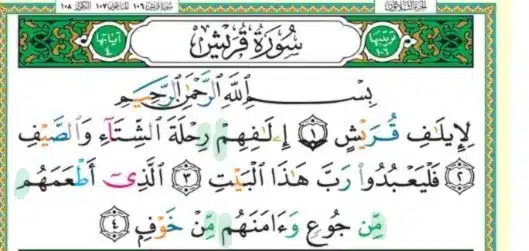
Start with Surah Quraysh. Ayah 4 carries two instances of the rule in a single verse — and almost every learner already knows this surah by heart, which makes it the fastest possible win. The merged meem is marked in blue, the meem carrying the shaddah in orange.
Surah Quraysh walkthrough · both occurrences in ayah 4
Tap a line to hear it.
Now the wider set. Ten short passages, each one a meem sakinah meeting a meem, recited by Sheikh Mahmoud Khalil Al-Husary. Most clips are trimmed to just the phrase, so they run a few seconds; the rows marked “full ayah” play the whole verse.
أَطْعَمَهُم مِّن جُوعٍ
Quraysh 106:4 · the best starting example
وَآمَنَهُم مِّنْ خَوْفٍ
Quraysh 106:4 · same ayah, second occurrence
فِي قُلُوبِهِم مَّرَضٌ
Al-Baqarah 2:10 · a phrase you will meet often
لَهُم مَّغْفِرَةٌ وَأَجْرٌ عَظِيمٌ
Al-Ma’idah 5:9 · short clip · this phrasing recurs across the Quran
وَلَكُم مَّا كَسَبْتُمْ
Al-Baqarah 2:141 · short clip · the merged meem carries the whole phrase
كُنتُم مُّؤْمِنِينَ
Aal ‘Imran 3:175 · full ayah · the merging is right at the end
إِنَّهُم مُّلَاقُو رَبِّهِمْ
Hud 11:29 · full ayah · the merging falls in إِنَّهُم مُّلَاقُو
لَهُم مَّا يَشَاءُونَ
Az-Zumar 39:34 · opens the ayah, easy to isolate
فَلَمَّا جَاءَهُم مُّوسَىٰ
Al-Qasas 28:36 · a naturally doubled meem and a merged meem in one line
وَمَا بِكُم مِّن نِّعْمَةٍ
An-Nahl 16:53 · short clip · idgham followed straight away by another one
What all ten Idgham Shafawi examples from the Quran have in common
Every one of them crosses a word boundary: the first meem ends one word, the second meem begins the next. That is the pattern to train your eye on, and it is also the reason the mistake below is so easy to make — your instinct is to finish the word before starting the next one, and this rule asks you not to.
Idgham Shafawi vs the Other Rules
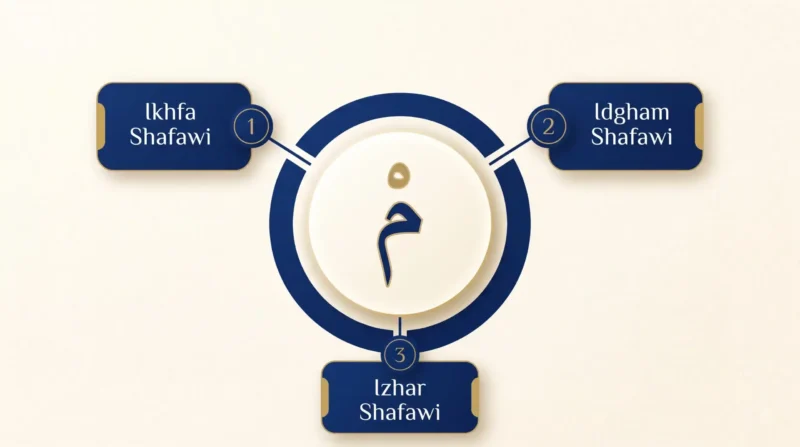
vs Ikhfa Shafawi and Izhar Shafawi
All three rules start from the same place — a meem sakinah — and differ only in what happens next.
vs the Idgham of Noon Sakinah
This is the single biggest confusion learners bring to the page, and it comes from studying the noon first. The idgham of noon sakinah splits into two categories: with ghunnah (ي ن م و) and without ghunnah (ل ر). Students arrive here expecting the same fork in the road and start hunting for the second branch.
There isn’t one. Idgham Shafawi is always with ghunnah, always two counts, in every position, with no exceptions and no second category to learn. If you want the fuller picture of how the noon behaves differently, it is covered in our guide to the Noon Sakin rules.
4 Common Idgham Shafawi Mistakes
1. Pronouncing two separate meems
Reading لَهُمْ مَا instead of لَهُم مَّا — two closures of the lips where the merged letter needs one. This is the most common error by a wide margin, and it comes from the eye: you see two meems, so you say two meems.
2. Dropping the ghunnah
The merging is done correctly, but with no nasal hold at all, so the result sounds like a plain doubled meem. This one is invisible to the person making it — the nose-pinch test above is the fastest way to notice it.
3. Over-holding the ghunnah
Four, five, six counts. The over-correction of mistake 2, and it turns a ghunnah into a drone that pulls the rhythm of the whole ayah out of shape. Two counts, then move on.
4. Adding a small vowel to the first meem
Reading لَهُمُ مَا to make the two words easier to join. It smooths the mouth’s job and changes the text — the meem sakinah carries no vowel, and inventing one undoes the merging entirely.
Practise Idgham Shafawi
Ghunnah consistency trainer
Two harakahs is a relative measure, not a fixed number of seconds — it stretches and shrinks with your recitation pace, so no tool can tell you that a particular duration is “correct Tajweed”. What a tool can do is show you whether your ghunnah is the same length each time, which is the part learners get wrong without noticing.
Press and hold the bar while you recite لَهُم مَّا, releasing exactly when your nasal hold ends. Your first hold becomes your reference. Match it on the next four.
Hold once to set your reference length, then try to match it.
This trainer measures steadiness only. Whether your two counts are actually two counts is judged by ear — by a qualified teacher, or against a recitation you are following.
Which rule of Meem Sakinah applies?
Ten questions. Each one shows you the letter pair, so you are answering from the rule rather than from memory of the verse. The Quranic example and the audio come with it.
Example from the Quran
Pick the rule that applies to this pair.
Free Game: Idgham Shafawi Basket
Recognition under time pressure is a different skill from recognition on a page. Catch only the words that contain Idgham Shafawi and let the rest fall past. It works on phones and tablets, and no account is needed.
Game not loading? Open it in a new tab · or browse all our free Tajweed games · the 3-rule tap game lives on the rules of Meem Sakinah hub.
Learn More
Idgham Shafawi is one of three rules that govern the meem sakinah. Here is what to study next:
All of them sit inside the wider set of Tajweed rules, and all are taught step by step in our Tajweed for adults and Tajweed for kids classes.
Idgham Shafawi FAQ
May Allah beautify your recitation and accept it from you. 🤲
Hafidha of the Quran · Arabic Language Graduate · Writer on Islamic Sciences
Jehad Mahmoud is a graduate of the Arabic Language department and a Hafidha of the Quran who writes the Islamic educational content at Quran Book Academy.
She writes with a focus on Tajweed, Quranic recitation and the sharia sciences, making technical rules accessible to English-speaking Muslim families.
Her articles are educational, not fatwa. Tajweed is learned by listening and correction: for your own recitation, study with a qualified teacher, and for a ruling on a specific personal situation, consult a qualified scholar or mufti.
References & Sources
The rule as described on this page follows the standard classical Tajweed manuals below, in the riwayah of Hafs ‘an ‘Asim.
1. Ibn al-Jazari, Al-Muqaddimah al-Jazariyyah (المقدمة الجزرية) — the foundational versified text on Tajweed.
2. Muhammad Makki Nasr al-Juraysi, Nihayat al-Qawl al-Mufid fi ‘Ilm Tajwid al-Qur’an al-Majid (نهاية القول المفيد) — on the rules of meem sakinah and the classification of idgham.
3. ‘Abd al-Fattah al-Marsafi, Hidayat al-Qari ila Tajwid Kalam al-Bari (هداية القاري) — on ghunnah, its measure, and complete versus incomplete idgham.
4. Muhammad Ahmad Ma’bad, Al-Mulakhkhas al-Mufid fi ‘Ilm al-Tajwid (الملخص المفيد في علم التجويد) — standard teaching summary used in Azhari curricula.
5. Al-Azhar Al-Sharif — azhar.eg
6. Quranic text — Surah Quraysh 106 and Surah Al-Baqarah 2, Quran.com
7. Encyclopedia of Arabic Language and Linguistics — Brill Reference Works
8. Recitation — Sheikh Mahmoud Khalil Al-Husary, via EveryAyah.com
© 2026 Quran Book Academy. All rights reserved.
Book Your Free Trial · Empowering Muslims Worldwide to Connect with the Quran