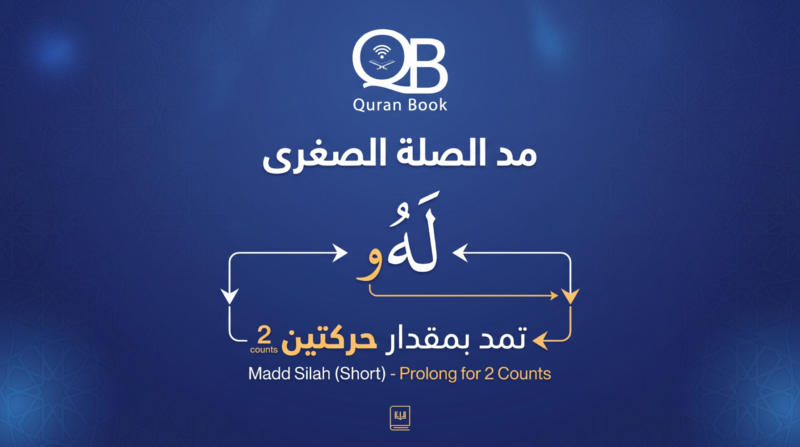
In Madd Silah, the madd letter is not written as a full letter on the baseline; it may be indicated by a small waw or yaa above or below the pronoun ha’.
A learner recites وَلَمْ يَكُن لَّهُۥ كُفُوًا أَحَدٌ but pronounces the هُ short, without the connecting stretch the rule requires. Nothing appears to signal the mistake because no full alif, waw or yaa is written on the baseline to indicate the stretch. In some Mushaf editions, only a small waw or yaa marks the connection. That is Madd Silah (also spelled Madd Sila) — the lengthening produced when the pronoun ha’ is connected to the following word.
One letter, two forms, one question. Silah Sughra is 2 counts. Silah Kubra is 4 or 5 counts. The only thing separating them is whether the next word begins with a hamzah. Every count on this page follows the riwayah of Hafs ‘an ‘Asim by the way of Ash-Shatibiyyah. Madd Silah belongs to the wider family of madd rules, which is one chapter of the Tajweed rules.
What Is Madd Silah in Tajweed?
Madd Silah (مد الصلة) is the lengthening of the pronoun ha’ (هـ) when it falls between two vowelled letters. The ha’ is stretched with an unwritten waw if it carries a dammah, or an unwritten yaa if it carries a kasrah. It is 2 counts (Sughra) or 4–5 counts (Kubra).
Silah means connection. The madd exists to connect the pronoun to the word after it, so the ha’ is never left hanging in the middle of a sentence. Once you know that, the name stops being arbitrary: this is the connecting madd, and it exists only while you are joining one word to the next.
Which ha’ is it? Only the ha’ ad-damir (هاء الضمير), also called ha’ al-kinayah — the ha’ that stands for a third-person singular masculine referent: his, him or it. The ha’ in وَجْه, نَفْقَهُ or ٱللَّهُ is part of the word itself, not a pronoun, and takes no silah. (Watch the letter too: the final letter of فَاكِهَةٌ is a taa marbutah ة, not a ha’ ه — it is not a candidate for silah in the first place.) Run this test before every rule below: is this ha’ ha’ al-kinayah? If not, silah normally does not apply.
One word breaks the test, and you should learn it now: هَٰذِهِۦ. The ha’ in هَٰذِهِ is not a pronoun — it belongs to the demonstrative itself — yet Hafs treats it like ha’ al-kinayah for silah, and the Madinah mushaf prints the small yaa on it: إِنَّ هَٰذِهِۦ تَذْكِرَةٌ (Al-Muzzammil 73:19). Being treated like a pronoun ha’ does not mean it is always stretched — the joining conditions still decide. In وَهَٰذِهِ ٱلْأَنْهَٰرُ (Az-Zukhruf 43:51) the next letter is the sakin lam of ال, so there is no silah at all.
One line on the unit of measure: a count (harakah) is the time it takes to open or close one finger at a steady pace. It is relative to your own tempo, not a fixed number of seconds.
Madd Silah Pronunciation
After a dammah the ha’ becomes a pure oo: هُ → hoo. After a kasrah it becomes a pure ee: هِ → hee. Keep the vowel pure and the length steady: no ghunnah, no break in the middle of the stretch, and the mouth does not move until it is finished. A natural rise or fall in tone is not itself a mistake — distorting the vowel or chopping the madd into pulses is. Hear the word on its own first, then inside the ayah:
Transliteration matters more here than on any other madd page: lahu and lahoo are the entire lesson.
Riwayah note. Every count on this page follows Hafs ‘an ‘Asim by the way of Ash-Shatibiyyah. Madd Silah is one of the rules where the riwayat genuinely differ, and several of the words below are read another way in other narrations. This page does not cover them.
The Madd Silah Letter You Cannot See
In Madd Silah, no full madd letter is written on the baseline. Instead, some Mushaf editions mark the connection with a small waw after a dammah or a small yaa after a kasrah. Other editions may leave the ha’ without this additional sign, so the reciter must recognise the rule from ha’ al-kinayah and the surrounding letters.
| The ha’ carries | You add | It sounds like | Mushaf mark |
|---|---|---|---|
| هُ dammah | an unwritten waw و | hoo | small waw ـۥ |
| هِ kasrah | an unwritten yaa ي | hee | small yaa ـۦ |
Not every mushaf prints that mark. Madinah-script copies show the small waw and small yaa clearly. Some other printings mark them differently or leave the ha’ bare, and the reciter is expected to apply the rule from the grammar alone. That single fact is why the pronoun test below matters more on this page than on any other madd page.
Three words, three different ha’s. Listen to them back to back and the difference stops being theoretical:
The Rules and Conditions of Madd Silah
Five conditions. As a general rule: if all five hold you have a silah, and if one fails you normally do not. Hafs also transmits two special cases that sit outside this framework and are memorised exactly as they were received — you will meet both further down the page.
1. The ha’ must be ha’ al-kinayah — the pronoun meaning his, him or its.
✅ بِعَبْدِهِۦ ❌ وَجْه ❌ نَفْقَهُ
Transmitted case: هَٰذِهِ is not a pronoun ha’, but is treated like one for silah when the joining conditions hold.
2. The letter before it must be vowelled — not sakin.
✅ إِنَّهُۥ ❌ مِنْهُ (noon sakinah) ❌ إِلَيْهِ (yaa sakinah — this is Madd Lin territory, not silah)
3. The letter after it must be vowelled — not sakin.
✅ لَّهُۥ كُفُوًا ❌ لَهُ ٱلْمُلْكُ (the lam of ال is sakin)
4. The ha’ itself must be vowelled — not sakin.
✅ يَرَهُۥ ❌ فَأَلْقِهْ (An-Naml 27:28 — a sakin ha’ in Hafs, so no silah)
5. You must be continuing, not stopping.
✅ يَرَهُۥ joined to the next word ❌ يَرَهْ at a stop
Madd Silah depends on the ha’ itself and on the letters around it. Conditions 1 and 4 are about the ha’ — its identity and its vowel. Conditions 2, 3 and 5 are about what surrounds it. That second half is why the very same pronoun can take a silah in one ayah and none in another.
Madd Silah Sughra (The Lesser Connection)
Silah Sughra is 2 counts, and it applies when the next word begins with any letter other than a hamzah. It is a branch of Madd Asli: the same fixed length, the same absence of a cause, and no choice for the reciter. If you can already hold a natural madd for two counts, you can already read a Silah Sughra — you just have to notice it is there.
And it is everywhere. Silah Sughra occurs frequently throughout the Quran. It is frequently shortened by learners because the full madd letter is not written on the baseline, and the person clipping it usually has no idea the rule exists. Four examples, word first, then the whole ayah:
Madd Silah Kubra (The Greater Connection)
Silah Kubra is 4 or 5 counts, and it applies when the next word begins with a hamzah qat’ (ء أ إ آ). This one is a Far’i madd — a branched madd with a cause — and it is the exact twin of Madd Jaiz Munfasil: a madd letter at the end of one word meeting a hamzah at the start of the next. The only difference is that here the madd letter is unwritten. The same hamzah, met inside a single word, would give you Madd Wajib Muttasil instead.
Choose one length and keep it. Whether you read 4 counts or 5, that choice applies to every Munfasil and every Silah Kubra in the same recitation. It is not a word-by-word decision. Sheikh Al-Husary reads 4, which is what you hear in every clip on this page.
The best teaching pair on the page. Al-Kahf 18:110 contains the word رَبِّهِۦ twice. The first one is 2 counts, the second is 4. The word did not change. The next word did.
One more trap worth naming: in مَالَهُۥٓ أَخْلَدَهُۥ the first ha’ is a Kubra, and the second sits at the end of the ayah — so if you stop there, it takes no silah at all.
Madd Silah Kubra vs Sughra
In isolation the two lengths are almost impossible to judge. Side by side, in the same voice, they are unmistakable. Play them one after the other:
SUGHRA · 2 COUNTS
لَّهُۥ كُفُوًا
KUBRA · 4 COUNTS
مَالَهُۥٓ أَخْلَدَهُۥ
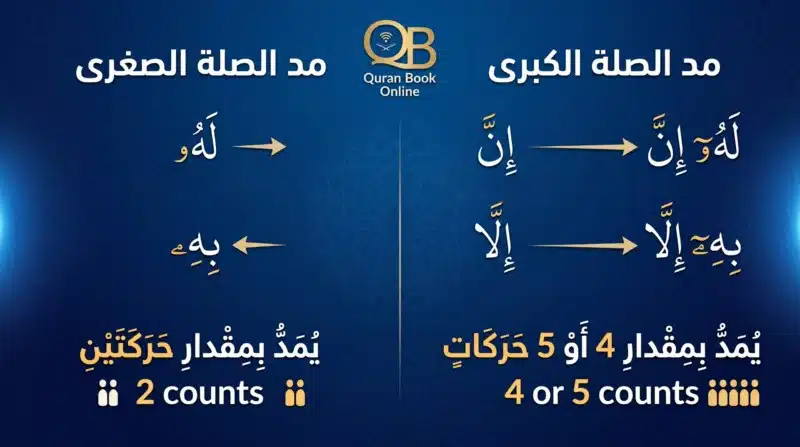
One pronoun ha’, two roads — and the next word chooses the road.
| Silah Sughra الصلة الصغرى | Silah Kubra الصلة الكبرى | |
|---|---|---|
| Next word starts with | any letter except a hamzah | a hamzah qat’ ء أ إ آ |
| Length | 2 counts | 4 or 5 counts |
| Family | Madd Asli (natural) | Madd Far’i (branched) |
| Ruling | fixed — no choice | permissible — choose 4 or 5, then stay consistent |
| Twin rule | Madd Asli | Madd Jaiz Munfasil |
| Frequency | very common | uncommon |
| Example | إِنَّهُۥ كَانَ | مَالَهُۥٓ أَخْلَدَهُۥ |
Sughra and Kubra are not two rules. They are one rule meeting two different next words — and the ha’ does not change at all. Only what follows it does.
When There Is No Madd Silah at All
Learning the rule creates a second problem: the reader starts saying hoo after every ha’ they meet. These five cases are the cure, and they are the ones you will meet first.
Sukoon before the ha’ — مِنْهُ · عَلَيْهِ · إِلَيْهِ · فِيهِ. A sakin letter cannot be connected across, so there is no silah.
It is not a pronoun ha’ — وَجْه · نَفْقَهُ · ٱللَّهُ. (هَٰذِهِ is the transmitted case: not a pronoun, but treated like one for silah when the conditions hold.) In وَجْهَهُۥ the first ha’ is a root letter and the second is the pronoun: only the second one can ever take a silah.
Stopping removes the connecting sound of the ha’, but this does not automatically create Madd ‘Arid lis-Sukoon; that rule applies only when its own conditions are present.
The Special Cases in Hafs
Two special cases in Hafs do not follow the general conditions described above. Their recitation is transmitted through the riwayah rather than derived from the general rule: one takes silah despite a sakin letter before the ha’, while the other takes no silah despite meeting the usual conditions.
To hear how strange يَرْضَهُ لَكُمْ really is, play the silah that appears at the end of the very same ayah: Same reciter, same ayah, one held and one not.
Madd Silah Examples in the Quran
Ten Madd Silah examples from the Quran, ordered by difficulty rather than by page: eight live silahs and two cases where the rule does not apply. The last two rows are deliberate — a table of nothing but valid silahs teaches the eye to stretch every ha’ it meets.
| # | Word | Reference | Type | Counts | Listen |
|---|---|---|---|---|---|
| 1 | لَّهُۥ كُفُوًا lahoo kufuwan | Al-Ikhlas 112:4 | Sughra | 2 | |
| 2 | إِنَّهُۥ كَانَ innahoo kaana | An-Nasr 110:3 | Sughra | 2 | |
| 3 | بِعَبْدِهِۦ لَيْلًا bi’abdihee laylan | Al-Isra 17:1 | Sughra | 2 | |
| 4 | حَوْلَهُۥ لِنُرِيَهُۥ hawlahoo linuriyahoo | Al-Isra 17:1 | Sughra ×2 | 2 | |
| 5 | سَبِيلَهُۥ فِى sabeelahoo fee | Al-Kahf 18:63 | Sughra | 2 | |
| 6 | مَالَهُۥٓ أَخْلَدَهُۥ maalahooo akhladah | Al-Humazah 104:3 | Kubra | 4–5 | |
| 7 | رَبِّهِۦٓ أَحَدًۢا rabbiheee ahadaa | Al-Kahf 18:110 | Kubra | 4–5 | |
| 8 | عِندَهُۥٓ إِلَّا بِإِذْنِهِۦ ‘indahooo illaa bi idhnih · full ayah | Al-Baqarah 2:255 | Kubra | 4–5 | |
| 9 | لَهُ ٱلْمُلْكُ lahul-mulk | At-Taghabun 64:1 | No silah — sakin after | — | |
| 10 | يَرَهُۥ yarah at a stop | Az-Zalzalah 99:7 | No silah — stopping | — |
Madd Silah Examples in Surah Al-Ikhlas and Ayat al-Kursi
Al-Ikhlas is the cleanest Sughra in the Quran and almost everyone has it memorised. The whole surah contains exactly one Madd Silah, in the final ayah: وَلَمْ يَكُن لَّهُۥ كُفُوًا أَحَدٌ. The هُ is a pronoun, the letter before it is vowelled, the next word starts with ك — so it is two counts, and it is the one most people cut short.
Ayat al-Kursi is one of the most widely memorised and frequently recited long verses and it carries all three states at once: لَّهُۥ مَا (Sughra), عِندَهُۥٓ إِلَّا and عِلْمِهِۦٓ إِلَّا (Kubra), and كُرْسِيُّهُ ٱلسَّمَٰوَٰتِ (no silah — the next letter is sakin). Tap the colours off and test yourself:
blue = Sughra · orange = Kubra · grey = no silah
بِإِذْنِهِۦ is the one that depends on you: continue into يَعْلَمُ and it is a Silah Sughra of 2 counts; stop at the waqf mark and the silah drops.
5 Common Madd Silah Mistakes
1. Cutting the ha’ dead. The default error, because nothing on the line asks for a stretch. لَّهُۥ كُفُوًا read as lahu kufuwan instead of lahoo kufuwan.
2. Stretching every ha’ you see. The over-correction that follows learning the rule: وَجْه · ٱللَّهُ · نَفْقَهُ all get a hoo, although their ha’ is part of the word itself. Identify ha’ al-kinayah first, then apply the silah.
3. Giving Kubra only 2 counts. Sughra is met first, so every silah gets treated as a Sughra. مَالَهُۥٓ أَخْلَدَهُۥ clipped to two.
4. Keeping the silah when you stop. yarahoo at the end of the ayah. The connection has nothing left to connect to.
5. Distorting the stretch. A ghunnah on the hoo, a wobble that breaks it into separate pulses, or a shift in the vowel itself part-way through. Melody is not the problem — changing the sound of the letter or cutting the count short is.
Practise Madd Silah
Two drills. The first trains the only decision this page rests on. The second stops you applying the rule where it does not belong.
Drill 1 — Sughra or Kubra?
Look at the word after the pronoun. If it starts with a hamzah, you are holding 4 or 5. If not, 2.
QUESTION 1 / 12 · SCORE 0
Drill 2 — Is There a Silah at All?
Six cards. Some are silahs, some fail one of the five conditions. The feedback names the condition that failed.
CARD 1 / 6 · SCORE 0
Want the full pronoun-ha’ hunt with decoys? It lives in our free Tajweed games.
Play: The Madd Silah Circle (Free Game)
Recognition on a page and recognition under time pressure are two different skills. Spot the pronoun ha’ that takes a connection and let the rest go past. It works on phones and tablets, and no account is needed.
Game not loading? Open it in a new tab · or browse all our free Tajweed games · the full counts table lives on the madd rules hub.
Learn More
Madd Silah only makes sense inside its family. Madd Asli is the baseline your Silah Sughra is measured against — the same two counts under a different name. Madd Badal is the other 2-count madd that looks as if it should be longer, and learners confuse the two constantly. Madd Wajib Muttasil has the same hamzah cause as your Silah Kubra, but inside one word instead of across two; the position of the hamzah is what separates the two rules, not the length — in Hafs by the way of Ash-Shatibiyyah, Muttasil is read 4 or 5 counts as well. The 4–5 you hold on a Kubra comes from the transmitted riwayah and tariq, not from counting words. And Madd Lazim provides the fixed six-count benchmark in this madd family, so it shows you how much freedom Kubra’s 4-or-5 really gives you.
Madd Rules
All ten madds and the full counts table
2 COUNTSMadd Asli
The natural madd your Sughra copies
2 COUNTSMadd Badal
Hamzah first, madd second
4–5 COUNTSMadd Wajib Muttasil
The same hamzah, inside one word
6 COUNTSMadd Lazim
The fixed six-count madd
4–5 COUNTSMadd Jaiz Munfasil
Silah Kubra’s twin rule
2 · 4 · 6Madd ‘Arid lis-Sukoon
What happens when you stop
2 · 4 · 6Madd Lin
Why عَلَيْهِ is not a silah
The rest of the chapter: Tajweed Rules · Rules of Meem Sakinah · Noon Sakin Rules · Qalqalah Letters · Tajweed for Adults · Tajweed for Kids
Madd Silah FAQ
What is Madd Silah?
Madd Silah (مد الصلة) is the lengthening of the pronoun ha’ (هـ) when it sits between two vowelled letters. The ha’ is stretched with an unwritten waw after a dammah or an unwritten yaa after a kasrah — 2 counts for Sughra, 4 or 5 for Kubra.
Is it spelled Madd Silah or Madd Sila?
Both refer to the same rule. Silah (صلة) means connection in Arabic, and the final h is only a transliteration choice. You will also see silla and sillah.
What is the difference between Madd Silah Sughra and Kubra?
Only the next word. If it begins with a hamzah, the silah is Kubra and held 4 or 5 counts. If it begins with anything else, it is Sughra and held exactly 2.
How many counts is Madd Silah?
Sughra is 2 counts and fixed. Kubra is 4 or 5, and whichever length you choose must stay the same across the whole recitation.
Which ha’ takes Madd Silah?
Ha’ al-kinayah — the pronoun ha’ (هاء الضمير) standing for a third-person singular masculine referent: his, him or it. The ha’ in وَجْه, نَفْقَهُ or ٱللَّهُ is part of the word itself and takes no silah. The one case to memorise is هَٰذِهِ: not a pronoun ha’, yet treated like one for silah in Hafs — إِنَّ هَٰذِهِۦ تَذْكِرَةٌ takes the silah, while وَهَٰذِهِ ٱلْأَنْهَٰرُ does not, because a sakin follows.
Why can’t I see the madd letter in the mushaf?
Because it is not written on the line. Madinah-script copies mark it with a small waw (ـۥ) or a small yaa (ـۦ); some other printings use a different sign for the same job, and others leave it unmarked, so you apply the rule from the surrounding letters.
Does Madd Silah apply when I stop on the ha’?
No. The silah connects the pronoun to the next word, so when you stop there is nothing left to connect to and the ha’ is read with a plain sukoon.
Why is there no silah in مِنْهُ or عَلَيْهِ?
The letter before the ha’ is sakin in both. Madd Silah requires a vowelled letter on each side of the pronoun ha’.
What are the special cases of Madd Silah in Hafs?
Two special cases are highlighted in Hafs. فِيهِۦ مُهَانًا (Al-Furqan 25:69) takes silah although the letter before the ha’ is sakin, while يَرْضَهُ لَكُمْ (Az-Zumar 39:7) takes no silah although the usual conditions are met. Both readings are transmitted through the riwayah rather than derived from the general rule.
Is Madd Silah Sughra a natural madd?
Yes. Silah Sughra is a branch of Madd Asli — 2 counts, no cause and no choice of length. Silah Kubra is a Far’i madd, caused by the hamzah after it.
Hear the Ha’ You Have Been Missing
Madd Silah is invisible on the page and inaudible to the person reciting — but a teacher hears the missing hoo in the first ayah. One lesson is usually enough to hear it forever.
Book Your Free Trial Lesson →ABOUT THE AUTHOR
Hafidha of the Quran · Arabic Language Graduate · Writer on Islamic Sciences
Jehad Mahmoud is a graduate of the Arabic Language department and a Hafidha of the Quran who writes the Islamic educational content at Quran Book Academy.
She writes with a focus on Tajweed, Quranic recitation and the sharia sciences, making technical rules accessible to English-speaking Muslim families.
Her articles are educational, not fatwa. For a ruling on a specific personal situation, readers are advised to consult a qualified scholar or mufti.
References & Sources
1. Al-Azhar Al-Sharif — azhar.eg
2. Sulayman al-Jamzuri, Tuhfat al-Atfal — the chapter on the madd letters and their lengths
3. Ayat cited in this article — Quran.com (Al-Ikhlas 112:4 · Al-Isra 17:1 · An-Nasr 110:3 · Al-Humazah 104:3 · Al-Baqarah 2:255 · Al-Kahf 18:63 and 18:110 · At-Taghabun 64:1 · Az-Zalzalah 99:7 · Al-Furqan 25:69 · Az-Zumar 39:7 · An-Naml 27:28)
4. Recitation — Sheikh Mahmoud Khalil Al-Husary (Hafs, murattal), audio via EveryAyah.com, word timings via Quran.com
© 2026 Quran Book Academy. All rights reserved.
Book Your Free Trial · Empowering Muslims Worldwide to Connect with the Quran