
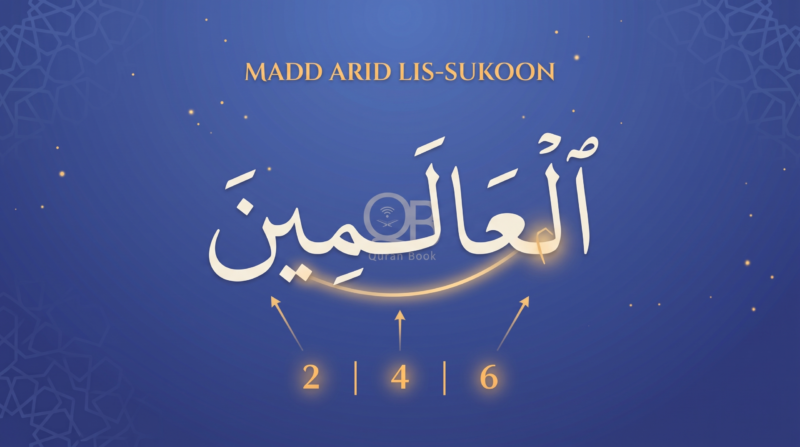

You reach the end of the ayah — رَبِّ الْعَالَمِينَ — and you take a breath. In that instant the yaa stopped being an ordinary two-count madd and became a decision. That is Madd Arid Sukoon: the Madd Arid Lis-Sukoon tajweed rule that only exists when you stop, and that is held for 2, 4 or 6 counts. It belongs to the Madd rules chapter of Tajweed rules. All counts here follow Hafs ‘an ‘Asim by the way of Ash-Shatibiyyah.
Also written Madd Arid As-Sukoon, Madd Aridh Lis-Sukoon, Madd Arid Lissukoon or Madd Arid Lis-Sukun — in Arabic, المد العارض للسكون. All one rule.
⚡ The 30-second version (the ordinary form taught here): a madd letter (ا · و · ي) sits immediately before the last letter of a word · you stop on that word · your stop creates a temporary sukoon · hold the madd for 2, 4 or 6 counts · and keep to the same length across the comparable stops in one sitting. All three lengths are valid in Hafs ‘an ‘Asim; this page shows you how to settle on one and hold it.
What Is Madd ‘Arid lis-Sukoon?
Madd ‘Arid lis-Sukoon (المد العارض للسكون) happens when a madd letter — alif (ا), waw (و) or yaa (ي) — is the second-to-last letter of a word and you stop on that word. The temporary sukoon arises when you stop on the final consonant, and the madd is then lengthened to 2, 4 or 6 counts. If you continue reading, it disappears.
Scope of this page: This page focuses on the ordinary Madd Asli-based form of Madd ‘Arid lis-Sukoon at a stop with full sukoon. Cases involving another existing madd cause, such as Madd Wajib Muttasil, follow additional stopping rules. For example, a word-final Madd Muttasil such as يَشَاءُ does not become a two-count madd when you continue, and its options at a stop depend on the applicable Hafs via Ash-Shatibiyyah rules and the length already chosen for Madd Muttasil in that recitation.
Madd ‘Arid lis-Sukoon Meaning
Every word of the name is doing work, which is why the name is the rule. Madd is lengthening. ‘Arid means temporary, newly-presented, accidental — something that was not there a moment ago. Lis-sukoon means “because of the sukoon.” Read literally: the lengthening that appears temporarily because of a sukoon. Learn the name properly and you never need to memorise a definition.
📖 The sentence that unlocks the whole rule
The sukoon is not written in the mushaf. The temporary sukoon arises when you stop on the final consonant. In the ordinary form taught here, continue past the word and the final letter takes its normal vowel back, the sukoon never forms, and the madd is a plain two-count Madd Asli.
What is a count? A harakah (count, or beat) is the time it takes to open or close one finger at a steady, unhurried pace. It is relative to your own recitation speed, not a fixed number of seconds. All counts on this page follow Hafs ‘an ‘Asim by the way of Ash-Shatibiyyah.
Why This Madd Only Exists When You Stop
Most madd rules are a property of the text. The hamzah is there or it is not; the shaddah is there or it is not. This one is different — it is a property of your waqf. The same word, in the same ayah, follows two different rules depending on nothing but whether you stopped there. Two other rules on this page behave the same way — Madd Lin at a stop, and Madd ‘Iwad when you stop on a tanween fath (other than on a taa marbutah) — so stop-dependence is a family trait, not something unique to ‘Arid. Hear it for yourself:
رَبِّ الْعَالَمِينَ
Continue → Madd Asli, 2 counts, no choice · Stop → Madd ‘Arid lis-Sukoon, 2 / 4 / 6
الرَّحْمَٰنِ الرَّحِيمِ
Continue → Madd Asli, 2 counts · Stop → Madd ‘Arid lis-Sukoon, 2 / 4 / 6
The madd is not a property of the word — it is a property of your waqf.
This is why no symbol for Madd ‘Arid lis-Sukoon is printed in the mushaf. You can identify the potential locations in advance — any word whose second-to-last letter is a madd letter is a candidate (unless the final letter is a hamzah, as in يَشَاءُ — that is Madd Wajib Muttasil, which follows additional stopping rules), and the four ending patterns further down let you spot them at a glance — but whether the rule actually applies is decided at the moment you stop. The length you hold is the one you have chosen to practise; it is not dictated by how much breath is left.
The Rules and Conditions of Madd ‘Arid lis-Sukoon
Three conditions, and the third one is yours to control:
1 · There is a madd letter
A sakinah ا, و or ي, with the matching vowel before it — fathah before alif, dammah before waw, kasrah before yaa. ✅ الْكِتَابُ ❌ الْكَوْثَرَ — that waw follows a fathah, so it is a layn letter, not a madd letter.
2 · Exactly one letter follows it, and it is the last letter of the word
This is the condition that is easiest to overlook, and most misidentifications trace back to it. ✅ نَسْتَعِينُ (ي then ن) ❌ يُولَدْ — the waw is a madd letter and the word does end in sukoon, but there is a ل in between. That one stays Madd Asli.
3 · You stop on that word
✅ stopping on الْمُفْلِحُونَ ❌ reading straight through it — then it is Madd Asli at two counts and nothing more.
All three must be true at the same moment. Whether this madd applies at all is decided by where you choose to stop — as it is for Madd Lin at a stop, and for Madd ‘Iwad on a tanween fath (except on a taa marbutah).
These conditions describe the ordinary form taught on this page. If the final letter is a hamzah — as in يَشَاءُ — the madd already has a cause of its own (Madd Wajib Muttasil). It does not drop to two counts when you continue, and its stopping options follow additional rules that are not covered here.
How Many Counts Is Madd ‘Arid lis-Sukoon? 2, 4 or 6
Two, four or six counts. All three are correct in Hafs ‘an ‘Asim by the way of Ash-Shatibiyyah, and the reciter chooses which one to use. None of the three is reserved for a particular reading speed — what changes with your pace is how long a single count lasts, not which lengths are permitted.
| Length | Arabic name | Counts | Status |
|---|---|---|---|
| Short | qasr · قصر | 2 | Valid. Often paired with a brisk pace (hadr), but permitted at any pace. |
| Medium | tawassut · توسط | 4 | Valid. Often paired with a moderate pace (tadweer), but permitted at any pace. |
| Long | tool · طول | 6 | Valid. Often paired with slow, measured recitation (tarteel), but permitted at any pace. |
Why three lengths at all? Because the sukoon here is temporary. The scholars placed this madd between Madd Asli — natural madd, which needs no hamzah or sukoon after the madd letter at all and is fixed at 2 — and Madd Lazim, whose sukoon is permanent and which is held for 6 (with one known exception, noted in the comparison below). A temporary cause earns a flexible ruling — and the whole thing stops looking arbitrary. For how every madd type compares side by side, the full counts table lives on the Madd rules hub.
The 2-4-6 Practice-Target Selector · Surah Al-Fatihah
Pick the length you intend to practise. It sets the same target for every ‘Arid madd in the surah at once — never just one. That is the consistency habit, built into the interface instead of written as a sentence.
Your practice target: 2 counts. The reference recording does not change with this selection.
This selector changes the labels and the beat bar only. There is one recording on this page and it plays exactly as recorded — the buttons cannot alter it, and nothing here is sped up, slowed down or cut short to imitate a different count.
Tap a line to hear it.
Audio is Sheikh Al-Husary’s own recitation (murattal, Hafs ‘an ‘Asim). Use it to hear how each ayah ending is shaped and where the stop falls. Use the beat bar separately, when you recite on your own, as the target for the length you have chosen — do not try to hold your own count against his in the same breath.
Which Length Should I Choose — 2, 4 or 6?
All three lengths are valid — pick one and practise it. Two, four and six counts are each permitted in Hafs ‘an ‘Asim by the way of Ash-Shatibiyyah, and none of them is tied to a particular reading speed. What your pace changes is the duration of a single count: recite quickly and a count is short, so six counts pass quickly too; recite slowly and every count stretches, including a two-count madd. Measure the counts against the pace you are actually reciting at, and the length you chose will sit naturally inside it.
Then stay consistent. Once you have chosen, apply that same length to the comparable ‘Arid stops in the same sitting. Reciting الْعَالَمِينَ at six counts and الرَّحِيمِ at two inside the same Fatihah is what sounds unsettled — not the two, and not the six. This is guidance about comparable Madd ‘Arid stops; it is not a rule that every madd in the Quran, or every possible way of stopping, must share one length.
A note on rawm and ishmam
Rawm (روم) is sounding a faint trace of the final vowel as you stop. It applies only to eligible endings whose original vowel is a kasrah or a dammah — not to a fathah. On the ordinary Madd ‘Arid endings taught on this page, stopping with rawm means the madd is read at two counts, because a full sukoon was never applied to the final letter.
Ishmam (إشمام) — rounding the lips after the stop, with no sound — applies only to eligible endings whose original vowel is a dammah. It does not affect the length; all three remain available. Both are refinements to take up with a teacher; neither changes the plain stop you are learning here.
✅ A practical way to start
If you would rather not choose, 4 is one reasonable practice target to begin with: it is long enough that you can hear your own length and correct it. Two and six are equally valid, so take your teacher’s guidance over any default suggested on a page. Practise one consistently with your teacher, measuring the counts according to your recitation pace.
How to Pronounce Madd ‘Arid lis-Sukoon
1 · Keep the vowel continuous for the whole length
Keep the vowel continuous and preserve the correct madd length. Avoid breaking the sound or introducing extra vowels or consonants. A reciter’s voice naturally rises and falls, and that on its own is not a Tajweed error — what damages the madd is fragmenting it: a gap, a catch in the throat, a re-attack halfway through, or a stray vowel appearing inside the stretch. One unbroken sound, held for the length you chose.
2 · Pronounce the final consonant clearly, with no vowel after it
Pronounce the final consonant clearly with its proper characteristics, without adding a vowel after it. Sukoon means the absence of a vowel — not the omission of the letter and not a whispered version of it. Stopping on الْعَالَمِينَ, the noon is still fully articulated and audible, with its ghunnah, and simply carries no vowel: …meen, not …meena and not …meenuh.
3 · Madd + qalqalah, when the final letter bounces
If that final letter is one of ب ج د ط ق, you get both rules at once: hold the madd for your chosen length, then give the final letter its qalqalah bounce. Qalqalah is the one place where the vowel-less final letter is released with an audible echo of its own — it is a separate rule, and it does not contradict the point above. See the full set of Qalqalah letters.
لَبِالْمِرْصَادِ
Al-Fajr 89:14 · hold the alif, then bounce the daal
How to Spot It in 3 Steps
You can see the candidates on the page; it is your stop that turns one into this madd.
Madd ‘Arid lis-Sukoon Examples in the Quran
Start with Surah Al-Fatihah, because you already know the text and no new vocabulary gets in the way. All seven verse endings of Al-Fatihah, using the numbering shown here, contain Madd ‘Arid lis-Sukoon when stopped on. The seventh is the interesting one, because it carries two different madds at once. In الضَّالِّينَ, the alif has Madd Lazim at six counts, while the final yaa has Madd ‘Arid lis-Sukoon at 2, 4 or 6 counts. The one does not cancel the other. The madd letter is marked in blue, the letter you stop on in orange. Every Word button plays from that word to the end of the ayah in Al-Husary’s voice.
The walkthrough above is inside the Length Selector — set your register there first, then use these rows for the wider set.
Madd ‘Arid lis-Sukoon Quran Examples · 13 verse endings
الْحَمْدُ لِلَّهِ رَبِّ الْعَالَمِينَ
Al-Fatihah 1:2 · yaa → noon · if you continue: Madd Asli, 2
الرَّحْمَٰنِ الرَّحِيمِ
Al-Fatihah 1:3 · yaa → meem · if you continue: Madd Asli, 2
مَالِكِ يَوْمِ الدِّينِ
Al-Fatihah 1:4 · yaa → noon · if you continue: Madd Asli, 2
وَإِيَّاكَ نَسْتَعِينُ
Al-Fatihah 1:5 · yaa → noon · if you continue: Madd Asli, 2
الصِّرَاطَ الْمُسْتَقِيمَ
Al-Fatihah 1:6 · yaa → meem · if you continue: Madd Asli, 2
وَلَا الضَّالِّينَ
Al-Fatihah 1:7 · two madds in one word. The alif before the doubled lam is Madd Lazim Kalimi Muthaqqal — six counts, fixed. The final yaa before the noon is Madd ‘Arid lis-Sukoon when you stop — 2, 4 or 6, your choice. The alif’s six counts do not cancel the yaa’s choice.
هُدًى لِّلْمُتَّقِينَ
Al-Baqarah 2:2 · yaa → noon · if you continue: Madd Asli, 2
وَأُولَٰئِكَ هُمُ الْمُفْلِحُونَ
Al-Baqarah 2:5 · waw → noon · the ـُونَ pattern that ends hundreds of ayat
قُلْ يَا أَيُّهَا الْكَافِرُونَ
Al-Kafirun 109:1 · waw → noon · ayat 1, 2 and 6 of this surah end in one; ayat 3–5 do not
لَكُمْ دِينُكُمْ وَلِيَ دِينِ
Al-Kafirun 109:6 · yaa → noon · When stopping on دِينِ, the yaa has Madd ‘Arid lis-Sukoon at 2, 4 or 6 counts.
قُلْ أَعُوذُ بِرَبِّ النَّاسِ
An-Nas 114:1 · alif → seen · the ـَاسِ pattern
الْوَسْوَاسِ الْخَنَّاسِ
An-Nas 114:4 · alif → seen · same pattern, three ayat later
إِنَّ رَبَّكَ لَبِالْمِرْصَادِ
Al-Fajr 89:14 · alif → daal · madd and qalqalah at the stop
Madd ‘Arid lis-Sukoon Words: Learn the Ending, Not the Word
Once you notice that most ayat in the Quran close on one of four or five endings, you stop identifying this madd word by word — you start recognising the shape. These four patterns cover the overwhelming majority of stops you will ever make:
| Ending | Madd letter | Examples |
|---|---|---|
| ـُونَ / ـِينَ | waw / yaa | يَعْمَلُونَ · الصَّابِرِينَ · تُفْلِحُونَ · الْمُتَّقِينَ |
| ـِيمِ / ـِيمٌ | yaa | عَظِيمٌ · حَكِيمٌ · الْحَكِيمُ · الرَّحِيمِ |
| ـَابُ / ـَابٍ | alif | الْكِتَابُ · حِسَابٍ · الْعِقَابِ |
| ـَاسِ | alif | النَّاسِ · الْخَنَّاسِ · الْوَسْوَاسِ |
🎧 The consistency demo: three stops, one length
Play ayat 1, 2 and 6 of Surah Al-Kafirun in order. Each of these three ends in a Madd ‘Arid lis-Sukoon when you stop there — الْكَافِرُونَ, تَعْبُدُونَ and دِينِ. Ayat 3, 4 and 5 are left out on purpose: they end in أَعْبُدُ, عَبَدتُّمْ and أَعْبُدُ, with no Madd ‘Arid at the ending. Listen for whether each of the three endings sounds like the one before it. That comparison, ending against ending, is what consistency means in practice; then try the same three stops in your own voice at the length you are practising.
Madd ‘Arid lis-Sukoon vs Madd Lazim vs Madd Lin
All three involve a sukoon, which is exactly why learners confuse them. Compare them letter by letter — and note that a single word can contain more than one of them:
| Feature | Madd ‘Arid lis-Sukoon | Madd Lazim | Madd Lin |
|---|---|---|---|
| Cause | Temporary sukoon that arises when you stop on the final consonant | Permanent sukoon or shaddah written in the mushaf | Layn letter + temporary sukoon from stopping |
| Letter before | Madd letter (ا/و/ي, matching vowel) | Madd letter | Layn letter — وْ or يْ after a fathah |
| Counts | 2, 4 or 6 — you choose | 6 — normally fixed. Known exception: the ‘Ayn in the opening letters of Maryam (كهيعص) and Ash-Shura (عسق), where Hafs via Ash-Shatibiyyah permits 4 or 6 | 2, 4 or 6 — you choose |
| Exists when continuing? | No — in the ordinary form taught here, it becomes Madd Asli (a word-final Madd Muttasil such as يَشَاءُ does not) | Yes, always | No |
| Example | The final yaa of الْعَالَمِينَ, at a stop | The alif before the doubled lam in الضَّالِّينَ | The yaa of وَالصَّيْفِ, at a stop |
| Listen |
One word, two madds: الضَّالِّينَ
This word appears in the Madd Lazim column because of its alif, not because the whole word is Lazim. The alif before the doubled lam is Madd Lazim Kalimi Muthaqqal at six counts. The final yaa before the noon is a separate madd letter, and when you stop on the word it carries Madd ‘Arid lis-Sukoon at 2, 4 or 6 counts like any other verse ending. The alif’s fixed six counts do not cancel the yaa’s choice — the two madds sit in the same word and are governed independently.
The verdict line: judge each madd letter on its own. If the sukoon after it is written in the mushaf, that letter is Lazim and it is normally 6. If the sukoon after it arises only because you stopped, it is ‘Arid — unless that letter is a layn letter rather than a madd letter, in which case it is Madd Lin, which has its own conditions and its own page.
6 Common Madd ‘Arid lis-Sukoon Mistakes
1 · Changing length between comparable stops
Six counts on الْعَالَمِينَ, two on الرَّحِيمِ. All three lengths are correct in themselves; drifting between them across the comparable ‘Arid stops of one sitting is what sounds unsettled.
2 · Applying it while continuing
Stretching الْعَالَمِينَ to four counts and then reading straight on into الرَّحْمَٰنِ. If you did not stop, there is no ‘Arid madd at all.
3 · Adding a vowel to the final letter — or swallowing the letter
Ending الْمُفْلِحُونَ as …hoona or …hoonuh is one error; trailing off so the noon barely sounds at all is the opposite one. Pronounce the final consonant clearly with its proper characteristics, without adding a vowel after it.
4 · Treating الضَّالِّينَ as one madd instead of two
Shortening the alif before the doubled lam to two or four counts — it is Madd Lazim at six, with no choice. And the mirror error: assuming that because of the alif, the final yaa loses its Madd ‘Arid lis-Sukoon. It does not. When you stop, the yaa takes 2, 4 or 6 counts like every other verse ending. Identify the letter first, then apply its rule.
5 · Treating a layn ending as ‘Arid
خَوْفٍ · الصَّيْفِ · بَيْتٍ — those are Madd Lin. Same 2/4/6 options, different letter, different rule.
6 · Breaking or distorting the prolonged vowel
A gap, a catch, a re-attack halfway through, or an extra vowel or consonant creeping into the stretch — and, most often, the length collapsing as the voice wavers. Keep the vowel continuous and preserve the correct madd length. A natural rise or fall in pitch is not itself a Tajweed error; fragmenting or distorting the sound is.
One more that comes up often: stopping on a tanween fath — حَكِيمًا read as حَكِيمَا — is also stop-dependent, but it is Madd ‘Iwad, a sub-type of Madd Asli fixed at two counts. Not ‘Arid, and not a choice. When stopping on a word ending in tanween fath, the tanween is normally replaced by an alif held for two counts. This does not apply to taa marbutah: a word such as رَحْمَةً is stopped on with a sakin haa, without Madd ‘Iwad.
Practise Madd ‘Arid lis-Sukoon
The Hold Timer · ten holds at the length you are practising
Pick a target, then press and hold the button for as long as you sustain the madd out loud. Two things are reported back: how close your holds were to the target duration, and how little they varied from each other. Read this honestly: the timer measures how long you held a button. It does not listen to your voice and it cannot judge your recitation. Use it to build a steady internal sense of length — then have the actual recitation heard by a teacher.
Round 1 of 10 · target 2 counts (1.0s at the selected tempo)
Green = hold length within 20% of the target · amber = shorter than that · red = longer than that.
A count (حركة) has no fixed value in seconds — it is relative to your own recitation pace, and reciters differ. The seconds-per-count above is an adjustable practice tempo for this timer only, not a Tajweed standard. Set it to whatever matches the pace you actually recite at.
Listen and choose: which madd is on the highlighted letter?
Ten stops, each played from the final word onward. One madd letter is highlighted in each question — judge that letter, assuming you stop on the word. Instant feedback, no sign-up.
Assume you are stopping on the word shown, and judge the highlighted letter.
Play: Madd ‘Arid Vault (Free Game)
Recognition under time pressure is a different skill from recognition on a page. Sort real Quranic word endings into the right madd before the clock runs out. It works on phones and tablets, and no account is needed.
Game not loading? Open it in a new tab · or browse all our free Tajweed games · the full madd sorter lives on the Madd rules hub.
Learn More
The four madds to learn next. Madd Asli is the baseline every other madd is measured against; Madd Badal puts the hamzah before the madd letter rather than after it, which is why it stays at 2; Madd Wajib Muttasil is the exact opposite of the rule you just learned — a hamzah in the same word makes it obligatory and permanent, not temporary; and Madd Silah splits into a 2-count Sughra and a 4–5-count Kubra depending on what follows the pronoun’s ها.
The madds most often confused with this one. These share either the sukoon or the choice of length — the comparison table above tells them apart in one glance.
The rest of the chapter.
All of it is taught step by step in our Tajweed for adults and Tajweed for kids classes.
Madd ‘Arid lis-Sukoon FAQ
May Allah beautify your recitation and accept it from you. 🤲
References & Sources
1. Tuhfat al-Atfal of Shaykh Sulayman al-Jamzuri — the madd chapter, which sets out the branch madds and the temporary sukoon at a stop. Classical text; consult a printed or teacher-verified edition.
2. Al-Muqaddimah al-Jazariyyah of Ibn al-Jazari — the madd chapter, and the sections on waqf, rawm and ishmam. Classical text; consult a printed or teacher-verified edition.
3. Recitation framework throughout this page: Hafs ‘an ‘Asim by the way of Ash-Shatibiyyah (Hirz al-Amani wa Wajh at-Tahani of Imam ash-Shatibi).
4. Quranic text of the verses quoted — Surah Al-Fatihah quran.com/1, Al-Baqarah quran.com/2, Al-Fajr quran.com/89, Quraysh quran.com/106, Al-Kafirun quran.com/109 and An-Nas quran.com/114
5. Audio — Sheikh Mahmoud Khalil Al-Husary (murattal, Hafs ‘an ‘Asim), served from EveryAyah.com. The specific madd length he uses at any given stop is not stated on this page, because it has not been verified by listening.
© 2026 Quran Book Academy. All rights reserved.
Book Your Free Trial · Empowering Muslims Worldwide to Connect with the Quran