📖

Wait! Before You Go…

Try our 100% free Islamic learning resources — no signup needed!

🏠 Home About
🕌 About Us ⚙️ How It Works 👨‍🏫 Meet Our Teachers
🧒 For Kids
Fiqh for Kids Arabic Online for Kids Islamic School for Kids Tajweed Made Easy Quran Memorization Nour El Bayan Noorani Qaida
👨 For Adults
Tajweed for Adults Islamic School for Adults Quran Memorization Arabic Online Online Quran for Adults
🧕 Ladies Section
Online Quran for Ladies Islamic Studies for Sisters Female Quran Teachers
✨ More Programs
Online Islamic School Quran with Tajweed Quranic Arabic Ijaza in Quran Online Quran Classes Qiraat Course Online Hifz Course Quran Memorization Course New Muslim Programs
🎓 Learn Free
🔤 Arabic Alphabet 🎮 Tajweed Game 🕋 Memorize Quran & Tafseer Free 🕌 Islamic Studies Games 📚 Free Resources
📝 Articles 💰 Price 📱 Follow Us
🎁 Free Trial

Category: Tajweed

  • Iqlab in Tajweed: The One Letter That Changes Noon to MeemIqlab

    Iqlab in Tajweed: The One Letter That Changes Noon to MeemIqlab

    Jehad Mahmoud - writer at Quran Book Academy
    Written by
    Published: 2026-08-14 · Updated: 2026-08-24 · 8 min read
    Noon Sakinah Rules · Iqlab

    Iqlab in Tajweed: The One Letter That Changes Noon to Meem

    Quran Book Academy · Quran & Tajweed Library

    One letter · The small Meem sign · Short audio clips by Sheikh Al-Husary · Free quiz & game

    Iqlab is the third rule of Noon Sakinah and Tanween. When a silent Noon (نْ) or Tanween is followed by the letter ب, the Noon changes into a hidden Meem (م) pronounced with a two-count nasal sound. Iqlab has only one trigger letter, which makes it the simplest of the four rules of Noon Sakinah and Tanween to recognise.

    Also spelled Iqlaab, Ilqab or Eqlab in English transliterations.

    The 30-second version: one trigger letter (ب) · the Noon or Tanween becomes a Meem · that Meem is hidden, not pressed shut · the nasal sound lasts two counts · in the Mushaf you will see a small Meem (ﻤ) above the Noon, and the Noon carries no sukoon.

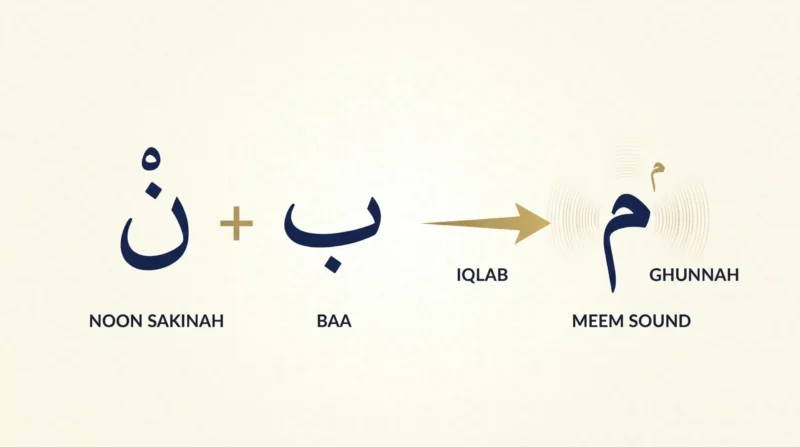
    Iqlab in Tajweed Noon Sakinah changing to Meem diagram
    One letter turns the silent Noon into a hidden Meem: ن + ب = م.

    What Does Iqlab Mean?

    Iqlab (إقلاب) literally means “to flip”, “to turn something over” or “to convert”. In Tajweed it means turning a silent Noon or Tanween into a hidden Meem before the letter ب, held with a nasal sound of two counts.

    The word comes from the root q-l-b (قَلَبَ) — to overturn, to flip a thing onto its other side. The name is unusually literal here. Nothing is being softened, shortened or concealed: one letter is replaced by a different letter.

    That single fact is worth pausing on, because it is what separates this rule from its three neighbours.

    A conversion, not a concealment

    In Izhar the Noon is announced. In Idgham it dissolves into the letter after it. In Ikhfaa it stays a Noon but is veiled. Only in this rule does the Noon stop being a Noon at all and become something else. It is the one place in the four rules where the identity of the letter itself changes — and that is exactly what the Arabic name says.

    So the working definition to carry with you is this: a silent Noon before ب is read as a Meem — a Meem you hide rather than announce. Everything else on this page is detail hanging off that sentence.

    The Iqlab Letters — Just One

    Learners arrive here expecting a list, because Izhar has six letters and Idgham has six. This rule has one. There is no mnemonic to learn, no grouping to memorise and no exceptions to file away — which makes it the fastest rule in Tajweed to learn properly.

    Letter Name Makhraj With Noon With Tanween Audio
    ب Baa (b) The two lips — الشفتان مِنۢ بَعْدِ سَمِيعًۢا بَصِيرًۭا

    Why ب specifically, and why a Meem?

    This is the part that turns a rule you memorise into a rule you understand, and it comes down to what your mouth can physically do.

    The Noon is voiced and nasal: the tongue tip meets the gum line and air escapes through the nose. The Baa is a lip sound with a small explosion in it — the lips press shut, pressure builds, and the sound releases. Moving straight from a nasal front-of-tongue consonant into a pressurised lip consonant is awkward, and the Arabs did not do it.

    🔑 The Meem is the bridge. It shares the nasal quality of the Noon and the lip position of the Baa — the only letter in Arabic that belongs to both worlds at once. The tongue never has to travel, because the sound is handed from the nose to the lips in a single motion.

    Linguists call this place assimilation: a consonant shifting its point of articulation towards the one that follows it. It happens in English too — most speakers say “ten bags” with an M-like sound in the middle without ever being taught to. What Tajweed does is take that natural tendency and fix it as a precise, measured rule. You can see where each of these sounds is formed in our guide to the Makhraj of Arabic letters.

    How to Spot Iqlab in the Mushaf

    Most learners meet this rule twice: once in a lesson, and once again a week later when they open the Quran, see a Noon with no sukoon on it and a tiny letter floating above, and wonder what happened. This is the section that answers that.

    1. The Noon carries no sukoon

    This is the first signal, and it is a signal of absence. Everywhere else a silent Noon wears the small circle of sukoon. Here it wears nothing — because it is no longer going to be pronounced as a Noon.

    2. A small Meem sits above it

    In its place you will find a miniature Meem (ﻤ) drawn above the Noon. That mark is an instruction: read this letter as a Meem. It is the whole rule, printed into the text.

    3. With Tanween, the two marks stop being parallel

    A normal Tanween is written as two identical marks side by side. Before a ب they are staggered — set one after the other rather than level — and the small Meem is placed with them. Once you have noticed this once, you will never miss it again.

    Symbol spotter: see the difference in ten seconds

    Switch between the three specimens below and tap the highlighted letter in each one. The first is an ordinary silent Noon; the second and third are Iqlab, with a Noon and with a Tanween.

    Tap the highlighted letter in the specimen above.

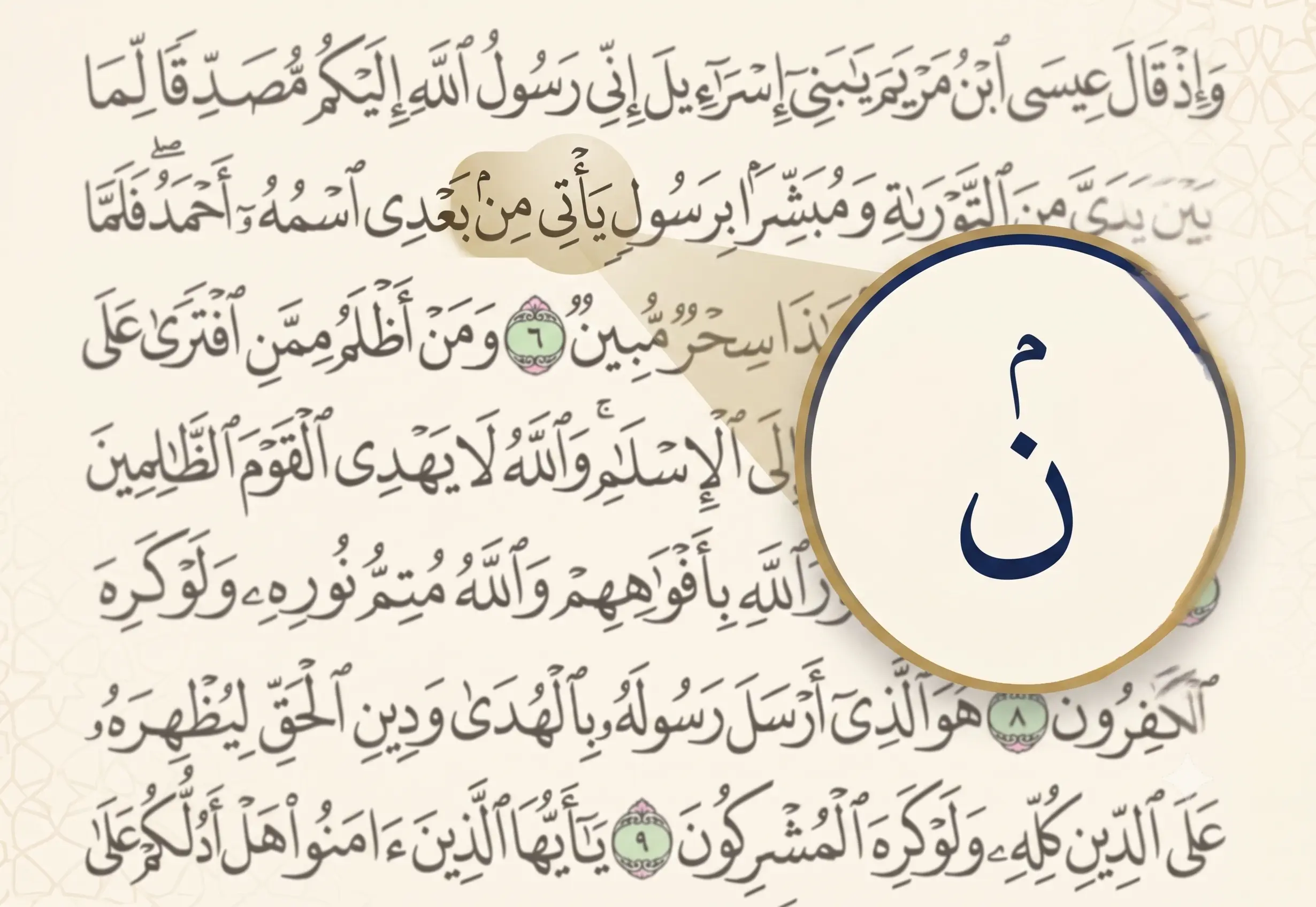
    Iqlab small Meem symbol above Noon Sakinah in the Mushaf
    The small Meem printed above the Noon — the visual marker of this rule.

    One caveat worth knowing: this small-Meem notation is the convention of the Madinah Mushaf in the narration of Hafs, printed by the King Fahd Glorious Quran Printing Complex and followed by most editions in circulation today. Some regional prints mark it slightly differently. The rule does not change — only the ink does.

    How to Pronounce Iqlab Correctly

    Understanding this rule takes about a minute. Producing it correctly takes longer, because almost everyone makes the same mistake — and it is a mistake you cannot hear in your own mouth until someone points it out.

    ⚠️ The Meem here is not a full Meem

    It is a hidden Meem — Meem Mukhfaah. The lips come close together; they do not press shut. If you clamp them the way you would for the M in “mother”, you have produced a clear Meem and lost the rule. The sound should feel unfinished at the lips and complete at the nose.

    1. Do not pronounce the Noon at all

    The tongue tip never touches the gum line. There is no trace of an N before the M — the letter was replaced, not decorated.

    2. Bring the lips near, and hold the nasal sound for two counts

    A small gap of air stays between the lips while the sound runs out through the nose. Two counts is the same length used in Ikhfaa and in Idgham with ghunnah — roughly two relaxed finger taps.

    3. Release straight into the Baa — no pause

    The lips are already in position, so the Baa needs no travel at all. Only now do they close fully, for the Baa itself.

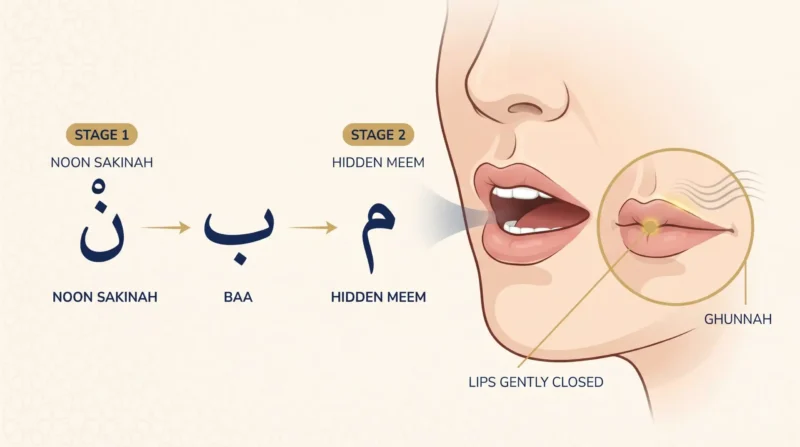
    Correct Iqlab lip position hidden Meem pronunciation
    Lips close but not sealed — the position of the hidden Meem.

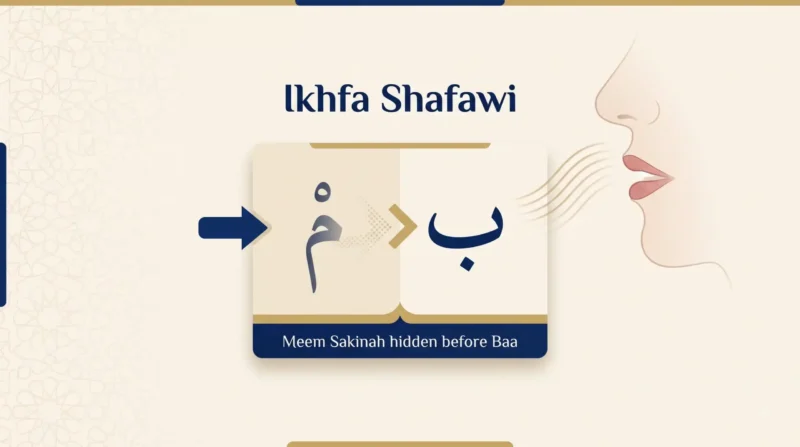
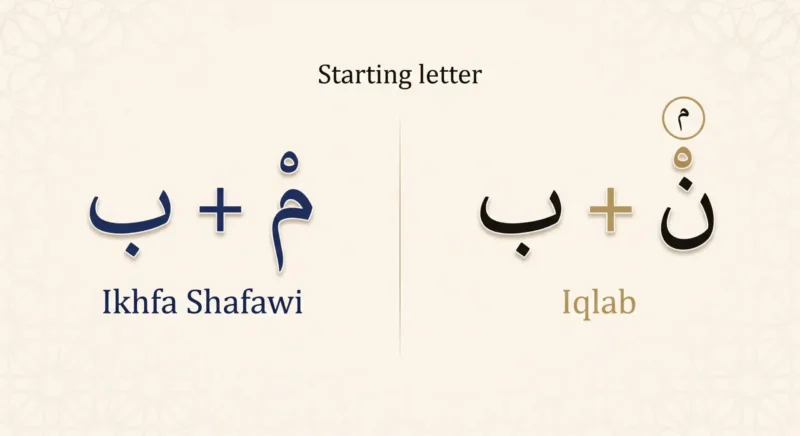
    There is a shortcut here that most pages never mention. This sound is not new to you if you already know Ikhfaa: the hidden Meem here is produced with exactly the same mechanism as Ikhfaa Shafawi, the hiding of a silent Meem before a ب. Same lips, same gap, same two counts. Learn one and you have learned both — compare the two clips below.

    مِنۢ بَعْدِ مِيثَٰقِهِۦ

    Iqlab — a silent Noon converted to a hidden Meem

    تَرْمِيهِم بِحِجَارَةٍ

    Ikhfaa Shafawi — a silent Meem hidden before the same ب. Identical mouth position.

    💡 The mirror exercise

    Say مِنۢ بَعْدِ in front of a mirror. If your lips visibly press and flatten before the ب, the Meem has become clear and the rule is gone. Then say the English words “some bread” naturally — that light, unpressed M in the middle is very close to the sound you want.

    Iqlab Rules: When It Applies

    The trigger has no conditions attached to it: a silent Noon or a Tanween, followed by ب. That combination shows up in three shapes.

    1. Inside a single word

    The silent Noon and the ب sit in the same word.

    أَنۢبِئْهُم  ·  لَيُنۢبَذَنَّ

    2. Across two words

    The word ends on a silent Noon and the next word opens with ب.

    مِنۢ بَعْدِ  ·  أَنۢ بُورِكَ

    3. Tanween + ب

    All three Tanween endings behave exactly like a silent Noon, because that is phonetically what they are.

    سَمِيعٌۢ بَصِيرٌ  ·  صُمٌّۢ بُكْمٌ

    ⚠️ A difference worth filing away: this rule works in all three positions without conditions. Idgham does not — it never applies inside a single word, which is why الدُّنْيَا is read clearly instead of merged. Here, أَنۢبِئْهُم converts just as readily as مِنۢ بَعْدِ.

    Iqlab vs the Other Noon Sakinah Rules

    Four rules, one silent Noon, and the only thing that decides between them is the letter that comes next.

    Rule Letters What happens to the Noon Ghunnah Example
    Izhar 6 throat letters Pronounced clearly Natural, 1 count مِنْ عِلْمٍ
    Idgham 6 (Yarmaloon) Disappears into the next letter 2 counts (4 letters) مَنْ يَعْمَلْ
    Iqlab ← this page ب only Turns into a hidden Meem 2 counts مِنۢ بَعْدِ
    Ikhfaa The remaining 15 Hidden between the two 2 counts مِنْ كُلِّ

    If you keep one sentence from this page, keep this one: Izhar reveals the Noon, Idgham erases it, Ikhfaa veils it — and Iqlab converts it. Three of the four rules decide how much of the Noon you hear. Only this one decides which letter you hear instead.

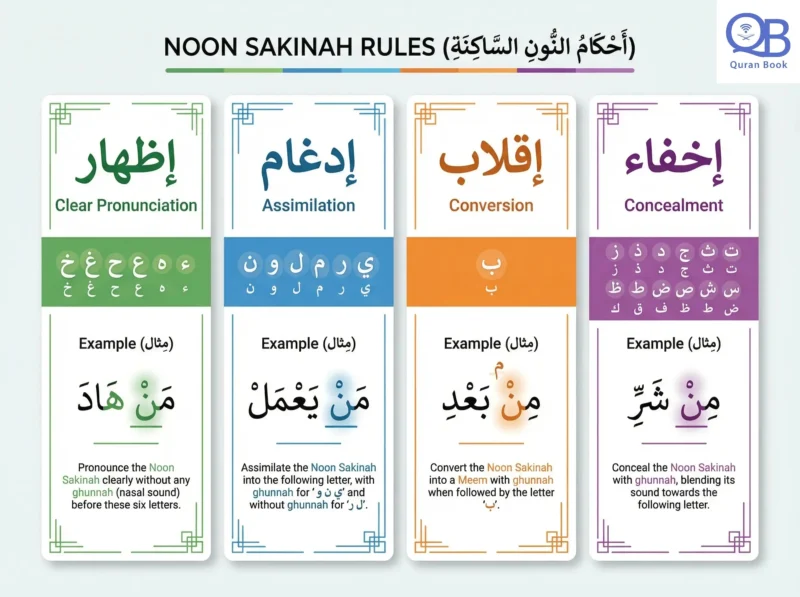
    Iqlab vs Izhar Idgham Ikhfaa Noon Sakinah rules chart
    The four rules of the silent Noon side by side.

    Interactive Practice: Find the Iqlab

    Iqlab has one letter — but can you spot it inside a verse, with the other three rules competing for your attention? Ten questions, instant feedback, no sign-up.

    Question 1 of 10 Score: 0

    Choose the rule that applies to the highlighted letter.

    Iqlab Examples from the Quran

    Six short examples covering both word positions and all three Tanween endings. The Noon or Tanween is marked in blue, the ب in orange. Each clip is a few seconds of the continuous recitation of Sheikh Mahmoud Khalil Al-Husary — recited at normal pace, not word by word.

    مِنۢ بَعْدِ مِيثَٰقِهِۦ

    Al-Baqarah 2:27 · Noon Sakinah + ب across two words

    لَيُنۢبَذَنَّ فِى ٱلْحُطَمَةِ

    Al-Humazah 104:4 · Noon Sakinah + ب inside one word

    كَانَ سَمِيعًۢا بَصِيرًۭا

    An-Nisa 4:58 · Tanween fatḥ + ب

    لَنَسْفَعًۢا بِٱلنَّاصِيَةِ

    Al-‘Alaq 96:15 · Tanween fatḥ + ب

    صُمٌّۢ بُكْمٌ عُمْىٌ

    Al-Baqarah 2:18 · Tanween ḍamm + ب

    كِرَامٍۭ بَرَرَةٍ

    ‘Abasa 80:16 · Tanween kasr + ب

    Two more worth knowing by heart, because they close dozens of ayat between them: سَمِيعٌۢ بَصِيرٌ and عَلِيمٌۢ بِذَاتِ ٱلصُّدُورِ. And inside a single word, the clearest example of all is أَنۢبِئْهُم — get this rule right once and it pays out across the whole Quran.

    Common Mistakes to Avoid

    1. Pressing the lips shut

    The number one error worldwide. A firmly closed lip turns the hidden Meem into a clear one, and the two-count nasal sound is lost with it. Close enough to feel the air, not enough to feel pressure.

    2. Sounding the Noon before the Meem

    Producing a faint “n” and then the Meem. The Noon is not present in any form — it was converted, and the tongue tip has no work to do at all.

    3. Cutting the nasal sound short

    Two counts, the same measure as Ikhfaa. Rushing it produces something that sounds almost like clear pronunciation, and dropping it entirely removes the rule altogether.

    4. Stopping between the Meem and the ب

    There is no gap and no catch of breath. The two sounds are continuous — the lips simply finish closing.

    5. Forgetting that Tanween counts

    Readers watch for a written Noon and recite straight past سَمِيعٌۢ بَصِيرٌ. A Tanween is a silent Noon that simply is not written as a letter — the rule applies identically.

    Play: Catch the Iqlab Letter (Free Game)

    Recognition under time pressure is a different skill from recognition on a page. Catch the letter that triggers the rule, dodge the rest, and see how long you last. It works on phones and tablets, and no account is needed.

    Game not loading? Open it in a new tab · or browse all our free Arabic letter games.

    Learn More

    Iqlab is one of four rules that govern the silent Noon. Here’s what to study next:

    All of them sit inside the wider set of Tajweed rules, and all of them are covered step by step in our Tajweed courses.

    Frequently Asked Questions

    Q1. What is Iqlab in Tajweed?
    Iqlab is the third rule of Noon Sakinah and Tanween. When a silent Noon or Tanween is followed by the letter ب, the Noon converts into a hidden Meem pronounced with a two-count nasal sound.
    Q2. What does Iqlab mean?
    Iqlab (إقلاب) literally means “to flip” or “to convert” in Arabic. The name describes exactly what happens: one letter is turned into another.
    Q3. How many Iqlab letters are there?
    Only one: ب. This is the simplest of the four Noon Sakinah rules because there is nothing to memorise — if you see a silent Noon or Tanween followed by ب, the rule applies.
    Q4. Which sign shows Iqlab in the Quran?
    A small Meem (ﻤ) is written above the Noon or above the Tanween, and the Noon carries no sukoon. That small Meem is the visual marker of this rule in the Madinah Mushaf.
    Q5. Why does the Noon have no sukoon in Iqlab?
    Because the Noon is no longer pronounced as a Noon. Since it converts into a Meem, the sukoon is removed and replaced by the small Meem symbol to show the change.
    Q6. Is the Meem in Iqlab fully pronounced?
    No. It is a hidden Meem (Meem Mukhfaah). The lips come close together but do not press shut, and the sound passes through the nose for two counts.
    Q7. Does Iqlab apply inside a single word?
    Yes. Unlike Idgham, it applies both within one word — as in أَنۢبِئْهُم — and across two words, as in مِنۢ بَعْدِ.
    Q8. Does Tanween follow the Iqlab rule too?
    Yes. Tanween is treated exactly like a silent Noon, so any Tanween followed by ب becomes a hidden Meem — as in سَمِيعٌۢ بَصِيرٌ.
    Q9. What is the difference between Iqlab and Ikhfaa?
    In Ikhfaa the Noon stays a Noon but is concealed. In Iqlab the Noon actually changes into a different letter — a Meem — before being concealed at the lips.
    Q10. Why does the Noon change into a Meem specifically?
    Because the Meem shares the nasal quality of the Noon and the lip articulation of the ب. It acts as a natural bridge between two sounds that are difficult to pronounce back to back.
    Q11. How long is the ghunnah in Iqlab?
    Two counts, the same length as in Ikhfaa and in Idgham with ghunnah. Shortening it is a common error.
    Q12. Can I learn Iqlab without a teacher?
    The rule itself takes minutes to understand, since it involves one letter. But the hidden Meem is easy to over-pronounce, and only a trained ear can tell you whether your lips are closing too firmly.

    Read one page to a certified teacher

    Thirty minutes with an Al-Azhar certified teacher — and a clear answer on whether your lips are pressing shut where they should only be closing in.

    Book a free trial lesson

    May Allah beautify your recitation and accept it from you. 🤲

    Jehad Mahmoud - Hafidha and Arabic Language graduate, writer at Quran Book Academy

    Hafidha of the Quran · Arabic Language Graduate · Writer on Islamic Sciences

    Jehad Mahmoud is a graduate of the Arabic Language department and a Hafidha of the Quran who writes the Islamic educational content at Quran Book Academy.

    She writes with a focus on Tajweed, Quranic recitation and the sharia sciences, making technical rules accessible to English-speaking Muslim families.

    Her articles are educational, not fatwa. For a ruling on a specific personal situation, readers are advised to consult a qualified scholar or mufti.

    Tajweed Noon Sakinah Makharij Quran Recitation

    References & Sources

    1. King Fahd Glorious Quran Printing Complex — qurancomplex.gov.sa

    2. Encyclopedia of Arabic Language and Linguistics — Brill Reference Works

    3. Al-Azhar Al-Sharif — azhar.eg

    4. Surah Al-‘Alaq 96 — Quran.com

    5. Recitation — Sheikh Mahmoud Khalil Al-Husary, via EveryAyah.com

    © 2026 Quran Book Academy. All rights reserved.

    Book Your Free Trial · Empowering Muslims Worldwide to Connect with the Quran
  • Idgham Letters: Rules, Types & Quran Examples

    Idgham Letters: Rules, Types & Quran Examples

    Jehad Mahmoud - writer at Quran Book Academy
    Written by
    Published: 12 August 2026 · Updated: 24 August 2026 · 14 min read
    Noon Sakinah Rules · Idgham

    Idgham Letters: Rules, Types & Quran Examples

    Quran Book Academy · Quran & Tajweed Library

    Yarmaloon · with & without ghunnah · Kamil vs Naqis · Audio by Sheikh Al-Husary · Free quiz & game

    The Idgham letters are six: ي ، ر ، م ، ل ، و ، ن — gathered in the word Yarmaloon (يرملون). When a silent Noon (نْ) or Tanween is followed by one of them across two words, the Noon merges into that letter and disappears. Four of these letters carry a nasal sound (ghunnah); two — ل and ر — do not. Merging is the second of the four rules of Noon Sakinah and Tanween.

    Also spelled Idghaam, Iddigham or Idgam in English transliterations.

    The 30-second version: 6 merging letters (ي ر م ل و ن) · memorised as «يَرْمَلُونَ» · the silent Noon vanishes and the next letter doubles · ي ن م و keep a two-count nasal sound, ل and ر keep none · it only works across two words, never inside one.

    Idgham letters Yarmaloon in Arabic Tajweed diagram
    The six merging letters gathered in one word: يرملون.

    What Is Idgham in Tajweed?

    Idgham (إدغام) literally means “to insert” or “to merge one thing into another”. In Tajweed it means entering a silent letter into the voiced letter after it, so that the two become a single stressed letter.

    This is the point most English pages blur. The silent Noon is not pronounced faintly, quickly or softly. It is not pronounced at all. The letter that follows takes its place and is doubled, and the shaddah (ّ) you see printed over that letter in the mushaf is the visual signal that the merge has happened.

    Read مِنْ رَبِّهِمْ and you will not hear min rabbihim with a small n. You will hear mir-rabbihim. The Noon has been absorbed and only the doubled Raa survives.

    Where this rule sits among the four

    Clear pronunciation and full assimilation are the two ends of one spectrum. Izhar keeps the Noon completely intact because the throat letters are as far from it as Arabic sounds get. Merging does the opposite: it erases the Noon because the following letter is close enough to swallow it. Hiding and conversion sit between the two.

    That distance principle is the whole logic. The nearer the next letter is to the Noon’s own articulation point — the tip of the tongue at the gum line — the less of the Noon survives. You can see where each sound is produced in our guide to the Makhraj of Arabic letters, and the six merging letters are all produced within a hair’s breadth of it.

    Linguists describe the same phenomenon outside Tajweed entirely: it is regressive nasal assimilation, where a nasal consonant takes on the identity of the sound that follows it. Arabic simply codified it earlier and more precisely than most languages, as documented in the Encyclopedia of Arabic Language and Linguistics. This rule is not a religious convention layered on top of speech — it is how the mouth already wants to behave.

    The 6 Idgham Letters (Yarmaloon)

    Six letters trigger this rule, and Tajweed scholars never ask students to memorise them as a loose list. They are packed into one pronounceable word instead. Tap play on any row to hear the example in the recitation of Sheikh Mahmoud Khalil Al-Husary.

    # Letter Name Type Ghunnah Quranic example Audio
    1 ي Yaa Naqis (incomplete) Yes فَمَن يَعْمَلْ
    2 ر Raa Kamil (complete) No عَن رَّبِّهِمْ
    3 م Meem Kamil (complete) Yes مِّن مَّاءٍ
    4 ل Laam Kamil (complete) No أَن لَّن
    5 و Waaw Naqis (incomplete) Yes مِّن وَلِيٍّ
    6 ن Noon Kamil (complete) Yes مِّن نُّطْفَةٍ

    The mnemonic: يَرْمَلُونَ (Yarmaloon)

    يَرْمَلُونَ

    Every letter in Yarmaloon is one of the six: ي، ر، م، ل، و، ن. It is worth saying plainly, because the question comes up constantly — Yarmaloon is not an Arabic word with a meaning. It carries no translation and appears nowhere in the Quran. Scholars built it as a memory device, arranging the six letters into a shape the tongue can hold. Learn the word and the list is yours permanently.

    ⚠️ The condition everyone forgets: this merging only happens across two words — the silent Noon ends one word and a Yarmaloon letter opens the next. If both sit inside the same word, the Noon is pronounced clearly instead. That exception has a name and only four words in the entire Quran, and it is covered in full further down this page.

    One more detail worth noticing on the table above: the six letters do not behave identically. Four of them keep a nasal hum and two erase it completely — and separately from that, two of them let a trace of the Noon survive while four wipe it out entirely. Those are two different splits of the same six letters, and the next three sections take them one at a time.

    Idgham With Ghunnah (Idgham Maal Ghunnah)

    Four of the six letters keep the nasal sound alive after the merge: ي، ن، م، و. They are memorised through a second, smaller mnemonic — يَنْمُو (yanmoo), which unlike Yarmaloon is a real word meaning “it grows”.

    The ghunnah here lasts two counts — roughly the time it takes to say two short vowels, or to tap your finger twice at a steady pace. It is held on the new doubled letter, not on the vanished Noon.

    Letter With Noon Sakinah With Tanween Audio
    ي فَمَن يَعْمَلْ يَوْمَئِذٍ يَصْدُرُ
    ن مِّن نُّطْفَةٍ يَوْمَئِذٍ نَّاعِمَةٌ
    م مِّن مَّاءٍ حَبْلٌ مِّن
    و مِّن وَلِيٍّ خَيْرٌ وَأَبْقَىٰ
    Idgham with ghunnah vs without ghunnah letters comparison
    Four letters keep the nasal sound; two remove it entirely.

    Ghunnah timer: see the two counts

    Two counts is easy to read and hard to feel. Press Play to hear the ayah recited by Sheikh Al-Husary, then press 2 counts and hold the hum yourself while the bar fills. The first example carries the nasal sound; the second has none at all. Alternate between them until the difference is obvious to your ear without looking at the screen.

    مِّن نُّطْفَةٍ

    ‘Abasa 80:19 · with ghunnah · 2 counts

    أَن لَّن

    Al-Balad 90:5 · without ghunnah · no nasal sound

    Press play on either row.

    Idgham Without Ghunnah (Idgham Bila Ghunnah)

    Two letters only: ل and ر. Here the merge is total. The Noon is gone, and so is every trace of nasal sound with it — the reader moves straight into a doubled Laam or a doubled Raa as if the Noon had never been written.

    Letter With Noon Sakinah With Tanween Audio
    ل أَن لَّن هُدًى لِّلْمُتَّقِينَ
    ر عَن رَّبِّهِمْ عِيشَةٍ رَّاضِيَةٍ

    The mistake that defines this section

    Leaving a light hum on ل and ر is the single most common error on this rule, and it is worth being blunt about it: this is not a shortfall in quality, it is the wrong rule. A nasal sound before these two letters is a different pronunciation entirely, not a weaker version of the right one. If you can hear any hum at all in مِن رَّبِّهِمْ, the merge has not been completed.

    The exception: مَنْ رَاقٍ

    One phrase in the Quran meets every condition for merging into ر and still is not merged. In Surah Al-Qiyamah 75:27, the recitation of Hafs places an obligatory brief pause — a saktah — between the two words. The pause breaks the contact between them, so the Noon is pronounced clearly instead.

    وَقِيلَ مَنْ ۜ رَاقٍ

    Al-Qiyamah 75:27 · saktah blocks the merge · read clearly

    Listen for the tiny catch before رَاقٍ. It is not a breath and not a stop — just a held silence, marked in the mushaf with a small س. Once you know it is there, the reason for the clear Noon becomes obvious.

    Complete vs Incomplete Idgham (Kamil & Naqis)

    Here is the question that almost every English page leaves hanging. If the Noon disappears completely, where does the nasal sound in مَن يَعْمَلْ come from? Yaa is not a nasal letter. Something has to be producing that hum.

    The classical answer is that the six letters split a second time — this time by how much of the Noon is absorbed.

    Type Letters What happens Why
    Idgham Kamil (كامل)
    complete
    ن ، م ، ل ، ر The Noon vanishes with both its body and its qualities The next letter absorbs it entirely
    Idgham Naqis (ناقص)
    incomplete
    ي ، و The Noon vanishes but its nasal quality stays The ghunnah transfers onto the new doubled letter

    So the hum you hear on ي and و is the last surviving property of a letter that is otherwise gone. The body of the Noon has been absorbed; one of its attributes has not. That is exactly what “incomplete” means here — incomplete absorption, not incomplete pronunciation.

    With ن and م the merge is complete and yet a ghunnah is still heard — but that one belongs to the receiving letter itself, since both are nasal by nature. Two different sources, one similar sound. With ل and ر nothing nasal exists on either side, which is why those two are silent in every sense.

    Play these two back to back and the distinction stops being theoretical:

    مِّن نُّطْفَةٍ

    ‘Abasa 80:19 · Kamil — complete absorption, ghunnah from the Noon that receives

    فَمَن يَعْمَلْ

    Az-Zalzalah 99:7 · Naqis — the Noon is gone, its ghunnah is not

    You do not need this distinction to recite correctly — the sound comes out the same either way. You need it to understand why the sound is what it is, and that is the difference between memorising a table and knowing the rule.

    Idgham vs Izhar vs Ikhfaa vs Iqlab

    One silent Noon, four possible outcomes, and the only thing that decides between them is which letter comes next. Every letter of the Arabic alphabet belongs to exactly one of these four groups — there is no overlap and no letter left over.

    Rule Letters What happens to the Noon Ghunnah Example
    Izhar 6 throat letters ء ه ع ح غ خ Pronounced clearly, fully intact Natural, 1 count مِنْ عِلْمٍ
    Idgham ← this page 6 letters ي ر م ل و ن (Yarmaloon) Disappears into the next letter, which doubles 2 counts — 4 letters only مَن يَعْمَلْ
    Iqlab ب only Turns into a hidden Meem 2 counts مِنۢ بَعْدِ
    Ikhfaa The remaining 15 letters Hidden — neither clear nor merged 2 counts مِن كُلِّ
    Idgham vs Izhar vs Ikhfaa vs Iqlab Noon Sakinah rules chart
    All four rules of the silent Noon on one chart.

    The two confusions worth settling

    Merging vs hiding. These two are mixed up more than any other pair, because both involve a nasal sound and neither gives you a clean Noon. The test is simple: ask whether the Noon still exists. In merging it does not — there is nothing left of it, and the next letter carries a shaddah. In hiding it is still there, produced somewhere between its own position and the next letter’s, audible as a hum without full contact. One erases the letter; the other conceals it.

    Merging vs clear pronunciation. These are opposite ends of the same line, so confusing them is rarer but more serious. Clear pronunciation keeps the Noon at its natural length before the six throat letters. Merging removes it altogether before the six Yarmaloon letters. If the letters are far from the Noon, it survives; if they are close, it does not. Every other rule of the silent Noon is a point somewhere between those two extremes.

    Merging vs conversion. Only one letter triggers conversion — ب — and the Noon does not stay and does not vanish. It changes identity and becomes a Meem, held with a two-count hum and the lips only lightly closed. It is the smallest rule of the four and the easiest to spot, since there is exactly one letter to watch for.

    Idgham Rules for Noon Sakinah and Tanween

    The trigger has two parts, and both must be present. First, a silent Noon or a Tanween. Second, one of the six merging letters opening the next word. Miss the second condition and the rule does not apply, no matter how right the letters look.

    1. Silent Noon at the end of a word

    The word closes on نْ and the next word opens with a Yarmaloon letter. This is the standard case and the one you will meet most often.

    مِن رَّبِّهِمْ  ·  مَن يَعْمَلْ  ·  مِن نُّطْفَةٍ

    2. Never inside a single word

    A silent Noon followed by a merging letter within the same word is read clearly. There are no exceptions to this and only four such words exist in the Quran — all covered below.

    الدُّنْيَا  ·  بُنْيَان  ·  صِنْوَان  ·  قِنْوَان

    Rules of Idgham with Tanween

    A Tanween is a silent Noon that is pronounced but not written as a letter. That is the whole of it. Every rule that governs نْ governs ـً ـٍ ـٌ in exactly the same way, and all six merging letters apply to it without modification.

    هُدًى لِّلْمُتَّقِينَ

    Al-Baqarah 2:2 · Tanween fatḥ + ل · No ghunnah

    عِيشَةٍ رَّاضِيَةٍ

    Al-Qari’ah 101:7 · Tanween kasr + ر · No ghunnah

    خَيْرٌ وَأَبْقَىٰ

    Al-A’la 87:17 · Tanween ḍamm + و · Ghunnah

    يَوْمَئِذٍ نَّاعِمَةٌ

    Al-Ghashiyah 88:8 · Tanween kasr + ن · Ghunnah

    Notice that the doubling appears in the text itself. Wherever this rule operates, the mushaf drops the sukoon from the Noon and places a shaddah on the following letter — the script is telling you what to do before you have worked it out.

    The exception: when merging does NOT apply

    Izhar Mutlaq (إظهار مطلق). When a silent Noon is followed by و or ي inside the same word, the Noon is pronounced clearly. Only four words in the Quran meet this description:

    الدُّنْيَا  ·  بُنْيَان  ·  صِنْوَان  ·  قِنْوَان

    The reasoning is about preserving meaning, not about sound. If these were merged, they would come out as ad-duyyā, buyyān, ṣiwwān — indistinguishable from words that genuinely contain a doubled letter. The root would be hidden and the word would look like something it is not. So the rule steps aside to keep the structure of the word visible.

    📌 Two special cases in the recitation of Hafs

    In يٰس وَالقُرْآن and ن وَالقَلَم, the disconnected letters end on a silent Noon and are followed by و — every condition is met, and yet Hafs reads them clearly. These are transmitted readings, preserved as they were received rather than derived from the rule. Alongside مَنْ رَاقٍ, they are the three places in the Quran where the letters say merge and the recitation says otherwise.

    Test Yourself: Which Rule Applies?

    Four rules, one silent Noon. We’ll show you a verse with the Noon or Tanween highlighted — you pick the rule. And when the answer is merging, there’s a second question waiting: with or without ghunnah? Twelve questions, instant feedback, no sign-up.

    Question 1 of 12 Score: 0

    Step 1 — which rule applies?

    Choose the rule that applies to the highlighted letter.

    Idgham Examples from the Quran

    Twelve passages: six with a silent Noon, six with Tanween, covering all six letters and both types. The Noon or Tanween is marked in blue, the merging letter in orange. Press play to hear each one recited by Sheikh Al-Husary.

    With Noon Sakinah

    فَمَن يَعْمَلْ مِثْقَالَ ذَرَّةٍ خَيْرًا يَرَهُ

    Az-Zalzalah 99:7 · Noon + ي · Ghunnah

    كَلَّا إِنَّهُمْ عَن رَّبِّهِمْ يَوْمَئِذٍ لَّمَحْجُوبُونَ

    Al-Mutaffifin 83:15 · Noon + ر · No ghunnah

    أَلَمْ نَخْلُقكُّم مِّن مَّآءٍ مَّهِينٍ

    Al-Mursalat 77:20 · Noon + م · Ghunnah

    أَيَحْسَبُ أَن لَّن يَقْدِرَ عَلَيْهِ أَحَدٌ

    Al-Balad 90:5 · Noon + ل · No ghunnah

    وَمَا لَكُم مِّن دُونِ ٱللَّهِ مِن وَلِىٍّ

    Al-Baqarah 2:107 · Noon + و · Ghunnah

    مِن نُّطْفَةٍ خَلَقَهُۥ فَقَدَّرَهُۥ

    ‘Abasa 80:19 · Noon + ن · Ghunnah

    With Tanween

    يَوْمَئِذٍ يَصْدُرُ ٱلنَّاسُ أَشْتَاتًا

    Az-Zalzalah 99:6 · Tanween kasr + ي · Ghunnah

    فَهُوَ فِى عِيشَةٍ رَّاضِيَةٍ

    Al-Qari’ah 101:7 · Tanween kasr + ر · No ghunnah

    فِى جِيدِهَا حَبْلٌ مِّن مَّسَدٍ

    Al-Masad 111:5 · Tanween ḍamm + م · Ghunnah

    ذَٰلِكَ ٱلْكِتَٰبُ لَا رَيْبَ فِيهِ هُدًى لِّلْمُتَّقِينَ

    Al-Baqarah 2:2 · Tanween fatḥ + ل · No ghunnah

    وَٱلْـَٔاخِرَةُ خَيْرٌ وَأَبْقَىٰ

    Al-A’la 87:17 · Tanween ḍamm + و · Ghunnah

    وُجُوهٌ يَوْمَئِذٍ نَّاعِمَةٌ

    Al-Ghashiyah 88:8 · Tanween kasr + ن · Ghunnah

    Surah Al-Ghashiyah verse 8 is the most efficient drill on this page: one short ayah containing two instances back to back, one merging into ي and the next into ن. If you can read it without letting the ghunnah slip, the rule is holding.

    Common Mistakes to Avoid

    1. Leaving a nasal sound on ل and ر

    The number one error, and it comes from habit: four of the six letters take a hum, so the hand reaches for it on all six. On these two there is nothing to hold. Say مِن رَّبِّهِمْ and مِن نُّطْفَةٍ back to back — if they feel similar in the nose, the first one is wrong.

    2. Pronouncing a faint Noon instead of removing it

    A weakened Noon is not a merged Noon — it is a hidden one, which is a different rule with different letters. Half-measures here do not produce a slightly imperfect merge; they produce the wrong rule entirely.

    3. Applying the rule inside a single word

    Reading الدُّنْيَا as ad-duyyā is a clear error, not a stylistic choice. The four words affected by this are worth memorising precisely because they look like textbook cases and are not.

    4. Cutting the ghunnah short

    Two counts is longer than most learners think, and fluent readers shorten it without noticing as their pace increases. Slow the passage down until the hum is unmistakable, then rebuild the speed around it.

    5. Forgetting that Tanween counts

    Students watch for a written Noon and read straight past هُدًى لِّلْمُتَّقِينَ. If you can hear an n at the end of the word, the rule applies — whether or not a Noon is printed there.

    Play: Idgham Basket (Free Game)

    Recognising the rule under time pressure is a different skill from recognising it on a page. Catch the words where the Noon merges, let the rest fall past, and see how long you last. It works on phones and tablets, and no account is needed.

    Game not loading? Open it in a new tab · or browse all our free Arabic letter games.

    Learn More

    Merging is one of four rules that govern the silent Noon. Here’s what to study next:

    All of them sit inside the wider set of Tajweed rules, and all of them are covered step by step in our Tajweed courses.

    Frequently Asked Questions

    Q1. What are the Idgham letters?
    There are six Idgham letters: ي، ر، م، ل، و، ن. They are memorized through the word Yarmaloon (يرملون). When a silent Noon or Tanween is followed by one of them in the next word, the Noon merges into it and is no longer pronounced.
    Q2. What is Idgham in Tajweed?
    Idgham means merging one letter into another so that they become a single stressed letter. In the rules of Noon Sakinah, it means the silent Noon disappears entirely and the following letter is doubled.
    Q3. What is the difference between Idgham with and without ghunnah?
    Idgham with ghunnah applies to four letters — ي، ن، م، و (Yanmoo) — and keeps a two-count nasal sound. Idgham without ghunnah applies to ل and ر only, and leaves no nasal sound at all.
    Q4. What is Yarmaloon?
    Yarmaloon (يرملون) is not a word with a meaning. It is a memory device created by Tajweed scholars, made of the six Idgham letters arranged into one pronounceable form.
    Q5. Does Idgham apply inside a single word?
    No. Idgham of Noon Sakinah only applies across two words. If a silent Noon is followed by و or ي inside the same word — as in الدنيا, بنيان, صنوان and قنوان — the Noon is pronounced clearly instead. This is called Izhar Mutlaq.
    Q6. What is the difference between Idgham and Ikhfaa?
    In Idgham the Noon disappears completely and the next letter is doubled. In Ikhfaa the Noon is still there but concealed — pronounced with a nasal sound between the two letters, without full merging.
    Q7. What is the difference between Idgham and Izhar?
    They are opposites. Izhar keeps the Noon fully clear before the six throat letters; Idgham removes it entirely before the six Yarmaloon letters.
    Q8. What is complete and incomplete Idgham?
    Complete Idgham (Kamil) occurs with ن، م، ل، ر, where both the Noon and its nasal quality vanish into the next letter. Incomplete Idgham (Naqis) occurs with ي and و, where the Noon vanishes but its nasal sound remains.
    Q9. How long is the ghunnah in Idgham?
    Two counts, roughly the time it takes to say two short vowels. Shortening it is one of the most common Tajweed errors.
    Q10. Does Tanween follow the same Idgham rules as Noon Sakinah?
    Yes. Tanween is treated exactly like a silent Noon, so all six Idgham letters apply to it in the same way — as in هُدًى لِّلْمُتَّقِينَ.
    Q11. Why is «مَنْ رَاقٍ» not merged?
    In the recitation of Hafs, this phrase contains an obligatory brief pause (saktah) between the two words, which prevents the merging and requires the Noon to be pronounced clearly.
    Q12. Can I learn Idgham without a teacher?
    Charts and audio will teach you the six letters and the two types quickly, but the two-count ghunnah is judged by ear. Only a trained teacher can tell you when yours is too short, too long, or leaking onto ل and ر.

    Read Surah Al-Ghashiyah to a certified teacher

    Two merges in a single ayah, thirty minutes with an Al-Azhar certified teacher — and a clear answer on whether your ghunnah is holding its full two counts.

    Book a free trial lesson

    May Allah beautify your recitation and accept it from you. 🤲

    Jehad Mahmoud - Hafidha and Arabic Language graduate, writer at Quran Book Academy

    Hafidha of the Quran · Arabic Language Graduate · Writer on Islamic Sciences

    Jehad Mahmoud is a graduate of the Arabic Language department and a Hafidha of the Quran who writes the Islamic educational content at Quran Book Academy.

    She writes with a focus on Tajweed, Quranic recitation and the sharia sciences, making technical rules accessible to English-speaking Muslim families.

    Her articles are educational, not fatwa. For a ruling on a specific personal situation, readers are advised to consult a qualified scholar or mufti.

    Tajweed Noon Sakinah Makharij Quran Recitation

    References & Sources

    1. Al-Azhar Al-Sharif — azhar.eg

    2. Encyclopedia of Arabic Language and Linguistics — Brill Reference Works

    3. Surah Al-Ghashiyah 88 — Quran.com

    4. Surah Al-Qiyamah 75 — Quran.com

    5. Recitation — Sheikh Mahmoud Khalil Al-Husary, via EveryAyah.com

    © 2026 Quran Book Academy. All rights reserved.

    Book Your Free Trial · Empowering Muslims Worldwide to Connect with the Quran
  • Izhar Letters: The 6 Throat Letters in Tajweed

    Izhar Letters: The 6 Throat Letters in Tajweed

    Jehad Mahmoud - writer at Quran Book Academy
    Written by
    Published: 11 August 2026· Updated: 24 August 2026 · 9 min read
    Noon Sakinah Rules · Izhar

    Izhar Letters: The 6 Throat Letters in Tajweed

    Quran Book Academy · Quran & Tajweed Library

    The 6 letters · The mnemonic · 3 levels · Audio by Sheikh Al-Husary · Free quiz & game

    The Izhar letters are six Arabic letters — ء ، ه ، ع ، ح ، غ ، خ — all pronounced from the throat. When a silent Noon (نْ) or Tanween is followed by any of them, it must be pronounced clearly and separately, with no merging, no hiding, and no extra nasal sound. Izhar means “to make clear” in Arabic, and it is the first of the four rules of Noon Sakinah and Tanween.

    Also spelled Idhar, Izhaar or Ith-har in English transliterations.

    The 30-second version: 6 throat letters (ء ه ع ح غ خ) · they follow a silent Noon or Tanween · the Noon stays clear and is never merged · its nasal sound lasts about one count, not two · memorise them with «أَخِي هَاكَ عِلْمًا حَازَهُ غَيْرُ خَاسِرِ».

    Izhar letters in Arabic with silent Noon pronunciation diagram
    The six throat letters that keep a silent Noon clear: ء ه ع ح غ خ.

    What Does Izhar Mean?

    Izhar (إظهار) literally means “to make apparent”, “to reveal” or “to make clear”. In Tajweed it means pronouncing a silent Noon or Tanween plainly from its own articulation point, without lengthening the nasal sound that naturally belongs to it.

    The word comes from the Arabic root ẓ-h-r (ظَهَرَ) — to appear, to become visible. The image behind the term is exactly right: the Noon does not hide behind the letter that follows it and does not dissolve into it. It stays out in the open, audible as itself.

    That is the whole rule in one sentence. But there is a detail here that most English pages get wrong, and it is worth slowing down for.

    Clear pronunciation does not mean “no ghunnah”

    The letter Noon carries a nasal quality (ghunnah) built into it — it is part of the letter, not an ornament added by a rule. You cannot remove it any more than you can pronounce an M without closing your lips. What changes from rule to rule is how long that nasal sound is held. In Izhar it lasts roughly one count, the natural length of the letter. In Ikhfaa and Idgham it is stretched to about two counts. Pages that tell you Izhar means “pronounce the Noon with no ghunnah at all” are describing a sound that does not exist.

    So a more precise definition is this: Izhar is the Noon at its natural length. Nothing added, nothing removed, nothing borrowed from the next letter. Once you hear it that way, the other three Noon Sakinah rules become easy to place — each one is a departure from this baseline in a different direction.

    The 6 Izhar Letters (Huroof al-Halq)

    All six letters of Izhar come out of the throat, which is why the classical books call them ḥurūf al-ḥalq — the throat letters. Tap the play button on any row to hear the example word in the recitation of Sheikh Mahmoud Khalil Al-Husary.

    # Letter Name Throat position Quranic example Audio
    1 ء Hamzah (ʾ) Deepest — أقصى الحلق كُفُوًا أَحَدٌ
    2 ه Haa (h) Deepest — أقصى الحلق مِنْهُمْ
    3 ع ʿAyn (ʿ) Middle — وسط الحلق أَنْعَمْتَ
    4 ح Ḥaa (ḥ) Middle — وسط الحلق نَارٌ حَامِيَةٌ
    5 غ Ghayn (gh) Nearest — أدنى الحلق مِنْ غِلٍّ
    6 خ Khaa (kh) Nearest — أدنى الحلق مِنْ خَوْفٍ
    The 6 Izhar letters chart with Akhi Haaka Ilman mnemonic
    The six throat letters gathered in one memorisable phrase.

    The mnemonic: أَخِي هَاكَ عِلْمًا حَازَهُ غَيْرُ خَاسِرِ

    Scholars do not ask students to memorise six loose letters. They hand over one short sentence instead:

    أَخِي هَاكَ عِلْمًا حَازَهُ غَيْرُ خَاسِرِ

    It reads Akhī hāka ʿilman ḥāzahu ghayru khāsirī and means: “My brother, take a knowledge that was gained by one who is no loser.” The first letter of every word is one of the six letters of Izhar, in the exact order they sit in the throat: أ → ه → ع → ح → غ → خ. Learn the sentence and you have the list, permanently.

    Why these six letters and not others?

    This is the part almost every English article skips, and it is the part that makes the rule stop feeling arbitrary. It comes down to distance.

    The Noon is produced at the very front of the mouth: the tip of the tongue touches the gum line just behind the upper front teeth, while air escapes through the nose. The six throat letters are produced at the opposite end of the vocal tract — in the glottis and the pharynx, as far back as Arabic goes. You can read more about how each sound is placed in our guide to the Makhraj of Arabic letters.

    Merging two sounds requires them to be neighbours. The tongue cannot slide from the front gum line into the back of the throat quickly enough to blur the two together, so the Noon survives intact — not because a rule protects it, but because the anatomy leaves it no other option. Phonetically these are the pharyngeal and glottal consonants of Arabic, described in reference works such as the Encyclopedia of Arabic Language and Linguistics, and the distance between them and the Noon is the largest in the language.

    Every other Noon Sakinah rule follows the same logic in reverse. The closer the following letter sits to the Noon’s own point of articulation, the more the Noon gives way to it — until, with the closest letters of all, it disappears completely into them.

    How to Pronounce Izhar Correctly

    Three steps, and the third one is where nearly everyone slips.

    1. Complete the Noon

    Place the tip of the tongue firmly at the gum line behind the upper front teeth and let the sound come through the nose. Do not soften the contact and do not let the tongue drift backwards in anticipation of the throat letter.

    2. Release immediately — one count, not two

    The nasal sound gets its natural length and no more. A useful mental measure: it should be over before you could tap your finger twice. If you can comfortably hold it while counting to two, you have turned the clear pronunciation into Ikhfaa.

    3. Start the throat letter cleanly — without a gap

    Clear does not mean separated. There is no pause, no catch of breath and no tiny silence between the Noon and the letter after it. The two sounds are adjacent; only their identities stay distinct.

    💡 The 10-second exercise

    Say مِنْ عِلْمٍ and then مِنْ كُلِّ back to back, out loud, three times. Same Noon, same position in the word — but the second one hides and hums, and the first one does not. If both come out sounding the same, your nasal sound is running long on the first. That single comparison is worth more than any amount of reading.

    The 3 Levels of Izhar

    The six letters do not all behave with equal strength. Because clarity is a function of distance, the further a throat letter sits from the Noon, the more obviously clear the Noon becomes. The classical works therefore grade this rule into three degrees, from strongest to weakest.

    Level Arabic Letters Why
    Strongestأعلى — أقصى الحلقء ، هFurthest of all from the Noon
    Mediumأوسط — وسط الحلقع ، حMid-range distance
    Weakestأدنى — أدنى الحلقغ ، خClosest to the Noon’s own point

    “Weakest” here does not mean optional. All six are pronounced clearly; the grading describes how pronounced the clarity feels to the ear, and it is why some reciters sound slightly firmer on مَنْ آمَنَ than on مِنْ غِلٍّ. This three-way grading is standard in the recitation manuals taught at institutions such as Al-Azhar.

    Throat map: hear the three levels

    Tap a zone to hear its two letters inside a real Quranic word, recited by Sheikh Al-Husary. Move from the top zone downwards and listen for how the Noon loosens slightly as the letters come closer to it.

    Tap a zone to hear it.

    Three levels of Izhar and throat articulation points
    The three zones of the throat and the letter pair that belongs to each.

    Izhar Rules: Where It Applies

    The trigger is simple and has no exceptions to memorise: a silent Noon or a Tanween, followed by one of the six throat letters. That combination occurs in three shapes.

    1. Inside a single word

    The silent Noon and the throat letter sit in the same word.

    يَنْهَوْنَ  ·  أَنْعَمْتَ  ·  وَٱنْحَرْ

    2. Across two words

    The word ends on a silent Noon and the next word opens with a throat letter.

    مِنْ هَادٍ  ·  مِنْ عَلَقٍ

    3. Tanween + throat letter

    All three Tanween endings behave exactly like a silent Noon, because that is phonetically what they are.

    عَلِيمٌ حَكِيمٌ  ·  كُفُوًا أَحَدٌ  ·  حَاسِدٍ إِذَا

    ⚠️ Worth noticing: this rule works in all three positions without conditions. Idgham, by contrast, does not apply inside a single word — which is why الدُّنْيَا is read clearly rather than merged. If a rule ever feels like it should apply but does not, the word boundary is usually the reason.

    The 4 Types of Izhar in Tajweed

    The word appears in four different places in Tajweed, and learners mix them up constantly. Everything on this page so far describes the first one — Izhar Halqi, the throat variety. Here is how it sits against the other three.

    Type Applies to Trigger letters
    Izhar Halqi (حلقي)
    ← this page
    Noon Sakinah & Tanweenء ه ع ح غ خ
    Izhar Shafawi (شفوي)Meem Sakinah (مْ)All letters except ب and م
    Izhar Mutlaq (مطلق)Noon Sakinahو ، ي inside one word — only four words in the Quran: الدُّنْيَا، بُنْيَان، صِنْوَان، قِنْوَان
    Izhar Qamari (قمري)The Lam of الThe 14 lunar letters

    The common thread is the meaning of the word itself: in every one of the four, a letter that could have been merged or softened is instead left plainly audible. Only the letter being protected changes — the Noon in the first and third, the Meem in the second, the Lam in the fourth.

    Four types of Izhar in Tajweed comparison chart
    The four types of Izhar side by side.

    Test Yourself: Spot the Izhar

    You know the six letters — now find them in real verses. We’ll show you an ayah with a silent Noon or Tanween highlighted. Tap the rule you think applies. Ten questions, instant feedback, no sign-up.

    Question 1 of 10 Score: 0

    Choose the rule that applies to the highlighted letter.

    Izhar Examples from the Quran

    Ten short passages covering all six letters, both word positions, and all three Tanween endings. The silent Noon or Tanween is marked in blue, the throat letter in orange. Press play to hear each one in the recitation of Sheikh Al-Husary.

    وَلَمْ يَكُن لَّهُۥ كُفُوًا أَحَدٌ

    Al-Ikhlas 112:4 · Tanween fatḥ + ء

    لَيْلَةُ ٱلْقَدْرِ خَيْرٌ مِّنْ أَلْفِ شَهْرٍ

    Al-Qadr 97:3 · Noon Sakinah + ء across two words

    سَلَٰمٌ هِىَ حَتَّىٰ مَطْلَعِ ٱلْفَجْرِ

    Al-Qadr 97:5 · Tanween ḍamm + ه

    لِكُلِّ ٱمْرِئٍ مِّنْهُمْ يَوْمَئِذٍ شَأْنٌ يُغْنِيهِ

    ‘Abasa 80:37 · Noon Sakinah + ه inside one word

    خَلَقَ ٱلْإِنسَٰنَ مِنْ عَلَقٍ

    Al-‘Alaq 96:2 · Noon Sakinah + ع

    صِرَٰطَ ٱلَّذِينَ أَنْعَمْتَ عَلَيْهِمْ

    Al-Fatihah 1:7 · Noon Sakinah + ع inside one word

    فَصَلِّ لِرَبِّكَ وَٱنْحَرْ

    Al-Kawthar 108:2 · Noon Sakinah + ح inside one word

    نَارٌ حَامِيَةٌ

    Al-Qari’ah 101:11 · Tanween ḍamm + ح

    وَنَزَعْنَا مَا فِى صُدُورِهِم مِّنْ غِلٍّ

    Al-A’raf 7:43 · Noon Sakinah + غ

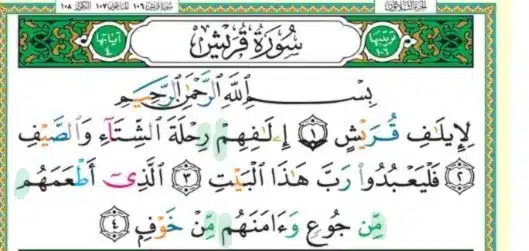
    ٱلَّذِىٓ أَطْعَمَهُم مِّن جُوعٍ وَءَامَنَهُم مِّنْ خَوْفٍ

    Quraysh 106:4 · Noon Sakinah + خ

    Surah Al-Qadr is the single best passage to drill this on: five short ayat, two clear instances, and a rhythm slow enough that you can hear your own nasal sound before the next word arrives.

    Common Mistakes to Avoid

    1. Holding the nasal sound too long

    The most common error worldwide, and it comes from good intentions: students who have just learned Ikhfaa start applying its two-count hum everywhere. The result is a Noon that hums into the throat letter instead of standing beside it. If your مِنْ عِلْمٍ sounds like your مِنْ كُلِّ, this is what is happening.

    2. Inserting a pause before the throat letter

    The over-correction of the first mistake. Learners chop the Noon off and take a small breath, producing a stop that does not exist in the text. Clarity is about the identity of the sound, not about separating it in time.

    3. Confusing ح with ه

    Both are transliterated with an “h” in English, and non-native speakers routinely swap them. They come from different depths of the throat and are different letters entirely — حَامِيَة and هَامِيَة are not the same word.

    4. Forgetting that Tanween counts

    Students watch for the written Noon and read straight past عَلِيمٌ حَكِيمٌ without applying anything. A Tanween ending is a silent Noon that simply is not written as a letter — every rule that applies to one applies to the other.

    Play: Eagle of Izhar (Free Game)

    Recognition under time pressure is a different skill from recognition on a page. Fly the eagle, catch only the six throat letters, and see how long you last. It works on phones and tablets, and no account is needed.

    Game not loading? Open it in a new tab · or browse all our free Arabic letter games.

    Learn More

    Izhar is the first of four rules that govern the silent Noon. Here’s what to study next:

    All of them sit inside the wider set of Tajweed rules, and all of them are covered step by step in our Tajweed courses.

    Frequently Asked Questions

    Q1. What are the Izhar letters?
    The Izhar letters are six letters pronounced from the throat: ء (Hamzah), ه (Haa), ع (ʿAyn), ح (Ḥaa), غ (Ghayn) and خ (Khaa). When any of them follows a silent Noon or Tanween, the Noon is pronounced clearly with no merging or hiding.
    Q2. What does Izhar mean?
    Izhar (إظهار) literally means “to make clear” or “to reveal” in Arabic. In Tajweed it means pronouncing the silent Noon or Tanween plainly from its own articulation point, without lengthening its nasal sound.
    Q3. What is Izhar in Tajweed?
    Izhar is the first of the four rules of Noon Sakinah and Tanween. It applies whenever a silent Noon or Tanween is followed by one of the six throat letters, and it requires clear, unmerged pronunciation.
    Q4. Why are these six letters called throat letters?
    All six originate from the throat (al-halq), far from the tip of the tongue where the Noon is produced. That distance makes merging physically awkward, so the Noon stays clear.
    Q5. How do you pronounce Izhar correctly?
    Pronounce the Noon fully from its articulation point, stop it immediately without stretching the nasal sound, then begin the throat letter cleanly. The nasal sound lasts roughly one count — half the length used in Ikhfaa or Idgham.
    Q6. Does Izhar have ghunnah?
    The Noon always carries its own natural nasal quality, but in Izhar it is not prolonged. Stretching it to two counts turns Izhar into Ikhfaa, which is a mistake.
    Q7. Does Izhar apply within a single word or only between words?
    Both. Izhar applies whether the throat letter appears in the same word as the Noon, as in يَنْهَوْنَ, or at the start of the next word, as in مِنْ هَادٍ.
    Q8. Is there an easy way to memorize the Izhar letters?
    Yes. Scholars use the phrase «أَخِي هَاكَ عِلْمًا حَازَهُ غَيْرُ خَاسِرِ» — the first letter of each word is one of the six Izhar letters, in order.
    Q9. What is the difference between Izhar Halqi and Izhar Shafawi?
    Izhar Halqi applies to a silent Noon or Tanween before the six throat letters. Izhar Shafawi applies to a silent Meem (مْ) before any letter except ب and م.
    Q10. Can I learn the Izhar rules without a teacher?
    Charts and audio will teach you the six letters quickly, but the length of the nasal sound is judged by ear, and only a trained teacher can tell you when yours is running too long.

    Read Surah Al-Qadr to a certified teacher

    Five ayat, two instances of this rule, thirty minutes with an Al-Azhar certified teacher — and a clear answer on whether your nasal sound is running long.

    Book a free trial lesson

    May Allah beautify your recitation and accept it from you. 🤲

    Jehad Mahmoud - Hafidha and Arabic Language graduate, writer at Quran Book Academy

    Hafidha of the Quran · Arabic Language Graduate · Writer on Islamic Sciences

    Jehad Mahmoud is a graduate of the Arabic Language department and a Hafidha of the Quran who writes the Islamic educational content at Quran Book Academy.

    She writes with a focus on Tajweed, Quranic recitation and the sharia sciences, making technical rules accessible to English-speaking Muslim families.

    Her articles are educational, not fatwa. For a ruling on a specific personal situation, readers are advised to consult a qualified scholar or mufti.

    Tajweed Noon Sakinah Makharij Quran Recitation

    References & Sources

    1. Al-Azhar Al-Sharif — azhar.eg

    2. Encyclopedia of Arabic Language and Linguistics — Brill Reference Works

    3. Surah Al-Qadr 97 — Quran.com

    4. Surah Quraysh 106 — Quran.com

    5. Recitation — Sheikh Mahmoud Khalil Al-Husary, via EveryAyah.com

    © 2026 Quran Book Academy. All rights reserved.

    Book Your Free Trial · Empowering Muslims Worldwide to Connect with the Quran
  • Noon Sakinah Rules: The 4 Tajweed Rules Explained

    Noon Sakinah Rules: The 4 Tajweed Rules Explained

    Jehad Mahmoud - writer at Quran Book Academy
    Written by
    Published: 11 August 2026 · Updated: 24 August 2026 · 15 min read
    Tajweed · Noon Sakinah & Tanween

    Noon Sakinah Rules: The 4 Tajweed Rules Explained

    Quran Book Academy · Quran & Tajweed Library

    4 rules · 28 letters · one chart · audio by Sheikh Al-Husary

    Noon Sakinah rules chart showing Izhar Idgham Iqlab and Ikhfa
    Four rules, twenty-eight letters. Every letter in the Arabic alphabet triggers exactly one of them — there is no fifth case and no overlap.

    Noon Sakinah rules determine how a silent Noon (نْ) or Tanween is pronounced depending on the letter that follows it. There are four rules: Izhar (clear pronunciation, 6 letters), Idgham (merging, 6 letters), Iqlab (conversion to Meem, 1 letter), and Ikhfa (concealment, 15 letters). Together these four cover all 28 Arabic letters — every letter triggers exactly one rule.

    The four Noon Sakinah rules at a glance
    Rule Letters Count Sound
    Izhar ء هـ ع ح غ خ 6 Clear, no ghunnah
    Idgham ي ر م ل و ن 6 Merged (4 with ghunnah, 2 without)
    Iqlab ب 1 Noon becomes Meem + ghunnah
    Ikhfa the remaining 15 15 Hidden, with ghunnah

    What Is Noon Sakinah?

    A Noon Sakinah (النون الساكنة) is the letter ن carrying a sukoon — a Noon with no vowel of its own. It appears in the middle of a word and at the end of one, and it turns up in every part of speech: in nouns (أَنْعَام), in verbs (يَنْصُر) and in particles (مِنْ, عَنْ).

    The rules on this page apply to that silent Noon only. A Noon carrying a fatḥah, ḍammah or kasrah — نَ نُ نِ — is simply pronounced as it is written, and none of the four rulings touch it. Students who mix the two end up applying Ikhfa in places it does not belong, so it is worth fixing the boundary early: no sukoon, no rule.

    One more property makes the Noon Sakinah the easier half of this topic: it is fixed. It is written in the muṣḥaf, it is pronounced in both continuation and pausing, and it does not appear or disappear depending on how you read the sentence. What you see on the page is what your tongue has to deal with.

    💡 The one question that decides everything: which letter comes immediately after the Noon Sakinah? That single letter selects the rule. Nothing else — not the word, not the meaning, not the position in the verse.

    What Is Tanween and Why Does It Follow the Same Rules?

    Tanween (التنوين) is a doubled vowel written at the end of an indefinite noun — ــًـ ــٌـ ــٍـ — and pronounced as an extra Noon Sakinah. The Noon is heard but never written, which is exactly why beginners treat Tanween as a separate topic when it is not one.

    The golden rule is short: any ruling that applies to a written Noon Sakinah applies identically to Tanween. Same four rules, same letter groups, same ghunnah length. There is nothing extra to memorise.

    Only one practical difference exists. A Noon Sakinah can sit inside a word, so the letter after it may belong to the same word. Tanween is always word-final, so the letter that triggers the rule is always the first letter of the next word. That is why Tanween examples always straddle a word boundary.

    Rule Noon Sakinah Tanween
    Izhar مَنْ أَعْطَىٰ قَوْلًا هَنِيئًا
    Idgham مِن مَّاءٍ عِيشَةٍ رَّاضِيَةٍ
    Iqlab لَيُنبَذَنَّ لَنَسْفَعًا بِالنَّاصِيَةِ
    Ikhfa مِّن سِجِّيلٍ مَاءً ثَجَّاجًا

    Read the two columns across and the parallel is unmistakable. If you can classify the left column, you can already classify the right one — the only new skill is hearing the Noon that isn’t printed.

    The 4 Noon Sakinah Rules at a Glance

    Most guides present the four Noon Sakinah rules as four unrelated lists to be memorised. They are not unrelated — they are one sliding scale, and once you see the scale the lists stop needing memorisation at all.

    The Noon is produced at the tip of the tongue against the gum ridge, with the sound resonating in the nose. Every rule below is decided by how far the following letter’s articulation point sits from that spot — which is why this topic sits so close to the Makhraj of Arabic letters.

    Far away — the throat letters → Izhar

    The Noon and the throat are too far apart to blend, so the Noon is left exactly as it is.

    Very close, or identical → Idgham

    The two points nearly coincide, so the Noon simply gives way and dissolves into the next letter.

    A lip letter → Iqlab

    Moving from the gum ridge straight to the lips is awkward, so the Noon converts to a Meem, which is already on the lips.

    Everything in between → Ikhfa

    Neither far enough to stay clear nor close enough to merge, so the Noon is held halfway — hidden, but audible as a nasal hum.

    That is the entire system in four sentences. The letter lists that follow are consequences of it, not arbitrary groupings, and students who understand the logic stop confusing Ikhfa with Idgham almost immediately.

    Hear all four rules on the same Noon

    Three of the four examples below begin with the same word — مِنْ. The Noon never changes. Only the letter after it does, and that alone produces four completely different sounds. Play them in order and the distinction stops being theoretical.

    Rule Example Play
    Izhar مِّنْ خَوْفٍ
    106:4
    Idgham مِن مَّاءٍ دَافِقٍ
    86:6
    Iqlab لَيُنبَذَنَّ
    104:4
    Ikhfa مِّن سِجِّيلٍ
    105:4

    Recitation: Sheikh Mahmoud Khalil Al-Husary. Twenty seconds here will do more for your ear than twenty minutes of reading.

    One detail to carry into the sections below: the ghunnah — the nasal hum — is measured in counts, not moments. Two counts (ḥarakatān), roughly the length of saying two short vowels. It appears in Ikhfa, in Iqlab and in four of the six Idgham letters, and it is absent in Izhar and in the remaining two Idgham letters. Getting the letter groups right but the ghunnah length wrong is the single most common way to sound untrained while technically applying the correct rule.

    Izhar — The 6 Clear Letters

    Izhar (إظهار) means “to make clear”. The Noon Sakinah or Tanween is pronounced exactly as it is — a clean Noon, released fully, with no added ghunnah and no blending whatsoever into the letter that follows.

    ء هـ ع ح غ خ

    hamzah · hā · ‘ayn · ḥā · ghayn · khā

    These six are not a random selection: they are the ḥurūf al-ḥalq, the throat letters, and they are the complete set of them. The Noon is made at the front of the mouth; these are made at the very back. The distance is too great for any blending to occur naturally, so the language leaves the Noon alone. Learn the six as “the throat group” and you will never need to recite the list.

    Letter Name Noon Sakinah Tanween Listen
    ء hamzah مَنْ أَعْطَىٰ 92:5 كُلٌّ آمَنَ
    هـ عَنْهُ مَالُهُ 111:2 جُرُفٍ هَارٍ
    ع ‘ayn أَنْعَمْتَ 1:7 سَمِيعٌ عَلِيمٌ
    ح ḥā وَٱنْحَرْ 108:2 عَلِيمٌ حَكِيمٌ
    غ ghayn مِنْ غِلٍّ 7:43 قَوْلًا غَيْرَ
    خ khā مِّنْ خَوْفٍ 106:4 عَلِيمٌ خَبِيرٌ
    Izhar and Idgham letters in Arabic with Quranic examples
    The six Izhar letters and the six Idgham letters — the two groups that between them decide half of every page you recite.

    The mistake almost every non-Arab reader makes here

    Adding a ghunnah to Izhar. Because three of the four rules involve a nasal hum, learners default to humming — and a Noon before ع or ح comes out as a soft nnn instead of a crisp Noon. Izhar is the rule where the nose does the least work, not the most. If you can hear a hum before a throat letter, you are applying Ikhfa by accident.

    Idgham — The 6 Merging Letters

    Idgham (إدغام) means “to merge”. The Noon Sakinah or Tanween disappears completely into the letter that follows, and that letter is doubled (given a shaddah) in its place. There is no trace of the Noon left as a consonant — only, in four of the six cases, the nasal resonance it leaves behind.

    The six Idgham letters are ي ر م ل و ن, traditionally gathered in the phrase يَرْمَلُونَ (yarmalūn). They split into two groups, and the split matters more than the list.

    Idgham with Ghunnah (4 letters: ي ن م و)

    These four are gathered in the word يَنْمُو (yanmū, “it grows”) — a mnemonic worth ten minutes of your time, because it is the only list on this page you truly have to hold. The Noon merges into the following letter and the nasal sound is held for two counts.

    فَمَن يَعْمَلْ مِثْقَالَ ذَرَّةٍ خَيْرًا يَرَهُ ي — merged with ghunnah. 99:7
    وَمَا لِأَحَدٍ عِندَهُ مِن نِّعْمَةٍ تُجْزَىٰ ن — merged with ghunnah. 92:19
    خُلِقَ مِن مَّاءٍ دَافِقٍ م — merged with ghunnah. 86:6
    وَٱللَّهُ مِن وَرَائِهِم مُّحِيطٌ و — merged with ghunnah. 85:20

    Idgham without Ghunnah (2 letters: ل ر)

    With Lām and Rā the merge is total and instant: the Noon vanishes and no nasal sound is left behind at all. This is the group learners over-hum most, because they carry the ghunnah habit across from the four letters above.

    وَلَمْ يَكُن لَّهُۥ كُفُوًا أَحَدٌۢ ل — merged, no ghunnah. 112:4
    فَهُوَ فِى عِيشَةٍ رَّاضِيَةٍ ر after Tanween — no ghunnah. 101:7

    The Exception — When Idgham Doesn’t Apply

    Idgham requires the Noon Sakinah and the following letter to sit in two separate words. When a Noon Sakinah is followed by و or ي inside the same word, there is no merging at all — the Noon is pronounced clearly. Scholars call this al-iẓhār al-muṭlaq, absolute clarity, and it is the reason a reader who has memorised the yarmalūn list can still get these words wrong.

    The only four words in the Quran where this occurs

    ٱلدُّنْيَا · بُنْيَانٌ · صِنْوَانٌ · قِنْوَانٌ

    ad-dunyā · bunyān · ṣinwān · qinwān — each one recited with a clear, undisguised Noon.

    Four words is a small thing to learn, and ٱلدُّنْيَا alone appears well over a hundred times in the muṣḥaf — so this exception is not academic trivia. It is a correction most readers need on their first page.

    Iqlab — The 1 Converting Letter

    Iqlab (إقلاب) means “to convert”. It has a single trigger letter — ب — and one instruction: when a Noon Sakinah or Tanween is followed by Bā, the Noon is turned into a hidden Meem, pronounced with the lips lightly together and a ghunnah held for two counts.

    ب

    one letter · one rule · no exceptions

    The reason is mechanical. The Bā is made at the lips; the Noon is made at the gum ridge with the nose open. Moving directly from one to the other forces an awkward jump, so Arabic substitutes the sound that already shares the Bā’s articulation point and the Noon’s nasality: the Meem. Nothing is invented — the Meem is simply the natural meeting point of the two.

    كَلَّا ۖ لَيُنۢبَذَنَّ فِى ٱلْحُطَمَةِ Noon Sakinah before ب. 104:4
    لَنَسْفَعًۢا بِٱلنَّاصِيَةِ Tanween before ب. 96:15

    The small meem you keep seeing in the muṣḥaf

    Iqlab is the only one of the four rules with its own printed marker. Wherever it occurs, a small ﻢ is written above the Noon or in place of one of the Tanween strokes — نۢ, ـًۢ. Readers see it constantly and rarely know what it means. It is not a vowel and not part of the spelling: it is an instruction to the reciter, telling you to produce a Meem here rather than a Noon.

    Iqlab sign in the Quran small meem above Noon Sakinah
    The Iqlab marker: a small meem printed above the Noon Sakinah or over one stroke of the Tanween.

    One nuance worth carrying: the lips should meet lightly. Pressing them shut turns the hidden Meem into a full, released Meem and cuts the ghunnah short. The target is a soft closure held for two counts, with the sound running through the nose the whole time.

    Ikhfa — The 15 Hidden Letters

    The Ikhfa rules cover more letters than the other three combined, which makes this the rule you will apply most often on any given page. Ikhfa (إخفاء) means “to conceal”: the Noon is pronounced neither clearly nor merged away, but held in a middle state — hidden behind a nasal hum lasting two counts.

    The practical description is more useful than the definition. In Ikhfa your tongue never touches the Noon’s articulation point at all. It leaves the gum ridge alone and moves straight into position for the letter that is coming, while the sound continues through the nose during the gap. That gap is the Ikhfa.

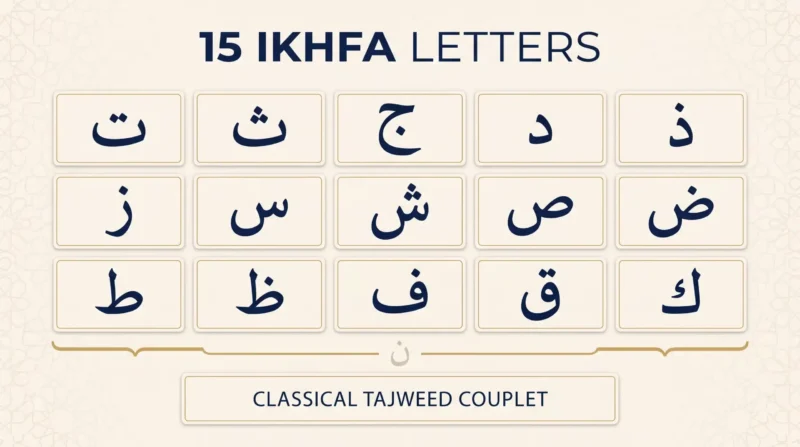
    ت ث ج د ذ ز س ش ص ض ط ظ ف ق ك

    fifteen letters — the whole remainder of the alphabet

    💡 Don’t memorise these fifteen. Memorise the thirteen letters of the other three rules — six for Izhar, six for Idgham, one for Iqlab. Everything left over is Ikhfa. Thirteen is a manageable number; fifteen is not, and the elimination method is how experienced teachers actually teach it.

    Some of the fifteen carry a sound of their own that changes the ghunnah: the ghunnah is slightly heavier before heavy letters in Arabic like ق and ط, and stays thin before light ones like ت and ك. It is a small adjustment, but it is what makes an Ikhfa sound native rather than mechanical.

    Letter Noon Sakinah Tanween Listen
    تكُنتُمْجَنَّاتٍ تَجْرِى
    ثوَٱلْأُنثَىٰ 92:3مَاءً ثَجَّاجًا
    جمِّن جُوعٍ 106:4خَلْقٍ جَدِيدٍ
    دأَندَادًاكَأْسًا دِهَاقًا
    ذأَنذَرْتَهُمْيَوْمَئِذٍ ذَاتَ
    زأَنزَلْنَٰهُ 97:1صَعِيدًا زَلَقًا
    سمِّن سِجِّيلٍ 105:4قَوْلًا سَدِيدًا
    شمِن شَرِّ 113:2عَذَابًا شَدِيدًا
    صأَنصَارَعَمَلًا صَٰلِحًا
    ضمَّنضُودٍ 56:29قَوْمًا ضَآلِّينَ
    طٱنطَلِقُوا 77:29صَعِيدًا طَيِّبًا
    ظيَنظُرُونَ 88:17ظِلًّا ظَلِيلًا
    ففَٱنفَلَقَخَالِدًا فِيهَا
    قمِن قَبْلُعِلْمًا قَلِيلًا
    كمَن كَانَكِتَٰبًا كَرِيمًا

    The three degrees of Ikhfa

    Not every Ikhfa sounds identical, and this is the layer most guides leave out. How close the concealment sits to Idgham or to Izhar depends on how near the following letter’s articulation point is to the Noon’s.

    Highest — ط د ت

    Made at almost the same spot as the Noon, so the concealment leans towards a merge.

    Middle — the remaining ten

    The standard Ikhfa most learners are taught, sitting evenly between the two extremes.

    Lowest — ق ك

    Made far back in the mouth, so the concealment leans towards clarity — the Noon is only just hidden.

    You do not need to reproduce the three degrees deliberately; they emerge on their own once the tongue is genuinely moving towards the next letter instead of stopping at the Noon. Knowing they exist simply explains why your Ikhfa before ق sounds different from your Ikhfa before ت — and reassures you that the difference is correct, not a fault. The same three-way gradation is set out in the classical Tajweed manuals, where it is tied directly to the articulation points rather than to convention.

    Test Yourself: Which Noon Sakinah Rule Applies?

    Four rules, twenty-eight letters — the only way to know if it’s stuck is to test it. We’ll show you a word from the Quran with the Noon Sakinah or Tanween highlighted. You pick the rule. Twelve questions, instant feedback, no sign-up.

    Question 1 of 12

    Play: The Eagle of Izhar

    The quiz checks whether you know the rule. This one checks whether you can spot the letters at speed — a different skill, and the one that actually shows up when you are reciting a page rather than studying a chart. Play it directly below, or open it in a new tab if you prefer a full screen.

    It works well for children too. The six throat letters stop being a list to recite and become a group they can recognise on sight — which is exactly the transfer you want in place before formal Tajweed lessons begin.

    Noon Sakinah and Tanween Examples from the Quran

    Rules settle once you meet them in the text you actually recite. Each line highlights the Noon or Tanween in its rule’s colour — Izhar, Idgham, Iqlab, Ikhfa — with the recitation of Sheikh Al-Husary beside it.

    ٱلَّذِىٓ أَطْعَمَهُم مِّن جُوعٍ وَءَامَنَهُم مِّنْ خَوْفٍۭ Ikhfa then Izhar in one verse. 106:4
    تَرْمِيهِم بِحِجَارَةٍ مِّن سِجِّيلٍ Ikhfa before س. 105:4
    مِن شَرِّ مَا خَلَقَ Ikhfa before ش. 113:2
    فَمَن يَعْمَلْ مِثْقَالَ ذَرَّةٍ خَيْرًا يَرَهُۥ Idgham with ghunnah before ي. 99:7
    خُلِقَ مِن مَّآءٍ دَافِقٍ Idgham with ghunnah before م. 86:6
    وَلَمْ يَكُن لَّهُۥ كُفُوًا أَحَدٌۢ Idgham without ghunnah before ل. 112:4
    فَهُوَ فِى عِيشَةٍ رَّاضِيَةٍ Tanween merging into ر — no ghunnah. 101:7
    كَلَّا ۖ لَيُنۢبَذَنَّ فِى ٱلْحُطَمَةِ Iqlab — the Noon becomes a Meem. 104:4
    لَنَسْفَعًۢا بِٱلنَّاصِيَةِ Iqlab on Tanween. 96:15
    فَأَمَّا مَنْ أَعْطَىٰ وَٱتَّقَىٰ Izhar before hamzah. 92:5
    مَآ أَغْنَىٰ عَنْهُ مَالُهُۥ وَمَا كَسَبَ Izhar before ه. 111:2
    أَفَلَا يَنظُرُونَ إِلَى ٱلْإِبِلِ كَيْفَ خُلِقَتْ Ikhfa inside a single word, before ظ. 88:17

    Notice how often two different rules land in the same short verse — 106:4 alone carries an Ikhfa and an Izhar four words apart. That is the real skill: not producing each sound in isolation, but switching between them cleanly at reciting speed. If you’d like to drill this alongside the other rules, our free Arabic letter games cover the same ground for children and adults.

    Common Mistakes to Avoid

    1. Adding a ghunnah to Izhar

    The most frequent Noon Sakinah error among non-Arab readers. Before ء ه ع ح غ خ the Noon is clean and released — no hum, no lengthening. If you hear a nasal buzz there, you have quietly turned Izhar into Ikhfa.

    2. Cutting the ghunnah short

    Two counts is a measurable duration, not a passing touch. Most learners produce roughly half of it in Ikhfa and Iqlab, which is why their recitation sounds hurried even when every letter is correctly classified.

    3. Treating Tanween as a separate case

    A Tanween is a Noon Sakinah you cannot see. Readers who apply the rules confidently to a written نْ often go blank at a Tanween — the rule is identical, and the hesitation is the only real problem.

    4. Merging in ٱلدُّنْيَا, بُنْيَان, صِنْوَان, قِنْوَان

    The yarmalūn list is correct but incomplete without this caveat: inside a single word, ن before و or ي is pronounced clearly. Four words, and one of them is on nearly every page.

    5. Pronouncing a clear Noon before Bā

    Iqlab is easy to know and easy to forget in the moment, because the Noon is still printed on the page. The small meem above it is the reminder — read it as a Meem, with the lips barely closed and the ghunnah running.

    You can learn the letters. The ghunnah needs an ear.

    Two counts is a length you can be told about but cannot check on your own. Recite a page to a certified teacher and find out where yours actually sits.

    Book a free trial lesson with a certified teacher

    Frequently Asked Questions

    Q1. What are the Noon Sakinah rules?
    Noon Sakinah rules are four Tajweed rules that determine how a silent Noon (نْ) or Tanween is pronounced based on the letter that follows it: Izhar (clear), Idgham (merged), Iqlab (converted to Meem), and Ikhfa (hidden). Between them, the four rules cover all 28 Arabic letters.
    Q2. What are the Ikhfa letters?
    There are fifteen Ikhfa letters: ت ث ج د ذ ز س ش ص ض ط ظ ف ق ك. When a Noon Sakinah or Tanween is followed by any of them, the Noon is hidden and pronounced with a ghunnah held for two counts. The easiest way to learn them is by elimination — memorize the thirteen letters of the other three rules, and everything left is Ikhfa.
    Q3. What are the Izhar letters?
    Izhar has six letters: ء ه ع ح غ خ. They are all pronounced from the throat, which is why the Noon stays clear before them — the two articulation points are too far apart to merge.
    Q4. What are the Idgham letters?
    Idgham has six letters, grouped in the word “يَنْمُو” plus ل and ر. Four of them (ي ن م و) are merged with a ghunnah; two (ل ر) are merged without one.
    Q5. What is the difference between Ikhfa and Idgham?
    In Idgham the Noon disappears completely into the following letter, which is then doubled. In Ikhfa the Noon is neither fully pronounced nor fully merged — the tongue stops short of the Noon’s articulation point and the sound is held as a nasal hum for two counts.
    Q6. Do the same rules apply to Tanween?
    Yes, exactly. Tanween is a doubled vowel that is pronounced as a Noon Sakinah even though no Noon is written. Every rule that applies to a written Noon Sakinah applies identically to Tanween.
    Q7. How long should the ghunnah be held?
    Two counts (harakatan) — roughly the time it takes to say two short vowels. This applies to Ikhfa, Iqlab, and Idgham with ghunnah. Shortening it to a brief nasal touch is the single most common Noon Sakinah error.
    Q8. Why is there no Idgham in words like الدُّنْيَا?
    Because Idgham only applies when the Noon Sakinah and the following letter are in two separate words. When ن is followed by و or ي inside the same word — as in الدُّنْيَا، بُنْيَان، صِنْوَان، قِنْوَان — the Noon is pronounced clearly instead. These four words are the only cases in the Quran.
    Q9. Can I learn the Noon Sakinah rules on my own?
    You can learn the letter groups from a chart in an afternoon. Producing a correct two-count ghunnah is a different matter — it’s a sound your ear has to be trained on, and a teacher hearing you recite is still the fastest way to get there.

    Where This Fits in Tajweed

    The Noon Sakinah rules are the first system most students meet inside the wider body of Tajweed rules, and they are a good place to start precisely because they close: four rules, twenty-eight letters, no gaps. Once the chart is in your head, every Noon on the page has an answer.

    What takes longer is the sound. Classifying a letter is a five-second decision; holding a ghunnah for a genuine two counts, in the middle of a verse, at reciting speed, is a physical habit. If you want that feedback, our Tajweed courses are built around exactly this kind of correction, or you can simply book a free trial lesson and recite a page.

    May Allah make the Quran the spring of your heart, and may He accept it from you. 🤲

    Jehad Mahmoud - Hafidha and Arabic Language graduate, writer at Quran Book Academy

    Hafidha of the Quran · Arabic Language Graduate · Writer on Islamic Sciences

    Jehad Mahmoud is a graduate of the Arabic Language department and a Hafidha of the Quran who writes the Islamic educational content at Quran Book Academy.

    She writes on Tajweed and Quranic phonetics as a Hafidha and Arabic Language graduate, focusing on making precise articulation rules — makharij, sifaat, and the rulings of Noon and Meem Sakinah — accessible to non-Arab reciters.

    Her articles are educational, not fatwa. For a ruling on a specific personal situation, readers are advised to consult a qualified scholar or mufti.

    Tajweed Noon Sakinah Arabic Phonetics Quran Recitation

    References & Sources

    1. The four rulings of Noon Sakinah and Tanween, and the three degrees of Ikhfa — classical Tajweed manuals

    2. Nasal assimilation — the phonetic process underlying Idgham and Ikhfa across languages

    3. Quran.com — Quranic text and verse references used throughout

    4. EveryAyah.com — recitation of Sheikh Mahmoud Khalil Al-Husary

    © 2026 Quran Book Academy. All rights reserved.

    Book Your Free Trial · Empowering Muslims Worldwide to Connect with the Quran
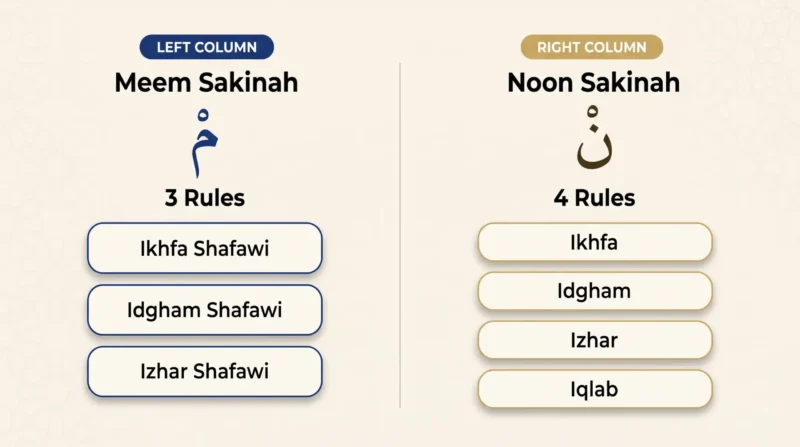
  • Qalqalah Letters: The 5 Letters & How to Pronounce Them Correctly

    Qalqalah Letters: The 5 Letters & How to Pronounce Them Correctly

    Jehad Mahmoud - writer at Quran Book Academy
    Written by
    Published: 8 August 2026 · Updated: 8 August 2026 · 10 min read
    Tajweed Rules · Qalqalah

    Qalqalah Letters: The 5 Letters & How to Pronounce Them Correctly

    Quran Book Academy · Quran & Tajweed Library

    The 5 letters · Makhraj · Sughra vs Kubra · Audio by Sheikh Al-Husary · Free practice game

    qalqalah letters — the 5 letters of qalqalah with the mnemonic قطب جد
    The five qalqalah letters ق ط ب ج د, gathered in the mnemonic قطب جد.

    There are five qalqalah letters in Arabic: ق ط ب ج د — Qaf, Ta, Ba, Jeem and Dal — gathered in the mnemonic قطب جد (Qutbu Jad). When one of them carries a sukoon, it is released with a light bounce or echo instead of being pressed flat. That bounce is qalqalah, and this page gives you the letters, the two types, real Quranic examples with the recitation of Sheikh Al-Husary, and a free game to practise spotting them.

    The 30-second version: 5 letters (ق ط ب ج د) · they only bounce when they carry sukoon · light bounce mid-word (Sughra) · stronger bounce at a stop (Kubra) · never add a vowel to the bounce.

    What Are the Qalqalah Letters?

    The qalqalah letters are ق (Qaf), ط (Ta), ب (Ba), ج (Jeem) and د (Dal). Qalqalah is the slight bounce or echo that these five letters produce when they carry a sukoon, and the five are memorised together through the phrase قطب جد.

    The word qalqalah (قلقلة) literally means shaking, disturbance or vibration. In Tajweed it describes a very short, controlled movement of sound that escapes when one of the five letters is released. You will also see the rule written as qalqala, qolqolah or haroof e qalqalah in different transliterations — they all refer to the same rule and the same five letters.

    The reason this rule exists is phonetic rather than decorative. These five letters share one key feature: they are all shadidah (plosive) — the airflow is completely blocked at the point of articulation. Without the bounce, the blocked air simply has nowhere to go and the letter gets swallowed — the listener hears a gap instead of a consonant. The qalqalah releases that blockage cleanly, so the letter stays audible.

    This is why qalqalah is not optional. A reciter who skips it is not reciting in a plainer style; the letter itself has been dropped from the word. Every recognised chain of recitation applies the rule, which is one of the reasons it is usually among the first three or four rules taught to a beginner alongside the other core Tajweed rules.

    The 5 Qalqalah Letters and Their Makhraj

    Each of the letters of qalqalah has its own point of articulation (makhraj). Knowing where the letter is formed makes the bounce far easier to produce, because the bounce is simply the release of that exact point:

    Letter Name Point of articulation (makhraj)
    قQafThe deepest part of the tongue against the soft palate — the furthest back of the five
    طTaTip of the tongue pressed to the gum line of the upper front teeth, with the tongue raised (heavy)
    بBaBoth lips pressed together, then released
    جJeemMiddle of the tongue against the roof of the mouth
    دDalTip of the tongue at the gum line of the upper front teeth, tongue flat (light)
    the five qalqalah letters and their points of articulation
    The letters of qalqalah and where each one is formed in the mouth.

    The mnemonic: قطب جد

    Rather than memorising five separate letters, teachers gather them into one short phrase: قطب جد, read as Qutbu Jad. Every letter in that phrase is a qalqalah letter, in order: ق, ط, ب, then ج, د. Learn the phrase and the whole list comes with it — which is why almost every child taught in a traditional halaqah can recite the huruf qalqalah before they can explain the rule.

    Some books use the variant qutb jadd or write it as two words. The spelling makes no difference; the five letters are fixed and agreed upon.

    How Many Qalqalah Letters Are There?

    There are exactly five qalqalah letters in Arabic: ق, ط, ب, ج and د. No recognised school of recitation adds a sixth or removes one of the five.

    Learners often expect the list to be longer, and there are two usual reasons. The first is confusion with the heavy letters of tafkheem — ص, ض, ط, ظ, غ, خ, ق. Two letters (ط and ق) belong to both groups, so students who meet tafkheem first assume the rest of that group bounces too. It does not: ص and ض are pronounced heavy, but the air is not released with an echo.

    The second reason is that a qalqalah letter with a vowel on it does not bounce, so learners hear ب in bismi and conclude the rule is inconsistent. It is not — the rule only ever activates on sukoon. That single condition is what separates a qalqalah letter from an actual qalqalah occurrence.

    How to Pronounce Qalqalah Letters (Step by Step)

    The mechanic is the same for all five letters. Only the point of contact changes:

    1. Close the makhraj completely

    Press the two lips together for ب, the tip of the tongue for د and ط, the middle of the tongue for ج, the back of the tongue for ق. The airflow must stop fully — a partial closure gives you a hiss, not a bounce.

    2. Hold for an instant

    A sukoon means no vowel follows, so the letter is held rather than moved through. This pause is what builds the small amount of pressure that the bounce releases.

    3. Release sharply, not slowly

    Open the makhraj in one clean movement. The sound that escapes is the qalqalah: a short echo, closer to a knock than to a syllable.

    4. Keep the mouth neutral

    Do not shape the lips or tongue towards a vowel while releasing. If your bounce sounds like “qa”, “qi” or “qu”, you have added a vowel that is not in the text — this is the single most common error in the rule.

    Listen and Practice: Qalqalah Letters in Action

    Reading about qalqalah isn’t the same as hearing it. Below, tap each letter to hear a real Quranic word where that letter carries a sukoon, recited by Sheikh Mahmoud Khalil Al-Husary, so you can hear exactly what the bounce sounds like — then repeat it aloud yourself before moving to the next one.

    Tap a letter to hear it.

    💡 A test you can do alone: say the word twice — once pressing the letter flat and once with the bounce. If the two versions sound identical, you are not closing the makhraj fully. The difference should be obvious even to someone who does not speak Arabic.

    The Two Types of Qalqalah: Sughra vs Kubra

    The rules of qalqalah divide it into two levels of strength. The letters are identical in both; what changes is where the sukoon falls, and therefore how much the bounce is emphasised.

    Qalqalah Sughra (القلقلة الصغرى) — minor

    The letter carries an original sukoon in the middle of a word, and the recitation continues straight past it. The bounce is light and quick, just enough to keep the letter audible.

    وَٱلْفَجْرِ  ·  لَمْ يَلِدْ وَلَمْ يُولَدْ

    Qalqalah Kubra (القلقلة الكبرى) — major

    The letter falls at the end of a word or an ayah and takes a sukoon only because the reciter stops there. Because the voice comes to rest on that letter, the bounce is noticeably stronger and slightly longer. This is what people usually mean by qalqalah akbar in the Quran.

    قُلْ هُوَ ٱللَّهُ أَحَدْ  ·  بِرَبِّ ٱلْفَلَقْ

      Qalqalah Sughra Qalqalah Kubra
    PositionMiddle of a wordEnd of a word or ayah, at a stop
    Source of sukoonOriginal, written in the MushafCreated by stopping (waqf)
    StrengthLight, quickStronger, more audible
    If you continue readingStill appliedNot applied — the letter takes its vowel
    qalqalah sughra vs qalqalah kubra comparison
    Qalqalah Sughra and Qalqalah Kubra compared side by side.

    The last row of that table catches a lot of learners. In qul huwa Allāhu aḥad, the د bounces only because you stopped on it. If you join the ayah to the next one, the word is read aḥadun and there is no bounce at all — the sukoon was never there to begin with.

    Examples of Qalqalah from the Quran

    These five ayat are the ones most often used to teach the rule, because the bounce falls in a place you cannot miss. Press play on each, and follow the highlighted letter as Sheikh Al-Husary recites it.

    وَٱلْفَجْرِ

    Surah Al-Fajr 89:1 · ج with sukoon · Sughra

    لَمْ يَلِدْ وَلَمْ يُولَدْ

    Surah Al-Ikhlas 112:3 · د twice · Sughra then Kubra at the stop

    قُلْ أَعُوذُ بِرَبِّ ٱلْفَلَقْ

    Surah Al-Falaq 113:1 · ق at the stop · Kubra

    تَبَّتْ يَدَآ أَبِى لَهَبٍ وَتَبّْ

    Surah Al-Masad 111:1 · ب at the stop · Kubra on a doubled letter

    إِنَّ ٱلْإِنسَٰنَ لَيَطْغَىٰ

    Surah Al-‘Alaq 96:6 · ط with sukoon · Sughra, heavy

    Surah Al-Ikhlas, Al-Falaq and An-Nas are worth reciting slowly as a set once you know the rule, because the qalqalah kubra lands on the final letter of several ayat in a row. Children pick the rule up from those three surahs faster than from any explanation.

    If you want to hear the same reciter across a longer passage while you practise, the phrase-by-phrase player on our Ayat al-Kursi memorization tool and on the last two ayat of Al-Baqarah uses the same recitation.

    Common Mistakes Students Make with Qalqalah

    Over-exaggerating the bounce

    The most frequent error by far. The bounce becomes a full vowel and aḥad turns into aḥadah. A qalqalah is an echo, not a syllable — if you can write it with a letter, it is too big.

    Dropping it at the stop

    Learners apply the rule carefully mid-word and then forget it at the end of the ayah, which is exactly where it should be strongest. Qalqalah kubra is the version listeners notice most.

    Confusing qalqalah with tafkheem

    Heavy letters such as ص, ض and ظ are pronounced with a raised tongue, but they do not bounce. Only ط and ق belong to both groups.

    Bouncing a letter that has a vowel

    No sukoon, no qalqalah. The ب of bismillāh and the د of al-ḥamdu are read normally — adding an echo there is an invented sound.

    Mistaking ذ for د

    In bi-idhnih the letter is ذ, not د, so there is no qalqalah in it. This is also why there is no qalqalah anywhere in Ayat al-Kursi, despite what many pages claim.

    Practise: Pop the Qalqalah Letters (Free Game)

    Recognising the letters in isolation is easy; recognising them inside a running word is the actual skill. Play the game below — pop only the letters of qalqalah as they appear, and try to finish without popping a wrong letter. It works on phones and tablets, and no account is needed.

    Game not loading? Open it in a new tab · or browse all our free Tajweed games.

    Qalqalah video for kids

    A short animated explanation of the rule for younger learners — useful if you are teaching qalqalah to a child at home:

    Why Qalqalah Matters in Quran Recitation

    Tajweed exists to preserve the Quran as it was recited and taught, sound for sound, through an unbroken chain of transmission. Qalqalah is a small part of that, but it is a part that is heard on almost every page — the five letters are among the most common in the language, and a reciter who ignores the rule alters the shape of hundreds of words.

    It is also a rule with a genuine payoff for beginners. Unlike the finer points of madd, qalqalah can be learned in an afternoon and applied immediately, and it makes recitation sound noticeably more correct straight away. That early win is often what carries a student into the rest of the Tajweed rules course.

    Common Questions About Qalqalah

    Q1. What does Qalqalah mean?
    Qalqalah is an Arabic Tajweed term meaning echo or bounce. It refers to the slight vibrating sound produced when one of five specific letters carries a sukoon, which prevents the letter from being pronounced flat or swallowed.
    Q2. What are the five letters of Qalqalah?
    The five qalqalah letters are ق (Qaf), ط (Ta), ب (Ba), ج (Jeem) and د (Dal). They are commonly memorised using the mnemonic word قطب جد (Qutbu Jad), which strings all five letters together in one phrase.
    Q3. How do you pronounce Qalqalah letters?
    You pronounce a qalqalah letter by closing its point of articulation completely, holding it for an instant, then releasing it sharply so a brief controlled bounce escapes — without adding a full vowel. The strength of the bounce depends on whether it is Qalqalah Sughra (lighter, mid-word) or Qalqalah Kubra (stronger, at a stop).
    Q4. What are the two types of Qalqalah?
    Qalqalah Sughra (minor) occurs when a qalqalah letter has sukoon in the middle of a word or ayah, producing a light bounce. Qalqalah Kubra (major) occurs when a qalqalah letter falls at the end of a word or ayah during a stop (waqf), producing a noticeably stronger bounce.
    Q5. What happens if you don’t apply Qalqalah?
    Skipping qalqalah causes the letter to sound flat, muted or swallowed, which changes the correct phonetic rendering of the Quranic text as it was revealed and taught. It is considered a Tajweed error rather than a stylistic preference.
    Q6. Which surah has the most Qalqalah?
    Qalqalah letters appear throughout the Quran since they are five of the most common Arabic letters, but they are especially frequent — and especially noticeable — in short rhythmic surahs such as Surah Al-Ikhlas, Al-Falaq and An-Nas, which are often used to teach the rule to beginners.
    Q7. What are common mistakes with Qalqalah?
    The most common mistakes are over-exaggerating the bounce so that it sounds like an added vowel, forgetting to apply it at a stop (Qalqalah Kubra), and confusing qalqalah letters with unrelated heavy (tafkheem) letters such as ص or ض.
    Q8. How can I remember the Qalqalah letters?
    The easiest way is the mnemonic قطب جد (Qutbu Jad) — each letter of this short phrase is one of the five qalqalah letters (ق ط ب ج د), so memorising one word gives you all five in the correct order.

    Practise Qalqalah with Quran Book Online

    You can learn the five letters from this page and drill them in the game above, but qalqalah is a sound, and a sound needs an ear on the other side. A teacher listening to you for ten minutes will tell you immediately whether your bounce is too heavy, too light, or landing on the wrong letter — something no page or app can do for you.

    Recite it once to a certified teacher

    Read Surah Al-Ikhlas and Al-Falaq in a free 30-minute session with an Al-Azhar certified teacher, and find out exactly where your qalqalah needs correcting.

    Book a free trial lesson

    May Allah beautify your recitation and accept it from you. 🤲

    Jehad Mahmoud - Hafidha and Arabic Language graduate, writer at Quran Book Academy

    Hafidha of the Quran · Arabic Language Graduate · Writer on Islamic Sciences

    Jehad Mahmoud is a graduate of the Arabic Language department and a Hafidha of the Quran who writes the Islamic educational content at Quran Book Academy.

    She writes with a focus on Tajweed, Quranic recitation and the sharia sciences, making technical rules accessible to English-speaking Muslim families.

    Her articles are educational, not fatwa. For a ruling on a specific personal situation, readers are advised to consult a qualified scholar or mufti.

    Tajweed Qalqalah Makharij Quran Recitation

    References & Sources

    1. Surah Al-Ikhlas 112 — Quran.com

    2. Surah Al-Falaq 113 — Quran.com

    3. PLACEHOLDER — Tajweed manual / Islamic studies institution reference for the Sughra vs Kubra distinction

    4. PLACEHOLDER — Arabic phonetics source supporting the makhraj descriptions

    5. Recitation — Sheikh Mahmoud Khalil Al-Husary, via EveryAyah.com

    © 2026 Quran Book Academy. All rights reserved.

    Book Your Free Trial · Empowering Muslims Worldwide to Connect with the Quran
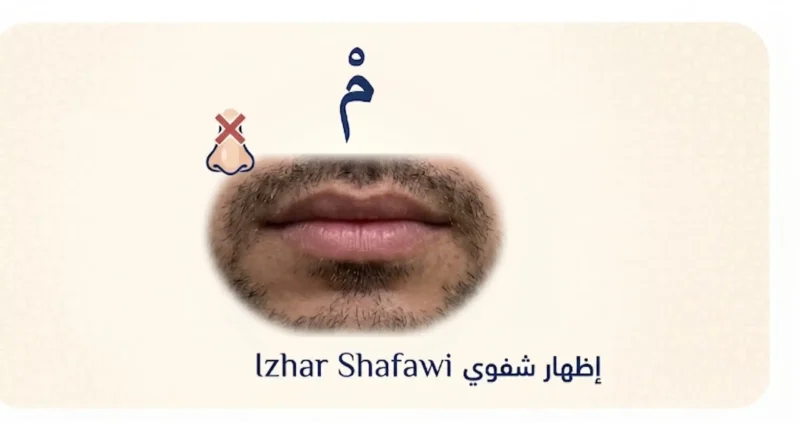
  • Tajweed Rules: 12 Powerful Essentials for Beautiful Quran Recitation

    Tajweed Rules: 12 Powerful Essentials for Beautiful Quran Recitation

    Beginner’s Guide

    Tajweed Rules: 12 Powerful Essentials for Beautiful Quran Recitation

    Master the art of Quranic recitation with clear, step-by-step guidance

    Jehad Mahmoud Written by | 📅 Published | 🔄 Updated | ⏱️ 13 min read
    Chart comparing basic reading vs applying Quran Tajweed rules for beginners
    A visual comparison showing “Reading” as identifying letters and “Tajweed” as adding rules like Ghunnah, Madd, and correct Makhraj.

    Tajweed Rules can feel intimidating when Arabic isn’t your first language—especially if you’re worried about making mistakes or feel like you “don’t have time”. You might look at a page of the Quran and feel overwhelmed by the symbols, wondering if you will ever recite with the flow and beauty of your favorite reciters.

    You are not alone. The good news is that Tajweed is a skill, not a talent. With small daily practice and guided feedback, your mouth and tongue build new “recitation muscle memory”.

    Every major rule on this page comes with a real Quranic example you can hear, recited by Sheikh Mahmoud Khalil Al-Husary. Read the rule, play the ayah, then repeat it aloud — that is the fastest loop for a beginner.

    The Prophet ﷺ taught that the one who struggles while reciting still receives two rewards—one for the recitation and one for the struggle. So your effort counts, even before you reach perfection.

    Sahih al-Bukhari 5027

    Tajweed Rules for Beginners: What Tajweed Really Means

    Tajweed Rules are the guidelines for pronouncing Arabic letters correctly when reciting the Quran—giving each letter its proper articulation point (makhraj), characteristics (sifaat), and timing.

    For beginners, Tajweed isn’t about having a “perfect voice.” It is about clarity, consistency, and avoiding mistakes that can change the meaning of Allah’s words.

    Tajweed Rules vs. “Just Reading”

    • Tajweed focuses on how letters sound and connect.
    • Quran reading fluency combines rhythm, accuracy, and confidence.
    • Beginner Goal: Aim for clear and steady recitation, not “fast” recitation.

    Why Tajweed Rules Matter in Quran Recitation

    Tajweed Rules matter because Allah commands measured recitation (Tarteel), and Tajweed helps protect Quranic meanings from pronunciation errors. (Quran 73:4)

    Beyond obligation, it builds confidence. Many adult learners avoid reciting aloud due to a fear of mistakes. Learning Tajweed rules turns that fear into a simple plan: learn the rules in small steps and practice them daily. Explore our Tajweed Course for Beginners for structured guidance.

    Tajweed Rules Foundations: Makhraj & Sifaat

    Before memorizing complex Tajweed Rules, beginners must train their mouth map: knowing where each Arabic letter comes from (Makhraj al-Huruf) and how it behaves (Sifaat al-Huroof). This is the fastest way to fix common pronunciation issues for English speakers and makes every later rule—like Ikhfa or Idgham—much easier.

    How Many Throat Letters are in Tajweed?

    Diagram of the throat showing makhraj points for 6 throat letters in Quran Tajweed rules
    An anatomical illustration of the throat labeling the top, middle, and bottom sections with their respective Arabic letters.

    There are 6 throat letters (حروف الحلق) that come from three different parts of the throat:

    • Top of throat: خ (Kha), غ (Ghain)
    • Middle of throat: ح (Ha), ع (Ain)
    • Bottom of throat: ء (Hamzah), هـ (Ha)

    Tajweed Rules: 7 Heavy Letters + Tafkheem & Tarqeeq

    List of the 7 heavy letters in Arabic for Tajweed rules practice
    A bold graphic displaying the heavy letters with an icon indicating a “full mouth” sound.

    One of the quickest upgrades for your recitation is learning “heavy vs. light” pronunciation. The 7 heavy letters are: خ ص ض غ ط ق ظ.

    Tajweed Rules for Tafkheem (heavy) and Tarqeeq (light) teach you how to shape the tongue and mouth so the sound is correct without exaggeration.

    CategoryWhat it meansLettersBeginner mistake to avoid
    Heavy (Tafkheem)Full-mouth soundخ ص ض غ ط ق ظOver-darkening nearby letters
    Light (Tarqeeq)Clear/bright soundMost lettersMaking ر / ل heavy everywhere
    Heavy ط Surah At-Tariq 86:1

    وَالسَّمَاءِ وَالطَّارِقِ

    Listen for: the ط fills the mouth and the sound stays dark right through the vowel — compare it to a light ت.

    Heavy ص Surah Al-Ikhlas 112:2

    اللَّهُ الصَّمَدُ

    Listen for: a heavy ص (not an English “s”), and then a Qalqalah bounce on the final د when you stop.

    Test Yourself: Heavy or Light?

    You know the seven heavy letters — now test whether you can recognize them in real Quranic examples.

    Open the Heavy Letters Gym in a new tab →

    If the game does not load inside the page, use the button above.

    Tajweed Rules for Noon Sakinah and Tanween

    Flowchart for Tajweed rules of Noon Sakinah and Tanween (Izhar, Idgham, Iqlab, Ikhfa)
    A decision tree showing how to determine which rule to apply based on the following letter.

    Noon Sakinah (نْ) and Tanween (double vowels: ــًــ / ــٍــ / ــٌــ) follow four core Tajweed Rules: Izhar, Idgham, Iqlab, and Ikhfa. These rules depend entirely on the next letter after the Noon or Tanween. Mastering this single chapter removes a huge percentage of beginner mistakes — the full chapter lives on our Noon Sakinah Rules page.

    When learners hear “Noon Sakinah rules,” they often panic because it feels like memorization. However, it is actually a simple recognition skill: spot the نْ or tanween, then look at the next letter to apply one of four actions (clear, merge, change, or hide). The easiest way to train your brain is through “micro-drills”: take one rule per day, practice 10 examples aloud, and record yourself for 60 seconds. Don’t confuse confidence with speed; rushing creates mistakes. Slow down (30–60 seconds per line) and treat every correction as success evidence.

    1. Izhar Rule (Clear)

    Izhar means “clear pronunciation”. When Noon Sakinah or Tanween is followed by a throat letter (ء هـ ع ح غ خ), the ن sound is read clearly without any nasal hiding. See the full set of Izhar Letters with worked examples.

    Izhar Surah Quraysh 106:4

    وَآمَنَهُم مِّنْ خَوْفٍ

    Listen for: the ن in min is pronounced fully and cleanly before خ — no hum, no hiding, no merging.

    2. Idgham Rule (Merging)

    Idgham means “merging”.

    • Idgham with Ghunnah: If followed by ي، ن، م، و, the sound merges with a nasal sound.
    • Idgham without Ghunnah: If followed by ل، ر, the sound merges completely without nasal sound.

    Both types, with the letter groups side by side, are covered on our Idgham Letters page.

    Idgham with Ghunnah Surah Az-Zalzalah 99:7

    فَمَن يَعْمَلْ مِثْقَالَ ذَرَّةٍ خَيْرًا يَرَهُ

    Listen for: you never hear a separate ن. It disappears into the ي and becomes one doubled letter carried on a two-count nasal hum.

    3. Iqlab Rule (Conversion)

    Iqlab means “conversion”. If Noon Sakinah or Tanween is followed by the letter ب (Ba), the ن sound changes into a hidden م (Meem) sound with a Ghunnah. This is one of the easiest Tajweed rules because the trigger is just one letter — see the dedicated Iqlab lesson.

    Iqlab Surah Al-‘Alaq 96:15

    لَنَسْفَعًاٸ بِالنَّاصِيَةِ

    Listen for: the tanween turns into a soft م sound with a hum before the ب. Your lips close lightly — they do not press shut.

    4. Ikhfa Rule (Hiding)

    Ikhfa means “hiding”. When followed by any of the remaining 15 letters, the sound is neither clear nor merged. Instead, you produce a controlled nasal sound (Ghunnah) while keeping the tongue slightly away from the palate. All fifteen Ikhfa Letters are listed and drilled on their own page.

    Ikhfa Surah Al-‘Adiyat 100:6

    إِنَّ الْإِنسَانَ لِرَبِّهِ لَكَنُودٌ

    Listen for: the ن is neither clear nor merged — it is held on the nose for about two counts while the tongue gets ready for س.

    Summary: Noon Sakinah & Tanween Rules

    RuleWhat happensTrigger lettersQuick cue
    IzharClear ن soundء هـ ع ح غ خ“Throat = clear”
    IdghamMerge into nextي ن م و / ل ر“Merge letters”
    IqlabChange to hidden مب“B = becomes M”
    IkhfaHidden with ghunnah(15 letters)“Between clear & merge”

    Tajweed Rules for Meem Sakinah

    Visual table of Meem Sakinah Tajweed rules for beginners
    An infographic highlighting the lips (Shafawi) and the three rules of Meem Sakinah.

    Meem Sakinah (مْ) has three Tajweed Rules: Ikhfa Shafawi, Idgham Shafawi, and Izhar Shafawi. These rules depend on the letter following the مْ. This chapter is very beginner-friendly because it is consistent and strongly connected to lip movement — the complete chapter is on our Meem Sakin Rules page.

    RuleTriggerWhat to doBeginner tip
    Ikhfa ShafawiبHide meem with ghunnahDon’t fully close lips too early
    Idgham ShafawiمMerge with ghunnahHold nasal sound steadily
    Izhar ShafawiAll other lettersClear meemClose lips cleanly, no extra hum
    Ikhfa Shafawi Surah Al-Fil 105:4

    تَرْمِيهِم بِحِجَارَةٍ مِّن سِجِّيلٍ

    Listen for: the lips stay slightly apart on the م and the sound hums through the nose into the ب.

    Idgham Shafawi Surah Al-Baqarah 2:10

    فِي قُلُوبِهِم مَّرَضٌ

    Listen for: two meems become one doubled meem, held on a full two-count ghunnah — not two separate lip closures.

    Izhar Shafawi Surah Al-Fil 105:1

    أَلَمْ تَرَ كَيْفَ فَعَلَ رَبُّكَ بِأَصْحَابِ الْفِيلِ

    Listen for: a clean, closed م with no hum at all before the ت. Beginners often add a hum here by accident.

    Tajweed Rules: Ghunnah Rule

    Ghunnah is the nasal sound used in specific Tajweed Rules (especially Ikhfa and some types of Idgham). Its own timing and exceptions are explained in detail in our Ghunnah lesson.

    Beginners often either remove Ghunnah completely or overdo it. The goal is a steady, controlled nasal tone—not a dramatic “singing hum”.

    Ghunnah Surah Al-Baqarah 2:3

    وَمِمَّا رَزَقْنَاهُمْ يُنفِقُونَ

    Listen for: the doubled م carries a steady two-count hum. Count it with your finger — it should be the same length every time you repeat it.

    Tajweed Rules: Qalqalah

    The 5 Qalqalah letters in Tajweed rules (Qutb Jad)
    A graphic showing the 5 letters bouncing off a surface to visualize the “echo” effect.

    Qalqalah is the “echo” or “bounce” sound produced on certain letters when they carry a sukoon (or when you stop on them). The Qalqalah Letters are collected in the phrase “Qutb Jad” (ق ط ب ج د).

    The bounce should be crisp and small—enough to hear the letter clearly, but not so strong that it sounds like you added an extra vowel.

    • Minor Qalqalah: Happens in the middle of a word.
    • Major Qalqalah: Happens when stopping at the end of a word (stronger bounce).
    Minor Qalqalah Surah An-Nasr 110:2

    وَرَأَيْتَ النَّاسَ يَدْخُلُونَ فِي دِينِ اللَّهِ أَفْوَاجًا

    Listen for: a small, quick bounce on the د in the middle of the word — no extra vowel added after it.

    Major Qalqalah Surah Al-Masad 111:1

    تَبَّتْ يَدَا أَبِي لَهَبٍ وَتَبَّ

    Listen for: the stop at the end of the ayah produces a stronger bounce on the ب than any Qalqalah inside a word.

    Tajweed Rules: Madd Rules and Types of Madd

    Scale showing counts for different Madd rules in Tajweed
    A ruler-style graphic showing 2 counts (short), 4–5 counts (medium), and 6 counts (long) with the corresponding rule names.

    Madd means lengthening a vowel sound. Madd Rules teach you how long to stretch specific letters in different situations. Beginners improve quickly by learning Madd Asli (natural length) first, then moving to longer Madd types caused by a Hamzah or Sukoon.

    TypeTypical lengthTriggerBeginner note
    Madd Asli (Tabee’i)2 countsNatural vowelYour foundation timing
    Madd Wajib Muttasil4–5 countsHamzah in same wordDon’t rush this stretch
    Madd Jaiz Munfasil4–5 countsHamzah in next wordKeep length consistent
    Madd ‘Arid lis-Sukun2/4/6 countsStoppingChoose one style & stick to it
    Madd Lazim6 countsFixed sukoonAdvanced but important

    One more type worth knowing early is Madd Badal, where the Hamzah comes before the madd letter instead of after it — it is read at the natural two counts.

    Madd Asli Surah Al-Fatihah 1:4

    مَالِكِ يَوْمِ الدِّينِ

    Listen for: a steady two-count stretch on the alif — the baseline length that every other Madd is measured against.

    Madd Wajib Muttasil Surah An-Nasr 110:1

    إِذَا جَاءَ نَصْرُ اللَّهِ وَالْفَتْحُ

    Listen for: the madd and the hamzah sit in the same word, so the stretch is clearly longer than two counts.

    Madd Jaiz Munfasil Surah Al-Kawthar 108:1

    إِنَّا أَعْطَيْنَاكَ الْكَوْثَرَ

    Listen for: the madd ends one word and the hamzah starts the next. Al-Husary holds it at a consistent length — copy that consistency.

    Madd Badal Surah Al-‘Asr 103:3

    إِلَّا الَّذِينَ آمَنُوا وَعَمِلُوا الصَّالِحَاتِ

    Listen for: the hamzah comes first and the stretch follows it — and it stays at two counts, not four.

    Madd Lazim Surah Al-Fatihah 1:7

    غَيْرِ الْمَغْضُوبِ عَلَيْهِمْ وَلَا الضَّالِّينَ

    Listen for: the longest stretch in the Quran — a full six counts before the doubled ل.

    Tajweed Rules: Laam and Raa Rules

    The Laam (ل) and Raa (ر) rules are common “why does it sound different?” moments for beginners. Tajweed Rules explain when these letters are heavy or light depending on the vowels and surrounding letters.

    • Laam in “Allah”: It is heavy if preceded by a Fatha or Damma, and light if preceded by a Kasra.
    • Raa: Heavy in certain vowel environments (like Fatha/Damma) and light in others (like Kasra). Mastering Raa alone makes your recitation sound noticeably more correct and confident.

    How to Perform Tajweed Rules While Reading (Step-by-Step)

    To perform Tajweed Rules correctly, don’t try to apply everything at once. Use a simple reading routine: identify the rule, slow down, apply it once correctly, then repeat the same ayah until it feels natural.

    1

    Choose 5–10 lines daily

    Keep it short and repeatable.

    2

    Mark one rule before you start

    Highlight one rule (e.g. Ikhfa) with a pencil or highlighter.

    3

    Listen, then read aloud slowly

    Follow a clear reciter, then recite the same line yourself.

    4

    Record yourself for 60 seconds

    Compare your recitation to the expert’s.

    5

    Get teacher feedback weekly

    This prevents “locked-in” mistakes from becoming habits.

    Learn more about our structured approach in our Quran Reading Course.

    How to Improve Tajweed Rules Fast (Beginner Practice Plan)

    You improve Tajweed Rules fastest with short daily practice and corrective feedback. Most learners don’t fail from “difficulty”—they fail from inconsistent routines and the fear of being corrected. A 10-minute daily plan is often enough to build confidence.

    Common Mistakes to Watch For

    • Mixing similar letters (like س/ص or د/ض).
    • Over-lengthening your Madd counts.
    • Overdoing the Ghunnah sounds.
    • Speeding up to “hide” your mistakes.

    Can You Learn Tajweed by Yourself?

    Yes, you can learn Tajweed Rules by yourself to a basic level using videos and practice, but most beginners progress faster with a teacher because small pronunciation errors are hard to self-detect. Many learners feel improvement in 4–8 weeks with consistent practice.

    OptionProsConsBest for
    Self-studyFlexible, low pressureMistakes can become habitsMotivated learners with strong listening
    Teacher-ledFast correction, confidenceScheduled timeBeginners, kids, adults who want structure

    The Quran Book Academy Method for Tajweed Rules

    At Quran Book Academy, we teach Tajweed Rules in manageable “chunks” so beginners don’t feel overwhelmed. You learn one rule family at a time, apply it in real ayat, then build fluency through repetition.

    The path is simple: start with letters and Makhraj (foundation), then the core rules (Noon, Meem, Madd, Qalqalah), then fluency training for flow, stops, and confidence. Live correction keeps every small mistake from turning into a habit.

    🎯 The Academy Method in 3 Words: Patience. Progress. Praise.

    Learn more about how it works →

    Tajweed Rules FAQ

    What are the basic rules of Tajweed?

    The basic Tajweed Rules cover correct letter pronunciation (makhraj), nasal sounds (ghunnah), Noon Sakinah/Tanween rules (Izhar, Idgham, Iqlab, Ikhfa), Meem Sakinah rules, Qalqalah, and Madd (lengthening). Beginners should learn them gradually and apply them in short daily recitation.

    What are the 7 heavy letters in Arabic?

    The 7 heavy (Tafkheem) letters are: خ ص ض غ ط ق ظ. They are pronounced with a fuller mouth sound. Learning these letters early makes your recitation noticeably clearer.

    How do you perform Tajweed?

    Perform Tajweed by pronouncing each letter from its correct makhraj and applying rules based on the next letter (especially for Noon Sakinah/Tanween). The quickest method is daily short practice plus weekly correction from a qualified teacher.

    Can you learn Tajweed by yourself?

    You can learn Tajweed Rules by yourself using videos for theory. But because Tajweed is physical (tongue, lips, throat), teacher feedback helps you catch errors you may not hear in yourself—saving months of re-learning later.

    What happens if you read the Quran without Tajweed?

    If you read without Tajweed, your recitation may include pronunciation mistakes that could change meanings. However, Islam encourages learning step-by-step; the Prophet ﷺ mentioned that even the struggling reciter is rewarded for effort. (Muslim 798a)

    How long does it take to learn Tajweed?

    Many beginners notice improvement in 4–8 weeks with consistent practice (10–20 minutes daily). Mastering all Tajweed Rules takes longer depending on your goals and live correction.

    How many throat letters are in Tajweed?

    There are six throat letters: ء هـ ع ح غ خ. They are important because they trigger Izhar (clear pronunciation) when they come after Noon Sakinah.

    Book Your Free Trial Lesson

    If Tajweed Rules feel overwhelming, don’t do it alone. A teacher can fix the “tiny mistakes” that keep you stuck and help you build confidence fast. We’ll assess your level, create a simple plan, and start improving your recitation from day one.

    Start Your Free Trial Lesson →

    You can also reach us on WhatsApp or join our free Maqra on Telegram.

    Written By

    Jehad Mahmoud — Arabic Language graduate and Hafidha of the Quran, writer on Tajweed and the Quranic sciences

    Hafidha of the Quran · Arabic Language Graduate · Writer on Islamic Sciences

    Jehad Mahmoud is a graduate of the Department of Arabic Language and a hafidha who has memorised the entire Holy Quran. She writes the Islamic content at Quran Book Academy, specialising in Tajweed, the Quranic sciences and the Arabic language that underpins them.

    Having memorised the Quran herself, she writes about recitation from the inside — she knows which letters non-Arabic speakers actually struggle with, and why. Every rule she explains is traced back to the established science of Tajweed, and where the scholars differ, she says so plainly.

    Her articles are educational, not fatwa. For a ruling on a specific personal situation, readers are advised to consult a qualified scholar or mufti.

    Tajweed Makharij Noon Sakinah Quranic Sciences Hifz Arabic Language