


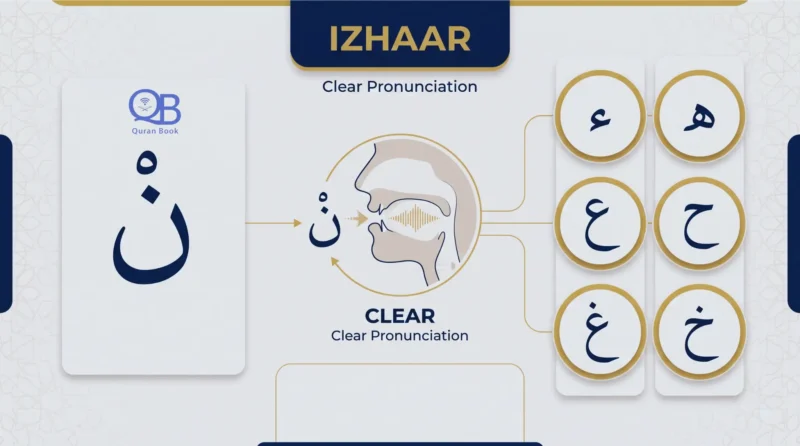
The Izhar letters are six Arabic letters — ء ، ه ، ع ، ح ، غ ، خ — all pronounced from the throat. When a silent Noon (نْ) or Tanween is followed by any of them, it must be pronounced clearly and separately, with no merging, no hiding, and no extra nasal sound. Izhar means “to make clear” in Arabic, and it is the first of the four rules of Noon Sakinah and Tanween.
Also spelled Idhar, Izhaar or Ith-har in English transliterations.
⚡ The 30-second version: 6 throat letters (ء ه ع ح غ خ) · they follow a silent Noon or Tanween · the Noon stays clear and is never merged · its nasal sound lasts about one count, not two · memorise them with «أَخِي هَاكَ عِلْمًا حَازَهُ غَيْرُ خَاسِرِ».
What Does Izhar Mean?
Izhar (إظهار) literally means “to make apparent”, “to reveal” or “to make clear”. In Tajweed it means pronouncing a silent Noon or Tanween plainly from its own articulation point, without lengthening the nasal sound that naturally belongs to it.
The word comes from the Arabic root ẓ-h-r (ظَهَرَ) — to appear, to become visible. The image behind the term is exactly right: the Noon does not hide behind the letter that follows it and does not dissolve into it. It stays out in the open, audible as itself.
That is the whole rule in one sentence. But there is a detail here that most English pages get wrong, and it is worth slowing down for.
Clear pronunciation does not mean “no ghunnah”
The letter Noon carries a nasal quality (ghunnah) built into it — it is part of the letter, not an ornament added by a rule. You cannot remove it any more than you can pronounce an M without closing your lips. What changes from rule to rule is how long that nasal sound is held. In Izhar it lasts roughly one count, the natural length of the letter. In Ikhfaa and Idgham it is stretched to about two counts. Pages that tell you Izhar means “pronounce the Noon with no ghunnah at all” are describing a sound that does not exist.
So a more precise definition is this: Izhar is the Noon at its natural length. Nothing added, nothing removed, nothing borrowed from the next letter. Once you hear it that way, the other three Noon Sakinah rules become easy to place — each one is a departure from this baseline in a different direction.
The 6 Izhar Letters (Huroof al-Halq)
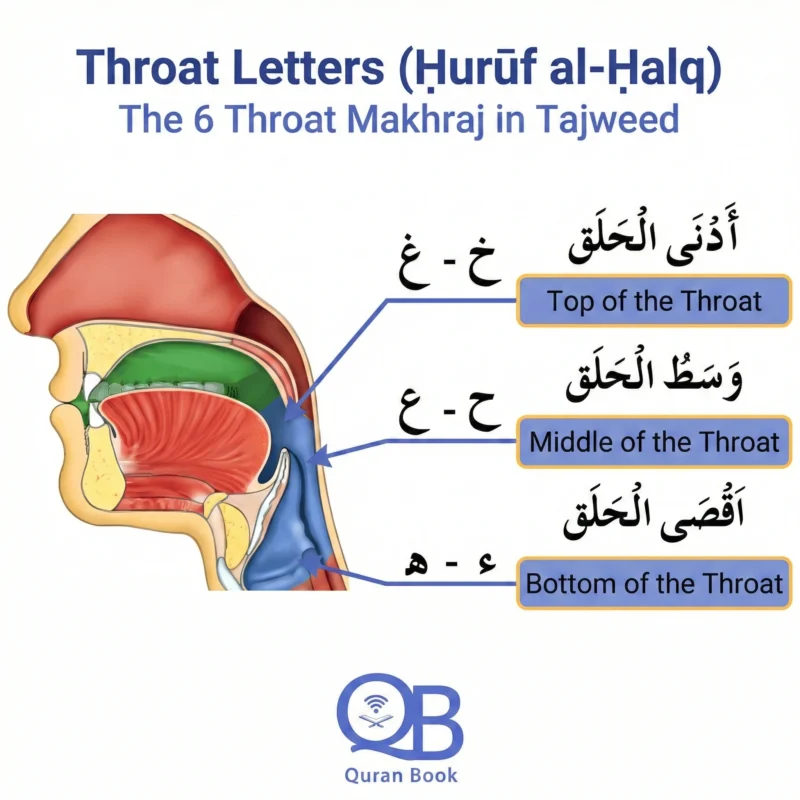
All six letters of Izhar come out of the throat, which is why the classical books call them ḥurūf al-ḥalq — the throat letters. Tap the play button on any row to hear the example word in the recitation of Sheikh Mahmoud Khalil Al-Husary.
The mnemonic: أَخِي هَاكَ عِلْمًا حَازَهُ غَيْرُ خَاسِرِ
Scholars do not ask students to memorise six loose letters. They hand over one short sentence instead:
أَخِي هَاكَ عِلْمًا حَازَهُ غَيْرُ خَاسِرِ
It reads Akhī hāka ʿilman ḥāzahu ghayru khāsirī and means: “My brother, take a knowledge that was gained by one who is no loser.” The first letter of every word is one of the six letters of Izhar, in the exact order they sit in the throat: أ → ه → ع → ح → غ → خ. Learn the sentence and you have the list, permanently.
Why these six letters and not others?
This is the part almost every English article skips, and it is the part that makes the rule stop feeling arbitrary. It comes down to distance.
The Noon is produced at the very front of the mouth: the tip of the tongue touches the gum line just behind the upper front teeth, while air escapes through the nose. The six throat letters are produced at the opposite end of the vocal tract — in the glottis and the pharynx, as far back as Arabic goes. You can read more about how each sound is placed in our guide to the Makhraj of Arabic letters.
Merging two sounds requires them to be neighbours. The tongue cannot slide from the front gum line into the back of the throat quickly enough to blur the two together, so the Noon survives intact — not because a rule protects it, but because the anatomy leaves it no other option. Phonetically these are the pharyngeal and glottal consonants of Arabic, described in reference works such as the Encyclopedia of Arabic Language and Linguistics, and the distance between them and the Noon is the largest in the language.
Every other Noon Sakinah rule follows the same logic in reverse. The closer the following letter sits to the Noon’s own point of articulation, the more the Noon gives way to it — until, with the closest letters of all, it disappears completely into them.
How to Pronounce Izhar Correctly
Three steps, and the third one is where nearly everyone slips.
1. Complete the Noon
Place the tip of the tongue firmly at the gum line behind the upper front teeth and let the sound come through the nose. Do not soften the contact and do not let the tongue drift backwards in anticipation of the throat letter.
2. Release immediately — one count, not two
The nasal sound gets its natural length and no more. A useful mental measure: it should be over before you could tap your finger twice. If you can comfortably hold it while counting to two, you have turned the clear pronunciation into Ikhfaa.
3. Start the throat letter cleanly — without a gap
Clear does not mean separated. There is no pause, no catch of breath and no tiny silence between the Noon and the letter after it. The two sounds are adjacent; only their identities stay distinct.
💡 The 10-second exercise
Say مِنْ عِلْمٍ and then مِنْ كُلِّ back to back, out loud, three times. Same Noon, same position in the word — but the second one hides and hums, and the first one does not. If both come out sounding the same, your nasal sound is running long on the first. That single comparison is worth more than any amount of reading.
The 3 Levels of Izhar
The six letters do not all behave with equal strength. Because clarity is a function of distance, the further a throat letter sits from the Noon, the more obviously clear the Noon becomes. The classical works therefore grade this rule into three degrees, from strongest to weakest.
“Weakest” here does not mean optional. All six are pronounced clearly; the grading describes how pronounced the clarity feels to the ear, and it is why some reciters sound slightly firmer on مَنْ آمَنَ than on مِنْ غِلٍّ. This three-way grading is standard in the recitation manuals taught at institutions such as Al-Azhar.
Throat map: hear the three levels
Tap a zone to hear its two letters inside a real Quranic word, recited by Sheikh Al-Husary. Move from the top zone downwards and listen for how the Noon loosens slightly as the letters come closer to it.
Tap a zone to hear it.
Izhar Rules: Where It Applies
The trigger is simple and has no exceptions to memorise: a silent Noon or a Tanween, followed by one of the six throat letters. That combination occurs in three shapes.
1. Inside a single word
The silent Noon and the throat letter sit in the same word.
يَنْهَوْنَ · أَنْعَمْتَ · وَٱنْحَرْ
2. Across two words
The word ends on a silent Noon and the next word opens with a throat letter.
مِنْ هَادٍ · مِنْ عَلَقٍ
3. Tanween + throat letter
All three Tanween endings behave exactly like a silent Noon, because that is phonetically what they are.
عَلِيمٌ حَكِيمٌ · كُفُوًا أَحَدٌ · حَاسِدٍ إِذَا
⚠️ Worth noticing: this rule works in all three positions without conditions. Idgham, by contrast, does not apply inside a single word — which is why الدُّنْيَا is read clearly rather than merged. If a rule ever feels like it should apply but does not, the word boundary is usually the reason.
The 4 Types of Izhar in Tajweed
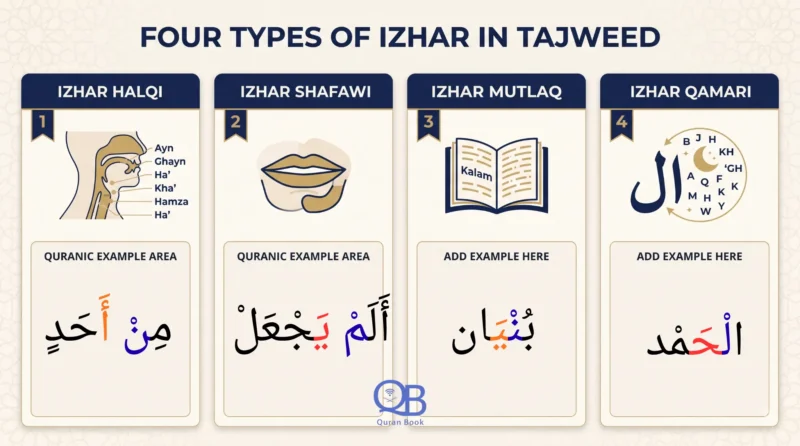
The word appears in four different places in Tajweed, and learners mix them up constantly. Everything on this page so far describes the first one — Izhar Halqi, the throat variety. Here is how it sits against the other three.
The common thread is the meaning of the word itself: in every one of the four, a letter that could have been merged or softened is instead left plainly audible. Only the letter being protected changes — the Noon in the first and third, the Meem in the second, the Lam in the fourth.
Test Yourself: Spot the Izhar
You know the six letters — now find them in real verses. We’ll show you an ayah with a silent Noon or Tanween highlighted. Tap the rule you think applies. Ten questions, instant feedback, no sign-up.
Choose the rule that applies to the highlighted letter.
Izhar Examples from the Quran
Ten short passages covering all six letters, both word positions, and all three Tanween endings. The silent Noon or Tanween is marked in blue, the throat letter in orange. Press play to hear each one in the recitation of Sheikh Al-Husary.
وَلَمْ يَكُن لَّهُۥ كُفُوًا أَحَدٌ
Al-Ikhlas 112:4 · Tanween fatḥ + ء
لَيْلَةُ ٱلْقَدْرِ خَيْرٌ مِّنْ أَلْفِ شَهْرٍ
Al-Qadr 97:3 · Noon Sakinah + ء across two words
سَلَٰمٌ هِىَ حَتَّىٰ مَطْلَعِ ٱلْفَجْرِ
Al-Qadr 97:5 · Tanween ḍamm + ه
لِكُلِّ ٱمْرِئٍ مِّنْهُمْ يَوْمَئِذٍ شَأْنٌ يُغْنِيهِ
‘Abasa 80:37 · Noon Sakinah + ه inside one word
خَلَقَ ٱلْإِنسَٰنَ مِنْ عَلَقٍ
Al-‘Alaq 96:2 · Noon Sakinah + ع
صِرَٰطَ ٱلَّذِينَ أَنْعَمْتَ عَلَيْهِمْ
Al-Fatihah 1:7 · Noon Sakinah + ع inside one word
فَصَلِّ لِرَبِّكَ وَٱنْحَرْ
Al-Kawthar 108:2 · Noon Sakinah + ح inside one word
نَارٌ حَامِيَةٌ
Al-Qari’ah 101:11 · Tanween ḍamm + ح
وَنَزَعْنَا مَا فِى صُدُورِهِم مِّنْ غِلٍّ
Al-A’raf 7:43 · Noon Sakinah + غ
ٱلَّذِىٓ أَطْعَمَهُم مِّن جُوعٍ وَءَامَنَهُم مِّنْ خَوْفٍ
Quraysh 106:4 · Noon Sakinah + خ
Surah Al-Qadr is the single best passage to drill this on: five short ayat, two clear instances, and a rhythm slow enough that you can hear your own nasal sound before the next word arrives.
Common Mistakes to Avoid
1. Holding the nasal sound too long
The most common error worldwide, and it comes from good intentions: students who have just learned Ikhfaa start applying its two-count hum everywhere. The result is a Noon that hums into the throat letter instead of standing beside it. If your مِنْ عِلْمٍ sounds like your مِنْ كُلِّ, this is what is happening.
2. Inserting a pause before the throat letter
The over-correction of the first mistake. Learners chop the Noon off and take a small breath, producing a stop that does not exist in the text. Clarity is about the identity of the sound, not about separating it in time.
3. Confusing ح with ه
Both are transliterated with an “h” in English, and non-native speakers routinely swap them. They come from different depths of the throat and are different letters entirely — حَامِيَة and هَامِيَة are not the same word.
4. Forgetting that Tanween counts
Students watch for the written Noon and read straight past عَلِيمٌ حَكِيمٌ without applying anything. A Tanween ending is a silent Noon that simply is not written as a letter — every rule that applies to one applies to the other.
Play: Eagle of Izhar (Free Game)
Recognition under time pressure is a different skill from recognition on a page. Fly the eagle, catch only the six throat letters, and see how long you last. It works on phones and tablets, and no account is needed.
Game not loading? Open it in a new tab · or browse all our free Arabic letter games.
Learn More
Izhar is the first of four rules that govern the silent Noon. Here’s what to study next:
All of them sit inside the wider set of Tajweed rules, and all of them are covered step by step in our Tajweed courses.
Frequently Asked Questions
May Allah beautify your recitation and accept it from you. 🤲
Hafidha of the Quran · Arabic Language Graduate · Writer on Islamic Sciences
Jehad Mahmoud is a graduate of the Arabic Language department and a Hafidha of the Quran who writes the Islamic educational content at Quran Book Academy.
She writes with a focus on Tajweed, Quranic recitation and the sharia sciences, making technical rules accessible to English-speaking Muslim families.
Her articles are educational, not fatwa. For a ruling on a specific personal situation, readers are advised to consult a qualified scholar or mufti.
References & Sources
1. Al-Azhar Al-Sharif — azhar.eg
2. Encyclopedia of Arabic Language and Linguistics — Brill Reference Works
3. Surah Al-Qadr 97 — Quran.com
4. Surah Quraysh 106 — Quran.com
5. Recitation — Sheikh Mahmoud Khalil Al-Husary, via EveryAyah.com
© 2026 Quran Book Academy. All rights reserved.
Book Your Free Trial · Empowering Muslims Worldwide to Connect with the Quran