How to Read Arabic: The 13-Step Path From First Letter to First Ayah
28 letters, 8 marks, one order. Here it is.
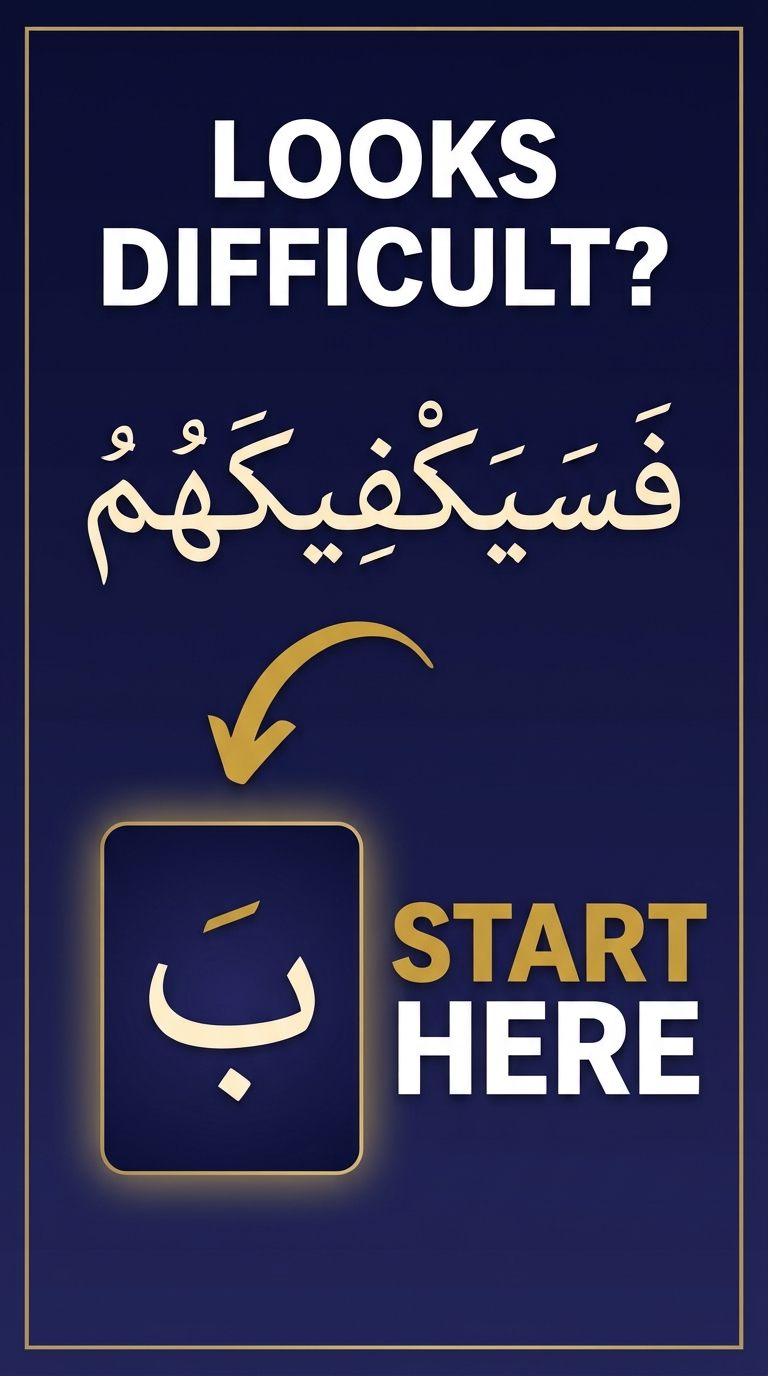
Most Muslims are not Arabs, yet millions of them read the Quran in Arabic every day without speaking the language. That is not a contradiction — it is how the script is built, and it is the real answer to how to read Arabic.
Arabic has 28 letters and 8 core marks, read from right to left, and each mark has one sound. Arabic reading is decoding, not memorising.
To learn how to read Arabic from zero, use this page as your map to read Arabic for beginners — each letter’s sound is in our Arabic alphabet pronunciation guide. By the end you’ll know the exact order to learn them in — and you’ll read your first real Arabic word before you reach the end.
The Short Answer: How to Read Arabic
To read Arabic, learn the 28 letters by sound (not by name), then their connected shapes, then the three short vowels: fatha, kasra and damma. Add sukoon, long vowels, shaddah and tanween. Then blend letters into syllables, syllables into words, and words into sentences.
That’s the whole system. Everything below is the order — and why the order matters more than the effort.
Why Arabic Is Easier to Read Than English
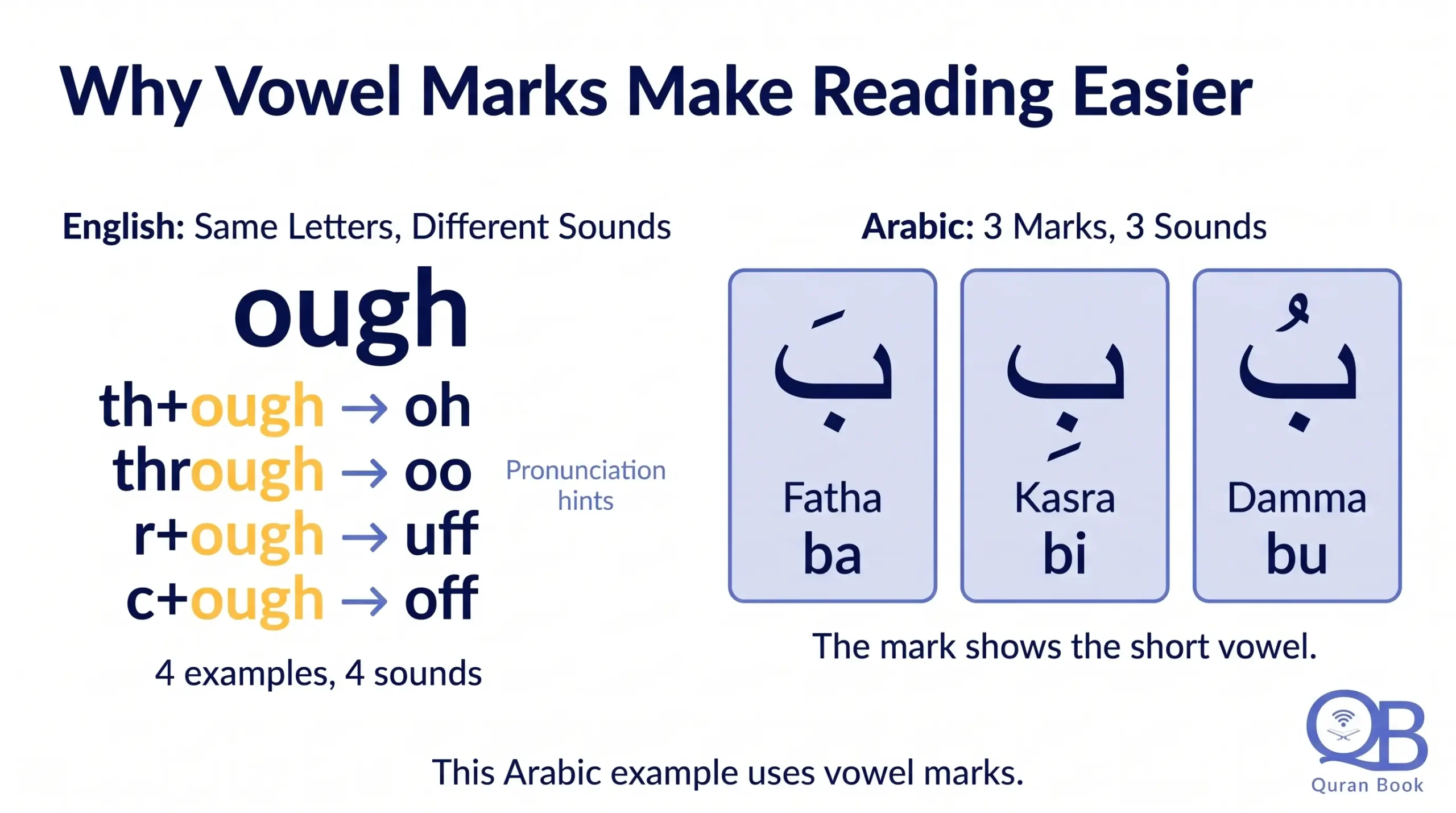
ba · bi · bu
In English you memorise each word. In Arabic, the mark tells you the sound — every time.
Fully vowelled Arabic has almost no surprises — and the few that exist are small rules you meet later, like the silent alif at the end of قَالُوا (qālū, “they said”). Once you know the pieces, you can read a word you have never seen — correctly, the first time.
Wondering about the language as a whole, not just the script? See is Arabic hard to learn.
Learn the Sounds, Not the Names
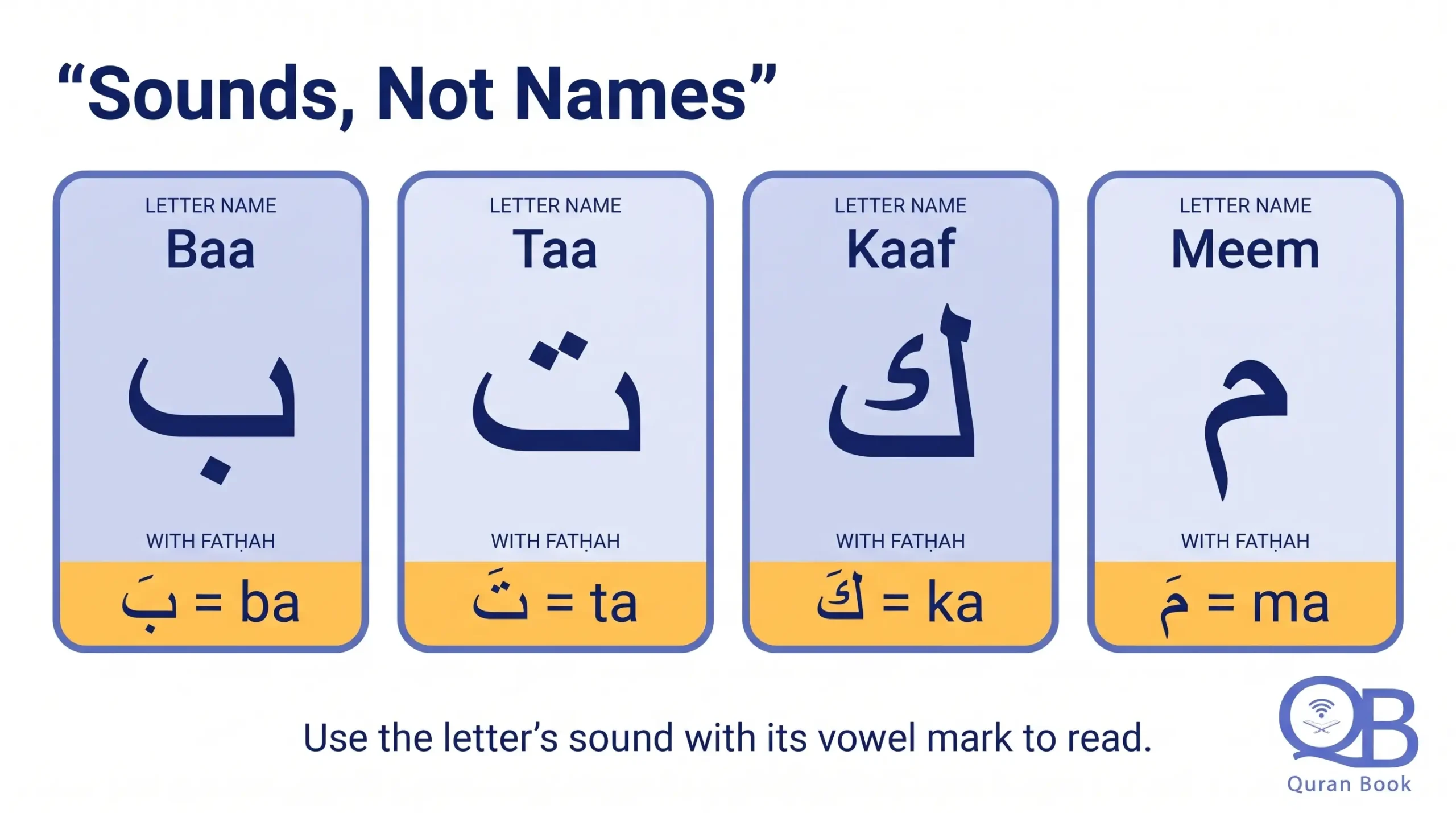
Every letter has a name and a sound. أَلِف، بَاء، تَاء (alif, bāʾ, tāʾ) are the letters’ names. Their sounds are a, b, t. On the page, you only ever read the sound.
An Arab child learns the names first because they have years of school and Arabic all around them to fix mistakes. An adult with 20 minutes a day needs the sound first. Many guides on how to read Arabic skip this, yet it saves the most time.
| Letter | Name | Sound | What beginners get wrong | Listen |
|---|---|---|---|---|
| ب | بَاء bāʾ | b | Saying “baa” in the middle of a word | |
| ت | تَاء tāʾ | t | Adding a vowel that isn’t written | |
| ك | كَاف kāf | k | Mixing it up with ق (q) — a different makhraj (point where the sound is made) | |
| م | مِيم mīm | m | Reading the name “meem” inside a word instead of the sound |
The full set of 28 — names, sounds and shapes — is in our Arabic alphabet pronunciation guide.
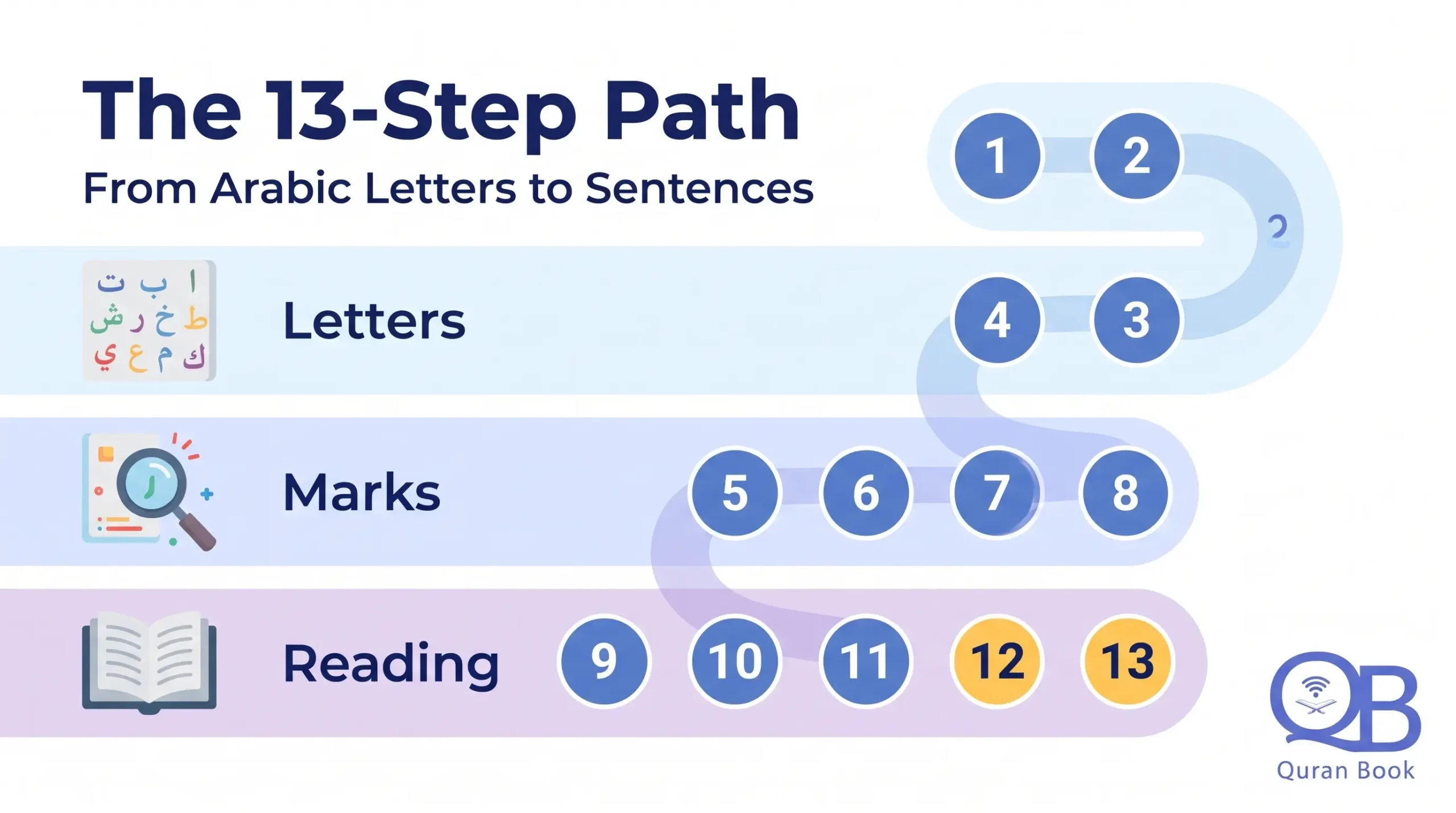
The 13-Step Path: Learn to Read Arabic in the Right Order
These are the Arabic reading steps — how to read Arabic in the order that works. Each step uses only what came before it.
Step 1
The 28 letters
The Arabic alphabet has 28 letters, written and read from right to left. This is where every plan to read Arabic for beginners starts.
ا ب ت ث ج — alif, bāʾ, tāʾ, thāʾ, jīm: the first five letters.
Why now: everything after this step is built on these shapes.
Meet all 28 in our Arabic alphabet pronunciation guide.
Step 2
Letter sounds
Each letter has one main sound, and that sound is what you read.
ب = “b”, not “bāʾ”.
Why now: you read sounds, never names — so the sound is the first thing you attach to each shape.
Hear every sound in the Arabic alphabet pronunciation guide.
Step 3
Letter shapes & connections
Most letters join the letter next to them, and their shape changes a little when they do.
ب بـ ـبـ ـب — bāʾ alone, at the start, in the middle, at the end.
Why now: the same letter can take up to four shapes. Without this, you can’t split a word into its letters.
See every shape: Arabic letters beginning middle end.
Step 4
Short vowels: fatha, kasra, damma
Three small marks — the حَرَكَات (ḥarakāt, “movements”) — give a letter a short vowel. Fatha is a small line above, kasra a line below, damma a tiny و above.
بَ ba · بِ bi · بُ bu
Why now: letters without vowels are consonants, not speech.
Learn all three in Arabic harakat.
Step 5
Sukoon
A small circle (ـْ) above a letter means: no vowel here.
قُلْ (qul, “say”) — the لْ carries no vowel.
Why now: it is the first “stop” mark. It tells you to add nothing, so you stop guessing vowels.
More in Sukoon in Arabic.
Step 6
Long vowels
Three letters — ا و ي (alif, wāw, yāʾ) — can stretch the short vowel before them into a long one.
كَتَبَ (kataba, “he wrote”) vs كَاتَبَ (kātaba, “he corresponded”).
Why now: one added letter stretches a sound — and changes the word.
Learn them in Arabic long vowels.
Step 7
Shaddah
The shaddah (ـّ) means the letter is said twice: once with no vowel, then once with its vowel.
دَرَسَ (darasa, “he studied”) vs دَرَّسَ (darrasa, “he taught”).
Why now: it doubles a letter — and can change the meaning.
See how it works: Shaddah.
Step 8
Tanween
Tanween is a doubled vowel mark on the last letter that adds an “n”: -an, -in, -un.
أَحَدٌ (aḥadun, “one”), from Al-Ikhlas 112:1:قُلْ هُوَ اللَّهُ أَحَدٌQul huwa llāhu aḥad — “Say: He is Allah, the One.”
All Quran examples follow the Hafs ‘an ‘Asim recitation. At the end of an ayah the reciter stops, so you hear aḥad.
Why now: it is the last core mark. After this you can read any vowelled page — including the ayah that قُلْ came from in Step 5.
All three forms: Tanween in Arabic.
Step 9
Blending letters
Blending means saying each letter-plus-mark in a row, without a pause, until they become one word.
كَ + تَ + بَ ← كَتَبَ (kataba)
Why now: this is the jump from “saying letters” to reading. Say it slowly first, then faster.
Practise it in How to read Arabic words.
Step 10
Short words
Two- and three-letter words are where blending becomes automatic.
مِنْ (min, “from”) — a kasra, then a sukoon.
Why now: most Arabic words are built on three-letter roots, so short words come quickly.
Next words: How to read Arabic words.
Step 11
Sentences
Now you read several words in one line.
Al-Fatiha 1:1:بِسْمِ اللَّهِ الرَّحْمَٰنِ الرَّحِيمِBismillāhi r-raḥmāni r-raḥīm — “In the name of Allah, the Most Merciful, the Most Compassionate.”
The first alif of اللَّهِ is silent when connected — that’s Hamzat al-Wasl.
Why now: your eye learns where words begin and end.
Keep going with Arabic reading practice.
Step 12
Passages
A passage is several lines or ayat read in one go, at a steady pace.
Al-Fatiha 1:2:الْحَمْدُ لِلَّهِ رَبِّ الْعَالَمِينَAl-ḥamdu lillāhi rabbi l-ʿālamīn — “All praise is for Allah, Lord of the worlds.”
Why now: speed comes here — not before.
Build speed with Arabic reading practice.
Step 13
Tajweed
Tajweed is the set of rules for reciting the Quran correctly and beautifully.
“Reading is the door; Tajweed is the room.”
Why now: reading correctly is not yet reciting beautifully — that comes after.
When you’re ready, start with our Tajweed rules guide.
Structured beginner methods such as the Noor Al Bayan Method follow this same order.
Find Your Starting Step
Already know some letters? Answer five quick questions and jump straight to your step.
How Long Does It Take to Learn to Read Arabic?
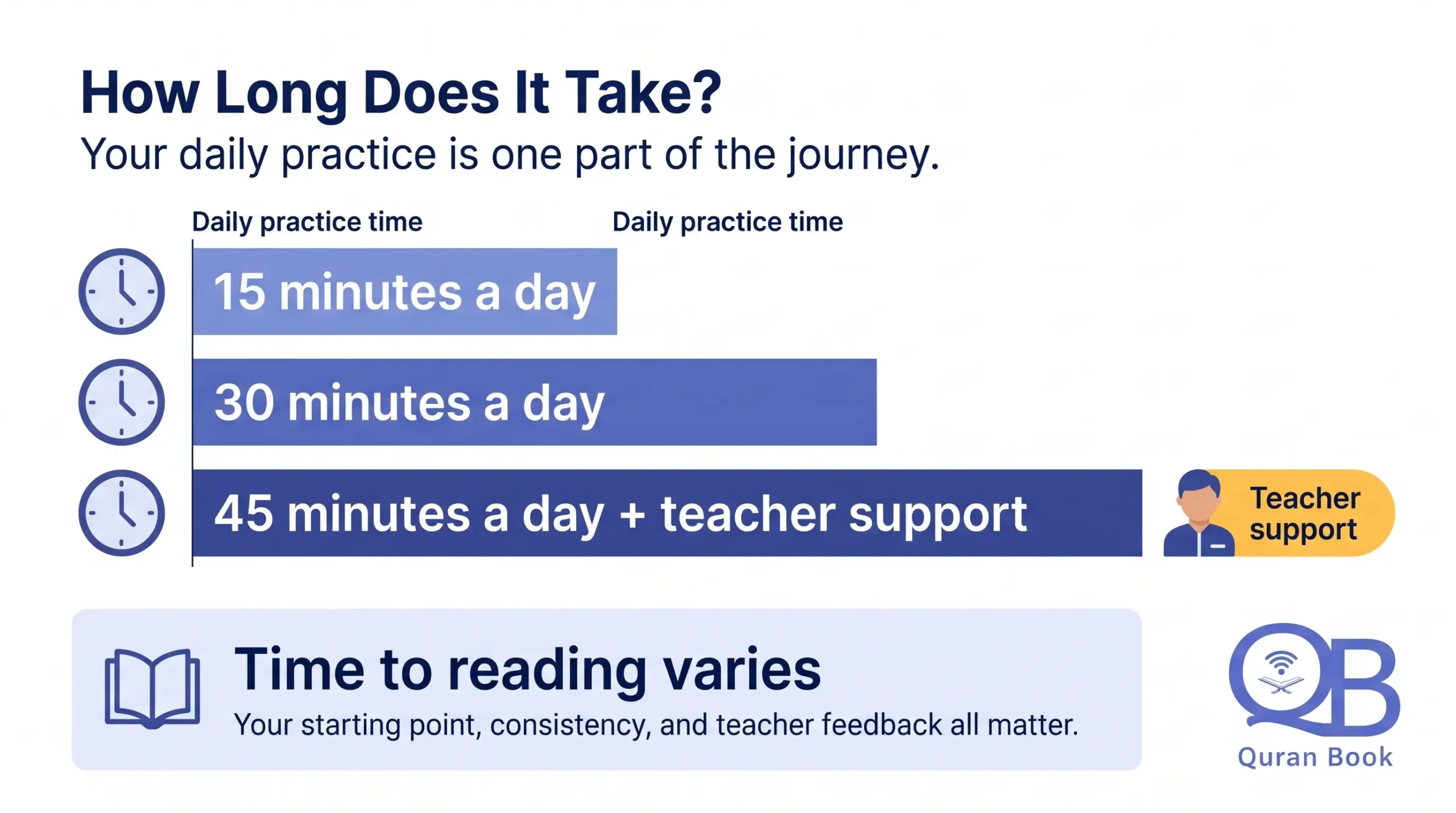
If you’re asking how to learn to read Arabic quickly, two things decide it: your daily minutes, and whether someone hears you read.
Typical estimates for an adult beginner — your pace may differ
| Daily practice | Letters + short vowels | Reading vowelled text (all 13 steps) |
|---|---|---|
| 15 minutes | 4–5 weeks | 4–6 months |
| 30 minutes | 2–3 weeks | 2–3 months |
| 45 minutes + a teacher | 10–14 days | 6–8 weeks |
The biggest variable isn’t talent — it’s whether someone corrects your pronunciation early, before a wrong habit sets in. That’s why our one-on-one classes to learn Quran reading for adults start with a teacher listening from the first lesson.
Read Your First Arabic Word Right Now
Right now you know three things: a letter has a sound, a fatha adds “a”, and Arabic runs right to left. That is enough to read a real word.
Take ك (k), ت (t) and ب (b). Give each one a fatha and join them from the right.
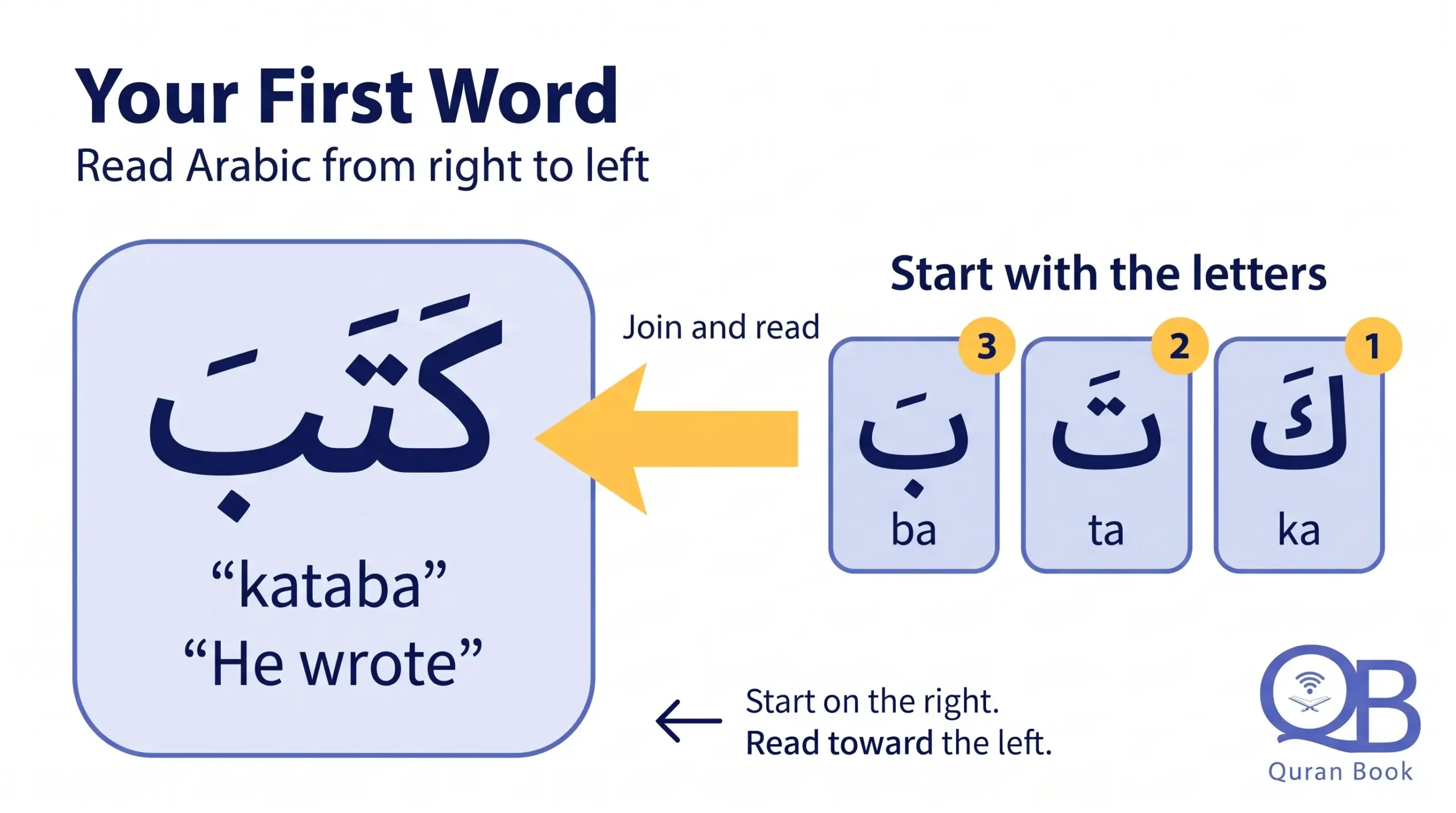
That took about a minute. There are 25 more letters and 7 more marks — that’s the whole system.
5 Mistakes That Slow Beginners Down
Most people who stall while learning how to read Arabic hit one of these.
👨👩👧 Teaching a child how to read Arabic? Same order, shorter sessions (10–15 minutes) and more play. Children enjoy seeing a letter and hearing its sound at the same time, so games fit Steps 1–4 well.
Get ideas for home in how to teach Arabic to kids, try our free Arabic alphabet game, or let a teacher guide them in our Quran reading for beginners program.
Practise for Free
Free tools to practise how to read Arabic between lessons.
▶ Meet the letters on YouTube — swipe →

Meet Yaa

Meet Waw

Letter Haa

My name is Noon
Quick Check: 5 Questions
Every wrong answer points you to the step that teaches it.
How to Read Arabic: FAQ
How do I start learning to read Arabic?
Start with the sounds of the 28 letters, not their names. Then learn how each letter changes shape inside a word, and then the three short vowels: fatha, kasra and damma. Following this order saves beginners weeks of confusion when they learn to read Arabic.
→ Start with Arabic alphabet pronunciation.
How long does it take to learn to read Arabic?
With about 30 minutes a day, many adult beginners learn the letters and short vowels in 2–3 weeks and can slowly read fully vowelled text within 2–3 months. These are typical estimates. A teacher who corrects your pronunciation early usually shortens the path.
Can I read Arabic without understanding it?
Yes. Millions of Muslims read the Quran this way. Fully vowelled Arabic shows you exactly how to pronounce each letter, so you can read a word correctly before you know its meaning. Understanding is a separate goal you can add later.
Is Arabic hard to read?
The script looks unfamiliar, runs right to left, and letters change shape. But once the vowel marks are written, the sound rules are far more regular than English spelling. Reading is usually the quickest part of Arabic to learn.
→ The bigger picture: is Arabic hard to learn?
Do I need to learn Arabic grammar to read?
No. Reading is decoding sounds; grammar is for understanding meaning. They are separate paths, and you can finish the first without starting the second.
What is the fastest way to learn how to read Arabic?
Short daily practice (20–30 minutes) in a fixed order, plus someone who listens to you read and corrects your pronunciation in the first weeks — before a wrong habit sets in.
Should I learn Tajweed at the same time?
Generally, no. Learn to read correctly first. Tajweed adds rules for reciting the Quran on top of reading you already have, and trying both from day one usually slows down both.
→ When you’re ready: Tajweed rules.
Which surah should I start reading first?
Surah Al-Fatiha. It has seven short ayat, many of its words repeat, and most Muslims have heard it thousands of times — so your ear helps your eyes.
Learn More
Hear Your Own Mistakes — Free
You can learn the letters alone. You can’t hear your own mistakes. One free trial lesson shows you how to read Arabic with a teacher who listens — what a book never will.
Book Your Free Trial Lesson💬 Chat on WhatsApp 📢 Follow our WhatsApp Channel
Arabic Language Graduate · Hafidha of the Quran · Writer on Arabic Reading
Jehad Mahmoud is a graduate of the Arabic Language department and a Hafidha of the Quran who writes the Arabic and Quran-reading guides at Quran Book Academy.
She writes for English-speaking learners and parents starting from zero: the letters by sound, the vowel marks, and the step-by-step order that leads to reading the Quran directly from the Mushaf.
Her Arabic Language studies and her memorisation of the Quran are the foundation of this reading series.
These guides teach the reading system step by step. Pronunciation is a skill of the ear and the mouth, so it is best checked by a qualified teacher who can hear you read.
References
- Quran.com — Surah Al-Fatiha 1:1: quran.com/1/1 · 1:2: quran.com/1/2
- Quran.com — Surah Al-Ikhlas 112:1: quran.com/112/1
- Quran recitation audio (Al-Fatiha 1:1–2, Al-Ikhlas 112:1): Sheikh Mahmoud Khalil Al-Husary, riwayah Hafs ‘an ‘Asim, via EveryAyah.com. Letter and syllable sounds (ب ت ك م, بَ بِ بُ, كَتَبَ) are Quran Book Academy recordings.
- Encyclopaedia Britannica — Arabic alphabet.