Arabic Alphabet Pronunciation: All 28 Letters and the 8 Hardest Sounds
The full chart with audio — and the eight sounds worth slowing down for.
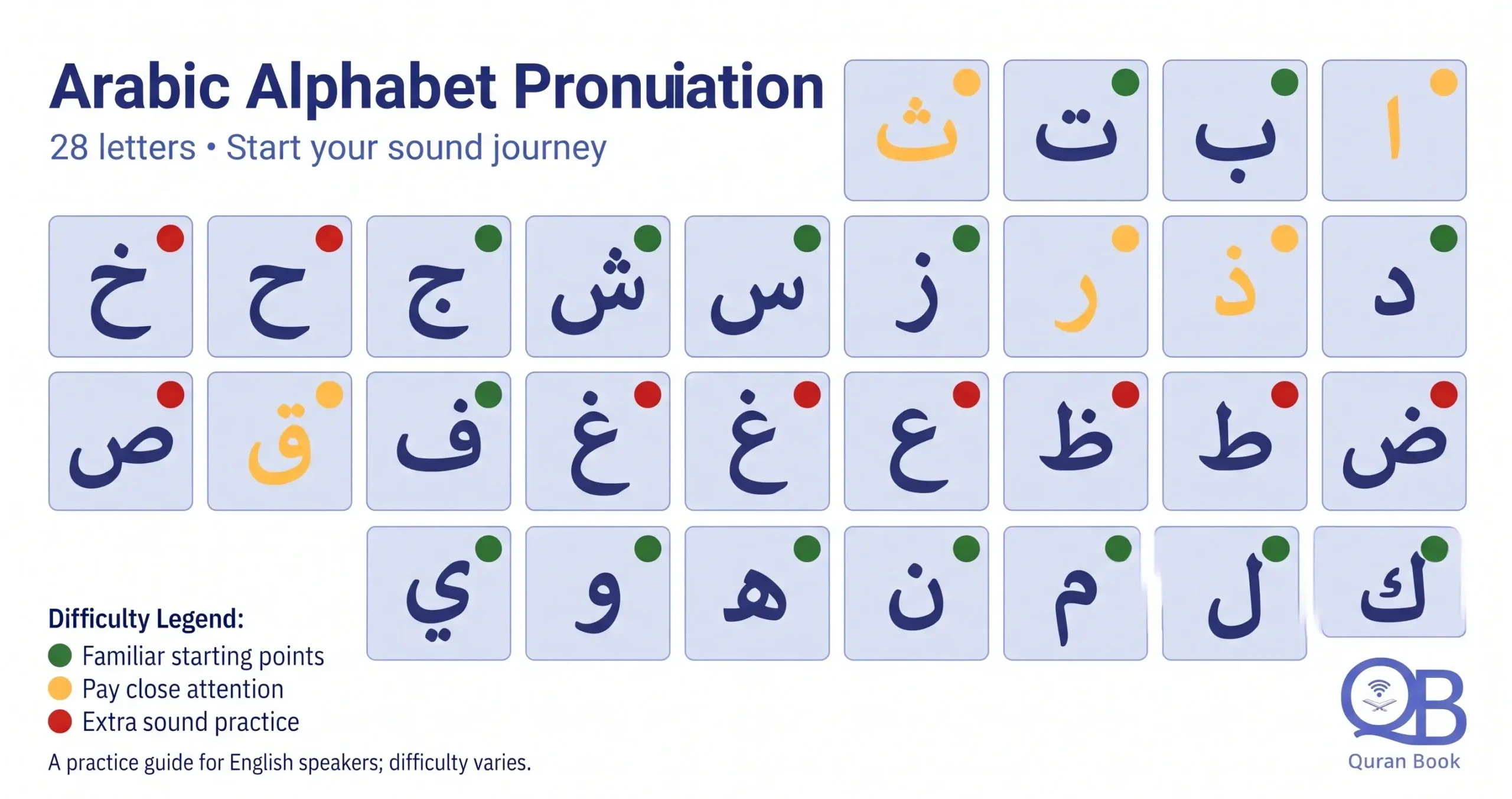
Arabic has 28 letters. Twenty of them will feel familiar within a day. Eight of them won’t.
This guide to Arabic alphabet pronunciation is the first step in learning how to read Arabic. It gives you three things: a chart of all 28 letters with real audio, a clear split between the easy letters and the new sounds, and practice you can do right now on your phone.
It is written for complete beginners — adults and parents starting from zero. Tap every 🔊 button as you go. Your ears will learn faster than your eyes.
The Arabic Alphabet Chart: All 28 Arabic Letters
Arabic is a Semitic language, and its script is an abjad: every letter is a consonant, and short vowels are added as small marks. Here are all 28 Arabic letters in the order learners use today. Tap 🔊 to hear the Arabic alphabet pronunciation of each letter: its sound, not its name.
| # | Letter | Name | Transliteration | Sounds like (English) | Level | 🔊 |
|---|---|---|---|---|---|---|
| 1 | ا | alif· ā / ʾ | ā / ʾ | “a” in father when it lengthens a vowel; a short catch (as in uh-oh) when it carries a hamza | 🟢 Easy | |
| 2 | ب | bāʾ· b | b | b in boy | 🟢 Easy | |
| 3 | ت | tāʾ· t | t | t in tea, but softer | 🟢 Easy | |
| 4 | ث | thāʾ· th | th | th in think | 🟢 Easy | |
| 5 | ج | jīm· j | j | j in jam | 🟢 Easy | |
| 6 | ح | ḥāʾ· ḥ | ḥ | a strong, breathy h — like fogging up a mirror | 🔴 New sound | |
| 7 | خ | khāʾ· kh | kh | ch in Scottish “loch” or German “Bach” | 🔴 New sound | |
| 8 | د | dāl· d | d | d in dog | 🟢 Easy | |
| 9 | ذ | dhāl· dh | dh | th in this | 🟢 Easy | |
| 10 | ر | rāʾ· r | r | a tapped r, like Spanish “pero” | 🟡 Watch out | |
| 11 | ز | zāy· z | z | z in zoo | 🟢 Easy | |
| 12 | س | sīn· s | s | s in sun | 🟢 Easy | |
| 13 | ش | shīn· sh | sh | sh in ship | 🟢 Easy | |
| 14 | ص | ṣād· ṣ | ṣ | a heavy, deep s | 🔴 New sound | |
| 15 | ض | ḍād· ḍ | ḍ | a heavy d with no English match | 🔴 New sound | |
| 16 | ط | ṭāʾ· ṭ | ṭ | a heavy, deep t | 🔴 New sound | |
| 17 | ظ | ẓāʾ· ẓ | ẓ | a heavy version of th in “this” | 🔴 New sound | |
| 18 | ع | ʿayn· ʿ | ʿ | a voiced squeeze in the throat — no English match | 🔴 New sound | |
| 19 | غ | ghayn· gh | gh | like a gentle gargle; close to the French r | 🔴 New sound | |
| 20 | ف | fāʾ· f | f | f in fun | 🟢 Easy | |
| 21 | ق | qāf· q | q | a k made further back — a deeper k | 🟡 Watch out | |
| 22 | ك | kāf· k | k | k in kite | 🟢 Easy | |
| 23 | ل | lām· l | l | l in lamp | 🟢 Easy | |
| 24 | م | mīm· m | m | m in moon | 🟢 Easy | |
| 25 | ن | nūn· n | n | n in noon | 🟢 Easy | |
| 26 | ه | hāʾ· h | h | h in hat — also pronounced at the end of a word | 🟢 Easy | |
| 27 | و | wāw· w / ū | w / ū | w in wet; or a long “oo” | 🟢 Easy | |
| 28 | ي | yāʾ· y / ī | y / ī | y in yes; or a long “ee” | 🟢 Easy |
- 🟢 Easy — close English sound
- 🟡 Watch out — close, but not the same
- 🔴 New sound — no English match
This is the Arabic alphabet with English transliteration: the Latin letters help your eyes on day one, but the audio is the real teacher.
Arabic Alphabet in Order (A to Z)
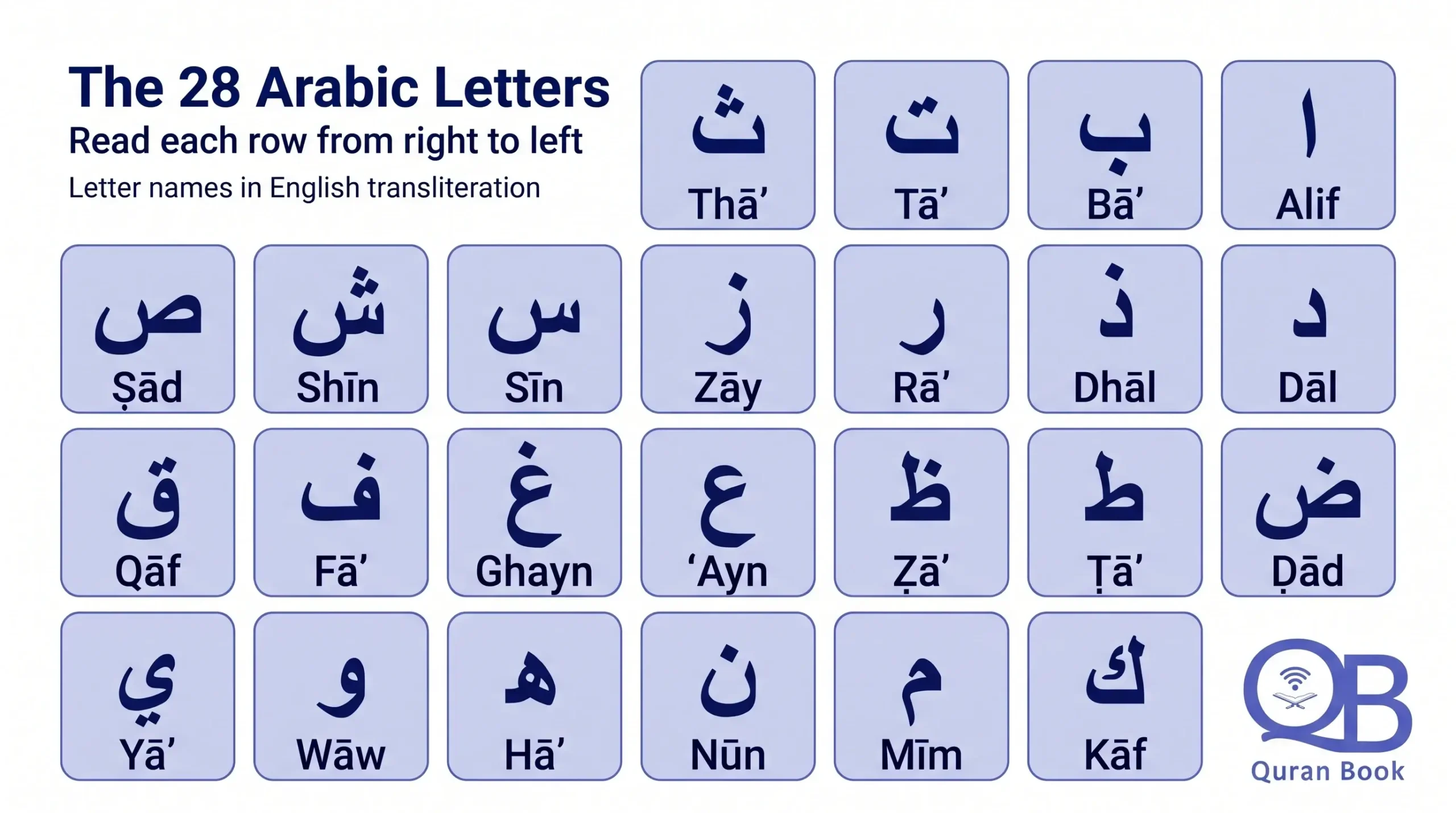
The chart above uses the hijāʾī order, the one taught in schools and Quran classes today. It groups letters by shape, so look-alikes such as ب ت ث sit side by side.
There is also an older abjad order — أَبْجَدْ هَوَّزْ (abjad hawwaz, the first two “words” of that list) — once used for numbering. For learning, stick with the chart order.
Arabic Alphabet Pronunciation: How Each Letter Sounds
Good Arabic alphabet pronunciation rests on three simple rules. They are the same in Modern Standard Arabic and in the Quran.
- Arabic is read from right to left. Your eyes start on the right side of the line.
- Each letter keeps one sound. There is no English-style “c” that is sometimes k and sometimes s. ك is always k.
- Short vowels are not letters. They are small marks written above and below the letters, called Arabic harakat.
One more habit makes the Arabic letter sounds click: inside a word, you read the letter’s sound, not its name. The letter ب is called بَاء (bāʾ, the letter’s name), but in a word it is simply b.
🎬 Watch the letters
How to Pronounce Arabic Letters: The 20 Familiar Ones
Start with the good news: most of the Arabic alphabet letters sound close to English.
- Thirteen sound like English: ب ت د ز س ش ف ك ل م ن ه ج. Only ت is a little softer than an English t.
- Two make the English “th” sounds: ث as in think, ذ as in this.
- Three double as long vowels: ا (ā), و (ū) and ي (ī).
- Two need a little care: ر is a tapped r, like Spanish “pero”, and ق is a deeper k, made further back.
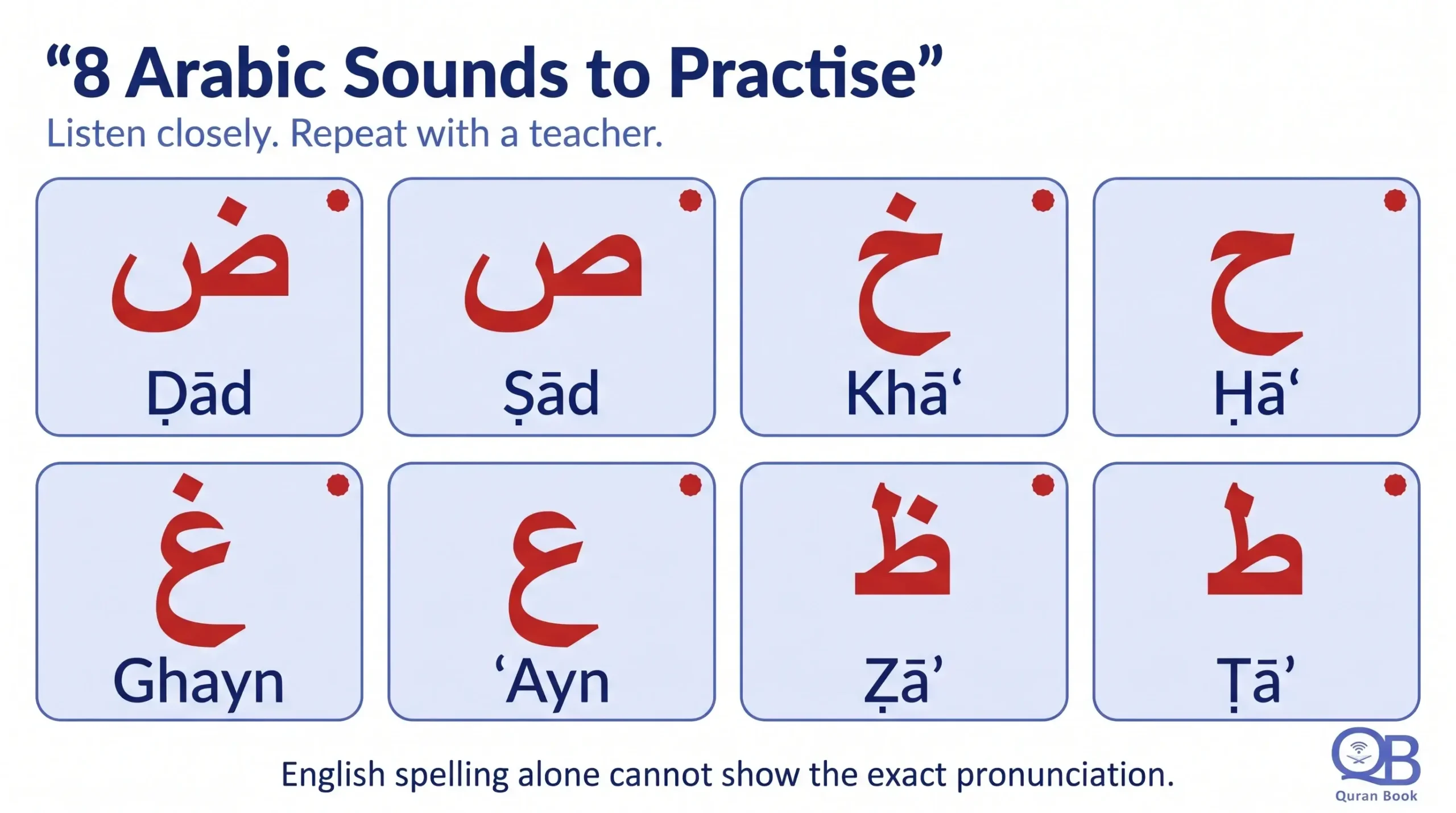
The 8 Hardest Sounds for English Speakers
These eight are the hardest part of Arabic alphabet pronunciation. Tap each one and listen before you copy it.
- ḥāʾ — A strong, breathy h — like fogging up a mirror. Much stronger than ه.
- khāʾ — A rough, scratchy sound, like the ch in Scottish “loch”.
- ṣād — A heavy, deep s — darker than the s in sun.
- ḍād — A heavy, deep d with no English match.
- ṭāʾ — A heavy, deep t — fuller than the t in tea.
- ẓāʾ — A heavy, deep version of the th in “this”.
- ʿayn — A tight, voiced squeeze — like the sound you make lifting something heavy.
- ghayn — A soft gargle, close to the French r in “Paris”.
Four of them — ص ض ط ظ — are heavy letters in Arabic: they sound full and deep. For where each sound is made, see makhraj. Each one gets its own lesson in Difficult Arabic Letters.
🔊 Hear them in the Quran
Together, these five verses contain all eight hard letters. Listen for the letters in red.
الْحَمْدُ لِلَّهِ رَبِّ الْعَالَمِينَ
Al-ḥamdu lillāhi rabbi l-ʿālamīn
“All praise is for Allah, Lord of the worlds.” (Al-Fatiha 1:2)
Listen for: ح · ع
Recited by Sheikh Mahmoud Khalil Al-Husary (murattal), riwayah Hafs ʿan ʿĀṣim. Audio via EveryAyah.
اهْدِنَا الصِّرَاطَ الْمُسْتَقِيمَ
Ihdinā ṣ-ṣirāṭa l-mustaqīm
“Guide us to the straight path.” (Al-Fatiha 1:6)
Listen for: ص · ط (and ق)
صِرَاطَ الَّذِينَ أَنْعَمْتَ عَلَيْهِمْ غَيْرِ الْمَغْضُوبِ عَلَيْهِمْ وَلَا الضَّالِّينَ
Ṣirāṭa lladhīna anʿamta ʿalayhim, ghayri l-maghḍūbi ʿalayhim wa lā ḍ-ḍāllīn
“The path of those You have blessed — not of those who earned Your anger, nor of those who went astray.” (Al-Fatiha 1:7)
Listen for: غ · ض
إِنَّهُ ظَنَّ أَن لَّن يَحُورَ
Innahū ẓanna an lan yaḥūr
“He thought he would never return.” (Al-Inshiqaq 84:14)
Listen for: ظ
مِن شَرِّ الْوَسْوَاسِ الْخَنَّاسِ
Min sharri l-waswāsi l-khannās
“From the evil of the whisperer who withdraws.” (An-Nas 114:4)
Listen for: خ
Can’t tell the difference yet? That’s exactly what a teacher’s ear is for.
Book Your Free Trial LessonStarting as a grown-up? See how we teach adults to learn Quran reading for adults, one-on-one.
Arabic Alphabet with English Transliteration
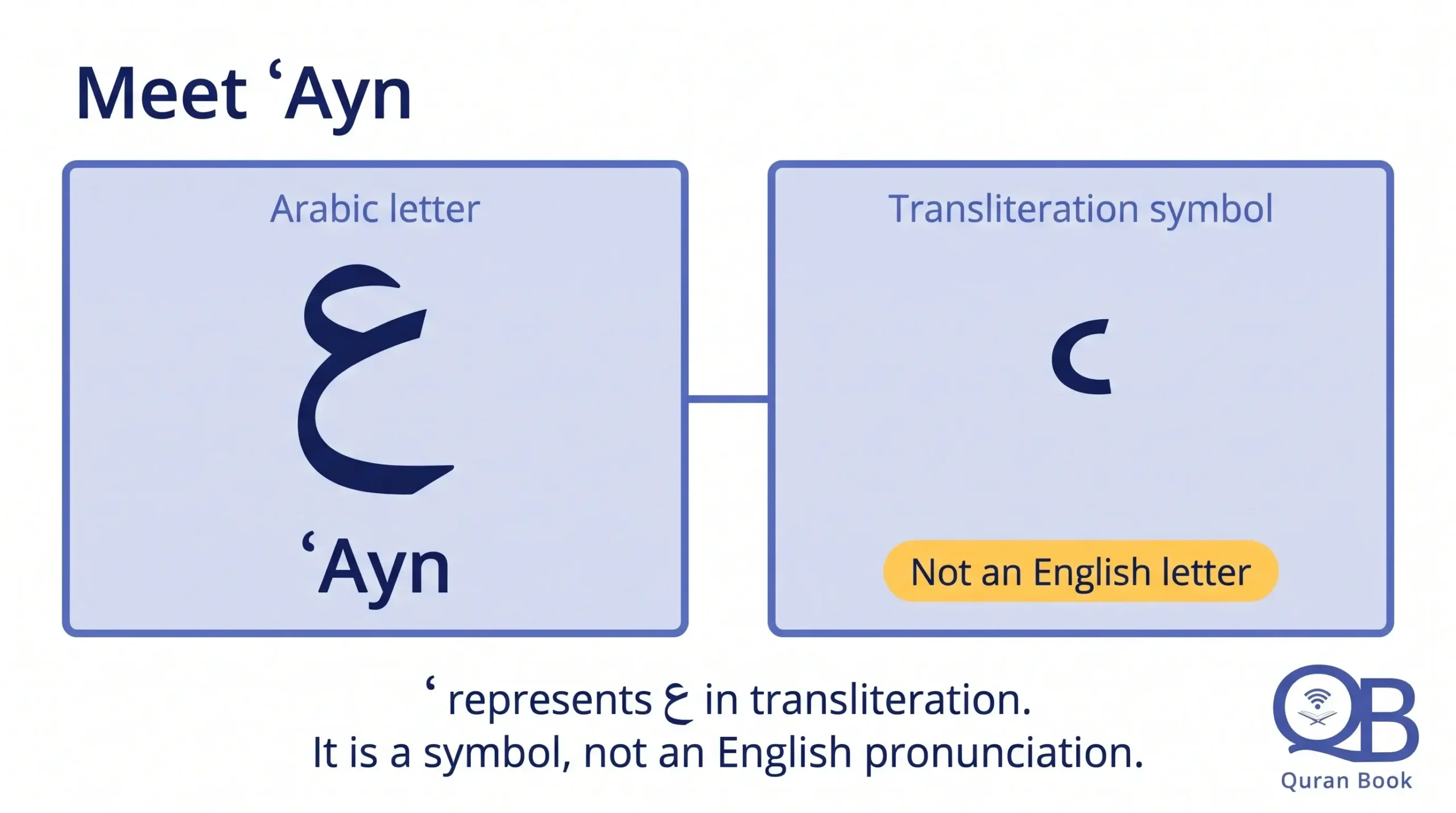
Arabic alphabet transliteration writes Arabic sounds with Latin letters. It helps your Arabic alphabet pronunciation on day one, but it is a temporary crutch. Symbols like ʿ, ḥ and ṣ are not English letters, and plain English spelling hides the difference between ح and ه — both become “h”.
Transliteration is a ladder — plan to kick it away by week three.
Practice: Hear It, Match It, Say It
Arabic alphabet pronunciation is learned with the ears, not by reading about it. Use these Arabic alphabet flashcards to hear every letter, then test yourself with the games below. Five minutes a day is a good start.
أ ب ت
Lesson 1 — Welcome to the Arabic Alphabet
28 flashcards with sound. Switch to Letter Only mode to test yourself.
🎲 Play: Arabic letters games
ا ب ت ث
Arabic Letters Games
Start with the Alphabet games, then try them with real words.
Want more? Try the free Arabic alphabet game.
👨👩👧 Teaching a child the letters? Use the same chart with shorter sessions and more play. The Arabic alphabet for kids works best as a game: our free Arabic alphabet game lets children tap, hear and match the letters. When they’re ready for a teacher, see our Quran reading for beginners classes.
What Comes After the Arabic Alphabet
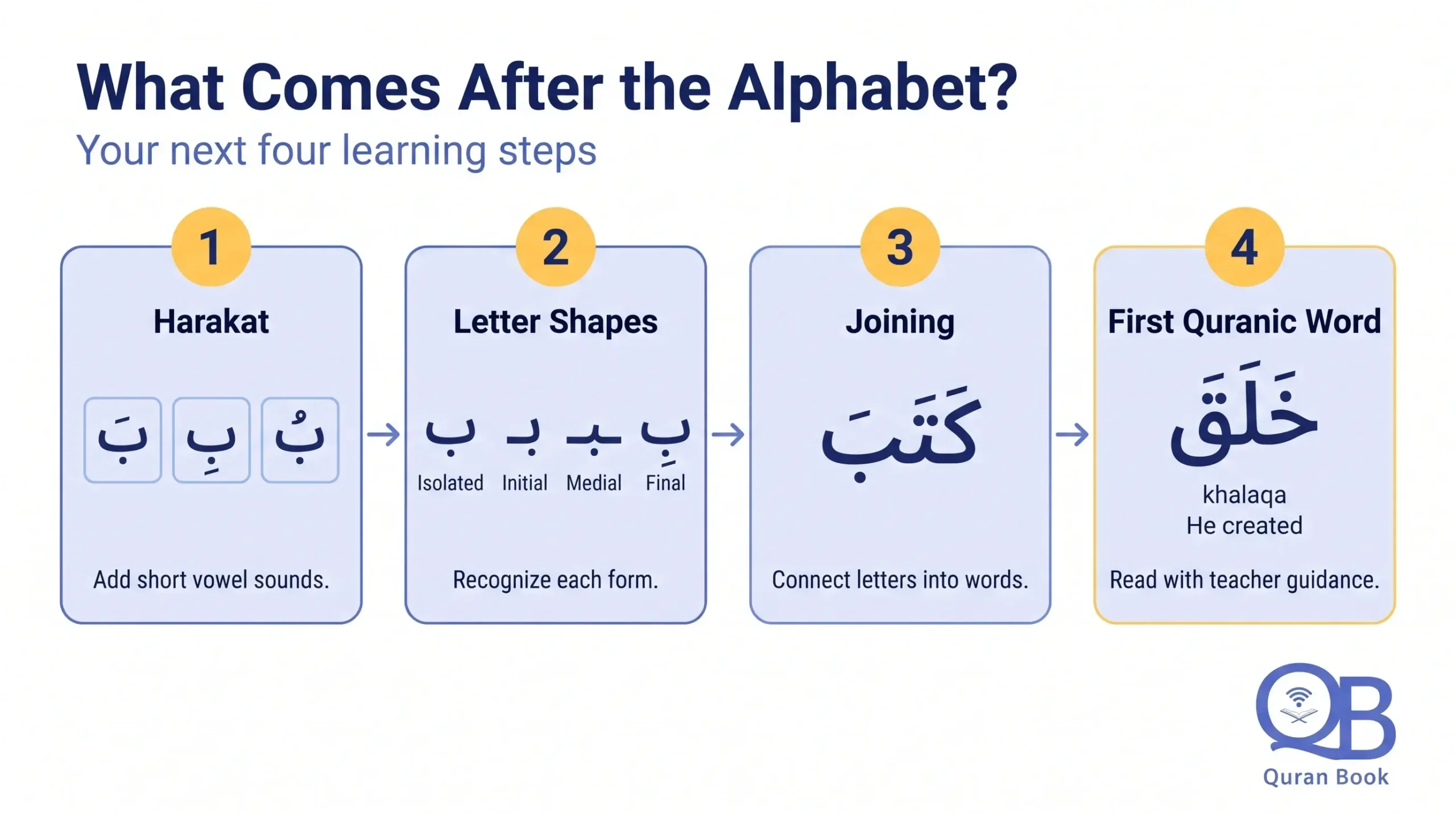
Once your Arabic alphabet pronunciation feels comfortable, the next steps come in this order:
- Short vowels — the marks covered in Arabic harakat.
- Letter shapes inside words — see Arabic letters beginning middle end.
- Joining letters into syllables and words.
- Your first Quranic word, read straight from the page.
Later you’ll meet ideas like sun and moon letters, but they never change the 28 sounds above. See the full path in our guide on how to read Arabic.
📚 Learn More
- Letters are only half the system — the vowels sit above and below them: Arabic harakat
- Once you know the sounds, learn to recognise letters when they join: Arabic letters beginning middle end
- Ready to fix the eight hard sounds properly? Difficult Arabic Letters
- Curious where each sound is made? makhraj
- Teaching a child instead of yourself? free Arabic alphabet game
Arabic Alphabet FAQ
How many letters are in the Arabic alphabet?
Arabic has 28 letters. All of them are consonants — the short vowels are written as small marks above and below the letters, not as separate letters. Some scholars also count the hamza (ء) as a 29th character, though it is usually treated as a sign rather than a full letter.
Is the Arabic alphabet hard to learn?
The shapes usually take one to three weeks of short daily practice. The sounds are the real work: about 20 letters have a close English sound, but eight (ح خ ص ض ط ظ ع غ) have no English match and are much easier to get right with a teacher listening.
What is the hardest Arabic letter to pronounce?
For English speakers, ع (ʿayn) is usually the hardest, followed by ح (ḥāʾ) and ض (ḍād). ع and ح are made in the throat, which English does not use for speech sounds, and ض is a sound unique to Arabic, so imitation alone rarely gets them right.
Are Arabic letters written right to left?
Yes. Arabic is written and read from right to left, and most letters connect to each other within a word. Numbers, however, are written from left to right.
Do Arabic letters change shape?
Yes. Most letters take a slightly different shape at the beginning, middle or end of a word. The core shape stays recognisable, so learning the standalone form first is enough to get started.
Next step: Arabic letters beginning middle end.
Can I learn the Arabic alphabet on my own?
You can learn the shapes, names and order on your own with a chart like the one above. Pronunciation is different: you cannot easily hear your own mistakes in sounds your language does not have, so most learners need a teacher to check the eight difficult letters.
Is the Arabic alphabet the same as the Quranic alphabet?
Yes, the letters are the same. The Quran’s script adds some special spellings and recitation marks, and Tajweed rules govern how letters are lengthened, merged or held — but the 28 letters do not change.
Related: Tajweed rules.
How long does it take to learn the Arabic alphabet?
Many beginners recognise all 28 letters within one to three weeks of 15–30 minutes a day. Saying the eight new sounds correctly takes longer and goes faster with regular feedback. These are typical estimates — everyone’s pace is different.
You know the 28 letters. Now make the 8 hard ones right.
Good Arabic alphabet pronunciation starts on day one. In a free one-on-one lesson, a qualified teacher listens to you read and fixes the eight new sounds before bad habits set in.
Book Your Free Trial LessonArabic Language Graduate · Hafidha of the Quran · Writer on Arabic Reading
Jehad Mahmoud is a graduate of the Arabic Language department and a Hafidha of the Quran who writes the Arabic and Quran-reading guides at Quran Book Academy.
She writes for English-speaking learners and parents starting from zero: the letters by sound, the vowel marks, and the step-by-step order that leads to reading the Quran directly from the Mushaf.
Her Arabic Language studies and her memorisation of the Quran are the foundation of this reading series.
These guides teach the reading system step by step. Pronunciation is a skill of the ear and the mouth, so it is best checked by a qualified teacher who can hear you read.
References
- Quran.com — Al-Fatiha 1:2: quran.com/1/2
- Quran.com — Al-Fatiha 1:6: quran.com/1/6
- Quran.com — Al-Fatiha 1:7: quran.com/1/7
- Quran.com — Al-Inshiqaq 84:14: quran.com/84/14
- Quran.com — An-Nas 114:4: quran.com/114/4
- Recitation audio: Sheikh Mahmoud Khalil Al-Husary (murattal, 128 kbps), via EveryAyah.
- Letter sounds (all 28 chart clips): recorded in-house by Quran Book Academy.
- The Unicode Consortium — Arabic code chart (U+0600–U+06FF).
- Encyclopaedia Britannica — Arabic alphabet.