Have you ever opened the Quran with excitement, only to feel overwhelmed by the Arabic letters staring back at you? You are not alone. Many Muslims describe the same worries — the fear of mispronouncing Allah’s words, the anxiety of starting late, or the concern that “I will never be able to read like native speakers.”
The Noor Al Bayan Method is a structured Arabic reading curriculum that takes a beginner from letter recognition all the way to reading Quranic text. It breaks Arabic reading into small, ordered stages, so each new skill rests on the one before it. If you are looking for a comprehensive Quran reading course for beginners, the Noor Al Bayan Method is a practical starting point. For learners who also want to work on pronunciation rules, studying Tajweed for beginners alongside this curriculum supports the same foundations.
Quick Answer
The Noor Al Bayan Method is a structured Arabic reading curriculum that teaches Quran reading step by step: Arabic letters, short vowels (Harakat), the three Madd letters, Sukoon, Tanween, Shaddah and connected reading patterns, and finally reading Quranic text with Tajweed applied. Progress varies by learner, age, previous exposure to Arabic and lesson frequency.
What is the Noor Al Bayan Method?
The Noor Al Bayan Method is an Arabic literacy and Quran reading curriculum associated with Sheikh Tariq Al-Saeed. It teaches reading through sound recognition and gradual progression, moving from the Arabic alphabet to short vowels, long vowels (Madd letters), Sukoon, Tanween, Shaddah and connected reading, and finally to reading Quranic text with Tajweed applied.
The Background and Approach of Noor Al Bayan
Noor Al Bayan is an Arabic and Quran reading curriculum associated with Sheikh Tariq Al-Saeed. It has been used to teach beginning readers, including children and learners who need stronger Arabic reading foundations. Today, Quran schools may also adapt the curriculum for non-Arabic-speaking students, adjusting the pace, examples and lesson length to suit the learner. Its defining feature is sequence: the learner is not asked to read a Quranic word until the letters, vowel marks and reading patterns inside that word have each been taught on their own.
Core Principles of the Noor Al Bayan Method
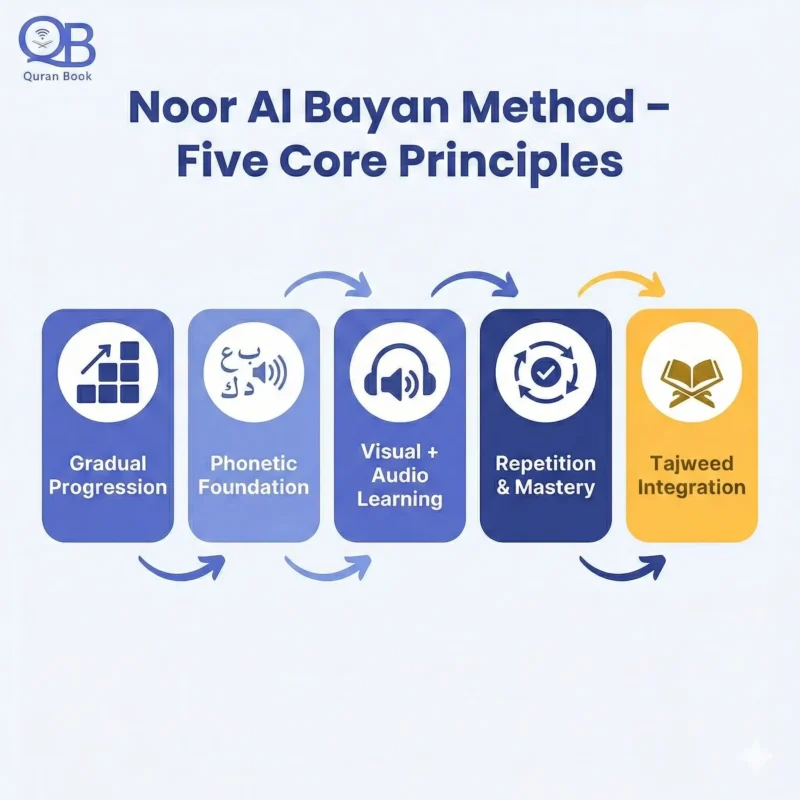
Understanding the principles behind the Noor Al Bayan Method helps explain why it suits learners of different ages and backgrounds. Reading about the benefits of learning Quran with Tajweed puts these foundations in context. The table below summarises the five pillars of the approach.
| Principle | Description | Benefit for Learners |
|---|---|---|
| Gradual Progression | Moves from simple to complex systematically | Helps prevent overwhelm and builds confidence |
| Phonetic Foundation | Focuses on sound recognition before rules | Reading is built on hearing and producing sounds |
| Visual + Audio Learning | Combines written letters with pronunciation | Engages more than one learning channel |
| Repetition & Mastery | Each stage is practised before advancing | Ensures a solid foundation |
| Tajweed Integration | Correct articulation taught alongside the letters | Pronunciation habits are formed early |
What Characterises the Noor Al Bayan Approach?
Reading-Focused: The goal is decoding and pronouncing Arabic script, so Arabic grammar study is not a prerequisite.
Adaptable Pacing: Lesson length and pace can be adjusted for a child, a teenager or a busy adult.
Sound-First Sequence: Letters and vowel marks are learned as sounds first, then combined into syllables and words.
Progressive Difficulty: Each stage builds on the previous one, so gaps in understanding are easier to spot.
Articulation Alongside Reading: Correct pronunciation is corrected from the first letter rather than added at the end.
This Hadith speaks to the virtue of learning the Quran and teaching it. For a beginner, learning to read the Arabic script correctly is the practical first step in that effort.
Noor Al Bayan for Adults: How It Fits Adult Learners

Adults can use the Noor Al Bayan Method because its stages are short, ordered and easy to fit around a schedule, and because a teacher can adapt the pace and lesson length to the learner. Short, regular sessions with feedback tend to suit adults who cannot study for long stretches. Explore our Quran classes for adults to find a suitable format.
Common Concerns Adult Beginners Raise
As an adult learner, you might be thinking: “I am too old to learn a new alphabet,” “I do not have hours a day to study,” or “What if I make mistakes in front of others?” A one-to-one setting addresses much of this directly: mistakes are corrected privately, the schedule is yours, and the curriculum is broken into stages small enough that you can see where you are. Adults often want to understand why a rule works, need flexibility in scheduling, and stay motivated by visible progress — which is why a clearly staged curriculum tends to work well.
Advantages Adults Bring to Arabic Reading
Adults often bring real advantages to learning Quran reading. Life experience means you already understand discipline and goal-setting. You can consciously compare sounds you already know with new Arabic sounds, ask direct questions about what confuses you, and choose your own optimal study times. Concentrated short sessions, repeated regularly, usually do more than occasional long ones.
And We have certainly made the Quran easy for remembrance, so is there any who will remember?
— Quran 54:17
This verse encourages Muslims in their relationship with the Quran. For beginners who need help with reading, structured lessons and guidance from a teacher can make the learning process more manageable.
The 7 Levels of the Noor Al Bayan Method Explained
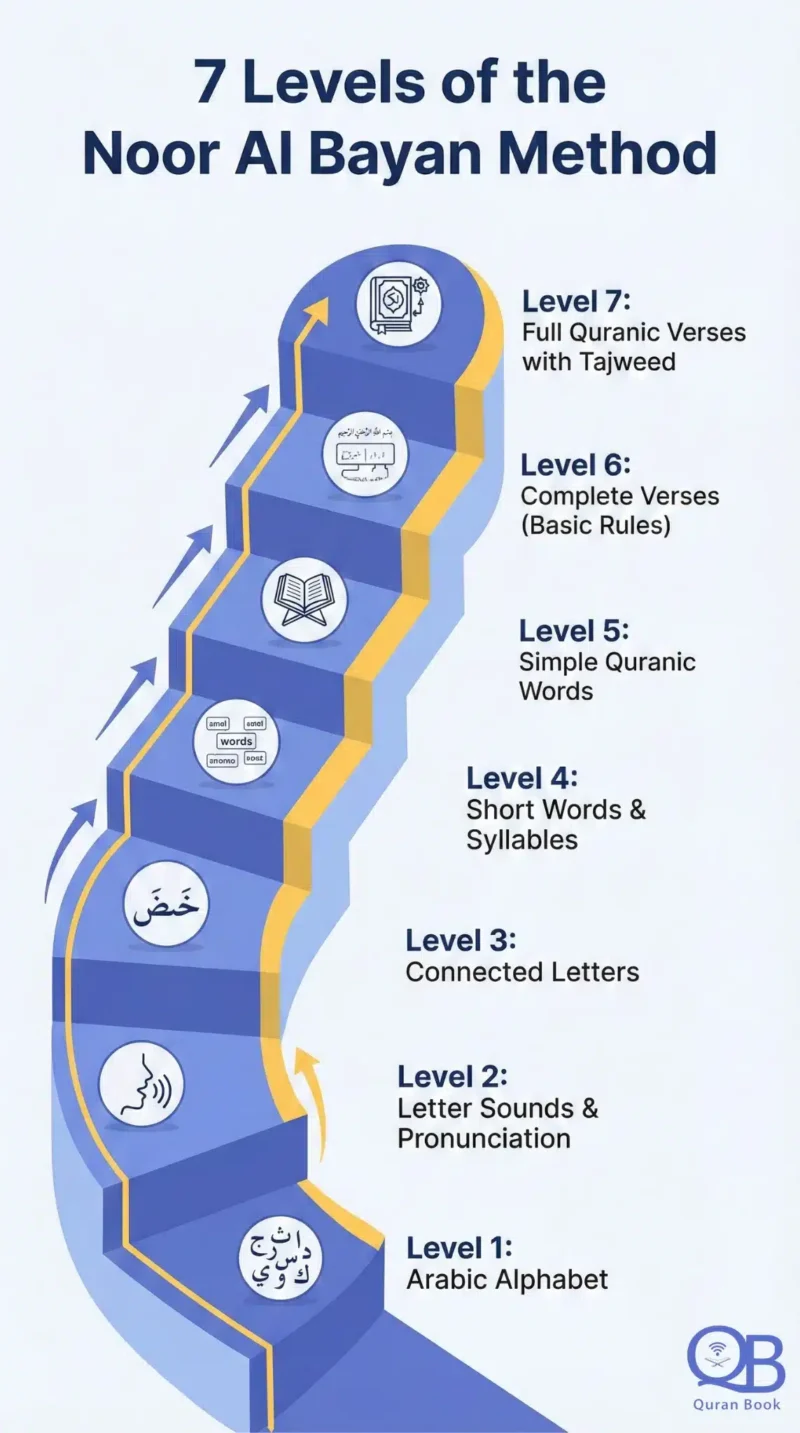
The Noor Al Bayan Method progresses through seven learning stages: (1) the Arabic alphabet (Hijaiyah letters), (2) short vowels — Fatha, Kasra and Damma, (3) the three Madd letters (long vowels) — Alif, Waw and Yaa, (4) Sukoon, (5) Tanween — Fathatayn, Kasratayn and Dammatayn, (6) Shaddah and related reading patterns, and (7) Quran reading with Tajweed applied. How long each stage takes varies by learner and lesson schedule.
Complete Level Breakdown
| Level | Focus Area | Key Skills |
|---|---|---|
| Level 1 | Arabic Alphabet (Hijaiyah Letters) | Letter names, shapes and sounds; letter forms in different positions |
| Level 2 | Short Vowels (Harakat) | Fatha, Kasra and Damma; reading letters with each vowel |
| Level 3 | The Three Madd Letters (Long Vowels) | Alif Madd, Waw Madd and Yaa Madd; holding the lengthened sound |
| Level 4 | Sukoon | Reading a letter with no vowel; closed syllables and joining sounds |
| Level 5 | Tanween | Fathatayn, Kasratayn and Dammatayn; the added n sound at word endings |
| Level 6 | Shaddah & Related Reading Patterns | Shaddah with Harakat, Shaddah with Tanween, and connected-reading patterns such as Lam Shamsiyyah |
| Level 7 | Quran Reading & Tajweed Application | Reading Quranic text and applying Tajweed to what has been learned |
On timing: the time each level takes varies by learner and lesson schedule. Age, previous exposure to Arabic, class frequency and independent practice all change the pace.
Level-by-Level Deep Dive
Level 1: The Arabic Alphabet
The journey begins with the Hijaiyah letters. Rather than presenting all of them at once, the curriculum introduces them in ordered groups so that similar shapes and similar sounds can be compared and distinguished. Each letter is met in its isolated form first, and the learner also sees how its shape changes at the beginning, middle and end of a word. By the end of this stage the aim is not memorising a list of symbols but recognising each letter reliably and producing its sound — the foundation everything else rests on.
Levels 2–3: Short Vowels and the Madd Letters
The short vowels — Fatha, Kasra and Damma — turn isolated letters into readable syllables. This is where a learner first moves from recognising letters to actually reading. The three Madd letters (Alif, Waw and Yaa) then teach the lengthened vowel sounds, and the contrast between a short vowel and its long counterpart is practised deliberately, because confusing the two changes how a Quranic word is read.
Levels 4–5: Sukoon and Tanween
Sukoon marks a letter carried with no vowel of its own, which is what allows syllables to close and sounds to join smoothly rather than being pronounced one by one. Tanween — Fathatayn, Kasratayn and Dammatayn — then introduces the added n sound at the end of a word. Together these two stages are what make continuous, connected reading possible.
Levels 6–7: Shaddah, Connected Reading and Quranic Text
Shaddah doubles a letter and is practised both with Harakat and with Tanween, alongside connected-reading patterns such as Lam Shamsiyyah, where the definite article assimilates into the following letter. The final stage moves from practice words to Quranic text itself — often beginning with short Surahs — so that everything learned about letters, vowels, Sukoon, Tanween and Shaddah is applied in recitation, with Tajweed corrected by a teacher as the learner reads.
How Quran Book Academy Teaches the Noor Al Bayan Method
Quran Book Academy delivers Noor Al Bayan through live one-to-one Zoom classes with certified native Arabic teachers. Students receive personalised lesson plans, access to a custom Learning Management System (LMS) for progress tracking, weekly email progress reports, and recorded sessions for review. Classes are scheduled flexibly across USA, Canada, UK and Australia time zones. Learn more about how our online Quran classes work.
The Quran Book Academy Approach

At Quran Book Academy, the Noor Al Bayan curriculum is delivered around five practical pillars. You can also meet our certified Quran teachers to see who will guide your lessons.
Personalised Assessment
Every student begins with an evaluation of their current reading level, a discussion of learning goals, and a starting point chosen to match them rather than a fixed lesson one for everybody.
Live Interactive Sessions
Zoom-powered one-to-one classes with native Arabic-speaking certified teachers provide real-time pronunciation correction and screen sharing for visual learning. Choose from 30, 45 or 60-minute session options.
Technology-Enhanced Learning
Our custom LMS lets you track progress through all 7 levels, access lesson materials around the clock, review recorded sessions and complete practice exercises. Automated email reports deliver weekly progress summaries and homework assignments to your inbox.
Short, Focused Lesson Segments
Lessons are broken into shorter focused segments — typically 10–15 minutes — so that new material, practice and review each get their own attention within a single class.
Tajweed Alongside Reading
Tajweed is not left as a separate subject for later. Makharij (articulation points) are taught with each letter, and further Tajweed rules are introduced gradually as the learner moves through the curriculum.
The Learning Journey: Stage by Stage
These are stages, not a timetable. Learners reach them at different points depending on their starting level, age, class frequency and practice between lessons.
Stage 1 — Recognising the Letters
Learn the Hijaiyah letters, their sounds and their different written forms. Milestone: recognising every letter reliably, in isolation and inside a word.
Stage 2 — Decoding Syllables
Short vowels and the three Madd letters turn letters into syllables. Milestone: reading simple words correctly, distinguishing short from long vowels.
Stage 3 — Connected Reading
Sukoon, Tanween, Shaddah and patterns such as Lam Shamsiyyah. Milestone: reading words continuously rather than letter by letter.
Stage 4 — Reading Quranic Text
Move from practice words to Quranic text, applying Tajweed with a teacher’s correction. Milestone: reading short Surahs from the Mushaf. Reading independently, and then fluently, continues to develop with practice well beyond this point.
The Prophet ﷺ taught that reciting a letter from the Book of Allah carries reward. Learning to read accurately can help students progress toward reciting the Quran correctly.
Learning Options Compared
Different formats suit different learners and budgets. The table below describes what each option does and does not provide, so you can decide what matters most for you.
| Feature | One-to-One Classes (Quran Book Academy) | Self-Study Book / PDF | Group Classes | Free Video Lessons |
|---|---|---|---|---|
| Feedback on your reading | Individual, in the moment | Self-checked only | Shared between students in the class | None — the lesson cannot hear you |
| Pronunciation correction | Live correction by a teacher | No personalised live pronunciation correction | Available, but shared across the group | No personalised live pronunciation correction |
| Progress tracking | LMS records plus weekly email reports | Self-monitored | Depends on the provider | Self-monitored |
| Scheduling | Booked around your own timetable | Entirely self-paced | Fixed class times | Entirely self-paced |
| Pace of the curriculum | Set to the individual learner | Set by the learner | Set to the group | Set by the video series |
| Cost | Paid, after a free trial lesson | Low cost or free | Usually lower than one-to-one | Free |
Many learners combine formats — using free materials for daily practice between lessons with a teacher. The free resources further down this page are intended for exactly that.
Reading-Focused Quran Curricula vs Comprehensive Arabic Language Study
Noor Al Bayan is a reading-focused curriculum: its goal is decoding and pronouncing the Arabic script so a learner can read the Quran. A comprehensive Arabic language programme has a different goal — understanding and using the language, including grammar, vocabulary, comprehension, writing, listening and conversation. Neither replaces the other; they answer different questions. If you want to work on meanings later, Quran Tafseer classes address that side.
Two Different Goals
Reading-Focused Curriculum (e.g. Noor Al Bayan)
Focuses primarily on:
- Arabic letter recognition
- Decoding written Arabic
- Vowel marks (Harakat, Madd, Sukoon, Tanween, Shaddah)
- Connected reading
- Pronunciation and articulation
- Foundational Quran reading
Comprehensive Arabic Language Programme
May include:
- Grammar (Nahw)
- Morphology (Sarf)
- Vocabulary building
- Reading comprehension
- Writing
- Listening
- Conversation
Which Fits Your Goal?
| A reading-focused curriculum fits if you: | Comprehensive Arabic study fits if you: |
|---|---|
| Mainly want to read the Quran and your Salah correctly | Want to understand and use the Arabic language |
| Are starting from the alphabet | Can already read the script comfortably |
| Have limited daily study time | Can commit to longer, sustained study |
| Your focus is recitation practice | Your focus is linguistic and grammatical depth |
| Need a clear, staged beginner path | Want comprehension of meanings in the original |
A common path: begin with a reading-focused curriculum such as Noor Al Bayan to establish decoding and pronunciation, then add Arabic language or Tafseer study if your goal is to understand the meanings as well.
Free Noor Al Bayan & Arabic Reading Practice
If you would like to try Arabic reading before booking a class, the resources below are free to use. They cover the earliest foundations — recognising letters and practising the Madd letters — and are useful for repetition between lessons.
They are practice tools, not a replacement for a teacher: no self-study resource can hear you read and correct your pronunciation.
Free Lesson: Welcome to the Arabic Alphabet
Free Lesson · Level 1
An introductory lesson on the Arabic alphabet — the first stage of the Noor Al Bayan curriculum. Open it in your browser and work through it at your own pace.
Open Free Arabic Alphabet LessonPractice with an Interactive Arabic Reading Game
This short activity lets beginners practise recognising Arabic letters and the Madd (long vowel) letters interactively, which is a helpful way to reinforce Levels 1 and 3 between classes.
Open the interactive game in a new page
Practice Arabic Reading for Free
Our free Arabic reading page gathers interactive practice for basic Arabic reading skills. Use it to review letters and vowel marks as often as you like.
Getting Started with the Noor Al Bayan Method: Your First Lesson
To start the Noor Al Bayan Method, book a free trial lesson at Quran Book Academy. A certified teacher assesses your current reading level, demonstrates how the curriculum works, and suggests a starting point and a learning plan. You will need a device with an internet connection and a quiet place to speak and listen.
What Happens in Your Free Trial Lesson?
The exact structure and duration of the free trial may vary depending on the student’s level and assessment needs.
Introduction
Meet your certified Quran teacher, discuss your background, and raise any concerns before you begin.
Level Assessment
The teacher checks your current Arabic reading ability and identifies the right starting level for you.
Method Demonstration
Try the Noor Al Bayan approach in practice, reading with live pronunciation feedback from the teacher.
Learning Goals
Talk through what you want to achieve — reading for Salah, reading the Mushaf, or preparing for Hifz later.
Program Explanation
Review the 7-level curriculum, class schedule options, and how the LMS and progress reports work.
Recommended Next Steps
Receive your first practice assignment in the LMS and decide whether you would like to schedule ongoing lessons.
What You Will Need to Get Started
Getting started requires little setup. For technology, you need a computer, tablet or smartphone with internet access, the free Zoom app installed, a working microphone and camera, and a stable connection. Learning materials are provided in digital format by the academy, though you may optionally buy a physical Noor Al Bayan book. A notebook for practice is useful. Most students schedule 2–3 classes per week (30–60 minutes each) and add short daily practice between lessons; how quickly you move through the curriculum depends on your starting level, age, previous exposure to Arabic, class frequency and how much you practise.
All packages and pricing options include live Zoom classes with a certified teacher, full LMS access, weekly progress reports by email, recorded sessions for review, WhatsApp support, and a certificate upon completion. Cancellations and refunds are handled according to the academy’s published refund policy — for subscriptions, the amount corresponding to the remaining unused classes in the current month is refunded on a prorated basis. Please read that page for the full terms before subscribing.
Noor Al Bayan Method: Frequently Asked Questions
References
The following are cited for the Islamic statements quoted in this article.
- Sahih al-Bukhari 5027 — Hadith on the virtue of learning the Quran and teaching it.
- Jami` at-Tirmidhi 2910 — Hadith on the reward for reciting a letter from the Book of Allah.
- Quran 54:17 — “And We have certainly made the Quran easy for remembrance.”
Useful Links on This Site
These are our own pages, offered for further reading rather than as independent sources.
Leave a Reply