
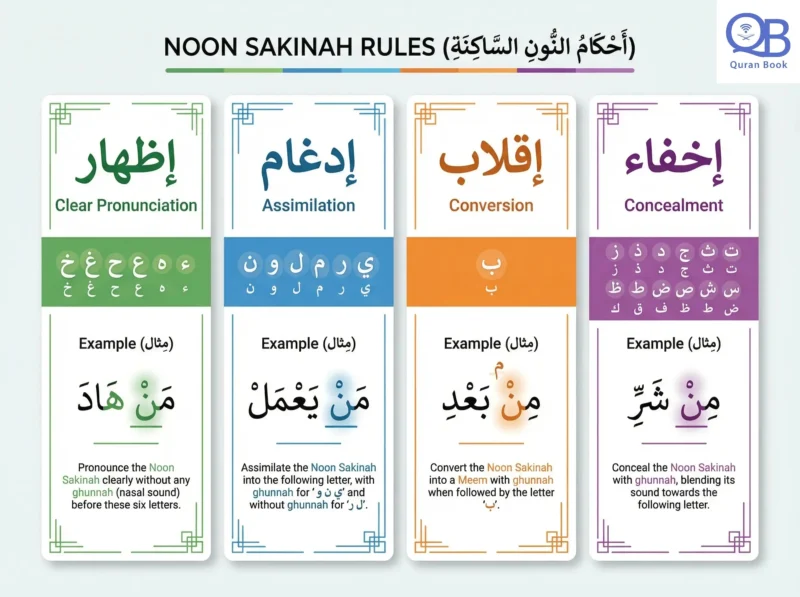

Noon Sakinah rules determine how a silent Noon (نْ) or Tanween is pronounced depending on the letter that follows it. There are four rules: Izhar (clear pronunciation, 6 letters), Idgham (merging, 6 letters), Iqlab (conversion to Meem, 1 letter), and Ikhfa (concealment, 15 letters). Together these four cover all 28 Arabic letters — every letter triggers exactly one rule.
What Is Noon Sakinah?
A Noon Sakinah (النون الساكنة) is the letter ن carrying a sukoon — a Noon with no vowel of its own. It appears in the middle of a word and at the end of one, and it turns up in every part of speech: in nouns (أَنْعَام), in verbs (يَنْصُر) and in particles (مِنْ, عَنْ).
The rules on this page apply to that silent Noon only. A Noon carrying a fatḥah, ḍammah or kasrah — نَ نُ نِ — is simply pronounced as it is written, and none of the four rulings touch it. Students who mix the two end up applying Ikhfa in places it does not belong, so it is worth fixing the boundary early: no sukoon, no rule.
One more property makes the Noon Sakinah the easier half of this topic: it is fixed. It is written in the muṣḥaf, it is pronounced in both continuation and pausing, and it does not appear or disappear depending on how you read the sentence. What you see on the page is what your tongue has to deal with.
💡 The one question that decides everything: which letter comes immediately after the Noon Sakinah? That single letter selects the rule. Nothing else — not the word, not the meaning, not the position in the verse.
What Is Tanween and Why Does It Follow the Same Rules?
Tanween (التنوين) is a doubled vowel written at the end of an indefinite noun — ــًـ ــٌـ ــٍـ — and pronounced as an extra Noon Sakinah. The Noon is heard but never written, which is exactly why beginners treat Tanween as a separate topic when it is not one.
The golden rule is short: any ruling that applies to a written Noon Sakinah applies identically to Tanween. Same four rules, same letter groups, same ghunnah length. There is nothing extra to memorise.
Only one practical difference exists. A Noon Sakinah can sit inside a word, so the letter after it may belong to the same word. Tanween is always word-final, so the letter that triggers the rule is always the first letter of the next word. That is why Tanween examples always straddle a word boundary.
Read the two columns across and the parallel is unmistakable. If you can classify the left column, you can already classify the right one — the only new skill is hearing the Noon that isn’t printed.
The 4 Noon Sakinah Rules at a Glance
Most guides present the four Noon Sakinah rules as four unrelated lists to be memorised. They are not unrelated — they are one sliding scale, and once you see the scale the lists stop needing memorisation at all.
The Noon is produced at the tip of the tongue against the gum ridge, with the sound resonating in the nose. Every rule below is decided by how far the following letter’s articulation point sits from that spot — which is why this topic sits so close to the Makhraj of Arabic letters.
Far away — the throat letters → Izhar
The Noon and the throat are too far apart to blend, so the Noon is left exactly as it is.
Very close, or identical → Idgham
The two points nearly coincide, so the Noon simply gives way and dissolves into the next letter.
A lip letter → Iqlab
Moving from the gum ridge straight to the lips is awkward, so the Noon converts to a Meem, which is already on the lips.
Everything in between → Ikhfa
Neither far enough to stay clear nor close enough to merge, so the Noon is held halfway — hidden, but audible as a nasal hum.
That is the entire system in four sentences. The letter lists that follow are consequences of it, not arbitrary groupings, and students who understand the logic stop confusing Ikhfa with Idgham almost immediately.
Hear all four rules on the same Noon
Three of the four examples below begin with the same word — مِنْ. The Noon never changes. Only the letter after it does, and that alone produces four completely different sounds. Play them in order and the distinction stops being theoretical.
Recitation: Sheikh Mahmoud Khalil Al-Husary. Twenty seconds here will do more for your ear than twenty minutes of reading.
One detail to carry into the sections below: the ghunnah — the nasal hum — is measured in counts, not moments. Two counts (ḥarakatān), roughly the length of saying two short vowels. It appears in Ikhfa, in Iqlab and in four of the six Idgham letters, and it is absent in Izhar and in the remaining two Idgham letters. Getting the letter groups right but the ghunnah length wrong is the single most common way to sound untrained while technically applying the correct rule.
Izhar — The 6 Clear Letters
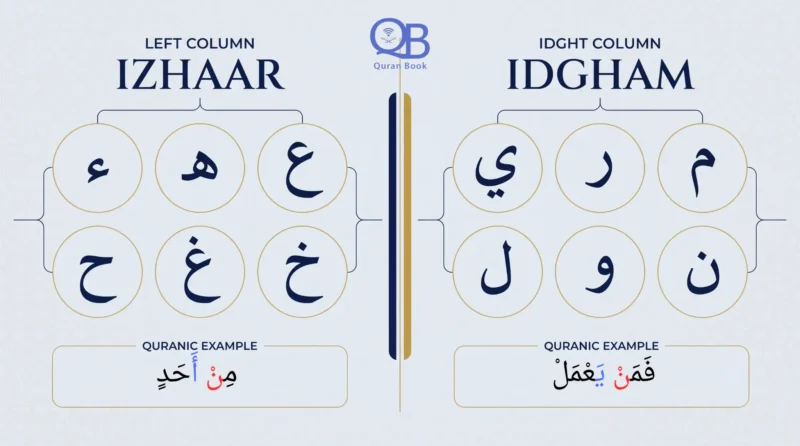
Izhar (إظهار) means “to make clear”. The Noon Sakinah or Tanween is pronounced exactly as it is — a clean Noon, released fully, with no added ghunnah and no blending whatsoever into the letter that follows.
ء هـ ع ح غ خ
hamzah · hā · ‘ayn · ḥā · ghayn · khā
These six are not a random selection: they are the ḥurūf al-ḥalq, the throat letters, and they are the complete set of them. The Noon is made at the front of the mouth; these are made at the very back. The distance is too great for any blending to occur naturally, so the language leaves the Noon alone. Learn the six as “the throat group” and you will never need to recite the list.
The mistake almost every non-Arab reader makes here
Adding a ghunnah to Izhar. Because three of the four rules involve a nasal hum, learners default to humming — and a Noon before ع or ح comes out as a soft nnn instead of a crisp Noon. Izhar is the rule where the nose does the least work, not the most. If you can hear a hum before a throat letter, you are applying Ikhfa by accident.
Idgham — The 6 Merging Letters
Idgham (إدغام) means “to merge”. The Noon Sakinah or Tanween disappears completely into the letter that follows, and that letter is doubled (given a shaddah) in its place. There is no trace of the Noon left as a consonant — only, in four of the six cases, the nasal resonance it leaves behind.
The six Idgham letters are ي ر م ل و ن, traditionally gathered in the phrase يَرْمَلُونَ (yarmalūn). They split into two groups, and the split matters more than the list.
Idgham with Ghunnah (4 letters: ي ن م و)
These four are gathered in the word يَنْمُو (yanmū, “it grows”) — a mnemonic worth ten minutes of your time, because it is the only list on this page you truly have to hold. The Noon merges into the following letter and the nasal sound is held for two counts.
Idgham without Ghunnah (2 letters: ل ر)
With Lām and Rā the merge is total and instant: the Noon vanishes and no nasal sound is left behind at all. This is the group learners over-hum most, because they carry the ghunnah habit across from the four letters above.
The Exception — When Idgham Doesn’t Apply
Idgham requires the Noon Sakinah and the following letter to sit in two separate words. When a Noon Sakinah is followed by و or ي inside the same word, there is no merging at all — the Noon is pronounced clearly. Scholars call this al-iẓhār al-muṭlaq, absolute clarity, and it is the reason a reader who has memorised the yarmalūn list can still get these words wrong.
The only four words in the Quran where this occurs
ٱلدُّنْيَا · بُنْيَانٌ · صِنْوَانٌ · قِنْوَانٌ
ad-dunyā · bunyān · ṣinwān · qinwān — each one recited with a clear, undisguised Noon.
Four words is a small thing to learn, and ٱلدُّنْيَا alone appears well over a hundred times in the muṣḥaf — so this exception is not academic trivia. It is a correction most readers need on their first page.
Iqlab — The 1 Converting Letter
Iqlab (إقلاب) means “to convert”. It has a single trigger letter — ب — and one instruction: when a Noon Sakinah or Tanween is followed by Bā, the Noon is turned into a hidden Meem, pronounced with the lips lightly together and a ghunnah held for two counts.
ب
one letter · one rule · no exceptions
The reason is mechanical. The Bā is made at the lips; the Noon is made at the gum ridge with the nose open. Moving directly from one to the other forces an awkward jump, so Arabic substitutes the sound that already shares the Bā’s articulation point and the Noon’s nasality: the Meem. Nothing is invented — the Meem is simply the natural meeting point of the two.
The small meem you keep seeing in the muṣḥaf
Iqlab is the only one of the four rules with its own printed marker. Wherever it occurs, a small ﻢ is written above the Noon or in place of one of the Tanween strokes — نۢ, ـًۢ. Readers see it constantly and rarely know what it means. It is not a vowel and not part of the spelling: it is an instruction to the reciter, telling you to produce a Meem here rather than a Noon.
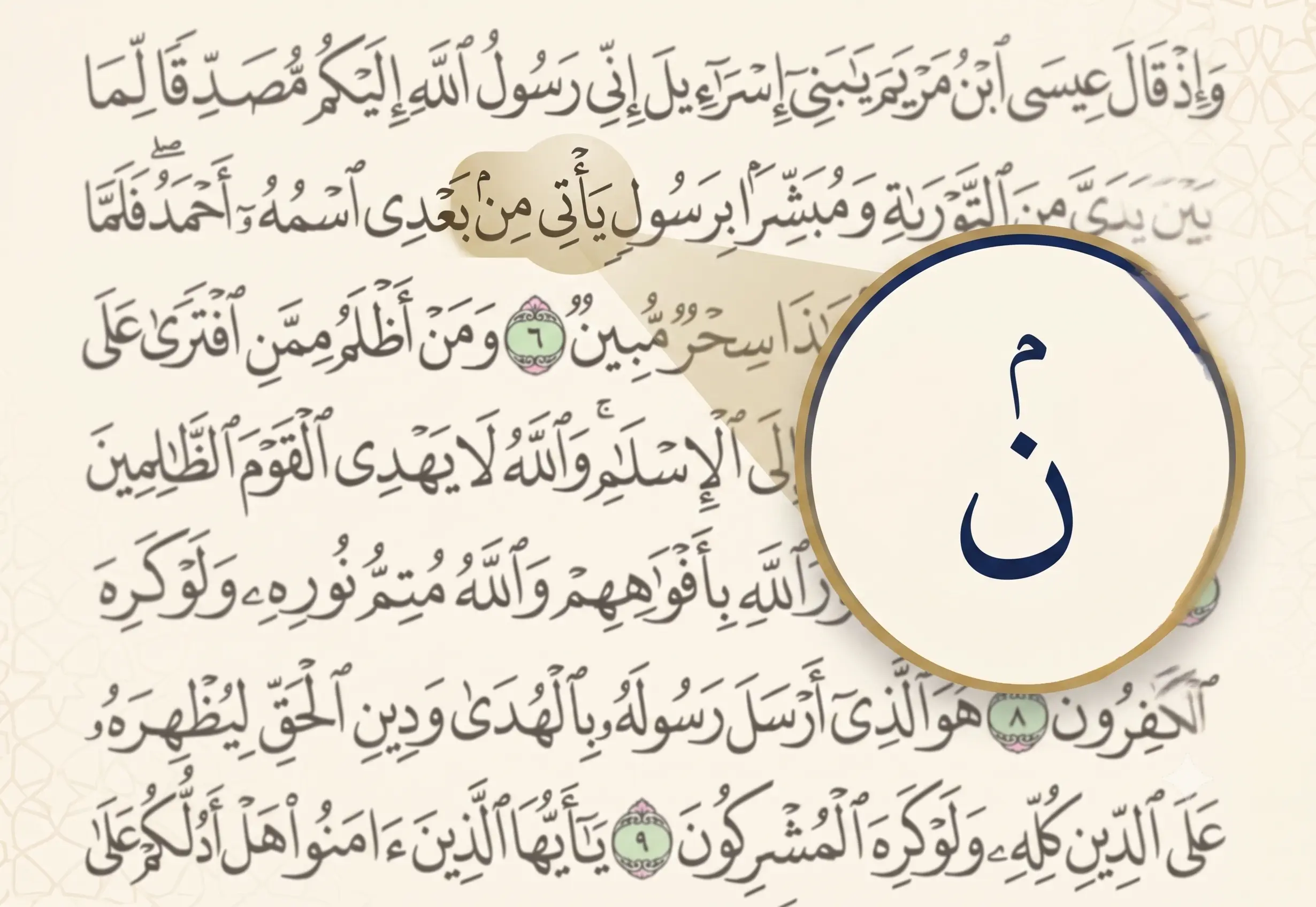
One nuance worth carrying: the lips should meet lightly. Pressing them shut turns the hidden Meem into a full, released Meem and cuts the ghunnah short. The target is a soft closure held for two counts, with the sound running through the nose the whole time.
Ikhfa — The 15 Hidden Letters
The Ikhfa rules cover more letters than the other three combined, which makes this the rule you will apply most often on any given page. Ikhfa (إخفاء) means “to conceal”: the Noon is pronounced neither clearly nor merged away, but held in a middle state — hidden behind a nasal hum lasting two counts.
The practical description is more useful than the definition. In Ikhfa your tongue never touches the Noon’s articulation point at all. It leaves the gum ridge alone and moves straight into position for the letter that is coming, while the sound continues through the nose during the gap. That gap is the Ikhfa.
ت ث ج د ذ ز س ش ص ض ط ظ ف ق ك
fifteen letters — the whole remainder of the alphabet
💡 Don’t memorise these fifteen. Memorise the thirteen letters of the other three rules — six for Izhar, six for Idgham, one for Iqlab. Everything left over is Ikhfa. Thirteen is a manageable number; fifteen is not, and the elimination method is how experienced teachers actually teach it.
Some of the fifteen carry a sound of their own that changes the ghunnah: the ghunnah is slightly heavier before heavy letters in Arabic like ق and ط, and stays thin before light ones like ت and ك. It is a small adjustment, but it is what makes an Ikhfa sound native rather than mechanical.
The three degrees of Ikhfa
Not every Ikhfa sounds identical, and this is the layer most guides leave out. How close the concealment sits to Idgham or to Izhar depends on how near the following letter’s articulation point is to the Noon’s.
Highest — ط د ت
Made at almost the same spot as the Noon, so the concealment leans towards a merge.
Middle — the remaining ten
The standard Ikhfa most learners are taught, sitting evenly between the two extremes.
Lowest — ق ك
Made far back in the mouth, so the concealment leans towards clarity — the Noon is only just hidden.
You do not need to reproduce the three degrees deliberately; they emerge on their own once the tongue is genuinely moving towards the next letter instead of stopping at the Noon. Knowing they exist simply explains why your Ikhfa before ق sounds different from your Ikhfa before ت — and reassures you that the difference is correct, not a fault. The same three-way gradation is set out in the classical Tajweed manuals, where it is tied directly to the articulation points rather than to convention.
Test Yourself: Which Noon Sakinah Rule Applies?
Four rules, twenty-eight letters — the only way to know if it’s stuck is to test it. We’ll show you a word from the Quran with the Noon Sakinah or Tanween highlighted. You pick the rule. Twelve questions, instant feedback, no sign-up.
Question 1 of 12
Play: The Eagle of Izhar
The quiz checks whether you know the rule. This one checks whether you can spot the letters at speed — a different skill, and the one that actually shows up when you are reciting a page rather than studying a chart. Play it directly below, or open it in a new tab if you prefer a full screen.
It works well for children too. The six throat letters stop being a list to recite and become a group they can recognise on sight — which is exactly the transfer you want in place before formal Tajweed lessons begin.
Noon Sakinah and Tanween Examples from the Quran
Rules settle once you meet them in the text you actually recite. Each line highlights the Noon or Tanween in its rule’s colour — Izhar, Idgham, Iqlab, Ikhfa — with the recitation of Sheikh Al-Husary beside it.
Notice how often two different rules land in the same short verse — 106:4 alone carries an Ikhfa and an Izhar four words apart. That is the real skill: not producing each sound in isolation, but switching between them cleanly at reciting speed. If you’d like to drill this alongside the other rules, our free Arabic letter games cover the same ground for children and adults.
Common Mistakes to Avoid
1. Adding a ghunnah to Izhar
The most frequent Noon Sakinah error among non-Arab readers. Before ء ه ع ح غ خ the Noon is clean and released — no hum, no lengthening. If you hear a nasal buzz there, you have quietly turned Izhar into Ikhfa.
2. Cutting the ghunnah short
Two counts is a measurable duration, not a passing touch. Most learners produce roughly half of it in Ikhfa and Iqlab, which is why their recitation sounds hurried even when every letter is correctly classified.
3. Treating Tanween as a separate case
A Tanween is a Noon Sakinah you cannot see. Readers who apply the rules confidently to a written نْ often go blank at a Tanween — the rule is identical, and the hesitation is the only real problem.
4. Merging in ٱلدُّنْيَا, بُنْيَان, صِنْوَان, قِنْوَان
The yarmalūn list is correct but incomplete without this caveat: inside a single word, ن before و or ي is pronounced clearly. Four words, and one of them is on nearly every page.
5. Pronouncing a clear Noon before Bā
Iqlab is easy to know and easy to forget in the moment, because the Noon is still printed on the page. The small meem above it is the reminder — read it as a Meem, with the lips barely closed and the ghunnah running.
Frequently Asked Questions
Where This Fits in Tajweed
The Noon Sakinah rules are the first system most students meet inside the wider body of Tajweed rules, and they are a good place to start precisely because they close: four rules, twenty-eight letters, no gaps. Once the chart is in your head, every Noon on the page has an answer.
What takes longer is the sound. Classifying a letter is a five-second decision; holding a ghunnah for a genuine two counts, in the middle of a verse, at reciting speed, is a physical habit. If you want that feedback, our Tajweed courses are built around exactly this kind of correction, or you can simply book a free trial lesson and recite a page.
May Allah make the Quran the spring of your heart, and may He accept it from you. 🤲
Learn More
Noon Sakinah is one system inside a much larger one. Here’s what to study next:
Hafidha of the Quran · Arabic Language Graduate · Writer on Islamic Sciences
Jehad Mahmoud is a graduate of the Arabic Language department and a Hafidha of the Quran who writes the Islamic educational content at Quran Book Academy.
She writes on Tajweed and Quranic phonetics as a Hafidha and Arabic Language graduate, focusing on making precise articulation rules — makharij, sifaat, and the rulings of Noon and Meem Sakinah — accessible to non-Arab reciters.
Her articles are educational, not fatwa. For a ruling on a specific personal situation, readers are advised to consult a qualified scholar or mufti.
References & Sources
1. The four rulings of Noon Sakinah and Tanween, and the three degrees of Ikhfa — classical Tajweed manuals
2. Nasal assimilation — the phonetic process underlying Idgham and Ikhfa across languages
3. Quran.com — Quranic text and verse references used throughout
4. EveryAyah.com — recitation of Sheikh Mahmoud Khalil Al-Husary
© 2026 Quran Book Academy. All rights reserved.
Book Your Free Trial · Empowering Muslims Worldwide to Connect with the Quran