Sukoon in Arabic: A Small Crescent, No Vowel After
Close the sound on the letter, spot the sign in all its shapes, and read your first words with it.
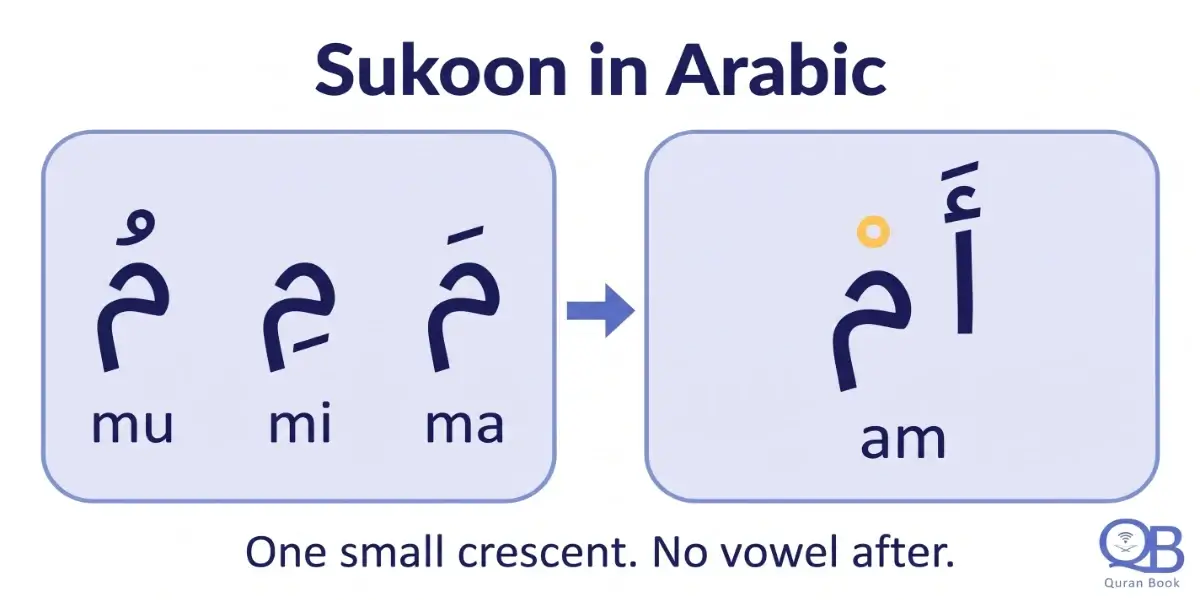
You can read مَ (ma), مِ (mi) and مُ (mu). Now put a small half-crescent on the letter, and a vowel before it: أَمۡ. It says “am”. Same letter, but the vowel comes first, and the m closes the sound. Nothing comes after it. That is sukoon in Arabic.
You’ve learned the short vowels and the Arabic long vowels. In this sukoon Arabic lesson you’ll hear every letter closed this way, learn the two mistakes to avoid, find the sign in the Mushaf and read your first words with it. It’s the next step in learning how to read Arabic.
In this lesson
What Is Sukoon in Arabic?
Sukoon is a small half-crescent written above a letter: ـۡ. In some books you’ll see a small circle instead (ـْ); more on that below. It means no vowel follows. The letter is still said, and the syllable closes on it.
A letter with sukoon is called sākin, which means “still”. Sakin letters are not silent: you hear them, you just add nothing after them.
The Arabic sukoon is not a vowel and not a letter. It is one of the tashkīl marks, but not one of the three Arabic harakat (fatha, kasra and dammah).
A sakin letter always comes after a letter with a vowel: أَ + مۡ = أَمۡ (am).
What Does Sukoon Mean?
The word سُكُون (sukūn) means “stillness” or “rest”. That is the sukoon meaning in English, and it fits the sign well. The vowel marks are called harakat, “movements”. A letter with sukoon stays still: no vowel moves it on.
In everyday Arabic and Urdu, the word also means calm or peace of mind. This lesson is about the reading sign.
How to Pronounce Sukoon
Say the vowel before it, then close on the letter. Tap each one and listen for the clean close:
Close, don’t bounce
- Don’t add a vowel. أَمۡ is “am”, not “ama”.
- Don’t drop it or break it. The m is still said, in one smooth sound: “am”, not “a… m”.
Say the vowel, then close on the letter. Nothing comes after it.
Arabic never starts from a sakin letter, so every example in this lesson begins with a vowel. That is the whole trick of how to read sukoon in Arabic: the vowel opens the syllable, and the sakin letter closes it.
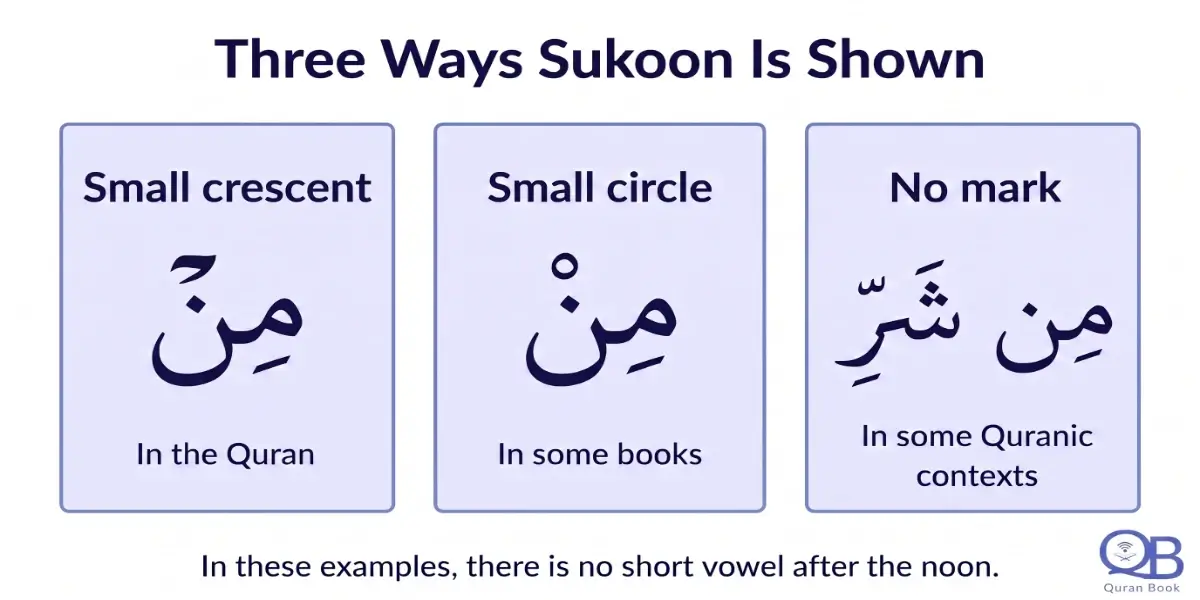
Three Ways Sukoon Appears: Crescent, Circle or No Mark
مِنۡ
Half-crescent ـۡ
The usual sukoon in the Madani Mushaf (the Uthmani script on quran.com), and the one this lesson uses.
مِنْ
Small circle ـْ
The same sign in some books and older prints. Same meaning, same sound.
قَالَ · مِن شَرِّ
No mark
You’ve met it already: the long-vowel letters ا و ي carry no mark. In the Mushaf a sakin letter is sometimes left bare because it blends into or hides before the next letter. That is a tajweed rule for later.
Not a sukoon: a small rounded zero (ـ۟) over a letter means that letter isn’t read at all.
Sukoon on Heavy and Bouncing Letters
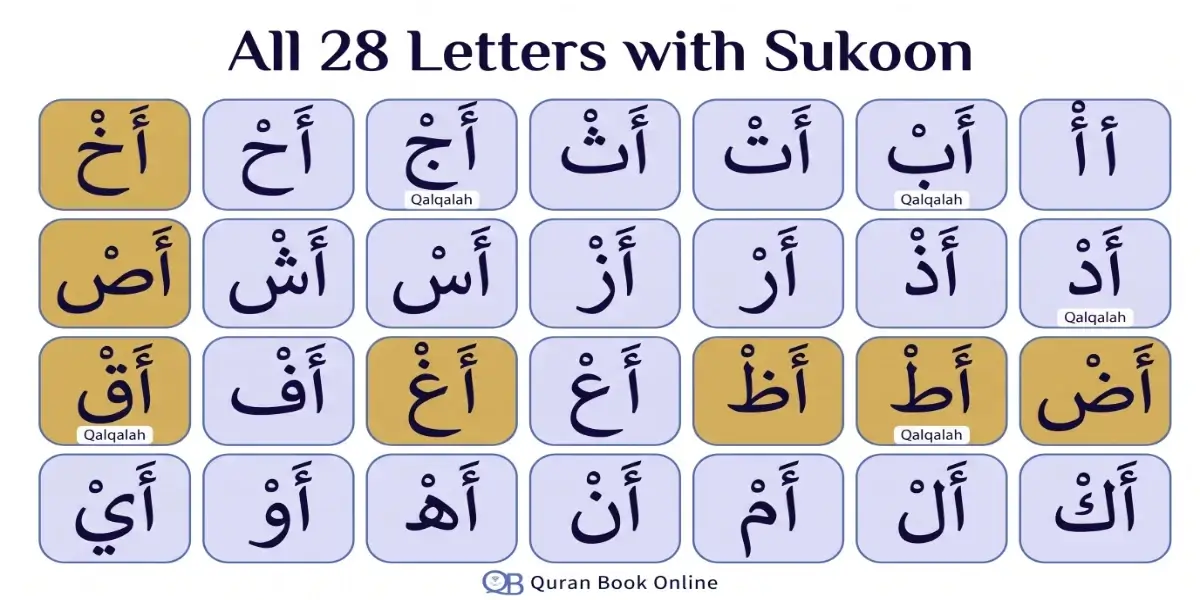
Heavy letters (خ ص ض ط ظ غ ق) stay heavy with sukoon: أَصۡ (aṣ) is fuller than أَسۡ (as).
رۡ takes its weight from the vowel before it. After fatha it is heavy: أَرۡ (ar).
Five letters, ق ط ب ج د, get a light bounce when they are sakin (qalqalah): أَبۡ (ab). The bounce is part of the letter, not a vowel: “ab”, never “abu”.
Go deeper: heavy letters in Arabic · sifaat al huroof.
Arabic Letters With Sukoon: All 28 Letters
Here are all 28 Arabic letters with sukoon. Each one comes after أَ, because a sakin letter needs a vowel before it. Heavy letters are tinted gold and the bouncing letters are tagged. The و and ي rows are blue: after fatha they make a soft “aw” and “ay”, not a long vowel.
Arabic Words With Sukoon
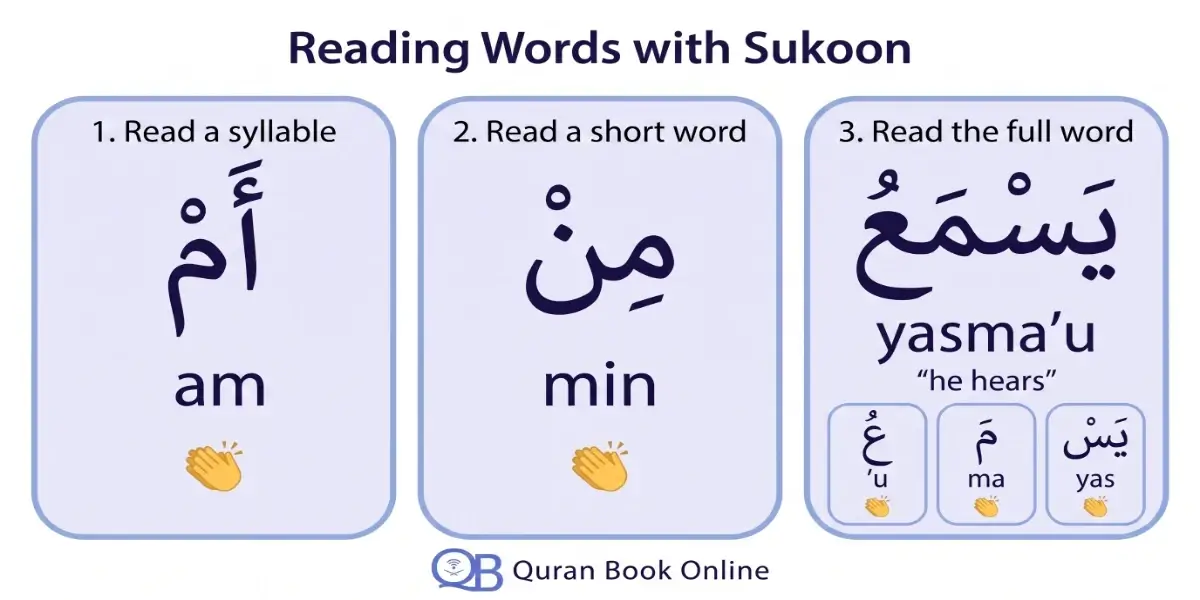
Now read real words in three levels. Read each one out loud first, then check yourself.
Level 1, one closed syllable: أَمۡ · أَنۡ · أَلۡ · أَسۡ (am · an · al · as).
Level 2, short words: مِنۡ (min, “from”) · قُلۡ (qul, “say”) · لَمۡ (lam, “did not”) · قِفۡ (qif, “stop”).
Level 3, longer words: one closed syllable, then two open ones. The sakin letter belongs to the syllable before it. Split the word first, then read it joined.
- يَسۡ مَ عُيَسۡمَعُyas-ma-ʿu · “he hears”
- يَشۡ رَ بُيَشۡرَبُyash-ra-bu · “he drinks”
- يَلۡ عَ بُيَلۡعَبُyal-ʿa-bu · “he plays”
- يَذۡ هَ بُيَذۡهَبُyadh-ha-bu · “he goes”
- يَفۡ هَ مُيَفۡهَمُyaf-ha-mu · “he understands”
- يَرۡ جِ عُيَرۡجِعُyar-ji-ʿu · “he returns”
These sukoon examples use joined letters. If a shape looks new, see Arabic letters beginning, middle & end.
Hear Sukoon in the Quran
Now find the Arabic sukoon in the Mushaf. Both ayat are in the Uthmani script from quran.com, so the mark is the same half-crescent you’ve been reading. Each look-for word sits mid-ayah: at the end of an ayah the reciter stops, so the last sound shows you little.
Look and listen
أَلَمۡ نَشۡرَحۡ لَكَ صَدۡرَكَ
alam nashraḥ laka ṣadrak
“Have We not uplifted your heart for you ˹O Prophet˺,” (Ash-Sharh 94:1)
Look for: نَشۡرَحۡ (nashraḥ), with sukoon on ش and on ح.
Recited by Sheikh Mahmoud Khalil Al-Husary (murattal), riwayah Hafs ʿan ʿĀṣim. Audio: EveryAyah.
فَإِنَّ مَعَ ٱلۡعُسۡرِ يُسۡرًا
fa-inna maʿa l-ʿusri yusrā
“So, surely with hardship comes ease.” (Ash-Sharh 94:5)
Look for: ٱلۡعُسۡرِ (al-ʿusri), with sukoon on ل and on س.
In recitation, نۡ and مۡ sometimes blend into or hide before the next letter; that belongs to tajweed rules. Here, every sakin letter you look for is heard clearly.
Closing cleanly on every sakin letter, with no extra vowel and no swallowed letter, is exactly what a teacher listens for.
Learning as a grown-up? See learn Quran reading for adults.
Sukoon Games for Kids
Two quick sukoon games turn reading into play. The first is the crescent hunt near the top. In the second sukoon game, your child taps ▶, hears a word, and picks it from three that look alike. Only the closed syllable is different, so the ear has to catch it.
Sukoon Activities for Kids
For parents: a few small habits make sukoon stick.
- “Little crescent on top, mouth closes.” Say the vowel, then shut the sound on the letter.
- Clap the syllables: yas | ma | ʿu. The sakin letter joins the clap before it.
- One row of the chart a day, in big print.
- Play the hunt together and let your child find the little crescents.
- Praise a clean close, and stop while it’s still fun.
Try it with your child
Read these aloud together, then tap to check:
Want a teacher to guide your child? See Quran reading for beginners.
Free Sukoon Worksheet (PDF)
Prefer paper? Both printables are free, with no sign-up. Tap to download.
Arabic Letters With Sukoon Chart
All 28 letters closed with sukoon on one page, with heavy letters in gold, the bouncing letters tagged, and the three shapes of the sign at the top.
Sukoon Worksheet for Kids
Find, split and read: four pages of sukoon practice. Circle the sukoon, split the words, match each closed syllable to its sound, then read the 10 words. Answer key included.
Common Sukoon Mistakes Beginners Make
- Mistake: Adding a vowel: مِنۡ → “mina”. Fix: “min”. Close on the letter.
- Mistake: Dropping the letter: مِنۡ → “mi”. Fix: The sakin letter is still said.
- Mistake: Breaking the word: “mi… n”, with a pause. Fix: One smooth syllable.
- Mistake: Mixing up the small crescent with dammah’s curl (both sit on top), or reading a circle ـْ as “o”. Fix: Crescent or circle means no vowel; the curl means “u”.
- Mistake: Turning the bounce on ق ط ب ج د into a full vowel (“abu”). Fix: A light bounce, no vowel: “ab”.
What to Learn After Sukoon
- Next lesson: shaddah, a sakin letter and the same letter with a vowel, written as one.
- Missed the long vowels? Go back to yaa madd, the last of the three.
- See the full path to how to read Arabic.
Learn more
- Why some letters sound fuller: heavy letters in Arabic
- Want a free guided start? learn Arabic reading free
Sukoon FAQ
What is sukoon in Arabic?
Sukoon (سُكُون) is a small mark written above an Arabic letter: in the Quran usually a small half-crescent (ـۡ), in some books a small circle (ـْ). It means the letter has no vowel after it: you say the letter and close the sound on it. So أَمۡ is read “am”, and مِنۡ is read “min”.
What does sukoon mean in English?
Sukoon means “stillness” or “rest”. The vowel marks are called harakat, “movements”; a letter with sukoon stays still, with no vowel after it. In everyday Arabic and Urdu, the word is also used for calm or peace of mind.
What does the sukoon symbol look like?
In the Mushaf it is usually a small half-crescent above the letter (ـۡ), like a tiny head of the letter ḥāʾ. Some books use a small circle instead (ـْ); it means the same thing. Sometimes a sakin letter has no mark at all: the long-vowel letters ا, و and ي carry none, and in the Mushaf a bare sakin letter often blends into or hides before the next letter, which is a tajweed rule for later.
How do you pronounce a letter with sukoon?
Say the vowel before it, then close on the letter without adding a vowel: أَ + مۡ = am, مِ + نۡ = min. The letter is still pronounced, it is not silent, and the word stays one smooth sound with no pause.
What is a sakin letter?
A sakin letter is any letter that carries a sukoon, like the نۡ in مِنۡ (min). “Sākin” means “still”. It closes a syllable, so a sakin letter always comes after a letter with a vowel.
Is sukoon a vowel?
No. Sukoon is a mark that shows there is no vowel. Fatha, kasra and dammah add a, i and u; sukoon adds nothing, so the letter closes the syllable.
Can an Arabic word start with sukoon?
No. Arabic is never pronounced starting from a sakin letter; there is always a vowel before it. That is why this lesson practises sukoon as أَمۡ (am) and أَنۡ (an), not as مۡ or نۡ on their own.
How can kids practise sukoon?
Clap the syllables of a word, yas | ma | ʿu, and show that the sakin letter belongs to the clap before it. Hunt for the little crescents in a game, read one short row a day in big print, and stop while it is still fun.
You can read a letter with no vowel now
That was sukoon in Arabic: you can read letters with a vowel and letters without one, the building blocks of every Arabic word. A teacher can make sure every sakin letter closes cleanly from your first lesson.
Arabic Language Graduate · Hafidha of the Quran · Writer on Arabic Reading
Jehad Mahmoud is a graduate of the Arabic Language department and a Hafidha of the Quran who writes the Arabic and Quran-reading guides at Quran Book Academy.
She writes for English-speaking learners and parents starting from zero: the letters by sound, the vowel marks, and the step-by-step order that leads to reading the Quran directly from the Mushaf.
Her Arabic Language studies and her memorisation of the Quran are the foundation of this reading series.
These guides teach the reading system step by step. Pronunciation is a skill of the ear and the mouth, so it is best checked by a qualified teacher who can hear you read.
References
- Surah Ash-Sharh 94:1, Uthmani script and The Clear Quran translation (Dr. Mustafa Khattab): quran.com/94/1
- Surah Ash-Sharh 94:5, Uthmani script and The Clear Quran translation (Dr. Mustafa Khattab): quran.com/94/5
- Quran audio: Sheikh Mahmoud Khalil Al-Husary (murattal, Hafs ʿan ʿĀṣim), via EveryAyah. All letter and word recordings on this page are recorded by Quran Book Academy.
- Encyclopaedia Britannica, “Arabic alphabet”.