Arabic Harakat: Same Letter, Three Sounds
Fatha, kasra and damma — hear them, spot them, read them.
Jump to the full chart ↓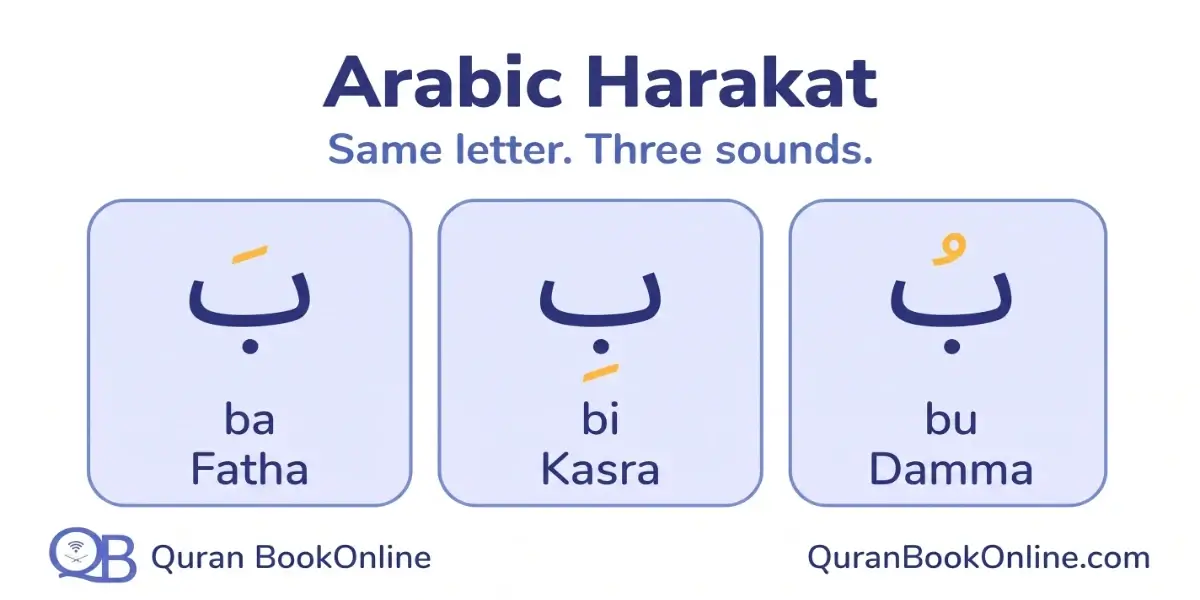
Tap each one:
Same letter, three sounds. The only difference is a mark smaller than a comma.
This is step 4 of learning how to read Arabic. Those tiny marks are the Arabic harakat, the Arabic short vowels. There are only three of them. Learn them, and every letter you already know becomes something you can read aloud.
This lesson covers Arabic short vowels for beginners: what each mark looks like, how it sounds, and how to read any letter with it. You will hear every sound, test yourself, and then see the marks in real ayat.
What Are Arabic Harakat?
Ḥaraka (حَرَكَة) means “movement”. The harakat (حَرَكَات) are the three small marks that tell you which short vowel to say after a letter.
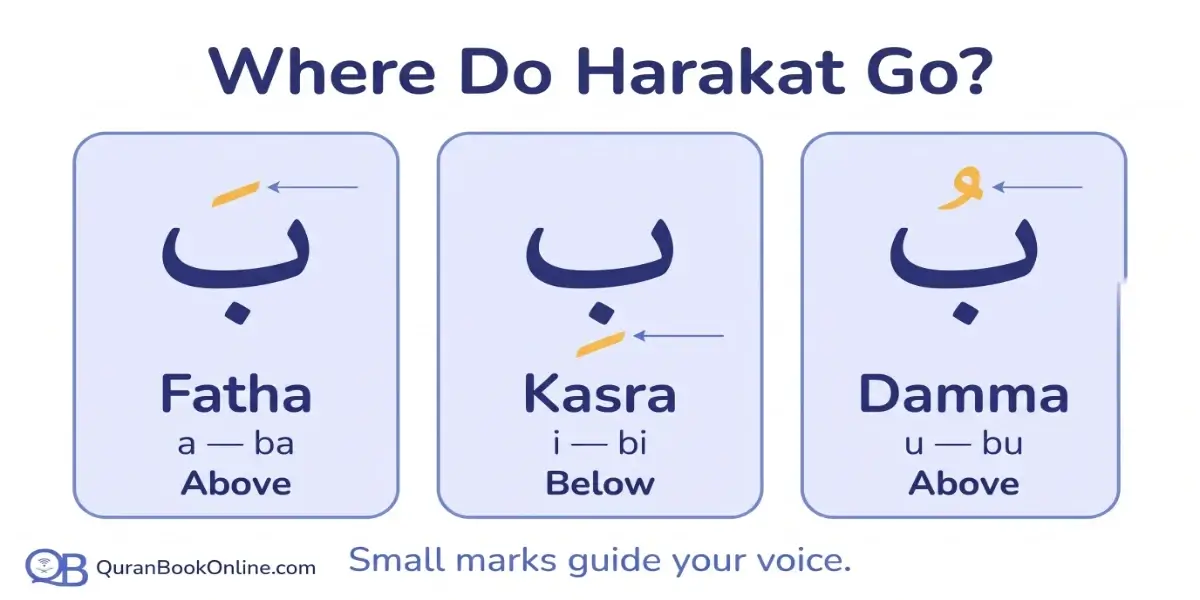
Arabic letters mostly write consonants. A ب on its own only tells you “b”. The marks add the vowel. Fatha and damma sit above the letter, and kasra sits below it.
You will see these marks on every letter in the Quran and in children’s and beginner books. Most other Arabic leaves them out (more on that in the FAQ). On this page, “Arabic short vowels” and “harakat” mean the same thing.
Fatha, Kasra and Damma at a Glance
Here are all three marks side by side. Tap an example to hear the mark on the letter ب.
| Mark | Name | Where | Looks like | Sound | Example |
|---|---|---|---|---|---|
| ـَ | Fatha / فَتْحَة | Above | A small slanted dash | Short open “a”, not “e” | |
| ـِ | Kasra / كَسْرَة | Below | The same dash, under the letter | Short “i” as in “sit”, not “e” | |
| ـُ | Damma / ضَمَّة | Above | A tiny curl, like a mini و | Short “u” as in “put”, lips rounded, not “o” |
Fatha: the “a” mark
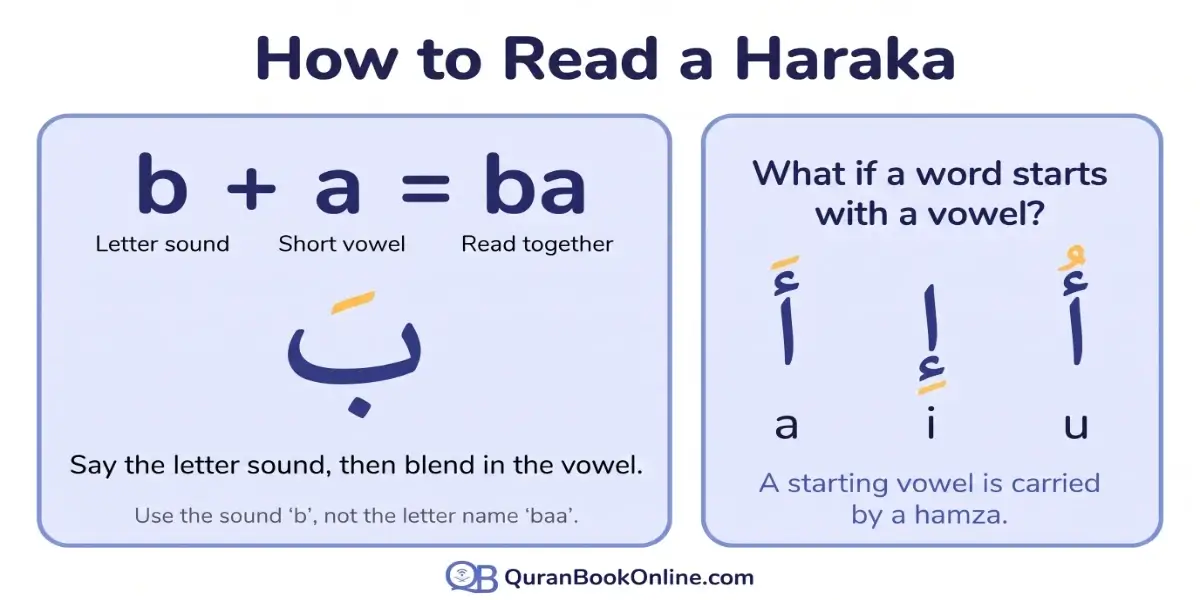
A small slanted dash above the letter says “a”: بَ = ba. Open your mouth and keep the sound short. It is never “e”. The full lesson, with every letter, is on fatha Arabic.
Kasra: the “i” mark
The same dash, written below the letter, says “i” as in “sit”: بِ = bi. With dotted letters, the kasra sits under the dots. Keep it short, never “e”. More in kasra Arabic.
Damma: the “u” mark
A tiny curl above the letter, like a mini و, says “u” as in “put”: بُ = bu. Round your lips. English speakers often slide into “o”. Practise it in the lesson on dammah.
After the heavy letters (خ ص ض ط ظ غ ق), fatha and damma sound fuller and deeper. You can hear why in heavy letters in Arabic.
How to Read a Letter With a Haraka
- Consonant first, then the vowel. ب + fatha = b + a = ba.
- One beat. Keep the vowel short. Hold it for two beats and it becomes a long vowel, a different sound you will meet in Arabic long vowels.
- A vowel never starts on its own. At the start of a word it sits on a hamza: أَ (ʾa) · إِ (ʾi) · أُ (ʾu). The hamza is a light catch in the throat, like the break in “uh-oh”.
Tip: with dotted letters, look past the dots to find the mark.
Read the Rows
Your first reading drill. Read each row from right to left, out loud. Then tap a syllable to check yourself.
Say the row first, then check. Don’t play first: your ear learns more when it has to guess.
Arabic Harakat Chart: All 28 Letters With Fatha, Kasra and Damma
Here is the Arabic alphabet with harakat, one letter per row. Read across: same letter, three sounds. Tap any syllable to hear it.
| # | Letter | Fatha (a) | Kasra (i) | Damma (u) |
|---|---|---|---|---|
| 1 | أalif (on a hamza) | |||
| 2 | بbāʾ | |||
| 3 | تtāʾ | |||
| 4 | ثthāʾ | |||
| 5 | جjīm | |||
| 6 | حḥāʾ | |||
| 7 | خkhāʾ † | |||
| 8 | دdāl | |||
| 9 | ذdhāl | |||
| 10 | رrāʾ ‡ | |||
| 11 | زzāy | |||
| 12 | سsīn | |||
| 13 | شshīn | |||
| 14 | صṣād † | |||
| 15 | ضḍād † | |||
| 16 | طṭāʾ † | |||
| 17 | ظẓāʾ † | |||
| 18 | عʿayn | |||
| 19 | غghayn † | |||
| 20 | فfāʾ | |||
| 21 | قqāf † | |||
| 22 | كkāf | |||
| 23 | لlām | |||
| 24 | مmīm | |||
| 25 | نnūn | |||
| 26 | هhāʾ | |||
| 27 | وwāw | |||
| 28 | يyāʾ |
† Always-heavy letters: fatha and damma sound fuller. ‡ The letter ر is heavy with fatha and damma, light with kasra. Details: heavy letters in Arabic.
Row 1: alif itself never carries a vowel, so the row shows the vowel on a hamza: أَ إِ أُ.
Why Harakat Matter: One Mark, a Different Word
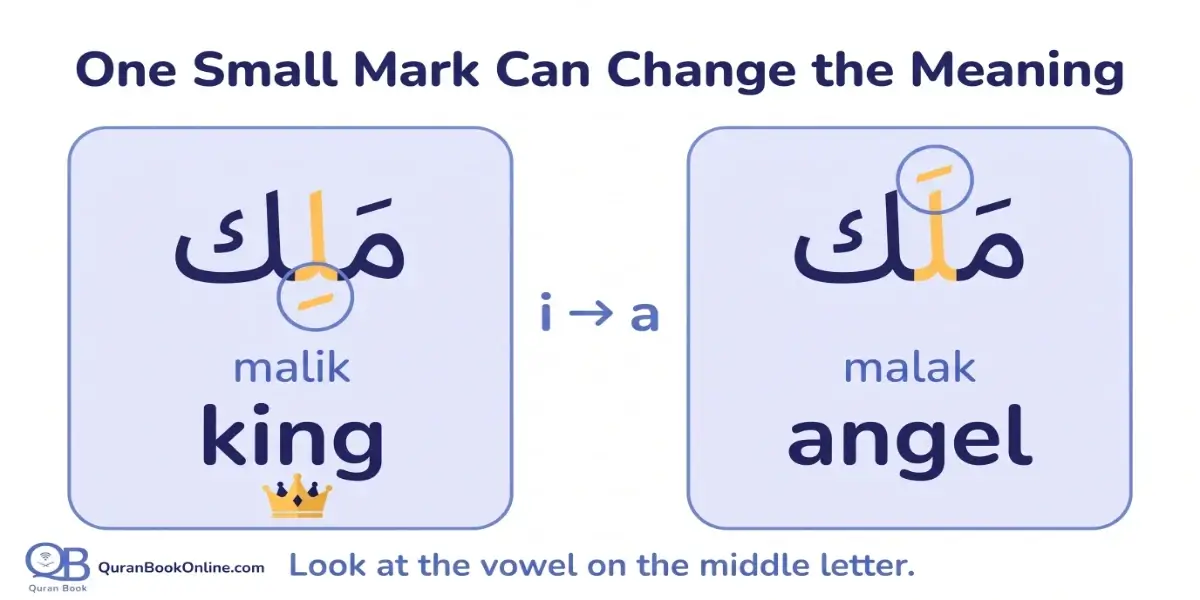
Look at these two pairs. The letters are the same. Only one mark changes.
مَلِكٌ = “a king”مَلَكٌ = “an angel”
Only the mark on ل changes.
عَلِمَ = “he knew”عُلِمَ = “it was known”
Only the mark on ع changes.
Same letters, different marks, different word. That’s why you read every haraka.
The ending marks on مَلِكٌ and مَلَكٌ are tanween, covered later in Tanween in Arabic.
Harakat in the Quran
The Mushaf is fully marked, so a reader who knows these three marks can follow every word. Listen to each ayah, then find the word under “Look for”.
Look and listen
Al-Fil 105:1
أَلَمۡ تَرَ كَيۡفَ فَعَلَ رَبُّكَ بِأَصۡحَٰبِ ٱلۡفِيلِ
a-lam tara kayfa faʿala rabbuka bi-aṣḥābi l-fīl
“Have you not seen how your Lord dealt with the Army of the Elephant?”
Look for: فَعَلَ (faʿala): three letters, three fathas — fa-ʿa-la
Recitation: Sheikh Mahmoud Khalil Al-Husary (murattal), riwayah Hafs ʿan ʿĀṣim, via EveryAyah.
Al-Falaq 113:1
قُلۡ أَعُوذُ بِرَبِّ ٱلۡفَلَقِ
qul aʿūdhu bi-rabbi l-falaq
“Say, ‘I seek refuge in the Lord of the daybreak.’”
Look for: ٱلۡفَلَقِ: fa-la-qi — two fathas, then a kasra under the last letter
Al-Fatiha 1:5
إِيَّاكَ نَعۡبُدُ وَإِيَّاكَ نَسۡتَعِينُ
iyyāka naʿbudu wa iyyāka nastaʿīn
“You alone we worship and You alone we ask for help.”
Look for: نَعۡبُدُ (naʿbudu): a damma on the last two letters — bu-du
The Mushaf also has extra small signs for recitation. Those belong to Tajweed. When you are ready, start with our guide to Tajweed rules.
Recognising the marks is the easy part. Saying a clean, short “u”, every time, is where a teacher’s ear saves months.
Book Your Free Trial LessonStarting as an adult? See how we help you learn Quran reading for adults.
Sukoon, Shaddah, Tanween and Long Vowels: The Other Marks
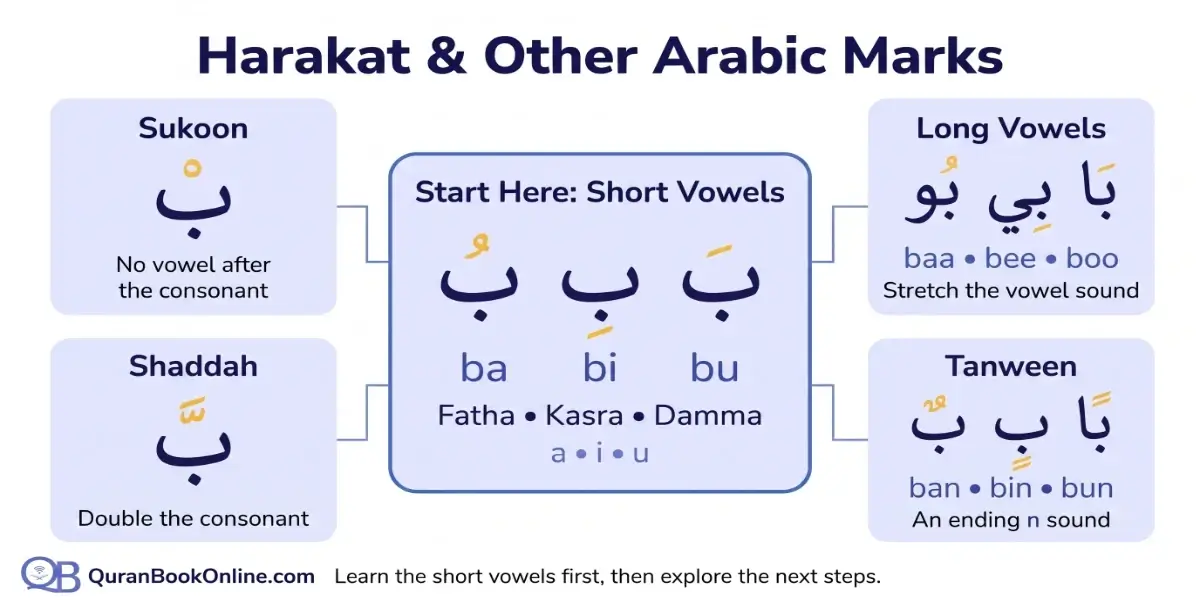
Fatha, kasra and damma are the short vowels. Tashkeel (تَشْكِيل) is the wider word: all the marks written on a text, often called Arabic diacritics in English. These three are one part of it.
These are the other marks you will learn next:
- ـْ ـۡSukoon in ArabicNo vowel: the letter stops.
- ا و يArabic long vowelsAfter a matching haraka: two beats.
- ـّShaddahThe letter is doubled.
- ـً ـٍ ـٌTanween in ArabicAdds an “n” at the end.
Arabic Vowel Games: Practise Each Haraka
Ready to learn Arabic short vowels one at a time? Each game practises one haraka. Tap “Play here” to open it on this page.
Common Mistakes With Arabic Harakat
Most mistakes with Arabic vowels for beginners are one of these five:
Mistake: Reading fatha as “e” (beh).
Fix: An open “a”: ba.
Mistake: Reading kasra as “e” (be).
Fix: A short “i”: bi.
Mistake: Reading damma as “o” (bo).
Fix: Round the lips: bu.
Mistake: Stretching the vowel (baa).
Fix: One beat. Stretching makes a long vowel.
Mistake: Mixing up the kasra and the dots under ب ج ي.
Fix: The dots belong to the letter. The dash under them is the kasra.
What to Learn After the Harakat
- Go deeper on each vowel: fatha Arabic · kasra Arabic · dammah.
- Next mark: Sukoon in Arabic, the sign for “no vowel”.
- A letter looks unfamiliar inside a word? Review Arabic letters beginning, middle & end.
See where this fits in the full path to how to read Arabic.
📚 Learn more
- Not sure of a letter’s sound yet? Arabic alphabet pronunciation
- Want a free guided start? learn Arabic reading free
Arabic Harakat FAQ
What are harakat in Arabic?
Harakat (حَرَكَات, “movements”) are the three short vowel marks written above or below Arabic letters: fatha (a), kasra (i) and damma (u). Arabic letters mostly write consonants; the harakat tell you which short vowel to say after each one.
What are fatha, kasra and damma?
They are the three Arabic short vowels. Fatha is a small slanted line above the letter and sounds “a” (بَ, ba). Kasra is the same line below the letter and sounds “i” (بِ, bi). Damma is a small curl, like a tiny wāw, above the letter and sounds “u” (بُ, bu).
Is sukoon one of the harakat?
Not strictly. Sukoon (ـْ) means “stillness” and shows that a letter has no vowel at all. Some teachers list it with the harakat because it is written in the same place, but the three short vowels are fatha, kasra and damma.
What is the difference between harakat and tashkeel?
Harakat are the three short vowel marks. Tashkeel (تَشْكِيل) is the wider word for all the marks added to a text: the harakat plus sukoon, shaddah and tanween. A “fully vowelled” text has complete tashkeel.
Why do most Arabic texts have no harakat?
Fluent readers already know the words, so newspapers, books and signs usually leave the marks out. The Quran, children’s books and beginner materials keep them so every word is read correctly. Beginners should always learn from fully vowelled text.
Do harakat change the meaning of a word?
Yes. The letters can be identical while the marks make a different word: مَلِكٌ (malikun) means “a king”, but مَلَكٌ (malakun) means “an angel”. That is why reading every mark matters, especially in the Quran.
How do you pronounce fatha, kasra and damma correctly?
Keep each one short, one beat. Fatha is an open “a” (not “e”), kasra is “i” as in “sit” (not “e”), and damma is “u” as in “put”, with rounded lips (not “o”). After heavy letters such as ق and ص, fatha and damma sound fuller.
How long does it take to learn the Arabic harakat?
If you already know the letters, many beginners can read any letter with fatha, kasra or damma within one to two weeks of 15–20 minutes of daily practice. Reading them smoothly inside words takes longer. These are typical estimates — everyone’s pace is different.
You can now read any letter with a, i or u
The next step is reading them smoothly in real words, with a teacher who catches the small slips early.
Book Your Free Trial LessonArabic Language Graduate · Hafidha of the Quran · Writer on Arabic Reading
Jehad Mahmoud is a graduate of the Arabic Language department and a Hafidha of the Quran who writes the Arabic and Quran-reading guides at Quran Book Academy.
She writes for English-speaking learners and parents starting from zero: the letters by sound, the vowel marks, and the step-by-step order that leads to reading the Quran directly from the Mushaf.
Her Arabic Language studies and her memorisation of the Quran are the foundation of this reading series.
These guides teach the reading system step by step. Pronunciation is a skill of the ear and the mouth, so it is best checked by a qualified teacher who can hear you read.
References
- Quran.com: Al-Fil 105:1 · Al-Falaq 113:1 · Al-Fatiha 1:5 (Uthmani script).
- Translations: The Clear Quran, Dr. Mustafa Khattab, via quran.com.
- Ayah recitation: Sheikh Mahmoud Khalil Al-Husary (murattal, Hafs ʿan ʿĀṣim), audio via EveryAyah.
- Letter, syllable and word audio: recorded in-house by Quran Book Academy.
- Encyclopaedia Britannica, “Arabic alphabet”.