Arabic Reading Practice: From Letter by Letter to Smooth Reading
You know every mark. Now learn to see syllables instead of letters, and practise on five levels, from a single syllable to a whole ayah.

You know every mark now. So read this:
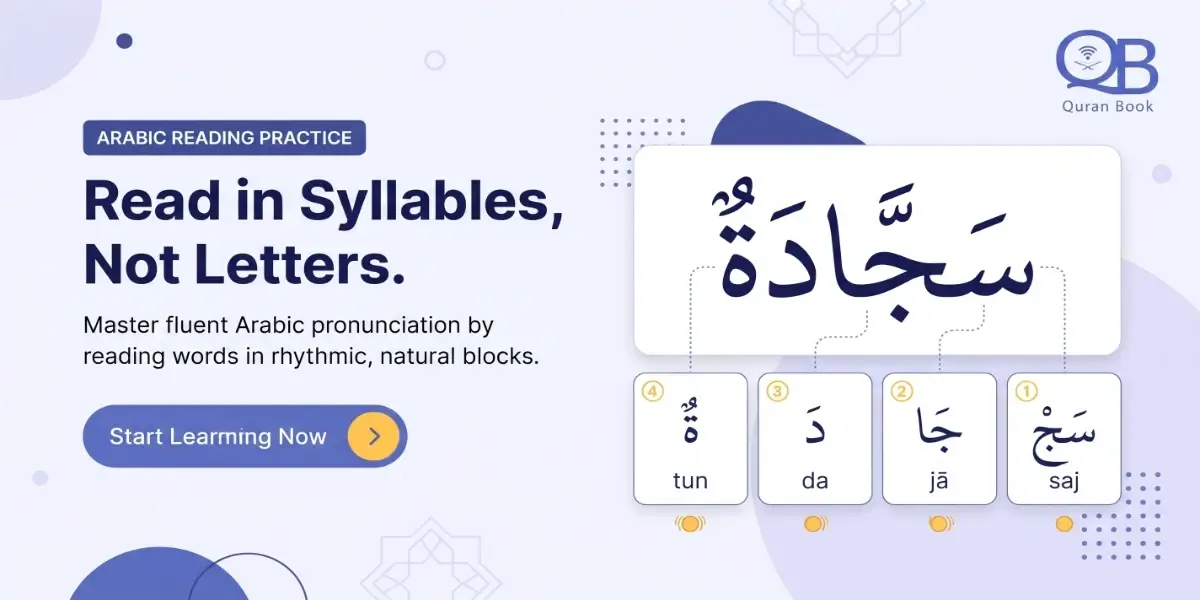
سَجَّادَةٌ
Check: sajjādatunIf you went s… a… j…, you read it letter by letter. Read it in syllables: saj-jā-da-tun, “a prayer mat”. Four vowel marks, four syllables. That is the gap between knowing the marks and reading.
You’ve just learned the last mark, the shaddah, so this page is the last step on the path to how to read Arabic. In this Arabic reading practice you’ll learn one rule that splits any word, the three syllable shapes, a way to practise that builds speed, and five levels, from a single syllable to a whole ayah.
Why Arabic Reading for Beginners Feels Slow
Each lesson so far taught one mark on one letter, so your eye learned to stop at every letter. That was right for learning the marks. It is wrong for reading.
Three habits keep you slow:
- Reading letter by letter, one sound at a time.
- Playing the audio before you read, so you copy the sound instead of reading it.
- Reading the English letters instead of the Arabic.
The fix is to move your eye one syllable at a time. Syllables are the units Arabic words are built from, and once you see them, a long word stops looking like a wall of letters. That one switch is what this Arabic reading practice trains.
The Syllable Rule: Count the Vowels
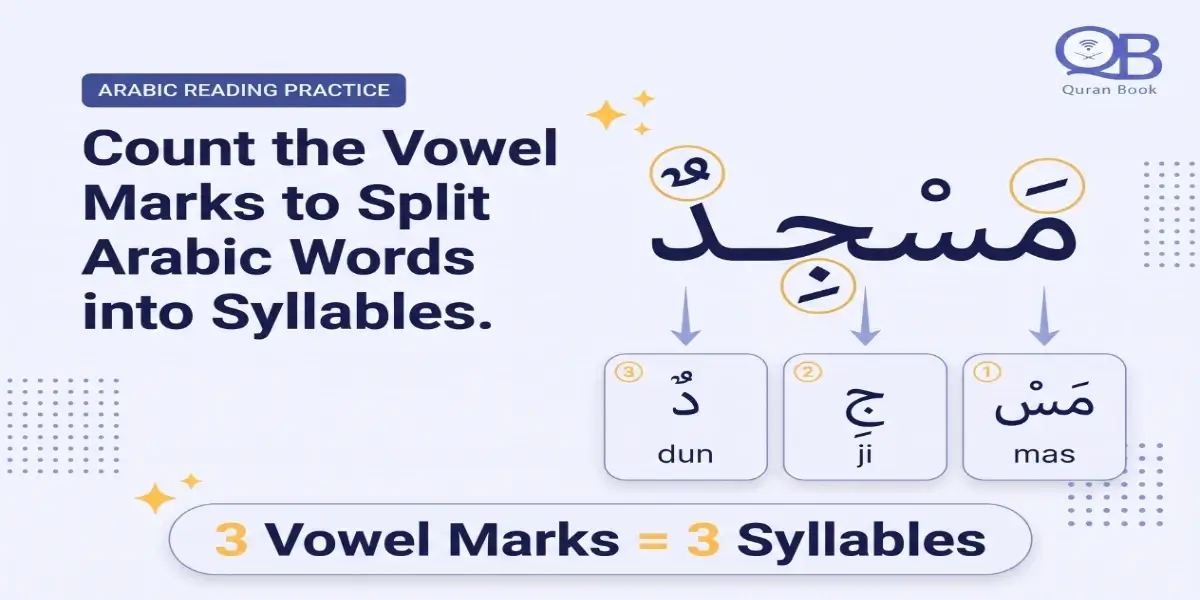
Every vowel mark starts a syllable. Count the vowel marks and you’ve counted the syllables.
The س has a sukoon: no vowel, so it doesn’t start a syllable. It closes “mas”.
A long-vowel letter (ا و ي) doesn’t count either: it stretches the vowel before it. A shaddah letter counts once, because its first half closes the syllable before. Tanween counts once too: one vowel plus n.
Every vowel mark is one of the Arabic harakat or a tanween.
The Three Syllable Shapes in Arabic
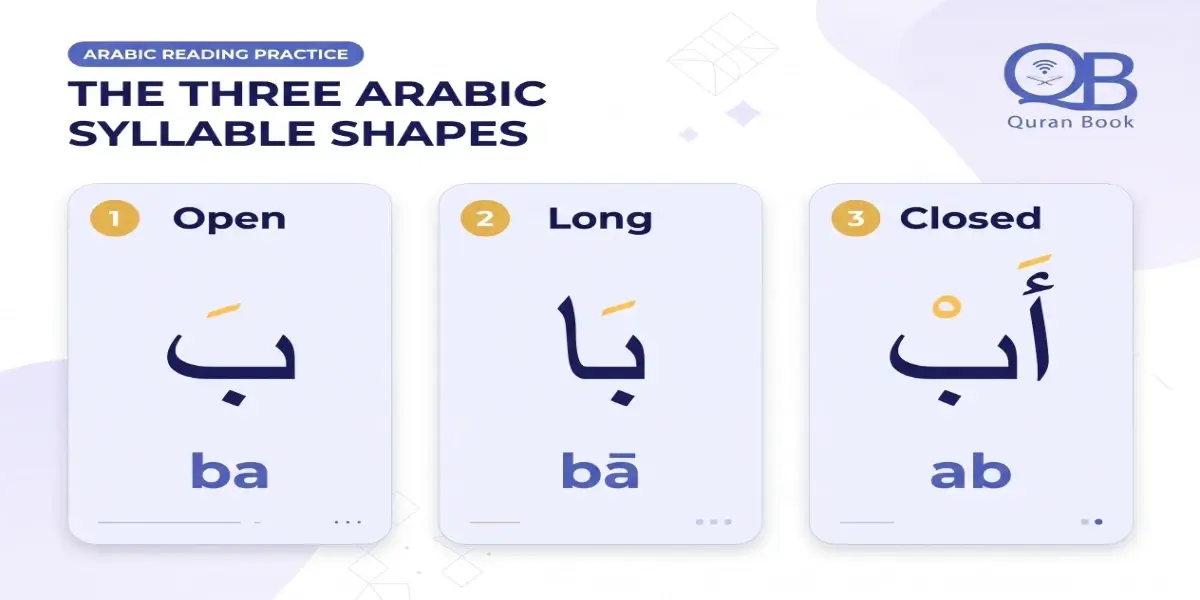
Long
بَا
bā
A consonant + a long vowel, held for two beats. Still one syllable. See Arabic long vowels.
Check: bāClosed
أَبۡ
ab
A vowel, then a letter with sukoon: the sound stops on a consonant. The soft “aw” and “ay” (يَوۡ, عَيۡ) are closed too. See sukoon in Arabic.
Check: abA shaddah is a closed syllable + an open one: سَجۡ | جَا in سَجَّادَةٌ. A tanween ends the word on a syllable that closes on n: دٌ = “dun”.
Every syllable starts with a consonant (hamza is one), so a word always splits just before a letter that has a vowel. With a shaddah, the split runs through the doubled letter.
How to Practise: Read First, Then Listen
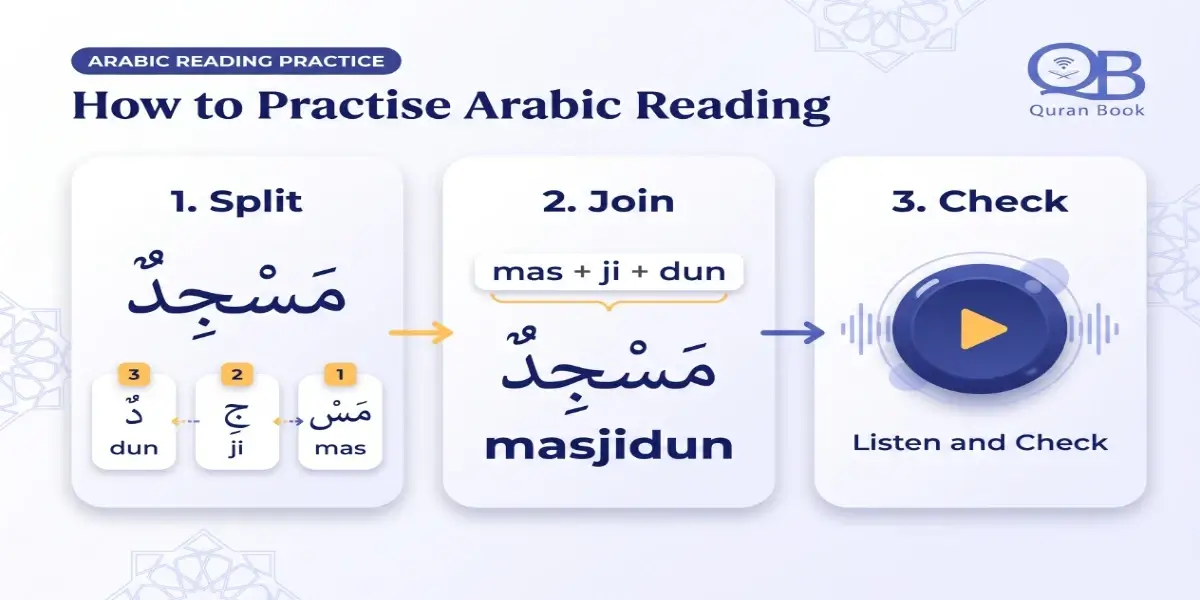
Use three passes for every item in your Arabic reading practice:
- Split. Read it syllable by syllable, out loud, with a finger under each one.
- Join. Read the whole word in one breath.
- Check. Tap ▶. If it matches, read it once more at normal pace. If not, find the syllable that was different and go back to pass 1.
Why read first? If you play the clip first, you copy the sound, and you haven’t read anything. Cover the transliteration too; it is only there to check.
Accuracy first, then smoothness, then speed. 10–15 minutes a day is a typical estimate for steady practice: short and daily is easier to keep up than long and weekly.
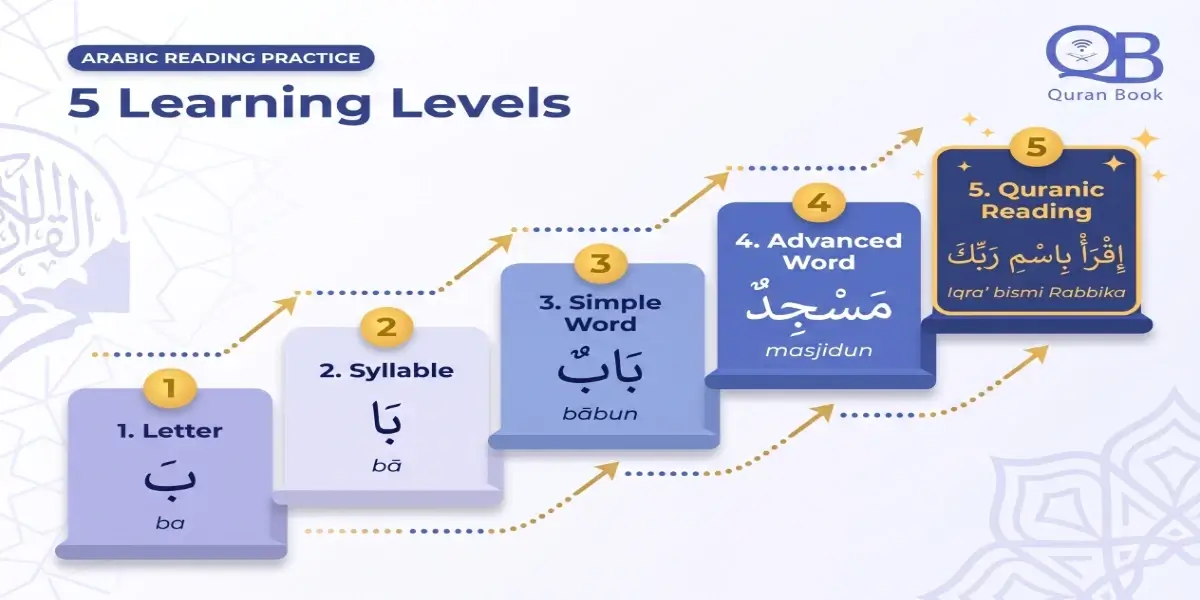
Arabic Reading Practice for Beginners: 5 Levels
This Arabic reading practice has five levels, and each level adds one thing. Start at Level 1 even if it feels easy, and move on when you can read every item of a level in pass 2 without stopping.
Level 1 Syllables: Open, Long or Closed?
Twelve syllables, mixed. Read each one out loud, decide its shape, then tap to check. They use all three shapes and only four letters, and every word on this page is built from shapes like these.
Level 2 Short Words
Six words of two or three syllables, with no shaddah: words with harakat you already know. Each one is shown split first, then joined:
شَمۡسٌ
If a joined shape looks new, see Arabic letters beginning, middle & end.
Level 3 Longer Words
Six words of three or four syllables, each with something extra: a closed syllable, a long vowel, a shaddah or a ة with tanween. Count the vowel marks before you read: سَجَّادَةٌ has four, so it is saj | jā | da | tun.
Heavy letters stay full in long words: the ṣ in صَدِيقٌ is just as heavy as it is on its own. Open the “Longer words” tab in the practice box above.
Level 4 Two-Word Phrases
Read the two words as one line, with no pause between them:
يَوۡمٌ عَظِيمٌ
yaw-mun ʿa-ẓī-mun · “a great day”
In these phrases the first word ends on a vowel, or on a tanween before a throat letter (ع ح أ), so you say its n clearly and go straight on. With some letters the n of tanween blends into the next word; that’s tajweed, later. For the n itself, see tanween in Arabic. Open the “Phrases” tab above.
Level 5 Read a Whole Ayah
In this course, your Arabic reading passages are ayat. Both ayat below use only marks you know.
Read, then listen
Al-Fil 105:3
وَأَرۡسَلَ عَلَيۡهِمۡ طَيۡرًا أَبَابِيلَ
13 syllables
wa-arsala ʿalayhim ṭayran abābīl
“For He sent against them flocks of birds,”
Look for: طَيۡرًا (ṭay-ran): a closed “ay”, then fathatain with its silent alif, then أ.
Read it three times first (split, join, normal pace), then press ▶.
Listen: Al-Husary, 105:3Recitation: Sheikh Mahmoud Khalil Al-Husary, murattal, riwayah Hafs ʿan ʿAsim. Audio: EveryAyah.com.
Al-Fajr 89:13
فَصَبَّ عَلَيۡهِمۡ رَبُّكَ سَوۡطَ عَذَابٍ
14 syllables
fa-ṣabba ʿalayhim rabbuka sawṭa ʿadhāb
“So your Lord unleashed on them a scourge of punishment.”
Look for: سَوۡطَ (saw-ṭa): a closed “aw”, then a heavy ṭ, then ع.
Read it three times first (split, join, normal pace), then press ▶.
Listen: Al-Husary, 89:13At the end of each ayah the reciter stops (abābīl, ʿadhāb): the stop rule from the tanween lesson.
These two ayat use only marks you know; the Mushaf has a few extra small signs. They belong to tajweed rules, the next step.
Reading a whole ayah on your own is a real step, and the best moment for a teacher to hear the syllable you rush.
Book Your Free Trial LessonLearning for yourself? See how you can learn Quran reading for adults with a teacher.
Arabic Reading Exercises: Which Word Did You Hear?
Your ear check. Each pair differs by one mark (a long vowel, a sukoon or a shaddah), and the meaning changes with it.
Arabic Reading Practice for Kids
For parents: keep it short, playful and in order.
- Clap once for every vowel mark, then read the word in claps.
- Play “count the marks” before every new word.
- Your child reads first; then you press ▶ together.
- A few items a day from one level, with a finger under each syllable.
- Praise a smooth word, not a fast one, and stop while it’s still fun.
Try it with your child
Read each word, clap it, then tap to check.
Want a teacher to guide your child step by step? See our Quran reading for beginners classes for kids.
Free Arabic Reading Practice PDF
Prefer paper? Print the levels and practise away from the screen. There’s no sign-up: the files download directly. These Arabic reading worksheets use circling and ticking only, with no tracing.
📄 Arabic Reading Practice PDF: 5 Levels
Every level of this page on 5 printable pages.
Download the PDF (5 pages)📄 Arabic Reading Worksheets for Kids
Count it, sort it, read it: 4 pages, with an answer key on the last page.
Download the worksheets (4 pages)Common Mistakes When Practising Arabic Reading
These habits slow down Arabic reading practice more than anything else:
- ❌ Reading letter by letter: م… س… ج… د ✅ Read in syllables: mas-ji-dun.
- ❌ Playing the clip first ✅ Read first, then check.
- ❌ Counting a sukoon letter as a syllable: “ma-sa-ji-dun” ✅ It closes the syllable before it.
- ❌ Breaking a long vowel in two: مِصۡبَاحٌ as “miṣ-ba-a-ḥun” ✅ One long syllable, bā, held for two beats.
- ❌ Pausing between the words of a phrase ✅ Read يَوۡمٌ عَظِيمٌ in one breath.
- ❌ Making heavy letters light in long words: صَدِيقٌ ✅ The ṣ stays full. See heavy letters in Arabic.
- ❌ Going for speed first ✅ Accuracy, then smoothness, then speed.
What to Learn After This
- You’ve finished the reading course. Next come the rules for reciting what you can now read: tajweed rules.
- Missed a mark? Go back to shaddah, or see the full path to how to read Arabic.
📚 Learn More
Want a structured book to keep practising? Try the noor al bayan method.
Want a free guided start? Learn Arabic reading free.
Arabic Reading Practice FAQ
How can beginners practise Arabic reading?
Read short items every day, in order: syllables, then short words, longer words, phrases and finally whole ayat. Read each item out loud first, syllable by syllable, then join it, and only then play the audio to check. Move to the next level when you can read every item without stopping.
How do I stop reading Arabic letter by letter?
Read in syllables instead of letters. Find the vowel marks first, because each one starts a syllable, then read one syllable at a time and join them: مَسۡجِدٌ is mas-ji-dun. With daily practice, your eye starts to see the syllables on its own.
How do I know how many syllables an Arabic word has?
Count the vowel marks. Every fatha, kasra, dammah or tanween starts one syllable. A letter with sukoon, a long-vowel letter and the first half of a shaddah don’t start one, so سَجَّادَةٌ has four vowel marks and four syllables: saj-jā-da-tun.
Should I listen first or read first?
Read first. If you play the audio first, you copy the sound instead of reading it. Read the item out loud, then use the audio to check yourself, and read it once more if your reading was different.
How long should I practise Arabic reading each day?
A typical estimate is 10 to 15 minutes a day. Short daily practice is easier to keep up than one long session a week, and it gives your eye the repetition it needs to read in syllables.
Should I practise reading Arabic without harakat?
Not yet. Reading without vowel marks depends on knowing the words and the grammar, which is a separate skill. The Quran is written with full marks, so if your goal is reading the Quran, keep practising with fully vowelled text.
Can I practise Arabic reading with the Quran?
Yes, and it is the best goal for your practice. Start with ayat where every letter carries a mark you know, like the two on this page. The Mushaf also has a few extra small signs; they belong to tajweed, the next step after this course.
How can kids practise Arabic reading?
Clap once for each vowel mark, then read the word in claps. Let the child read before you press play, read a few items a day from one level, and praise a smooth word more than a fast one. Stop while it is still fun.
The whole reading course is behind you
You can now read any fully vowelled word, one syllable at a time. Keep up your Arabic reading practice a few minutes a day. Practice checks you against a clip. A teacher checks you, before tajweed builds on it.
Book Your Free Trial LessonArabic Language Graduate · Hafidha of the Quran · Writer on Arabic Reading
Jehad Mahmoud is a graduate of the Arabic Language department and a Hafidha of the Quran who writes the Arabic and Quran-reading guides at Quran Book Academy.
She writes for English-speaking learners and parents starting from zero: the letters by sound, the vowel marks, and the step-by-step order that leads to reading the Quran directly from the Mushaf.
Her Arabic Language studies and her memorisation of the Quran are the foundation of this reading series.
These guides teach the reading system step by step. Pronunciation is a skill of the ear and the mouth, so it is best checked by a qualified teacher who can hear you read.
References
- Quran 105:3 (Al-Fil), Uthmani text and translation: quran.com/105/3
- Quran 89:13 (Al-Fajr), Uthmani text and translation: quran.com/89/13
- Translations: The Clear Quran, Dr. Mustafa Khattab, via quran.com.
- Recitation audio: Sheikh Mahmoud Khalil Al-Husary (murattal, Hafs ʿan ʿAsim), via EveryAyah.com.
- Encyclopaedia Britannica, “Arabic alphabet”.
- All other audio on this page is recorded by Quran Book Academy.