Yaa Madd: A Clear “ii”, Held for Two Beats
Hear bi vs bii, keep the sound clear, and learn which yāʾ is a long vowel.
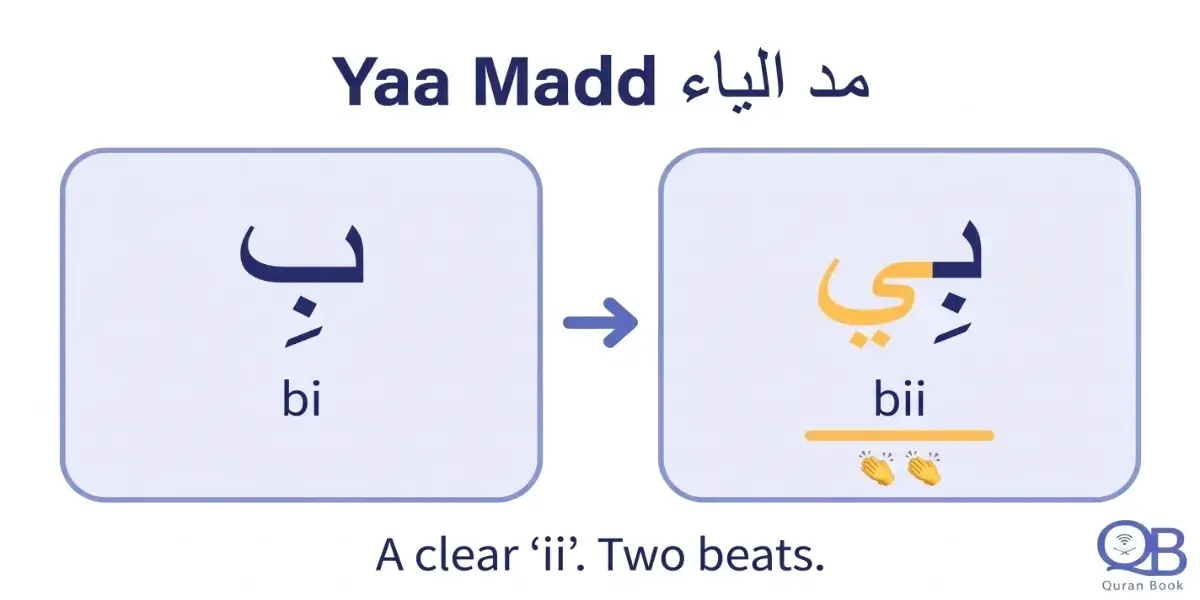
بِبِي
bi → bii
You already know بِ (bi) from kasra. Put a yāʾ after it — بِي — and hold the same “i” for two beats: “bii”. That’s yaa madd, the long ee sound in Arabic and the last of the Arabic long vowels.
In this final long-vowel lesson, you’ll hear it on all 28 letters, learn the two sound mistakes to avoid, find out which yāʾ is a madd, spot it in the Quran and read your first words. Whenever you see ▶, tap it.
In this lesson
What Is Yaa Madd?
Yaa madd is a yāʾ (ي) with no vowel of its own, written after a letter that has a kasra: بِ + ي = بِي.
The kasra stays under the letter before. The yāʾ doesn’t add a “y” sound — it only stretches that kasra into a long “ii”. So the short “i” lasts one beat, and the long “ii” lasts two. You’ll sometimes see it searched as “yaa maddah”; it’s the same thing.
After alif madd and waw madd, this is the third and last of the Arabic long vowels.
Kasra vs Yaa Madd: Yaa Madd Pronunciation
Tap each pair: the short kasra first, then the long one. Same letter, same “i” — only the length changes.
A good yaa madd sound comes down to three things:
Clear, two beats, no y
- Hold it. Two beats — clap twice as you say “bii”.
- Keep it clear. An “ee”, as in “see”. Not “eye” (dīn is not “dine”), and not the short “ih” of “sit”.
- No “y” at the end. “bii”, not “biy”. The yāʾ has no sound of its own.
Smile, hold it, let it go — no y.
After the heavy letters (خ ص ض ط ظ غ ق), the start sounds fuller, but the vowel is still a clear “ii” — see heavy letters in Arabic. In the Quran, some are held longer when a madda sign (ـٓ) is written over them; that’s one of the tajweed rules for later.
Yaa Madd or Just a Yāʾ?
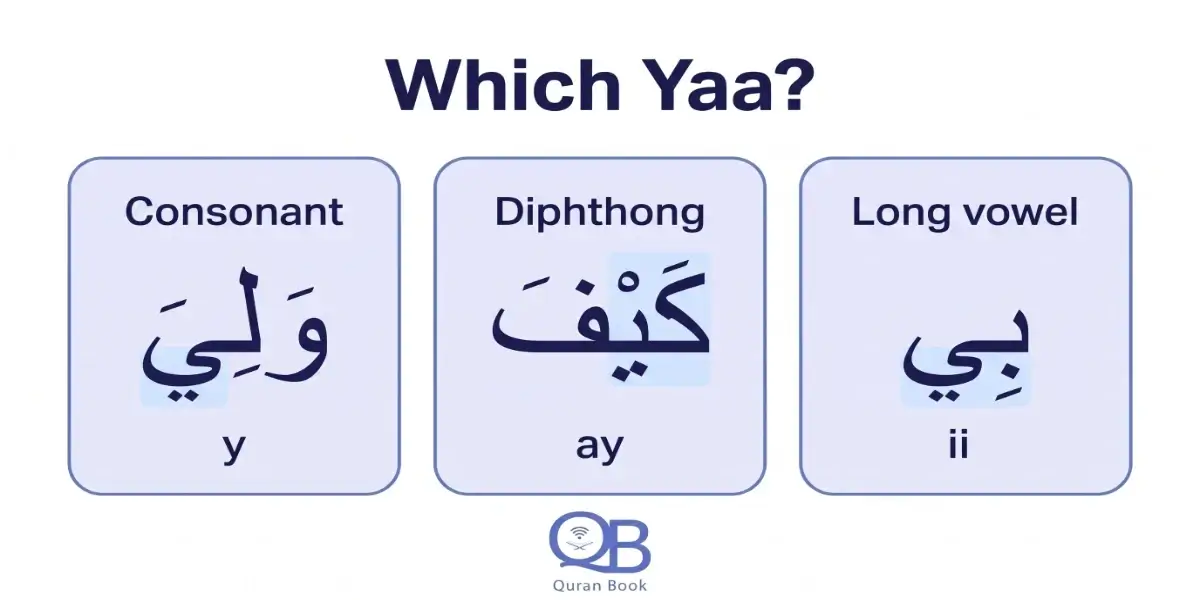
Not every ي is a long vowel. Three cases:
وَلِيَ
wa-liya · “and for me”
The yāʾ has its own vowel → a consonant “y”.
✗ Not a maddكَيۡدَهُمۡ
kaydahum · “their plan”
A fatha before, no vowel on the yāʾ → a soft “ay”. Not a long vowel; it comes later.
✗ Not a long vowelبِي
bii
A kasra before, no vowel on the yāʾ → yaa madd.
✓ Long vowelLook at the letter before the yāʾ — and at the yāʾ itself.
Yaa Madd in the Mushaf
In the Madani Mushaf (the Uthmani script on quran.com), a yaa madd has no mark of its own — just a bare ي after a kasra: دِينُكُمۡ (dīnukum). Three more things you’ll see:
- Some printed Mushafs write a final ي without its two dots: فِى. It’s the same letter, read the same way: fī.
- A small yāʾ (ۦ) after هِ, as in بِهِۦ, is usually read as a long “ii” too: bihī.
- Don’t mix it up with ىٰ (a small alif on top). That is a long “aa”, from the alif madd lesson.
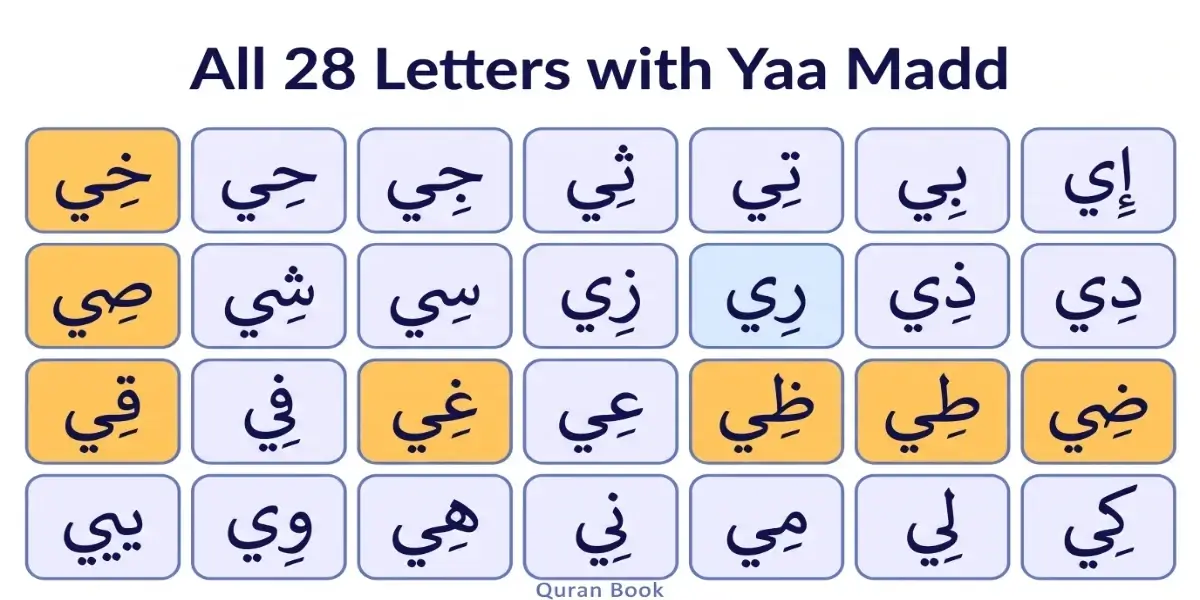
Arabic Letters With Yaa Madd: All 28
Here is every Arabic letter with a kasra, then a bare yāʾ. Read a row out loud first, then tap to check yourself. Heavy letters are in gold; رِي is in blue because ر with a kasra is light. Two are real words: فِي “in” and لِي “for me”. Notice that ي joins on both sides — see Arabic letters beginning, middle & end.
Yaa Madd Words: Read It, Then Check
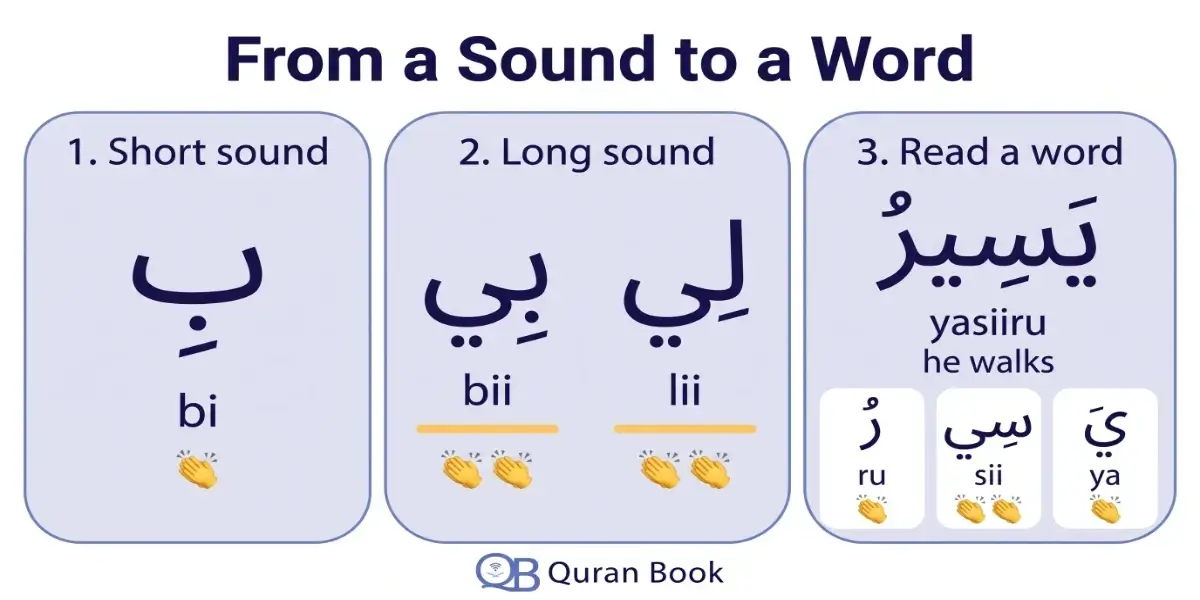
Now read some yaa madd examples. Say each one out loud first, then tap to check yourself. There are three levels:
- Level 1 — one syllable: بِي · تِي · مِي · نِي
- Level 2 — short, then long: بِ بِي · مِ مِي · سِ سِي · نِ نِي
- Level 3 — six words, short–long–short. Each word is split first, يَ | سِي | رُ, then joined: يَسِيرُ (ya-sī-ru).
The first word is a verb from the alif madd lesson, now in the present tense: سَارَ “he walked” → يَسِيرُ “he walks”.
Count the beats as you read: يَسِيرُ is ya (1 beat) – sii (2 beats) – ru (1 beat). If the middle syllable gets only one beat, you’ve read it short. Go slowly; at this stage a clear, steady “ii” matters more than speed.
Yaa Madd in the Quran
Listen to these two ayat and look for the long “ii”. Both words sit in the middle of the ayah, because at the end of an ayah the reciter stops and the last sound changes. Each ayah also has a yāʾ that is not a madd — spot the difference. Play each ayah twice: first just listen, then follow the words with your finger.
🔊 Look and listen
لَكُمۡ دِينُكُمۡ وَلِيَ دِينِ
lakum dīnukum wa-liya dīn — “You have your way, and I have my Way.” (Al-Kāfirūn 109:6)
Look for: دِينُكُمۡ (dīnukum): a bare yāʾ after دِ — dii, two beats. Compare وَلِيَ (wa-liya): its yāʾ has a fatha, so it’s a consonant “y”.
Recited by Sheikh Mahmoud Khalil Al-Husary, riwayah of Hafs ʿan ʿĀṣim.
أَلَمۡ يَجۡعَلۡ كَيۡدَهُمۡ فِي تَضۡلِيلٖ
alam yajʿal kaydahum fī taḍlīl — “Did He not frustrate their scheme?” (Al-Fīl 105:2)
Look for: فِي (fī): a bare yāʾ after فِ — fii, two beats. Compare كَيۡدَهُمۡ (kaydahum): a yāʾ after a fatha — a soft “ay”, not a long vowel.
Audio: EveryAyah. Translation: The Clear Quran, Dr. Mustafa Khattab.
Hearing a clear, two-beat “ii” in Al-Husary’s recitation is easy. Keeping yours that clear — no “eye”, no “y” — is what a teacher listens for.
Book Your Free Trial LessonStarting as a grown-up? See how we help you learn Quran reading for adults, one-on-one.
Yaa Madd Game
Can you hear one beat or two? In this yaa madd game, a clip plays and you decide: short or long. The syllable only appears after you answer, so trust your ear.
Madd Yaa for Kids: Easy Activities
Teaching your child? These yaa madd activities keep it short, physical and fun:
- One clap for بِ, two claps for بِي.
- Smile wide for “ii”, and keep smiling until the sound ends.
- Do one row of the chart a day, in big print.
- Play the short-or-long game together and let your child shout “short!” or “long!”.
- Praise a clear, steady “ii” — and stop while it’s still fun.
If your child uses the Noorani Qaida, this is the same lesson.
Try it with your child
Read these aloud together, then tap to check:
Want a teacher to guide your child? See our Quran reading for beginners classes.
Free Madd Yaa Worksheet (PDF)
Prefer paper? Download these free printables — no sign-up, just print and practise. They follow the same order as this lesson.
📄 Arabic Letters With Yaa Madd Chart
All 28 letters with a long “ii” on one page, heavy letters in gold and rāʾ in blue.
Download the chart (PDF)📄 Madd Yaa Worksheet for Kids
Circle, sort and read — 4 pages of practice, with an answer key on the last page.
Download the worksheet (PDF)Common Yaa Madd Mistakes Beginners Make
Each of these is easy to fix once you can hear it.
- ❌ Not holding it: بِي read as “bi” → ✅ two beats: bii.
- ❌ “Eye” instead of “ii”: دِين read like “dine” → ✅ a clear “ee”: dīn.
- ❌ The short “ih” of “sit” → ✅ a long, clear “ii”.
- ❌ A “y” at the end: “biy” → ✅ the yāʾ has no sound of its own.
- ❌ Treating every ي as a madd → ✅ look at the letter before: a kasra, then a yāʾ with no vowel = yaa madd.
What to Learn After Yaa Madd
That’s all three long vowels. The method stayed the same each time: see the mark, hear the length, say it.
- Next lesson: Sukoon in Arabic — the mark that means “no vowel here”.
- Missed one? Go back to waw madd.
- See where this fits in the full path to how to read Arabic.
📚 Learn More
Want a free guided start? learn Arabic reading free
Yaa Madd FAQ
What is yaa madd?
Yaa madd is the letter yāʾ (ي) with no vowel of its own, coming after a letter with kasra. The yāʾ is not said as a “y”: it stretches the kasra into a long “ii” held for two beats. So بِ (bi) becomes بِي (bii).
How do you pronounce yaa madd?
Keep the “i” of the kasra and hold it for two beats: بِي = bii, فِي = fii. Make it a clear “ee”, as in “see”, not the short “i” of “sit” and not “eye”, and add no “y” at the end.
What is the difference between kasra and yaa madd?
Kasra (ـِ) is a short “i” that lasts one beat: بِ = bi. Yaa madd is the same “i” held for two beats, because a yāʾ with no vowel follows it: بِي = bii.
How long is yaa madd?
Two beats, about the time of two short vowels. In the Quran some yaa madds are held longer when a madda sign (ـٓ) is written over them; that is a tajweed rule you learn later.
Is every yāʾ a yaa madd?
No. A yāʾ with its own vowel (يَ، يِ، يُ) is a consonant “y”. A yāʾ with no vowel after a fatha makes a soft “ay”, as in كَيۡدَهُمۡ (kaydahum). Only a yāʾ with no vowel after a kasra is yaa madd.
What are some yaa madd examples?
Syllables like بِي (bii), مِي (mii) and نِي (nii), the little words فِي (fī, “in”) and لِي (lī, “for me”), and words like يَسِيرُ (yasīru, “he walks”) and يَطِيرُ (yaṭīru, “it flies”).
What is the small yāʾ in the Quran?
In the Mushaf, a small yāʾ (ۦ) is often written after the letter هِ, as in بِهِۦ. It is usually read as a long “ii”, just like yaa madd: bihī.
How can kids practise yaa madd?
Smile wide for a long “ii” and hold it for two claps, then compare it with one clap for kasra. Read one short row a day in big print, and play a short-or-long listening game together.
All three long vowels done
Sukoon comes next. A teacher can make sure every long vowel stays clear and the right length — from your very first lesson.
Book Your Free Trial LessonReferences
- Quran.com — Surah Al-Kāfirūn 109:6 and Surah Al-Fīl 105:2 (Uthmani text).
- Translations: The Clear Quran, Dr. Mustafa Khattab, via quran.com.
- Recitation: Sheikh Mahmoud Khalil Al-Husary (murattal, Hafs ʿan ʿĀṣim), audio via EveryAyah.com.
- Encyclopaedia Britannica, “Arabic alphabet”.
- Syllable and word audio recorded in-house by Quran Book Online.