Tanween Damma: Two Dammas, One -un Sound
Spot the second damma — even when it hides as a hook — hear the n you can’t see, and read your first words with dammatain.
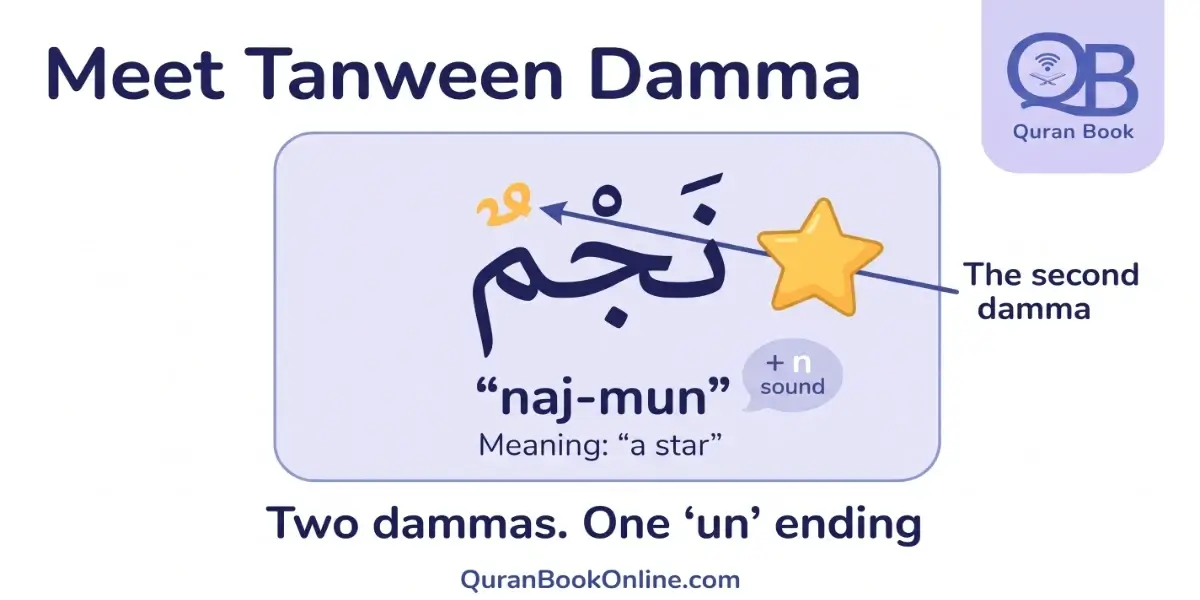
Read this word. If you said najmu, you saw one damma. Look again: the little hook is a second damma — and an n that isn’t written.
You’ve just met tanween kasra, so this is the last of the three types in Tanween in Arabic. In this tanween damma lesson you’ll hear damma + n, spot ـٌ in both its shapes, hear all 28 letters with it, read 6 words and find it in 2 ayat.
In this lesson
Tanween Damma (ـٌ): Two Dammas and a Hidden N
Tanween damma is two dammas (ـٌ) on the last letter of a word: you read the damma, then a short n.
ـٌ
It’s also called dammatain (“two dammas”) or damma tanween; you may see dammatan or double damma.
The n is heard, but it is never written as ن.
How to Pronounce Tanween Damma: Damma, Then N
The n is the sakin n you know from sukoon — here it isn’t written. Good tanween damma pronunciation is short and clean:
Damma, then n
- Don’t say the damma twice — بٌ is “bun”, not “bu-u”.
- Don’t drop the n — “bu” is a single damma.
- Don’t add a vowel after it — “bunu” ✗.
Say u, then close on a short n. Nothing comes after it.
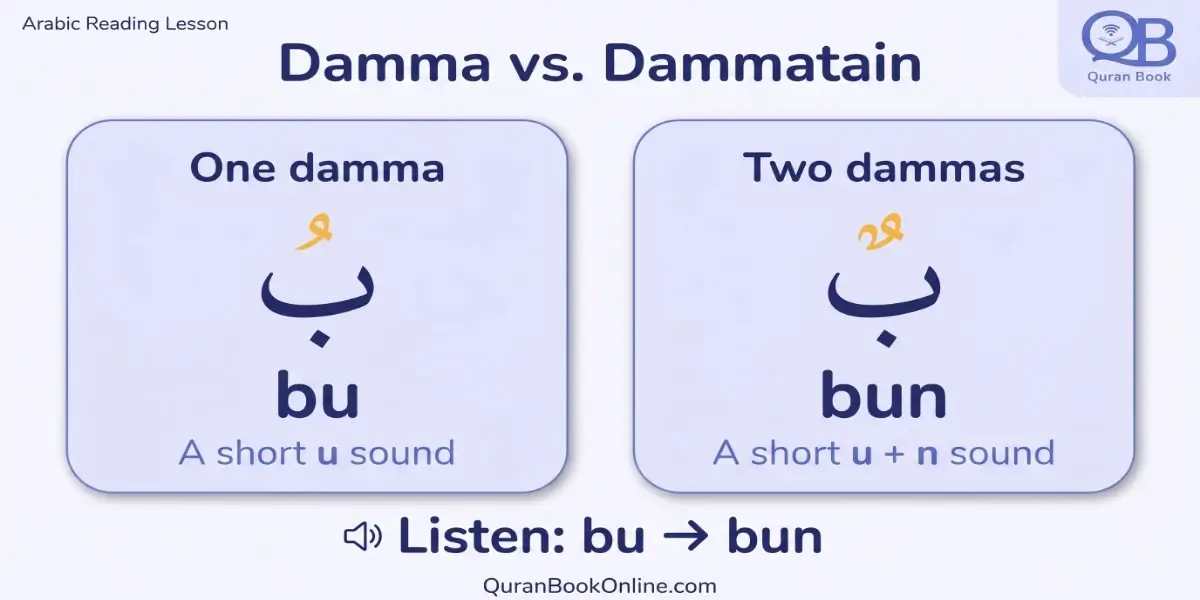
Damma vs Dammatain
Count the dammas — and remember the second one may be joined to the first.
The single damma is one of the Arabic harakat. And ـٌ is not a long “uu”: a long uu is written with a waw after the damma, as you saw with the long vowels.
The Joined Mark: One Damma With a Hook
نَجۡمٌ
Joined: one damma with a hook
نَجۡمٌ
Side by side: two small dammas
Same mark, same sound: -un.
- If a damma has a tail, a hook or a second curl, it’s dammatain.
- ـٌ can sit on ة, which you read “t” while you keep going: وَرۡدَةٌ wardatun, “a rose”. Listen
- Heavy letters stay heavy, and رٌ is heavy: رُطَبٌ ruṭabun, “fresh dates”. Listen

Arabic Letters With Tanween Damma: All 28 Letters
Here is every letter with the mark. Read each one out loud, then tap to check. Heavy letters are in gold — رٌ included. More on them in heavy letters in Arabic.
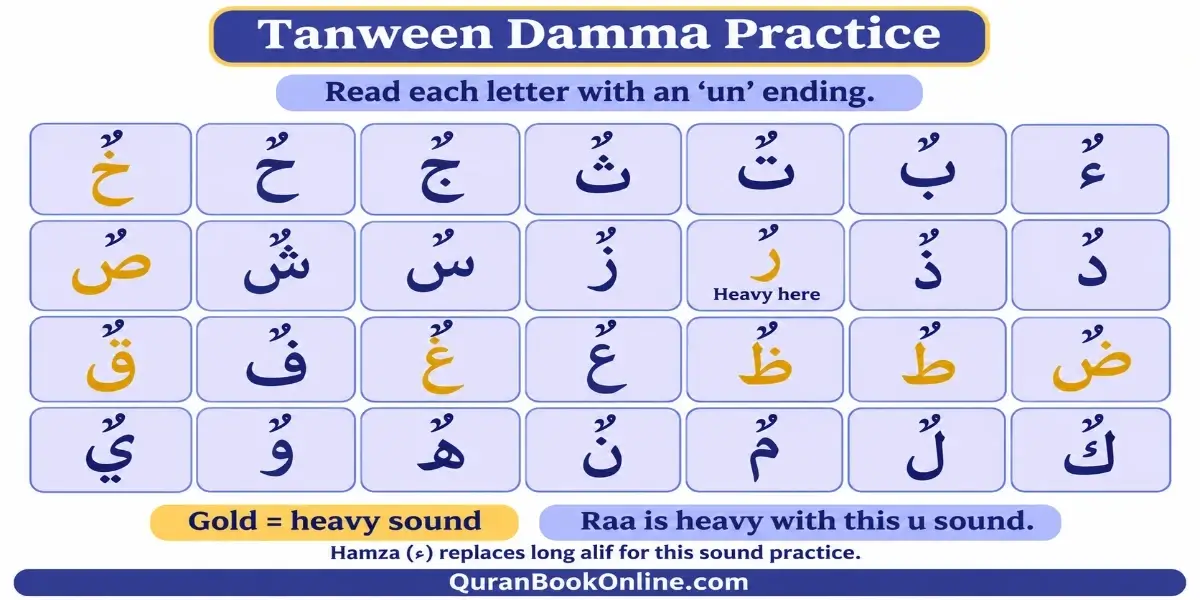
Tanween Damma Examples: Your First Words
Three levels — read first, then tap to check.
- Level 1 — four letters: جٌ jun · رٌ run · ضٌ ḍun · وٌ wun (رٌ and ضٌ are heavy).
- Level 2 — heavy or light? صٌ ṣun / سٌ sun · ظٌ ẓun / ذٌ dhun. Same n; the heavy letter keeps its full sound.
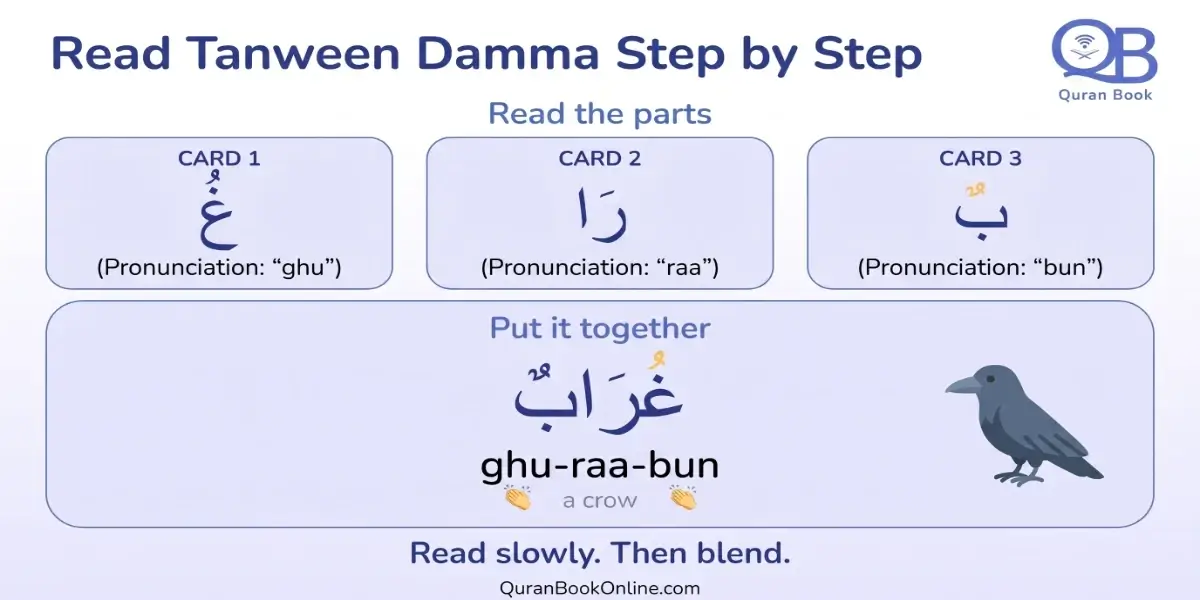
- Level 3 — six words, each shown split, then joined:
- نَجۡمٌnajmuna starListen
- دِيكٌdīkuna roosterListen
- خُبۡزٌkhubzunbreadListen
- غُرَابٌghurābuna crowListen
- وَرۡدَةٌwardatuna roseListen
- رُطَبٌruṭabunfresh datesListen
The n belongs to the last syllable: naj-mun. The sakin جۡ in نَجۡمٌ is the Sukoon in Arabic you already know. If the joined shape of ة looks new, see Arabic letters beginning, middle & end.
When you stop on نَجۡمٌ, the damma and the n drop: najm (ة becomes h). The full stop rule is in Tanween in Arabic.
Tanween Damma in the Quran: Look and Listen
Here it is in two ayat. Find the clear ـٌ and listen for the n.
🔊 Look and listen
سَلَٰمٌ هِيَ حَتَّىٰ مَطۡلَعِ ٱلۡفَجۡرِ
salāmun hiya ḥattā maṭlaʿi l-fajr
“It is all peace until the break of dawn.” — Al-Qadr 97:5
Look for: سَلَٰمٌ (sa-lā-mun) — dammatain, then هِ. The n is clear.
Recited by Mahmoud Khalil Al-Husary (murattal), riwayah Hafs ‘an ‘Asim. Audio: EveryAyah.
خَتَمَ ٱللَّهُ عَلَىٰ قُلُوبِهِمۡ وَعَلَىٰ سَمۡعِهِمۡۖ وَعَلَىٰٓ أَبۡصَٰرِهِمۡ غِشَٰوَةࣱۖ وَلَهُمۡ عَذَابٌ عَظِيمࣱ
khatama llāhu ʿalā qulūbihim wa-ʿalā samʿihim wa-ʿalā abṣārihim ghishāwatun wa-lahum ʿadhābun ʿaẓīm
“Allah has sealed their hearts and their hearing, and their sight is covered. They will suffer a tremendous punishment.” — Al-Baqarah 2:7
Look for: عَذَابٌ (ʿa-dhā-bun) — dammatain, then ع.
If the mark looks different (ـࣱ — the open, offset dammatain) or turns into a small m, the n joins the next word. That’s from the tajweed rules, a later step; these words were picked so you hear the n clearly. Notice غِشَٰوَةࣱ in 2:7: its mark has the other shape.
A damma with a hook is the easiest mark to misread — and its n is the first thing a teacher listens for.
Reading as an adult? See how to learn Quran reading for adults with a teacher.
Tanween Damma for Kids
For parents — keep it short and playful:
- Teach one rule: “two dammas = un.”
- Play “find the hook”: point at the hook on the damma before reading.
- Say najmu, then najmun, and let your child point to the word with the hook.
- Hum the n (nnn) for the first few days, then make it short.
- One row of the chart a day, in big print — and stop while it’s fun.
Play: tap a letter in the chart while your child looks away, then let them find the card they heard.
Want a teacher for your child? See Quran reading for beginners.
Free Dammatain Worksheet (PDF)
📄 Dammatain Worksheet
Spot it, sort it, read it — 4 pages of tanween damma practice:
- Page 1: circle every ـٌ, in both shapes.
- Page 2: one damma or two? Tick “u” or “un”.
- Page 3: read the 6 words split, then joined.
- Page 4: answer key.
Common Tanween Damma Mistakes
- ❌ Reading the joined mark as one damma: نَجۡمٌ → “najmu”. ✅ najmun — the hook is the second damma.
- ❌ Saying the damma twice or long: بٌ → “bu-u” / “buu”. ✅ bun — the second mark is the n.
- ❌ Adding a vowel after the n: “najmunu”. ✅ Close on the n.
- ❌ Mixing ـٌ with ـً or ـٍ. ✅ Dammatain is the curl on top: “un”.
- ❌ Thinning رٌ or the heavy letters. ✅ run, ṣun, ṭun stay heavy.
- ❌ Keeping the n when you stop. ✅ najm (see the stop line above).
What to Learn After This
- Next: shaddah — a doubled letter.
- Review the other two: tanween fatha and tanween kasra.
- See the full path to how to read Arabic.
📚 Learn More
Want a free guided start? learn Arabic reading free
Tanween Damma FAQ
What is tanween damma?
Tanween damma is two dammas (ـٌ) written on the last letter of a word. You read the damma, then a short “n” that is not written as a letter, so بٌ is “bun” and نَجۡمٌ is “najmun”. It is one of the three types of tanween.
Is dammatain the same as damma tanween?
Yes. Dammatain means “two dammas”, and damma tanween and tanween damma are other names for it. You may also see it spelled dammatan. All of these names mean the same mark, ـٌ, read “-un”.
How do you pronounce tanween damma?
Say the damma, then close on a short n, with nothing after it: بُ + نۡ = “bun”. Don’t say the damma twice (“bu-u”), don’t drop the n (“bu”), and don’t add a vowel after it (“bunu”).
What is the difference between damma and dammatain?
A damma is one mark (ـُ) and is read “u”. Dammatain is two dammas (ـٌ) and is read “un”. So بُ is “bu” and بٌ is “bun”. If the damma has a second damma or a small hook attached, it is dammatain.
Why does dammatain look like one damma with a hook?
In many fonts the two dammas are drawn joined: one damma with a small tail or curl attached to it. Other fonts draw two small dammas side by side. Both shapes are dammatain, and both are read “-un”.
Is dammatain a long “uu” sound?
No. Dammatain is not a long vowel: you say a short “u” and close on an “n”. نَجۡمٌ is “najmun”, not “najmuu”. A long “uu” is written with a waw after the damma, which you learned with the long vowels.
Is the letter ra heavy with tanween damma?
Yes. رٌ is read heavy (“run”), just as ر is heavy with a single damma. The other heavy letters, such as خ, ص and ط, also stay heavy with dammatain: صٌ is “ṣun”.
What are some tanween damma examples?
نَجۡمٌ (najmun, a star), دِيكٌ (dīkun, a rooster), خُبۡزٌ (khubzun, bread), غُرَابٌ (ghurābun, a crow), وَرۡدَةٌ (wardatun, a rose) and رُطَبٌ (ruṭabun, fresh dates). In the Quran, look for سَلَٰمٌ in Surah Al-Qadr 97:5.
You can now read all three types of tanween — and you won’t miss a damma’s hook again.
A teacher can make sure every -un is clean from the first lesson.
Arabic Language Graduate · Hafidha of the Quran · Writer on Arabic Reading
Jehad Mahmoud is a graduate of the Arabic Language department and a Hafidha of the Quran who writes the Arabic and Quran-reading guides at Quran Book Academy.
She writes for English-speaking learners and parents starting from zero: the letters by sound, the vowel marks, and the step-by-step order that leads to reading the Quran directly from the Mushaf.
Her Arabic Language studies and her memorisation of the Quran are the foundation of this reading series.
These guides teach the reading system step by step. Pronunciation is a skill of the ear and the mouth, so it is best checked by a qualified teacher who can hear you read.
References
- Quran 97:5 — quran.com/97/5 (Uthmani script)
- Quran 2:7 — quran.com/2/7 (Uthmani script)
- Recitation: Mahmoud Khalil Al-Husary (murattal), via EveryAyah. All letter and word clips are recorded by Quran Book Academy.
- Translations: The Clear Quran, Dr. Mustafa Khattab, via quran.com.
- Britannica — Arabic alphabet