Arabic Long Vowels: Same Letter, Held a Little Longer
Alif, waw and yaa turn a short a, i, u into aa, ee, oo. Hear it, find each vowel’s partner, and read your first long vowels.
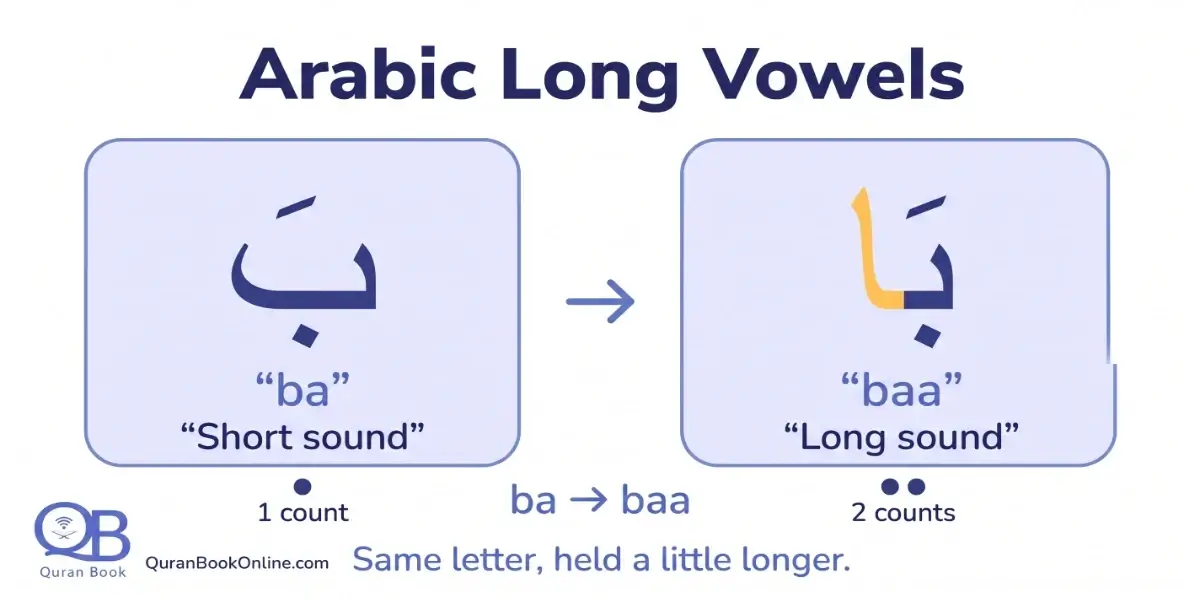
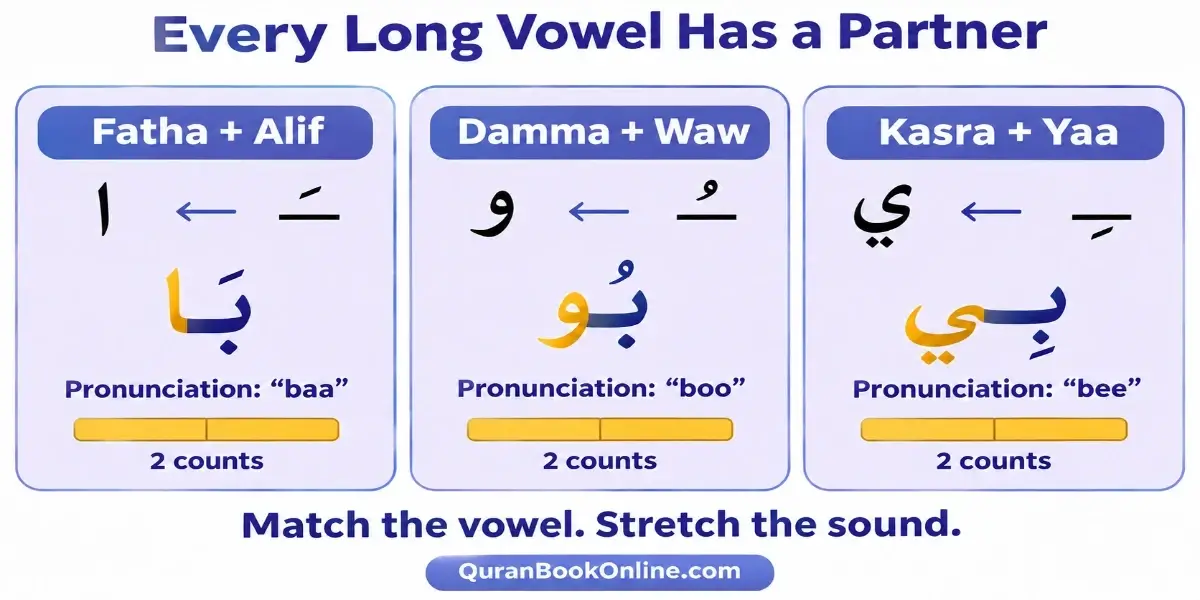
You can read بَ — ba. Now add an alif after it: بَا. Same letter, same fatha — but the alif tells you to hold it: ba becomes bā. Tap both to hear the difference.
That stretch is an Arabic long vowel. If you already know the Arabic harakat, this is the next step in learning how to read Arabic. There are only three long vowels in Arabic, and each one is a short vowel you already know plus a partner letter. You’ll find each partner, hear short against long, and read every letter in the chart, real words and three Quran examples.
Does Arabic Have Vowels? Yes: Three Short and Three Long
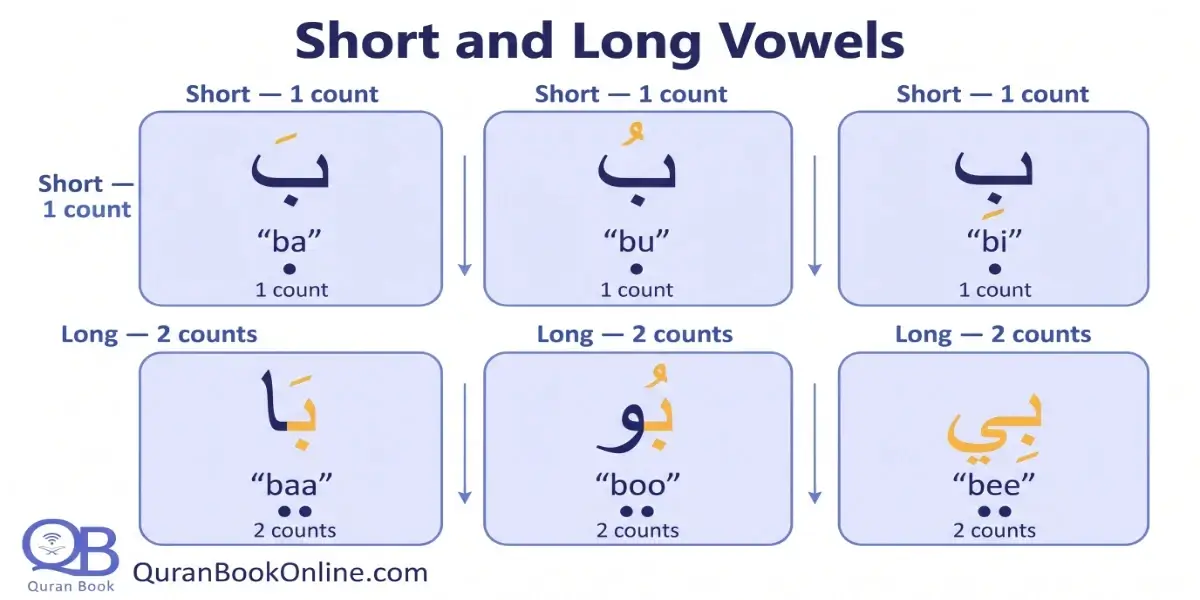
Yes. Arabic has six vowel sounds: the short ones are written as small marks, and the long ones are written as letters. If you’re wondering how many vowels in Arabic there are: six. And how many long vowels in Arabic? Three — one for each short vowel.
| Short (a mark, 1 beat) | Long (mark + partner letter, 2 beats) | Sound |
|---|---|---|
| ـَ | ـَا | a → aa (as in “father”) |
| ـِ | ـِي | i → ee (as in “see”) |
| ـُ | ـُو | u → oo (as in “moon”) |
Everyday Arabic often leaves out the short-vowel marks, but the long vowels stay, because they are letters. That’s why beginners’ books and the Quran show every mark: you never have to guess.
There are also two gliding sounds, aw and ay. They come with the next mark you learn.
What Are Arabic Long Vowels?
Arabic long vowels are the short vowels held for about two beats. You see them as a letter — ا, و or ي — right after a letter with the matching mark.
The long letter has no mark of its own. The mark before it tells you the sound; the letter tells you to hold it.
Same sound, held a little longer — one smooth sound, no break.
So the long vowels in Arabic ask nothing new of your mouth. You already know every sound; now you just hold it.
What Is Madd in Arabic?
Madd (مَدّ) means “stretching” — it is the Arabic name for a long vowel. ا, و and ي are called the letters of madd: ḥurūf al-madd (حُرُوفُ ٱلۡمَدِّ). You may also see it spelled huroof al madd or huruf mad. In beginner reading, a madd lasts about two beats. In Quran recitation some long vowels are held longer — that is part of Madd Rules in Tajweed, a later step.
The 3 Long Vowels in Arabic at a Glance
Each long vowel has one partner mark. Tap any syllable or word to hear it.
| Letter | Partner (the mark before it) | Sound | Syllable | Word |
|---|---|---|---|---|
| ا alif | fatha ـَ | ā — “aa” as in “father” | ||
| و wāw | damma ـُ | ū — “oo” as in “moon” | ||
| ي yāʾ | kasra ـِ | ī — “ee” as in “see” |
Alif Madd: ا after a fatha
Alif never carries a mark; it only lengthens a fatha. Open your mouth for a long “aa” as in “father” — never “ay”, never “e”. After the always-heavy letters the aa sounds deeper; see heavy letters in Arabic. The full lesson: Alif Madd.
Waw Madd: و after a damma
Round your lips for the damma and keep them round: “oo” as in “moon” — never “o” as in “go”, never “ow”. The و adds no “w” sound; it only holds the oo. More practice in Waw Madd.
Yaa Madd: ي after a kasra
A long “ee” as in “see”, never “ay”. The two dots under ي belong to the letter itself — the kasra sits on the letter before it. The ي adds no “y” sound. Go deeper with Yaa Madd.
How to Read an Arabic Long Vowel
- Find the partner. Fatha → ا, damma → و, kasra → ي.
- Hold it for two beats. One smooth sound: no break, no extra consonant.
- A و or ي with its own vowel is a consonant. In حَاوَلَ (ḥā-wa-la, “he tried”) the alif is long, but the وَ is just “wa”.
One more case: و or ي after a fatha is not a long vowel either — it glides (aw, ay). You’ll meet it with Sukoon in Arabic.
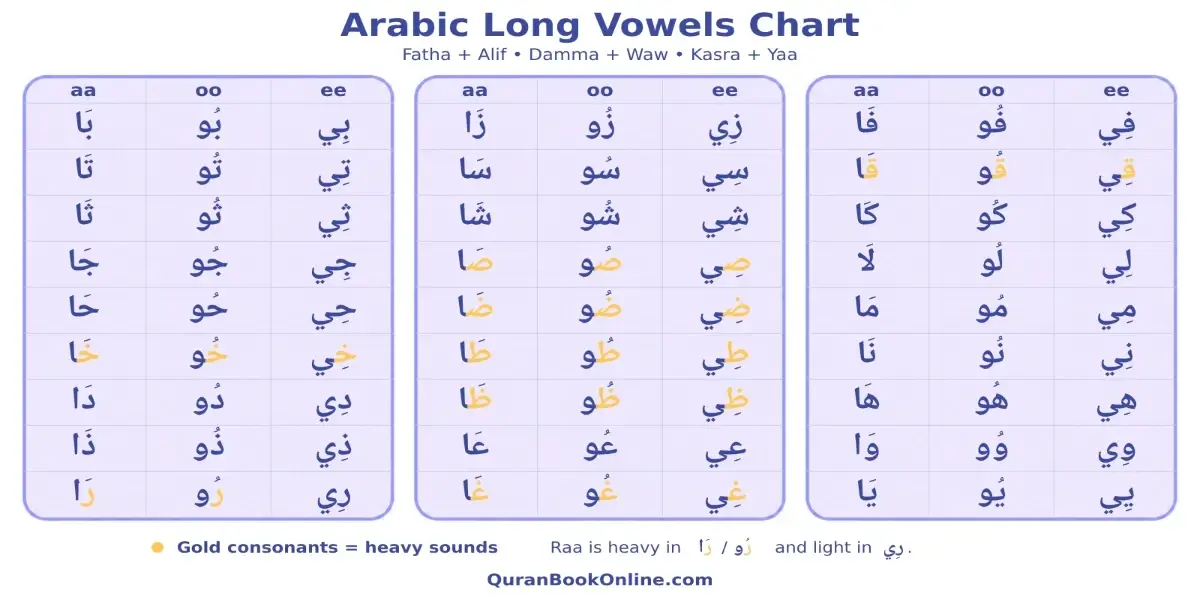
Arabic Long Vowels Chart: Every Letter With ا, و and ي
This is the whole Arabic alphabet long vowels set on one page: read each row across — aa, oo, ee. These are the Arabic letters with long vowels you will meet in every word. Tap any syllable to hear it. Not sure of a letter’s sound? See Arabic alphabet pronunciation.
| # | Letter | with alif (ā) | with waw (ū) | with yaa (ī) |
|---|---|---|---|---|
| 1 | ب bāʾ | |||
| 2 | ت tāʾ | |||
| 3 | ث thāʾ | |||
| 4 | ج jīm | |||
| 5 | ح ḥāʾ | |||
| 6 | خ khāʾ † | |||
| 7 | د dāl § | |||
| 8 | ذ dhāl § | |||
| 9 | ر rāʾ ‡§ | |||
| 10 | ز zāy § | |||
| 11 | س sīn | |||
| 12 | ش shīn | |||
| 13 | ص ṣād † | |||
| 14 | ض ḍād † | |||
| 15 | ط ṭāʾ † | |||
| 16 | ظ ẓāʾ † | |||
| 17 | ع ʿayn | |||
| 18 | غ ghayn † | |||
| 19 | ف fāʾ | |||
| 20 | ق qāf † | |||
| 21 | ك kāf | |||
| 22 | ل lām | |||
| 23 | م mīm | |||
| 24 | ن nūn | |||
| 25 | ه hāʾ | |||
| 26 | و wāw § | |||
| 27 | ي yāʾ |
- † Always-heavy letters (gold rows): the long ā sounds deeper. See heavy letters in Arabic above.
- ‡ ر is heavy in رَا and رُو, light in رِي.
- § د ذ ر ز و never join to the next letter, and neither do ا and و — so the long letter stands apart: دَا, رُو. See Arabic letters beginning, middle & end.
- Alif has no row: it is the long-vowel letter itself and never carries a vowel.
- In the و and ي rows, the first و / ي has its own vowel (a consonant); the second is the long letter.
Download the Arabic long vowels chart (PDF)
Arabic Long Vowels Examples: Read Real Words
Here are real words with long vowels in Arabic, three for each long vowel. Each word is split into syllables first, then shown joined. Tap a word to hear it.
The long letter belongs to the syllable before it: ذَا | قَ, not ذَ | اقَ.
Five of these words start with يَ. It has its own fatha, so it is the consonant “y” — only a mark-free ي after a kasra is long.
With alif · ā
ذَاقَ
he tasted
سَافَرَ
he travelled
حَاوَلَ
he tried
The وَ has its own fatha: “wa”, a consonant.
With waw · ū
يَدُورُ
it turns, goes round
يَذُوقُ
he tastes
Same root as ذَاقَ, now with a long ū.
يَطُوفُ
he walks around (as in ṭawāf)
After heavy ط the ū sounds deep.
With yaa · ī
يَزِيدُ
it increases
First ي has a fatha (y); the second follows a kasra (ī).
يَمِيلُ
it leans
تَلِينُ
it becomes soft
Short and Long Vowels in Arabic: One Beat or Two
Listen to each pair: short first, then long.
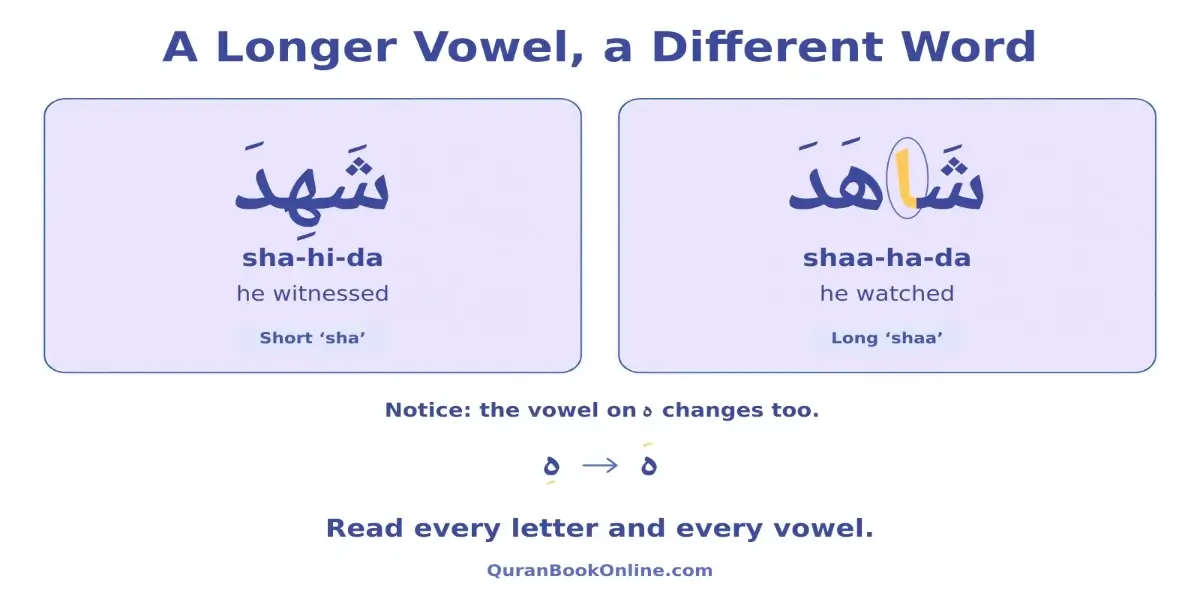
Now the important part: the length can change the word.
Same letters — one alif more, and it’s a different word.
So long and short vowels in Arabic are not decoration. Skip the stretch, and you say another word.
Long Vowels in the Quran
Now hear the same stretch from a reciter. Each ayah has one long vowel to look for — listen for the two-beat hold.
🔊 Look and listen
أَرَءَيۡتَ إِن كَانَ عَلَى ٱلۡهُدَىٰٓ
a-raʾayta in kāna ʿala l-hudā
“What if this ˹servant˺ is ˹rightly˺ guided,” — Al-ʿAlaq 96:11
Look for: كَانَ (kā-na) — alif after the fatha on ك, two beats.
Recited by Mahmoud Khalil Al-Husary (murattal), riwayah Hafs ʿan ʿĀsim. Audio: EveryAyah.
أَرَءَيۡتَ مَنِ ٱتَّخَذَ إِلَٰهَهُۥ هَوَىٰهُ أَفَأَنتَ تَكُونُ عَلَيۡهِ وَكِيلًا
a-raʾayta mani ttakhadha ilāhahū hawāhu, a-fa-anta takūnu ʿalayhi wakīlā
“Have you seen ˹O Prophet˺ the one who has taken their own desires as their god? Will you then be a keeper over them?” — Al-Furqān 25:43
Look for: تَكُونُ (ta-kū-nu) — waw after the damma on ك, two beats.
إِنَّ ٱلۡإِنسَٰنَ لَفِي خُسۡرٍ
inna l-insāna la-fī khusr
“Surely humanity is in ˹grave˺ loss,” — Al-ʿAṣr 103:2
Look for: لَفِي (la-fī) — yaa after the kasra on ف, two beats, then خ starts the next word.
Translations: The Clear Quran, Dr. Mustafa Khattab, via quran.com.
The small upright alif in ٱلۡإِنسَٰنَ (103:2) is read as a long ā too — the Mushaf writes some long alifs this way.
The small wavy sign (ـٓ) over ٱلۡهُدَىٰٓ (96:11) means the reciter holds it longer — that’s Tajweed, for later.
Holding a long vowel for two clean beats — not cutting it, not adding a “w” or “y” — is exactly what a teacher listens for. If you’re an adult starting out, see how we learn Quran reading for adults, one to one.
More Long Vowel Practice
Play the five games on this page again, then try the alif game: tap each letter and watch it stretch into a long ā.
Balloon Stretch: the alif gameStretch every letter into a long ā — 28 balloons.Common Mistakes With Arabic Long Vowels
Most mistakes with Arabic long vowels are about length or an extra sound.
- ❌ Mistake: Not holding it: بَا read as “ba”. ✅ Fix: bā, two beats. Read short, شَاهَدَ becomes شَهِدَ — a different word.
- ❌ Mistake: Adding a consonant: بُو as “buw”, بِي as “biy-a”. ✅ Fix: the long letter only stretches the vowel.
- ❌ Mistake: The wrong sound: بِي as “bay”, بُو as “bow” or “bo”. ✅ Fix: ee as in “see”, oo as in “moon”.
- ❌ Mistake: Stretching a short vowel: بَ as “baa”. ✅ Fix: no partner letter means one beat.
- ❌ Mistake: Reading every و or ي as long. ✅ Fix: with its own vowel it’s a consonant: the يَ in يَزِيدُ is “ya”.
- ❌ Mistake: Looking for a mark on the long letter. ✅ Fix: the mark is on the letter before; ا و ي have none.
Arabic Long Vowels for Kids: Tips for Parents
- Partners hold hands: fatha with alif, damma with waw, kasra with yaa.
- Stretch your arms apart while you both say the long sound.
- One chart row a day, in big print, is plenty.
- Play “Stretch the sound” together and take turns choosing short or long.
- Praise a clean two-beat hold, and stop while it’s still fun.
Try it with your child
Read these aloud together, then tap to check:
Want a teacher to guide your child? See our Quran reading for beginners classes for kids.
What to Learn After the Long Vowels
Next lesson: each long vowel in depth, starting with Alif Madd, then Waw Madd and Yaa Madd.
Missed the short vowels? Go back to Arabic harakat.
The big picture: see the full path to how to read Arabic.
📚 Learn more
- Why some long vowels sound fuller: heavy letters in Arabic
- Want a free guided start? Learn Arabic reading free
Arabic Long Vowels FAQ
Does Arabic have vowels?
Yes. Arabic has six vowel sounds. The three short vowels (a, i, u) are written as small marks above or below a letter: fatha, kasra and damma. The three long vowels (aa, ee, oo) are written as letters: ا, و and ي. Many everyday texts leave out the short-vowel marks, but the long vowels are usually written in full.
How many vowels are in Arabic?
Six: three short (a, i, u) and three long (aa, ee, oo). Each long vowel is the same sound as a short one, held for about two beats. Arabic also has two gliding sounds, aw and ay, which you meet in the sukoon lesson.
What are the long vowels in Arabic?
Alif (ا) after a fatha sounds “aa” (بَا), waw (و) after a damma sounds “oo” (بُو), and yaa (ي) after a kasra sounds “ee” (بِي). The long letter has no vowel mark of its own: the mark before it gives the sound, and the letter tells you to hold it.
What is madd in Arabic?
Madd (مَدّ) means “stretching”. In reading, it is the name for a long vowel: a short vowel stretched by alif, waw or yaa, which are called the letters of madd. As a beginner you hold it for about two beats. In Quran recitation some long vowels are held longer; that is part of Tajweed.
What is the difference between short and long vowels in Arabic?
A short vowel is a mark and lasts one quick beat: بَ (ba). A long vowel is the same mark followed by its partner letter and lasts about two beats: بَا (bā). The length can change the word: شَهِدَ (shahida) means “he witnessed”, but شَاهَدَ (shāhada) means “he watched”.
How long do you hold an Arabic long vowel?
About two beats, roughly twice as long as a short vowel, in one smooth sound with no break. In Quran recitation some long vowels, often marked with a small wavy sign (ـٓ), are held longer; you learn those with the Tajweed rules.
Is every و and ي a long vowel?
No. They are long vowels only when they follow their partner vowel and have no vowel of their own, as in بُو and بِي. With its own vowel, و is the consonant “w” and ي is the consonant “y”, as at the start of يَزِيدُ (yazīdu).
How long does it take to learn the Arabic long vowels?
If you can already read fatha, kasra and damma, many beginners can read the three long vowels on any letter within a few days to a week of 15–20 minutes of daily practice. Reading them smoothly inside words takes longer. These are typical estimates — everyone’s pace is different.
You now know all six Arabic vowel sounds
Three short, three long — and the Arabic long vowels are simply the short ones, held. A teacher can make sure every long vowel gets its two clean beats from the very first lesson — before habits set in.
Or follow the Quran Book Online channel on WhatsApp for new lessons.
Arabic Language Graduate · Hafidha of the Quran · Writer on Arabic Reading
Jehad Mahmoud is a graduate of the Arabic Language department and a Hafidha of the Quran who writes the Arabic and Quran-reading guides at Quran Book Academy.
She writes for English-speaking learners and parents starting from zero: the letters by sound, the vowel marks, and the step-by-step order that leads to reading the Quran directly from the Mushaf.
Her Arabic Language studies and her memorisation of the Quran are the foundation of this reading series.
These guides teach the reading system step by step. Pronunciation is a skill of the ear and the mouth, so it is best checked by a qualified teacher who can hear you read.
References
- Quran.com — Al-ʿAlaq 96:11 · Al-Furqān 25:43 · Al-ʿAṣr 103:2 (Uthmani text; translation: The Clear Quran, Dr. Mustafa Khattab)
- Recitation: Mahmoud Khalil Al-Husary, murattal, Hafs ʿan ʿĀsim — audio from EveryAyah
- Encyclopaedia Britannica — Arabic alphabet
- Syllable and word audio on this page: recorded in-house by Quran Book Academy.