Shaddah in Arabic: Close the Letter, Then Open It Again
One small mark doubles a letter, and it can change the word. Hear it, look inside it, and read real words and Quran examples with it.
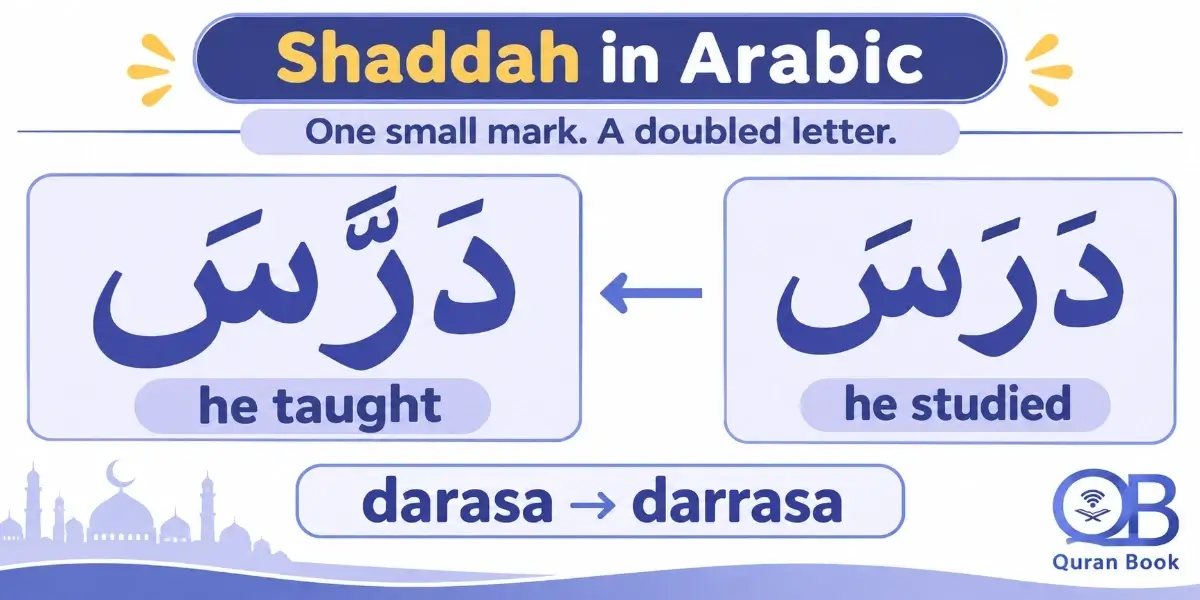
darasa · “he studied”
darrasa · “he taught”
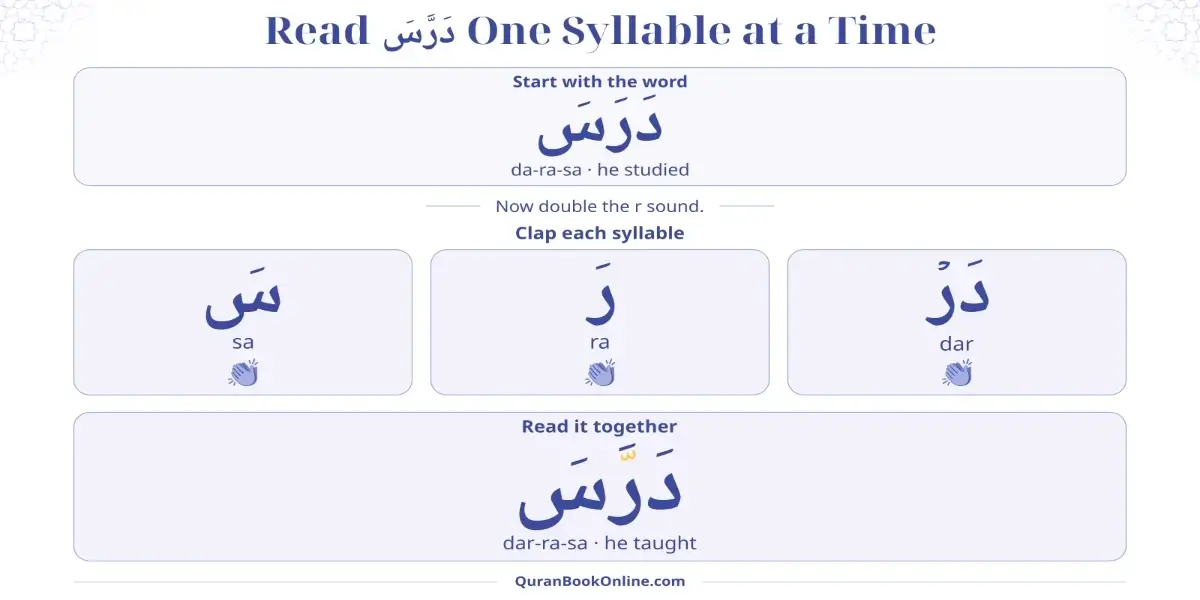
You can read دَرَسَ: da-ra-sa, “he studied”. Now add one small mark on the r: دَرَّسَ. It says dar-ra-sa, “he taught”.
Same three letters, but now the r carries a small “w”. That’s the shaddah: the r closes one syllable and opens the next, and “he studied” becomes “he taught”.
You already know the Sukoon in Arabic and tanween, so this is the next step in learning how to read Arabic. In this lesson on shaddah in Arabic, you’ll see what is hidden inside the mark, hear all 28 letters doubled, learn where its vowel sits, and read real words and two Quran examples.
What Is Shaddah in Arabic?
Shaddah is a small mark written above a letter: ـّ. It looks like a little “w”. It tells you the letter is doubled: you say it once closed, then once more with the vowel written on the mark, with no vowel between the two parts.
So a doubled letter is one letter on the page and two sounds in your mouth. That’s why a doubled letter always has a vowel before it: دَ + رَّ + سَ = dar-ra-sa.
This mark and tanween can even sit on the same letter. You’ll see how below.
What Does Shaddah Mean? (Also Spelled Shadda)
Here is the shaddah meaning in one line: شَدَّة (shadda) means “strength” or “intensity”. Doubling a letter with it is called tashdīd, “strengthening”; linguists call it gemination.
Notice that the word shadda in Arabic carries its own mark: shad-da.
What’s Inside a Shaddah: Shaddah and Sukoon
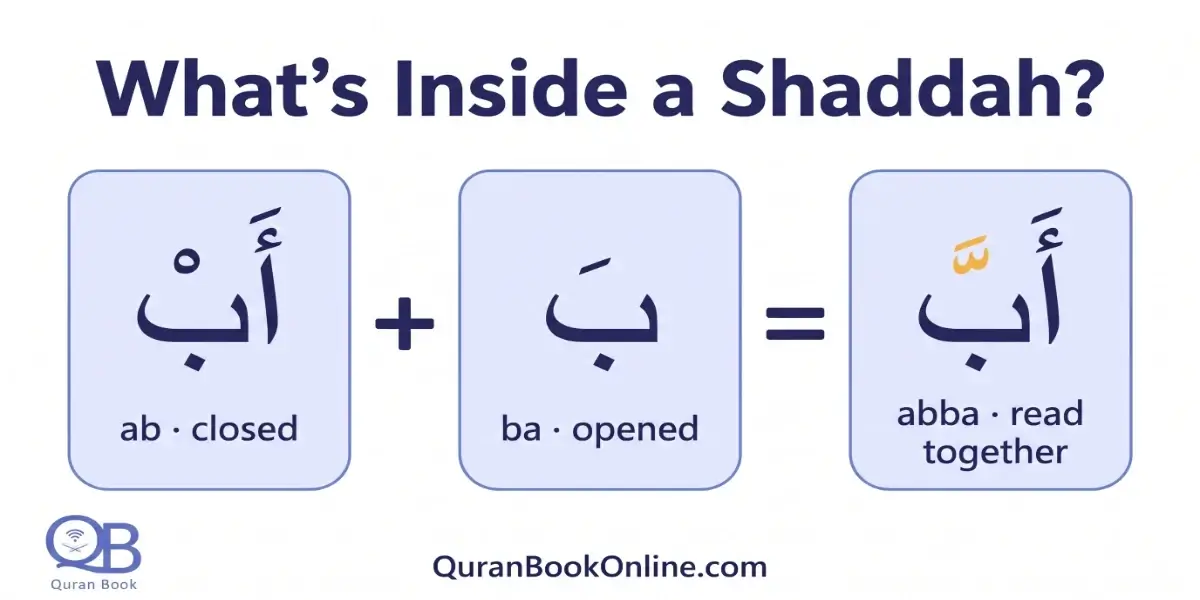
أَبۡ + بَ = أَبَّ
ab + ba = abba
Every shaddah hides a sukoon. The first b closes the syllable (ab); the second b opens the next one with the vowel (ba). Join them and you get abba: one written letter, two b sounds.
They are still two different marks. Sukoon means “no vowel”. The doubled letter contains a sakin letter, but the mark is not a sukoon. That closing sound is the one you practised in Sukoon in Arabic.
How to Pronounce Shaddah: Close, Then Open
Here’s how to read shaddah: say the vowel before it, close on the letter, then open the same letter with its vowel.
Close, then open
- Don’t skip it. دَرَّسَ is dar-ra-sa, not da-ra-sa (that’s a different word).
- Don’t add a vowel inside it. أَبَّ is abba, not a-ba-ba.
- Don’t stretch the vowel. The mark doubles the letter, never the vowel.
Close the letter, then open it: one smooth sound, no vowel in between.
Shaddah With Fatha, Kasra, Dammah and Tanween
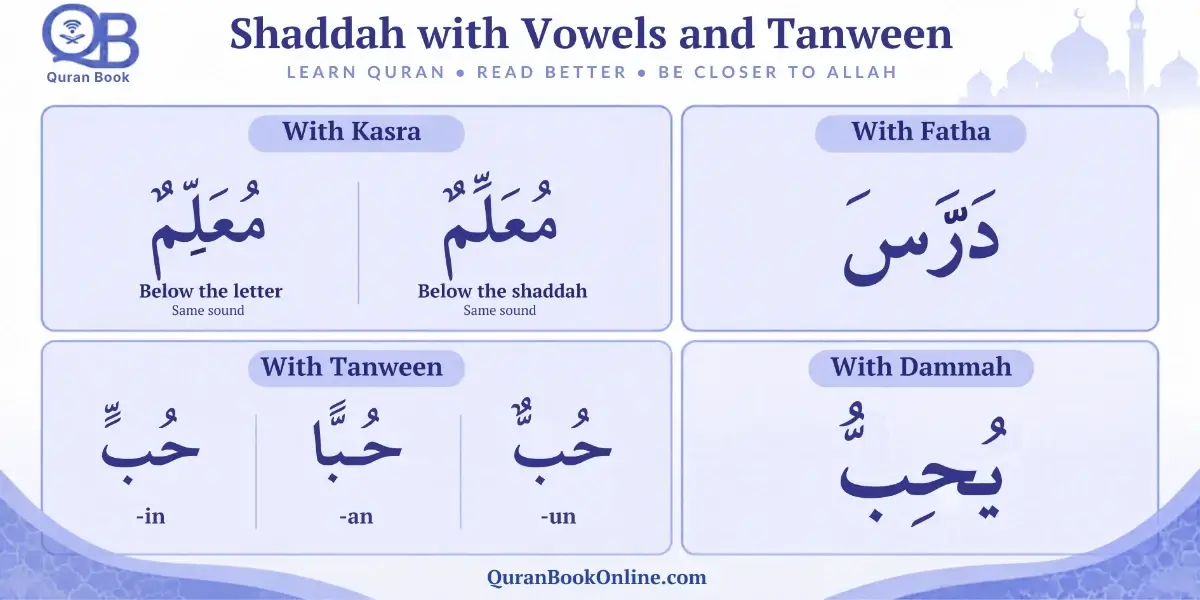
The shaddah tells you to double the letter; the vowel on it tells you which sound opens it. These are the Arabic harakat you already read.
Fatha: on top
دَرَّسَ
dar-ra-sa, “he taught”
Kasra: below
مُعَلِّمٌ
mu-ʿal-li-mun, “a teacher”
Dammah: on top
يُحِبُّ
yu-ḥib-bu, “he loves”
With tanween: one word, three endings
“Love”. Hold the b, then open it with the tanween, never “ḥu-bun”. Same rule: ـًّ and ـٌّ sit on top, ـٍّ under the letter or under the shaddah. More in Tanween in Arabic.
On a doubled letter, kasra sits under the letter (as on this page) or as a small dash just under the mark, depending on the font or print. It is the same kasra.
Shaddah on Heavy, Bouncing and Nasal Letters
- Heavy letters stay heavy when doubled: أَصَّ (aṣṣa) is fuller than أَسَّ (assa).
- رّ follows its own vowel: heavy with fatha, أَرَّ arra ; light with kasra, يُدَرِّسُ yu-dar-ri-su . More on heavy letters in Arabic.
- ق ط ب ج د don’t bounce inside a shaddah: the closed half goes straight into its twin, so أَبَّ is abba . See sifaat al huroof.
- نّ and مّ hum: they are held longer with a nasal hum (ghunnah), about two counts in recitation, a point from the tajweed rules. Every other doubled letter is a short hold.
Arabic Letters With Shaddah: All 28 Letters
Every row is أَ + the doubled letter with fatha, because it needs a vowel before it. Heavy letters are tinted gold, and the tags show which letters don’t bounce and which two hum.
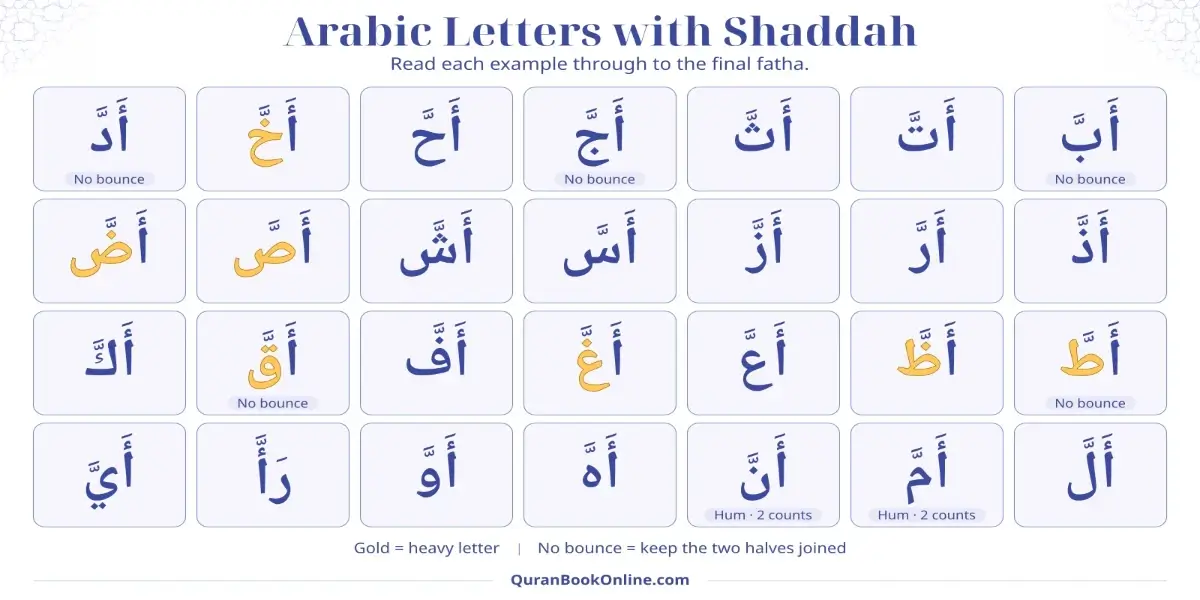
وّ and يّ here are not long vowels: أَوَّ is a soft “aw”, then wa, and أَيَّ a soft “ay”, then ya. They are doubled consonants, not the Arabic long vowels.
Arabic Words With Shaddah: Read Them Step by Step
Here is shaddah for beginners in three levels. These shaddah exercises work best out loud: read each one first, then tap to check.
- Level 1: four doubled syllables: أَبَّ · أَسَّ · أَلَّ · أَكَّ.
- Level 2: four short words, one doubled letter each, with a fatha on it: دَرَّسَ · فَكَّرَ · سَبَّحَ · كَبَّرَ.
- Level 3: six longer words with kasra, dammah, a long vowel or tanween, shown split first: مُ | عَلۡ | لِ | مٌ = mu-ʿal-li-mun.
The closed half belongs to the syllable before; the vowelled half starts the next. If a joined shape looks new, see Arabic letters beginning, middle & end.
Shaddah Examples in Quran Recitation
Here is how to read shaddah in Quran recitation. Find the highlighted words, then listen: the reciter holds each doubled letter and opens it with its vowel.
Look and listen
Fatha and dammah · Ad-Duha 93:3
مَا وَدَّعَكَ رَبُّكَ وَمَا قَلَىٰ
mā waddaʿaka rabbuka wa-mā qalā
“Your Lord ˹O Prophet˺ has not abandoned you, nor has He become hateful ˹of you˺.”
Look for: وَدَّعَكَ (wad-da-ʿa-ka): doubled د with fatha, no bounce · رَبُّكَ (rab-bu-ka): doubled ب with dammah.
Recitation: Mahmoud Khalil Al-Husary (murattal), riwayah of Hafs ʿan ʿAsim. Audio: EveryAyah.com.
Kasra · Al-A‘la 87:1
سَبِّحِ ٱسۡمَ رَبِّكَ ٱلۡأَعۡلَى
sabbiḥi sma rabbika l-aʿlā
“Glorify the Name of your Lord, the Most High,”
Look for: رَبِّكَ (rab-bi-ka): doubled ب with kasra. Here the kasra sits under the ب; in the Mushaf font on quran.com it appears as a small dash just under the mark. Same kasra.
All three words sit in the middle of their ayah, so you hear the vowel that opens the letter. In recitation, نّ and مّ get a longer nasal hum, a tajweed rule; these words were picked so you hear a plain doubled letter.
Holding a doubled letter for just the right moment, not skipping it and not adding a vowel inside it, is exactly what a teacher listens for.
Book Your Free Trial LessonReading on your own as a grown-up? See how we help you learn Quran reading for adults.
Shaddah Games: Which Word Did You Hear?
Shaddah games train your ear as well as your eye. Every clip below is a real word, read correctly; your job is to hear whether the letter was held. It’s a quick way to practice shaddah online, a few rounds a day.
Shaddah for Kids: Activities for Parents
For parents: keep it short, playful and out loud.
- “Little w on top: close it, then open it.” Make it your family’s rule.
- Clap the parts: dar | ra | sa. The doubled letter closes one clap and opens the next.
- Play the meaning-pair game: say darasa or darrasa, and let your child point at the right word.
- One row of the chart a day, in big print, and play the find-it game above together to hunt for the little “w”.
- Praise a clean hold, and stop while it’s fun.
Try it with your child
Read them aloud, then tap to check.
Want a teacher for your child? See our Quran reading for beginners classes for kids.
Free Shaddah Worksheets (PDF)
Print them and practise a little every day. No sign-up needed.
Arabic Letters With Shaddah Chart
All 28 doubled letters on one page.
- Heavy letters in gold, with no-bounce and hum tags
- The split أَبۡ + بَ = أَبَّ at the top
- The three vowel positions
Shaddah Worksheet for Kids
Find, split and read: 4 pages of shaddah practice.
- Circle every little “w”
- Split the word
- Match the meaning pairs
- Read the 10 words, plus an answer key
Common Shaddah Mistakes Beginners Make
- ✗ Skipping it: دَرَّسَ read as “da-ra-sa”. ✓ dar-ra-sa. Without the mark it’s a different word, “he studied”.
- ✗ Adding a vowel inside it: أَبَّ read as “a-ba-ba”. ✓ abba: the first half has no vowel.
- ✗ Stretching the vowel instead: “daa-ra-sa”. ✓ A shaddah doubles the letter, not the vowel.
- ✗ Mixing it up with sukoon or tanween, which also sit on top. ✓ Little “w” = doubled; small crescent = no vowel; two marks = tanween.
- ✗ Reading a kasra under the shaddah as a fatha because it sits high. ✓ A small dash under the mark is still a kasra: mu-ʿal-li-mun.
- ✗ Holding every doubled letter for two counts. ✓ Only نّ and مّ get the long nasal hum in recitation.
- ✗ Dropping the shaddah when tanween follows: حُبٌّ read as “ḥu-bun”. ✓ ḥub-bun: hold the letter, then the tanween.
What to Learn After Shaddah
- Next lesson: putting it all together in real words, how to read Arabic words.
- Missed the lesson before? Go back to Tanween in Arabic.
- The big picture: see the full path to how to read Arabic.
Learn more
Why some doubled letters sound fuller: heavy letters in Arabic.
Want a free guided start? Try our learn Arabic reading free lessons.
Shaddah FAQ
What is shaddah in Arabic?
Shaddah (شَدَّة) is a small mark written above an Arabic letter (ـّ). It means the letter is doubled: the first part closes with no vowel, like a sukoon, and the second part carries the vowel written with the shaddah. So دَرَّسَ is read “dar-ra-sa”, not “da-ra-sa”.
What does shaddah mean?
Shaddah means “strength” or “intensity”. Doubling a letter with it is called tashdīd (“strengthening”). In reading, it tells you to hold the letter for a moment before its vowel, and that often changes the word: دَرَسَ (darasa) means “he studied”, but دَرَّسَ (darrasa) means “he taught”.
What does the shaddah symbol look like?
It looks like a small “w” written above the letter (ـّ). The vowel goes with it: a fatha or a dammah sits on top of the shaddah, and a kasra sits either under the letter or as a small dash just under the shaddah, depending on the print. Tanween follows the same rule, as in حُبٌّ (ḥubbun).
How do you pronounce a letter with shaddah?
Say the vowel before it, close on the letter, then open the same letter with its vowel, all in one smooth sound: أَ + بۡ + بَ = abba. Don’t add a vowel between the two parts (“a-ba-ba”), and don’t skip the hold (“aba”).
Is shadda the same as shaddah or tashdeed?
Yes. Shaddah and shadda are two English spellings of the same Arabic word, شَدَّة. Tashdeed (tashdīd) is the name for doubling a letter with this mark, and a letter that carries it is called mushaddad, “doubled”.
What is the difference between shaddah and sukoon?
Sukoon (ـۡ) means a letter has no vowel. Shaddah (ـّ) means the letter is doubled: a part with no vowel, then the same letter with a vowel. So every shaddah has a sukoon hidden inside it: أَبۡ (ab) + بَ (ba) = أَبَّ (abba). They are two different marks with two different jobs.
Is every shaddah held for two counts?
No. Most letters with shaddah are simply doubled and held briefly. In Quran recitation, نّ and مّ with shaddah are held longer with a nasal hum called ghunnah, about two counts. You will learn that later with the tajweed rules.
How can kids practise shaddah?
Clap the word in parts, like dar | ra | sa, and show that the doubled letter closes one clap and opens the next. Hunt for the little “w” in a game, read one row of the chart a day in big print, and stop while it is still fun.
Hold every doubled letter cleanly
You now know the main reading marks: vowels, long vowels, sukoon, tanween and shaddah. The next step is reading them together. A teacher can make sure every doubled letter is held cleanly from your first lesson.
Book Your Free Trial LessonArabic Language Graduate · Hafidha of the Quran · Writer on Arabic Reading
Jehad Mahmoud is a graduate of the Arabic Language department and a Hafidha of the Quran who writes the Arabic and Quran-reading guides at Quran Book Academy.
She writes for English-speaking learners and parents starting from zero: the letters by sound, the vowel marks, and the step-by-step order that leads to reading the Quran directly from the Mushaf.
Her Arabic Language studies and her memorisation of the Quran are the foundation of this reading series.
These guides teach the reading system step by step. Pronunciation is a skill of the ear and the mouth, so it is best checked by a qualified teacher who can hear you read.
References
- Quran 93:3 and 87:1, Uthmani text: quran.com/93/3 · quran.com/87/1
- Recitation: Mahmoud Khalil Al-Husary (murattal, Hafs ʿan ʿAsim), audio from EveryAyah.com. All syllable and word clips on this page are recorded by Quran Book Academy.
- Translations: The Clear Quran, Dr. Mustafa Khattab, via quran.com.
- Britannica, “Arabic alphabet”.