Tanween Fatha: Two Fathas, One -an Sound
Hear the n you can’t see, learn the alif you don’t say, and read your first words with fathatain.
Read this word:
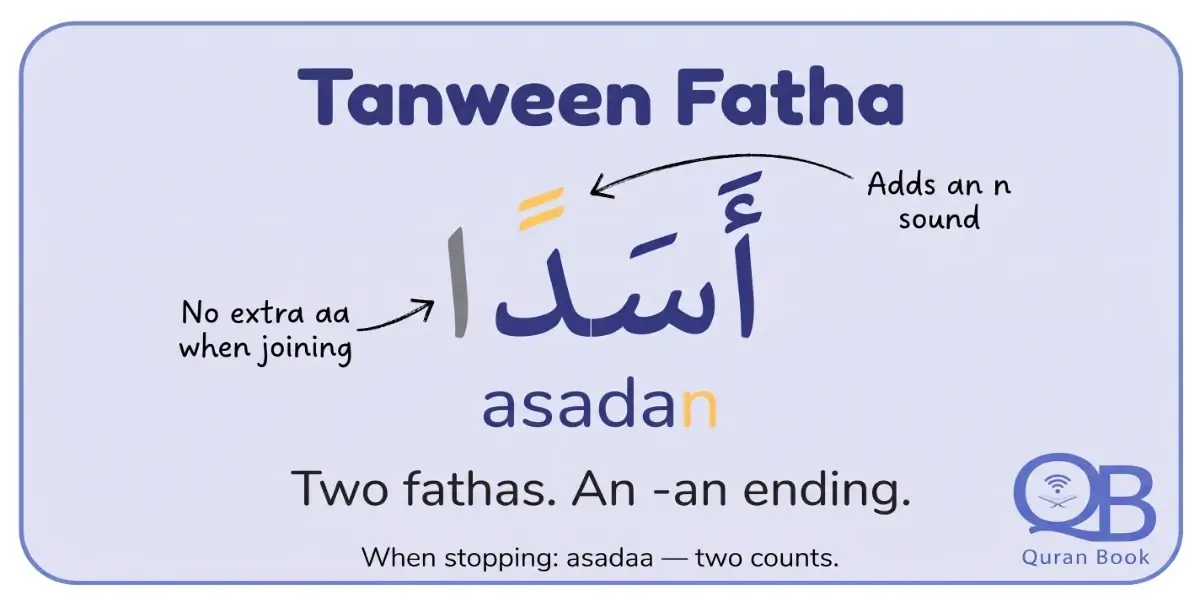
أَسَدًا
asadan — “a lion”
If you read asadā, you said a letter that isn’t read. If you read asada, you dropped a sound that isn’t written. The right reading is asadan.
You met all three types in Tanween in Arabic. In this tanween fatha lesson you’ll hear fatha + n and see why most words add an alif you don’t read (and which words don’t). Then you’ll hear all 28 letters with ـً, read 6 words and find it in 3 ayat.
Tanween Fatha (ـً): Two Fathas and a Hidden N
Tanween fatha is two fathas (ـً) on the last letter of a word: you read the fatha, then a short n.
ـً
It sits on top of the letter, just like a single fatha. It’s also called fathatain (“two fathas”); you may see fathatan, tanween al-fath or double fatha.
The n is heard, but it is never written as the letter ن.
How to Pronounce Tanween Fatha: Fatha, Then N
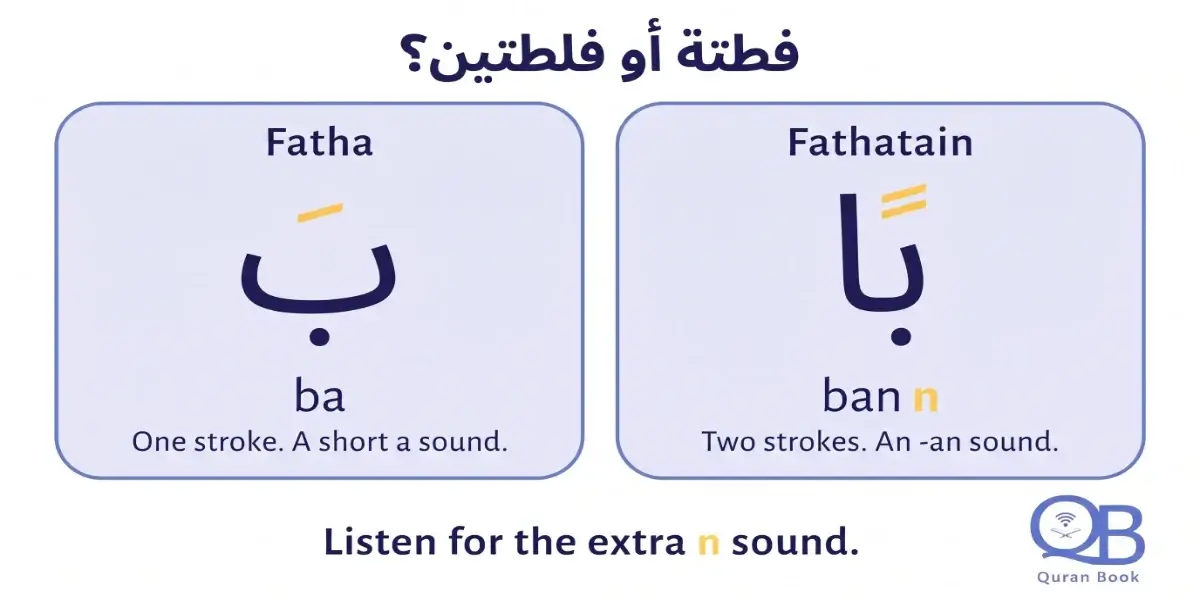
بَ + نۡ = بً
ba + n = ban
The n is the sakin n you know from sukoon. Here it simply isn’t written. That’s the whole of tanween fatha pronunciation. Now hear it on three letters:
قً stays heavy: the two fathas don’t make a heavy letter light.
Fatha, then n
- Don’t say the fatha twice. بً is “ban”, not “ba-a”.
- Don’t drop the n. “Ba” is a single fatha.
- Don’t add a vowel after it. “Bana” ✗
Say a, then close on a short n. Nothing comes after it.
Fatha vs Tanween Fatha
Count the marks: one fatha = a, two fathas = an.
The single fatha is one of the Arabic harakat; doubling it adds the n.
Watch out for عَنۡ (ʿan, “about”). It sounds the same at the end, but its n is a real ن with sukoon. Tanween’s n is never written.
Why Is There an Alif After Tanween Fatha?
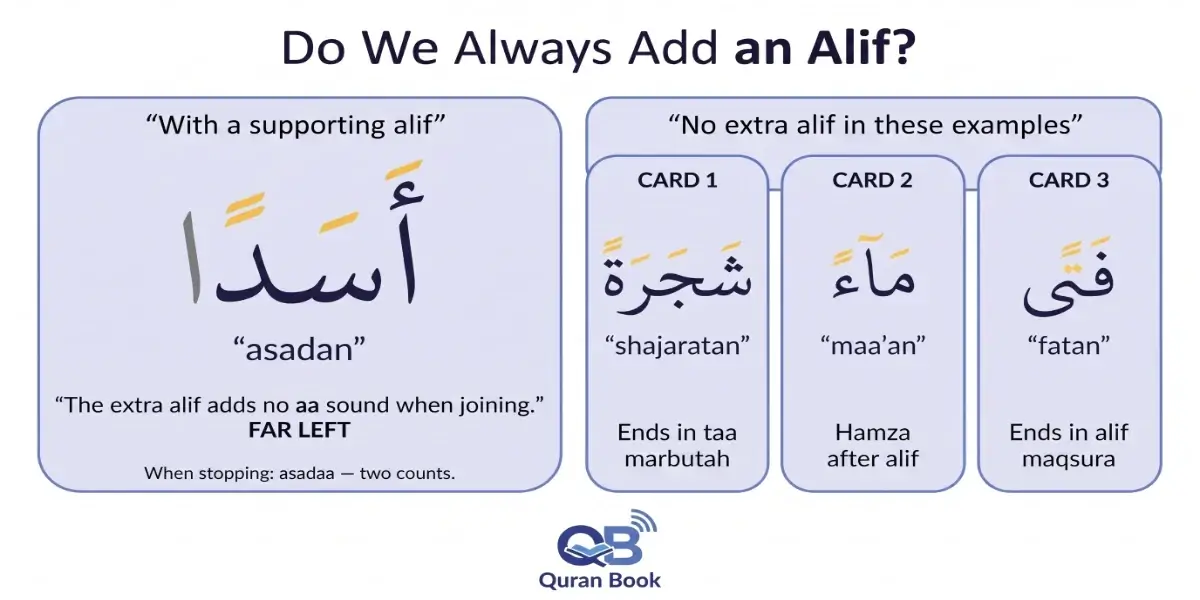
أَسَدًا asadan
Most words with tanween fatha are written with an alif after it. While you keep reading, you don’t read it: asadan, not asadā. This alif is not alif madd, so there’s no long “aa”.
So why is it written? When you stop on the word, -an becomes a long aa (asadā), and the alif shows that. The full stop rule for all three types is in Tanween in Arabic.
Where do the marks sit? In tanween fatha with alif, they usually sit on the letter before the alif (ـًا). On signs and in some books you’ll see them on the alif (ـاً), with the same reading.
When Tanween Fatha Has No Alif
Three endings take no extra alif, but the two fathas are still there, so the sound is still -an.
| Ending | Word · listen | Read it | Why no alif |
|---|---|---|---|
| ـةً | شَجَرَةً shajaratan, “a tree” | sha-ja-ra-tan: ة is read “t” while you keep going | ة never takes the extra alif |
| ـَاءً | مَاءً māʾan, “water” | mā-ʾan: the marks sit on the hamza | The word already has an alif before the hamza |
| ـىً | فَتًى fatan, “a young man” | fa-tan: the marks sit on the letter before ى | ى does the alif’s job: written, not read while you keep going |
Look for the two fathas, not for the alif.
Arabic Letters With Tanween Fatha: All 28 Letters
Here is every letter with fathatain, read the way you’d say it mid-sentence. Heavy letters are tinted gold, because they stay heavy with ـً. See heavy letters in Arabic for why.
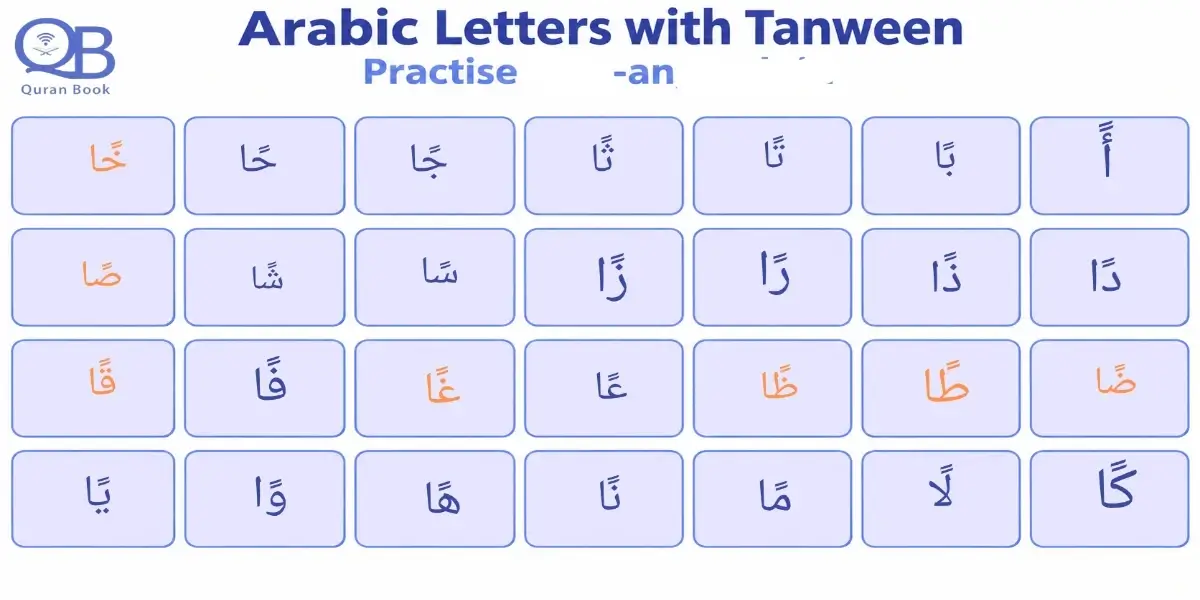
The chart shows ـً without the alif, as in a Qaida chart. In real words most of these add an alif you don’t read: بًا.
Tanween Fatha Examples: Your First Words
These fathatain examples come in three levels. Read each one out loud first, then tap to check.
- Level 1: four letters: جً · رً · طً · هً.
- Level 2: the same sound with the alif: بًا · سًا · قًا · نًا. It’s the same clip as the chart, because the alif adds nothing while you keep reading.
- Level 3: six words, split first, then joined. Three have the alif and three are the no-alif endings.
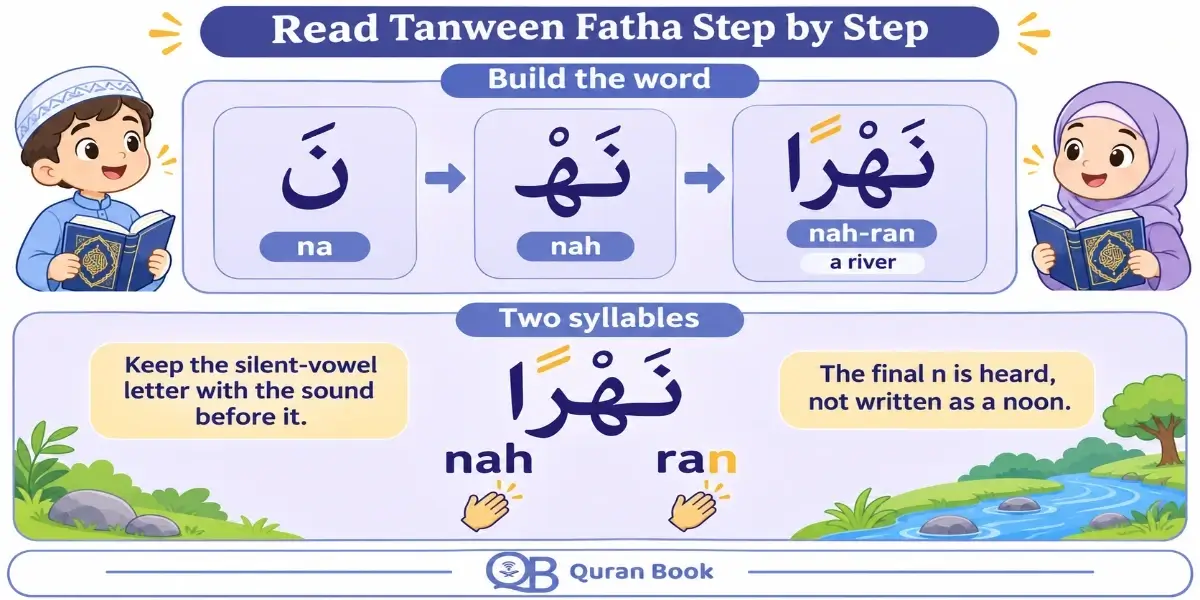
The n belongs to the last syllable: nah-ran. The sakin هۡ in نَهۡرًا is the Sukoon in Arabic you already know. If the joined shapes of ة or ى look new, see Arabic letters beginning, middle & end.
Tanween Fatha in the Quran: Look and Listen
Here is tanween fatha in the Quran, one ayah for each case: with the alif, on a hamza after an alif, and on ة. Find the highlighted word and its two stacked fathas, then listen for the n.
Look and listen
With the alif · Al-Ghashiyah 88:4
تَصۡلَىٰ نَارًا حَامِيَةࣰ
taṣlā nāran ḥāmiyah
“burning in a scorching Fire,”
Look for: نَارًا (nā-ran): fathatain, then an alif you don’t read.
Recitation: Mahmoud Khalil Al-Husary (murattal), riwayah of Hafs ‘an ‘Asim. Audio: EveryAyah.com.
On a hamza after an alif · An-Naba 78:36
جَزَآءࣰ مِّن رَّبِّكَ عَطَآءً حِسَابࣰا
jazāʾam mir rabbika ʿaṭāʾan ḥisābā
“a ˹fitting˺ reward as a generous gift from your Lord,”
Look for: عَطَآءً (ʿa-ṭā-ʾan): fathatain on the hamza, no extra alif.
Notice جَزَآءࣰ at the start: its marks are offset, because its n joins the next word.
On ة · Al-An’am 6:47
قُلۡ أَرَءَيۡتَكُمۡ إِنۡ أَتَىٰكُمۡ عَذَابُ ٱللَّهِ بَغۡتَةً أَوۡ جَهۡرَةً هَلۡ يُهۡلَكُ إِلَّا ٱلۡقَوۡمُ ٱلظَّٰلِمُونَ
qul araʾaytakum in atākum ʿadhābu llāhi baghtatan aw jahratan hal yuhlaku illa l-qawmu ẓ-ẓālimūn
“Ask, “Imagine if Allah’s punishment were to overwhelm you with or without warning—who would be destroyed other than the wrongdoers?””
Look for: بَغۡتَةً (bagh-ta-tan): ة + fathatain, no alif. Bonus: جَهۡرَةً (jah-ra-tan).
If the two marks look offset or turn into a small m, the n joins the next word. That comes from the tajweed rules, a later step. These words were picked so you hear the n clearly.
The n after a fatha is the easiest sound to drop, and the first thing a teacher listens for.
Book Your Free Trial LessonReading on your own as a grown-up? See how we help you learn Quran reading for adults.
Tanween Fatha Game: Which One Did You Hear?
A quick listening game. Every clip is a correct reading; your job is to hear which one it is.
Tanween Fatha for Kids
For parents: keep it short, playful and out loud.
- Two fathas = an. Make it your family’s rule.
- Hunt for the hidden n. Say asada, then asadan, and let your child point to the word with two marks.
- Play “secret alif”. Cover the alif in أَسَدًا with a finger and read: it sounds the same.
- One row a day of the chart, in big print.
- Play together. Do the find-it game above, praise a clean n, and stop while it’s fun.
Try it with your child
Read them aloud, then tap to check.
Want a teacher for your child? See our Quran reading for beginners classes for kids.
Free Tanween Fatha Worksheet (PDF)
Print it and practise a little every day. No sign-up needed.
Tanween Fatha Worksheet
Spot it, sort it, read it: 4 pages of tanween fatha practice.
- Circle every ـً
- Alif or no alif? Tick a box for each of the 6 words
- Read the 6 words split, then joined
- Answer key
Common Tanween Fatha Mistakes
- ✗ Dropping the n: أَسَدًا read as “asada”. ✓ asadan: two fathas, one n.
- ✗ Saying the fatha twice: بً read as “ba-a”. ✓ ban: the second mark is the n.
- ✗ Reading the alif: “asadā” or “asadaan”. ✓ asadan. The “aa” is only for stopping.
- ✗ Adding a vowel after the n: “asadana”. ✓ Close on the n.
- ✗ Missing it when there’s no alif: شَجَرَةً · مَاءً · فَتًى. ✓ Look for the two fathas, not the alif.
- ✗ Mixing up look-alikes: ـً vs one fatha, ـٌ or ـٍ. ✓ Count the marks and check where they sit: two on top = an.
What to Learn After This
- Next: tanween kasra, the same n after a kasra, with the marks under the letter.
- Then: tanween damma.
- The big picture: see the full path to how to read Arabic.
Learn more
Want a free guided start? Try our learn Arabic reading free lessons.
Tanween Fatha FAQ
What is tanween fatha?
Tanween fatha is two fathas (ـً) written on the last letter of a word. You read the fatha, then a short “n” that is not written as a letter, so بً is “ban” and أَسَدًا is “asadan”. It is one of the three types of tanween.
Is fathatain the same as tanween fatha?
Yes. Fathatain means “two fathas”, and it is another name for tanween fatha. You may also see it spelled fathatan or called tanween al-fath. All of these names mean the same mark, ـً, read “-an”.
How do you pronounce tanween fatha?
Say the fatha, then close on a short n, with nothing after it: بَ + نۡ = “ban”. Don’t say the fatha twice (“ba-a”), don’t drop the n (“ba”), and don’t add a vowel after it (“bana”).
What is the difference between fatha and tanween fatha?
A fatha is one mark (ـَ) and is read “a”. Tanween fatha is two marks (ـً) and is read “an”. So بَ is “ba” and بً is “ban”. Count the marks: one fatha, no n; two fathas, an n.
Why is there an alif after tanween fatha?
Most words with tanween fatha are written with an extra alif, as in أَسَدًا. You don’t read it while you keep reading: the word is “asadan”. It shows how the word sounds when you stop on it, when “-an” becomes a long “aa”.
Is the alif after tanween fatha a long vowel?
No. It is not alif madd, so you don’t stretch the sound while you keep reading: أَسَدًا is “asadan”, not “asadaan”. The long “aa” is only heard when you stop on the word.
When is tanween fatha written without an alif?
In three common cases: on ة (شَجَرَةً, “shajaratan”), on a hamza that comes after an alif (مَاءً, “māʾan”), and before ى (فَتًى, “fatan”). There is no extra alif, but the two fathas are there and the sound is still “-an”.
What are some tanween fatha examples?
أَسَدًا (asadan, a lion), نَهۡرًا (nahran, a river), قَمِيصًا (qamīṣan, a shirt), شَجَرَةً (shajaratan, a tree), مَاءً (māʾan, water) and فَتًى (fatan, a young man). In the Quran, look for نَارًا in Surah Al-Ghashiyah 88:4.
Make every -an clean from day one
You can now read fathatain, and you know which alif to skip and which words have none. A teacher can make sure every n is clean from your first lesson.
Book Your Free Trial LessonArabic Language Graduate · Hafidha of the Quran · Writer on Arabic Reading
Jehad Mahmoud is a graduate of the Arabic Language department and a Hafidha of the Quran who writes the Arabic and Quran-reading guides at Quran Book Academy.
She writes for English-speaking learners and parents starting from zero: the letters by sound, the vowel marks, and the step-by-step order that leads to reading the Quran directly from the Mushaf.
Her Arabic Language studies and her memorisation of the Quran are the foundation of this reading series.
These guides teach the reading system step by step. Pronunciation is a skill of the ear and the mouth, so it is best checked by a qualified teacher who can hear you read.
References
- Quran 88:4, 78:36 and 6:47, Uthmani text: quran.com/88/4 · quran.com/78/36 · quran.com/6/47
- Recitation: Mahmoud Khalil Al-Husary (murattal, Hafs ‘an ‘Asim), audio from EveryAyah.com. All letter and word clips on this page are recorded by Quran Book Academy.
- Translations: The Clear Quran, Dr. Mustafa Khattab, via quran.com.
- Britannica, “Arabic alphabet“.