Tanween in Arabic: The N You Hear but Never See
Two small marks at the end of a word add one sound. Hear it, meet its three types, and read your first words with it.

Read this word:
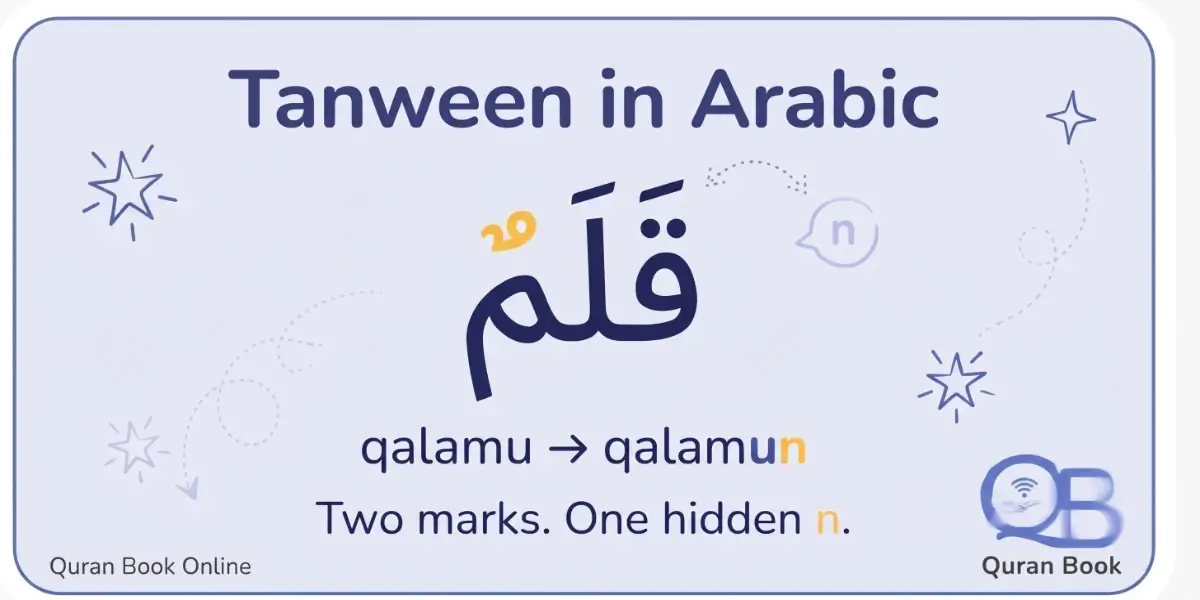
قَلَمٌ
qalamun — “a pen”
If you said qalamu, you’re one sound short. It’s qalamun. The second little mark is an n you can’t see, and it’s never written as a letter.
You’ve just learned the Sukoon in Arabic, and tanween is the next step in learning how to read Arabic. In this guide to tanween in Arabic, you’ll hear the hidden n, meet its three types and hear all 28 letters with each one. Then you’ll read your first words, learn what happens when you stop, and find tanween in three ayat.
What Is Tanween in Arabic?
What is tanween? It’s a doubled vowel mark on the last letter of a word that adds an n sound.
ـٌـًـٍ
Tanween is not a letter, and it’s not two vowels. You say the vowel once, then a short n closes the word. It only ever sits on the last letter of a word.
The marks are simply two of the Arabic harakat written together: two dammas, two fathas or two kasras.
One mark more, one sound more.
What Does Tanween Mean?
تَنۡوِين (tanwīn) means “adding a nūn”, the Arabic letter n. In English it’s called nunation, and you’ll also see it spelled tanwin.
So the tanween meaning is the rule itself: tanween adds an n to the end of a word. Keep that in mind, and the rest of this lesson will feel simple.
The Hidden N: How to Pronounce Tanween
قَلَمُ + نۡ = قَلَمٌ
qalamu + n = qalamun
You already know the sakin n from the Sukoon in Arabic lesson. That closing n, as in أَنۡ (an), is exactly the sound tanween adds.
Now hear one letter with all three types. Listen for the same n at the end of each:
Vowel, then n
- Don’t say the vowel twice. بٌ is “bun”, not “bu-u”.
- Don’t drop the n. “Bu” is a different reading.
- Don’t add a vowel after it. “Bunu” ✗
Say the vowel, then close on a short n. Nothing comes after it.
The Three Types of Tanween
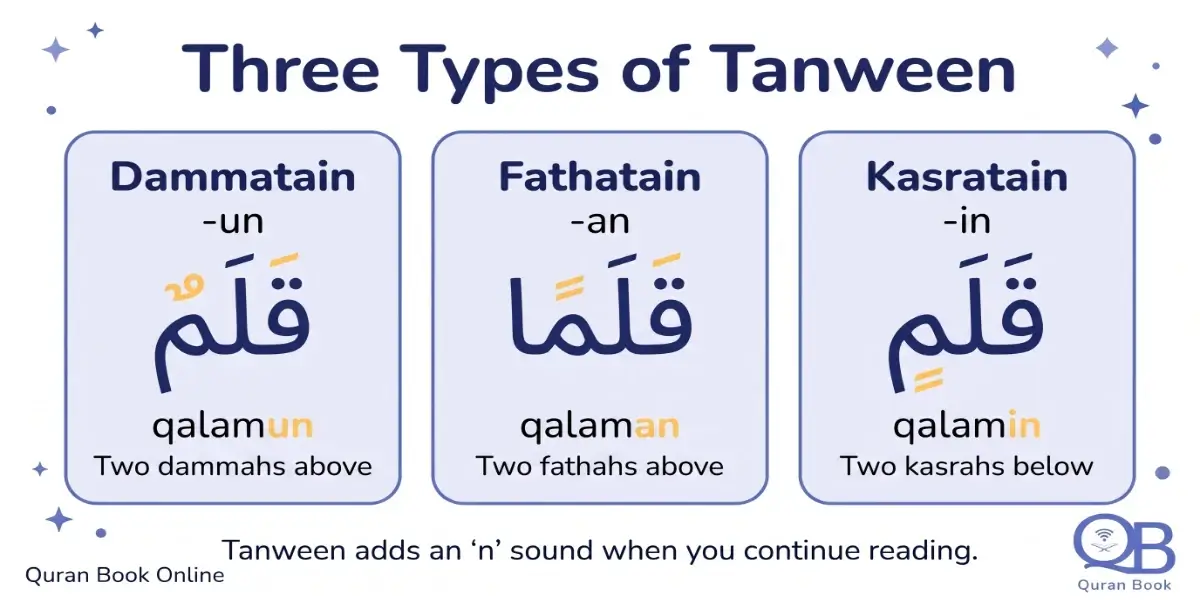
There are three types of tanween: fathatain, kasratain and dammatain. Each one is a short vowel you already know, plus the hidden n.
ـٌ
Dammatain · -un
قَلَمٌ qalamun
Two dammas, often drawn joined. Say “u”, then n.
Learn it in depth: tanween damma
ـً
Fathatain · -an
قَلَمًا qalaman
Two fathas, usually with an extra alif you don’t read while you keep going (it is not alif madd).
More in the fatha lesson: tanween fatha
ـٍ
Kasratain · -in
قَلَمٍ qalamin
Two kasras, under the letter. Say “i”, then n.
Learn it in depth: tanween kasra
How Tanween Looks in the Mushaf
Open quran.com and you’ll see the two marks drawn in different ways. That shows how the n joins the next word when the Quran is recited. It’s a tajweed rule for later (see our tajweed rules guide). The three ayat on this page all use the clear, stacked kind.
ـٌ ـً ـٍ
Stacked
The n is said clearly.
ـࣱ ـࣰ ـࣲ
Offset
The n blends into, or hides before, the next word.
ـُۢ ـَۢ ـِۭ
Small m
The n turns into an m.
Arabic Letters With Tanween: All 28 Letters
Here is every letter with all three types of tanween. Each clip is read the way you’d say it mid-sentence, with its n. Heavy letters are tinted gold, because they stay heavy with tanween.
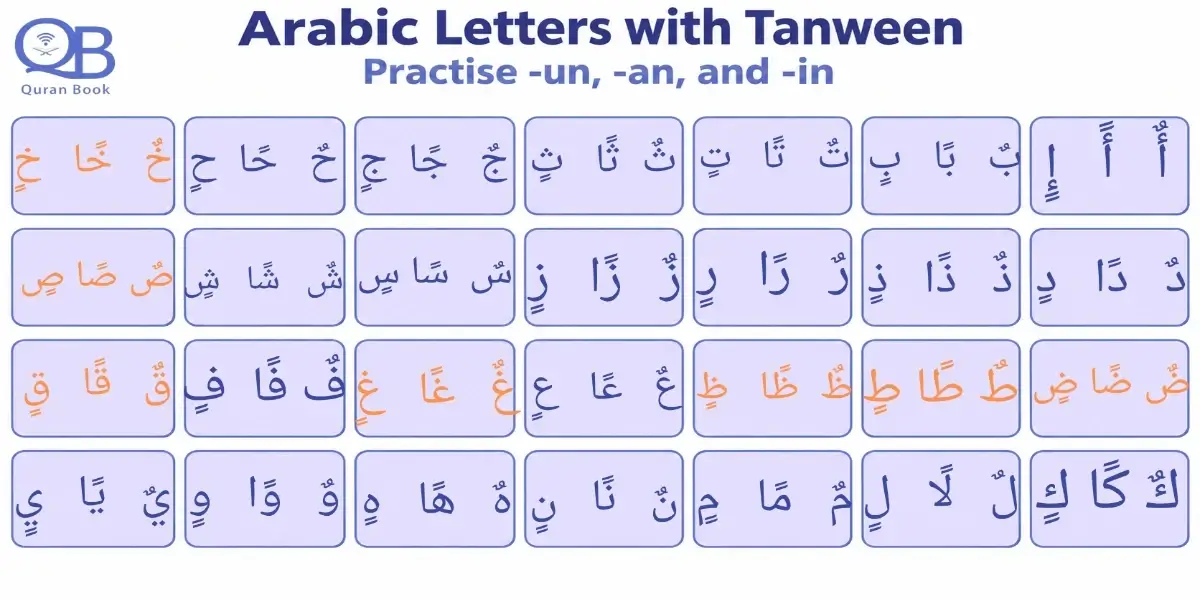
The chart shows ـً without its alif, as in a Qaida chart. In real words, ـً usually comes with a silent alif: بَابًا.
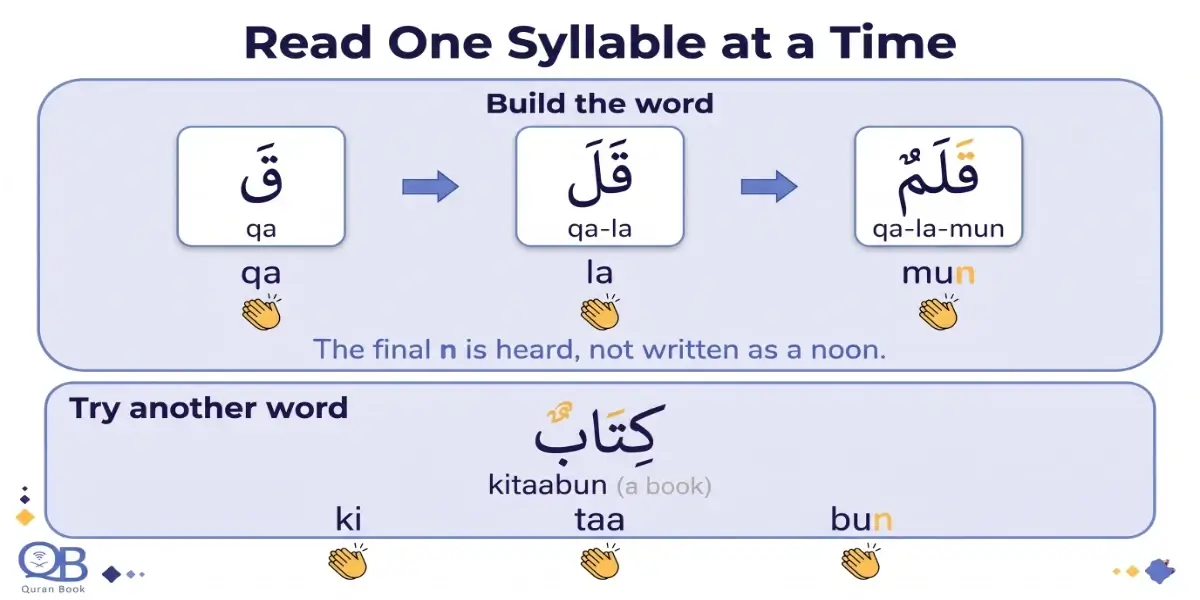
Tanween Examples: Your First Words
Now put tanween into words. Read each item out loud first, then tap to check yourself.
- Level 1: four letters, mixed tanween: بٌ · تً · دٍ · سٌ.
- Level 2: one word, three endings: قَلَمٌ · قَلَمًا · قَلَمٍ (qalamun · qalaman · qalamin, “a pen”). The word stays the same; only the ending changes.
- Level 3: six first words, two per type. Read them syllable by syllable first: qa-ma-run (قَ | مَ | رٌ). The n belongs to the last syllable.
The extra alif in بَابًا and سَمَكًا isn’t read; the fatha lesson explains why. If a joined shape looks new, see Arabic letters beginning, middle & end.
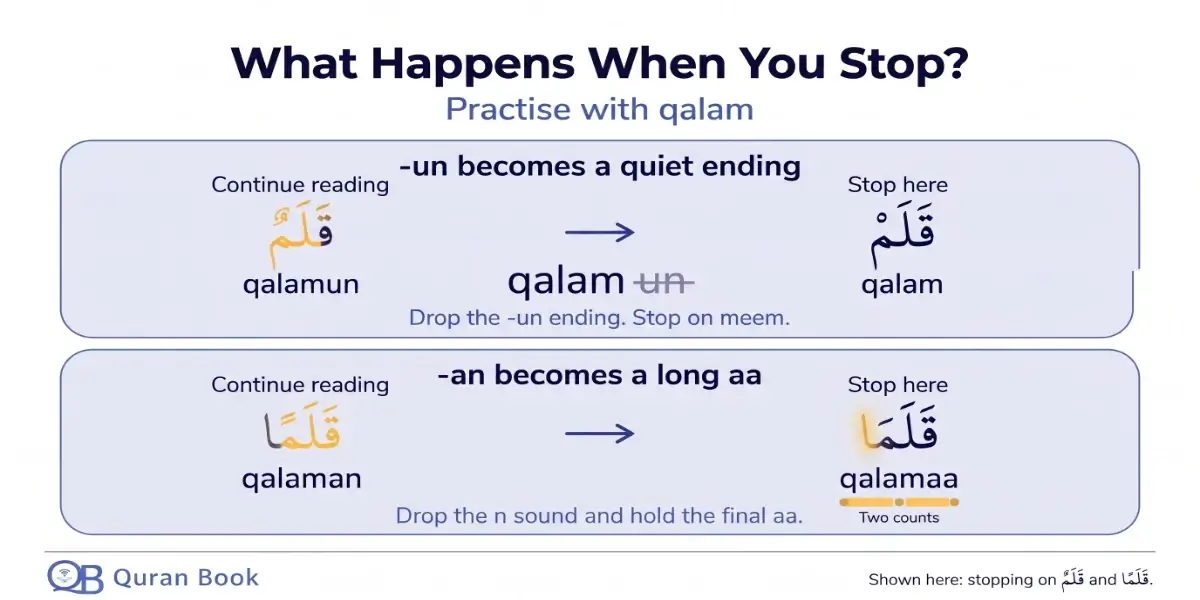
What Happens When You Stop on Tanween?
When you stop on a word with tanween, the n drops. You’ll hear this at the end of almost every ayah.
- -un and -in drop. The last letter becomes sakin.
- -an becomes a long “aa”. That’s why the alif is written.
- ة with tanween is said as a soft “h” when you stop.
Tanween in Quran: Look and Listen
Here is tanween in Quran recitation, one ayah per type. Find the highlighted word, then listen for its n. Each sits mid-ayah; at the end of an ayah the reciter stops and the n drops, as you just learned.
When tanween meets certain letters, reciters blend or hide the n; that’s part of the tajweed rules. These words were picked so you can hear it clearly.
Look and listen
Dammatain · At-Tin 95:6
إِلَّا ٱلَّذِينَ ءَامَنُواْ وَعَمِلُواْ ٱلصَّٰلِحَٰتِ فَلَهُمۡ أَجۡرٌ غَيۡرُ مَمۡنُونࣲ
illā lladhīna āmanū wa-ʿamilu ṣ-ṣāliḥāti fa-lahum ajrun ghayru mamnūn
“except those who believe and do good—they will have a never-ending reward.”
Look for: أَجۡرٌ (aj-run): dammatain, “-un”.
Recitation: Mahmoud Khalil Al-Husary (murattal), riwayah of Hafs ‘an ‘Asim. Audio: EveryAyah.com.
Fathatain · Al-Ikhlas 112:4
وَلَمۡ يَكُن لَّهُۥ كُفُوًا أَحَدُۢ
wa-lam yakun lahū kufuwan aḥad
“And there is none comparable to Him.”
Look for: كُفُوًا (ku-fu-wan): fathatain, “-an”. Its alif is not read.
Kasratain · Al-Ghashiyah 88:2
وُجُوهࣱ يَوۡمَئِذٍ خَٰشِعَةٌ
wujūhun yawmaʾidhin khāshiʿah
“On that Day ˹some˺ faces will be downcast,”
Look for: يَوۡمَئِذٍ (yaw-ma-ʾi-dhin): kasratain, “-in”.
Notice وُجُوهࣱ: its marks are offset. That’s the tajweed kind from the Mushaf section above.
That small n at the end of a word is the easiest sound to drop, and the first thing a teacher listens for.
Book Your Free Trial LessonReading on your own as a grown-up? See how we help you learn Quran reading for adults.
Tanween Game: Which One Did You Hear?
A quick listening game. Every clip is a correct reading. Your job is to hear which ending it has.
Tanween for Kids
For parents: keep it short, playful and out loud.
- Two marks = one n. Make it your family’s rule.
- Hunt for “the n you can’t see”. Say qalamu, then qalamun, and let your child point to the word with two marks.
- Hum it at first. For the first few days, finish the word on a hum (nnn), then make the n short.
- One row a day of the chart, in big print.
- Play together. Do the “find every tanween” game above, praise a clean n, and stop while it’s fun.
Try it with your child
Read them aloud, then tap to check.
Want a teacher for your child? See our Quran reading for beginners classes for kids.
Common Tanween Mistakes Beginners Make
- ✗ Dropping the n: قَلَمٌ read as “qalamu”. ✓ qalamun: two marks, one n.
- ✗ Saying the vowel twice: بٌ read as “bu-u”. ✓ bun: the second mark is the n, not a second vowel.
- ✗ Adding a vowel after the n: “qalamunu”. ✓ Close on the n.
- ✗ Reading the alif after fathatain as a long vowel: قَلَمًا read as “qalamaan”. ✓ qalaman. The “aa” is only for stopping.
- ✗ Keeping the n when you stop: “qalamun.” at a stop. ✓ qalam / qalamā.
- ✗ Mixing up ـٌ with one dammah, or ـٍ with one kasra. ✓ Count the marks: two = tanween.
What to Learn After This
- Next: the three types one by one. Start with tanween fatha, then tanween kasra and tanween damma.
- After tanween: shaddah, the mark that doubles a letter.
- The big picture: see the full path to how to read Arabic.
Learn more
Want a free guided start? Try our learn Arabic reading free lessons.
Tanween FAQ
What is tanween in Arabic?
Tanween (تَنۡوِين) is a doubled vowel mark written on the last letter of a word: two dammas (ـٌ), two fathas (ـً) or two kasras (ـٍ). It means the vowel is followed by an “n” sound that is not written as a letter. So قَلَمٌ is read “qalamun”, not “qalamu”.
What does tanween mean?
Tanween means “adding a nūn”, the Arabic letter n. In English it is also called nunation, and it is sometimes spelled tanwin. The name tells you exactly what it does: it adds an n sound to the end of a word.
What are the three types of tanween?
Dammatain (ـٌ) is read “-un”, fathatain (ـً) is read “-an” and kasratain (ـٍ) is read “-in”. Each is the short vowel you already know, plus a hidden n: بٌ is bun, بً is ban and بٍ is bin.
How do you pronounce tanween?
Say the vowel, then close on a short n, with nothing after it: قَلَمُ + نۡ = qalamun. Don’t say the vowel twice (“qalamu-u”), and don’t drop the n (“qalamu”).
Is tanween written with a noon?
No. The n sound of tanween is heard but never written as the letter ن. The doubled vowel mark is the only sign of it. That is why beginners often miss it until they learn to look for the second mark.
What happens to tanween when you stop at the end of a word?
When you stop, the n drops. With dammatain or kasratain the last letter becomes still, so قَلَمٌ becomes “qalam”. With fathatain you say a long “aa” instead, so قَلَمًا becomes “qalamā”. A ة with tanween is said as a soft “h”.
What are the rules of tanween in tajweed?
When a word with tanween runs into the next word, its hidden n can be said clearly, blended into the next letter, hidden, or turned into an m, depending on that letter. These are the noon sakinah and tanween rules of tajweed, a later step; this lesson teaches how to read tanween itself.
How can kids practise tanween?
Turn it into a hunt for “the n you can’t see”: say a word with and without its n and let the child point to the one with two marks. Read one row of the chart a day in big print, play a short listening game, and stop while it is still fun.
Make every tanween clean from day one
You can now hear the n that isn’t written, and you know when it drops. A teacher can make sure every tanween is clean from your first lesson, before the tajweed rules build on it.
Book Your Free Trial LessonArabic Language Graduate · Hafidha of the Quran · Writer on Arabic Reading
Jehad Mahmoud is a graduate of the Arabic Language department and a Hafidha of the Quran who writes the Arabic and Quran-reading guides at Quran Book Academy.
She writes for English-speaking learners and parents starting from zero: the letters by sound, the vowel marks, and the step-by-step order that leads to reading the Quran directly from the Mushaf.
Her Arabic Language studies and her memorisation of the Quran are the foundation of this reading series.
These guides teach the reading system step by step. Pronunciation is a skill of the ear and the mouth, so it is best checked by a qualified teacher who can hear you read.
References
- Quran 95:6, 112:4 and 88:2, Uthmani text: quran.com/95/6 · quran.com/112/4 · quran.com/88/2
- Recitation: Mahmoud Khalil Al-Husary (murattal, Hafs ‘an ‘Asim), audio from EveryAyah.com. All letter and word clips on this page are recorded by Quran Book Academy.
- Translations: The Clear Quran, Dr. Mustafa Khattab, via quran.com.
- Britannica, “Arabic alphabet“.