
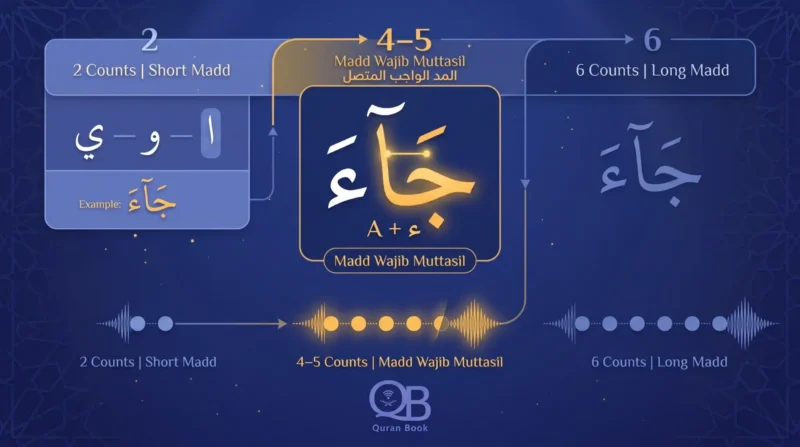
You reach جَاءَ نَصْرُ اللَّهِ and you know this one is longer than normal — but four counts or five? And once you have chosen, does the next one have to match? Madd Muttasil happens when a hamzah (ء) comes directly after a madd letter inside the same word, and in Hafs it is held for four or five counts. This page gives you the one cause, the three conditions, how the 4-or-5 choice works inside a recitation, and when a stop allows six. All lengths here follow Hafs ‘an ‘Asim by the way of Ash-Shatibiyyah. It is a branch rule inside the Madd rules chapter of Tajweed.
Also written Madd al-Wajib al-Muttasil (المد الواجب المتصل), Wajib Muttasil, Mad Wajib Mutasil, or in English simply the connected obligatory madd. This is Madd Wajib Muttasil as it is taught in classical primers such as تحفة الأطفال and المقدمة الجزرية.
⚡ The 30-second version: madd letter + hamzah + same word · hold it 4 or 5 counts · keep one length for every Muttasil in the same recitation · if you stop with sukoon on a word that ends in that hamzah, you may keep your length or extend it to 6. The rest of this page is about making that habit reliable.
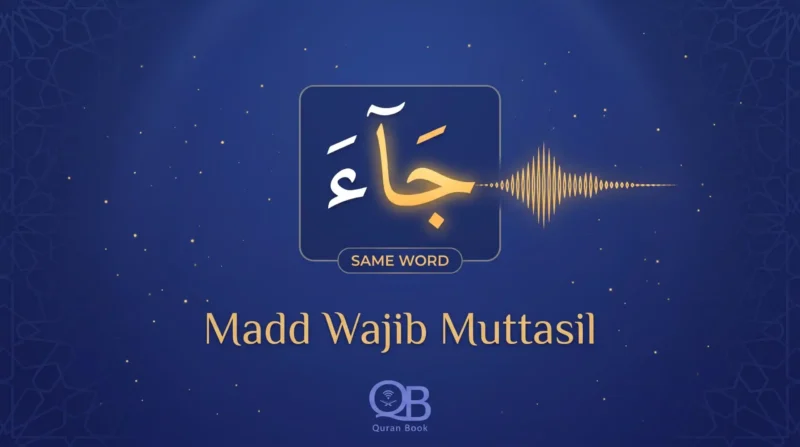
What Is Madd Wajib Muttasil in Tajweed?
Muttasil means connected. The madd letter and the hamzah are joined inside one word. That single word is the whole test. Move the hamzah to the start of the next word and the same pattern becomes Madd Jaiz Munfasil instead.
The cause is the hamzah. Not a shaddah, not a sukoon — a madd letter followed by a permanent sukoon or shaddah is Madd Lazim, and one followed by a sukoon that appears only because you stop is Madd ‘Arid lis-Sukoon. Fixing that in your head now prevents most misclassifications later.
What is a count? A count — a harakah, sometimes called a beat — is the time of one short vowel. Its actual duration in seconds grows or shrinks with your pace of recitation (slow tahqeeq, medium tadweer or quicker hadr), so two reciters at different speeds can both be correct. Counting on fingers is only an approximation; the precise length is learned by listening to and reciting before a qualified teacher.
📖 Riwayah note: every count on this page follows Hafs ‘an ‘Asim by the way of Ash-Shatibiyyah. Other riwayat, and other turuq of Hafs, treat some madds differently.
What Does “Wajib” Mean Here?
In the name of this madd, wajib (واجب) is a technical label. It records that the reciters agree this madd is lengthened beyond the natural two counts. They do not all agree on one number: they differ on how far it is lengthened — in Hafs by the way of Ash-Shatibiyyah it is four or five counts, while other reciters lengthen it further.
Compare it with jaiz (جائز) in Madd Jaiz Munfasil. Here the label describes the reciters again: they differ over whether that madd is lengthened at all, so some riwayat read it short and others long. Both names describe the reciters’ agreement or difference — they are terms of the science of qira’at, not a ruling about the individual reader.
The Rule and Conditions of Madd Muttasil
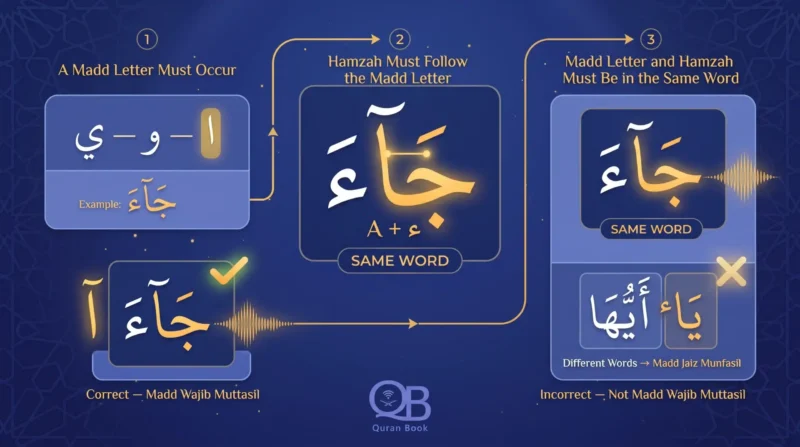
The Madd Wajib Muttasil rules reduce to three conditions. All three must be true at once — miss one and you are looking at a different madd.
1. There is a madd letter
An alif ا, waw و or yaa ي that is sakin, with the matching vowel before it (fathah before alif, dammah before waw, kasrah before yaa).
✅ جَاءَ · ❌ شَيْءٍ — that yaa is sakin after a fathah, so it is a layn letter, not a madd letter. It is not lengthened while you continue; only if you stop on the hamzah with sukoon does it become Madd Lin.
2. A hamzah comes immediately after it
Nothing in between — the hamzah is the very next letter.
✅ السَّمَاءِ · ❌ قَالَ — a lam follows the alif, not a hamzah or a sukoon, so nothing causes a secondary madd here. The alif keeps its natural madd → Madd Asli, 2 counts.
3. Both are in the same word
This is the condition that names the rule: muttasil, connected.
✅ أُولَٰئِكَ · ❌ إِنَّا أَعْطَيْنَاكَ — the hamzah starts the next word → Madd Jaiz Munfasil
One neighbour worth naming: if the hamzah comes before the madd letter instead of after it — as in آمَنُوا — that is Madd Badal, 2 counts in Hafs, not Muttasil.
🖊️ The mushaf sign: most printed Qurans place a small wavy line (~) over the madd letter. It is a helpful marker, not the rule — the same sign appears over Munfasil and Lazim too. Learn the cause, not just the symbol.
How Many Counts Is Madd Muttasil?
Four or five counts in Hafs ‘an ‘Asim by the way of Ash-Shatibiyyah. If the hamzah is the last letter of the word and you stop on it with sukoon, you may keep your chosen length or extend it to six (details in the stopping section). Here is where it sits between two madds you already know:
| Madd | Counts | Fixed or a choice? |
|---|---|---|
| Madd Asli | 2 | Fixed |
| Madd Wajib Muttasil | 4 or 5 (6 optional at a stop with sukoon on a final hamzah) | Choose one — keep it through the recitation |
| Madd Lazim | 6 | Fixed |
The full counts table for every madd type lives on the Madd rules hub.
🎧 Three madds in context — Sheikh Al-Husary
Each button plays the full verse. Listen for the marked word inside it.
Madd Wajib Muttasil: 4 or 5 Counts — How the Choice Works
- Both are correct. Four counts is tawassut; five is fuwayq at-tawassut. Both are accepted lengths in Hafs by the way of Ash-Shatibiyyah.
- Keep one length within a recitation. Once you begin with four, give every Muttasil four until that recitation ends; the same if you begin with five. Using 4 in one ayah and 5 in the next of the same reading is the error. Reading with the other valid length in a separate, later recitation is not an error in itself.
- Speed changes the seconds, not the number. A count lasts longer in slow recitation and shorter in quicker recitation, so the time in seconds changes while the number of counts you adopted stays the same. Speed alone does not decide whether you read with four or five.
- Keep the Munfasil and Muttasil matched in Hafs by the way of Ash-Shatibiyyah. If you read the Munfasil for four counts, read the Muttasil for four; if you read the Munfasil for five, read the Muttasil for five. Keep that face consistent throughout the recitation. The stopping options for a final-hamzah Muttasil are explained separately below.
- Your teacher’s instruction comes first. Madd lengths are learned by listening and reciting before a qualified teacher (talaqqi). Read with the accepted face your teacher has given you.
How to Identify Madd Wajib Muttasil in 3 Steps
Run this decision path while you read. With practice it becomes quick.
Find the madd letter. An ا, و or ي that is sakin, with the matching vowel before it. No madd letter → no Madd Muttasil.
Is the very next letter a hamzah (ء)? If not, it is not Muttasil — check the other causes on the madd rules hub.
Is that hamzah in the same word? Yes → Madd Wajib Muttasil, 4 or 5 counts. No, it starts the next word → Madd Jaiz Munfasil.
✍️ Written spacing is a useful guide, but not the final word. Some combinations are joined in writing while remaining separate in ruling. In هَٰؤُلَاءِ, the first madd is Munfasil Hukmi, while the second is Muttasil.
What Happens When You Stop on a Madd Muttasil?
When the hamzah is the last letter of the word — السَّمَاءِ, هَٰؤُلَاءِ, يَشَاءُ — and you stop on it with a plain sukoon, the sukoon of stopping is added to the hamzah that already caused the madd. In Hafs by the way of Ash-Shatibiyyah this allows the madd to be extended to six counts as an option.
- Six is optional, not required. Keeping your chosen length at the stop is also correct.
- Stay in step with your reading. If you have been reading Muttasil with four, stop with four or six. If you have been reading with five, stop with five or six. (Scholars note that when no earlier Muttasil or Munfasil in the recitation has set your length, four, five or six are all allowed at that stop.)
- While continuing, it is never six in this riwayah and tariq — you stay at your chosen four or five.
Not every stop is this case:
- If you stop with rawm (a partly voiced final vowel, possible on words ending in kasrah or dammah), there is no six — keep your four or five.
- If the word ends in a hamzah with tanween fath, such as مَرِيئًا, the stop turns the tanween into an alif and the hamzah keeps its fathah. The hamzah is not stopped with sukoon, so the six-count option described above does not arise there.
- If the hamzah is in the middle of the word, as in أُولَٰئِكَ, stopping at the end of the word does not touch the madd at all.
🔀 The Stop Switch
A visual illustration of the lengths that are allowed — it does not play a recording of a stop.
مِنَ السَّمَاءِ
Continuing → your chosen length: 4 or 5 counts.
Related, and often confused with this: Madd ‘Arid lis-Sukoon, where the sukoon of stopping is the only cause of the madd.
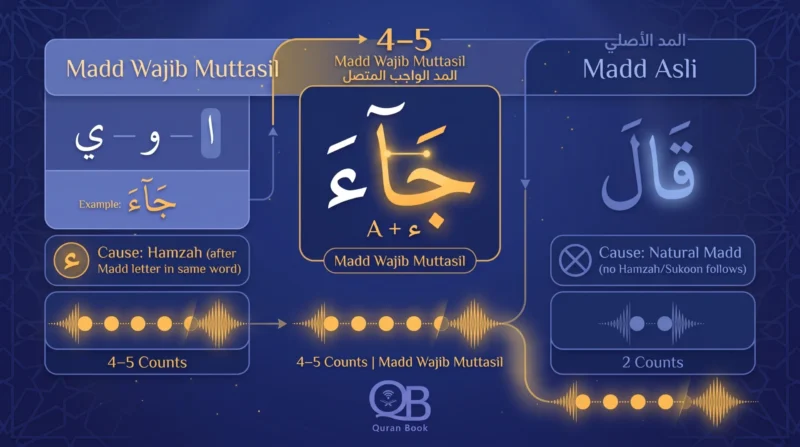
Madd Wajib Muttasil vs Madd Asli
| Feature | Madd Asli (المد الأصلي) | Madd Wajib Muttasil (المد الواجب المتصل) |
|---|---|---|
| Cause | None — it is the natural baseline | A hamzah after the madd letter |
| Position of the hamzah | — | Same word |
| Length | Always 2 | 4 or 5 (6 optional at a stop with sukoon on a final hamzah) |
| Any choice? | No | Yes — 4 or 5, kept consistent through the recitation |
| Category | Asli (original) | Far’i (branch) |
| Examples | قَالَ · يَقُولُ · قِيلَ | جَاءَ · السَّمَاءِ · سُوءَ |
Madd Wajib Muttasil vs Madd Jaiz Munfasil
This is the comparison learners ask about most. Start from your side: your hamzah is in the same word — here is what changes because of that.
| Feature | Madd Wajib Muttasil | Madd Jaiz Munfasil |
|---|---|---|
| Meaning of the name | Connected; reciters agree it is lengthened | Separated; reciters differ over lengthening it |
| Where is the hamzah? | Same word | At the start of the next word |
| Length in Hafs (Ash-Shatibiyyah) | 4 or 5 | 4 or 5 |
| Ever read at 2 counts? | No — in no reading | Not in Hafs by Ash-Shatibiyyah; yes in some other riwayat and turuq |
| At a stop | If the hamzah is final and you stop with sukoon: your length, or 6 as an option | Stopping on the first word removes the cause; its madd letter keeps only the natural 2 counts |
| Example | جَاءَ | إِنَّا أَعْطَيْنَاكَ |
- In Hafs the lengths are the same. The difference is not what you hear — it is why the madd is there.
- The stop row matters in practice. If you stop on إِنَّا, the hamzah of the next word is no longer joined to it, so the Munfasil cause is gone and the alif is read with its natural two counts. A Muttasil’s hamzah is inside the word, so it cannot be separated that way.
🎧 A/B: judge by the word boundary, not by the ear
Both are full verses recited continuously by Sheikh Al-Husary. In Hafs the two madds can sound the same length — the difference is where the hamzah sits.

The full treatment from the other side is on the Madd Jaiz Munfasil page.
Madd Wajib Muttasil Examples in the Quran
Madd Wajib Muttasil in the Quran is very common once you can see it. Below are twelve Madd Wajib Muttasil examples, checked against Quran.com. Each has a short word clip so you can recognise the word on its own, and the full ayah in Sheikh Al-Husary’s voice for context. The madd letter is marked in green and the hamzah in orange.
Word clips come from Quran.com’s word-by-word audio (the reciter of those clips is not identified here). They are isolated recordings meant for recognising a word — use the full-ayah recitation, and your teacher, as the model for length.
| # | Word / phrase | Listen | Reference | Letters | Note |
|---|---|---|---|---|---|
| 1 | جَاءَ نَصْرُ اللَّهِ | An-Nasr 110:1 | ا + ء | The reference example | |
| 2 | مِنَ السَّمَاءِ | Al-Baqarah 2:19 | ا + ء | Final hamzah: may be extended to 6 when stopping on it with sukoon | |
| 3 | أُولَٰئِكَ | Al-Baqarah 2:5 | ا + ء | Mid-word hamzah — easy to read past (the madd is the small alif on the lam) | |
| 4 | سَوَاءٌ عَلَيْهِمْ | Al-Baqarah 2:6 | ا + ء | Hamzah carries tanween dammah; the madd is still connected | |
| 5 | وَلَوْ شَاءَ اللَّهُ | Al-Baqarah 2:20 | ا + ء | The waw in وَلَوْ is a layn letter, not a madd letter | |
| 6 | هَٰؤُلَاءِ | Al-Baqarah 2:31 | ا + ء | The first madd is Munfasil Hukmi; the highlighted second madd is Muttasil. When stopping with sukoon on the final hamzah, the second madd may be extended to six counts. | |
| 7 | السُّفَهَاءُ | Al-Baqarah 2:13 | ا + ء | Final hamzah — the word occurs twice in this ayah | |
| 8 | وَجِيءَ بِالنَّبِيِّينَ | Az-Zumar 39:69 | ي + ء | Yaa madd followed by a hamzah | |
| 9 | هَنِيئًا مَرِيئًا | An-Nisa 4:4 | ي + ء | Two Muttasils in a row. At the end of the ayah the tanween fath becomes an alif, so the hamzah is not stopped with sukoon | |
| 10 | سُوءَ الْحِسَابِ | Ar-Ra’d 13:21 | و + ء | Waw madd: dammah on the seen, then waw — not the layn word سَوْء | |
| 11 | يَشَاءُ | Al-Baqarah 2:212 | ا + ء | A word that recurs often across the Quran | |
| 12 | نِسَاؤُكُمْ حَرْثٌ لَكُمْ | Al-Baqarah 2:223 | ا + ء | Hamzah written on a waw seat — same rule |
💡 Rows 8, 9 and 10 use yaa and waw. Madd Muttasil is not limited to alif — all three madd letters can carry it, so look for all three when you scan a page.
A Note on Surah Al-Fatihah
Surah Al-Fatihah contains no Madd Wajib Muttasil: nowhere in the surah does a hamzah follow a madd letter inside the same word. That makes a useful memory hook — if you are hunting for a Muttasil in Al-Fatihah, there isn’t one. (It does contain a six-count Madd Lazim in الضَّالِّينَ.)
6 Common Madd Muttasil Mistakes
1. Switching between 4 and 5 inside one recitation
Both numbers are correct; mixing them within the same reading is the error. Pick one length when you begin and keep it until that recitation ends.
2. Confusing it with Munfasil because the lengths match
In Hafs they can sound identical. Classify by the word boundary, not by the sound.
3. Stretching the hamzah instead of the madd letter
The length belongs to the ا / و / ي. The hamzah is pronounced clearly at the end of it, not drawn out.
4. Treating شَيْء and سَوْء as Muttasil
Their يْ and وْ are sakin after a fathah — layn letters, not madd letters. In Hafs they are not lengthened while you continue. Only when you stop on the following hamzah with sukoon does Madd Lin apply, with 2, 4 or 6 counts allowed. Compare سُوءَ (dammah on the seen, then a true waw madd), which is Muttasil.
5. Using six while continuing
In Hafs by the way of Ash-Shatibiyyah, six is only an option when you stop with sukoon on a final hamzah. While you continue through the word, stay at your chosen four or five. At that stop, keeping your four or five is also correct — six is never compulsory.
6. Breaking or distorting the lengthened vowel
Keep one continuous vowel sound, with its correct quality, for the full length you adopted — no break in the middle, no extra letter slipping in, and no stretching beyond the length. Beautifying your voice is encouraged; the problem is only when the melody changes the letters or the lengths.
Practise Madd Wajib Muttasil
A. Hold-Duration Consistency Exercise
Recite each word aloud and press and hold the button for as long as you hold the madd. Your first hold becomes your reference, and each later hold is compared with it.
What this exercise can and cannot do:
- It only measures how long you hold a button. It does not listen to you, and it cannot check your pronunciation, your Tajweed, or whether your hold really equals four or five counts.
- The “close to your reference” range (within 15%) is a setting of this exercise, not a Tajweed or religious standard.
- Choosing 4 or 5 just labels your practice. Switching resets the reference and your progress.
- Whether your length is right is something a teacher confirms by listening.
Word 1 of 8
Mouse, touch, or keyboard: hold Space or Enter while focused on the button.
Hold from the start of the madd letter until you reach the hamzah.
B. Muttasil or Munfasil?
Twelve real Quran phrases — six of each — in shuffled order. The madd letter being tested is marked green and its hamzah orange. After you answer, a box is drawn around each word so you can see whether the two colours sit in one box or across two.
Is the hamzah in the same word, or at the start of the next one?
Play: Madd Wajib Muttasil Words (Free Game)
Recognition under time pressure is a different skill from recognition on a page. Catch the words that carry a connected madd and let the rest go past. It works on phones and tablets, and no account is needed.
Game not loading? Open it in a new tab · or browse all our free Tajweed games · the full madd sorting game lives on the Madd rules hub.
Madd Wajib Muttasil FAQ
What is Madd Wajib Muttasil?
Madd Wajib Muttasil (المد الواجب المتصل) occurs when a hamzah (ء) comes directly after a madd letter — alif, waw or yaa — with both in the same word. In Hafs by the way of Ash-Shatibiyyah it is lengthened to four or five counts.
Why is it called “wajib”?
“Wajib” is a technical label: the reciters agree that this madd is lengthened beyond the natural two counts, although they differ on how far. It is contrasted with “jaiz” in Madd Jaiz Munfasil, where the reciters differ over whether to lengthen it at all.
How many counts is Madd Muttasil?
Four or five counts in Hafs ‘an ‘Asim by the way of Ash-Shatibiyyah. If the hamzah is the last letter of the word and you stop on it with sukoon, you may keep your chosen length or extend it to six.
How do I identify Madd Wajib Muttasil?
Find a madd letter, check whether a hamzah comes immediately after it, then check that the hamzah is in the same word. If all three are true, it is Madd Wajib Muttasil.
Should I read it with 4 or 5 counts?
Both are accepted. Follow the face your qualified teacher has taught you, and keep the same length for every Muttasil within a recitation. Your recitation speed changes how long a count lasts, but it does not by itself decide between four and five.
What is the difference between Madd Wajib Muttasil and Madd Jaiz Munfasil?
The cause is the same — a hamzah after a madd letter. In Muttasil the hamzah is in the same word; in Munfasil it starts the next word. In Hafs by the way of Ash-Shatibiyyah both are four or five counts. If you stop on the first word of a Munfasil, its cause is gone and the madd letter keeps only its natural two counts; a Muttasil’s hamzah cannot be separated from its word that way.
What is the difference between Madd Wajib Muttasil and Madd Asli?
Madd Asli has no cause beyond the madd letter itself and is always two counts. Madd Wajib Muttasil is caused by a hamzah in the same word and is lengthened to four or five.
Can Madd Muttasil ever be six counts?
In Hafs by the way of Ash-Shatibiyyah, six is an option only when the hamzah is the last letter of the word and you stop on it with sukoon, as in السَّمَاءِ or هَٰؤُلَاءِ. Keeping your chosen four or five there is also correct. While continuing — or when stopping with rawm — it stays at four or five.
Is the waw in سَوْء a Madd Muttasil?
No. That waw is sakin after a fathah, so it is a layn letter, not a madd letter. In Hafs it is not lengthened while you continue; if you stop on the hamzah with sukoon, it becomes Madd Lin with 2, 4 or 6 counts allowed. The word سُوءَ (dammah on the seen) is different: its waw is a madd letter, so it is Muttasil.
Where can I find Madd Wajib Muttasil in the Quran?
In جَاءَ (An-Nasr 110:1), السَّمَاءِ (Al-Baqarah 2:19), أُولَٰئِكَ (Al-Baqarah 2:5), سُوءَ (Ar-Ra’d 13:21) and وَجِيءَ (Az-Zumar 39:69), among many others. Surah Al-Fatihah contains none.
Learn More
How the neighbouring madds differ from Muttasil: Madd Lazim is caused by a permanent sukoon or shaddah and is always six. ‘Arid lis-Sukoon and Lin are caused by the sukoon of stopping, which is why both allow three lengths at a stop. Madd Silah is the madd on ha’ al-kinayah (هاء الكناية) — the singular masculine third-person pronoun “him / his”, ـهُ or ـهِ — between two voweled letters. Its Sughra form is two counts; its Kubra form, when the next word begins with a hamzah, is caused by that hamzah and is read like the Munfasil you just met.
The siblings under the same hub:
The rest of the Tajweed cluster:
May Allah beautify your recitation and accept it from you. 🤲
Hafidha of the Quran · Arabic Language Graduate · Writer on Islamic Sciences
Jehad Mahmoud is a graduate of the Arabic Language department and a Hafidha of the Quran who writes the Islamic educational content at Quran Book Academy.
She writes with a focus on Tajweed, Quranic recitation and the sharia sciences, making technical rules accessible to English-speaking Muslim families.
Her articles are educational, not fatwa. For a ruling on a specific personal situation, readers are advised to consult a qualified scholar or mufti.
References & Sources
- IslamWeb Fatwa 66313 — حكم الوقف على المد المتصل إذا كانت الهمزة متطرفة (stopping on a Muttasil whose hamzah ends the word)
- IslamWeb Fatwa 49979 — مقدار المد المنفصل والمتصل عند القراء (agreement on lengthening Muttasil; lengths of Muttasil and Munfasil; learning lengths by oral transmission)
- IslamWeb Fatwa 71008 — مد اللين.. تعريفه.. وسبب ومقدار مده (layn letters and when they are lengthened)
- IslamWeb Articles — مصطلحات في علم القراءات (2) (definition of a count and how its duration varies with recitation speed)
- Al-Marsafi, Hidayat al-Qari, IslamWeb Library — أقسام المد (the divisions of madd, including real and hukmi separation in Munfasil)
- Al-Marsafi, Hidayat al-Qari, IslamWeb Library — فصل في بيان الأوجه الجائزة وقفا في المد العارض للسكون (permitted lengths when stopping on a final-hamzah Muttasil, with sukoon and with rawm)
- Al-Nawawi, Al-Tibyan fi Adab Hamalat al-Quran, IslamWeb Library — فصل في استحباب تحسين الصوت بالقراءة (beautifying the voice, and its limits)
- Quranic text, verse references and word positions — Quran.com
- Full-verse recitation — Sheikh Mahmoud Khalil Al-Husary, via EveryAyah.com; word clips — Quran.com word-by-word audio
© 2026 Quran Book Academy. All rights reserved.
Book Your Free Trial · Empowering Muslims Worldwide to Connect with the Quran