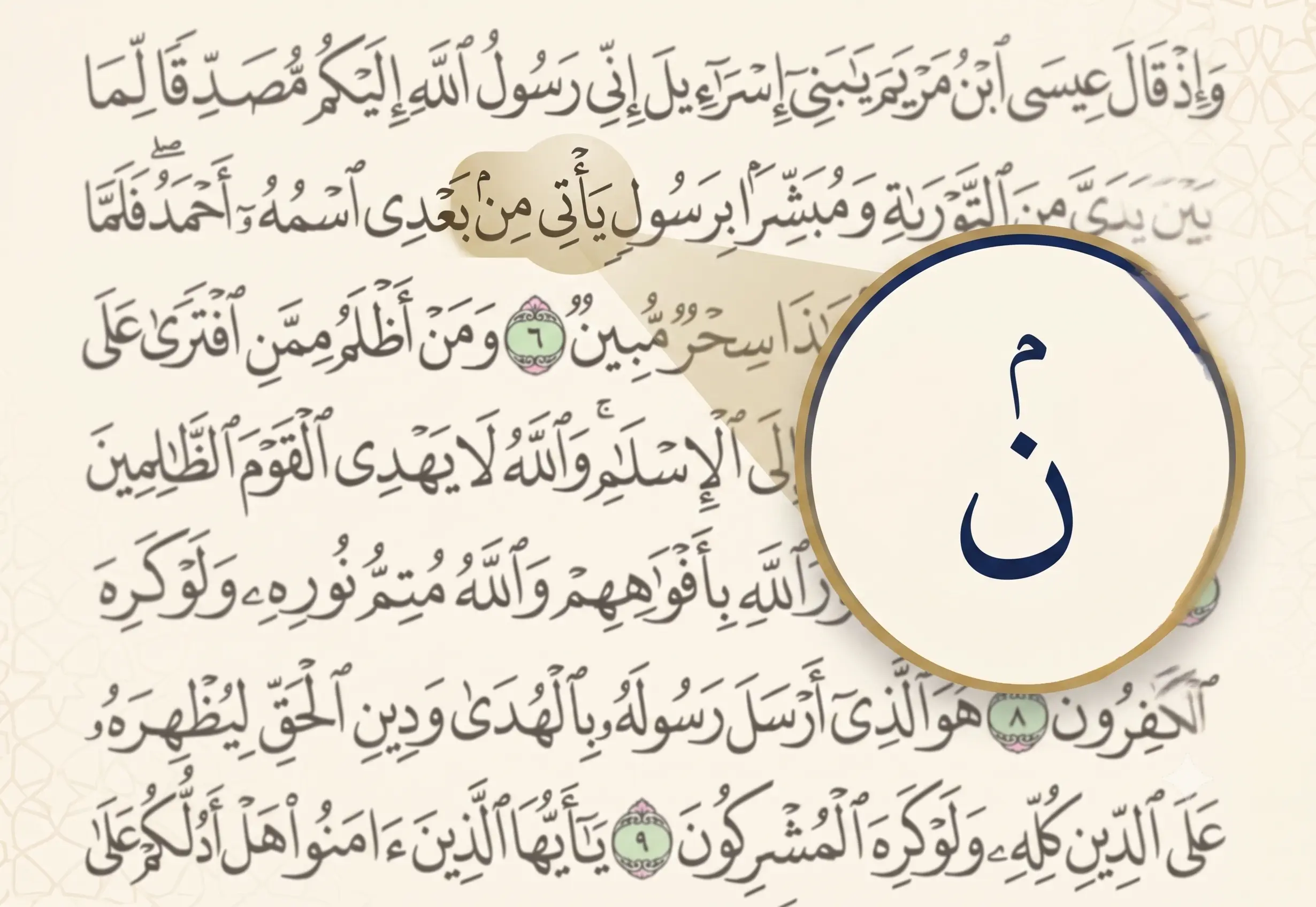
Iqlab is the third rule of Noon Sakinah and Tanween. When a silent Noon (نْ) or Tanween is followed by the letter ب, the Noon changes into a hidden Meem (م) pronounced with a two-count nasal sound. Iqlab has only one trigger letter, which makes it the simplest of the four rules of Noon Sakinah and Tanween to recognise.
Also spelled Iqlaab, Ilqab or Eqlab in English transliterations.
⚡ The 30-second version: one trigger letter (ب) · the Noon or Tanween becomes a Meem · that Meem is hidden, not pressed shut · the nasal sound lasts two counts · in the Mushaf you will see a small Meem (ﻤ) above the Noon, and the Noon carries no sukoon.
What Does Iqlab Mean?
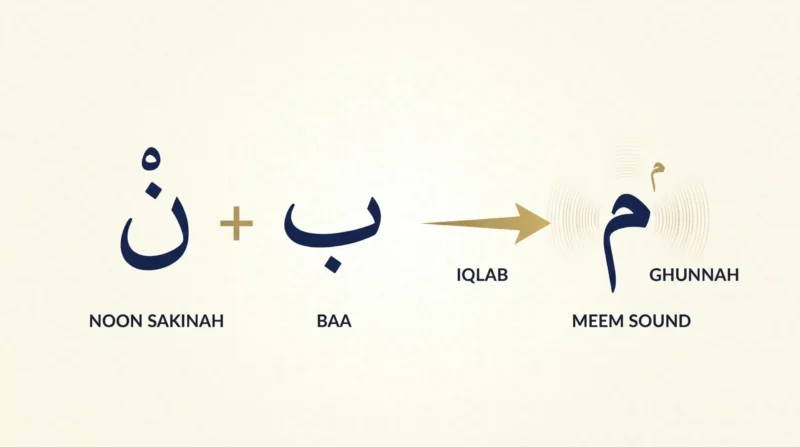
Iqlab (إقلاب) literally means “to flip”, “to turn something over” or “to convert”. In Tajweed it means turning a silent Noon or Tanween into a hidden Meem before the letter ب, held with a nasal sound of two counts.
The word comes from the root q-l-b (قَلَبَ) — to overturn, to flip a thing onto its other side. The name is unusually literal here. Nothing is being softened, shortened or concealed: one letter is replaced by a different letter.
That single fact is worth pausing on, because it is what separates this rule from its three neighbours.
A conversion, not a concealment
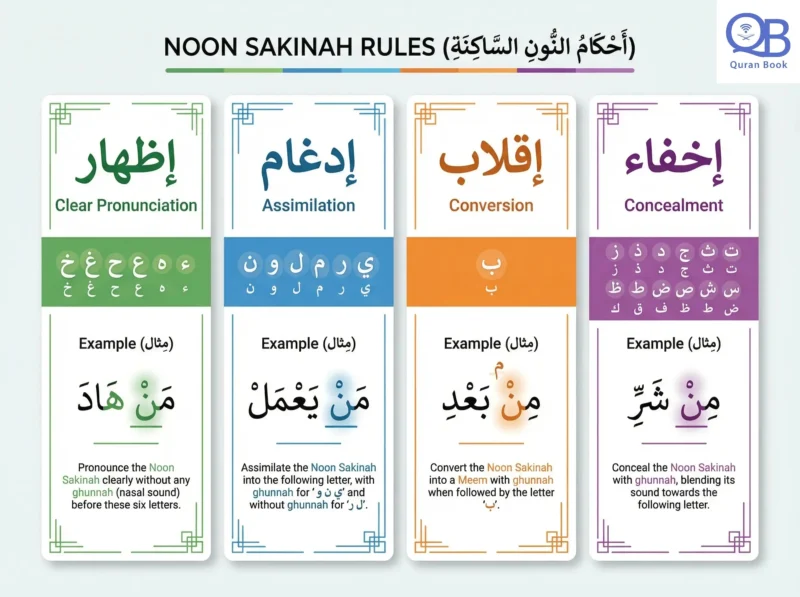
In Izhar the Noon is announced. In Idgham it dissolves into the letter after it. In Ikhfaa it stays a Noon but is veiled. Only in this rule does the Noon stop being a Noon at all and become something else. It is the one place in the four rules where the identity of the letter itself changes — and that is exactly what the Arabic name says.
So the working definition to carry with you is this: a silent Noon before ب is read as a Meem — a Meem you hide rather than announce. Everything else on this page is detail hanging off that sentence.
The Iqlab Letters — Just One
Learners arrive here expecting a list, because Izhar has six letters and Idgham has six. This rule has one. There is no mnemonic to learn, no grouping to memorise and no exceptions to file away — which makes it the fastest rule in Tajweed to learn properly.
Why ب specifically, and why a Meem?
This is the part that turns a rule you memorise into a rule you understand, and it comes down to what your mouth can physically do.
The Noon is voiced and nasal: the tongue tip meets the gum line and air escapes through the nose. The Baa is a lip sound with a small explosion in it — the lips press shut, pressure builds, and the sound releases. Moving straight from a nasal front-of-tongue consonant into a pressurised lip consonant is awkward, and the Arabs did not do it.
🔑 The Meem is the bridge. It shares the nasal quality of the Noon and the lip position of the Baa — the only letter in Arabic that belongs to both worlds at once. The tongue never has to travel, because the sound is handed from the nose to the lips in a single motion.
Linguists call this place assimilation: a consonant shifting its point of articulation towards the one that follows it. It happens in English too — most speakers say “ten bags” with an M-like sound in the middle without ever being taught to. What Tajweed does is take that natural tendency and fix it as a precise, measured rule. You can see where each of these sounds is formed in our guide to the Makhraj of Arabic letters.
How to Spot Iqlab in the Mushaf
Most learners meet this rule twice: once in a lesson, and once again a week later when they open the Quran, see a Noon with no sukoon on it and a tiny letter floating above, and wonder what happened. This is the section that answers that.
1. The Noon carries no sukoon
This is the first signal, and it is a signal of absence. Everywhere else a silent Noon wears the small circle of sukoon. Here it wears nothing — because it is no longer going to be pronounced as a Noon.
2. A small Meem sits above it
In its place you will find a miniature Meem (ﻤ) drawn above the Noon. That mark is an instruction: read this letter as a Meem. It is the whole rule, printed into the text.
3. With Tanween, the two marks stop being parallel
A normal Tanween is written as two identical marks side by side. Before a ب they are staggered — set one after the other rather than level — and the small Meem is placed with them. Once you have noticed this once, you will never miss it again.
Symbol spotter: see the difference in ten seconds
Switch between the three specimens below and tap the highlighted letter in each one. The first is an ordinary silent Noon; the second and third are Iqlab, with a Noon and with a Tanween.
Tap the highlighted letter in the specimen above.
One caveat worth knowing: this small-Meem notation is the convention of the Madinah Mushaf in the narration of Hafs, printed by the King Fahd Glorious Quran Printing Complex and followed by most editions in circulation today. Some regional prints mark it slightly differently. The rule does not change — only the ink does.
How to Pronounce Iqlab Correctly
Understanding this rule takes about a minute. Producing it correctly takes longer, because almost everyone makes the same mistake — and it is a mistake you cannot hear in your own mouth until someone points it out.
⚠️ The Meem here is not a full Meem
It is a hidden Meem — Meem Mukhfaah. The lips come close together; they do not press shut. If you clamp them the way you would for the M in “mother”, you have produced a clear Meem and lost the rule. The sound should feel unfinished at the lips and complete at the nose.
1. Do not pronounce the Noon at all
The tongue tip never touches the gum line. There is no trace of an N before the M — the letter was replaced, not decorated.
2. Bring the lips near, and hold the nasal sound for two counts
A small gap of air stays between the lips while the sound runs out through the nose. Two counts is the same length used in Ikhfaa and in Idgham with ghunnah — roughly two relaxed finger taps.
3. Release straight into the Baa — no pause
The lips are already in position, so the Baa needs no travel at all. Only now do they close fully, for the Baa itself.
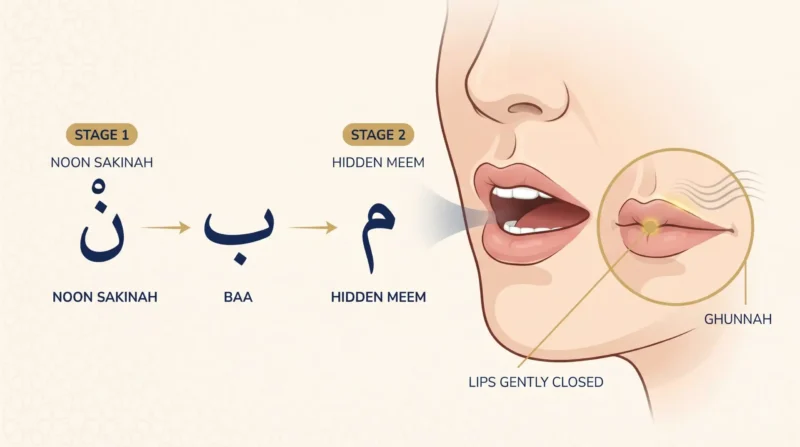
There is a shortcut here that most pages never mention. This sound is not new to you if you already know Ikhfaa: the hidden Meem here is produced with exactly the same mechanism as Ikhfaa Shafawi, the hiding of a silent Meem before a ب. Same lips, same gap, same two counts. Learn one and you have learned both — compare the two clips below.
مِنۢ بَعْدِ مِيثَٰقِهِۦ
Iqlab — a silent Noon converted to a hidden Meem
تَرْمِيهِم بِحِجَارَةٍ
Ikhfaa Shafawi — a silent Meem hidden before the same ب. Identical mouth position.
💡 The mirror exercise
Say مِنۢ بَعْدِ in front of a mirror. If your lips visibly press and flatten before the ب, the Meem has become clear and the rule is gone. Then say the English words “some bread” naturally — that light, unpressed M in the middle is very close to the sound you want.
Iqlab Rules: When It Applies
The trigger has no conditions attached to it: a silent Noon or a Tanween, followed by ب. That combination shows up in three shapes.
1. Inside a single word
The silent Noon and the ب sit in the same word.
أَنۢبِئْهُم · لَيُنۢبَذَنَّ
2. Across two words
The word ends on a silent Noon and the next word opens with ب.
مِنۢ بَعْدِ · أَنۢ بُورِكَ
3. Tanween + ب
All three Tanween endings behave exactly like a silent Noon, because that is phonetically what they are.
سَمِيعٌۢ بَصِيرٌ · صُمٌّۢ بُكْمٌ
⚠️ A difference worth filing away: this rule works in all three positions without conditions. Idgham does not — it never applies inside a single word, which is why الدُّنْيَا is read clearly instead of merged. Here, أَنۢبِئْهُم converts just as readily as مِنۢ بَعْدِ.
Iqlab vs the Other Noon Sakinah Rules
Four rules, one silent Noon, and the only thing that decides between them is the letter that comes next.
If you keep one sentence from this page, keep this one: Izhar reveals the Noon, Idgham erases it, Ikhfaa veils it — and Iqlab converts it. Three of the four rules decide how much of the Noon you hear. Only this one decides which letter you hear instead.
Interactive Practice: Find the Iqlab
Iqlab has one letter — but can you spot it inside a verse, with the other three rules competing for your attention? Ten questions, instant feedback, no sign-up.
Choose the rule that applies to the highlighted letter.
Iqlab Examples from the Quran
Six short examples covering both word positions and all three Tanween endings. The Noon or Tanween is marked in blue, the ب in orange. Each clip is a few seconds of the continuous recitation of Sheikh Mahmoud Khalil Al-Husary — recited at normal pace, not word by word.
مِنۢ بَعْدِ مِيثَٰقِهِۦ
Al-Baqarah 2:27 · Noon Sakinah + ب across two words
لَيُنۢبَذَنَّ فِى ٱلْحُطَمَةِ
Al-Humazah 104:4 · Noon Sakinah + ب inside one word
كَانَ سَمِيعًۢا بَصِيرًۭا
An-Nisa 4:58 · Tanween fatḥ + ب
لَنَسْفَعًۢا بِٱلنَّاصِيَةِ
Al-‘Alaq 96:15 · Tanween fatḥ + ب
صُمٌّۢ بُكْمٌ عُمْىٌ
Al-Baqarah 2:18 · Tanween ḍamm + ب
كِرَامٍۭ بَرَرَةٍ
‘Abasa 80:16 · Tanween kasr + ب
Two more worth knowing by heart, because they close dozens of ayat between them: سَمِيعٌۢ بَصِيرٌ and عَلِيمٌۢ بِذَاتِ ٱلصُّدُورِ. And inside a single word, the clearest example of all is أَنۢبِئْهُم — get this rule right once and it pays out across the whole Quran.
Common Mistakes to Avoid
1. Pressing the lips shut
The number one error worldwide. A firmly closed lip turns the hidden Meem into a clear one, and the two-count nasal sound is lost with it. Close enough to feel the air, not enough to feel pressure.
2. Sounding the Noon before the Meem
Producing a faint “n” and then the Meem. The Noon is not present in any form — it was converted, and the tongue tip has no work to do at all.
3. Cutting the nasal sound short
Two counts, the same measure as Ikhfaa. Rushing it produces something that sounds almost like clear pronunciation, and dropping it entirely removes the rule altogether.
4. Stopping between the Meem and the ب
There is no gap and no catch of breath. The two sounds are continuous — the lips simply finish closing.
5. Forgetting that Tanween counts
Readers watch for a written Noon and recite straight past سَمِيعٌۢ بَصِيرٌ. A Tanween is a silent Noon that simply is not written as a letter — the rule applies identically.
Play: Catch the Iqlab Letter (Free Game)
Recognition under time pressure is a different skill from recognition on a page. Catch the letter that triggers the rule, dodge the rest, and see how long you last. It works on phones and tablets, and no account is needed.
Game not loading? Open it in a new tab · or browse all our free Arabic letter games.
Learn More
Iqlab is one of four rules that govern the silent Noon. Here’s what to study next:
All of them sit inside the wider set of Tajweed rules, and all of them are covered step by step in our Tajweed courses.
Frequently Asked Questions
May Allah beautify your recitation and accept it from you. 🤲
Hafidha of the Quran · Arabic Language Graduate · Writer on Islamic Sciences
Jehad Mahmoud is a graduate of the Arabic Language department and a Hafidha of the Quran who writes the Islamic educational content at Quran Book Academy.
She writes with a focus on Tajweed, Quranic recitation and the sharia sciences, making technical rules accessible to English-speaking Muslim families.
Her articles are educational, not fatwa. For a ruling on a specific personal situation, readers are advised to consult a qualified scholar or mufti.
References & Sources
1. King Fahd Glorious Quran Printing Complex — qurancomplex.gov.sa
2. Encyclopedia of Arabic Language and Linguistics — Brill Reference Works
3. Al-Azhar Al-Sharif — azhar.eg
4. Surah Al-‘Alaq 96 — Quran.com
5. Recitation — Sheikh Mahmoud Khalil Al-Husary, via EveryAyah.com
© 2026 Quran Book Academy. All rights reserved.
Book Your Free Trial · Empowering Muslims Worldwide to Connect with the Quran