Fatha in Arabic: One Small Dash, One Open “a”
Hear it on every letter, read your first words, and test yourself.
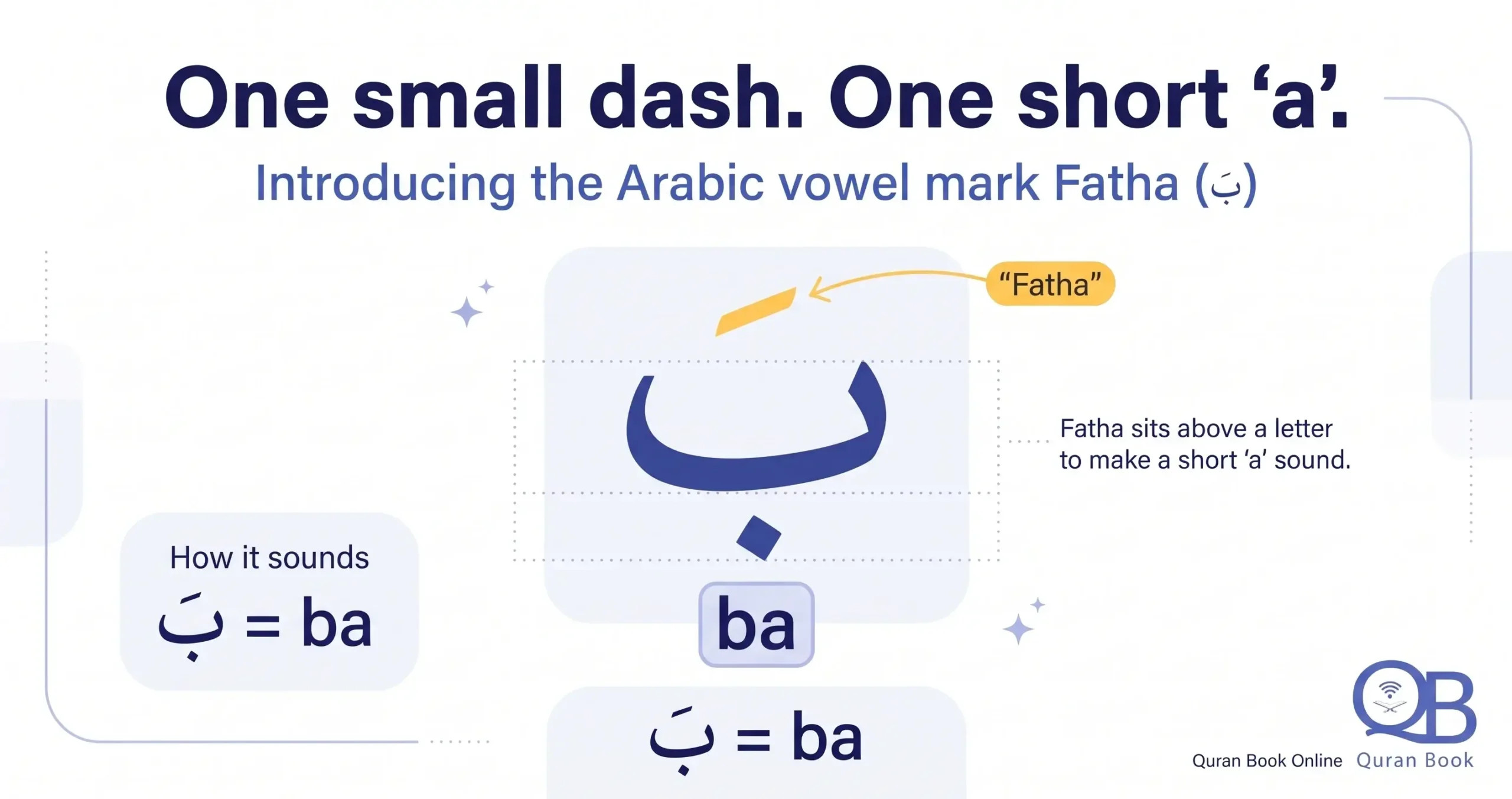
ببَ
b → ba
ب is just a “b”. Add one tiny dash above it — بَ — and it says “ba”. That tiny dash is the fatha, and it is the first vowel mark most learners meet. Fatha is one of the three Arabic harakat, the small marks that tell you which vowel to say after a letter.
This lesson covers fatha in Arabic from the first sound to your first words: you’ll hear it on all 28 letters, learn why it sounds fuller on some of them, read your first syllables and words, and test yourself as you go. Whenever you see ▶, tap it.
In this lesson
What Is Fatha in Arabic?
Fatha is a small slanted dash written above a letter: ـَ. It is a vowel mark, not a letter. The letter gives you the consonant, and the fatha adds a short “a” right after it. So ب (b) becomes بَ (ba), and م (m) becomes مَ (ma).
The name tells you how to say it. Fatḥa (فَتْحَة) means “an opening” — open your mouth and you’ve already said it. You’ll see this mark on almost every line of the Mushaf, so it’s worth getting right first.
One thing not to mix up: two fathas stacked together (ـً) are a different mark called tanween. You’ll meet it later in Tanween in Arabic.
What Does the Fatha Sound Like?
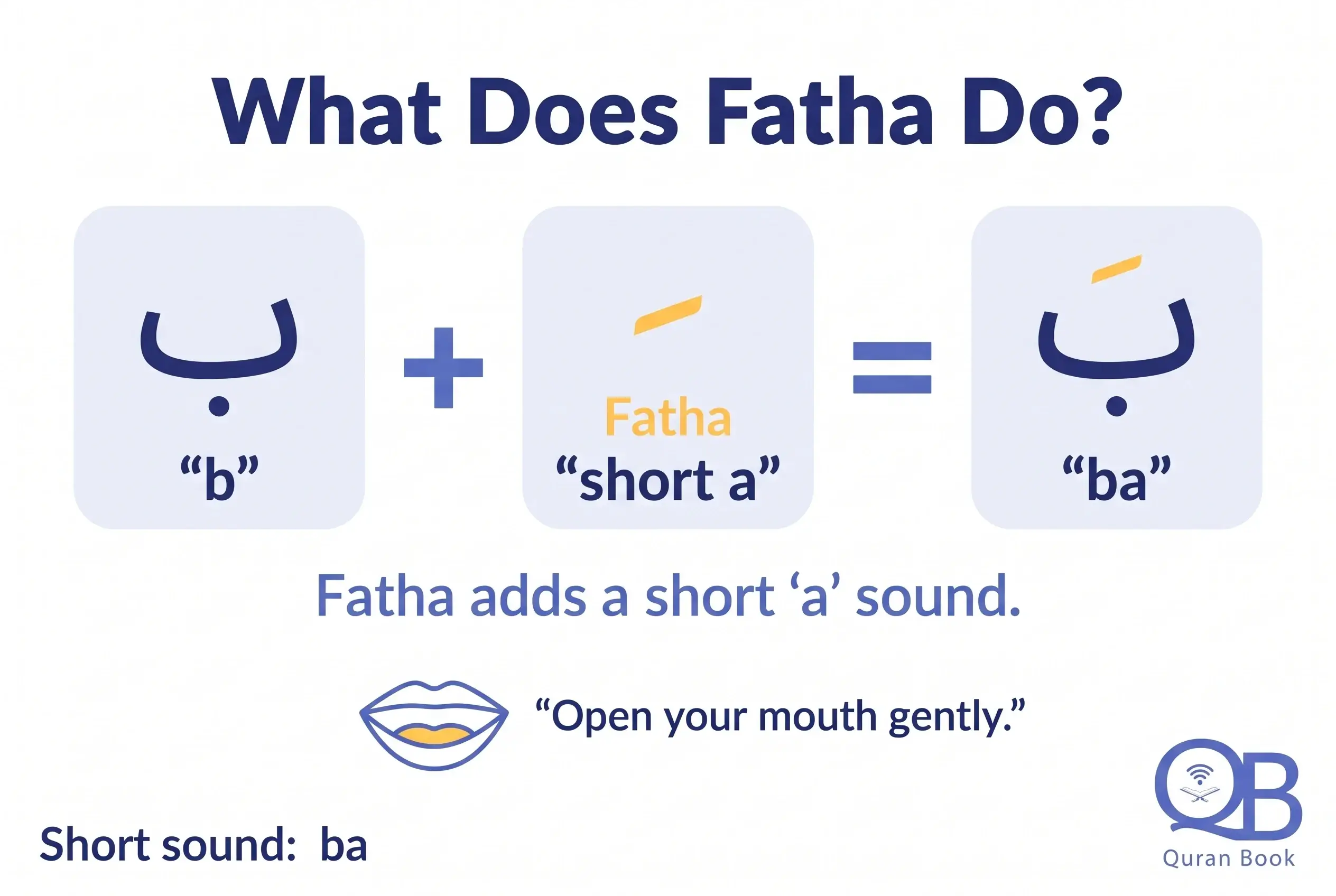
The fatha sound is a short, open “a”. Your mouth opens, and the sound stops quickly. Listen:
Three rules for a clean fatha
- Open. Your jaw drops a little. Never “e”: it’s ba, not “beh”.
- Short. One beat: ba, not baa. Holding it longer turns it into one of the Arabic long vowels — a different lesson.
- Always the same mark. The letter changes; the fatha’s job doesn’t.
That single quick beat is what makes fatha a short vowel. Tip: rest a hand under your chin. On a clean fatha, you’ll feel your jaw drop a little.
Light and Heavy Fatha
On most letters, fatha is light and bright: سَ (sa). On the seven always-heavy letters — خ ص ض ط ظ غ ق — and on رَ, the back of the tongue rises, and the “a” sounds fuller and deeper: صَ (ṣa). It is still an “a”, never an “o”. Tap each pair a few times — the difference is small, but your ear will catch it:
Want the full picture? Read about heavy letters in Arabic.
Arabic Alphabet With Fatha: All 28 Letters
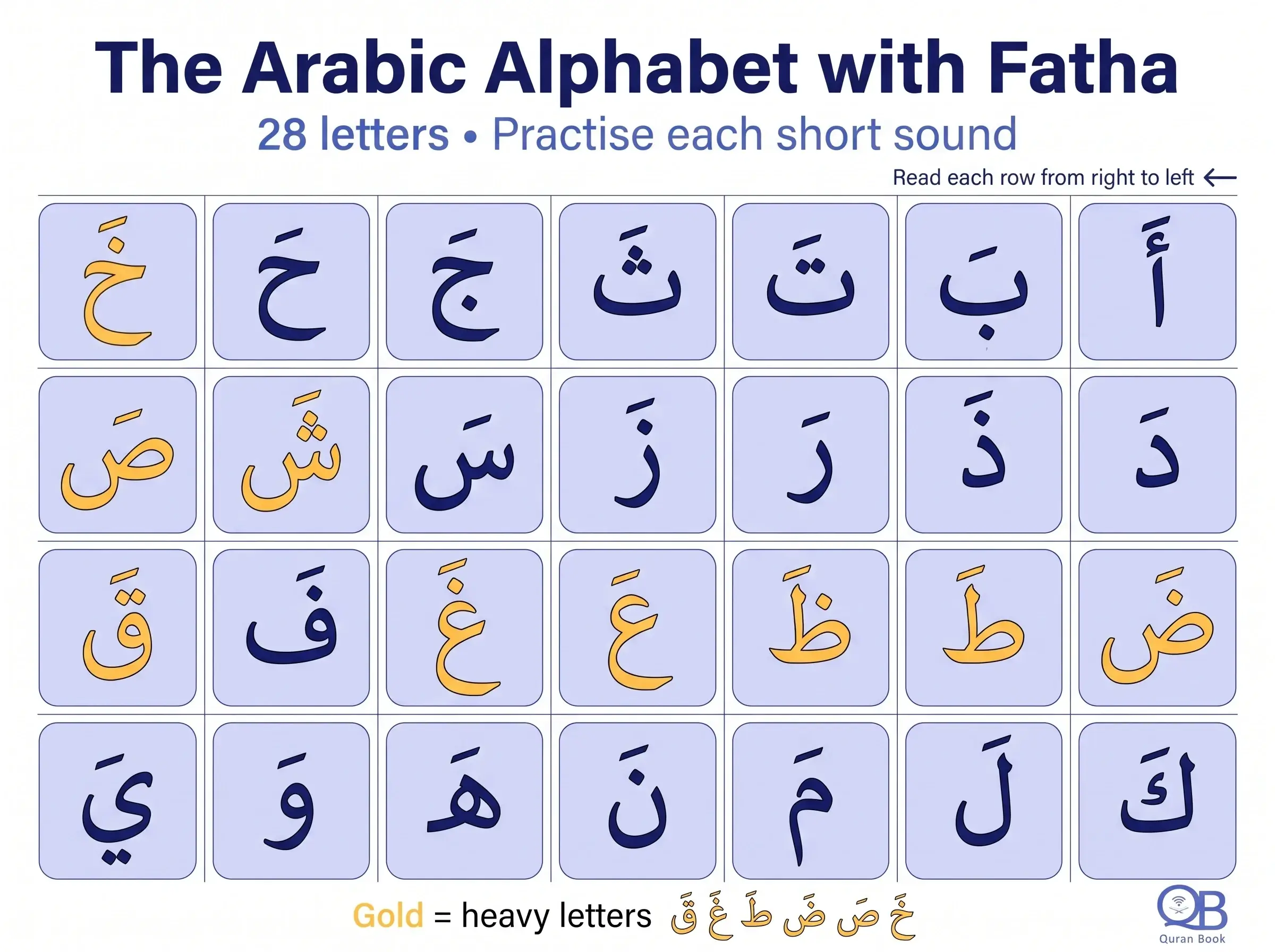
Here is the Arabic alphabet with fatha: every letter, one short “a”. The eight heavy letters are in gold, so you can hear the fuller “a” as you go. Read a row out loud first, then tap to check yourself.
Reading Arabic Letters With Fatha
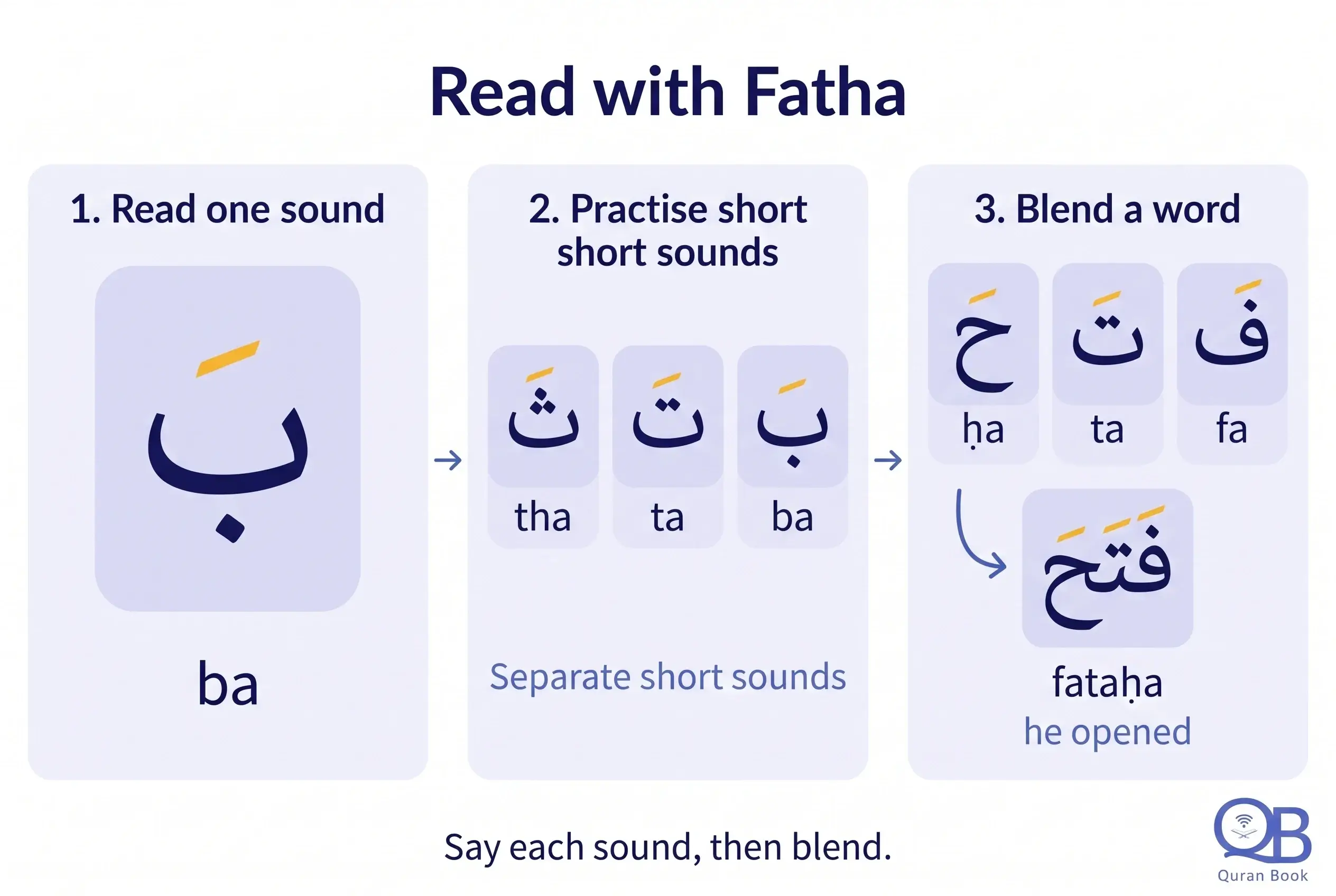
Now put the fatha to work. Read each item out loud first, then tap to check yourself. Go slowly — at this stage, a clean sound matters more than speed. There are three levels:
- Level 1 — one syllable: بَ · سَ · لَ · نَ
- Level 2 — two syllables: بَ تَ · مَ نَ · سَ لَ · دَ كَ
- Level 3 — three-letter words with only fathas. Each word is split first, فَ | تَ | حَ, then joined: فَتَحَ.
A nice surprise: فَتَحَ (fataḥa) means “he opened” — the same root as the word fatḥa.
Inside words, the letters join together. If a shape looks new, see Arabic letters beginning, middle & end.
Fatha vs Kasra and Damma
Same letter, three marks, three different sounds. Fatha has two partners: kasra is a dash below the letter for “i”, and damma is a small curl above it for “u”. Today, fatha only — the next lesson is kasra Arabic. To see all three side by side, visit Arabic harakat.
Hear Fatha in the Quran
Fatha is everywhere in the Quran. Listen to these two short ayat and look for the fathas as you hear them.
🔊 Look and listen
عَبَسَ وَتَوَلَّىٰٓ
ʿabasa wa tawallā — “He frowned and turned ˹his attention˺ away,” (ʿAbasa 80:1)
Look for: عَبَسَ (ʿabasa): three letters, three fathas — ʿa-ba-sa.
خَلَقَ ٱلۡإِنسَٰنَ مِنۡ عَلَقٍ
khalaqa l-insāna min ʿalaq — “created humans from a clinging clot.” (Al-ʿAlaq 96:2)
Look for: خَلَقَ (khalaqa): three fathas, two of them heavy (خ, ق).
Both ayat recited by Sheikh Mahmoud Khalil Al-Husary, riwayah of Hafs ʿan ʿĀṣim. Audio: EveryAyah. Translation: The Clear Quran, Dr. Mustafa Khattab.
Did you hear the fuller “a” on خ and ق? That’s the heavy fatha from light and heavy fatha.
Seeing the fatha is easy. Keeping it open, short and the right weight on every letter is what a teacher listens for in your first lessons.
Book Your Free Trial LessonStarting as a grown-up? See how we help you learn Quran reading for adults, one-on-one.
Fatha Games
Ready for a bigger challenge? This fatha game gives you 28 quick rounds: tap the letter with a fatha above it, and hear the right answer. Spot them all, and you’re ready for kasra.
Fatha for Kids: Simple Practice at Home
Teaching your child? Fatha is a great first vowel because it’s easy to see and fun to say. Short, daily practice beats one long session:
- Use big letters and do one row of the chart a day.
- Say “open your mouth — a!” and lift your hand as you say it.
- Use “find every fatha” and the reading levels together on your phone.
- Praise the open “a”. If you hear “e”, gently say it again together.
- Stop while it’s still fun.
Try it with your child
Read these aloud together, then tap to check:
Want a teacher to guide your child? See our Quran reading for beginners classes.
Free Fatha Worksheets for Kids
Prefer paper? Download these free fatha worksheets — no sign-up, just print and practise. They follow the same order as this lesson.
📄 Arabic Alphabet With Fatha Chart
All 28 letters with fatha on one page — keep it next to your Mushaf.
Download the chart (PDF)📄 Fatha Practice Pack for Kids
Circle, match and read — 4 pages of practice, with an answer key on the last page.
Download the pack (PDF)Common Fatha Mistakes Beginners Make
Most beginners make at least one of these. Each one is easy to fix once you can hear it.
- ❌ “beh” — closing the fatha into “e” → ✅ open your mouth: ba. A mirror helps — you should see your jaw drop.
- ❌ “baa” — stretching it → ✅ one beat; the long one is a different sound. Try one clap per syllable.
- ❌ The same light “a” on every letter → ✅ fuller on خ ص ض ط ظ غ ق and رَ.
- ❌ Reading بَ as just “b” → ✅ every marked letter gets its vowel, even the last one in a word.
- ❌ Reading two fathas (ـً) as one → ✅ that’s tanween — a different mark.
What to Learn After Fatha
Take your time here. Once fatha feels easy on every letter, the next two marks come quickly, because the method is the same: see the mark, say the vowel.
- Next lesson: kasra Arabic — the “i” mark under the letter.
- Then dammah — the “u” curl above the letter.
- See where this fits in the full path to how to read Arabic.
📚 Learn More
Why some letters sound fuller: heavy letters in Arabic
Want a free guided start? learn Arabic reading free
Fatha FAQ
What is fatha in Arabic?
Fatha (فَتْحَة) is a small slanted line written above an Arabic letter. It is a vowel mark, not a letter: it tells you to add a short “a” sound after the letter, so ب (b) with fatha, بَ, is read “ba”.
What sound does fatha make?
Fatha makes a short, open “a” sound — the mouth opens and the sound stops quickly: بَ (ba), تَ (ta), مَ (ma). It should never sound like “e”, and it should not be stretched into “baa”.
Is fatha a short vowel?
Yes. Fatha is one of the three Arabic short vowels, together with kasra and damma. It lasts one beat. When a fatha is followed by the letter alif (ا), the sound is held for two beats and becomes a long vowel.
Why does fatha sound different on some letters?
On the heavy letters — خ ص ض ط ظ غ ق — and on رَ, the back of the tongue rises, so the fatha sounds fuller and deeper: compare سَ (sa) with صَ (ṣa). It is still an “a” sound, never an “o”.
Does fatha ever sound like “e”?
In the recitation of Hafs ʿan ʿĀṣim, almost never. There is one exception in the whole Quran: the word مَجۡر۪ىٰهَا in Surah Hud (11:41) is read with a sound tilted towards “e”, called imāla. Everywhere else, fatha stays an open “a”.
How do you read Arabic letters with fatha?
Say the letter’s sound, then a short “a”: ب + fatha = ba, س + fatha = sa. Alif cannot carry a vowel itself, so at the start of a word the fatha sits on a hamza: أَ (ʾa).
How can kids learn fatha?
Keep it short and playful: one row of letters a day, big print, and the same three steps — look, listen, say it. Tap-to-hear games and a printable chart help children connect the mark with the open “a” sound.
What does the word “fatha” mean?
Fatḥa comes from the Arabic verb فَتَحَ (fataḥa), “to open”. It describes how the mouth opens to make the “a” sound.
You can now read every letter with fatha
Next come kasra and damma — and a teacher can make sure all three sound right from your very first lesson.
Book Your Free Trial LessonReferences
- Quran.com — Surah ʿAbasa 80:1, Surah Al-ʿAlaq 96:2 and Surah Hud 11:41 (Uthmani text).
- Translations: The Clear Quran, Dr. Mustafa Khattab, via quran.com.
- Recitation: Sheikh Mahmoud Khalil Al-Husary (murattal, Hafs ʿan ʿĀṣim), audio via EveryAyah.com.
- Encyclopaedia Britannica, “Arabic alphabet”.
- Syllable and word audio recorded in-house by Quran Book Online.