
When a meem sakinah is followed by the letter ب at the start of the next word, the meem is not pronounced fully clearly, and it is not merged into the ba either. It is concealed, with a ghunnah held for two counts, and then the ba is pronounced. You can hear it in تَرْمِيهِم بِحِجَارَةٍ. That is Ikhfa Shafawi, and it has exactly one trigger letter: ب. It is one of the three rules of Meem Sakinah inside the wider set of Tajweed rules — and one of its clearest examples sits in a surah you probably already know by heart.
Also written Ikhfaa Shafawi, Ikhfa Shafawee or Ikhfa Shafawi Meem Sakinah — in Arabic, إخفاء شفوي.
⚡ The 30-second version: one trigger letter (ب) · a meem sakinah at the end of one word meets a ba at the start of the next · conceal the meem — don’t pronounce it fully clear, don’t merge it · keep a ghunnah of two counts · then pronounce the ba. Teachers describe the exact lip position in two ways, covered below; the rest of this page is about making your mouth do it — and about not mixing it up with Iqlab.
What Is Ikhfa Shafawi?
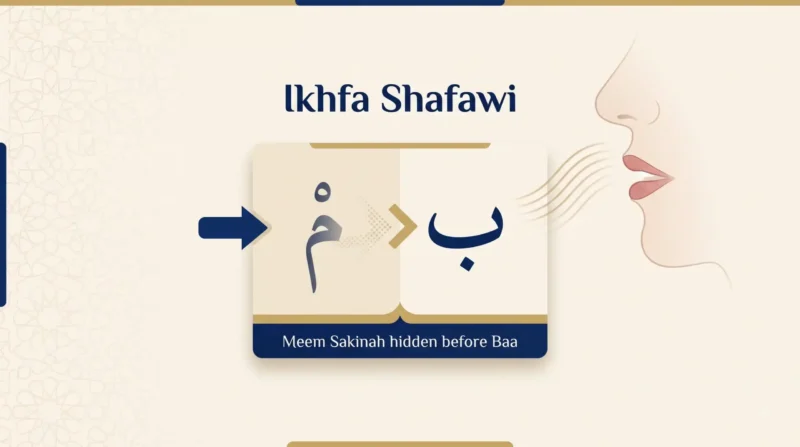
Ikhfa Shafawi (إخفاء شفوي) is the Tajweed rule for a meem sakinah (مْ) followed by the letter ب in the next word. The meem is neither pronounced fully clearly (Izhar) nor merged into the ba (Idgham): it is concealed — a state between the two — with a ghunnah held for two counts.[3][1]
Both halves of the name are literal. Ikhfa (إخفاء) means concealing: the meem sakinah is concealed when it meets the ba. Shafawi (شفوي) means “of the lips”, from shafah (شفة), because the meem and the ba are both pronounced from the two lips.[3] So the name gives you the action and the place.
Why “hidden” and not “merged”?
Because that is how the rule was transmitted. Imam Ibn al-Jazari reported that the reciters of old differed over a meem sakinah before ba — some pronounced it clearly, some concealed it, and some merged it — and he stated that he held concealment.[1] Hidayat al-Qari records concealment with ghunnah as the chosen practice, followed by the reciters of Egypt, the Levant, al-Andalus and elsewhere.[3]
The same book gives a reason (wajh) for the ruling: the meem and the ba share the same articulation point at the lips and most of their attributes.[3] Treat that as an explanation of a ruling that was received from teachers, not as a formula you can use to work out rulings yourself. “Different letters can’t merge” is not a rule either — a noon sakinah, for example, is merged into a following م, و or ي, all letters other than noon — so Tajweed rulings are learned as they were transmitted.[2] Meem before meem has its own separate ruling, Idgham Shafawi.
Ikhfa Shafawi Letters: Just One
There is one Ikhfa Shafawi letter: ب.[3] That is the entire list. Whenever a meem sakinah at the end of a word is followed by a ba at the start of the next word, and you recite the two words joined, the chosen practice is Ikhfa Shafawi.
What is worth memorising is how that one letter sits against the other two rules of the chapter, because the three of them together account for every letter that can follow a meem sakinah (a meem sakinah never comes before an alif of madd).[3]
| Rule | Number of Letters | Trigger Letters |
|---|---|---|
| Ikhfa Shafawi ← this page | 1 | ب |
| Idgham Shafawi | 1 | م |
| Izhar Shafawi | 26 | All the remaining letters |
Source for the letter counts: Hidayat al-Qari, chapter on Meem Sakinah.[3]
(end of word 1)
(start of word 2)
Ba is the only trigger letter for Ikhfa Shafawi.
Teaching notation: the sukoon is drawn on مْ here to show that the meem is sakin (vowelless). In the Madani mushaf this meem is printed without a sukoon — see below.
How to spot it in the mushaf
In the Madani-style mushaf the meem here carries no sukoon — it is written bare:
تَرْمِيهِم بِحِجَارَةٍ
Not تَرْمِيهِمْ with a sukoon on the meem. A bare, unmarked meem is your cue that something other than Izhar is happening — so check the next letter. If it is ب, this is Ikhfa Shafawi. If it is م with a shaddah, it is Idgham Shafawi. Once you have noticed this a few times you stop working the rule out and simply see it.
⚠️ Note: Ikhfa Shafawi only occurs across two words — the meem ends one word and the ب begins the next.[3] The rule applies when you recite the two words joined; if you stop on the first word, no ba follows the meem. More on the whole chapter in the rules of Meem Sakinah.
How to Pronounce Ikhfa Shafawi (4 Steps)
Four steps. The ghunnah and its length are the parts every teacher agrees on; the exact lip position is described in two ways, explained after the steps.
1. Ease the pressure on your lips
A concealed meem is pronounced with less pressure on the lips than a clear meem.[1] Teachers describe the position either as light contact without pressing or as a very slight gap — neither presses the lips hard, and neither opens them wide. Follow the way your teacher received it.
2. Keep the sound flowing through your nose
The ghunnah is a nasal sound. Keep it smooth and steady, without stretching it or turning it into a sung note.[2]
3. Hold for two counts
The ghunnah of a concealed meem is a full ghunnah of two counts, measured like a natural madd at your recitation pace — no longer and no shorter.[2] Because your pace changes between slow and faster recitation, two counts is a rhythm, not a fixed number of seconds.
4. Then pronounce the ba
At the end of the ghunnah the lips come together for the ب itself, which is pronounced clearly. Recited joined, تَرْمِيهِم بِحِجَارَةٍ flows as one continuous phrase.
👃 About the nose-pinch test
Some guides suggest pinching your nose to “check” the ghunnah. Hidayat al-Qari notes that holding the nose blocks the nasal sound of a meem in every state — even a clearly pronounced meem, which keeps its basic nasal quality without the full two-count ghunnah.[2] So pinching your nose during أَلَمْ تَرَ will also affect the sound. The test can show that a nasal sound is present; it cannot tell you whether you held a full two-count ghunnah or concealed the meem correctly. That is judged by ear.
What the sources say about the lips
Teachers do not all describe the lip position for Ikhfa Shafawi in the same way, and it is better to know that from the start.
- IslamWeb’s fatwa no. 52856 describes the question — whether the lips close or keep a small gap, in both Iqlab and Ikhfa Shafawi — as a point of difference among the later reciters.[1]
- The fatwa says it found no explicit statement from Imam Ibn al-Jazari either way. He chose concealment (ikhfa), and some understood that to mean leaving a small gap; the fatwa points out that texts from earlier scholars complicate that reading — Ibn Ghalbun and Abu ‘Amr al-Dani, as quoted there, describe the lips as closing.[1]
- Contemporary teachers quoted in the fatwa also differ. Some say they received it with the lips closed, and one adds that there is no harm in a light closure without pressing the lips together. Others, quoted from the book Zad al-Muqri’in, prefer a very slight gap: neither a full, tight closure nor an opening so wide that it spoils the concealment.[1]
- The fatwa also mentions contemporaries who accept either way, according to what the reciter received from their teachers.[1]
What both descriptions share: the meem is concealed rather than pronounced with full force, the lips are not pressed hard, the mouth is not opened wide, and the ghunnah is held for two counts. Al-Mar’ashi, quoted in the same fatwa, explains concealing the meem as weakening it by reducing the pressure on its articulation point — not erasing it.[1] This page does not declare either description invalid on the basis of lip contact alone. The exact performance is learned by ear: read to a qualified teacher and follow the way they received it.
Ikhfa Shafawi Examples in the Quran
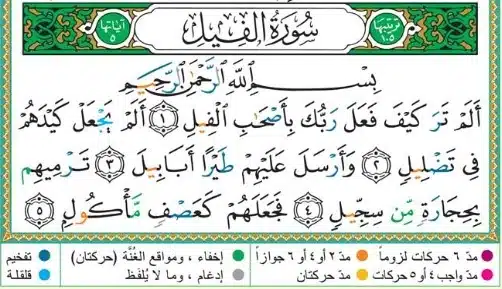
Start with Surah Al-Fil. Ayah 4 holds a clear example of the rule, and the rest of the surah gives you the contrast for free: every other meem sakinah in it is Izhar Shafawi. In the Arabic below, the meem sakinah is shaded blue, the ب orange, Izhar meems green, and — in Iqlab examples — the noon or tanween gold.
Surah Al-Fil walkthrough · hear Izhar and Ikhfa in one surah
Tap a line to hear it.
Now the wider set of Ikhfa Shafawi Quran examples. Ten passages, each one a meem sakinah meeting a ب, recited by Sheikh Mahmoud Khalil Al-Husary. Rows marked short clip play a trimmed excerpt; rows marked full ayah play the whole verse, and the ones marked long verse take a while to reach the example.
تَرْمِيهِم بِحِجَارَةٍ
لَّسْتَ عَلَيْهِم بِمُصَيْطِرٍ
إِنَّ رَبَّهُم بِهِمْ يَوْمَئِذٍ لَّخَبِيرٌ
فَدَمْدَمَ عَلَيْهِمْ رَبُّهُم بِذَنبِهِمْ
أَلَمْ يَعْلَم بِأَنَّ اللَّهَ يَرَىٰ
وَهُم بِالْآخِرَةِ هُمْ يُوقِنُونَ
وَمَا هُم بِمُؤْمِنِينَ
وَمَا هُم بِخَارِجِينَ
أَنبِئْهُم بِأَسْمَائِهِمْ
الَّذِي أَنتُم بِهِ مُؤْمِنُونَ
Ikhfa Shafawi examples from the Quran: the pattern
Look at the word just before the ب in the rows above: هُم, أَنتُم, عَلَيْهِم, رَبُّهُم. Most of them end in a plural pronoun. Train your eye on those endings, then glance at the next letter — that habit will catch many of the cases you meet. Just remember it is a habit, not the rule: in أَلَمْ يَعْلَم بِأَنَّ the meem ends a verb, and the ruling is the same.
Ikhfa Shafawi vs Iqlab: The Confusion Worth Clearing Up
This is the pair that trips up almost every intermediate learner, and for a good reason: they sound the same. Imam Ibn al-Jazari stated that, once the noon has been changed into a meem, there is no difference in pronunciation between أَن بُورِكَ and يَعْتَصِم بِاللَّهِ.[1] Your ear is not deceiving you.
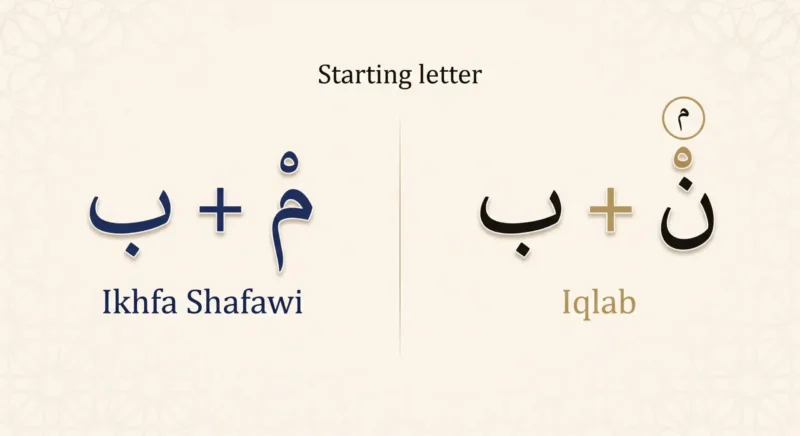
The difference is entirely in what you started with. In Ikhfa Shafawi the letter was already a meem sakinah. In Iqlab it was a noon sakinah or a tanween, which changes into a meem before the ba — and that meem is then concealed.[2] Same destination, different starting point — which is why you cannot tell them apart by listening alone, and why the mushaf marks them differently.
تَرْمِيهِم بِحِجَارَةٍ
لَنَسْفَعًا بِالنَّاصِيَةِ
| Feature | Ikhfa Shafawi | Iqlab |
|---|---|---|
| Starting letter | م sakinah | ن sakinah or tanween |
| Following letter | ب | ب |
| What happens | The meem sakinah is concealed | The noon or tanween changes into a meem, which is then concealed |
| Ghunnah | ✅ 2 counts | ✅ 2 counts |
| Where it occurs | Across two words only | Inside one word or across two words |
| Mark in the Madani mushaf | The meem is printed without a sukoon | A small م is printed with the noon or tanween |
| Example | تَرْمِيهِم بِحِجَارَةٍ | مِن بَعْدِ · أَنبِئْهُم |
The Arabic on this page uses simplified vowel notation, so the small Iqlab م is not drawn in it — you will see that mark in a Madani-style mushaf. Sources: [2], [3], and Ibn al-Jazari’s examples quoted in [1].
🔑 The one-line takeaway: if it was already a meem, it is Ikhfa Shafawi; if it was a noon or a tanween, it is Iqlab. In a Madani-style mushaf you also get a visual cue: the small م printed for Iqlab. The full treatment of Iqlab lives in our guide to the Noon Sakin rules.
Ikhfa Shafawi vs the Other Meem Sakinah Rules
The three rules of Meem Sakinah all start from the same place — a meem sakinah — and the letter that follows decides what happens to it: concealed before ba, merged into a following meem, or pronounced clearly before every other letter.[3]
| Feature | Ikhfa Shafawi | Idgham Shafawi | Izhar Shafawi |
|---|---|---|---|
| Trigger | ب | م | The other 26 letters |
| How the meem is pronounced | Concealed before ba | Merged into the following meem | Pronounced clearly |
| Ghunnah | ✅ Full ghunnah, 2 counts | ✅ Full ghunnah, 2 counts | No added two-count ghunnah |
| Example | تَرْمِيهِم بِ | وَلَكُم مَّا | أَلَمْ تَرَ |
Every meem keeps its natural nasal quality; what Izhar does not have is the full, two-count ghunnah of the other two rules.[2]
4 Common Ikhfa Shafawi Mistakes
1. Pressing the lips hard — or opening them wide
Pressing the lips firmly together, as you might for a clear meem, pronounces the meem with too much force for a concealment. Opening the lips wide goes wrong the other way. Neither of the two descriptions in the scholarly difference above does either.[1]
2. Dropping the ghunnah
The meem is concealed but the nasal sound fades out. The ghunnah of a concealed meem is a full two-count ghunnah, not a trace.[2]
3. Stretching the ghunnah past two counts
The over-correction of mistake 2. Ghunnah is performed smoothly, without stretching and without adding to or cutting from its set length.[2] If you notice yourself droning, listen to the recording again and match its length.
4. Cutting the ghunnah short before the ba
The mouth is already reaching for the next word, so the two counts shrink. Give the ghunnah its full length, then pronounce the ba.
Practise Ikhfa Shafawi
Rhythm practice timer
This timer measures one thing only: how long you hold the button. It does not hear your recitation, so it cannot tell whether your ghunnah is present, correct, or too short. Two counts are measured like a natural madd at the pace you are reciting, so the right number of seconds changes with your tempo.[2]
Listen to Sheikh Al-Husary first. Then hold the button for as long as your ghunnah lasts while you recite تَرْمِيهِم بِ, and compare what you see with what you heard — and with your teacher’s correction.
تَرْمِيهِم بِحِجَارَةٍ
Mouse, touch, or keyboard: focus the button and hold Space or Enter. Press Escape to cancel a hold.
Your hold time will appear here.
A practice aid, not a judge: the bar fills over three seconds for display only. No time on it is “correct” — the right length is two counts at your own recitation tempo.
Ikhfa or Iqlab? Fifteen phrases
Every phrase below produces a concealed meem sound before a ب. Only one thing changes: what the letter was to begin with. The letter to judge and the ba after it are highlighted. Tap the rule you think applies — you get the reason either way.
Meem to begin with, or noon to begin with?
Listen and choose: which rule of Meem Sakinah?
Ten verses, one meem sakinah highlighted in each. Play the clip, then tap the rule you hear. Instant feedback, no sign-up.
Choose the rule that applies to the highlighted meem.
Play: Catch the Ikhfa Shafawi Fish (Free Game)
Recognition under time pressure is a different skill from recognition on a page. Catch only the words that contain Ikhfa Shafawi and let the rest swim past. It works on phones and tablets, and no account is needed.
Game not loading? Open it in a new tab · or browse all our free Tajweed games · the 3-rule tap game lives on the rules of Meem Sakinah hub.
Learn More
Ikhfa Shafawi is one of three rules that govern the meem sakinah. Here is what to study next:
All of them sit inside the wider set of Tajweed rules, and all are taught step by step in our Tajweed for adults and Tajweed for kids classes.
Ikhfa Shafawi FAQ
What is Ikhfa Shafawi?
What is Ikhfa Shafawi in Tajweed?
What is the rule of Ikhfa Shafawi?
How many Ikhfa Shafawi letters are there?
Do you close your lips in Ikhfa Shafawi?
What is the difference between Ikhfa Shafawi and Iqlab?
What is an example of Ikhfa Shafawi in the Quran?
What is the difference between Ikhfa Shafawi and Izhar Shafawi?
Can Ikhfa Shafawi happen inside one word?
May Allah beautify your recitation and accept it from you. 🤲
Hafidha of the Quran · Arabic Language Graduate · Writer on Islamic Sciences
Jehad Mahmoud is a graduate of the Arabic Language department and a Hafidha of the Quran who writes the Islamic educational content at Quran Book Academy.
She writes with a focus on Tajweed, Quranic recitation and the sharia sciences, making technical rules accessible to English-speaking Muslim families.
Her articles are educational, not fatwa. For a ruling on a specific personal situation, readers are advised to consult a qualified scholar or mufti.
References & Sources
Tajweed explanations on this page rely on the IslamWeb pages below. Where a statement comes from a scholar quoted inside the fatwa, the text says so; that is not the same as the fatwa’s own conclusion. Hidayat al-Qari is a book hosted in IslamWeb’s library, not an IslamWeb ruling.
- IslamWeb Fatwa Center, fatwa no. 52856 — «الأدلة على ترك فرجة في النطق بالإقلاب والإخفاء الشفوي» (The evidence on leaving a gap when pronouncing Iqlab and Ikhfa Shafawi), 2 September 2004. islamweb.net/ar/fatwa/52856
Used for: the lip-position difference among later reciters; Ibn al-Jazari’s statements and the quotations from Ibn Ghalbun, al-Dani, al-Mar’ashi and contemporary teachers, as quoted in the fatwa. - Hidayat al-Qari ila Tajwid Kalam al-Bari, ‘Abd al-Fattah al-Mirsafi — chapter 6, «الباب السادس في الغنة وأحكامها وأقوال العلماء في ذلك» (IslamWeb Library). islamweb.net/ar/library/content/231/29
Used for: ghunnah as a permanent quality of every noon and meem; the full two-count ghunnah of a concealed meem versus the basic nasal quality of a clear meem; ghunnah length and smooth performance; the nose-holding note; Iqlab as a changed meem that is then concealed. - Hidayat al-Qari ila Tajwid Kalam al-Bari, ‘Abd al-Fattah al-Mirsafi — chapter 7, «الباب السابع في أحكام الميم الساكنة» (IslamWeb Library). islamweb.net/ar/library/content/231/30
Used for: the definition and name of Ikhfa Shafawi; ba as its single letter; its occurrence across two words only; concealment with ghunnah as the chosen practice; the letter counts of the three rules. - Verse text — Surah Al-Fil 105 and Surah Al-Baqarah 2 via Quran.com.
- Recitation — Sheikh Mahmoud Khalil Al-Husary, via EveryAyah.com.
© 2026 Quran Book Academy. All rights reserved.
Book Your Free Trial · Empowering Muslims Worldwide to Connect with the Quran