

1. Introduction: Finding Peace Through the Divine Names of Allah
“The ya hayyu ya qayyum bi rahmatika astaghees benefits are best understood as faith-based reflections: turning to Allah in hardship, seeking His mercy, and relying on Him. This supplication invokes Allah’s names ‘The Ever-Living’ and ‘The Self-Sustaining,’ and through dua and remembrance of Allah generally a believer may hope for tranquility and divine assistance.”
Have you ever felt overwhelmed by life’s challenges, desperately seeking a connection with your Creator but feeling intimidated by Arabic pronunciation? Perhaps you’ve tried to learn Islamic supplications before, only to feel discouraged by the complexity of proper recitation. If so, you’re not alone, and your desire to connect with Allah through His beautiful names shows the sincerity in your heart.
The dua “Ya Hayyu Ya Qayyum Bi Rahmatika Astaghees” is one of the most powerful supplications in Islam, offering profound ya hayyu ya qayyum bi rahmatika astaghees benefits that can transform your spiritual life. Whether you’re dealing with anxiety, facing difficult decisions, or simply seeking a deeper connection with Allah, this comprehensive guide will show you how this blessed dua can become your source of comfort and strength.
Allah says in the Quran:
“And your Lord says, ‘Call upon Me; I will respond to you.’” (Surah Ghafir 40:60)
This divine promise reminds us that Allah is always ready to answer our calls. Through understanding and practising this supplication, you can reflect on the ya hayyu ya qayyum bi rahmatika astaghees benefits as faith-based lessons in turning to Allah.
2. What Does Ya Hayyu Ya Qayyum Bi Rahmatika Astaghees Mean?
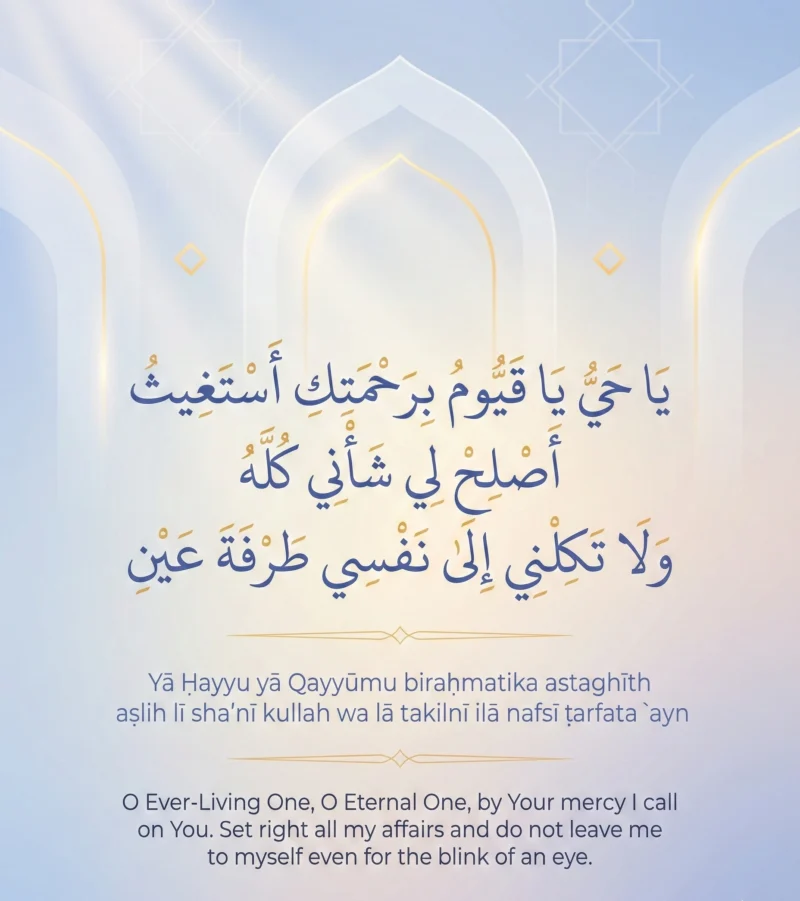
“Ya Hayyu Ya Qayyum Bi Rahmatika Astaghees translates to: ‘O Ever-Living, O Self-Sustaining, by Your Mercy I seek relief.’ This dua directly invokes two of Allah’s greatest names while asking for His merciful assistance in times of need.”
Understanding the meaning of ya hayyu ya qayyum bi rahmatika astaghees deepens your spiritual connection and enhances the benefits of reciting this powerful dua. Let’s explore the word-by-word translation:
These two divine names, Al-Hayyu and Al-Qayyum, appear together in Ayat al-Kursi (Surah Al-Baqarah 2:255), which is described as the greatest verse in the Quran. By invoking these names, you’re calling upon Allah’s eternal existence and His power to sustain all creation. The phrase “Bi Rahmatika Astaghees” completes the supplication by humbly requesting Allah’s mercy and seeking relief from whatever difficulties you face.
3. Seven Faith-Based Reflections on the Ya Hayyu Ya Qayyum Bi Rahmatika Astaghees Benefits
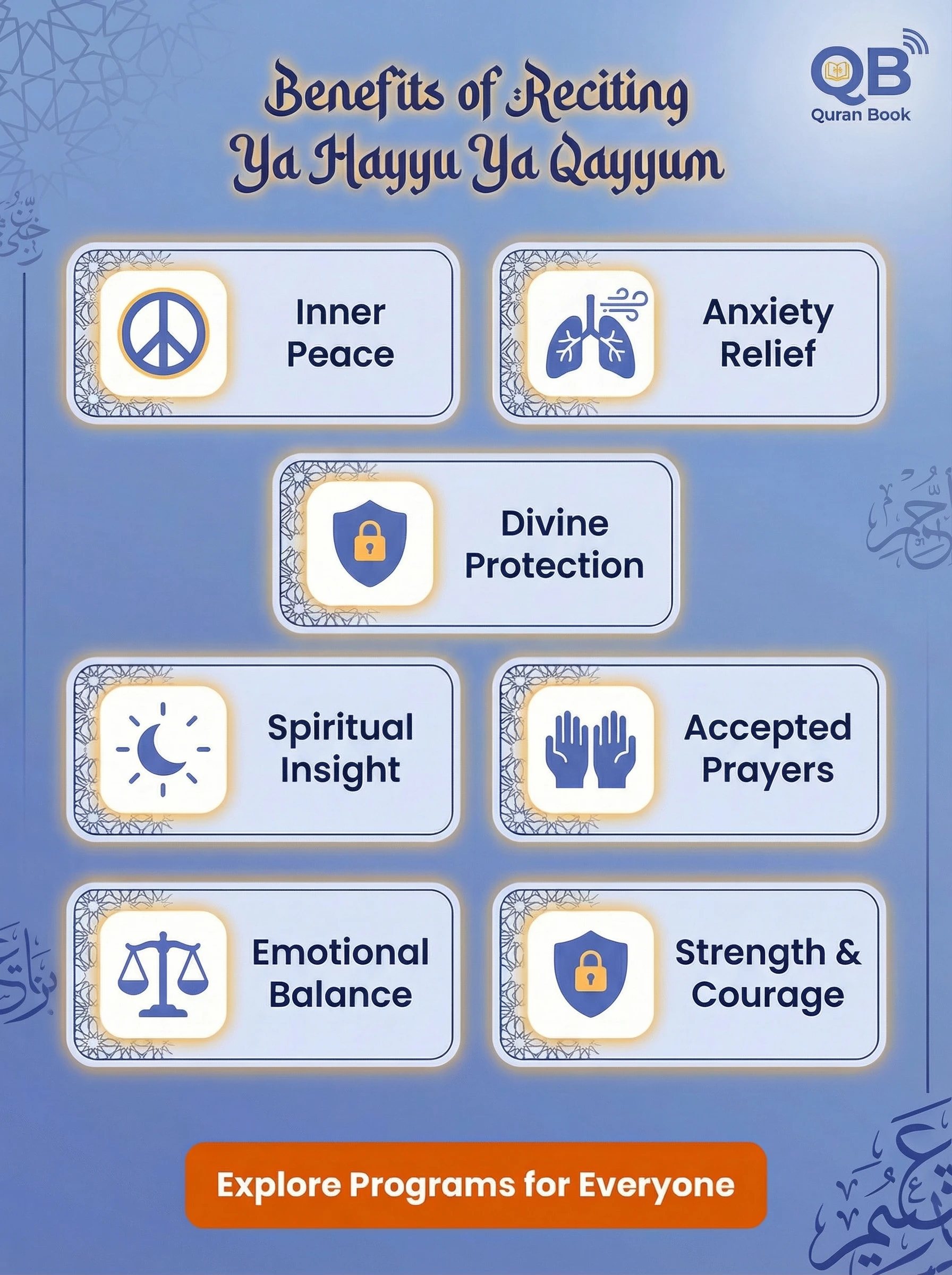
“The seven points below are faith-based reflections and spiritual lessons connected to turning to Allah through dua and remembrance of Allah generally, not seven outcomes promised for this particular wording: (1) turning to Allah during anxiety and distress, (2) seeking spiritual tranquility, (3) trusting Allah’s protection, (4) hoping for Allah’s response, (5) reflecting on purification of the heart, (6) hoping for barakah, and (7) a strengthened connection with Allah.”
Turning to Allah During Anxiety and Distress
The Prophet ﷺ used this supplication when a matter distressed him, as reported in Jamiʿ at-Tirmidhi 3524. It teaches the believer to turn to Allah for mercy and help, but a particular or immediate emotional outcome should not be guaranteed. The very act of acknowledging Allah as Al-Ḥayyu (The Ever-Living) can remind the believer that temporary troubles are in the hands of the Eternal One.
Seeking Spiritual Tranquility (Sakina)
Allah tells us in the Quran: “Verily, in the remembrance of Allah do hearts find rest” (Surah Ar-Ra’d 13:28). Through dua and remembrance of Allah generally, a believer may hope for this state of sakina (tranquility), which modern psychology also associates with mental well-being. This form of dhikr can serve as a mindful practice rooted in Islamic tradition.
Trusting Allah’s Protection
Turning to Allah regularly can remind the believer that safety and protection belong to Allah alone. Invoking Allah’s beautiful names is an expression of reliance upon Him, and no particular wording should be treated as a guaranteed shield against calamities or hardship.
Hoping for Allah’s Response
Many scholars have held that Al-Ḥayyu and Al-Qayyūm are connected to Ism Allah al-Aʿẓam (Allah’s Greatest Name), while scholars have differed over its precise identification, as discussed in IslamQA — Names and Attributes of Allah. Narrations that encourage calling upon Allah by His Greatest Name must not be turned into a guarantee that every request will be granted in the form or timing the person chooses; a believer may hope for Allah’s response while trusting His wisdom.
Reflecting on Purification of the Heart
Consistent dhikr can remind the believer to examine the heart and to seek freedom from arrogance, envy, and attachment to worldly matters. This is a general lesson of remembrance and sincerity rather than a purification established for this specific wording.
Hoping for Barakah in Daily Life
Barakah (divine blessing) is entirely from Allah, and a believer may hope for it while maintaining a connection with Allah through His beautiful names. No specific increase in time, wealth, or relationships can be promised as a result of reciting a particular phrase.
Strengthened Connection with Allah
Perhaps the most meaningful of these ya hayyu ya qayyum bi rahmatika astaghees reflections is the deepened relationship with your Creator. Understanding and reciting Allah’s names with sincerity can strengthen your iman (faith) and nurture a bond that the believer hopes will bring peace in this life and the next.
Turning to Allah in Every Circumstance
Begin each morning remembering that The Ever-Living, The Self-Sustaining is never unaware of you. When worry comes, the believer turns to Allah with “Ya Hayyu Ya Qayyum Bi Rahmatika Astaghees,” seeking His mercy and placing the outcome in His hands. This is the hope of a believer who makes dua and remembrance of Allah a steady part of daily life, without claiming any guaranteed result.
4. Understanding Al-Hayyu and Al-Qayyum: Exploring Asma-ul-Husna
“Al-Hayyu (The Ever-Living) refers to Allah’s eternal existence without beginning or end. Al-Qayyum (The Self-Sustaining) means Allah sustains all creation while needing nothing Himself. Together, these names appear in Ayat al-Kursi, and many scholars have connected them to Ism Allah al-A’zam (Allah’s Greatest Name), although scholars have differed over its precise identification.”
Al-Hayyu
(The Ever-Living)
This magnificent name signifies that Allah’s life is perfect and eternal. Unlike created beings who experience birth and death, Allah has always existed and will forever exist. His life is not dependent on anything; rather, all life depends on Him. When you call upon Al-Hayyu, you’re acknowledging that the source of all life is listening to your supplication.
Al-Qayyum
(The Self-Sustaining)
This name means that Allah is self-subsisting and sustains all of creation. He needs nothing, while everything depends entirely on Him. The entire universe, from the smallest atom to the largest galaxy, is maintained by Al-Qayyum. This name reminds us of our complete dependence on Allah for every breath we take.
Quranic References:
In Surah Al-Baqarah 2:255 (Ayat al-Kursi), Allah declares: “Allah – there is no deity except Him, the Ever-Living, the Self-Sustaining…”
And in Surah Taha 20:111: “And all faces will be humbled before the Ever-Living, the Self-Sustaining.”
Many scholars, including Ibn Taymiyyah and Ibn al-Qayyim, have stated that Al-Ḥayyu and Al-Qayyūm together may constitute or contain Ism Allah al-Aʿẓam (Allah’s Greatest Name), while others have identified it differently; the question has long been discussed among scholars, as summarised by IslamQA — Names and Attributes of Allah. This is why calling upon Allah by these names is given such weight in the tradition, and why the ya hayyu ya qayyum bi rahmatika astaghees benefits are presented here as faith-based reflections rather than promised results. You can explore the wider set in our guide to the 99 Names of Allah.
5. Prophet Muhammad’s (Peace Be Upon Him) Advice to Fatimah (RA) About This Blessed Dua

“Two separate narrations are involved. The shorter supplication — ‘Yā Ḥayyu, Yā Qayyūmu, bi-raḥmatika astaghīthu’ — is reported as what the Prophet ﷺ said when a matter distressed him (Jamiʿ at-Tirmidhi 3524). The narration concerning Fatimah رضي الله عنها contains the complete morning-and-evening wording, which adds: ‘aṣliḥ lī sha’nī kullahu, wa-lā takilnī ilā nafsī ṭarfata ʿayn.’”
One of the most beautiful aspects of Islamic tradition is the tender relationship between Prophet Muhammad (peace be upon him) and his beloved daughter Fatimah (may Allah be pleased with her). The Prophet’s advice to his daughter regarding spiritual practices demonstrates his deep concern for her well-being in this life and the hereafter.
It is important to distinguish between two separate reports rather than treating them as a single narration. The first is the shorter supplication said at a time of distress; the second is the complete supplication taught to Fatimah رضي الله عنها to be said in the morning and evening.
1. The shorter supplication said when a matter distressed the Prophet ﷺ
يَا حَيُّ يَا قَيُّومُ، بِرَحْمَتِكَ أَسْتَغِيثُ
Transliteration: Yā Ḥayyu, Yā Qayyūmu, bi-raḥmatika astaghīthu.
Meaning: “O Ever-Living, O Self-Sustaining, by Your mercy I seek help.”
Source: Jamiʿ at-Tirmidhi 3524
2. The complete morning-and-evening supplication taught to Fatimah رضي الله عنها
يَا حَيُّ يَا قَيُّومُ، بِرَحْمَتِكَ أَسْتَغِيثُ، أَصْلِحْ لِي شَأْنِي كُلَّهُ، وَلَا تَكِلْنِي إِلَى نَفْسِي طَرْفَةَ عَيْنٍ
Transliteration: Yā Ḥayyu, Yā Qayyūmu, bi-raḥmatika astaghīthu, aṣliḥ lī sha’nī kullahu, wa-lā takilnī ilā nafsī ṭarfata ʿayn.
Meaning: “O Ever-Living, O Self-Sustaining, by Your mercy I seek help. Set right all of my affairs and do not leave me to myself even for the blink of an eye.”
Direct reference: Dorar — narration of the advice to Fatimah رضي الله عنها, where it is recorded with its chains, including through al-Nasa’i’s al-Sunan al-Kubra and al-Hakim.
The narration concerning Fatimah رضي الله عنها contains the complete wording, and it instructs that it be said in the morning and in the evening. The shorter phrase on its own is therefore not the full wording of the advice given to her, and the two reports should not be combined as though they were one narration.
This Prophetic guidance is particularly relevant for modern families. Just as the Prophet cared for his daughter’s spiritual well-being, parents today can follow his example through online Quran classes for kids, teaching their children these blessed supplications early.
6. How to Pronounce Ya Hayyu Ya Qayyum Correctly in Arabic
Watch the pronunciation video above.
“To pronounce Ya Hayyu Ya Qayyum correctly: (1) Start with ‘Yā’ as a calling particle, (2) ‘Ḥayyu’ begins with Ḥāʾ (ح) and emphasises the doubled ‘y’ sound, (3) ‘Qayyūmu’ begins with Qāf (ق), articulated with the back of the tongue against the corresponding area of the upper palate, with a doubled ‘y’, (4) ‘bi-raḥmatika’ flows smoothly, (5) ‘astaghīthu’ ends with the unvoiced ‘th’ sound as in ‘think’.”
A note on terminology: Tajweed is formally the science of reciting the Quran, and this supplication is a dua rather than Quranic recitation, so its rules are not applied to it as such. Even so, studying Tajweed builds awareness of the makhārij (points of articulation) and the qualities of the Arabic letters, which helps learners pronounce the words of this dua accurately.
Step-by-Step Pronunciation Guide:
Common Pronunciation Mistakes to Avoid:
- ✗ Replacing Qāf (ق) with the English “k” sound instead of articulating it with the back of the tongue against the corresponding area of the upper palate
- ✗ Skipping or rushing through the shaddah on Ḥayyu and Qayyūmu
- ✗ Not giving proper attention to the Ghayn (غ) in astaghīthu, or ending the word with a voiced “th” as in “this”
- ✗ Rushing through the dua without paying attention to correct Arabic letter articulation, doubled consonants, and vowel length
Reciting this dua accurately starts with correct makhraj, and that takes practice, not talent. Many adult beginners find that structured Quran lessons for adults give them the confidence to read and pronounce without hesitation.
7. The Academy Method: How Quran Book Academy Teaches Duas and Tajweed

“The Academy Method breaks complex Arabic pronunciation into small, manageable psychological ‘chunks’ that non-Arabic speakers can master step-by-step. Through live Zoom sessions and a custom LMS tracking system, students receive personalised feedback and progress reports.”
Psychological Chunking Approach
We break complex duas into bite-sized learning units. Each “chunk” is mastered before moving to the next, reducing overwhelm and building confidence progressively.
Technology Stack
Live Zoom Sessions: One-on-one and group classes with real-time feedback.
Custom learning management system: Track progress with detailed metrics.
Email Reports: Regular progress updates to your inbox.
Addressing Learning Barriers
Fear of Failure: Judgment-free environment.
Time Constraints: Flexible scheduling across all time zones.
Pronunciation Anxiety: Patient, repetition-based practice.
Experience The Academy Method firsthand!
8. When and How to Recite Ya Hayyu Ya Qayyum for Maximum Benefits
“The relevant narration instructs saying the supplication in the morning and evening but does not specify three, 33, or 100 repetitions. The shorter wording may also be said as a general supplication at times of difficulty, and dua and dhikr are encouraged at times such as sujood, the last third of the night, and after the obligatory prayers.”
Best Times for Recitation:
Recommended Practice Routine:
What matters most in the ya hayyu ya qayyum bi rahmatika astaghees benefits discussed here is consistency and sincerity, following the reported wording without assigning a specific religious virtue to an unprescribed number of repetitions. You may repeat the dua without treating any chosen number as a Sunnah. Even a small, regular practice is more valuable than occasional lengthy sessions, so make this dua a steady part of your daily routine.
9. Frequently Asked Questions About Ya Hayyu Ya Qayyum Benefits
Quick Knowledge Check
1. When is the complete dua in the narration concerning Fatimah رضي الله عنها said?
- A. Only after the Friday prayer
- B. In the morning and evening
- C. Only during the last ten nights of Ramadan
Show the answer
B. In the morning and evening. The narration concerning Fatimah رضي الله عنها contains the complete wording and instructs that it be said in the morning and in the evening.
2. Does the narration assign 3, 33, or 100 repetitions?
- A. Yes, it specifies 33 repetitions
- B. Yes, it specifies 100 repetitions
- C. No fixed number is stated
Show the answer
C. No fixed number is stated. The relevant narration instructs saying the supplication in the morning and evening but does not specify three, 33, or 100 repetitions.
3. Where is Qāf (ق) articulated?
- A. With the back of the tongue against the corresponding area of the upper palate
- B. With the lips, like the English “k”
- C. With the tip of the tongue behind the front teeth
Show the answer
A. With the back of the tongue against the corresponding area of the upper palate. Qāf should not be replaced with the English “k” sound.
10. Conclusion: Begin Your Spiritual Journey with Ya Hayyu Ya Qayyum Today

Throughout this guide, we’ve explored the ya hayyu ya qayyum bi rahmatika astaghees benefits as faith-based reflections rather than promised outcomes: turning to Allah during distress, seeking tranquility, trusting His protection, and hoping for His response. Through dua and remembrance of Allah generally, a believer may hope for closeness to Allah, while the outcome always remains with Him.
Remember, you don’t need to be perfect to start this journey. Do not let fear of pronunciation prevent you from learning. Begin sincerely, practise carefully, and seek correction from a qualified teacher.
The path to learning this dua begins with a single step. Whether you’re in the USA, UK, Canada, Australia, or anywhere else in the world, you can begin studying its wording and meaning right now.
Ready to Learn This Dua Correctly?
At Quran Book Academy, our qualified Quran and Arabic teachers will guide you through correct pronunciation with personalised feedback via Zoom, tracked progress on our custom learning management system, and regular progress reports.
Book Your FREE Trial Lesson TodayLearn the wording, meaning, and pronunciation of this dua with guidance.
Hafidha of the Quran · Arabic Language Graduate · Writer on Islamic Sciences
Jehad Mahmoud is a graduate of the Arabic Language department and a Hafidha of the Quran who writes the Islamic educational content at Quran Book Academy.
She writes on the Quranic sciences, the Names and Attributes of Allah, and the adhkar of the Sunnah, making classical material accessible to English-speaking Muslim families.
Her articles are educational, not fatwa. For a ruling on a specific personal situation, readers are advised to consult a qualified scholar or mufti.
📚References & Further Reading
Internal Resources
- →Ayat al-Kursi: Meaning and Benefits
- →Understanding Tajweed Rules for Beginners
- →How to Finish a Khatam in Ramadan
- →Virtues of Surah Al-Mulk
- →Understanding the 99 Names of Allah
- →Learn Quran Reading for Adults
- →All Academy Programs
- →Quran and Arabic Teachers at the Academy
- →Quran Book Academy Telegram Channel (academy resource)
Leave a Reply