
Introduction: Why Learning Basic Arabic Phrases Changes Your Spiritual Life

Basic Arabic phrases rooted in Islamic virtues—like Alhamdulillah, SubhanAllah, and JazakAllahu Khayran—are more than simple words. They are daily acts of worship that connect every Muslim to the Quran and Sunnah, regardless of their native language. Whether you are a new revert or a lifelong believer seeking deeper understanding, mastering these basic Arabic phrases can genuinely transform the way you pray, give thanks, and navigate everyday life.
If you have ever felt overwhelmed trying to learn Arabic, or worried you would never pronounce it correctly—you are not alone. Millions of Muslims around the world share that same concern. The encouraging truth is that you only need a handful of powerful, virtue-based phrases to elevate your daily worship and strengthen your connection with Allah.
Allah says in the Quran: “Indeed, We have sent it down as an Arabic Quran so that you might understand.” — Quran 12:2
This verse reminds us that Arabic is the chosen language of divine guidance. Learning even a few common Arabic words opens a window into the meaning behind your prayers and dhikr.
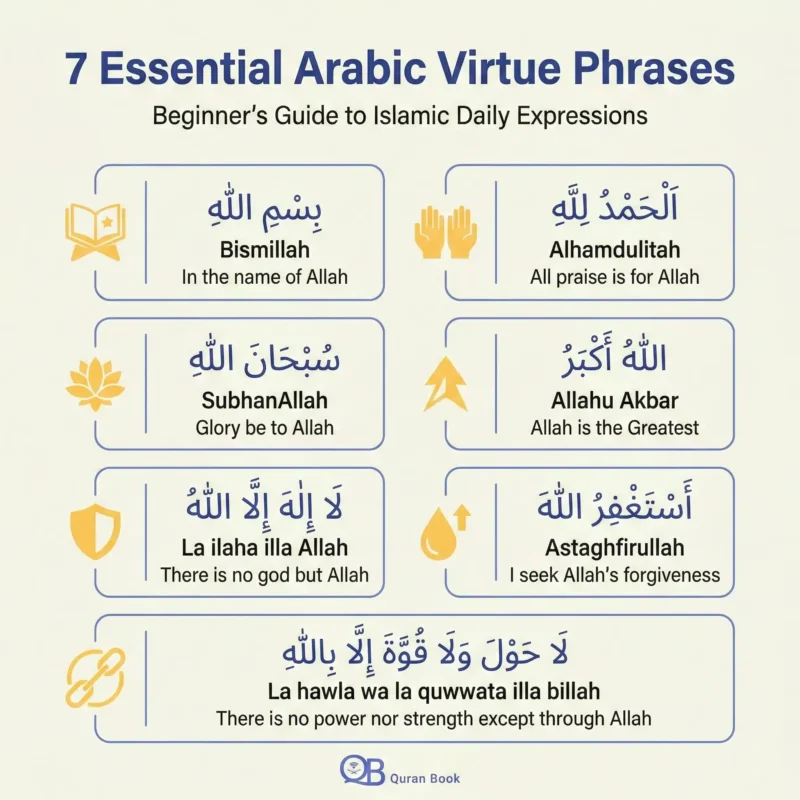
In this comprehensive guide, we will walk you through the 7 most essential Arabic phrases about virtues, explain their deep spiritual significance, and show you exactly how to pronounce and use them. You will also discover a practical step-by-step method to master these easy Arabic words with correct Arabic pronunciation. Let’s begin.
What Are Virtue-Based Arabic Phrases? (And Why They Matter for Muslims)
Virtue-based Arabic phrases for beginners are expressions deeply rooted in Islamic moral teachings—gratitude, patience, praise, and mercy. Expressions such as Marhaba and Shukran reflect courtesy and gratitude, while prescribed forms of dhikr have particular virtues established in the Quran and Sunnah. These virtue phrases are used in daily prayers, Quran recitation, and interactions between Muslims worldwide. When you say “Alhamdulillah,” you are not simply expressing thanks; you are performing an act of worship that Prophet Muhammad ﷺ practiced and encouraged.
Understanding the difference between common Arabic phrases and virtue-based ones is essential. Everyday expressions often serve social purposes and can also reflect Islamic values; prescribed dhikr has virtues established in the Quran and Sunnah. This distinction is what makes learning basic Arabic words and phrases of virtue so uniquely rewarding for every Muslim.
Comparison Table: Common vs. Virtue-Based Phrases
| Type | Example | Meaning | Spiritual Context |
|---|---|---|---|
| Common Greeting | Marhaba | Hello | A welcoming expression reflecting good manners |
| Virtue | As-salamu Alaykum | Peace be upon you | Sunnah greeting with reward |
| Common Thanks | Shukran | Thanks | An expression of gratitude encouraged in Islam |
| Virtue | JazakAllahu Khayran | May Allah reward you | Hadith-based supplication |
Prophet Muhammad ﷺ said: “The best of you are those who learn the Quran and teach it.” — Sahih al-Bukhari 5027
The Quranic foundation of these phrases is unmistakable. These words and phrases appear throughout the Quran and Hadith and form part of the everyday spiritual vocabulary of Muslims.
7 Essential Basic Arabic Phrases of Virtue (with Meaning & Pronunciation)
The 7 most essential basic Arabic phrases of virtue are: Bismillah, Alhamdulillah, SubhanAllah, Allahu Akbar, Astaghfirullah, JazakAllahu Khayran, and La Hawla Wa La Quwwata Illa Billah. Each carries deep spiritual significance rooted in the Quran and authenticated Hadith. Below, we explore every phrase in detail so you can learn Arabic words and phrases with full confidence.
How These 7 Phrases Map to the Core Islamic Virtues
When you look at these seven basic Arabic words and phrases together, a beautiful pattern emerges. Each phrase maps directly to a foundational Islamic virtue that shapes the believer’s daily life.
Bismillah represents remembrance of Allah and seeking His help and blessings when beginning a permissible action. Alhamdulillah embodies gratitude (shukr). SubhanAllah captures wonder and awe (ta’ajjub). Allahu Akbar instills humility (khushu’). Astaghfirullah cultivates repentance (tawbah). JazakAllahu Khayran fosters generosity of spirit (karam). La Hawla Wa La Quwwata Illa Billah anchors the believer in complete reliance on Allah (tawakkul).
Educational psychologists call this approach “chunking”—learning manageable, meaningful pieces rather than trying to absorb an entire language at once. By mastering just these seven basic Arabic phrases, you build a spiritual vocabulary that strengthens your salah, your dhikr, and your daily interactions as a Muslim.
How to Learn and Pronounce Basic Islamic Phrases Correctly (Step-by-Step)
To learn Islamic Arabic words and phrases with correct pronunciation, follow this proven five-step method: listen to native recitation, break each phrase into syllables, practice with a qualified teacher, use spaced repetition daily, and record yourself for self-assessment. Studying Makharij al-Huruf—the articulation points of the Arabic letters—supports every one of these steps. Here is how each step works in detail.
5 Steps to Master Arabic Virtue Phrases
Listen to Native Pronunciation
Before attempting to speak, listen to a native Arabic speaker or qualified Quran teacher recite each phrase multiple times. Pay attention to the rhythm, the emphasis, and the unique Arabic sounds that do not exist in English. Audio and video resources from trusted teachers are invaluable at this stage.
Break Each Phrase into Syllables
Use the “chunking” method: break long phrases like “La Hawla Wa La Quwwata Illa Billah” into small, manageable syllable groups. Practice each chunk separately before combining them into the full phrase.
Practice with a Live Quran Teacher via Zoom
Nothing replaces real-time feedback from a certified teacher. A qualified instructor can hear subtle pronunciation errors and correct them immediately, preventing bad habits from forming.
Use Spaced Repetition
Review phrases at increasing intervals—daily at first, then every few days, then weekly. This scientifically proven technique transfers knowledge from short-term to long-term memory.
Record Yourself and Compare
Use your phone to record your recitation, then compare it with your teacher’s model. This self-assessment accelerates improvement and builds confidence.
🎥 YouTube Video Resources
We highly recommend visiting the Quran Book Academy YouTube Channel where our certified teachers demonstrate correct pronunciation of each virtue phrase. Our channel also features a fun and engaging series that teaches Arabic letters in a playful, kid-friendly way—perfect for children and absolute beginners who want to build a strong foundation before tackling phrases.
Additionally, we recommend the Nour El Bayan course on YouTube—a widely respected Arabic reading methodology that takes learners from recognizing individual letters all the way to fluent Quran reading. Combining Nour El Bayan with our live Tajweed sessions creates a comprehensive learning path for mastering basic Arabic phrases and beyond.
The Academy Method: How Quran Book Academy Teaches Arabic Phrases
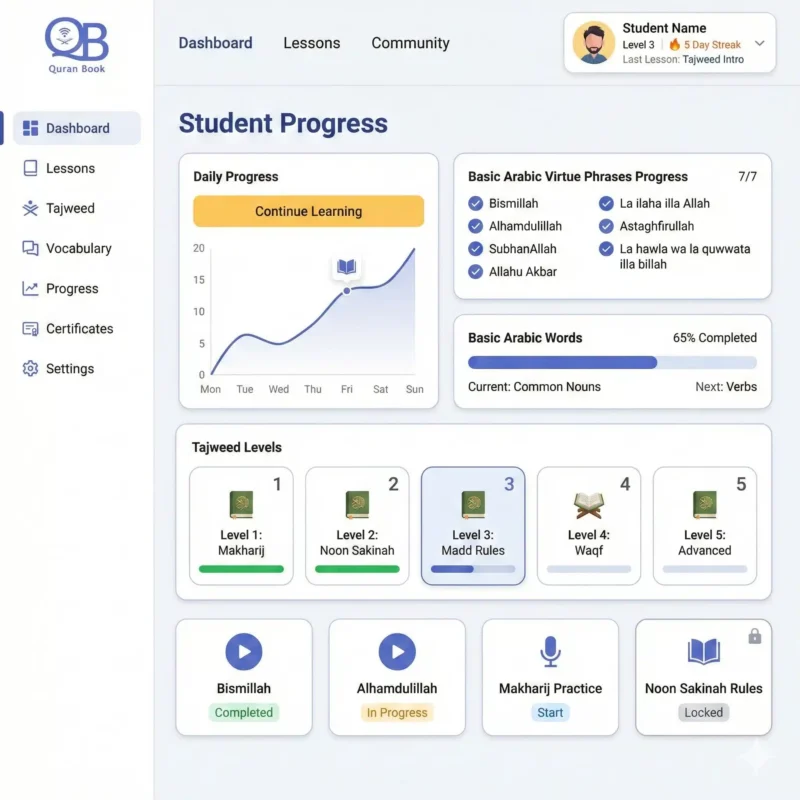
Quran Book Academy uses a proven 3-step methodology to help students master basic Arabic phrases and develop full Quran reading fluency: live one-on-one Zoom sessions with certified teachers, a custom Learning Management System (LMS) to track progress and send email reports, and a psychological “chunking” approach that builds confidence through manageable daily practice.
Live Zoom Sessions with Certified Teachers
Every student receives personalized, one-on-one instruction via Zoom. Our certified teachers use screen sharing for real-time correction of Arabic pronunciation. Unlike group classes where individual errors go unnoticed, our approach ensures every mispronunciation is caught and corrected immediately.
Custom LMS + Email Progress Reports
Our custom-built Learning Management System tracks each student’s journey through Arabic letters, words, phrases, Tajweed rules, and Quran surahs. Parents of young learners receive regular email progress reports, creating transparency and accountability.
Psychological Chunking for Quran Reading Fluency
Our curriculum follows the educational psychology principle of “chunking”: breaking complex Arabic into small, repeatable pieces. The learning path moves from Arabic letters → common Arabic words → basic Arabic phrases → Quran verses → full surahs.
Practice Arabic Phrases Daily: Free Resources & Community
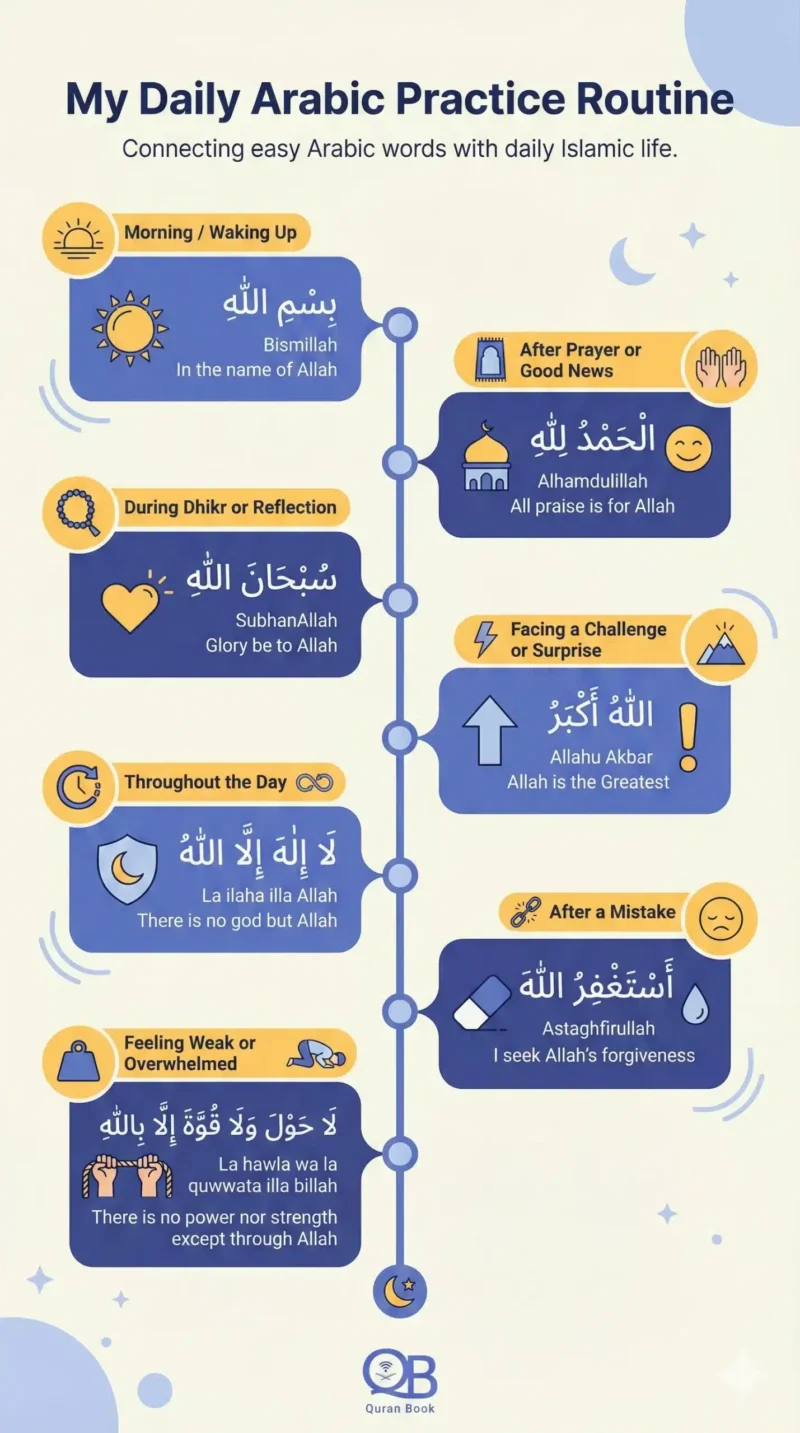
Practice basic Arabic phrases daily by incorporating them into your natural routine: say Bismillah before meals, practise the prescribed post-prayer dhikr after obligatory prayers, express Alhamdulillah throughout the day, and close your evening with Astaghfirullah. Consistency—not perfection—is the key to fluency. Here is a simple daily practice routine you can start today.
Daily Practice Routine
| Time of Day | Phrase | Context |
|---|---|---|
| ☀️ Morning | Bismillah | Before breakfast |
| 🌅 After Fajr | SubhanAllah x33 | Part of the prescribed dhikr after obligatory prayers |
| 🕐 Anytime | Alhamdulillah | Express gratitude |
| 🤝 After any favour | JazakAllahu Khayran | Thank someone the Islamic way |
| 🌙 Evening Reflection | Astaghfirullah | Seek Allah’s forgiveness while reviewing your day |
Join Our Community for Daily Practice
Join the Quran Book Academy Telegram Community for daily Arabic phrase challenges, teacher Q&A sessions, and live recitation circles. Practicing with a supportive community keeps you motivated and accountable on your journey to mastering basic Arabic words and phrases.
Quick Quiz: Test What You Learned
Answer these five short questions about the phrases you have just studied, then check your answers.
1. Which phrase means “All praise is for Allah”?
2. Which phrase means “I seek Allah’s forgiveness”?
3. Which phrase is commonly said before beginning a permissible action?
4. Which phrase means “May Allah reward you with good”?
5. Which phrase expresses that strength and ability come only from Allah?
FAQ: Common Questions About Basic Arabic Phrases
Q What are the most useful Arabic phrases?
The most useful basic Arabic phrases for Muslims are Bismillah (In the name of Allah), Alhamdulillah (All praise is for Allah), SubhanAllah (Glory to Allah), and Allahu Akbar (Allah is Greatest).
Other essential phrases include Astaghfirullah (I seek forgiveness), JazakAllahu Khayran (May Allah reward you), and La Hawla Wa La Quwwata Illa Billah (There is no might nor power except with Allah). These 7 virtue phrases are used in daily worship and carry spiritual reward.
Q What are some famous Arabic sayings?
Famous Arabic sayings rooted in Islamic virtue include “In sha Allah” (If Allah wills), “Ma sha Allah” (What Allah has willed), and “Tawakkul ala Allah” (Reliance on Allah). These phrases reflect core Islamic values of trust, gratitude, and submission to Allah’s divine will. You can read more about the meaning and proper use of InshaAllah, as well as the meaning and proper use of MashaAllah.
Q What are common Arabic phrases with English meaning?
Common Arabic phrases with English meanings include: As-salamu Alaykum (Peace be upon you), Alhamdulillah (Praise be to God), SubhanAllah (Glory to God), Bismillah (In the name of God), and Astaghfirullah (I seek God’s forgiveness). Each of these is both a greeting or expression and an act of worship in Islam.
Q What does “Yalla Wallah” mean?
“Yalla” means “let’s go” or “hurry up,” while “Wallah” means “I swear by Allah.” Together, “Yalla Wallah” is a casual Arabic expression meaning “Let’s go, I swear!” While common in spoken Arabic, it is important to note that swearing by Allah is a serious matter in Islam and should not be used lightly.
Q How can a non-Arabic speaker learn basic Arabic phrases quickly?
The fastest way for non-Arabic speakers to learn Arabic words and phrases is through: repetition during daily prayers, working with a native-speaking teacher who can correct pronunciation in real time, and learning the correct articulation points of the Arabic letters. Quran Book Academy offers free trial lessons with certified teachers via Zoom, plus you can start building your foundation with our YouTube channel that teaches Arabic letters in a fun, engaging way.

References
Quranic Sources:
Quran 12:2 — “Indeed, We have sent it down as an Arabic Quran so that you might understand.”
Quran 1:1 — Bismillahir Rahmanir Raheem — quran.com/1/1
Quran 1:2 — Alhamdulillahi Rabbil Aalameen — quran.com/1/2
Hadith Sources:
Sahih al-Bukhari 5027 — “The best of you are those who learn the Quran and teach it.” — sunnah.com
Sahih Muslim 223 — Alhamdulillah fills the scale, and SubhanAllah together with Alhamdulillah fill what is between the heavens and the earth. — sunnah.com
Sahih al-Bukhari 6307 — The Prophet ﷺ sought forgiveness 70+ times daily. — sunnah.com
Tirmidhi 2035 — JazakAllahu Khayran as sufficient thanks. — sunnah.com
Sahih al-Bukhari 4205 — La Hawla as “treasure of Paradise.” — sunnah.com
Learning Resources:
Quran Book Academy YouTube Channel — youtube.com
Nour El Bayan Course (YouTube) — youtube.com
Quran Book Academy Telegram Community — t.me/maqraquranbookonline