Arabic reading · Step 3: Arabic letter forms
Arabic Letters Beginning, Middle, End: One Letter, Up to Four Shapes
The full Arabic letter forms chart, the six letters that never join, and a real ayah to test your eye.
See the full chart ↓▶ 1:36 · Meet the Dot Family: ب ت ث
You already know ب. Now find it in بِرَبِّ (bi-rabbi, “in the Lord”). It’s in there twice.
If that took a second look, you’re not alone. Letters you know from a chart look different once they join inside a word. One rule explains every shape. This is step 3 of learning how to read Arabic: how Arabic letters change at the beginning, middle and end of a word.
You’ll get the full Arabic alphabet: beginning, middle, end and isolated forms in one chart, six letters to remember, and practice on real words and a real ayah.
Why Do Arabic Letters Change Shape?
Arabic is joined-up writing. Inside a word, most letters link to the next one. To make that link, a letter drops its tail or grows a short connecting stroke. The core shape and the dots stay the same, so you can still recognise it.
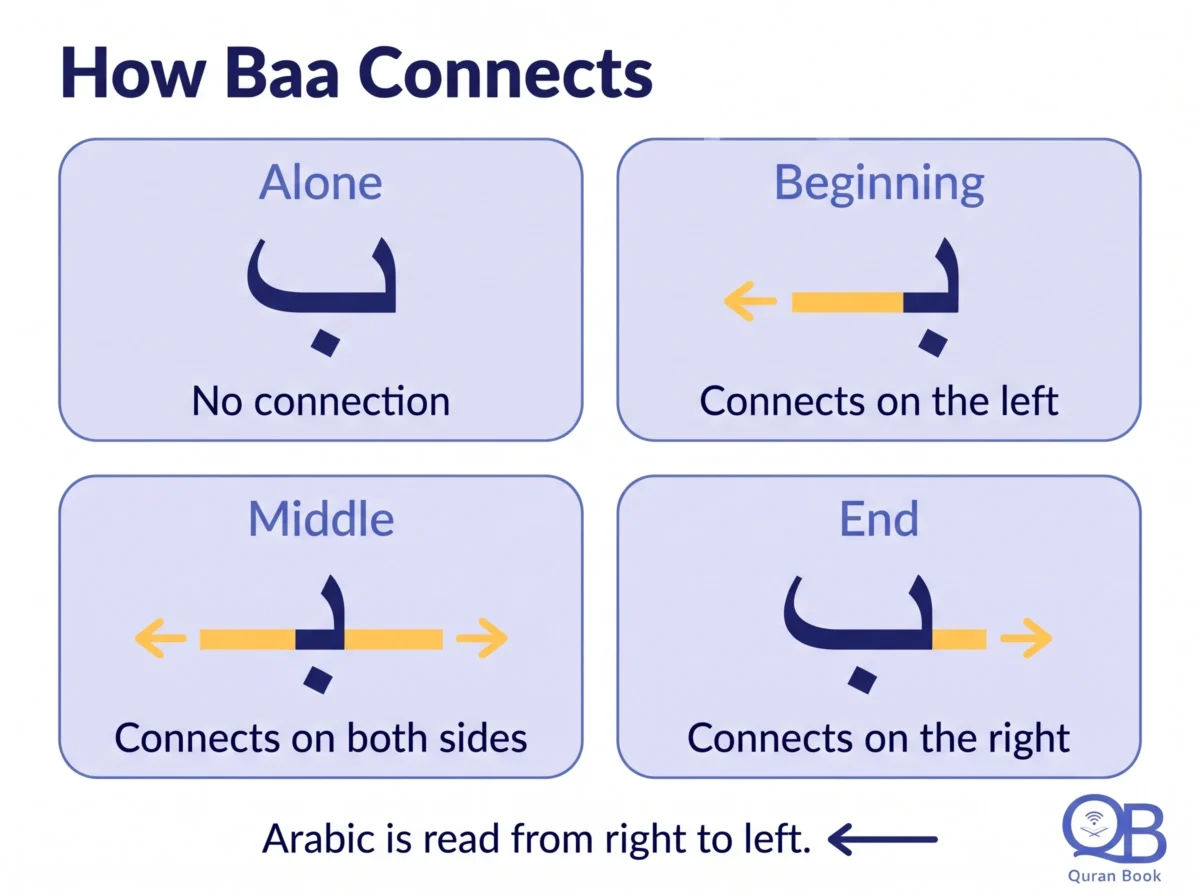
- بAlonejoined to nothing
- بـBeginningjoined to the next letter
- ـبـMiddlejoined on both sides
- ـبEndjoined to the letter before
These are not four letters. They are one letter holding hands in four different ways.
Keep one thing in mind: a letter’s form depends on what it joins, not on where it sits in the word. The letter-form recognition games below let you test each idea.
Arabic Letters Isolated, Initial, Medial, Final: The Four Forms
Every letter that joins on both sides has four Arabic letter forms: isolated, plus a beginning, middle and end form. Here they are with ب.
Isolated form (alone)
Joined to nothing. This is the letter on its own, exactly as you see it on an alphabet chart, with its full tail.
Initial form (beginning)
Joined only to the letter after it, which sits on its left because Arabic runs right to left. The tail is dropped so the line can carry on.
Medial form (middle)
Joined on both sides: to the letter before it and to the letter after it. Only a short stroke is left, with the dot still underneath.
Final form (end)
Joined only to the letter before it. Nothing comes after, so the tail comes back. It looks like the isolated form with a link on its right.
Arabic Letters Beginning, Middle, End: Full Forms Chart
Here are all 28 Arabic letters at the beginning, middle and end of a word, plus their isolated form, in one chart. Read each row as Isolated → Beginning → Middle → End. The last column tells you if the letter can join the letter after it. That column explains most of the “strange” gaps you see in words.
Arabic letters beginning, middle, end: all 28 letters
| Letter | Isolated | Beginning | Middle | End | Joins the next letter? |
|---|---|---|---|---|---|
| 1alif | ا | ا | ـا | ـا | never |
| 2bāʾ | ب | بـ | ـبـ | ـب | yes |
| 3tāʾ | ت | تـ | ـتـ | ـت | yes |
| 4thāʾ | ث | ثـ | ـثـ | ـث | yes |
| 5jīm | ج | جـ | ـجـ | ـج | yes |
| 6ḥāʾ | ح | حـ | ـحـ | ـح | yes |
| 7khāʾ | خ | خـ | ـخـ | ـخ | yes |
| 8dāl | د | د | ـد | ـد | never |
| 9dhāl | ذ | ذ | ـذ | ـذ | never |
| 10rāʾ | ر | ر | ـر | ـر | never |
| 11zāy | ز | ز | ـز | ـز | never |
| 12sīn | س | سـ | ـسـ | ـس | yes |
| 13shīn | ش | شـ | ـشـ | ـش | yes |
| 14ṣād | ص | صـ | ـصـ | ـص | yes |
| 15ḍād | ض | ضـ | ـضـ | ـض | yes |
| 16ṭāʾ | ط | طـ | ـطـ | ـط | yes |
| 17ẓāʾ | ظ | ظـ | ـظـ | ـظ | yes |
| 18ʿayn | ع | عـ | ـعـ | ـع | yes |
| 19ghayn | غ | غـ | ـغـ | ـغ | yes |
| 20fāʾ | ف | فـ | ـفـ | ـف | yes |
| 21qāf | ق | قـ | ـقـ | ـق | yes |
| 22kāf | ك | كـ | ـكـ | ـك | yes |
| 23lām | ل | لـ | ـلـ | ـل | yes |
| 24mīm | م | مـ | ـمـ | ـم | yes |
| 25nūn | ن | نـ | ـنـ | ـن | yes |
| 26hāʾ | ه | هـ | ـهـ | ـه | yes |
| 27wāw | و | و | ـو | ـو | never |
| 28yāʾ | ي | يـ | ـيـ | ـي | yes |
Gold rows = the six letters that never join the next letter. In their rows, Beginning looks like Isolated and Middle looks like End. Every other letter has four different beginning, middle and end shapes.
Shapes you’ll also meet
Lām-alif (ل + ا)
- Alone
- لا
- Joined to the letter before
- ـلا
- Joins next?
- ✗ No
Always one combined shape, never ل and ا side by side.
Tāʾ marbūṭa
- Alone
- ة
- Joined to the letter before
- ـة
- Joins next?
- ✗ No
Appears only at the end of a word.
Alif maqṣūra
- Alone
- ى
- Joined to the letter before
- ـى
- Joins next?
- ✗ No
Only at the end of a word; looks like ي without dots.
Hamza on the line
- Alone
- ء
- Joined to the letter before
- none
- Joins next?
- ✗ No
Never joins on either side.
Hamza on a seat
- Alone
- أ إ ؤ ئ
- Joined to the letter before
- ـأ ـؤ ـئـ
- Joins next?
- As its seat
أ إ behave like alif, ؤ like wāw, and ئ joins on both sides.
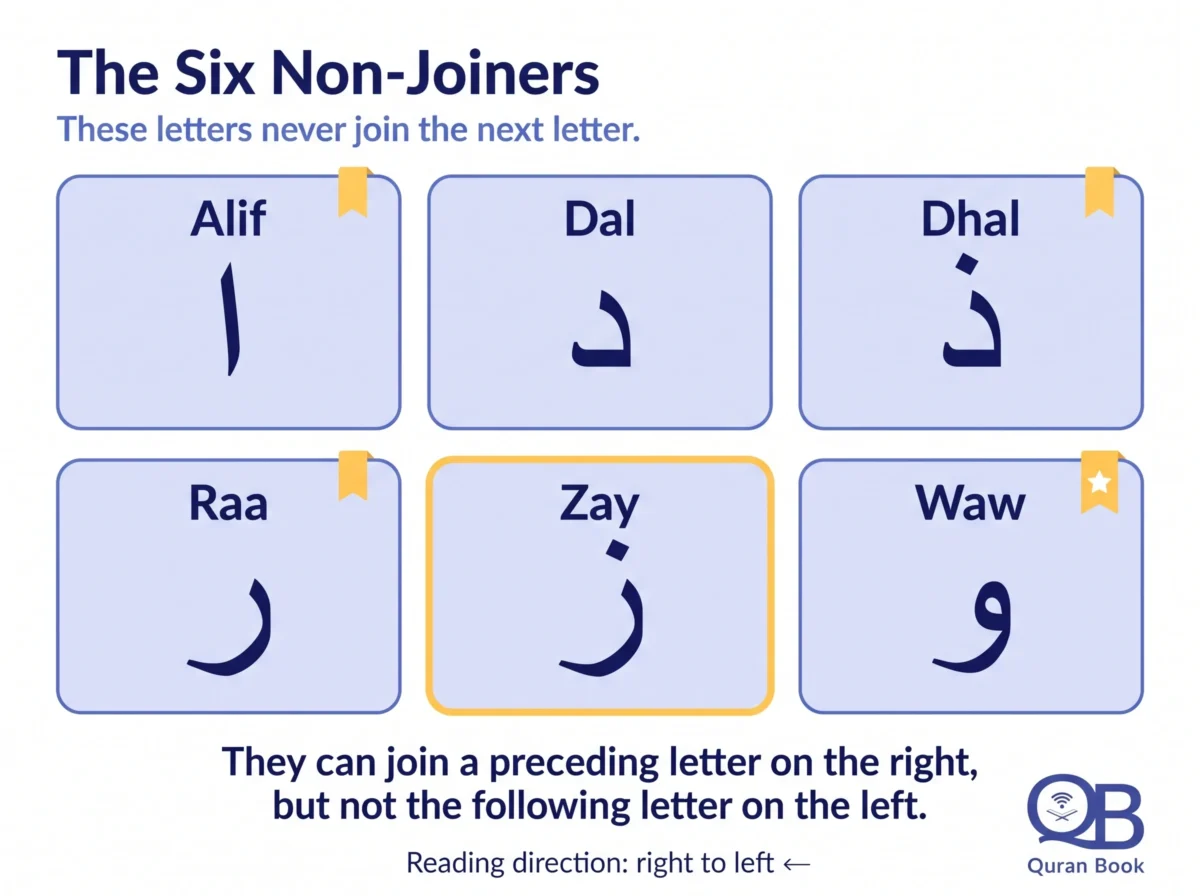
The 6 Arabic Letters That Never Join the Next Letter
Remember these six.
- اalif
- دdāl
- ذdhāl
- رrāʾ
- زzāy
- وwāw
These six join the letter before them, never the letter after them, so the next letter starts fresh. That’s why many Arabic words have gaps inside them, and why their beginning, middle and end shapes look so alike.
Take بَابٌ (bābun, “a door”). The first ب joins ا. Then ا stops, so the second ب stands alone. One word, two joined pieces:
One more shape never joins at all: the hamza ء written on the line. It doesn’t join on either side.
Why a Letter Can Be “Alone” in the Middle of a Word
This is the key idea on the page. After one of the six, the next letter can only take its beginning form or its isolated form, even in the middle or at the end of the word.
In كِتَابٌ (kitābun, “a book”), ب is the last letter, but it’s isolated: ا never joins forward. In وَرْدٌ (wardun, “roses”), all three letters stand alone.
Beginning, middle and end describe a letter’s place in its joined piece, not in the whole word.
The Letters That Change the Most
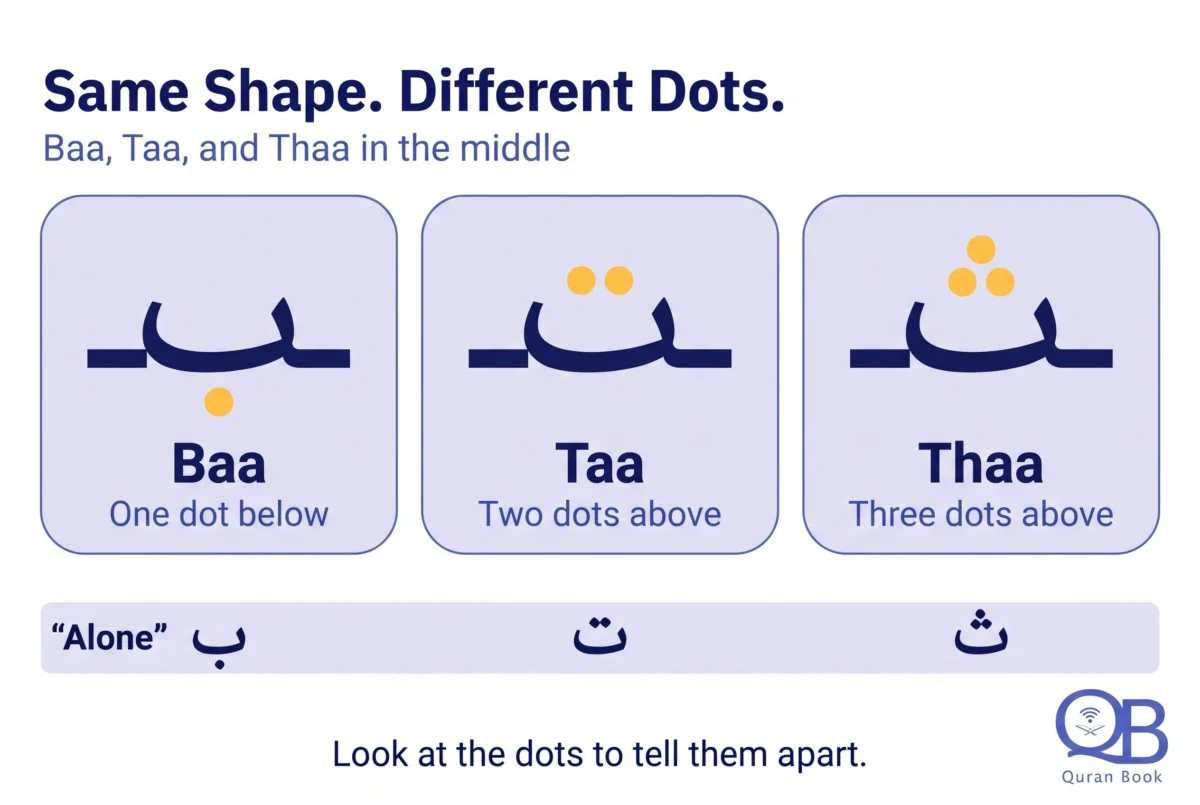
Most letters just drop or add a tail. A few change enough to fool beginners:
- ع and غ: open at the beginning (عـ), a closed loop in the middle (ـعـ).
- ه: four quite different shapes (ه هـ ـهـ ـه). The middle one varies from font to font.
- ك: loses the small zigzag inside it when it joins (كـ ـكـ).
- ن and ي: lose their bowls and shrink to a “tooth” that looks exactly like ـبـ. Only the dots tell ـبـ ـتـ ـثـ ـنـ ـيـ apart.
Special Shapes: Lām-Alif, Tāʾ Marbūṭa and Alif Maqṣūra
Lām-alif. When ل is followed by ا, they always merge into one shape. You’ll see it all through the Quran, as in لَا (lā, “no”). It isn’t a 29th letter.
Tāʾ marbūṭa. A tāʾ shape that appears only at the end of a word, as in جَنَّةٌ (jannatun, “a garden”).
Alif maqṣūra. An alif shape at the end of a word that looks like ي without its dots, as in عَلَى (ʿalā, “on”).
And the hamza: written on the line (ء), it never joins. On a seat (أ ؤ ئ), it follows the joining of its seat.
See the Letter Forms in the Quran
The Mushaf uses exactly the same joining rules, so the beginning, middle and end shapes you just learned are all there. Play a clip if you like, follow the Arabic, and look for the shape named in each box. This is about spotting shapes, not checking your recitation.
🔊 Look and listen
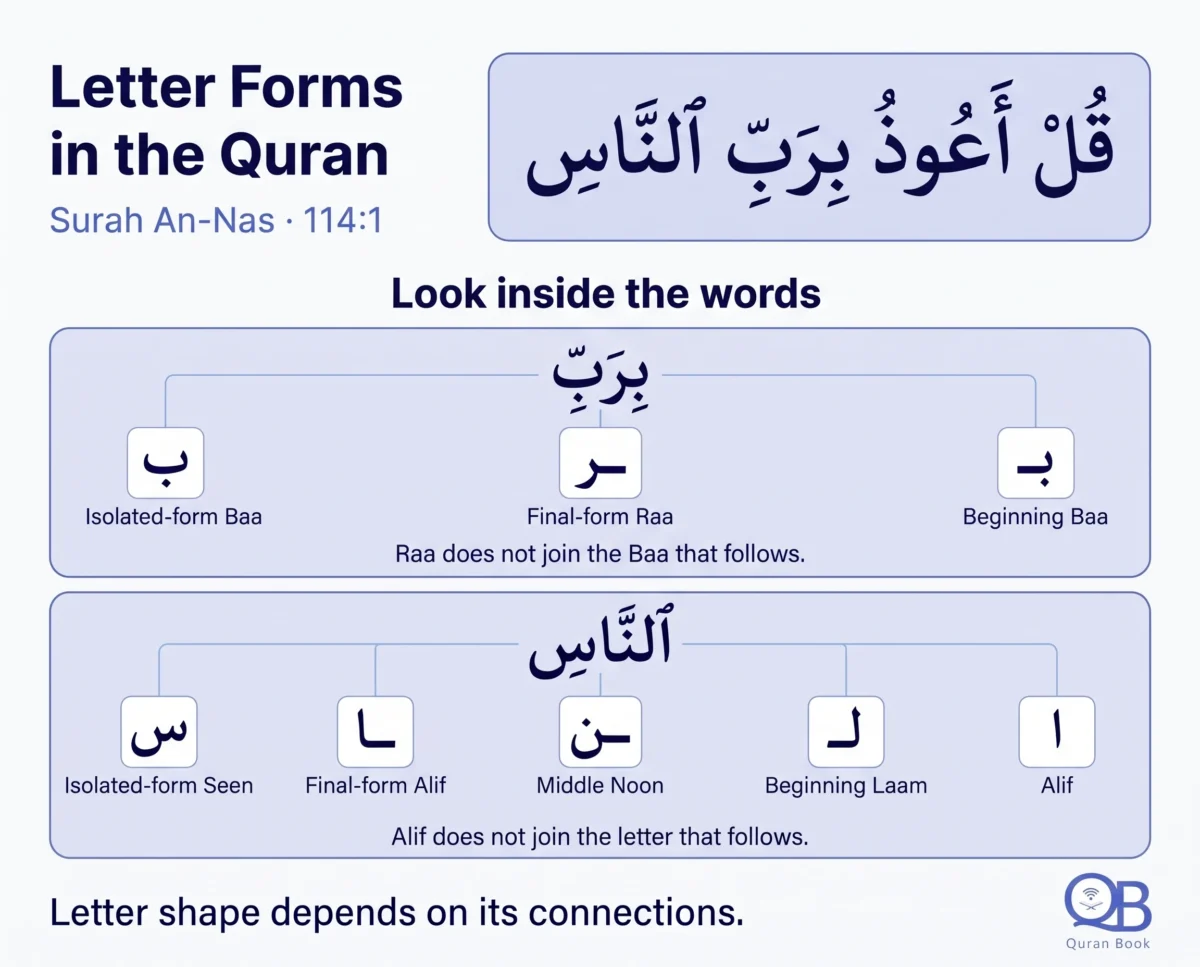
An-Nas 114:1
قُلۡ أَعُوذُ بِرَبِّ ٱلنَّاسِ
qul aʿūdhu bi-rabbi n-nās
“Say, ˹O Prophet,˺ ‘I seek refuge in the Lord of humankind,’”
Look for: ب twice in بِرَبِّ: first in its beginning form, then alone after ر.
Recited by Sheikh Mahmoud Khalil Al-Husary (murattal), riwayah Hafs ʿan ʿĀṣim. Audio: EveryAyah.
Al-Ikhlas 112:3
لَمۡ يَلِدۡ وَلَمۡ يُولَدۡ
lam yalid wa lam yūlad
“He has never had offspring, nor was He born.”
Look for: و splits يُولَدۡ (yūlad, “was born”) into two pieces.
Al-Kafirun 109:2
لَآ أَعۡبُدُ مَا تَعۡبُدُونَ
lā aʿbudu mā taʿbudūn
“I do not worship what you worship,”
Look for: لا as one shape, and و and ن alone at the end of تَعۡبُدُونَ (taʿbudūn, “you worship”).
A note on ٱلنَّاسِ (an-nās, “humankind”): the ٱ at the start is an alif shape, so the ل after it starts fresh. The small mark on top belongs to Hamzat al-Wasl, a later topic.
Spotting the shapes is step one. Reading them smoothly in an ayah, with someone correcting you, is where a teacher helps.
Book Your Free Trial LessonStarting as a grown-up? Here’s how to learn Quran reading for adults at your own pace.
Free Arabic Letter Forms Printables
Prefer paper? These Arabic alphabet practice worksheets cover the same skills as the games above: every letter at the beginning, middle and end, with an answer key.
Free Arabic Letter Forms Chart
Keep all 28 letters in every position beside you while you read. One A4 page, with the six non-joiners in gold.
Download the chart (PDF)Arabic Letter Forms Practice Sheets
Spot, match and join: the same skills as the games above, on paper. The answer key is on the last page.
Download the practice sheets (PDF)Common Mistakes With Arabic Letter Forms
- Mistake: Treating بـ ـبـ ـب as three new letters.Fix: Same letter, same dots, different joins.
- Mistake: Expecting every letter to join the next one.Fix: ا د ذ ر ز و never join the next letter.
- Mistake: Thinking “last letter = final form”.Fix: After one of the six, it’s isolated, like the ب in كِتَابٌ.
- Mistake: Reading لا as one letter, or hunting for a missing ل.Fix: It’s ل + ا merged into one shape.
- Mistake: Reading the “teeth” by shape alone.Fix: In ـبـ ـتـ ـثـ ـنـ ـيـ only the dots decide.
Teaching a child Arabic letter forms?
Use big letters and one family at a time. Start with ب ت ث ن ي, which share one shape. Turn the six non-joiners into a “hold hands or let go” game. For more play, try our free Arabic alphabet game, or see how our Quran reading for beginners classes work for kids.
What to Learn After Arabic Letter Forms
- Not sure of every letter’s sound yet? Go back to Arabic alphabet pronunciation.
- Next: the small marks above and below the letters are vowels. That’s the next step: Arabic harakat.
- Then: joining letters and marks into real words, in how to read Arabic words.
Once beginning, middle and end shapes feel easy, see where this fits in the full path to how to read Arabic.
📚 Learn more
- Know the Arabic letter forms but not the sounds? Arabic alphabet pronunciation
- Letters are half the system; the vowels sit above and below them. Arabic harakat
- Ready to join letters into words? How to read Arabic words
- Teaching a child instead of yourself? Free Arabic alphabet game
Arabic Letter Forms FAQ
What are the four forms of Arabic letters?
Isolated (the letter on its own), initial (joined only to the letter after it), medial (joined on both sides) and final (joined only to the letter before it). They are often called the beginning, middle and end forms. The letter stays the same — only its joining strokes change.
Why do Arabic letters change shape?
Arabic is joined-up writing, so most letters link to their neighbours inside a word. To make that link, a letter drops its tail or adds a short connecting stroke. The core shape and the dots stay the same, which is how you still recognise it.
Do all Arabic letters have four forms?
No. 22 of the 28 letters have four forms. The other six — ا د ذ ر ز و — never join the letter after them, so they have only two shapes: one on their own and one joined to the letter before.
Which Arabic letters do not connect to the next letter?
Six letters: alif (ا), dāl (د), dhāl (ذ), rāʾ (ر), zāy (ز) and wāw (و). They join the letter before them but never the one after, so the next letter starts fresh. That is why gaps appear inside many Arabic words. The hamza (ء) written on the line does not join on either side.
Why does a letter at the end of a word sometimes look isolated?
Because a letter’s form depends on joining, not on its position in the word. If the letter before it is one of the six non-joining letters, nothing connects to it, so it takes its isolated form even at the end of a word — like the ب in كِتَابٌ (kitābun, “a book”).
What is lam-alif (لا) in Arabic?
When lām (ل) is followed by alif (ا), the two are always written as one combined shape: لا. It is not an extra letter, just two letters joined in a special way. You will see it constantly in the Quran, for example in لَا (lā, “no”).
Are Arabic letter forms the same in the Quran?
Yes. The Quran follows the same joining rules. The Mushaf script adds recitation marks and a few special spellings, such as a small alif written above a letter, but every letter still joins — or doesn’t — exactly as in the chart.
Those recitation marks are part of Tajweed rules.
How long does it take to learn Arabic letter forms?
If you already know the 28 letters on their own, many learners recognise the joined forms within one to two weeks of 15–20 minutes of daily practice. Reading them quickly inside real words takes longer. These are typical estimates — everyone’s pace is different.
You can now spot Arabic letters at the beginning, middle and end of a word.
The next step is reading whole words aloud, and that goes faster when a teacher hears you and corrects you. Try a one-on-one lesson on Zoom, free.
Book Your Free Trial LessonArabic Language Graduate · Hafidha of the Quran · Writer on Arabic Reading
Jehad Mahmoud is a graduate of the Arabic Language department and a Hafidha of the Quran who writes the Arabic and Quran-reading guides at Quran Book Academy.
She writes for English-speaking learners and parents starting from zero: the letters by sound, the vowel marks, and the step-by-step order that leads to reading the Quran directly from the Mushaf.
Her Arabic Language studies and her memorisation of the Quran are the foundation of this reading series.
These guides teach the reading system step by step. Pronunciation is a skill of the ear and the mouth, so it is best checked by a qualified teacher who can hear you read.
References
- Quran text (Uthmani) and translation: An-Nas 114:1, Al-Ikhlas 112:3, Al-Kafirun 109:2 on Quran.com. Translations: The Clear Quran, Dr. Mustafa Khattab, via Quran.com.
- Recitation: Sheikh Mahmoud Khalil Al-Husary (murattal), audio via EveryAyah.
- The Unicode Consortium, Arabic code chart (U+0600–U+06FF).
- Encyclopaedia Britannica, “Arabic alphabet”.