
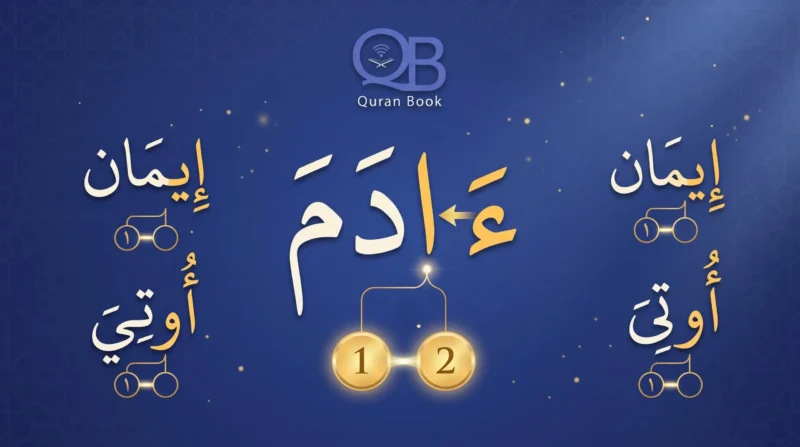
You have just learned that Madd Asli is two counts and the branch madds are usually longer. Then you reach ءَامَنُوا, you see a hamzah and a long alif, you stretch it to four — and in Hafs that is too long. Madd Badal occurs when a hamzah comes before a madd letter inside the same word, and in Tajweed according to Hafs it is read for two counts. It is classed among the branch madds, one of the Madd rules, yet in Hafs it is not lengthened beyond two unless a stronger cause comes after the madd letter.
One cause, one basic length, a name that tells you what happened to the word, and a letter-order test that separates Madd Badal in Tajweed from the two madds that look almost identical. Also written Madd al-Badal, Mad Badal, the substitute madd — in Arabic, المد البدل. All counts on this page follow Hafs ʿan ʿAsim by the way of Ash-Shatibiyyah.
⚡ The 30-second version: a hamzah (ء) comes before a madd letter (ا / و / ي) in one word · that makes it a branch madd by classification · in Hafs it is read for two counts, the same as Madd Asli — that is the transmitted reading · then glance at what comes after the madd letter: a hamzah or a sukoon there brings in a longer rule · reverse the two letters (madd letter first, hamzah second) and you have Madd Wajib Muttasil, four or five counts.
What Is Madd Badal in Tajweed?
Madd Badal (المد البدل) is a madd that occurs when a hamzah (ء) comes before a madd letter — alif (ا), waw (و) or yaa (ي) — with both in the same word. In Hafs ʿan ʿAsim it is read for two counts, the same as Madd Asli, even though it is classed as a branch madd (Madd Farʿi).
Read the first point before anything else, because it is the entire distinction:
- The hamzah comes first. A hamzah, then a madd letter, in that order. That single fact is what makes it Badal and not one of the madds it is confused with.
- It is a branch madd by classification, and a two-count madd in Hafs by transmission. The hamzah earns it the Farʿi label; the length you recite is the one transmitted in the riwayah. Naming that apparent contradiction out loud is the reason this page exists.
- A “count” (harakah) is a rough unit — often taught as the time to fold or open one finger at a steady pace. It follows your recitation speed; it is not a fixed number of seconds.[3]
📌 One riwayah note: all counts here follow Hafs ʿan ʿAsim by the way of Ash-Shatibiyyah, where Badal is read short (two counts). In Warsh ʿan Nafiʿ by the route of al-Azraq, Badal may also be read medium or long — commonly taught as 2, 4 or 6 counts — but not in every word: the yaa of إِسْرَائِيلَ, and words such as الْقُرْآن where the hamzah is preceded by a sakin sahih (a consonant with sukoon) in the same word, are read short there too.[2] That is why you find different numbers online. If you recite Hafs, Badal is two.
Why Is It Called “Badal”? The Missing Hamzah
Badal means substitute. In the original Badal words, the madd letter stands in for a second hamzah. Two hamzahs in a row are heavy on the tongue, so the second (sakin) one was replaced by a madd letter matching the vowel on the first:[1]
| Original form | Became | The substitution |
|---|---|---|
| أَأْمَنُوا | آمَنُوا | fathah + sakin hamzah → alif (ا) |
| إِئْمَان | إِيمَان | kasrah + sakin hamzah → yaa (ي) |
| أُؤْتُوا | أُوتُوا | dammah + sakin hamzah → waw (و) |
In these words the madd letter you are reading used to be a hamzah — that is why the rule is named after a swap, not after a length.
Original Badal and Shabih bil-Badal. Where the madd letter after the hamzah was never a hamzah — for example الْقُرْآن, يَشَاءُونَ, مُتَّكِئِينَ and the yaa of إِسْرَائِيلَ — scholars call it shabih bil-badal, “resembling Badal”. It shares the defining shape (hamzah, then madd letter) and is taught under Badal, with the same two counts in Hafs.[1]
The Rule and Conditions of Madd Badal
These are the Madd Badal rules in Tajweed as a four-point checklist:
1. There is a hamzah you actually pronounce
Usually a hamzat al-qatʿ (أ / إ / ء). ✅ أُوتُوا · ❌ اهْدِنَا — its opening alif is a hamzat al-wasl, and no madd letter follows it, whether you start on the word or connect it.
When you start a word: starting on words such as ائْذَنْ (At-Tawbah 9:49) or اؤْتُمِنَ (Al-Baqarah 2:283) is different. You pronounce the hamzat al-wasl, and the word’s own sakin hamzah after it becomes a madd letter — you say إِيذَنْ, أُوتُمِنَ — so a Badal appears. Connect the word to the one before it and the hamzat al-wasl drops, the hamzah is pronounced sakin, and there is no Badal.[1][2] Not every hamzat al-wasl does this — only these words, where a sakin hamzah follows it.
2. A madd letter comes immediately after the hamzah
ا, و or ي — sakin, matching the hamzah’s vowel. ✅ آدَمَ · ❌ أَنْعَمْتَ (a hamzah, but no madd letter follows it).
3. Both are in the same word, in that order
Hamzah first, madd letter second. ✅ إِيمَانًا · ❌ جَاءَ (madd letter first, hamzah second → that is Madd Wajib Muttasil).
4. Nothing stronger comes after the madd letter
If a hamzah follows the madd letter (بُرَآءُ, Al-Mumtahanah 60:4; رَأَى أَيْدِيَهُمْ, Hud 11:70), or a permanent sukoon or shaddah (آمِّينَ, Al-Maʾidah 5:2), the stronger cause sets the length, and the madd is read by that rule instead.[1] When you stop on a word like الْمَآب, the madd letter is followed by the sukoon of stopping, so it is read by the rule of Madd ʿArid lis-Sukoon.
✅ If all four hold, it is Madd Badal — and in Hafs you read it for two counts.
⚠️ Spelling is not a length sign. In everyday Arabic spelling, a hamzah followed by an alif is written as one character, آ — an alif with a small wavy mark on top. That mark is part of the spelling; it is not an instruction to stretch.
The widely used Madinah mushaf (Hafs) prints the same Badal as ءَا — a hamzah with a fathah, then a plain alif — as in ءَامَنُوا۟ and ءَادَمَ, with no madd sign. In that print the small madd sign ( ـٓ ) sits over a madd letter that is lengthened beyond two counts, as in جَآءَ. Whatever print you use, decide from the letters — what comes before the madd letter and what comes after it — not from one symbol on its own.
How Many Beats Is Madd Badal?
Madd Badal is two counts in Hafs ʿan ʿAsim by the way of Ash-Shatibiyyah — the same length as Madd Asli — whenever nothing stronger (a hamzah or a sukoon) comes after the madd letter.
Here is where it sits among the madds you are learning. This is the short placement table; the full counts table lives on the Madd rules hub.
| Madd | Counts in Hafs | Fixed or optional? |
|---|---|---|
| Madd Asli | 2 | Fixed |
| Madd Badal ← this page | 2 | Fixed, unless a stronger cause follows the madd letter |
| Madd Wajib Muttasil | 4 or 5 | Choose one, stay consistent |
| Madd Lazim | 6 | Fixed |
Madd Badal 2 Beats: Why It Stays at Two in Hafs
Yes — in Hafs it really is two. If you typed that into a search box to have someone confirm it, here is the confirmation, and where it comes from:
- It is two because that is how the reading is transmitted. Ash-Shatibiyyah states that a madd letter coming after a hamzah is read short (qasr) by the readers, and that only Warsh is reported with longer lengths. Hidayat al-Qari puts it plainly: فالقصر لجميع القراء، والتوسط والمد زائدان لورش من طريق الأزرق خاصة — “shortening is for all the readers; the medium and long lengths are additional, for Warsh by the route of al-Azraq only.”[1][2]
- The hamzah’s position is how you recognise the rule. It tells you which madd you are looking at. It is not, on its own, the reason for the length — the same Badal words are read longer in Warsh.
- A memory aid, not a ruling: “hamzah behind the madd letter — keep it at two; hamzah ahead of it — hold it longer.” It works for Hafs and helps you sort Badal from Muttasil quickly.
- A stronger cause after the madd letter overrides it. آمِّينَ begins like a Badal but is six counts, because a shaddah follows the madd letter. And if someone taught you four or six for ordinary Badal words, they were most likely teaching Warsh.
ءَامَنُوا
Al-Baqarah 2:9 · hear an unhurried two-count Badal — the length a learner who over-stretches needs in their ear.
How to Identify Madd Badal in 4 Steps
1. Find the madd letter
Locate an ا, و or ي that is sakin, with the matching vowel before it.
2. Look at the letter immediately before it
Is it a hamzah? If no → it is not Badal; go back to the hub and check the other madds.
3. Is the hamzah before the madd letter, not after?
Before → a Badal pattern. After → Madd Wajib Muttasil (same word) or Madd Jaiz Munfasil (next word).
4. Check what comes after the madd letter
A plain vowelled letter → Madd Badal, 2 counts in Hafs. A hamzah, a permanent sukoon or a shaddah → that stronger rule sets the length (بُرَآءُ, آمِّينَ). When stopping makes the consonant immediately after the madd letter sakin, as in الْمَآبْ, Madd ʿArid lis-Sukoon applies. When stopping with pure sukoon, it may be read for 2, 4 or 6 counts.
Hamzah first, then the stretch — two counts in Hafs, if nothing stronger follows. Stretch first, then the hamzah — four or five. The order of two letters is the main difference.
The Order Flipper — reverse two letters, change the madd
Tap Flip the order. The hamzah and the madd letter swap places, the word changes, the count bar jumps from two to four-or-five, and the Al-Husary audio changes with it.
ءَامَنُوا
Madd Badal · hamzah before the madd letter
آمَنُوا (Al-Baqarah 2:9) ↔ جَاءَ (An-Nasr 110:1). The same two ingredients in reverse order — a different madd and a different length.
Madd Badal vs Madd Asli
This is the comparison people search for at the exact moment they hit the contradiction. Both are two counts in Hafs — so what is the difference, and why bother learning it?
| Feature | Madd Asli (المد الأصلي) | Madd Badal (المد البدل) |
|---|---|---|
| Cause | None — it is the baseline | A hamzah before the madd letter |
| Position of the hamzah | — | Immediately before, same word |
| Length in Hafs | 2 | 2 (unless a stronger cause follows) |
| Classification | Asli (original) | Farʿi (branch) |
| Does it sound different? | — | No |
| Examples | قَالَ · يَقُولُ · قِيلَ | آمَنُوا · إِيمَان · أُوتُوا |
1. They sound identical. In Hafs, a listener cannot tell a Badal from an Asli — both are two counts. The difference is one of classification, not of recitation.
2. So why learn it? Because knowing the rule is what stops you lengthening it. A reader who does not know آمَنُوا is a named two-count madd will see the hamzah, assume “branch = longer,” and stretch it.
▶ Audio A/B — the identical twins. Same reciter, back to back. They should sound the same length; that is the point.
-
قَالَ
Al-Baqarah 2:30 · Madd Asli — a plain two-count madd, no hamzah.
-
ءَامَنُوا
Al-Baqarah 2:9 · Madd Badal — a hamzah before the madd letter, same two counts.
Madd Badal vs Madd Wajib Muttasil and Madd Jaiz Munfasil
All three of these madds involve a hamzah next to a madd letter. Lining them up in one view is the fastest way to see that the order — and, for the last two, the word boundary — is what differs.
| Feature | Madd Badal | Madd Wajib Muttasil | Madd Jaiz Munfasil |
|---|---|---|---|
| Where is the hamzah? | Before the madd letter | After it, same word | After it, next word |
| Shape | ء + ا | ا + ء | ا | ء |
| Length in Hafs | 2 | 4 or 5 | 4 or 5 |
| Example | آمَنُوا | جَاءَ | إِنَّا أَعْطَيْنَاكَ |
All three involve a hamzah. Only Badal has the hamzah in front — and of the three, only Badal is read for two counts in Hafs.
▶ The order ladder — hear the length change when the hamzah moves after the madd letter:
-
ءَامَنُوا
Al-Baqarah 2:9 · Madd Badal — hamzah first · 2 counts
-
جَاءَ
An-Nasr 110:1 · Madd Wajib Muttasil — madd letter first, hamzah after, same word · 4–5 counts
-
مِنَ السَّمَاءِ
Al-Baqarah 2:22 · another Muttasil — hear how much longer the hold is than آمَنُوا · 4–5 counts
Madd Badal Examples in the Quran
Eleven Madd Badal examples from the Quran and one non-example, each with a word-by-word button in the voice of Sheikh Mahmoud Khalil Al-Husary. Each button plays one word, cut from the full-ayah recording using published word timings, so a clip may begin or end a fraction early or late. Badal appears with all three madd letters — alif, waw and yaa — not alif alone. All examples are read in connected recitation.
hamzahmadd letter
-
وَالَّذِينَ ءَامَنُوا
Al-Baqarah 2:9 · ء + ا · the reference example.
-
وَعَلَّمَ ءَادَمَ
Al-Baqarah 2:31 · ء + ا · one of the most recognisable Badal words in the Quran.
-
زَادَتْهُمْ إِيمَانًا
Al-Anfal 8:2 · إ + ي · a yaa Badal.
-
الَّذِينَ أُوتُوا الْكِتَابَ
Al-Baqarah 2:101 · أ + و · a waw Badal (the first waw, right after the hamzah).
-
أُنْزِلَ فِيهِ الْقُرْءَانُ
Al-Baqarah 2:185 · ء + ا · a Badal in the middle of a word — easily missed. Strictly shabih bil-badal, since this alif was never a hamzah.
-
وَبِالْءَاخِرَةِ هُمْ يُوقِنُونَ
Al-Baqarah 2:4 · ء + ا · the same pattern, extremely frequent.
-
الَّذِينَ ءَاتَيْنَاهُمُ الْكِتَابَ
Al-Baqarah 2:121 · ء + ا · a verb form.
-
قُلْ أُوحِيَ إِلَيَّ
Al-Jinn 72:1 · أ + و · a waw Badal opening the surah.
-
إِيلَافِهِمْ رِحْلَةَ الشِّتَاءِ
Quraysh 106:2 · إ + ي · a short surah — easy to memorise the rule with.
-
وَأُوذُوا حَتَّىٰ أَتَاهُمْ نَصْرُنَا
Al-Anʿam 6:34 · أ + و · a waw Badal.
-
يَا بَنِي إِسْرَائِيلَ
⭐ Al-Baqarah 2:40, read on without stopping · two madds in one word. The alif after the raa comes before the second hamzah → Madd Wajib Muttasil (4–5). The yaa comes after that kasrah-bearing hamzah (ئِ) → shabih bil-badal, taught under Badal: 2 counts. The word starts is- with a short kasrah — there is no long “ee” before the seen. (If you stop on this word, the yaa meets the sukoon of stopping and is read by that rule.)
-
أَحْسَنُ أَثَاثًا وَرِئْيًا
Maryam 19:74 · non-example: the hamzah here is sakin and comes before the yaa, and the yaa carries a vowel, so it is not a madd letter. The tooth that holds the hamzah (ئ) is only its written seat, not a separate yaa. No madd letter after a hamzah → no Badal.
A note on Surah Al-Fatihah
Your instinct is that every rule must appear in the surah you know best. Surah Al-Fatihah contains no Madd Badal — its hamzahs in إِيَّاكَ and أَنْعَمْتَ are not followed by a madd letter. That clean negative is a strong memory hook. Instead, reach for the short surah that does contain one, Quraysh, and hear it word by word above (إِيلَافِهِمْ, 106:2).
5 Common Madd Badal Mistakes
1. Stretching it to 4 or 6 because it “looks long”
The wavy mark in the everyday spelling آ is spelling, not a length instruction — and the Madinah mushaf prints this Badal as ءَا with no madd sign at all. If nothing stronger follows the madd letter, it is two counts in Hafs.
2. Reading a Warsh length in a Hafs recitation
Medium and long Badal are authentic — in Warsh by the route of al-Azraq, and even there with exceptions. If you recite Hafs, it is two.
3. Confusing Badal with Muttasil because both have a hamzah
Check the order, not the presence. Hamzah before the madd letter is Badal; after it is Muttasil. Words like إِسْرَائِيلَ contain both.
4. Getting the hamzat al-wasl wrong in either direction
In اهْدِنَا no madd letter follows the opening hamzah, so there is no Badal whether you start or connect. But when you start on words like ائْذَنْ or اؤْتُمِنَ, a Badal does appear — and it disappears when you connect.
5. Cutting it shorter than two counts because it “isn’t a real madd”
It is a full two counts, like Madd Asli — not a fleeting vowel.
🔎 Advanced note: in آمِّينَ الْبَيْتَ (Al-Maʾidah 5:2) the word begins like a Badal, but the madd letter is followed by a shaddah — which makes it Madd Lazim Kalimi Muthaqqal, six counts. The same check applies to بُرَآءُ, where a hamzah follows the madd letter. That is step 4 of the checklist: always look at what comes after the madd letter.
Practise Madd Badal
A two-beat rhythm exercise
Choose a practice tempo and watch the two beats. Then press and hold the bar for the length of the highlighted madd vowel only — the green alif — not for the whole word, and release when you would end it.
This exercise measures how long you hold the button — it cannot hear or judge your pronunciation. Real madd timing follows the speed of your recitation and is learned by listening to a qualified reciter.[3] Works with mouse, touch, pen, or the Space and Enter keys.
ءَامَنُوا
The green band marks two beats at the chosen practice tempo.
Listen and choose: which madd do you hear?
Nine words, one highlighted in each. Play the Al-Husary clip, then tap the madd it is. Instant feedback, no sign-up. Watch the order of the hamzah and the madd letter.
Choose the madd that applies to the highlighted letters.
Spotting the madd is the easy half. Whether your lengths are actually right is judged by ear — and that part needs a listener.
Book a free trial lessonPlay: Madd Badal Tower (Free Game)
Recognition under time pressure is a different skill from recognition on a page. Catch only the words that contain Madd Badal — hamzah first, then the madd letter — and let the rest fall past. It works on phones and tablets, and no account is needed.
Game not loading? Open it in a new tab · or browse all our free Tajweed games.
Learn More
Madd Badal has its hamzah in front and, in Hafs, is read for two counts. The four madds below are lengthened — each for a different reason. Madd Lazim is caused by a permanent sukoon or shaddah after the madd letter and is read for six. Madd Wajib Muttasil and Madd Jaiz Munfasil share Badal’s ingredient — a hamzah — but have it after the madd letter, which is their cause for lengthening to four or five; what separates those two is whether the hamzah is in the same word or the next one. Madd Silah’s Sughra form is a plain two-count like Badal, while its Kubra form is followed by a hamzah in the next word and behaves like the Munfasil.
The sibling madds under the same hub:
All of them sit inside the wider set of Tajweed rules, and are taught step by step in our Tajweed for adults and Tajweed for kids classes. See also the rules of Meem Sakinah, Noon Sakin rules and Qalqalah letters.
Madd Badal FAQ
May Allah beautify your recitation and accept it from you. 🤲
Hafidha of the Quran · Arabic Language Graduate · Writer on Islamic Sciences
Jehad Mahmoud is a graduate of the Arabic Language department and a Hafidha of the Quran who writes the Islamic educational content at Quran Book Academy.
She writes with a focus on Tajweed, Quranic recitation and the sharia sciences, making technical rules accessible to English-speaking Muslim families.
Her articles are educational, not fatwa. For a ruling on a specific personal situation, readers are advised to consult a qualified scholar or mufti.
Sources and Further Reading
- Book · IslamWeb Libraryهداية القاري إلى تجويد كلام الباري (Hidayat al-Qari ila Tajwid Kalam al-Bari), ʿAbd al-Fattah al-Marsafi — Chapter 11, al-Madd wal-Qasr, section «الكلام على النوع الثالث وهو المد الجائز البدل»: definition, original Badal vs shabih bil-badal, the Warsh (al-Azraq) lengths, the stronger-cause condition, and Badal that appears only when starting a word.
- Book · IslamWeb Libraryالوافي في شرح الشاطبية (Al-Wafi fi Sharh al-Shatibiyyah), ʿAbd al-Fattah al-Qadi — Bab al-Madd wal-Qasr, commentary on the verses «وما بعد همز ثابت أو مغير فقصر…»: qasr for all readers, the added lengths for Warsh, and the words excepted from them (the yaa of إسرائيل, a hamzah preceded by a sakin sahih (a consonant with sukoon) in the same word, as in القرآن, and starting after hamzat al-wasl).
- Fatwa · IslamWebIslamWeb Fatwa No. 196957 — «مراتب القراءة في المدود والغنة على قدر أسلوب قراءتهم» (2013): the length of madd and ghunnah follows the speed of recitation (tahqiq, tadwir, hadr) and is learned by hearing it from skilled teachers.
- AudioRecitation: Sheikh Mahmoud Khalil Al-Husary, Hafs, murattal — verse files from the EveryAyah collection (EveryAyah.com, served via the QuranicAudio mirror). Word timings: Quran.com word segments for the same Al-Husary verse files. Timings are approximate.
- TextSurahs Al-Baqarah, Al-Anʿam, Al-Anfal, Maryam, Al-Jinn and Quraysh — Quran.com.
© 2026 Quran Book Academy. All rights reserved.
Book Your Free Trial · Empowering Muslims Worldwide to Connect with the Quran